

TECHNICAL SEMINAR ON
POWER GENERATION BY
USING SPEED BREAKERS
PRESENTED BY:
PRACHURYA SARMA
USN:1SI08ME077
OBJECTIVES
 To use a non-conventional source of energy to
generate electricity.
 To generate electricity at low cost.
 To trap a readily available source of energy.
 To reduce load on the national grid.
INTRODUCTION
A large amount of energy is wasted at the speed
breakers through the dissipation of heat and also
through friction, every time a vehicle passes over it
there is great possibility of tapping this energy and
generating power by making the speed-breaker as
a power generation unit. The generated power can
be used for the lamps, near the speed breakers and
resulting in saving a lot of energy which is spent
on street lights.
BASIC PRINCIPLE
 Law of conservation of energy.
 Simple energy conversion from Mechanical to
Electrical.
 To generate electricity using the vehicle weight
(potential energy) as input.
TYPES OF MECHANISM
Possible using 3 different mechanisms:
I. Roller mechanism
II. Crank-shaft mechanism
III. Rack- Pinion mechanism
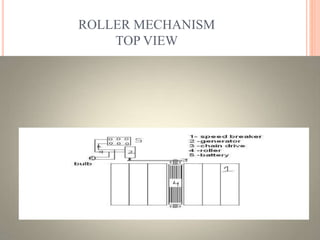
ROLLER MECHANISM
TOP VIEW
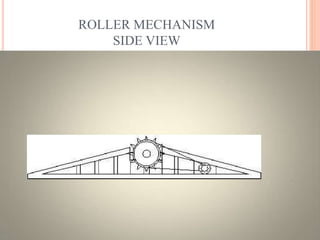
ROLLER MECHANISM
SIDE VIEW
CRANK SHAFT MECHANISM
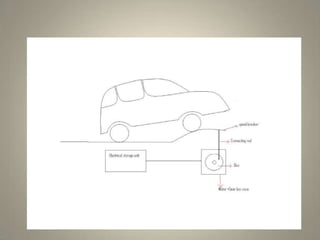
 The crankshaft is a mechanism that transforms
linear movement into rotary movement and vice
versa.
 Whenever the vehicle going on the speed breaker
the speed breaker goes downwards .So, the
potential energy is converted into kinetic energy of
the crank shaft.
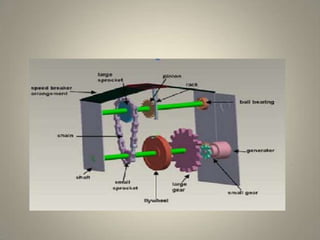
RACK AND PINION
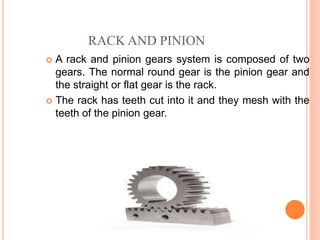
 A rack and pinion gears system is composed of two
gears. The normal round gear is the pinion gear and
the straight or flat gear is the rack.
 The rack has teeth cut into it and they mesh with the
teeth of the pinion gear.
 The rack and pinion is used to convert between
rotary and linear motion. Rack and pinion can
convert from rotary to linear of from linear to rotary.
 The diameter of the gear determines the speed that
the rack moves as the pinion turns.
 Rack and pinions are commonly used in the
steering system of cars to convert the rotary motion
of the steering wheel to the side to side motion in
the wheels.
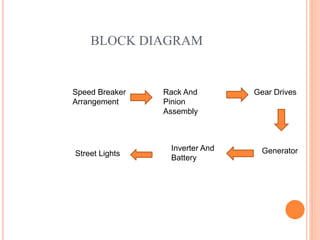
BLOCK DIAGRAM
Speed Breaker
Arrangement
Rack And
Pinion
Assembly
Gear Drives
GeneratorInverter And
Battery
Street Lights
WHY RACK PINION?
 Maintenance will be very difficult in case of roller
mechanism where rack pinion assembly is highly
convenient.
 Might cause collision.
 Crank-shafts are required to be mounted on
bearings which creates balancing problem leading
to mechanical vibrations which in turn damage the
bearings.
 Secondly any occurrence of variable load leads to
balancing problem.
 While rack pinion assembly gives good efficiency
and power generation can be done in a faster way.
FUTURE SCOPE
 Such speed breakers can be designed for heavy
vehicles, thus increasing input torque and
ultimately output of generator.
 More suitable and compact mechanisms to
enhance efficiency.
CONCLUSION
 In order to overcome energy crisis, India should
implement such projects to share a burden of
National Grid.
 Such a mechanism will save a lot of electricity
which is wasted in illuminating the street lights.
PRESENTED BY:PRACHURYA SARMA
Power Generation Using Speed Breakers

Power Generation Using Speed Breakers

  • 1.
    TECHNICAL SEMINAR ON POWERGENERATION BY USING SPEED BREAKERS PRESENTED BY: PRACHURYA SARMA USN:1SI08ME077
  • 2.
    OBJECTIVES  To usea non-conventional source of energy to generate electricity.  To generate electricity at low cost.  To trap a readily available source of energy.  To reduce load on the national grid.
  • 3.
    INTRODUCTION A large amountof energy is wasted at the speed breakers through the dissipation of heat and also through friction, every time a vehicle passes over it there is great possibility of tapping this energy and generating power by making the speed-breaker as a power generation unit. The generated power can be used for the lamps, near the speed breakers and resulting in saving a lot of energy which is spent on street lights.
  • 4.
    BASIC PRINCIPLE  Lawof conservation of energy.  Simple energy conversion from Mechanical to Electrical.  To generate electricity using the vehicle weight (potential energy) as input.
  • 5.
    TYPES OF MECHANISM Possibleusing 3 different mechanisms: I. Roller mechanism II. Crank-shaft mechanism III. Rack- Pinion mechanism
  • 6.
  • 7.
  • 8.
    CRANK SHAFT MECHANISM The crankshaft is a mechanism that transforms linear movement into rotary movement and vice versa.  Whenever the vehicle going on the speed breaker the speed breaker goes downwards .So, the potential energy is converted into kinetic energy of the crank shaft.
  • 10.
    RACK AND PINION A rack and pinion gears system is composed of two gears. The normal round gear is the pinion gear and the straight or flat gear is the rack.  The rack has teeth cut into it and they mesh with the teeth of the pinion gear.
  • 11.
     The rackand pinion is used to convert between rotary and linear motion. Rack and pinion can convert from rotary to linear of from linear to rotary.  The diameter of the gear determines the speed that the rack moves as the pinion turns.  Rack and pinions are commonly used in the steering system of cars to convert the rotary motion of the steering wheel to the side to side motion in the wheels.
  • 12.
    BLOCK DIAGRAM Speed Breaker Arrangement RackAnd Pinion Assembly Gear Drives GeneratorInverter And Battery Street Lights
  • 14.
    WHY RACK PINION? Maintenance will be very difficult in case of roller mechanism where rack pinion assembly is highly convenient.  Might cause collision.
  • 15.
     Crank-shafts arerequired to be mounted on bearings which creates balancing problem leading to mechanical vibrations which in turn damage the bearings.  Secondly any occurrence of variable load leads to balancing problem.  While rack pinion assembly gives good efficiency and power generation can be done in a faster way.
  • 16.
    FUTURE SCOPE  Suchspeed breakers can be designed for heavy vehicles, thus increasing input torque and ultimately output of generator.  More suitable and compact mechanisms to enhance efficiency.
  • 17.
    CONCLUSION  In orderto overcome energy crisis, India should implement such projects to share a burden of National Grid.  Such a mechanism will save a lot of electricity which is wasted in illuminating the street lights.
  • 18.