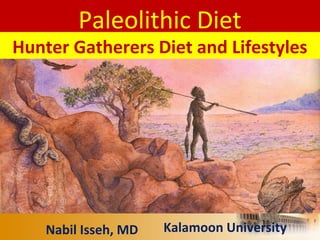
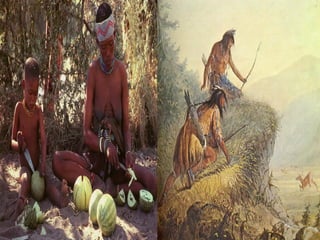
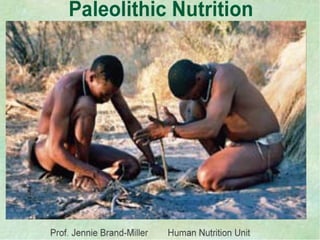
Paleolithic Diet
Hunter Gatherers Diet and Lifestyles
Nabil Isseh, MD Kalamoon University
THANK YOU
‫يمصر‬ ‫اشتقنا‬ ‫وال‬
conflict of Interest Declaration
No other conflicts to report
UEDA Luxor 2011 conference
and I dislike pharaohsI like Tahreer Square
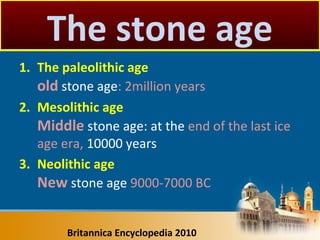
1. The paleolithic age
old stone age: 2million years
2. Mesolithic age
Middle stone age: at the end of the last ice
age era, 10000 years
3. Neolithic age
New stone age 9000-7000 BC
Britannica Encyclopedia 2010
The stone age
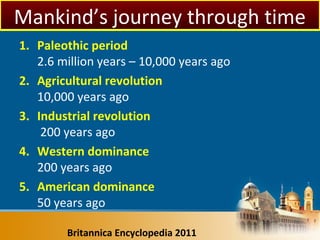
1. Paleothic period
2.6 million years – 10,000 years ago
2. Agricultural revolution
10,000 years ago
3. Industrial revolution
200 years ago
4. Western dominance
200 years ago
5. American dominance
50 years ago
Britannica Encyclopedia 2011
Mankind’s journey through time
Why?
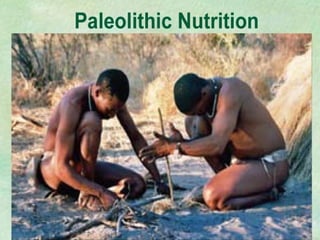
Paleolithic nutrition
Discordance Hypothesis
The prevalence in modern
societies of many chronic
diseases is the consequence of
a mismatch between modern
dietary patterns and the type of
diet that our species evolved to
eat as prehistoric hunter-
gatherer
Eaton SB & Konnor M
N. Engl J. Med 312, 283-289
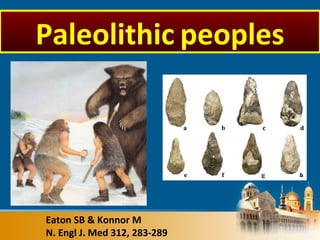
Paleolithic peoples
Eaton SB & Konnor M
N. Engl J. Med 312, 283-289
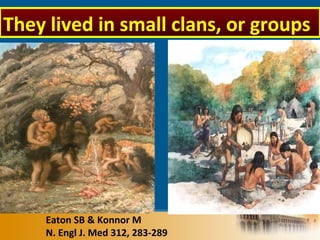
They lived in small clans, or groups
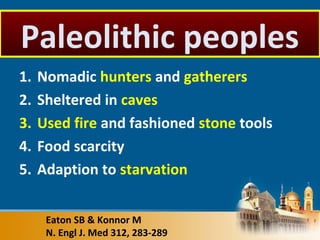
1. Nomadic hunters and gatherers
2. Sheltered in caves
3. Used fire and fashioned stone tools
4. Food scarcity
5. Adaption to starvation
Eaton SB & Konnor M
N. Engl J. Med 312, 283-289
Paleolithic peoples
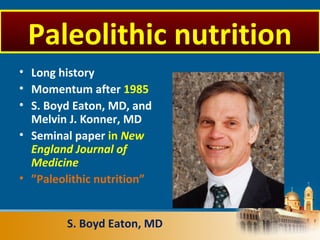
• Long history
• Momentum after 1985
• S. Boyd Eaton, MD, and
Melvin J. Konner, MD
• Seminal paper in New
England Journal of
Medicine
• ”Paleolithic nutrition”
S. Boyd Eaton, MD
Paleolithic nutrition
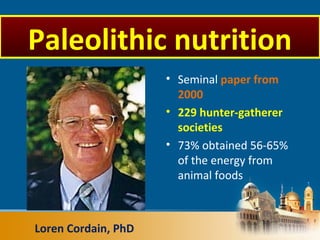
• Seminal paper from
2000
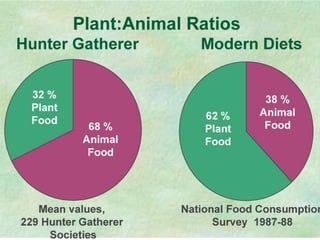
• 229 hunter-gatherer
societies
• 73% obtained 56-65%
of the energy from
animal foods
Loren Cordain, PhD
Paleolithic nutrition
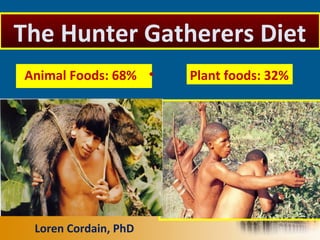
•Animal Foods: 68% Plant foods: 32%
Loren Cordain, PhD
The Hunter Gatherers Diet
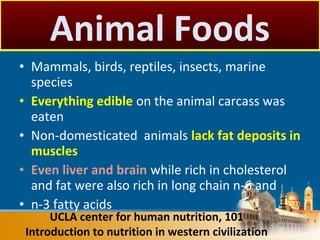
• Mammals, birds, reptiles, insects, marine
species
• Everything edible on the animal carcass was
eaten
• Non-domesticated animals lack fat deposits in
muscles
• Even liver and brain while rich in cholesterol
and fat were also rich in long chain n-6 and
• n-3 fatty acids
UCLA center for human nutrition, 101
Introduction to nutrition in western civilization
Animal Foods
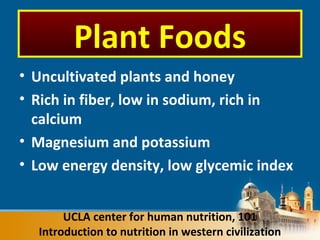
• Uncultivated plants and honey
• Rich in fiber, low in sodium, rich in
calcium
• Magnesium and potassium
• Low energy density, low glycemic index
UCLA center for human nutrition, 101
Introduction to nutrition in western civilization
Plant Foods
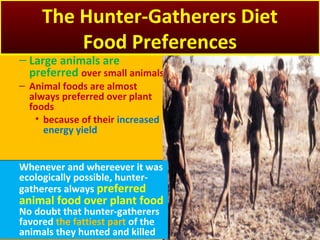
– Large animals are
preferred over small animals
– Animal foods are almost
always preferred over plant
foods
• because of their increased
energy yield
Whenever and whereever it was
ecologically possible, hunter-
gatherers always preferred
animal food over plant food
No doubt that hunter-gatherers
favored the fattiest part of the
animals they hunted and killed
The Hunter-Gatherers Diet
Food Preferences
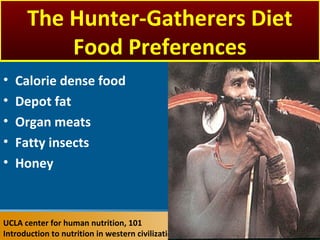
• Calorie dense food
• Depot fat
• Organ meats
• Fatty insects
• Honey
UCLA center for human nutrition, 101
Introduction to nutrition in western civilization
The Hunter-Gatherers Diet
Food Preferences
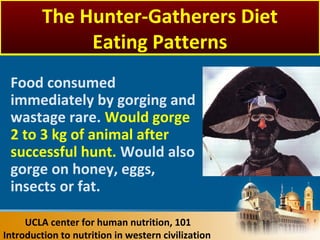
Food consumed
immediately by gorging and
wastage rare. Would gorge
2 to 3 kg of animal after
successful hunt. Would also
gorge on honey, eggs,
insects or fat.
UCLA center for human nutrition, 101
Introduction to nutrition in western civilization
The Hunter-Gatherers Diet
Eating Patterns
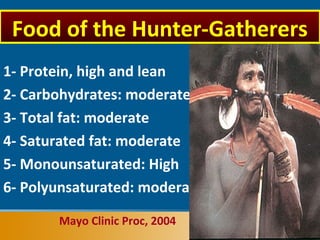
1- Protein, high and lean
2- Carbohydrates: moderate
3- Total fat: moderate
4- Saturated fat: moderate
5- Monounsaturated: High
6- Polyunsaturated: moderate
Mayo Clinic Proc, 2004
Food of the Hunter-Gatherers
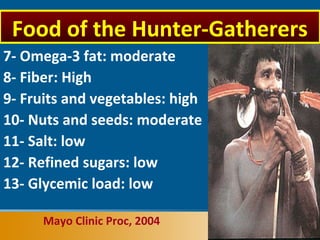
7- Omega-3 fat: moderate
8- Fiber: High
9- Fruits and vegetables: high
10- Nuts and seeds: moderate
11- Salt: low
12- Refined sugars: low
13- Glycemic load: low
Mayo Clinic Proc, 2004
Food of the Hunter-Gatherers
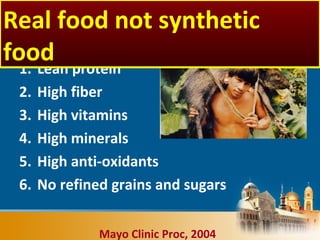
1. Lean protein
2. High fiber
3. High vitamins
4. High minerals
5. High anti-oxidants
6. No refined grains and sugars
Mayo Clinic Proc, 2004
Real food not synthetic
food
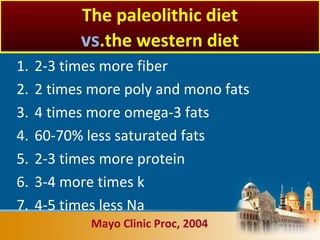
1. 2-3 times more fiber
2. 2 times more poly and mono fats
3. 4 times more omega-3 fats
4. 60-70% less saturated fats
5. 2-3 times more protein
6. 3-4 more times k
7. 4-5 times less Na
The paleolithic diet
vs.the western diet
Mayo Clinic Proc, 2004
Richard
Wrangham
Easier to Eat Meat
More Benefit from Food:
increases digestibility of plants
Why Cooking is
Important
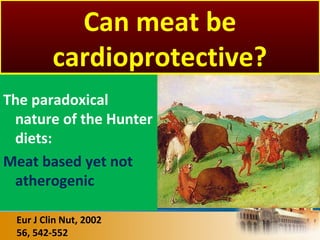
The paradoxical
nature of the Hunter
diets:
Meat based yet not
atherogenic
Eur J Clin Nut, 2002
56, 542-552
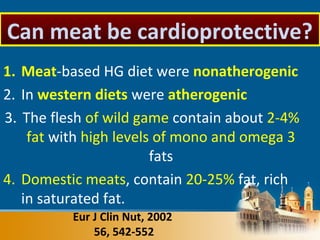
Can meat be
cardioprotective?
1. Meat-based HG diet were nonatherogenic
2. In western diets were atherogenic
3. The flesh of wild game contain about 2-4%
fat with high levels of mono and omega 3
fats
4. Domestic meats, contain 20-25% fat, rich
in saturated fat.
Eur J Clin Nut, 2002
56, 542-552
Can meat be cardioprotective?
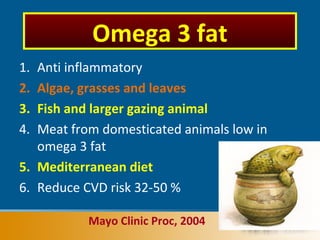
1. Anti inflammatory
2. Algae, grasses and leaves
3. Fish and larger gazing animal
4. Meat from domesticated animals low in
omega 3 fat
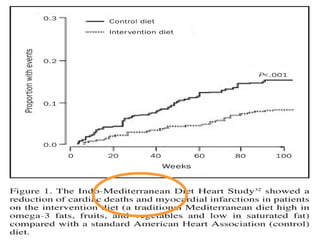
5. Mediterranean diet
6. Reduce CVD risk 32-50 %
Mayo Clinic Proc, 2004
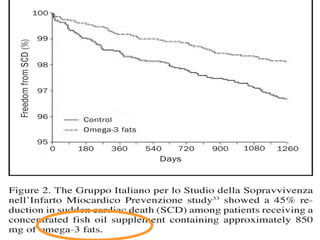
Omega 3 fat
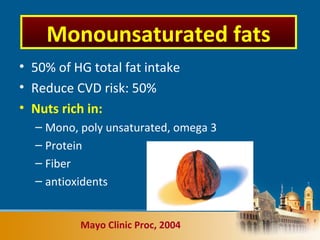
• 50% of HG total fat intake
• Reduce CVD risk: 50%
• Nuts rich in:
– Mono, poly unsaturated, omega 3
– Protein
– Fiber
– antioxidents
Mayo Clinic Proc, 2004
Monounsaturated fats
Eaton S, Osteoporos Int, 17(suppl 2): S2-3, 2006
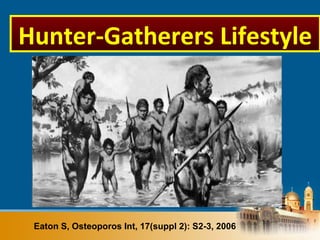
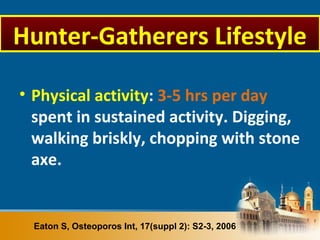
Hunter-Gatherers Lifestyle
• Physical activity: 3-5 hrs per day
spent in sustained activity. Digging,
walking briskly, chopping with stone
axe.
Eaton S, Osteoporos Int, 17(suppl 2): S2-3, 2006
Hunter-Gatherers Lifestyle
How is human health
when eating Paleolithic
diet and unprocessed
foods?
•Non-communicable diseases (cancer,
ASCVD, obesity, diabetes, hypertension)
are rare to non-existent.
•Life was short, death rates were high.
. Main causes of death include:
accidents, food shortage, predation,
parasitic disease
Hunter-gatherer health and
disease
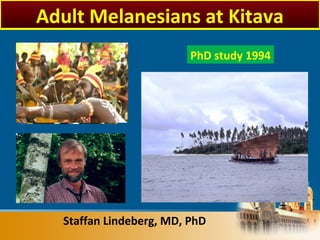
Staffan Lindeberg, MD, PhD
PhD study 1994
Adult Melanesians at Kitava
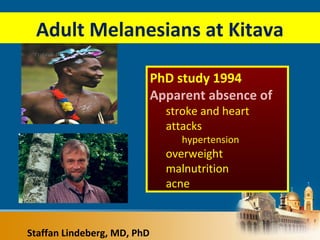
Staffan Lindeberg, MD, PhD
Adult Melanesians at Kitava
PhD study 1994
Apparent absence of
stroke and heart
attacks
hypertension
overweight
malnutrition
acne
1. Lean
2. Fit
3. Free from chronic diseases
AMJ Med 1988
84: 739+
The hunter gatherers
THANK YOU FOR TRYING TO
STAY AWAKE
‫العلي‬ ‫ناجي‬ ‫من‬
‫العلي‬ ‫ناجي‬ ‫من‬
‫العلي‬ ‫ناجي‬ ‫من‬
The revolution
that has
changed the
human’s life
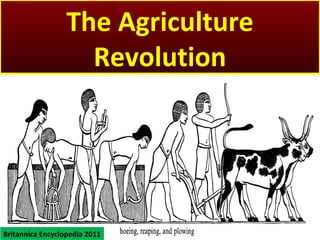
The Agriculture
Revolution
Britannica Encyclopedia 2011
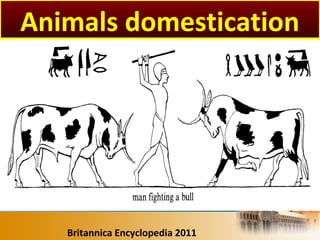
Animals domestication
Agriculture
Agriculture is thought to have
offered one principle
advantage — providing a
greater amount of food per
unit area of land — which
could feed a larger population
Early River Valley Civilizations
Britannica Encyclopedia 2011
The origin Agriculture
Revolution
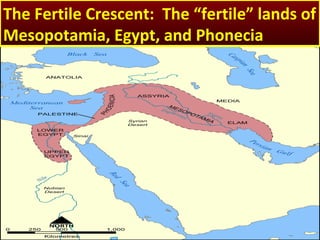
The Fertile Crescent: The “fertile” lands of
Mesopotamia, Egypt, and Phonecia

Britannica Encyclopedia 2011
River Valley Civilizations
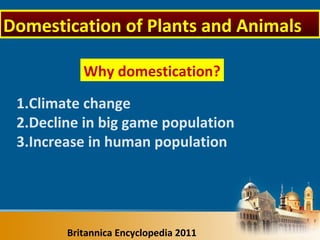
Why domestication?
1.Climate change
2.Decline in big game population
3.Increase in human population
Britannica Encyclopedia 2011
Domestication of Plants and Animals

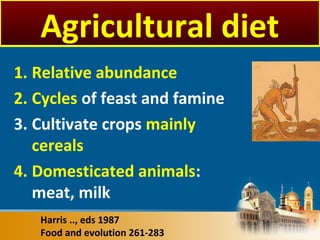
Harris .., eds 1987
Food and evolution 261-283
Agricultural diet
1. Relative abundance
2. Cycles of feast and famine

3. Cultivate crops mainly
cereals
4. Domesticated animals:
meat, milk
‫يوسف‬ ‫سورة‬
‫رقم‬ ‫آية‬46
‫تجربة‬
‫البشرية‬
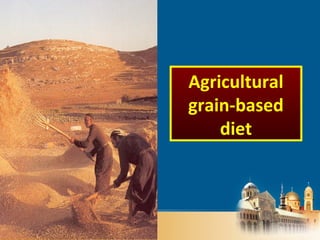
Agricultural
grain-based
diet
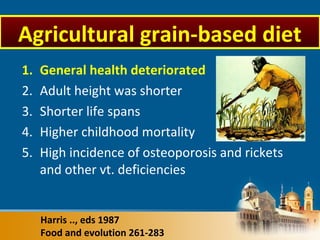
1. General health deteriorated
2. Adult height was shorter
3. Shorter life spans
4. Higher childhood mortality
5. High incidence of osteoporosis and rickets
and other vt. deficiencies
Harris .., eds 1987
Food and evolution 261-283
Agricultural grain-based diet
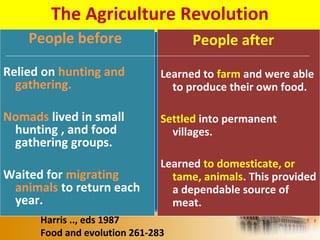
The Agriculture Revolution
People before
Relied on hunting and
gathering.
Nomads lived in small
hunting , and food
gathering groups.
Waited for migrating
animals to return each
year.
People after
Learned to farm and were able
to produce their own food.
Settled into permanent
villages.
Learned to domesticate, or
tame, animals. This provided
a dependable source of
meat.
Harris .., eds 1987
Food and evolution 261-283
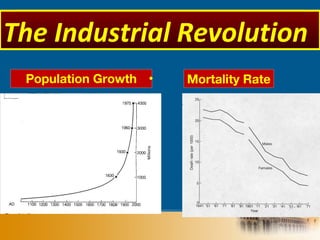
The Industrial Revolution
•Population Growth Mortality Rate
IndustryThe Industrial Revolution
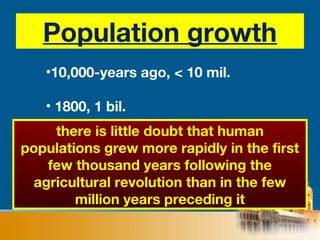
Population growth
•10,000-years ago, < 10 mil.
• 1800, 1 bil.
there is little doubt that human
populations grew more rapidly in the first
few thousand years following the
agricultural revolution than in the few
million years preceding it
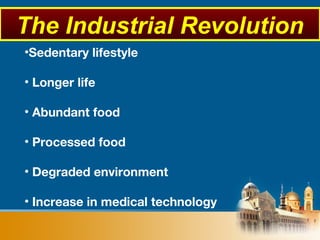
•Sedentary lifestyle
• Longer life
• Abundant food
• Processed food
• Degraded environment
• Increase in medical technology
The Industrial Revolution
• Sedentary life
• Eating highly processed synthetic diet
Today…
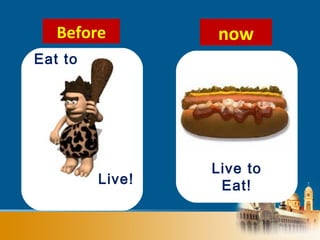
Eat to
Live!
Live to
Eat!
Before now
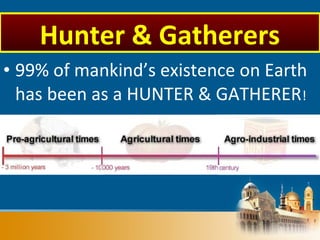
• 99% of mankind’s existence on Earth
has been as a HUNTER & GATHERER!
Hunter & Gatherers
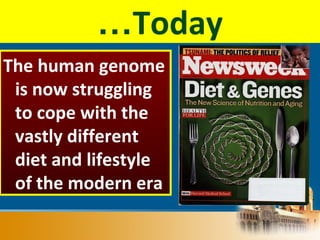
Today…
The human genome
is now struggling
to cope with the
vastly different
diet and lifestyle
of the modern era
AMJ Hum Genet 1999
The human genome has
remained largely unchanged
during the past 10,000 years.
The genes we are born with are
those that we live an die with.
•Eaton SB. 2006. Proc Nutrit Soc. 65(1):1-6
The human genome evolved under harsh
selection conditions over a period of 3.5
million years ~
The spontaneous mutation rate for nuclear
DNA is estimated at about 0.5% per million
years
Over the past 10,000 years, the human
genome is calculated to have changed
only 0.05% from our paleolithic ancestors
~
The modern human paradox
But genetically we
remain citizens of the
stone age
Socially we are a people
of the 21st
century
Modern man fails to
adapt to changing
diets and lifestyles
76
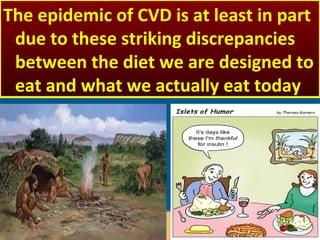
The epidemic of CVD is at least in part
due to these striking discrepancies
between the diet we are designed to
eat and what we actually eat today
• Obesity
• Cardiovascular diseases
–CHD, stroke, hypertension
• Diabetes
• Certain cancers
–colon, prostate, breast
• Osteoporosis
• Non-infective bowel diseases
Mayo Clinic Proc, 2004
Diet-related diseases of western
lifestyle
What happens when
humans start eating a
modern and processed
diet?
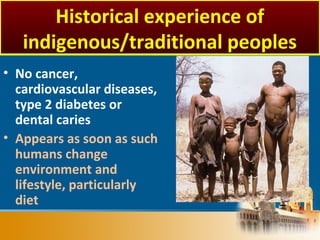
• No cancer,
cardiovascular diseases,
type 2 diabetes or
dental caries
• Appears as soon as such
humans change
environment and
lifestyle, particularly
diet
Historical experience of
indigenous/traditional peoples
Striking replacement of infectious
disease that kills early in life with non-
communicable disease that kills late
New diseases in human history caused
by conditions of life arising during the
industrial period (smoking example).
diseases of affluence
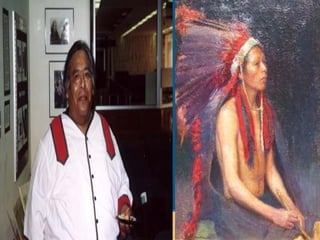
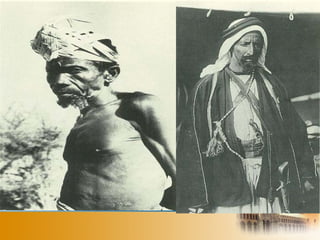
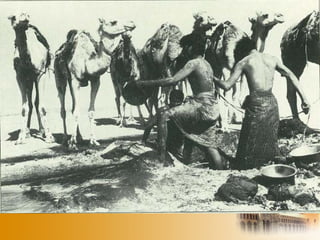
Diabetes care 1999, 22: 1993+
Pima Indians
Aboriginal people
Rich Arabs
When the former hunter
adopts the westerner’s
lifestyle
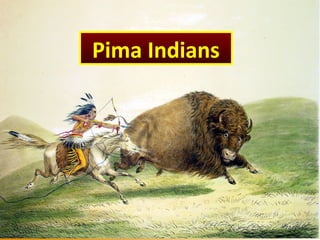
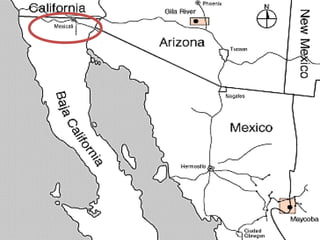
Pima Indians
• 1900s
–Moving to reservations caused
them to adopt western food
• 1940s and 50s
–No longer able to live off land and
were required to buy foods
Changing With Time
• Starch often takes up too
much of meal
• Portion sizes are much larger
• Use much more fat and salt in
cooking processes
• Lower activity level and food
patterns have caused decline in
health
Indian Diets Today
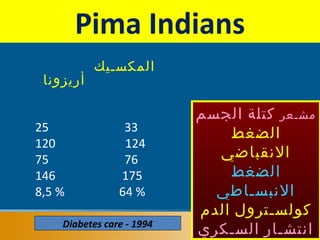
‫المكسـيك‬
‫أريزونا‬
25 33
120 124
75 76
146 175
8,5 % 64 %
Diabetes care - 1994
Pima Indians
‫مشـعر‬‫الجسم‬ ‫كتلة‬
‫الضغط‬
‫النقباضي‬
‫الضغط‬
‫النبسـاطي‬
‫الدم‬ ‫كولسـترول‬
‫السـكري‬ ‫انتشـار‬
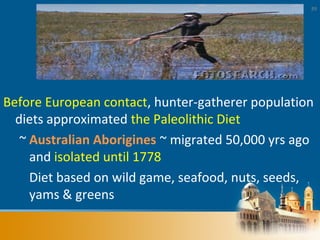
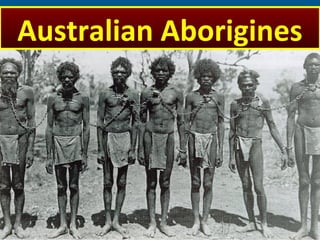
Australian Aborigines
89
Before European contact, hunter-gatherer population
diets approximated the Paleolithic Diet
~ Australian Aborigines ~ migrated 50,000 yrs ago
and isolated until 1778
Diet based on wild game, seafood, nuts, seeds,
yams & greens
Australian Aborigines
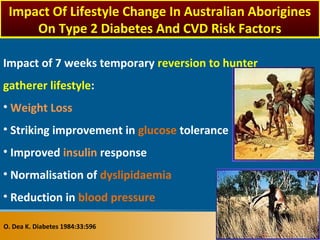
Impact of 7 weeks temporary reversion to hunter
gatherer lifestyle:
• Weight Loss
• Striking improvement in glucose tolerance
• Improved insulin response
• Normalisation of dyslipidaemia
• Reduction in blood pressure
O. Dea K. Diabetes 1984:33:596
Impact Of Lifestyle Change In Australian Aborigines
On Type 2 Diabetes And CVD Risk Factors
November 4, 2009
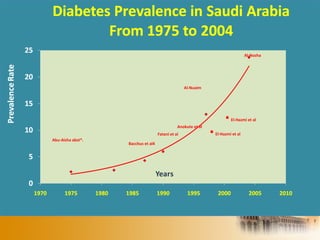
Al-Nuaim
Fatani et al
Anokute et al
 El-Hazmi et al
 El-Hazmi et al
Al-Nozha
Bacchus et al4
Abu-Aisha abst*.
References
THANK YOU
FOR TRYING
TO STAY
AWAKE
THANK YOU

ueda2011 paleolithic-d.nabil

  • 1.
    Paleolithic Diet Hunter GatherersDiet and Lifestyles Nabil Isseh, MD Kalamoon University
  • 2.
  • 3.
  • 4.
    conflict of InterestDeclaration No other conflicts to report UEDA Luxor 2011 conference and I dislike pharaohsI like Tahreer Square
  • 6.
    1. The paleolithicage old stone age: 2million years 2. Mesolithic age Middle stone age: at the end of the last ice age era, 10000 years 3. Neolithic age New stone age 9000-7000 BC Britannica Encyclopedia 2010 The stone age
  • 7.
    1. Paleothic period 2.6million years – 10,000 years ago 2. Agricultural revolution 10,000 years ago 3. Industrial revolution 200 years ago 4. Western dominance 200 years ago 5. American dominance 50 years ago Britannica Encyclopedia 2011 Mankind’s journey through time
  • 8.
  • 9.
    Discordance Hypothesis The prevalencein modern societies of many chronic diseases is the consequence of a mismatch between modern dietary patterns and the type of diet that our species evolved to eat as prehistoric hunter- gatherer
  • 10.
    Eaton SB &Konnor M N. Engl J. Med 312, 283-289 Paleolithic peoples
  • 11.
    Eaton SB &Konnor M N. Engl J. Med 312, 283-289 They lived in small clans, or groups
  • 12.
    1. Nomadic huntersand gatherers 2. Sheltered in caves 3. Used fire and fashioned stone tools 4. Food scarcity 5. Adaption to starvation Eaton SB & Konnor M N. Engl J. Med 312, 283-289 Paleolithic peoples
  • 13.
    • Long history •Momentum after 1985 • S. Boyd Eaton, MD, and Melvin J. Konner, MD • Seminal paper in New England Journal of Medicine • ”Paleolithic nutrition” S. Boyd Eaton, MD Paleolithic nutrition
  • 14.
    • Seminal paperfrom 2000 • 229 hunter-gatherer societies • 73% obtained 56-65% of the energy from animal foods Loren Cordain, PhD Paleolithic nutrition
  • 15.
    •Animal Foods: 68%Plant foods: 32% Loren Cordain, PhD The Hunter Gatherers Diet
  • 17.
    • Mammals, birds,reptiles, insects, marine species • Everything edible on the animal carcass was eaten • Non-domesticated animals lack fat deposits in muscles • Even liver and brain while rich in cholesterol and fat were also rich in long chain n-6 and • n-3 fatty acids UCLA center for human nutrition, 101 Introduction to nutrition in western civilization Animal Foods
  • 18.
    • Uncultivated plantsand honey • Rich in fiber, low in sodium, rich in calcium • Magnesium and potassium • Low energy density, low glycemic index UCLA center for human nutrition, 101 Introduction to nutrition in western civilization Plant Foods
  • 19.
    – Large animalsare preferred over small animals – Animal foods are almost always preferred over plant foods • because of their increased energy yield Whenever and whereever it was ecologically possible, hunter- gatherers always preferred animal food over plant food No doubt that hunter-gatherers favored the fattiest part of the animals they hunted and killed The Hunter-Gatherers Diet Food Preferences
  • 20.
    • Calorie densefood • Depot fat • Organ meats • Fatty insects • Honey UCLA center for human nutrition, 101 Introduction to nutrition in western civilization The Hunter-Gatherers Diet Food Preferences
  • 21.
    Food consumed immediately bygorging and wastage rare. Would gorge 2 to 3 kg of animal after successful hunt. Would also gorge on honey, eggs, insects or fat. UCLA center for human nutrition, 101 Introduction to nutrition in western civilization The Hunter-Gatherers Diet Eating Patterns
  • 22.
    1- Protein, highand lean 2- Carbohydrates: moderate 3- Total fat: moderate 4- Saturated fat: moderate 5- Monounsaturated: High 6- Polyunsaturated: moderate Mayo Clinic Proc, 2004 Food of the Hunter-Gatherers
  • 23.
    7- Omega-3 fat:moderate 8- Fiber: High 9- Fruits and vegetables: high 10- Nuts and seeds: moderate 11- Salt: low 12- Refined sugars: low 13- Glycemic load: low Mayo Clinic Proc, 2004 Food of the Hunter-Gatherers
  • 24.
    1. Lean protein 2.High fiber 3. High vitamins 4. High minerals 5. High anti-oxidants 6. No refined grains and sugars Mayo Clinic Proc, 2004 Real food not synthetic food
  • 25.
    1. 2-3 timesmore fiber 2. 2 times more poly and mono fats 3. 4 times more omega-3 fats 4. 60-70% less saturated fats 5. 2-3 times more protein 6. 3-4 more times k 7. 4-5 times less Na The paleolithic diet vs.the western diet Mayo Clinic Proc, 2004
  • 27.
    Richard Wrangham Easier to EatMeat More Benefit from Food: increases digestibility of plants Why Cooking is Important
  • 28.
    The paradoxical nature ofthe Hunter diets: Meat based yet not atherogenic Eur J Clin Nut, 2002 56, 542-552 Can meat be cardioprotective?
  • 29.
    1. Meat-based HGdiet were nonatherogenic 2. In western diets were atherogenic 3. The flesh of wild game contain about 2-4% fat with high levels of mono and omega 3 fats 4. Domestic meats, contain 20-25% fat, rich in saturated fat. Eur J Clin Nut, 2002 56, 542-552 Can meat be cardioprotective?
  • 30.
    1. Anti inflammatory 2.Algae, grasses and leaves 3. Fish and larger gazing animal 4. Meat from domesticated animals low in omega 3 fat 5. Mediterranean diet 6. Reduce CVD risk 32-50 % Mayo Clinic Proc, 2004 Omega 3 fat
  • 31.
    • 50% ofHG total fat intake • Reduce CVD risk: 50% • Nuts rich in: – Mono, poly unsaturated, omega 3 – Protein – Fiber – antioxidents Mayo Clinic Proc, 2004 Monounsaturated fats
  • 34.
    Eaton S, OsteoporosInt, 17(suppl 2): S2-3, 2006 Hunter-Gatherers Lifestyle
  • 35.
    • Physical activity:3-5 hrs per day spent in sustained activity. Digging, walking briskly, chopping with stone axe. Eaton S, Osteoporos Int, 17(suppl 2): S2-3, 2006 Hunter-Gatherers Lifestyle
  • 36.
    How is humanhealth when eating Paleolithic diet and unprocessed foods?
  • 37.
    •Non-communicable diseases (cancer, ASCVD,obesity, diabetes, hypertension) are rare to non-existent. •Life was short, death rates were high. . Main causes of death include: accidents, food shortage, predation, parasitic disease Hunter-gatherer health and disease
  • 38.
    Staffan Lindeberg, MD,PhD PhD study 1994 Adult Melanesians at Kitava
  • 39.
    Staffan Lindeberg, MD,PhD Adult Melanesians at Kitava PhD study 1994 Apparent absence of stroke and heart attacks hypertension overweight malnutrition acne
  • 40.
    1. Lean 2. Fit 3.Free from chronic diseases AMJ Med 1988 84: 739+ The hunter gatherers
  • 41.
    THANK YOU FORTRYING TO STAY AWAKE
  • 42.
  • 46.
  • 48.
  • 50.
  • 51.
  • 52.
  • 53.
    Agriculture Agriculture is thoughtto have offered one principle advantage — providing a greater amount of food per unit area of land — which could feed a larger population
  • 54.
    Early River ValleyCivilizations Britannica Encyclopedia 2011 The origin Agriculture Revolution
  • 55.
    The Fertile Crescent:The “fertile” lands of Mesopotamia, Egypt, and Phonecia
  • 56.
  • 57.
    Why domestication? 1.Climate change 2.Declinein big game population 3.Increase in human population Britannica Encyclopedia 2011 Domestication of Plants and Animals
  • 58.
    Harris .., eds1987 Food and evolution 261-283 Agricultural diet 1. Relative abundance 2. Cycles of feast and famine 3. Cultivate crops mainly cereals 4. Domesticated animals: meat, milk
  • 59.
  • 60.
  • 61.
    1. General healthdeteriorated 2. Adult height was shorter 3. Shorter life spans 4. Higher childhood mortality 5. High incidence of osteoporosis and rickets and other vt. deficiencies Harris .., eds 1987 Food and evolution 261-283 Agricultural grain-based diet
  • 62.
    The Agriculture Revolution Peoplebefore Relied on hunting and gathering. Nomads lived in small hunting , and food gathering groups. Waited for migrating animals to return each year. People after Learned to farm and were able to produce their own food. Settled into permanent villages. Learned to domesticate, or tame, animals. This provided a dependable source of meat. Harris .., eds 1987 Food and evolution 261-283
  • 63.
  • 64.
    •Population Growth MortalityRate IndustryThe Industrial Revolution
  • 65.
    Population growth •10,000-years ago,< 10 mil. • 1800, 1 bil. there is little doubt that human populations grew more rapidly in the first few thousand years following the agricultural revolution than in the few million years preceding it
  • 66.
    •Sedentary lifestyle • Longerlife • Abundant food • Processed food • Degraded environment • Increase in medical technology The Industrial Revolution
  • 67.
    • Sedentary life •Eating highly processed synthetic diet Today…
  • 68.
  • 69.
    • 99% ofmankind’s existence on Earth has been as a HUNTER & GATHERER! Hunter & Gatherers
  • 70.
    Today… The human genome isnow struggling to cope with the vastly different diet and lifestyle of the modern era
  • 71.
    AMJ Hum Genet1999 The human genome has remained largely unchanged during the past 10,000 years. The genes we are born with are those that we live an die with.
  • 72.
    •Eaton SB. 2006.Proc Nutrit Soc. 65(1):1-6 The human genome evolved under harsh selection conditions over a period of 3.5 million years ~ The spontaneous mutation rate for nuclear DNA is estimated at about 0.5% per million years Over the past 10,000 years, the human genome is calculated to have changed only 0.05% from our paleolithic ancestors ~
  • 73.
    The modern humanparadox But genetically we remain citizens of the stone age Socially we are a people of the 21st century
  • 74.
    Modern man failsto adapt to changing diets and lifestyles
  • 76.
    76 The epidemic ofCVD is at least in part due to these striking discrepancies between the diet we are designed to eat and what we actually eat today
  • 77.
    • Obesity • Cardiovasculardiseases –CHD, stroke, hypertension • Diabetes • Certain cancers –colon, prostate, breast • Osteoporosis • Non-infective bowel diseases Mayo Clinic Proc, 2004 Diet-related diseases of western lifestyle
  • 78.
    What happens when humansstart eating a modern and processed diet?
  • 79.
    • No cancer, cardiovasculardiseases, type 2 diabetes or dental caries • Appears as soon as such humans change environment and lifestyle, particularly diet Historical experience of indigenous/traditional peoples
  • 80.
    Striking replacement ofinfectious disease that kills early in life with non- communicable disease that kills late New diseases in human history caused by conditions of life arising during the industrial period (smoking example). diseases of affluence
  • 81.
    Diabetes care 1999,22: 1993+ Pima Indians Aboriginal people Rich Arabs When the former hunter adopts the westerner’s lifestyle
  • 82.
  • 83.
    • 1900s –Moving toreservations caused them to adopt western food • 1940s and 50s –No longer able to live off land and were required to buy foods Changing With Time
  • 84.
    • Starch oftentakes up too much of meal • Portion sizes are much larger • Use much more fat and salt in cooking processes • Lower activity level and food patterns have caused decline in health Indian Diets Today
  • 87.
    ‫المكسـيك‬ ‫أريزونا‬ 25 33 120 124 7576 146 175 8,5 % 64 % Diabetes care - 1994 Pima Indians ‫مشـعر‬‫الجسم‬ ‫كتلة‬ ‫الضغط‬ ‫النقباضي‬ ‫الضغط‬ ‫النبسـاطي‬ ‫الدم‬ ‫كولسـترول‬ ‫السـكري‬ ‫انتشـار‬
  • 88.
  • 89.
    89 Before European contact,hunter-gatherer population diets approximated the Paleolithic Diet ~ Australian Aborigines ~ migrated 50,000 yrs ago and isolated until 1778 Diet based on wild game, seafood, nuts, seeds, yams & greens
  • 90.
  • 91.
  • 92.
    Impact of 7weeks temporary reversion to hunter gatherer lifestyle: • Weight Loss • Striking improvement in glucose tolerance • Improved insulin response • Normalisation of dyslipidaemia • Reduction in blood pressure O. Dea K. Diabetes 1984:33:596 Impact Of Lifestyle Change In Australian Aborigines On Type 2 Diabetes And CVD Risk Factors
  • 98.
  • 99.
    Al-Nuaim Fatani et al Anokuteet al  El-Hazmi et al  El-Hazmi et al Al-Nozha Bacchus et al4 Abu-Aisha abst*.
  • 100.
  • 104.
  • 105.

Editor's Notes

  • #69 There was a time when man ate to live. Today it seems as if we would rather live to eat.