NCDs Alliances
The Way to go
Prof. Adel A El Sayed
Aswan Feb 2014
Introduction
• Communicable versus non-communicable
diseases NCDs.
• What NCDs?
• NCDs Alliances
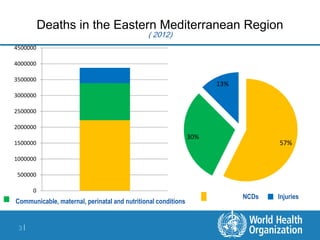
3 |
57%
30%
13%
0
500000
1000000
1500000
2000000
2500000
3000000
3500000
4000000
4500000
Deaths in the Eastern Mediterranean Region
( 2012)
Communicable, maternal, perinatal and nutritional conditions
NCDs Injuries
4 |
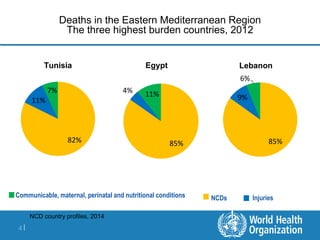
Deaths in the Eastern Mediterranean Region
The three highest burden countries, 2012
Communicable, maternal, perinatal and nutritional conditions NCDs Injuries
82%
11%
7%
Tunisia
85%
4% 11%
85%
9%
6%
Egypt Lebanon
NCD country profiles, 2014
NCDs, 1-2 September 20155
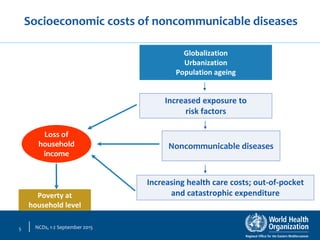
Increased exposure to
risk factors
Noncommunicable diseases
Increasing health care costs; out-of-pocket
and catastrophic expenditurePoverty at
household level
Loss of
household
income
Socioeconomic costs of noncommunicable diseases
New perspectives
Globalization
Urbanization
Population ageing
NCDs, 1-2 September 20156
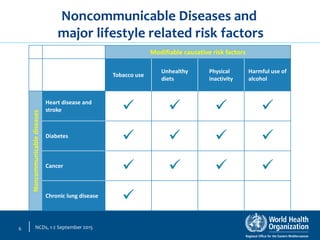
Modifiable causative risk factors
Tobacco use
Unhealthy
diets
Physical
inactivity
Harmful use of
alcohol
Noncommunicablediseases
Heart disease and
stroke    
Diabetes
   
Cancer
   
Chronic lung disease

Noncommunicable Diseases and
major lifestyle related risk factors
NCDs, 1-2 September 20157
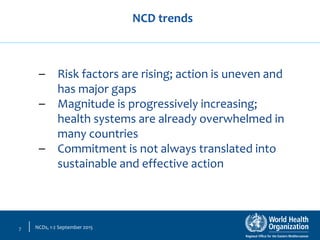
– Risk factors are rising; action is uneven and
has major gaps
– Magnitude is progressively increasing;
health systems are already overwhelmed in
many countries
– Commitment is not always translated into
sustainable and effective action
NCD trends
8 |
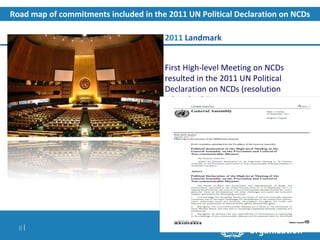
2011 Landmark
First High-level Meeting on NCDs
resulted in the 2011 UN Political
Declaration on NCDs (resolution
A/RES/66/2)
Road map of commitments included in the 2011 UN Political Declaration on NCDs
The global NCD response and
the role of civil society
The NCD Alliance
NCD Civil Society Action...
National and Regional Level
EMRO Sept. 2015 Meeting
Eg-NCDA
• Formation
• Members
• Application to Global NCDA membership

Ueda2016 nc ds alliances - adel el sayed

  • 1.
    NCDs Alliances The Wayto go Prof. Adel A El Sayed Aswan Feb 2014
  • 2.
    Introduction • Communicable versusnon-communicable diseases NCDs. • What NCDs? • NCDs Alliances
  • 3.
    3 | 57% 30% 13% 0 500000 1000000 1500000 2000000 2500000 3000000 3500000 4000000 4500000 Deaths inthe Eastern Mediterranean Region ( 2012) Communicable, maternal, perinatal and nutritional conditions NCDs Injuries
  • 4.
    4 | Deaths inthe Eastern Mediterranean Region The three highest burden countries, 2012 Communicable, maternal, perinatal and nutritional conditions NCDs Injuries 82% 11% 7% Tunisia 85% 4% 11% 85% 9% 6% Egypt Lebanon NCD country profiles, 2014
  • 5.
    NCDs, 1-2 September20155 Increased exposure to risk factors Noncommunicable diseases Increasing health care costs; out-of-pocket and catastrophic expenditurePoverty at household level Loss of household income Socioeconomic costs of noncommunicable diseases New perspectives Globalization Urbanization Population ageing
  • 6.
    NCDs, 1-2 September20156 Modifiable causative risk factors Tobacco use Unhealthy diets Physical inactivity Harmful use of alcohol Noncommunicablediseases Heart disease and stroke     Diabetes     Cancer     Chronic lung disease  Noncommunicable Diseases and major lifestyle related risk factors
  • 7.
    NCDs, 1-2 September20157 – Risk factors are rising; action is uneven and has major gaps – Magnitude is progressively increasing; health systems are already overwhelmed in many countries – Commitment is not always translated into sustainable and effective action NCD trends
  • 8.
    8 | 2011 Landmark FirstHigh-level Meeting on NCDs resulted in the 2011 UN Political Declaration on NCDs (resolution A/RES/66/2) Road map of commitments included in the 2011 UN Political Declaration on NCDs
  • 9.
    The global NCDresponse and the role of civil society
  • 10.
    The NCD Alliance NCDCivil Society Action... National and Regional Level EMRO Sept. 2015 Meeting
  • 11.
    Eg-NCDA • Formation • Members •Application to Global NCDA membership