prehisto
    art
     ric
Timeline
 Stone Age

   Paleolithic Era (2,500,000 – 10,000 BC)
      ļ‚§   Lower Paleolithic (2,500,000 – 200,000 BC)
      ļ‚§   Middle Paleolithic (200,000 – 40,000 BC)
      ļ‚§   Upper Paleolithic (40,000 – 10,000 BC)
   Mesolithic Era 10,000 – 4,000 BC)
   Neolithic Era (4,000 – 2,000 BC)

 Bronze Age (3,300 – 1,200 BC)

 Iron Age (1,300 BC – 200 AD)
a hunter-gatherer culture


               paleolithic
                            era
Stone Age Art
 Petroglyphs
    - cupules, engravings,
    drawings, symbols
 Sculpture/Carving
 Cave Painting
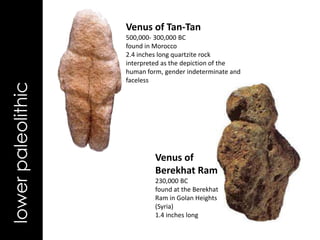
Venus of Tan-Tan
                    500,000- 300,000 BC
                    found in Morocco
                    2.4 inches long quartzite rock
                    interpreted as the depiction of the
                    human form, gender indeterminate and
                    faceless
lower paleolithic


                             Venus of
                             Berekhat Ram
                             230,000 BC
                             found at the Berekhat
                             Ram in Golan Heights
                             (Syria)
                             1.4 inches long
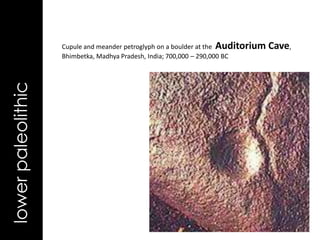
Cupule and meander petroglyph on a boulder at the Auditorium   Cave,
                    Bhimbetka, Madhya Pradesh, India; 700,000 – 290,000 BC
lower paleolithic
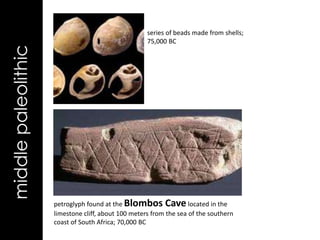
series of beads made from shells;
                                                     75,000 BC
middle paleolithic


                     petroglyph found at the Blombos Cave located in the
                     limestone cliff, about 100 meters from the sea of the southern
                     coast of South Africa; 70,000 BC
middle paleolithic
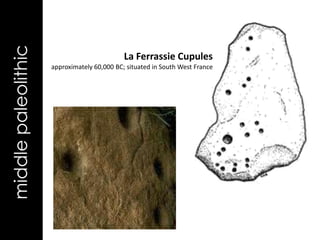
                                             La Ferrassie Cupules
                     approximately 60,000 BC; situated in South West France
upper paleolithic


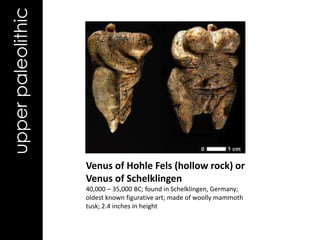
                    Venus of Hohle Fels (hollow rock) or
                    Venus of Schelklingen
                    40,000 – 35,000 BC; found in Schelklingen, Germany;
                    oldest known figurative art; made of woolly mammoth
                    tusk; 2.4 inches in height
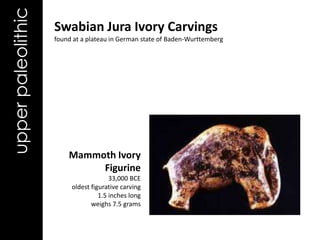
upper paleolithic   Swabian Jura Ivory Carvings
                    found at a plateau in German state of Baden-Wurttemberg


                        Mammoth Ivory
                             Figurine
                                       33,000 BCE
                         oldest figurative carving
                                   1.5 inches long
                                weighs 7.5 grams
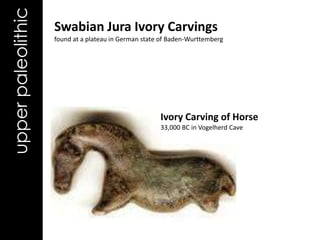
upper paleolithic   Swabian Jura Ivory Carvings
                    found at a plateau in German state of Baden-Wurttemberg


                                                      Ivory Carving of Horse
                                                      33,000 BC in Vogelherd Cave
upper paleolithic   Swabian Jura Ivory Carvings
                    found at a plateau in German state of Baden-Wurttemberg


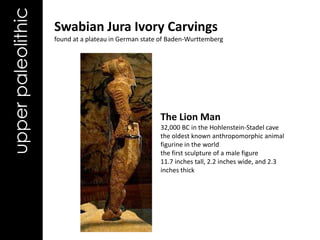
                                                      The Lion Man
                                                      32,000 BC in the Hohlenstein-Stadel cave
                                                      the oldest known anthropomorphic animal
                                                      figurine in the world
                                                      the first sculpture of a male figure
                                                      11.7 inches tall, 2.2 inches wide, and 2.3
                                                      inches thick
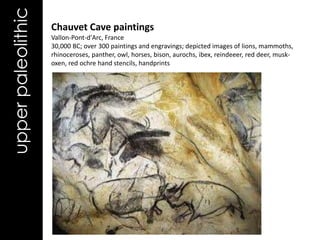
upper paleolithic   Chauvet Cave paintings
                    Vallon-Pont-d'Arc, France
                    30,000 BC; over 300 paintings and engravings; depicted images of lions, mammoths,
                    rhinoceroses, panther, owl, horses, bison, aurochs, ibex, reindeeer, red deer, musk-
                    oxen, red ochre hand stencils, handprints
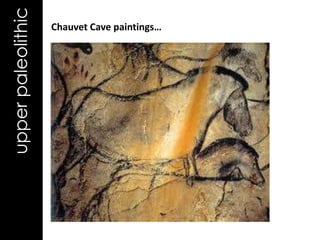
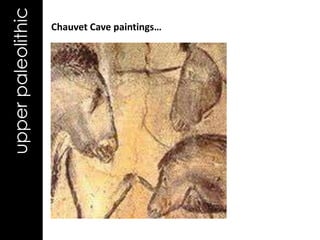
upper paleolithic   Chauvet Cave paintings…
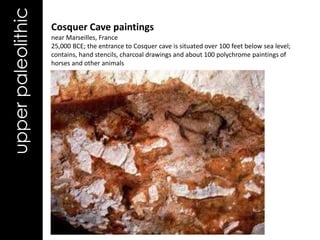
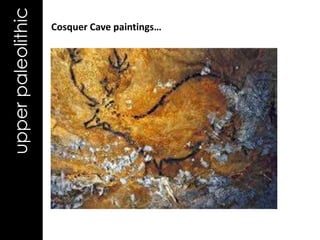
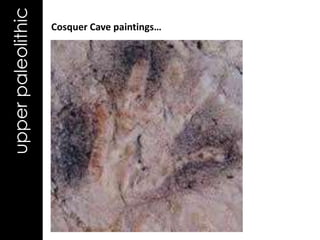
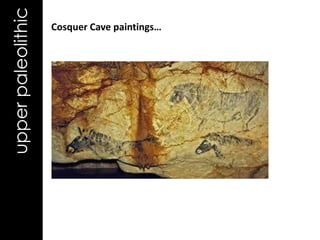
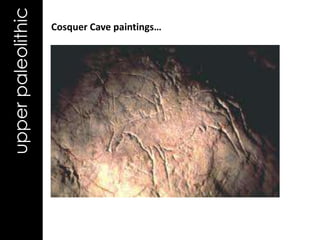
upper paleolithic   Cosquer Cave paintings
                    near Marseilles, France
                    25,000 BCE; the entrance to Cosquer cave is situated over 100 feet below sea level;
                    contains, hand stencils, charcoal drawings and about 100 polychrome paintings of
                    horses and other animals
upper paleolithic   Cosquer Cave paintings…
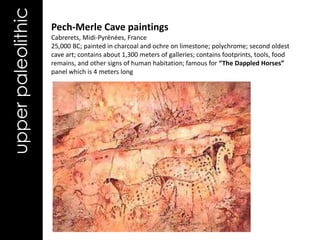
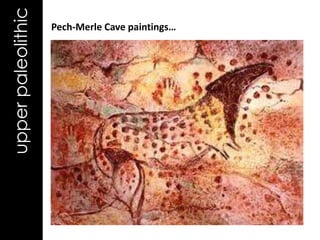
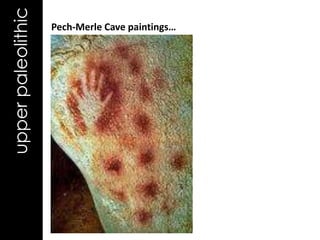
upper paleolithic   Pech-Merle Cave paintings
                    Cabrerets, Midi-PyrƩnƩes, France
                    25,000 BC; painted in charcoal and ochre on limestone; polychrome; second oldest
                    cave art; contains about 1,300 meters of galleries; contains footprints, tools, food
                    remains, and other signs of human habitation; famous for ā€œThe Dappled Horsesā€
                    panel which is 4 meters long
upper paleolithic   Pech-Merle Cave paintings…
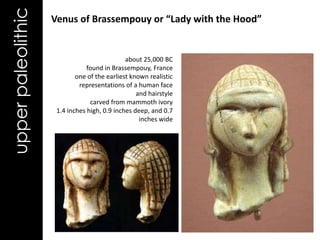
upper paleolithic   Venus of Brassempouy or ā€œLady with the Hoodā€


                                              about 25,000 BC
                                found in Brassempouy, France
                            one of the earliest known realistic
                             representations of a human face
                                                  and hairstyle
                                 carved from mammoth ivory
                     1.4 inches high, 0.9 inches deep, and 0.7
                                                   inches wide
upper paleolithic


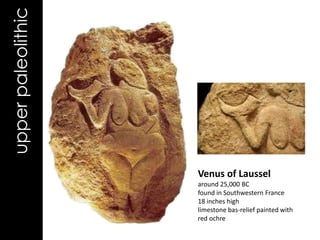
                    Venus of Laussel
                    around 25,000 BC
                    found in Southwestern France
                    18 inches high
                    limestone bas-relief painted with
                    red ochre
upper paleolithic


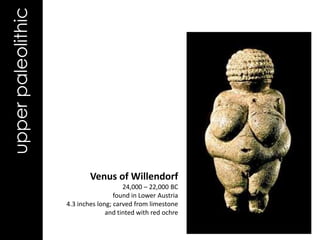
                            Venus of Willendorf
                                        24,000 – 22,000 BC
                                     found in Lower Austria
                    4.3 inches long; carved from limestone
                                  and tinted with red ochre
upper paleolithic


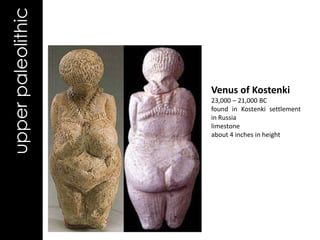
                    Venus of Kostenki
                    23,000 – 21,000 BC
                    found in Kostenki settlement
                    in Russia
                    limestone
                    about 4 inches in height
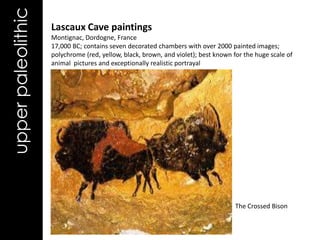
upper paleolithic   Lascaux Cave paintings
                    Montignac, Dordogne, France
                    17,000 BC; contains seven decorated chambers with over 2000 painted images;
                    polychrome (red, yellow, black, brown, and violet); best known for the huge scale of
                    animal pictures and exceptionally realistic portrayal


                                                                                    The Crossed Bison
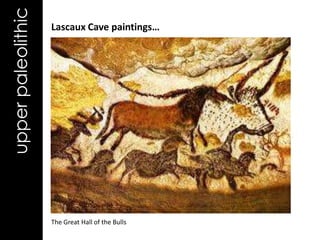
upper paleolithic   Lascaux Cave paintings…


                    The Great Hall of the Bulls
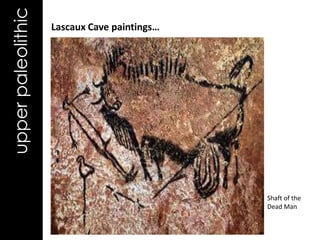
upper paleolithic   Lascaux Cave paintings…


                                              Shaft of the
                                              Dead Man
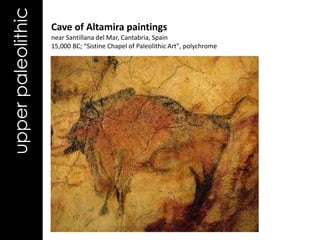
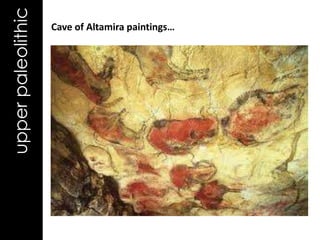
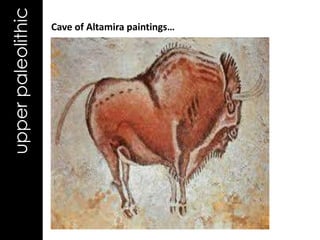
upper paleolithic   Cave of Altamira paintings
                    near Santillana del Mar, Cantabria, Spain
                    15,000 BC; ā€œSistine Chapel of Paleolithic Art", polychrome
upper paleolithic   Cave of Altamira paintings…
Things to ponder…
1. What motivated primitive man to create such art?
2. What does it mean to be human?
3. How was the art of the prehistoric period related to society?


                                                         Vannessa E. San Juan
                             Philippine High School for the Arts/Art Studies IV
                                                                  16 June 2011

Prehistoric art

  • 1.
    prehisto art ric
  • 2.
    Timeline  Stone Age  Paleolithic Era (2,500,000 – 10,000 BC) ļ‚§ Lower Paleolithic (2,500,000 – 200,000 BC) ļ‚§ Middle Paleolithic (200,000 – 40,000 BC) ļ‚§ Upper Paleolithic (40,000 – 10,000 BC)  Mesolithic Era 10,000 – 4,000 BC)  Neolithic Era (4,000 – 2,000 BC)  Bronze Age (3,300 – 1,200 BC)  Iron Age (1,300 BC – 200 AD)
  • 3.
  • 4.
    Stone Age Art Petroglyphs - cupules, engravings, drawings, symbols  Sculpture/Carving  Cave Painting
  • 5.
    Venus of Tan-Tan 500,000- 300,000 BC found in Morocco 2.4 inches long quartzite rock interpreted as the depiction of the human form, gender indeterminate and faceless lower paleolithic Venus of Berekhat Ram 230,000 BC found at the Berekhat Ram in Golan Heights (Syria) 1.4 inches long
  • 6.
    Cupule and meanderpetroglyph on a boulder at the Auditorium Cave, Bhimbetka, Madhya Pradesh, India; 700,000 – 290,000 BC lower paleolithic
  • 7.
    series of beadsmade from shells; 75,000 BC middle paleolithic petroglyph found at the Blombos Cave located in the limestone cliff, about 100 meters from the sea of the southern coast of South Africa; 70,000 BC
  • 8.
    middle paleolithic La Ferrassie Cupules approximately 60,000 BC; situated in South West France
  • 9.
    upper paleolithic Venus of Hohle Fels (hollow rock) or Venus of Schelklingen 40,000 – 35,000 BC; found in Schelklingen, Germany; oldest known figurative art; made of woolly mammoth tusk; 2.4 inches in height
  • 10.
    upper paleolithic Swabian Jura Ivory Carvings found at a plateau in German state of Baden-Wurttemberg Mammoth Ivory Figurine 33,000 BCE oldest figurative carving 1.5 inches long weighs 7.5 grams
  • 11.
    upper paleolithic Swabian Jura Ivory Carvings found at a plateau in German state of Baden-Wurttemberg Ivory Carving of Horse 33,000 BC in Vogelherd Cave
  • 12.
    upper paleolithic Swabian Jura Ivory Carvings found at a plateau in German state of Baden-Wurttemberg The Lion Man 32,000 BC in the Hohlenstein-Stadel cave the oldest known anthropomorphic animal figurine in the world the first sculpture of a male figure 11.7 inches tall, 2.2 inches wide, and 2.3 inches thick
  • 13.
    upper paleolithic Chauvet Cave paintings Vallon-Pont-d'Arc, France 30,000 BC; over 300 paintings and engravings; depicted images of lions, mammoths, rhinoceroses, panther, owl, horses, bison, aurochs, ibex, reindeeer, red deer, musk- oxen, red ochre hand stencils, handprints
  • 14.
    upper paleolithic Chauvet Cave paintings…
  • 15.
    upper paleolithic Chauvet Cave paintings…
  • 16.
    upper paleolithic Cosquer Cave paintings near Marseilles, France 25,000 BCE; the entrance to Cosquer cave is situated over 100 feet below sea level; contains, hand stencils, charcoal drawings and about 100 polychrome paintings of horses and other animals
  • 17.
    upper paleolithic Cosquer Cave paintings…
  • 18.
    upper paleolithic Cosquer Cave paintings…
  • 19.
    upper paleolithic Cosquer Cave paintings…
  • 20.
    upper paleolithic Cosquer Cave paintings…
  • 21.
    upper paleolithic Pech-Merle Cave paintings Cabrerets, Midi-PyrĆ©nĆ©es, France 25,000 BC; painted in charcoal and ochre on limestone; polychrome; second oldest cave art; contains about 1,300 meters of galleries; contains footprints, tools, food remains, and other signs of human habitation; famous for ā€œThe Dappled Horsesā€ panel which is 4 meters long
  • 22.
    upper paleolithic Pech-Merle Cave paintings…
  • 23.
    upper paleolithic Pech-Merle Cave paintings…
  • 24.
    upper paleolithic Venus of Brassempouy or ā€œLady with the Hoodā€ about 25,000 BC found in Brassempouy, France one of the earliest known realistic representations of a human face and hairstyle carved from mammoth ivory 1.4 inches high, 0.9 inches deep, and 0.7 inches wide
  • 25.
    upper paleolithic Venus of Laussel around 25,000 BC found in Southwestern France 18 inches high limestone bas-relief painted with red ochre
  • 26.
    upper paleolithic Venus of Willendorf 24,000 – 22,000 BC found in Lower Austria 4.3 inches long; carved from limestone and tinted with red ochre
  • 27.
    upper paleolithic Venus of Kostenki 23,000 – 21,000 BC found in Kostenki settlement in Russia limestone about 4 inches in height
  • 28.
    upper paleolithic Lascaux Cave paintings Montignac, Dordogne, France 17,000 BC; contains seven decorated chambers with over 2000 painted images; polychrome (red, yellow, black, brown, and violet); best known for the huge scale of animal pictures and exceptionally realistic portrayal The Crossed Bison
  • 29.
    upper paleolithic Lascaux Cave paintings… The Great Hall of the Bulls
  • 30.
    upper paleolithic Lascaux Cave paintings… Shaft of the Dead Man
  • 31.
    upper paleolithic Cave of Altamira paintings near Santillana del Mar, Cantabria, Spain 15,000 BC; ā€œSistine Chapel of Paleolithic Art", polychrome
  • 32.
    upper paleolithic Cave of Altamira paintings…
  • 33.
    upper paleolithic Cave of Altamira paintings…
  • 35.
    Things to ponder… 1.What motivated primitive man to create such art? 2. What does it mean to be human? 3. How was the art of the prehistoric period related to society? Vannessa E. San Juan Philippine High School for the Arts/Art Studies IV 16 June 2011