Designing Instruction for
Deep Learning and Diversity
          Session 3
       February 9, 2010
            LMCC
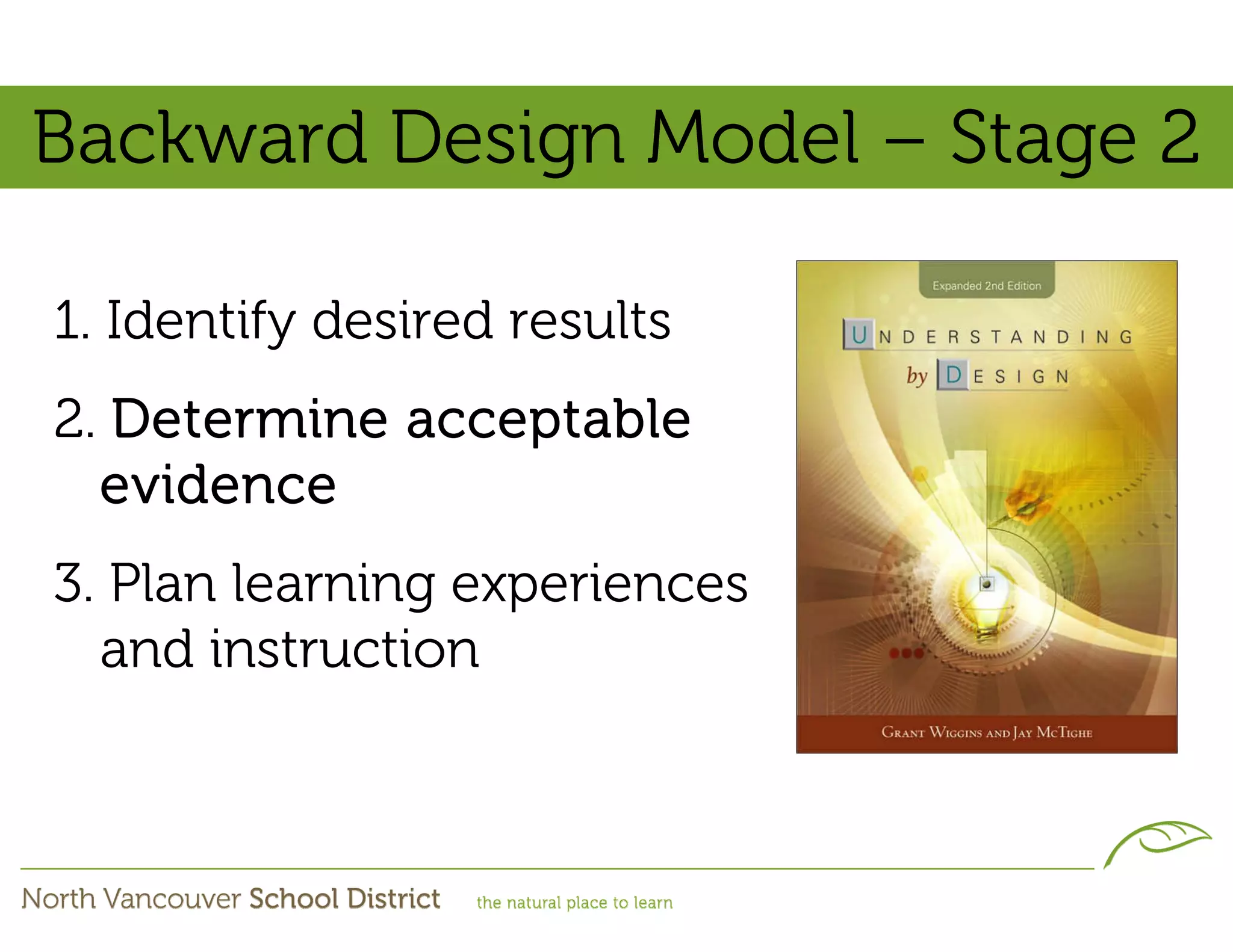
Backward Design Model – Stage 2

1. Identify desired results
2. Determine acceptable
  evidence
3. Plan learning experiences
  and instruction
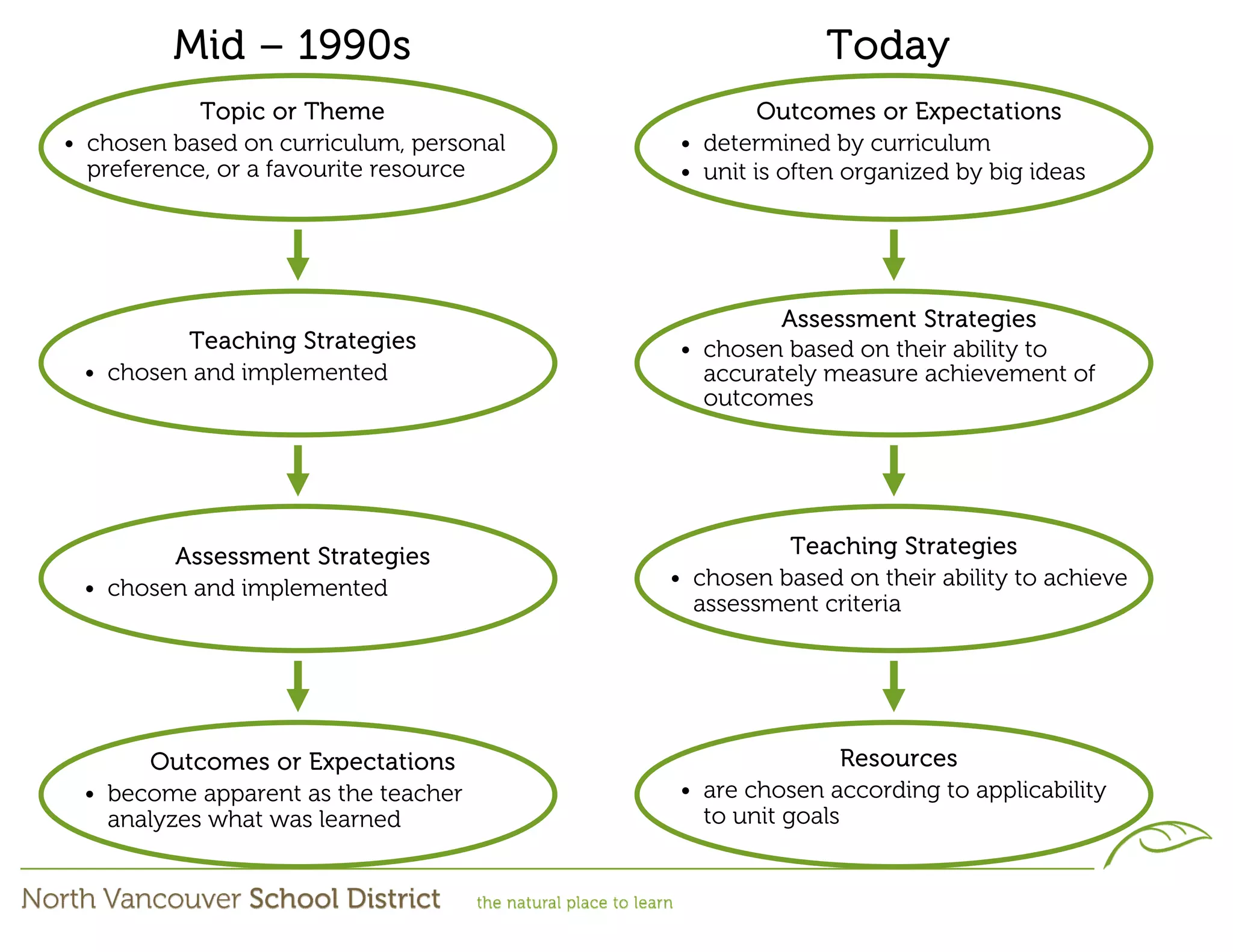
Mid – 1990s                                   Today
            Topic or Theme                       Outcomes or Expectations
• chosen based on curriculum, personal   • determined by curriculum
  preference, or a favourite resource    • unit is often organized by big ideas


                                                  Assessment Strategies
         Teaching Strategies             • chosen based on their ability to
 • chosen and implemented                  accurately measure achievement of
                                           outcomes


        Assessment Strategies                      Teaching Strategies
 • chosen and implemented                • chosen based on their ability to achieve
                                           assessment criteria


       Outcomes or Expectations                          Resources
 • become apparent as the teacher        • are chosen according to applicability
   analyzes what was learned               to unit goals
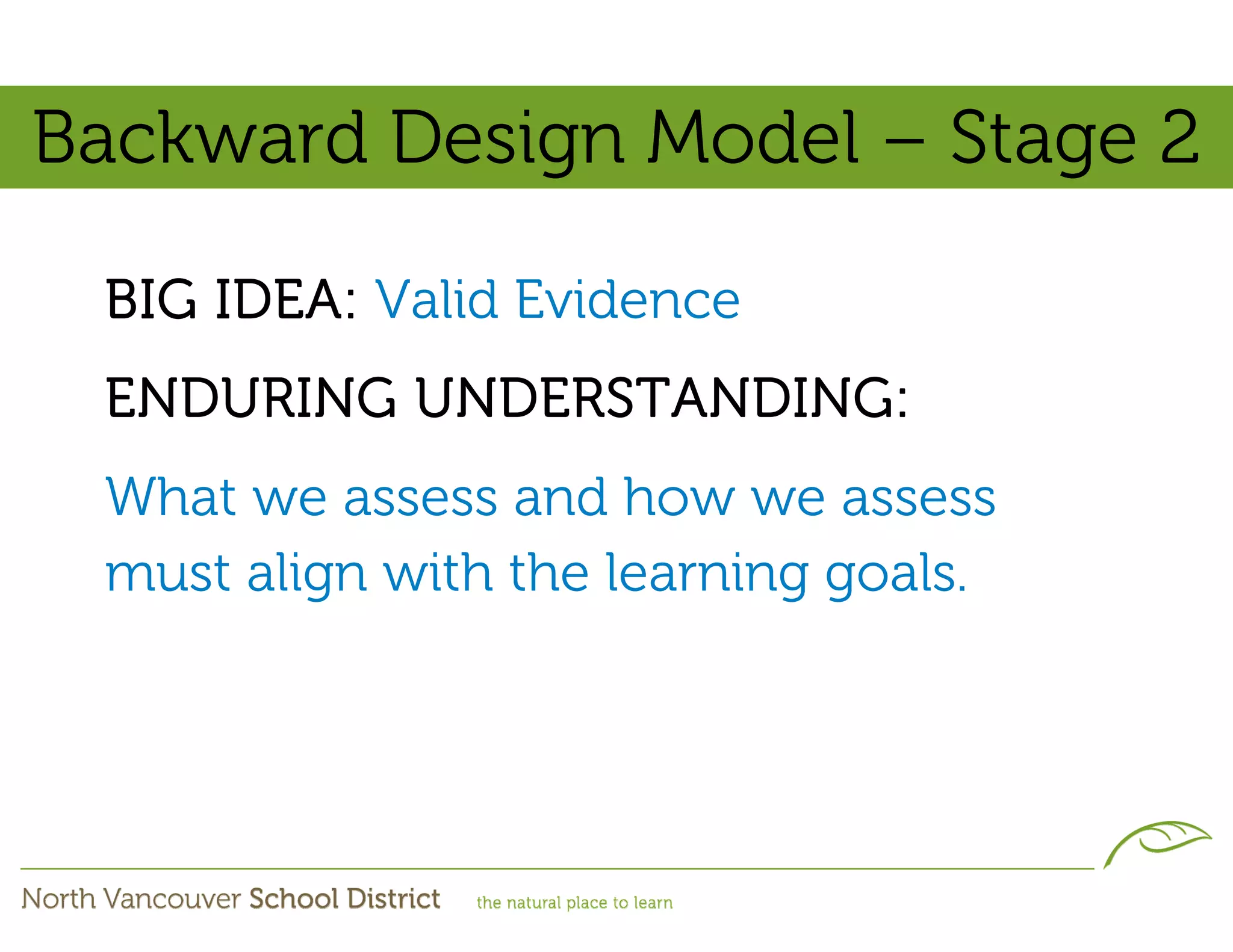
Backward Design Model – Stage 2

 BIG IDEA: Valid Evidence
 ENDURING UNDERSTANDING:
 What we assess and how we assess
 must align with the learning goals.
Backward Design Model – Stage 2
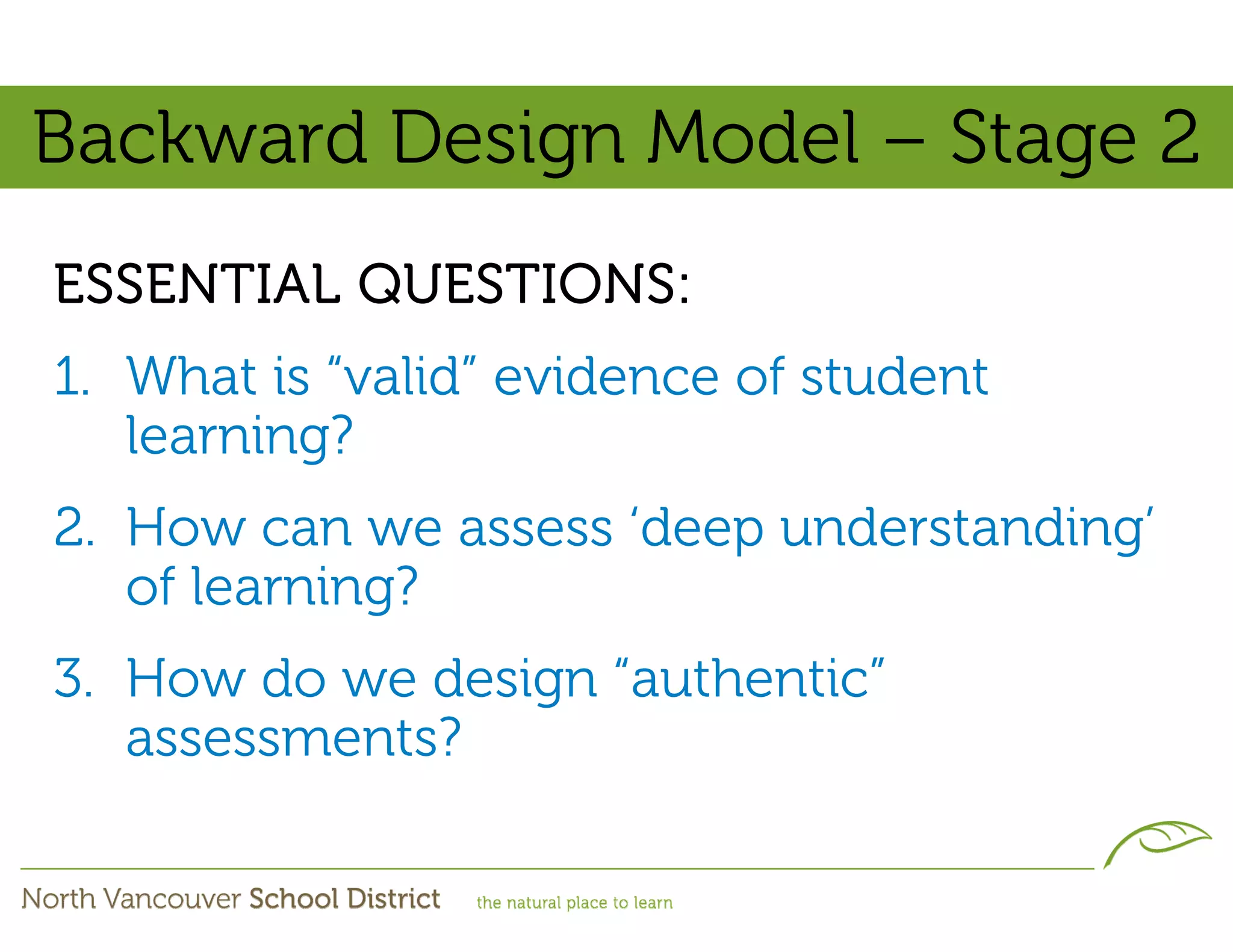
ESSENTIAL QUESTIONS:
1. What is “valid” evidence of student
   learning?
2. How can we assess ‘deep understanding’
   of learning?
3. How do we design “authentic”
   assessments?
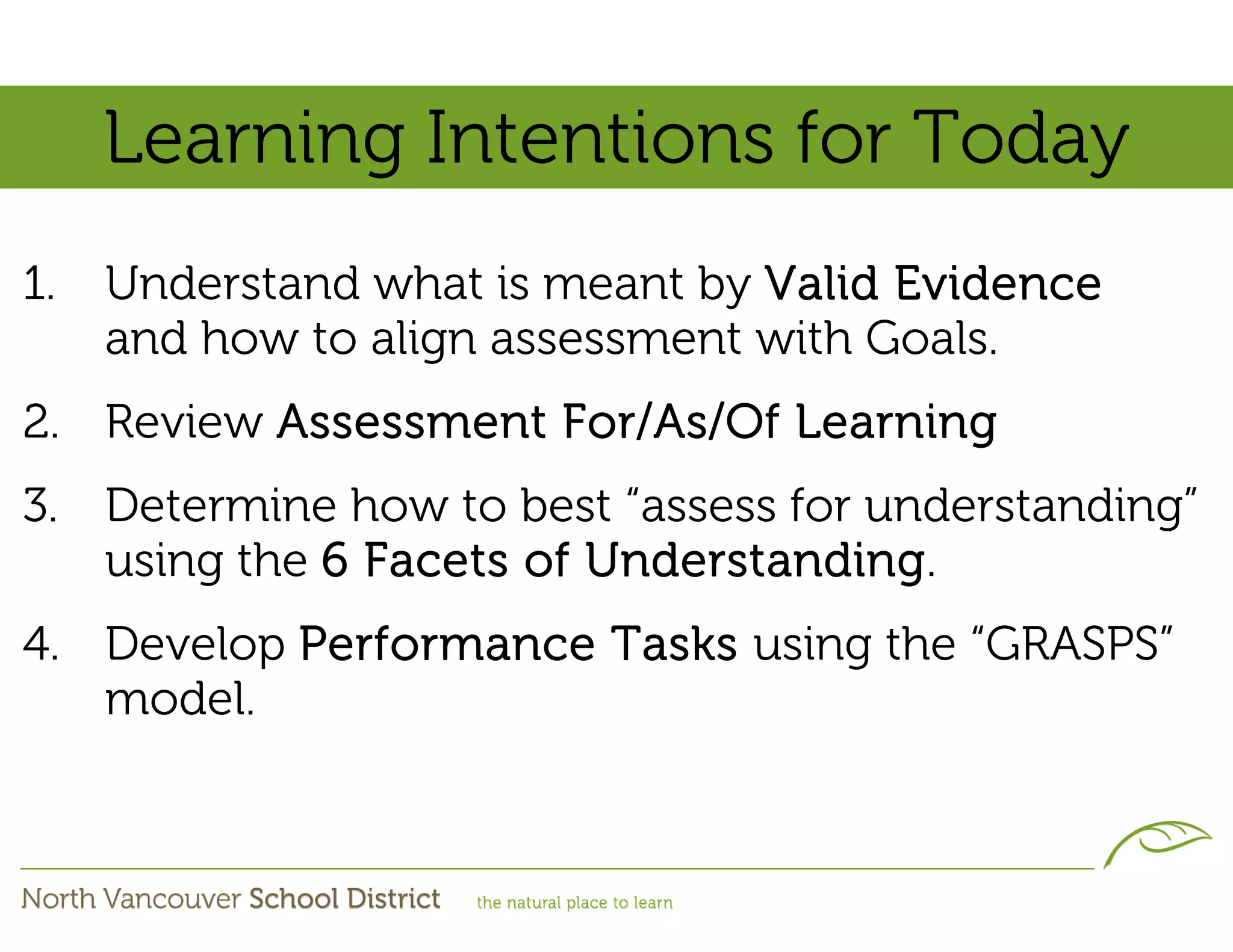
Learning Intentions for Today
1.   Understand what is meant by Valid Evidence
     and how to align assessment with Goals.
2. Review Assessment For/As/Of Learning
3. Determine how to best “assess for understanding”
   using the 6 Facets of Understanding.
4. Develop Performance Tasks using the “GRASPS”
   model.
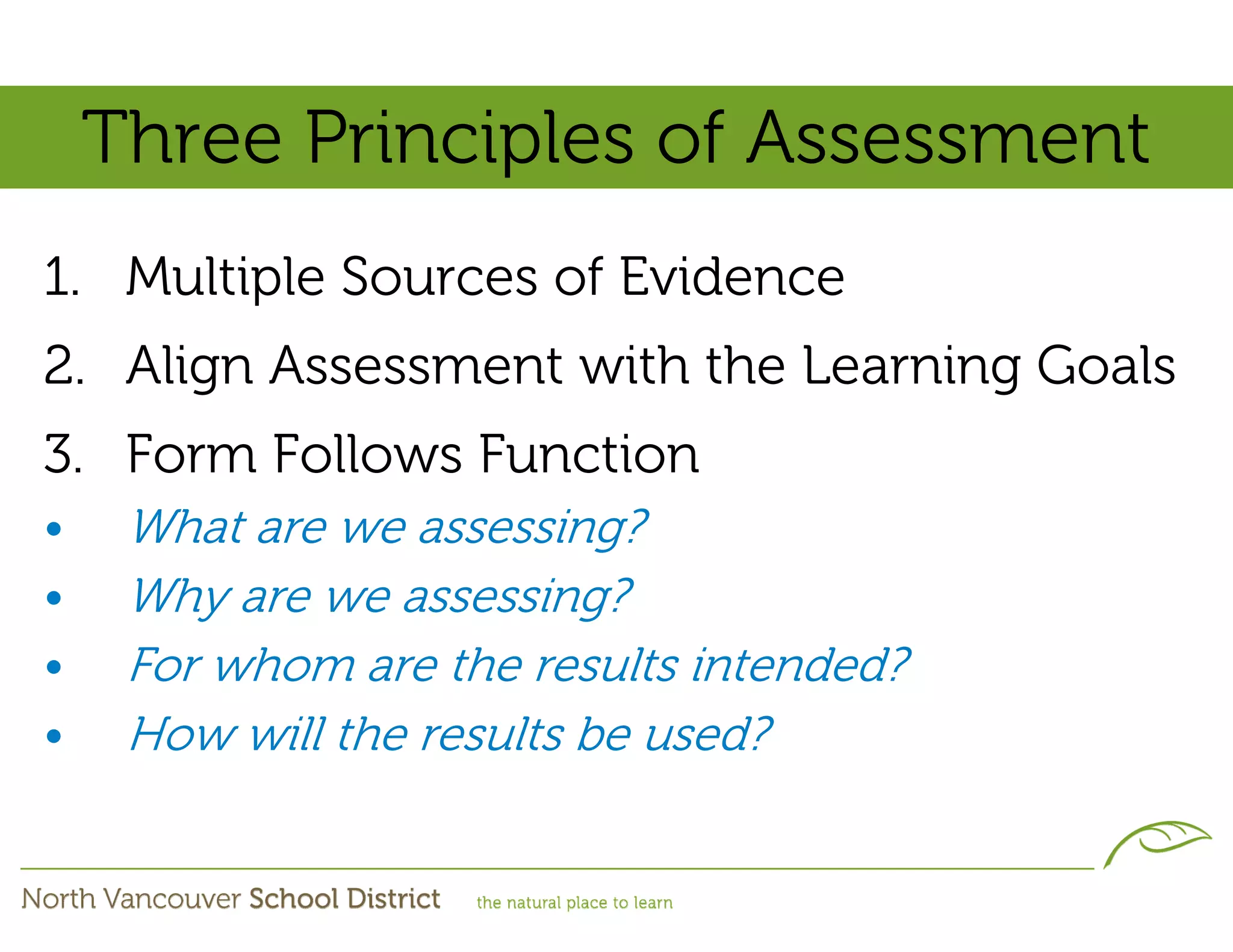
Three Principles of Assessment
1. Multiple Sources of Evidence
2. Align Assessment with the Learning Goals
3. Form Follows Function
•    What are we assessing?
•    Why are we assessing?
•    For whom are the results intended?
•    How will the results be used?
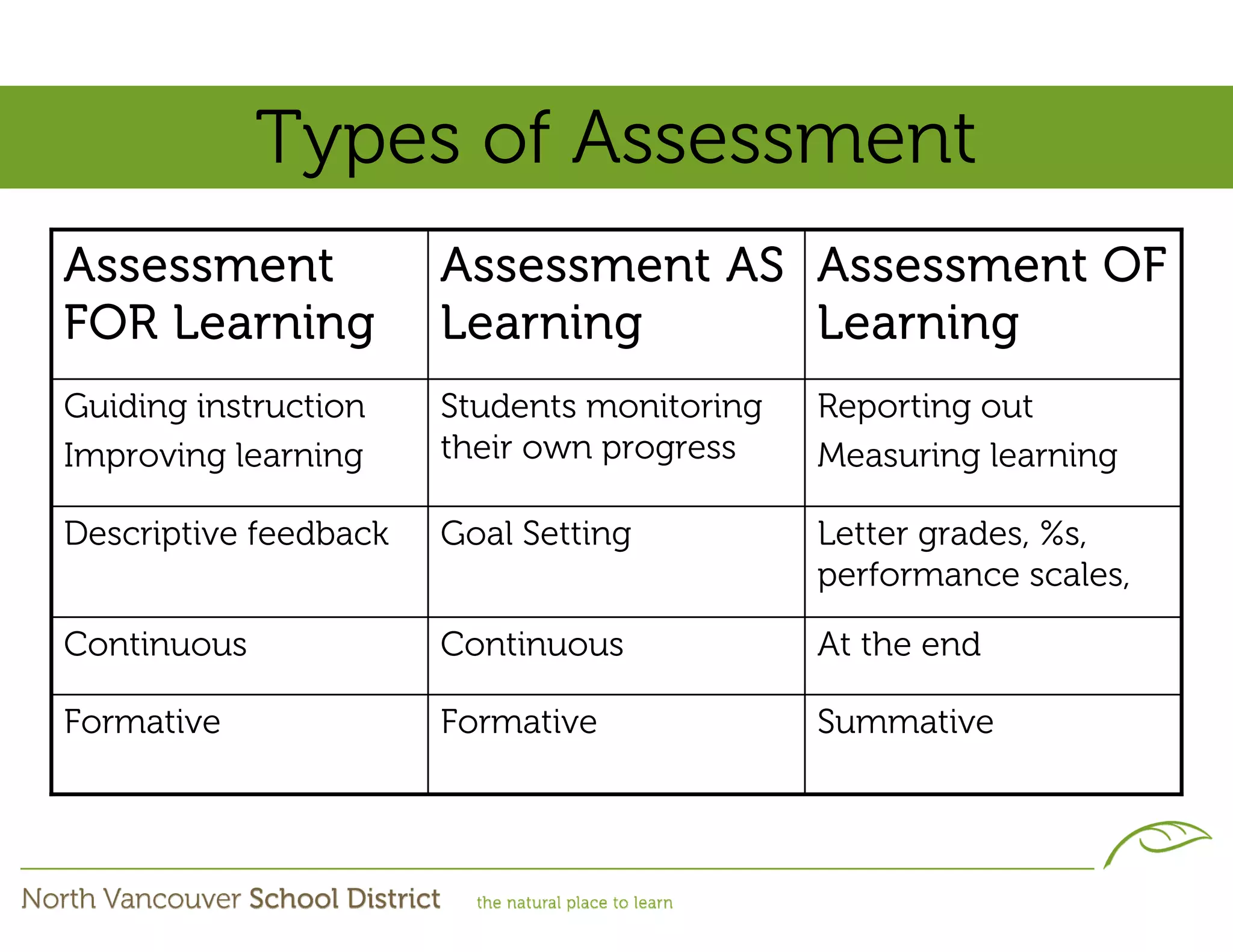
Types of Assessment
Assessment             Assessment AS Assessment OF
FOR Learning           Learning      Learning
Guiding instruction    Students monitoring   Reporting out
Improving learning     their own progress    Measuring learning

Descriptive feedback   Goal Setting          Letter grades, %s,
                                             performance scales,

Continuous             Continuous            At the end

Formative              Formative             Summative
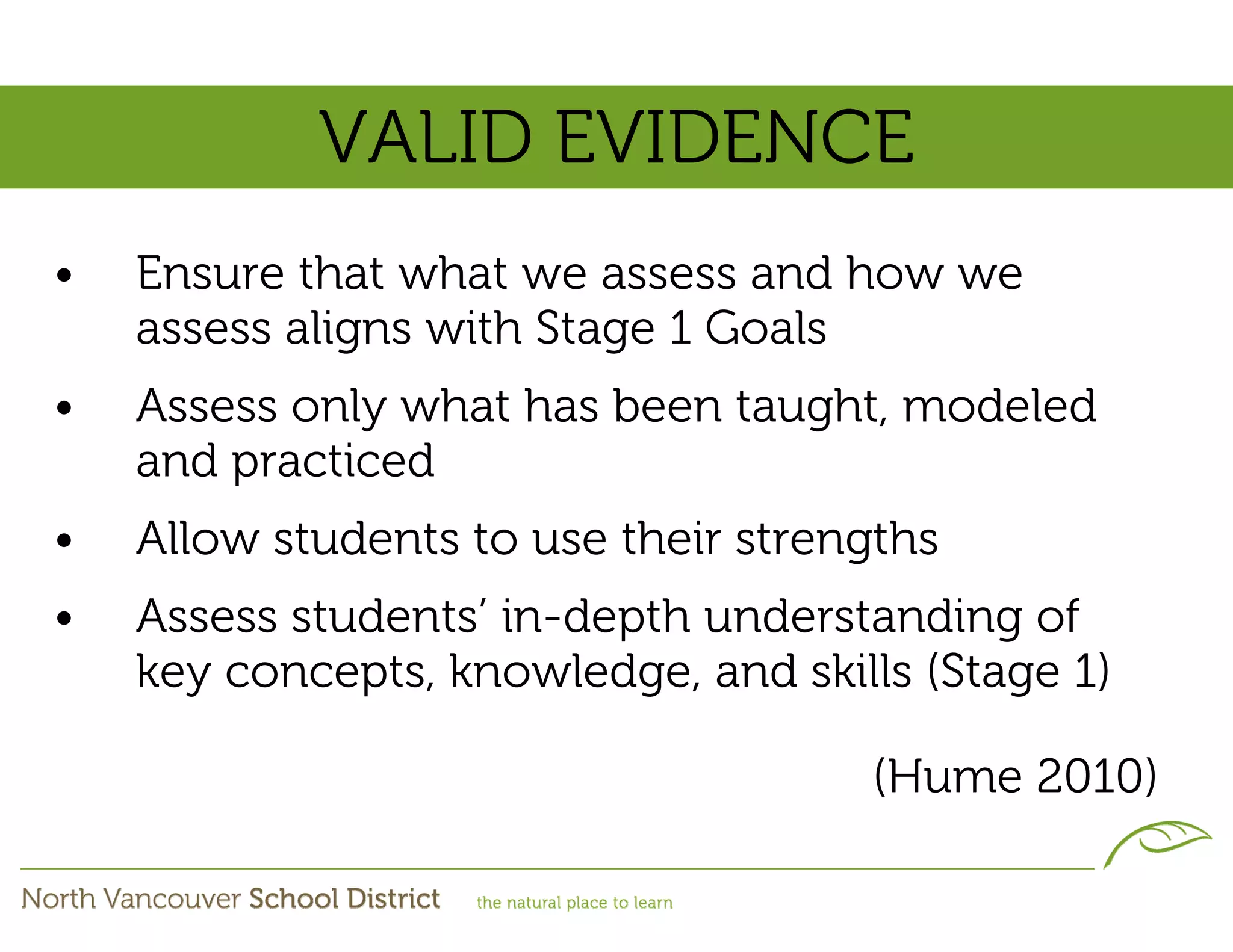
VALID EVIDENCE
•   Ensure that what we assess and how we
    assess aligns with Stage 1 Goals
•   Assess only what has been taught, modeled
    and practiced
•   Allow students to use their strengths
•   Assess students’ in-depth understanding of
    key concepts, knowledge, and skills (Stage 1)

                                     (Hume 2010)
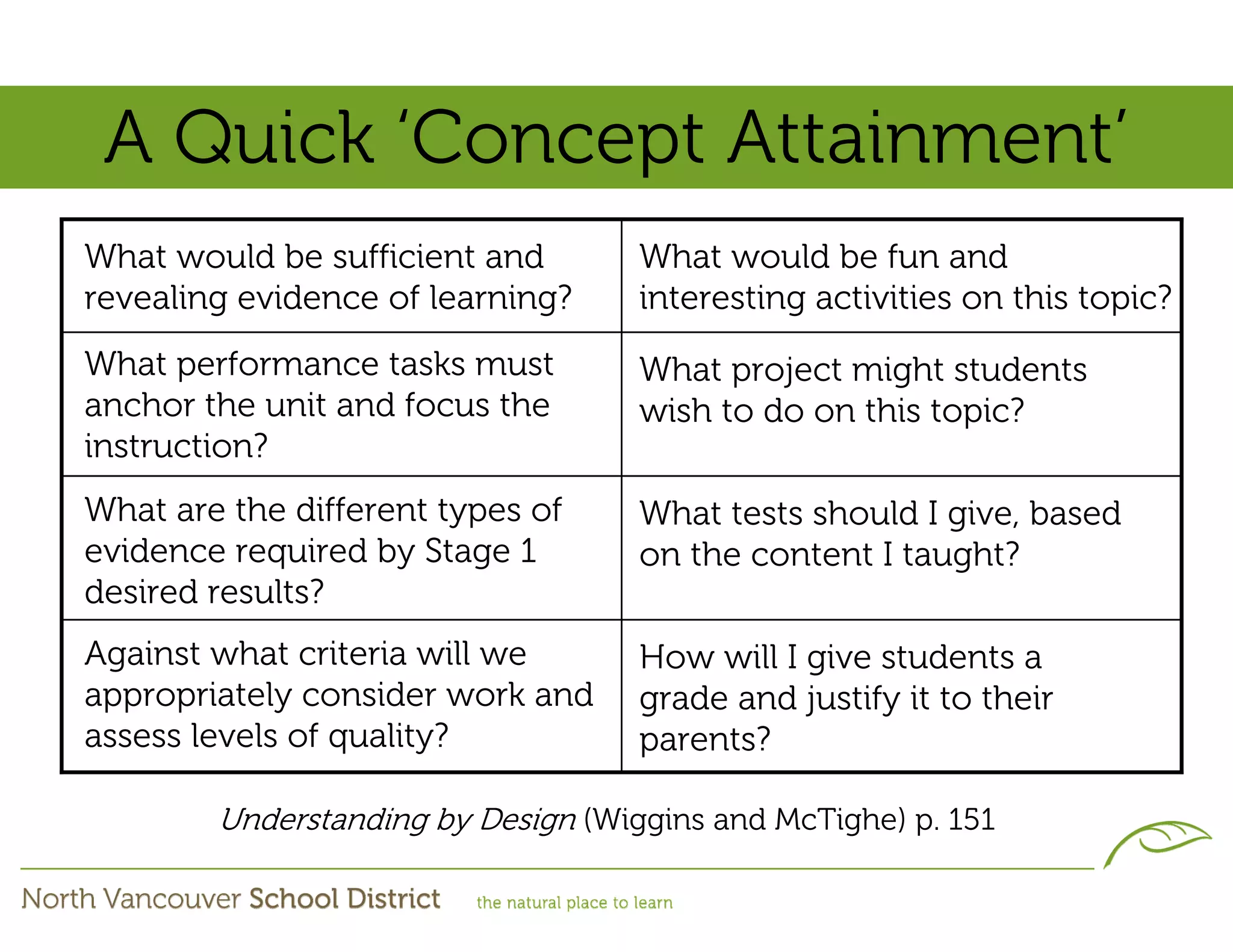
A Quick ‘Concept Attainment’
What would be sufficient and        What would be fun and
revealing evidence of learning?     interesting activities on this topic?
What performance tasks must         What project might students
anchor the unit and focus the       wish to do on this topic?
instruction?
What are the different types of     What tests should I give, based
evidence required by Stage 1        on the content I taught?
desired results?
Against what criteria will we       How will I give students a
appropriately consider work and     grade and justify it to their
assess levels of quality?           parents?

        Understanding by Design (Wiggins and McTighe) p. 151
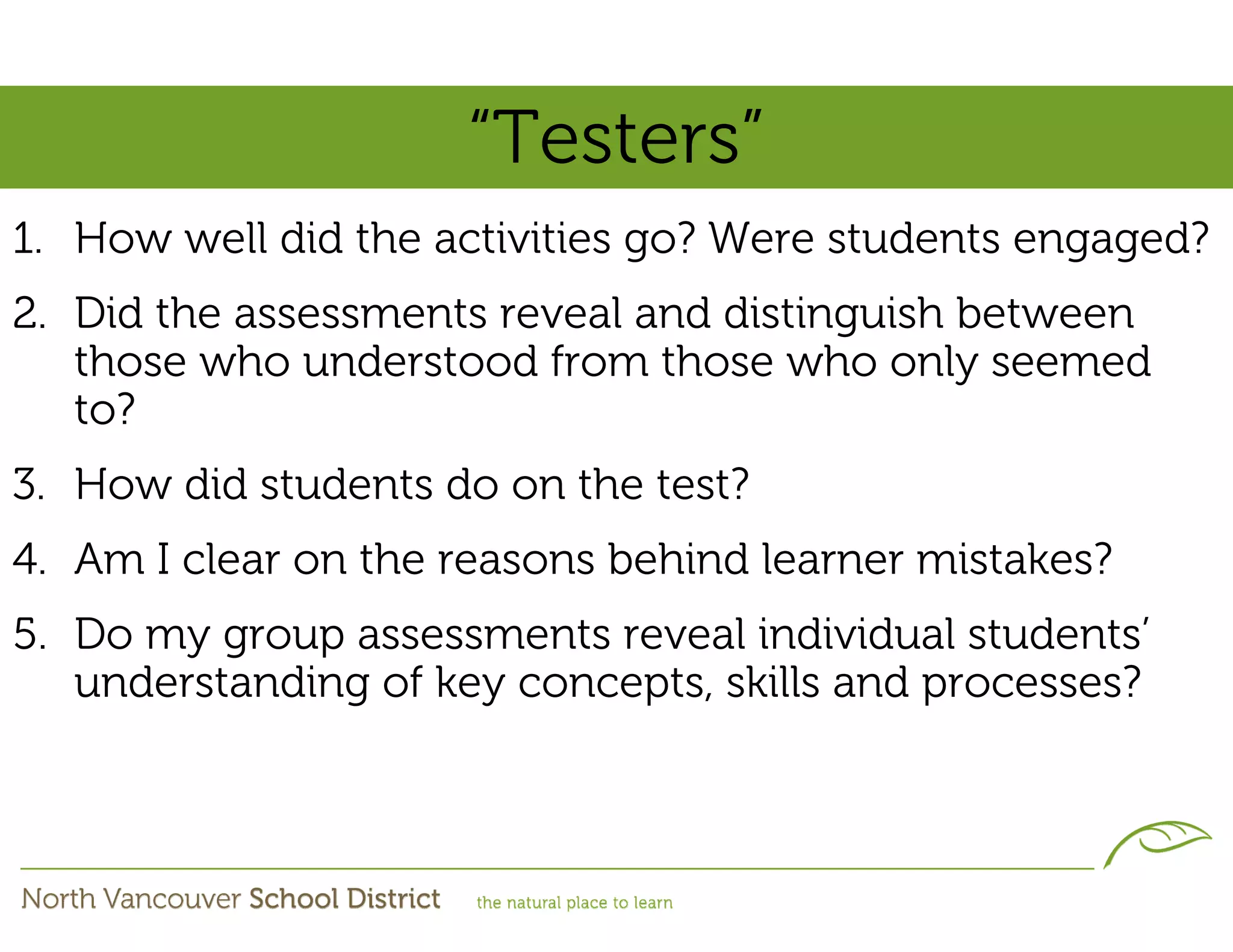
“Testers”
1. How well did the activities go? Were students engaged?
2. Did the assessments reveal and distinguish between
   those who understood from those who only seemed
   to?
3. How did students do on the test?
4. Am I clear on the reasons behind learner mistakes?
5. Do my group assessments reveal individual students’
   understanding of key concepts, skills and processes?
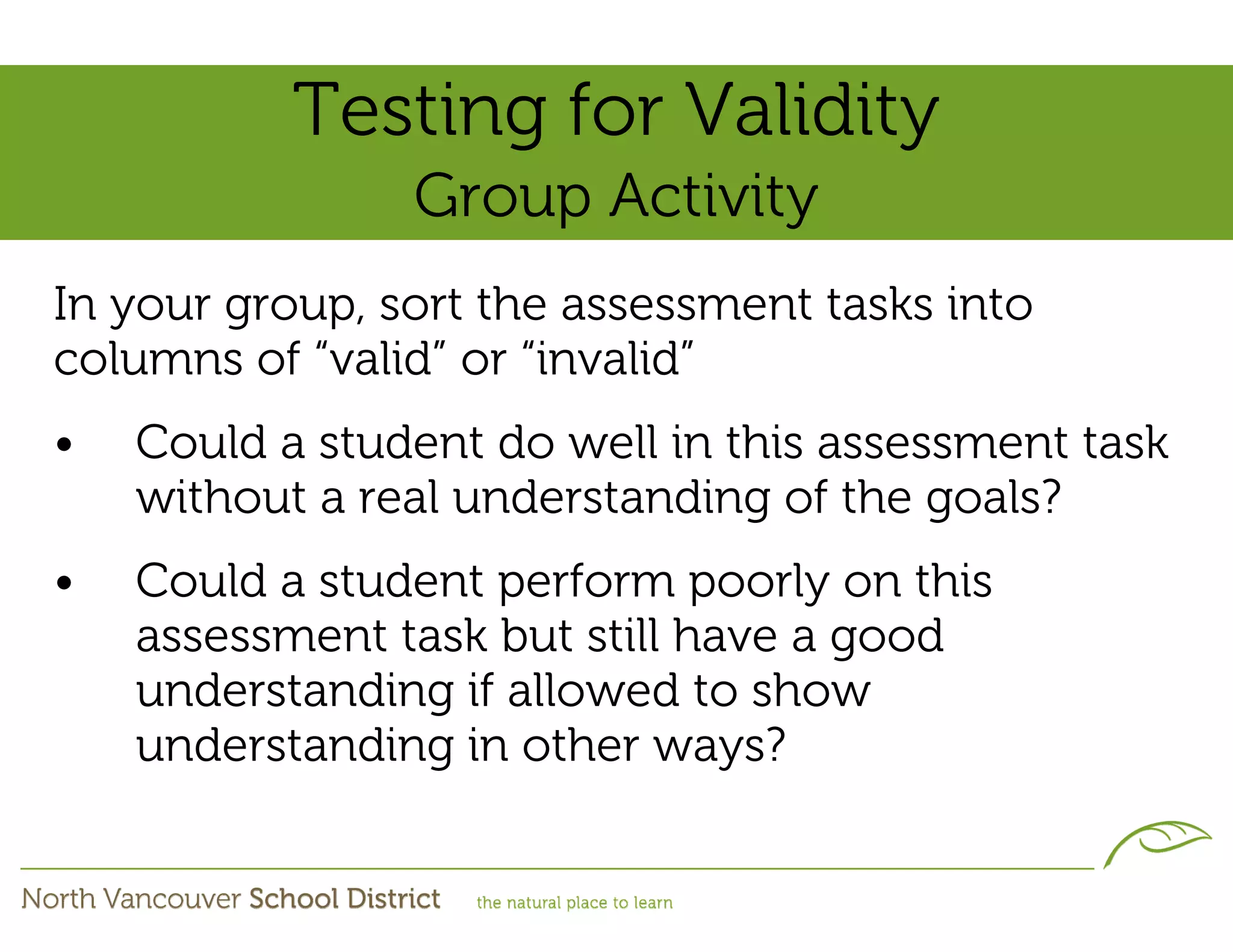
Testing for Validity
                Group Activity
In your group, sort the assessment tasks into
columns of “valid” or “invalid”
•   Could a student do well in this assessment task
    without a real understanding of the goals?
•   Could a student perform poorly on this
    assessment task but still have a good
    understanding if allowed to show
    understanding in other ways?
The Six Facets of
  Understanding


“…Understanding shows its face
 when people can think and act
flexibly around what they know.”
We want students to be able to:
• Explain why they did something
• Discuss their evidence and support for
  their answer/ approach/ design
• Reflect on the results they achieved
  and possible alternative ways to
  achieve it
Explanation
• Demonstrate insight
• Explain the big idea / significant concept in their own
  words
• Make connections
• Justify an argument with evidence
• Avoid common misunderstandings

  Why are the characteristics of …
  What accounts for …
  How did … come about
Interpretation
• Requires students to make sense of something
• Read between the lines and offer plausible accounts
  for discrepancies
• Offer a meaningful account of a complex situation


 What does it mean when…
 How does this relate to…
 Predict what might happen if…
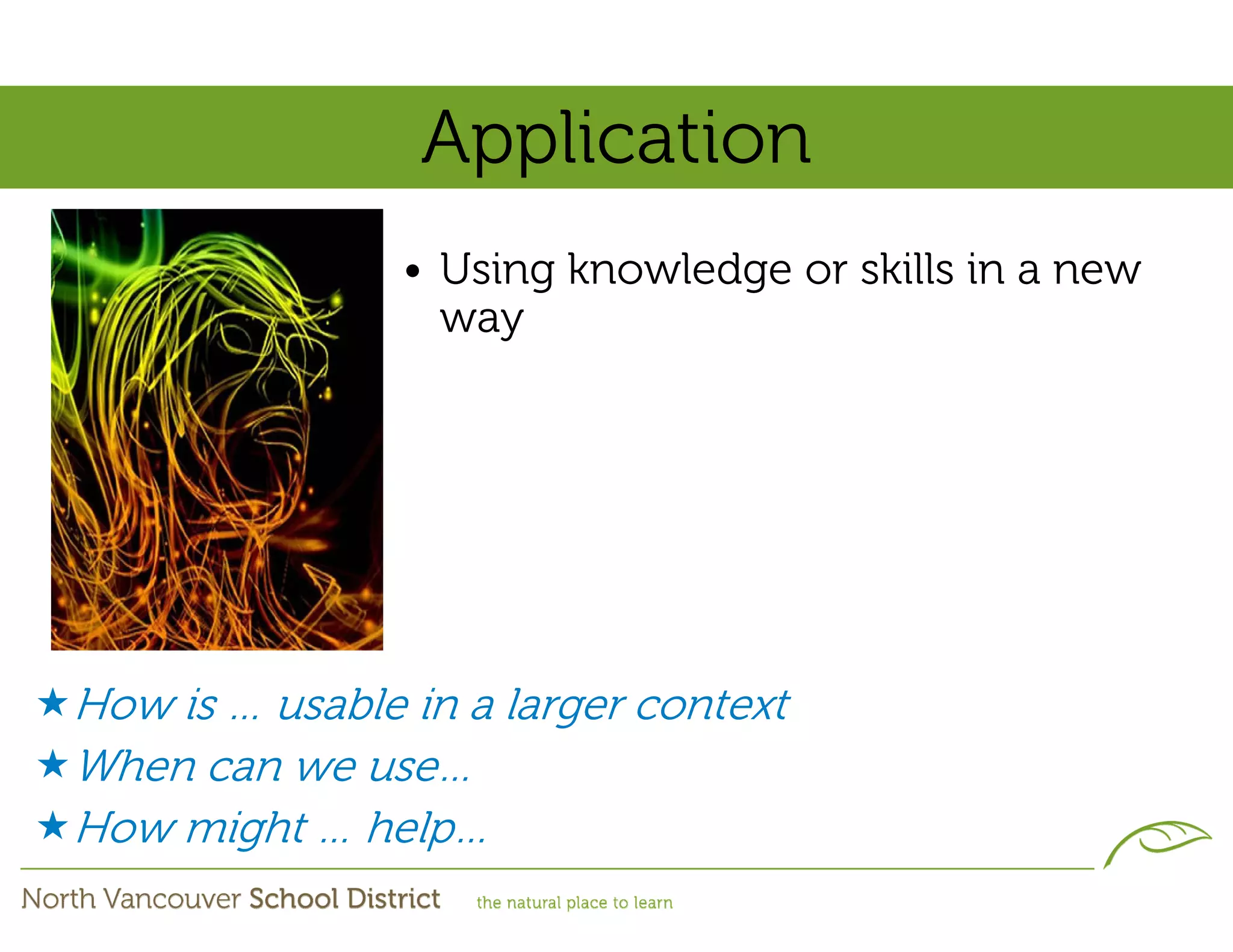
Application
                • Using knowledge or skills in a new
                  way


How is … usable in a larger context
When can we use…
How might … help…
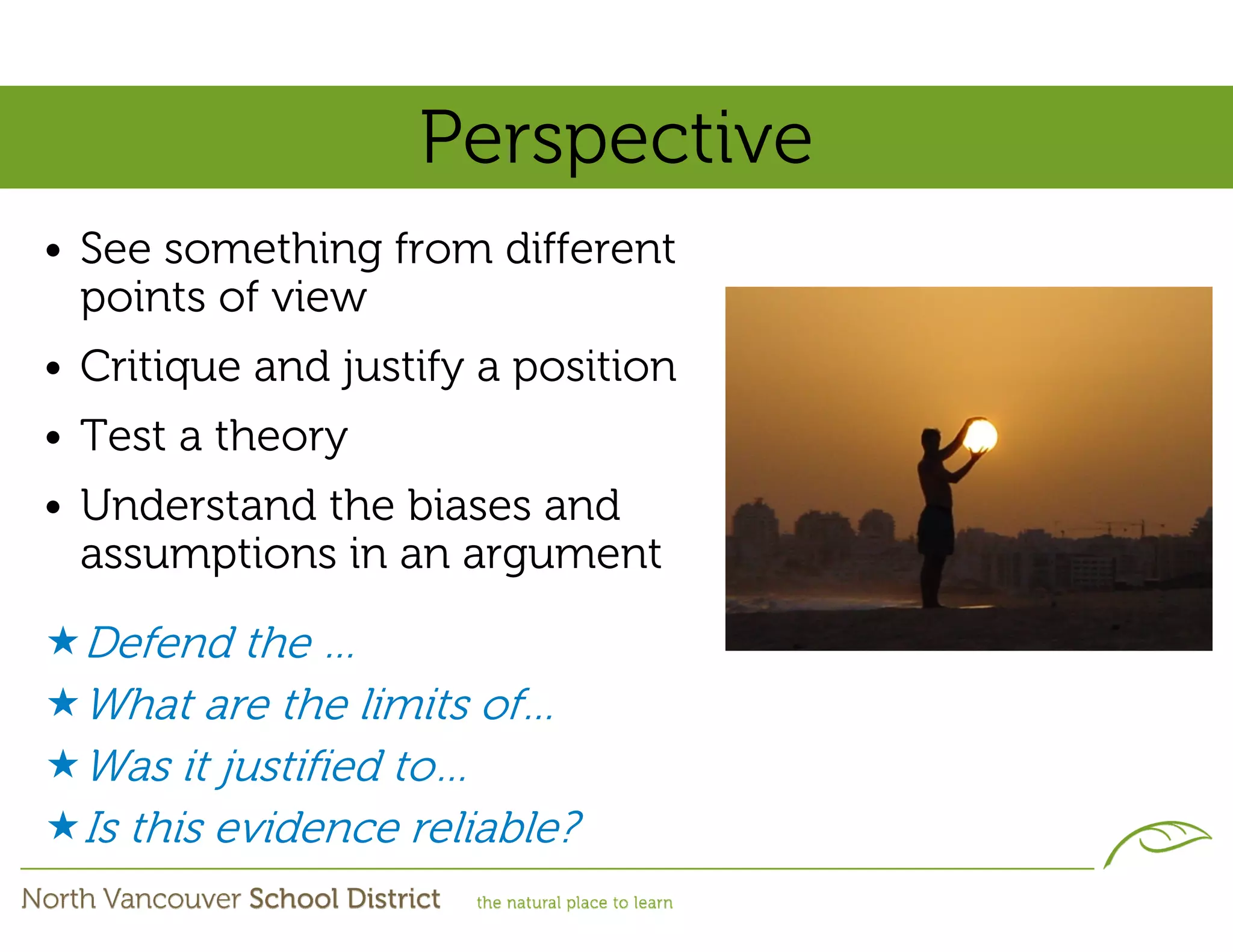
Perspective
• See something from different
  points of view
• Critique and justify a position
• Test a theory
• Understand the biases and
  assumptions in an argument

  Defend the …
  What are the limits of…
  Was it justified to…
  Is this evidence reliable?
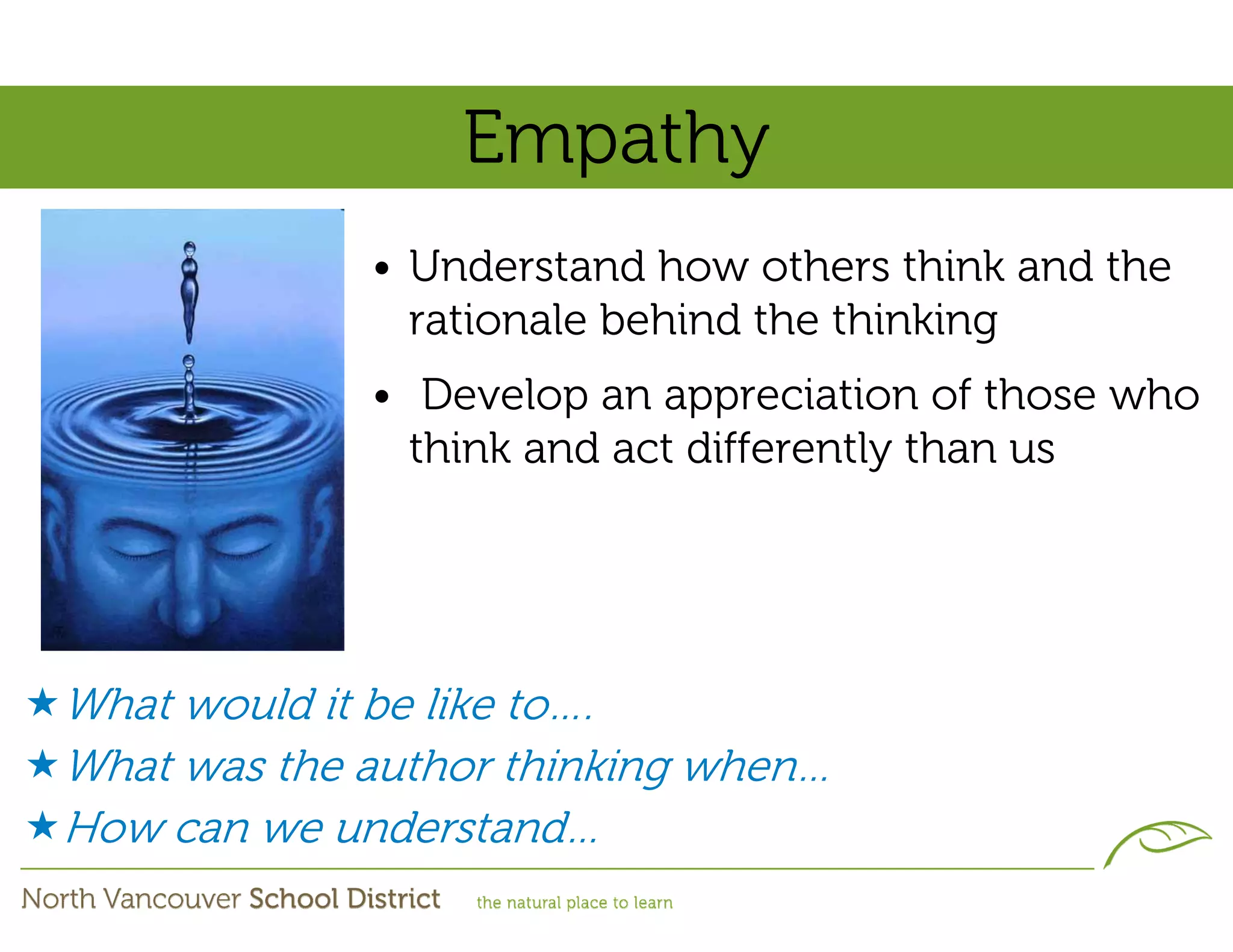
Empathy
             • Understand how others think and the
               rationale behind the thinking
             • Develop an appreciation of those who
               think and act differently than us


What would it be like to….
What was the author thinking when…
How can we understand…
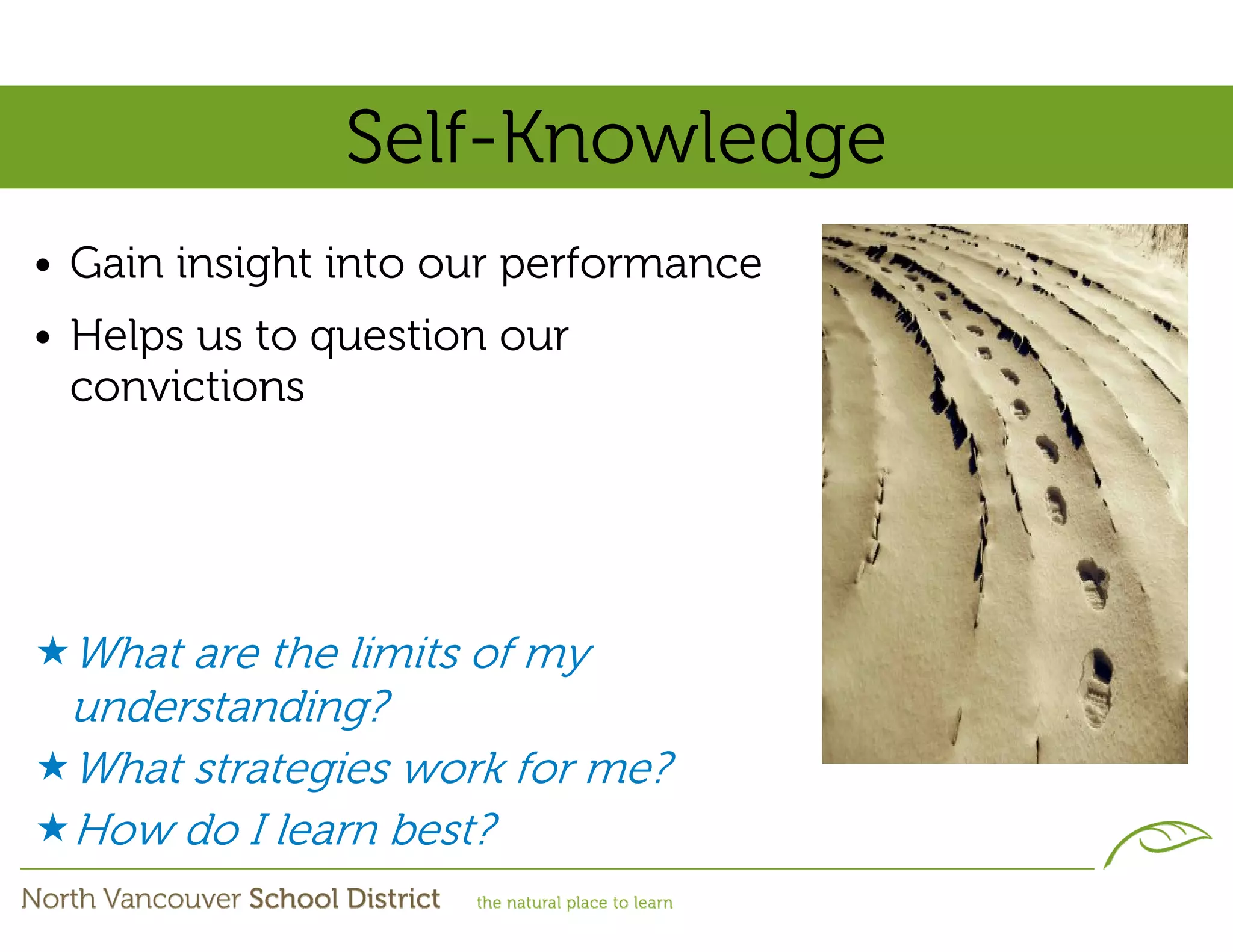
Self-Knowledge
• Gain insight into our performance
• Helps us to question our
  convictions


 What are the limits of my
 understanding?
 What strategies work for me?
 How do I learn best?
Six Key Facets
• Help us find authentic assessment that is suitable
  for our significant concept/big idea
• Guide us to an measurement that we deem
  quintessential for understanding and
  comprehension
• Help us find a balance between factual recall and
  deep understanding
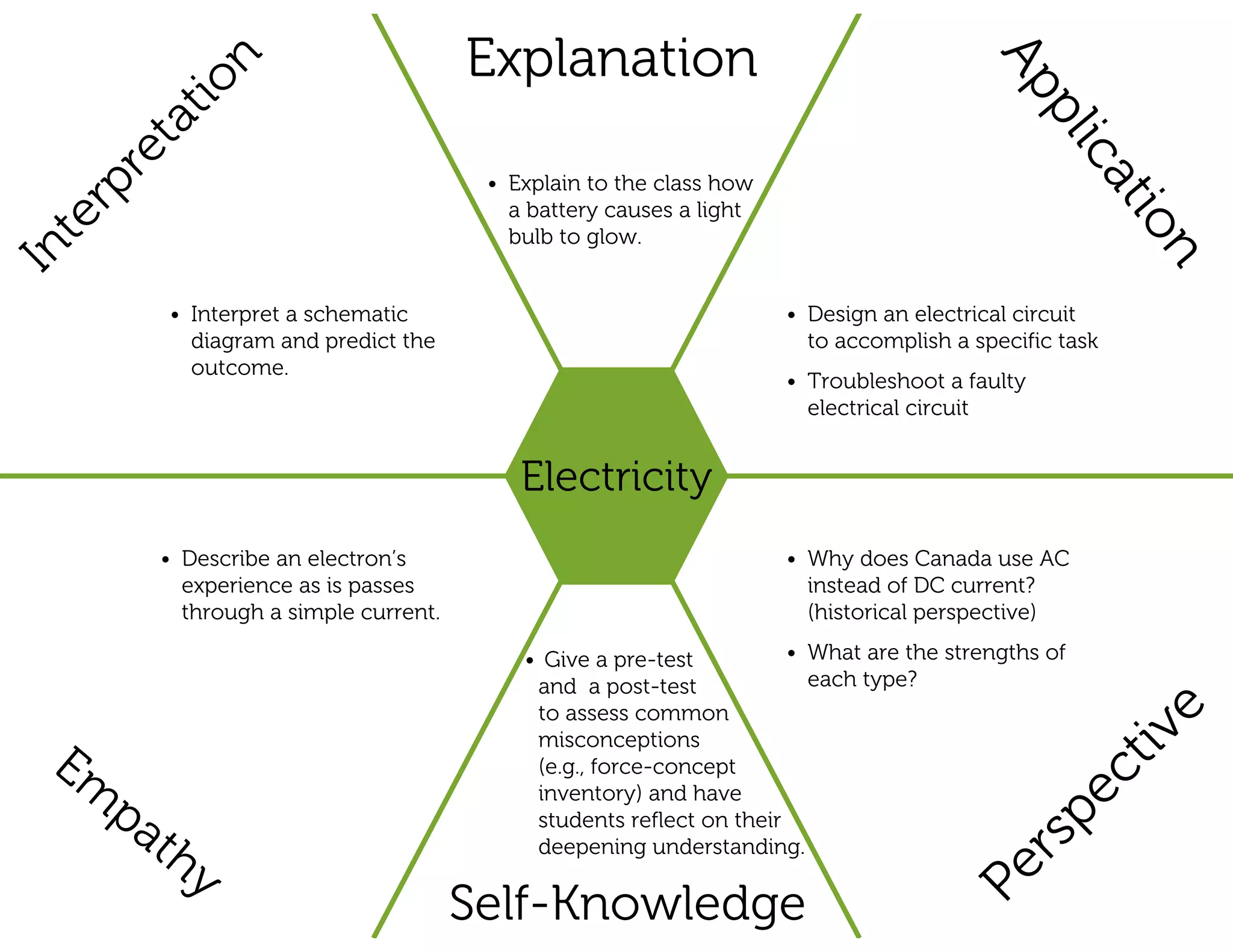
on                   Explanation


                                                                                            Ap
                  ti
             ta


                                                                                              pl
           re


                                                                                                 ica
         p                                 • Explain to the class how
    er


                                                                                                     tio
                                             a battery causes a light

I nt                                         bulb to glow.


                                                                                                        n
            • Interpret a schematic                                     • Design an electrical circuit
              diagram and predict the                                     to accomplish a specific task
              outcome.
                                                                        • Troubleshoot a faulty
                                                                          electrical circuit


                                              Electricity
            • Describe an electron’s                                    • Why does Canada use AC
              experience as is passes                                     instead of DC current?
              through a simple current.                                   (historical perspective)

                                              • Give a pre-test          • What are the strengths of
                                               and a post-test             each type?


Em
                                               to assess common
                                               misconceptions
                                                                                                       tive
                                                                                                    ec
                                               (e.g., force-concept
  pa                                           inventory) and have

     t
                                               students reflect on their
                                                                                                 sp
            hy                                                                                er
                                               deepening understanding.

                                          Self-Knowledge                                     P
Why Performance Tasks?
• Higher-order thinking skills
• Acquisition of content and procedural knowledge
• Differentiate content, process and product
  according to students’ readiness, interests, and
  learning profiles
                                     Tomlinson 1999
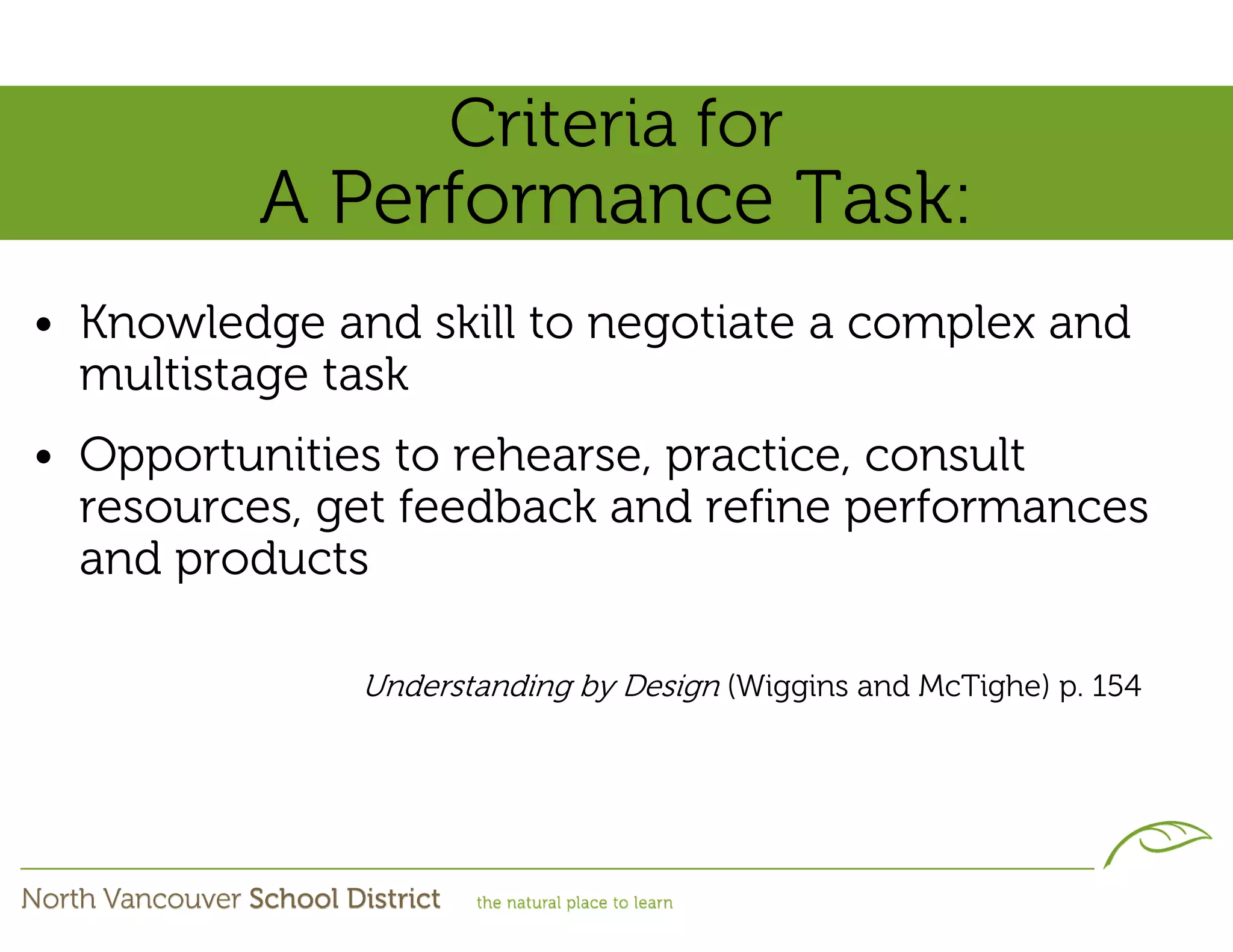
Criteria for
        A Performance Task:
• Realistically contextualized
• Judgments and innovation
• Asks the student to “do” the subject
Criteria for
         A Performance Task:
• Knowledge and skill to negotiate a complex and
  multistage task
• Opportunities to rehearse, practice, consult
  resources, get feedback and refine performances
  and products

              Understanding by Design (Wiggins and McTighe) p. 154
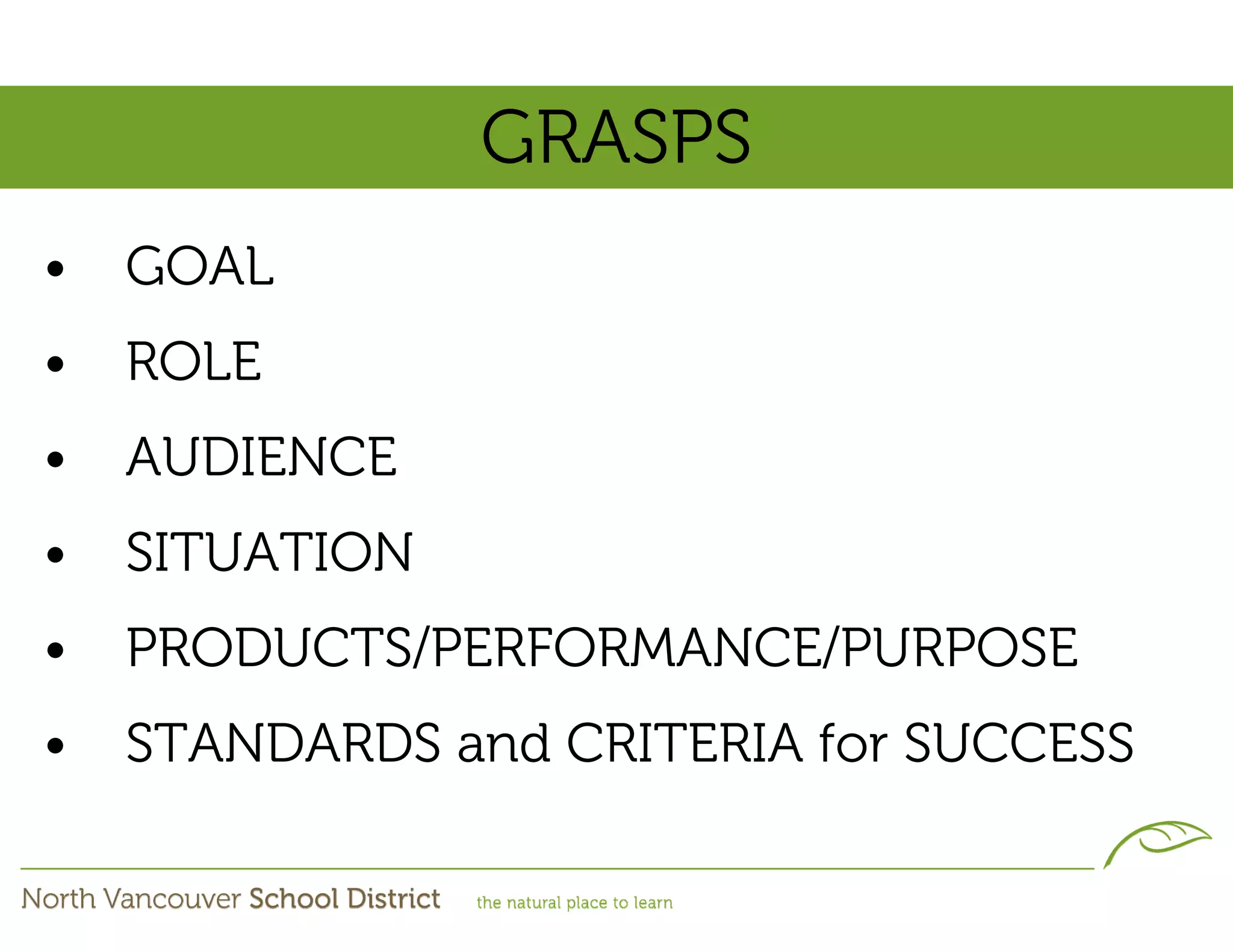
GRASPS
•   GOAL
•   ROLE
•   AUDIENCE
•   SITUATION
•   PRODUCTS/PERFORMANCE/PURPOSE
•   STANDARDS and CRITERIA for SUCCESS
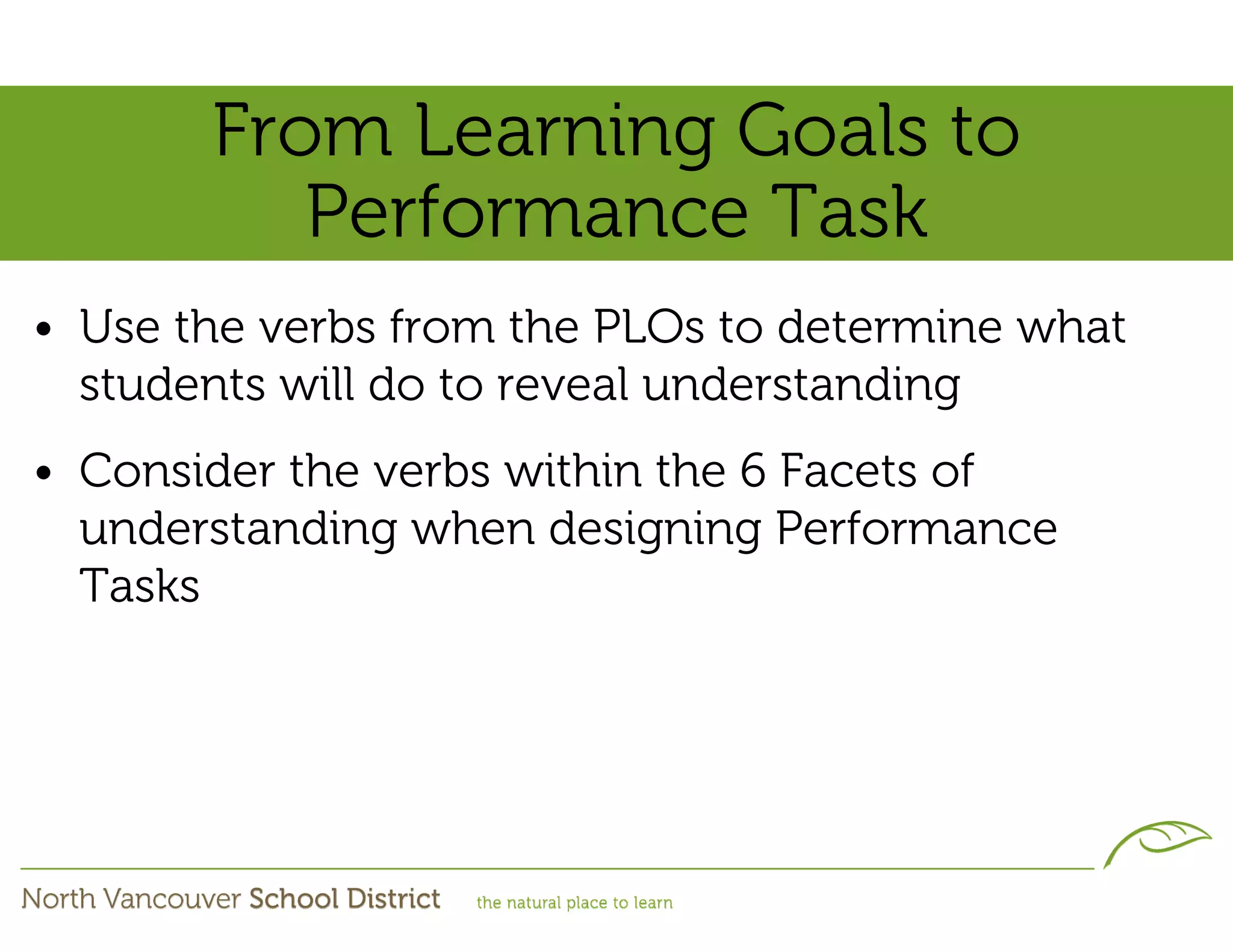
From Learning Goals to
          Performance Task
• Use the verbs from the PLOs to determine what
  students will do to reveal understanding
• Consider the verbs within the 6 Facets of
  understanding when designing Performance
  Tasks
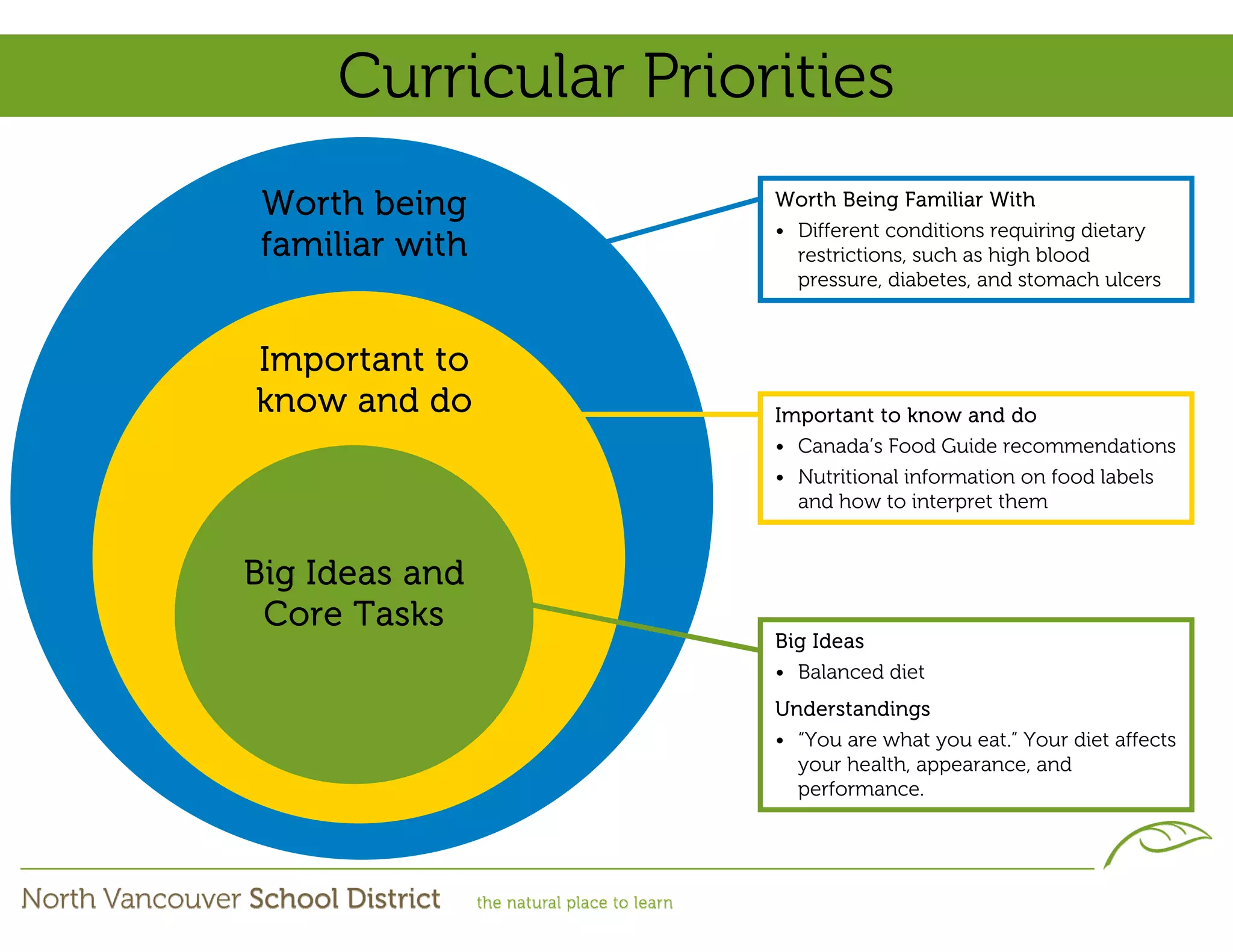
Curricular Priorities
 Worth being         Worth Being Familiar With
                     • Different conditions requiring dietary
 familiar with         restrictions, such as high blood
                       pressure, diabetes, and stomach ulcers


Important to
know and do          Important to know and do
                     • Canada’s Food Guide recommendations
                     • Nutritional information on food labels
                       and how to interpret them


Big Ideas and
 Core Tasks
                     Big Ideas
                     • Balanced diet
                     Understandings
                     • “You are what you eat.” Your diet affects
                       your health, appearance, and
                       performance.
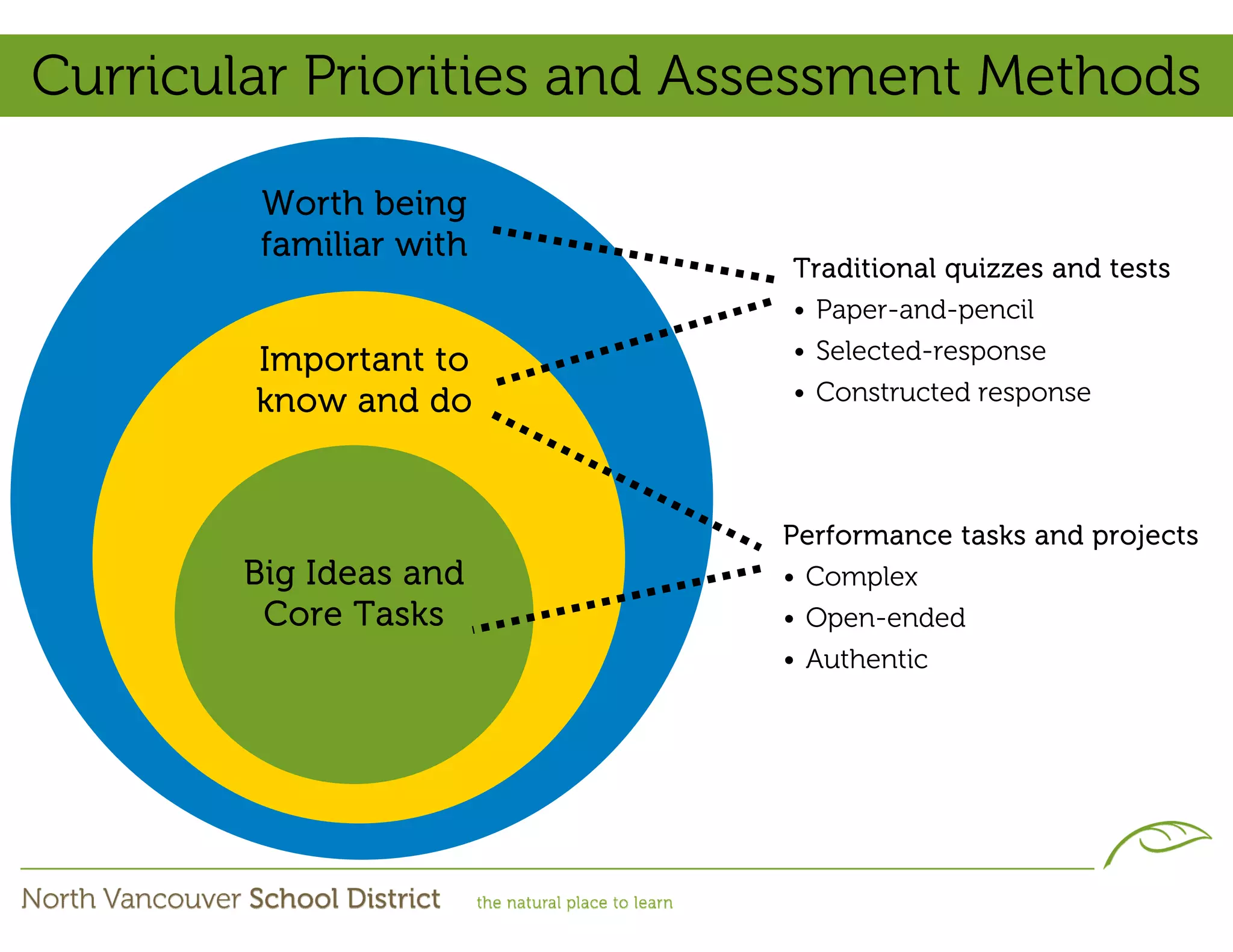
Curricular Priorities and Assessment Methods

        Worth being
        familiar with
                            Traditional quizzes and tests
                            • Paper-and-pencil
        Important to        • Selected-response
        know and do         • Constructed response


                            Performance tasks and projects
       Big Ideas and        • Complex
        Core Tasks          • Open-ended
                            • Authentic
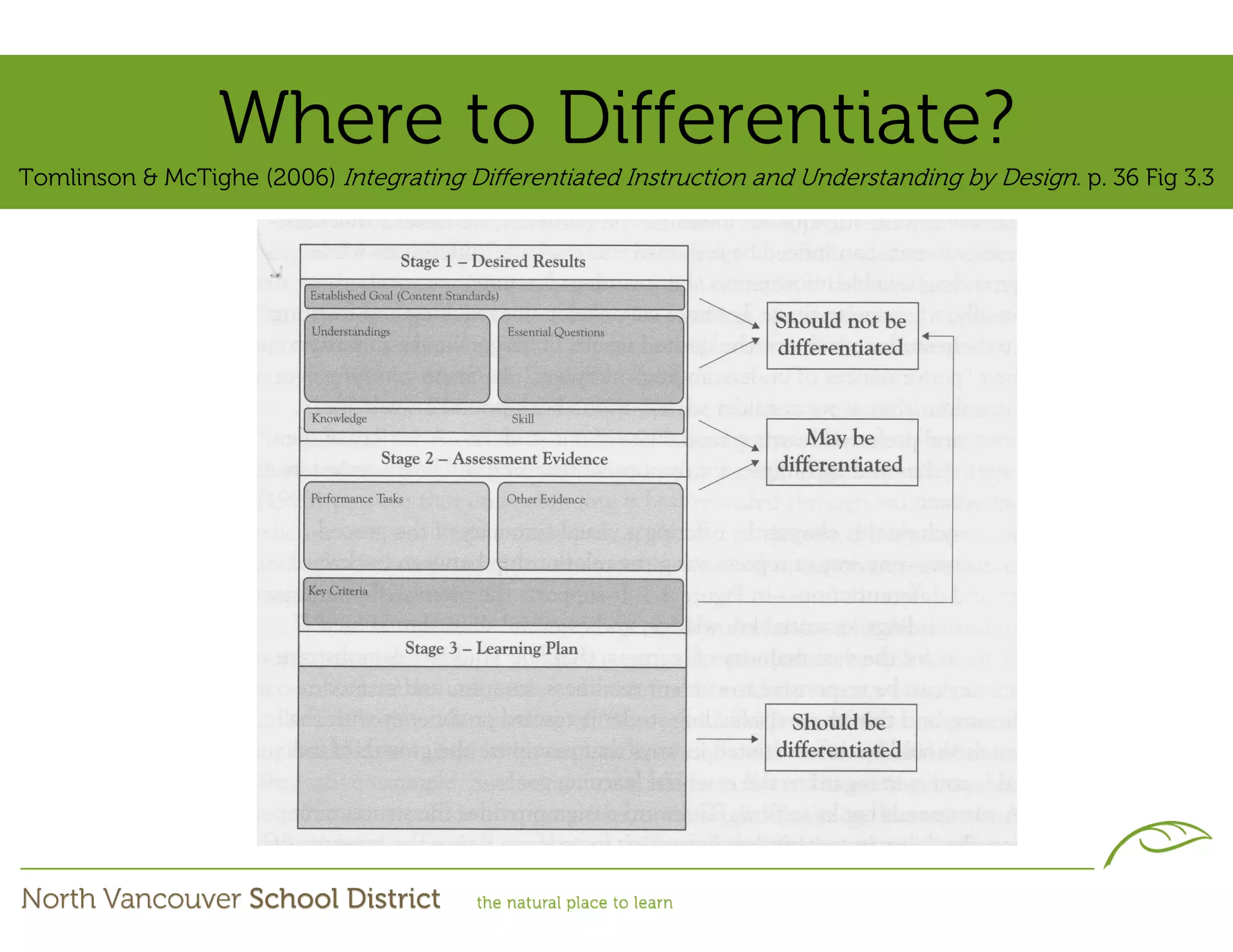
Where to Differentiate?
Tomlinson & McTighe (2006) Integrating Differentiated Instruction and Understanding by Design. p. 36 Fig 3.3
School Teams: Your Task
• Use the concept of Validity, the 6 Facets
  of Understanding and the GRASPS
  template, design a performance task for
  your planned unit of instruction.
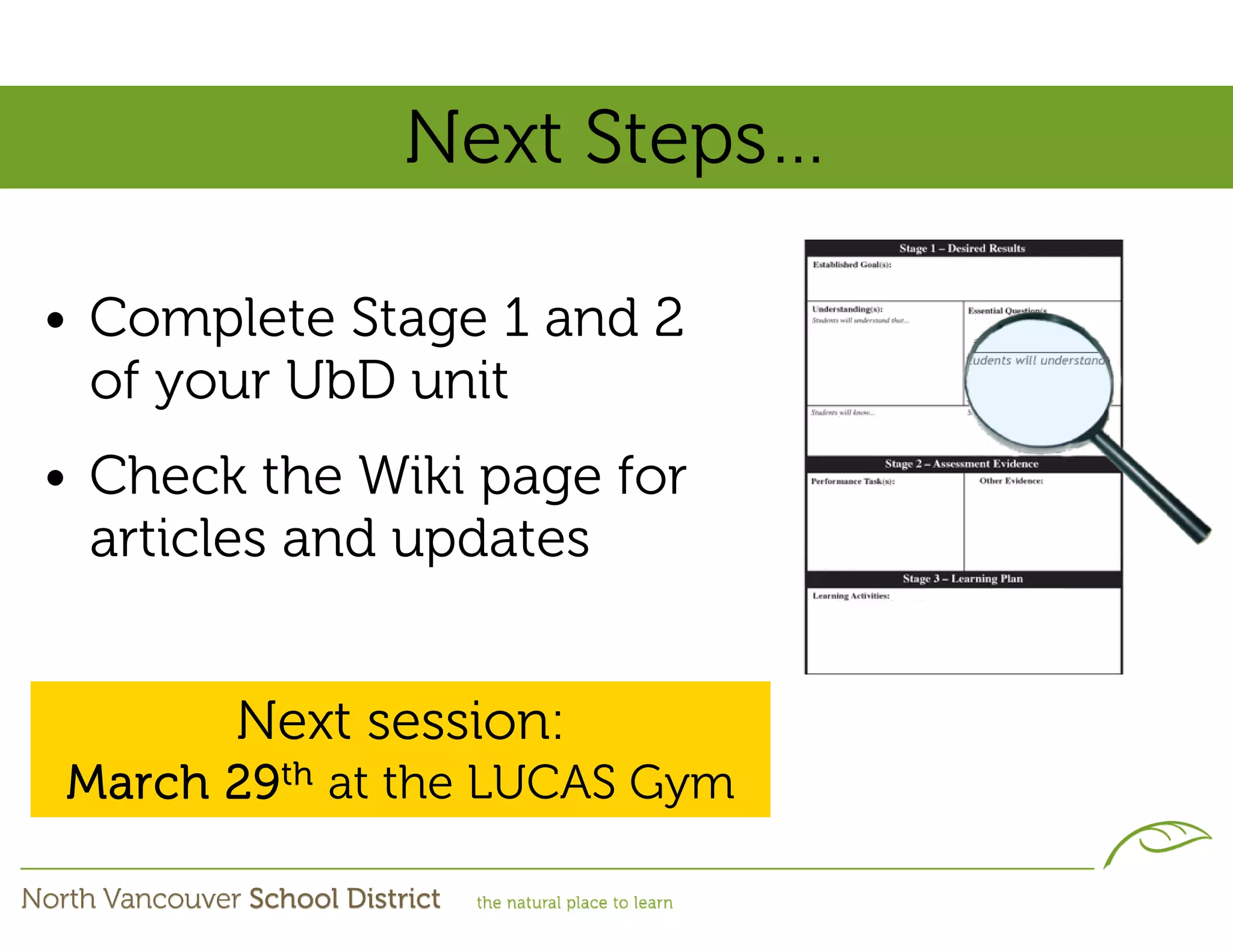
Next Steps…

• Complete Stage 1 and 2
  of your UbD unit
• Check the Wiki page for
  articles and updates


       Next session:
March 29th at the LUCAS Gym

Designs 2010 Session 3 Secondary

  • 1.
    Designing Instruction for DeepLearning and Diversity Session 3 February 9, 2010 LMCC
  • 2.
    Backward Design Model– Stage 2 1. Identify desired results 2. Determine acceptable evidence 3. Plan learning experiences and instruction
  • 3.
    Mid – 1990s Today Topic or Theme Outcomes or Expectations • chosen based on curriculum, personal • determined by curriculum preference, or a favourite resource • unit is often organized by big ideas Assessment Strategies Teaching Strategies • chosen based on their ability to • chosen and implemented accurately measure achievement of outcomes Assessment Strategies Teaching Strategies • chosen and implemented • chosen based on their ability to achieve assessment criteria Outcomes or Expectations Resources • become apparent as the teacher • are chosen according to applicability analyzes what was learned to unit goals
  • 4.
    Backward Design Model– Stage 2 BIG IDEA: Valid Evidence ENDURING UNDERSTANDING: What we assess and how we assess must align with the learning goals.
  • 5.
    Backward Design Model– Stage 2 ESSENTIAL QUESTIONS: 1. What is “valid” evidence of student learning? 2. How can we assess ‘deep understanding’ of learning? 3. How do we design “authentic” assessments?
  • 6.
    Learning Intentions forToday 1. Understand what is meant by Valid Evidence and how to align assessment with Goals. 2. Review Assessment For/As/Of Learning 3. Determine how to best “assess for understanding” using the 6 Facets of Understanding. 4. Develop Performance Tasks using the “GRASPS” model.
  • 7.
    Three Principles ofAssessment 1. Multiple Sources of Evidence 2. Align Assessment with the Learning Goals 3. Form Follows Function • What are we assessing? • Why are we assessing? • For whom are the results intended? • How will the results be used?
  • 8.
    Types of Assessment Assessment Assessment AS Assessment OF FOR Learning Learning Learning Guiding instruction Students monitoring Reporting out Improving learning their own progress Measuring learning Descriptive feedback Goal Setting Letter grades, %s, performance scales, Continuous Continuous At the end Formative Formative Summative
  • 9.
    VALID EVIDENCE • Ensure that what we assess and how we assess aligns with Stage 1 Goals • Assess only what has been taught, modeled and practiced • Allow students to use their strengths • Assess students’ in-depth understanding of key concepts, knowledge, and skills (Stage 1) (Hume 2010)
  • 10.
    A Quick ‘ConceptAttainment’ What would be sufficient and What would be fun and revealing evidence of learning? interesting activities on this topic? What performance tasks must What project might students anchor the unit and focus the wish to do on this topic? instruction? What are the different types of What tests should I give, based evidence required by Stage 1 on the content I taught? desired results? Against what criteria will we How will I give students a appropriately consider work and grade and justify it to their assess levels of quality? parents? Understanding by Design (Wiggins and McTighe) p. 151
  • 11.
    “Testers” 1. How welldid the activities go? Were students engaged? 2. Did the assessments reveal and distinguish between those who understood from those who only seemed to? 3. How did students do on the test? 4. Am I clear on the reasons behind learner mistakes? 5. Do my group assessments reveal individual students’ understanding of key concepts, skills and processes?
  • 12.
    Testing for Validity Group Activity In your group, sort the assessment tasks into columns of “valid” or “invalid” • Could a student do well in this assessment task without a real understanding of the goals? • Could a student perform poorly on this assessment task but still have a good understanding if allowed to show understanding in other ways?
  • 13.
    The Six Facetsof Understanding “…Understanding shows its face when people can think and act flexibly around what they know.”
  • 14.
    We want studentsto be able to: • Explain why they did something • Discuss their evidence and support for their answer/ approach/ design • Reflect on the results they achieved and possible alternative ways to achieve it
  • 15.
    Explanation • Demonstrate insight •Explain the big idea / significant concept in their own words • Make connections • Justify an argument with evidence • Avoid common misunderstandings Why are the characteristics of … What accounts for … How did … come about
  • 16.
    Interpretation • Requires studentsto make sense of something • Read between the lines and offer plausible accounts for discrepancies • Offer a meaningful account of a complex situation What does it mean when… How does this relate to… Predict what might happen if…
  • 17.
    Application • Using knowledge or skills in a new way How is … usable in a larger context When can we use… How might … help…
  • 18.
    Perspective • See somethingfrom different points of view • Critique and justify a position • Test a theory • Understand the biases and assumptions in an argument Defend the … What are the limits of… Was it justified to… Is this evidence reliable?
  • 19.
    Empathy • Understand how others think and the rationale behind the thinking • Develop an appreciation of those who think and act differently than us What would it be like to…. What was the author thinking when… How can we understand…
  • 20.
    Self-Knowledge • Gain insightinto our performance • Helps us to question our convictions What are the limits of my understanding? What strategies work for me? How do I learn best?
  • 21.
    Six Key Facets •Help us find authentic assessment that is suitable for our significant concept/big idea • Guide us to an measurement that we deem quintessential for understanding and comprehension • Help us find a balance between factual recall and deep understanding
  • 22.
    on Explanation Ap ti ta pl re ica p • Explain to the class how er tio a battery causes a light I nt bulb to glow. n • Interpret a schematic • Design an electrical circuit diagram and predict the to accomplish a specific task outcome. • Troubleshoot a faulty electrical circuit Electricity • Describe an electron’s • Why does Canada use AC experience as is passes instead of DC current? through a simple current. (historical perspective) • Give a pre-test • What are the strengths of and a post-test each type? Em to assess common misconceptions tive ec (e.g., force-concept pa inventory) and have t students reflect on their sp hy er deepening understanding. Self-Knowledge P
  • 23.
    Why Performance Tasks? •Higher-order thinking skills • Acquisition of content and procedural knowledge • Differentiate content, process and product according to students’ readiness, interests, and learning profiles Tomlinson 1999
  • 24.
    Criteria for A Performance Task: • Realistically contextualized • Judgments and innovation • Asks the student to “do” the subject
  • 25.
    Criteria for A Performance Task: • Knowledge and skill to negotiate a complex and multistage task • Opportunities to rehearse, practice, consult resources, get feedback and refine performances and products Understanding by Design (Wiggins and McTighe) p. 154
  • 26.
    GRASPS • GOAL • ROLE • AUDIENCE • SITUATION • PRODUCTS/PERFORMANCE/PURPOSE • STANDARDS and CRITERIA for SUCCESS
  • 27.
    From Learning Goalsto Performance Task • Use the verbs from the PLOs to determine what students will do to reveal understanding • Consider the verbs within the 6 Facets of understanding when designing Performance Tasks
  • 28.
    Curricular Priorities Worthbeing Worth Being Familiar With • Different conditions requiring dietary familiar with restrictions, such as high blood pressure, diabetes, and stomach ulcers Important to know and do Important to know and do • Canada’s Food Guide recommendations • Nutritional information on food labels and how to interpret them Big Ideas and Core Tasks Big Ideas • Balanced diet Understandings • “You are what you eat.” Your diet affects your health, appearance, and performance.
  • 29.
    Curricular Priorities andAssessment Methods Worth being familiar with Traditional quizzes and tests • Paper-and-pencil Important to • Selected-response know and do • Constructed response Performance tasks and projects Big Ideas and • Complex Core Tasks • Open-ended • Authentic
  • 30.
    Where to Differentiate? Tomlinson& McTighe (2006) Integrating Differentiated Instruction and Understanding by Design. p. 36 Fig 3.3
  • 31.
    School Teams: YourTask • Use the concept of Validity, the 6 Facets of Understanding and the GRASPS template, design a performance task for your planned unit of instruction.
  • 32.
    Next Steps… • CompleteStage 1 and 2 of your UbD unit • Check the Wiki page for articles and updates Next session: March 29th at the LUCAS Gym