Understanding 
By 
Design 
UbD
Understanding by Design (UbD) is a conceptual 
framework for education anchored on the tenet of 
“teaching for understanding.” 
by Jay McTighe and Grant P. Wiggins in 1998, UbD 
espouses the process of “backward design” in the 
development of a school curriculum.
Three steps of backward design 
Backward design entails three steps: 
• Identifying desired results 
• Defining acceptable evidence 
• Planning learning experiences and instruction
Identifying desired results 
Desired results cannot be just limited to 
traditional parameters such as a good 
performance in state assessment tests, but 
rather include specific goals that contribute to a 
deeper understanding of a topic.
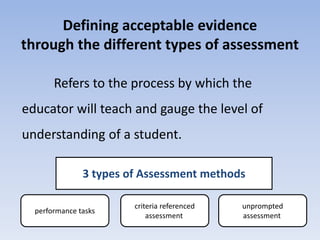
Defining acceptable evidence 
through the different types of assessment 
Refers to the process by which the 
educator will teach and gauge the level of 
understanding of a student. 
3 types of Assessment methods 
performance tasks 
criteria referenced 
assessment 
unprompted 
assessment
Planning learning experiences and 
instruction 
Details students' activities throughout the 
class, lists which resources to be used, and 
evaluates if these activities and resources follow 
the WHERETO criteria.
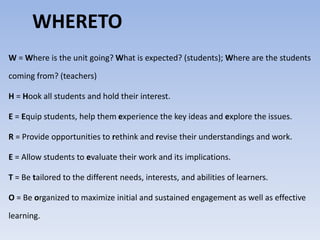
WHERETO 
W=Where is the unit going?What is expected? (students); Where are the students 
coming from? (teachers) 
H = Hook all students and hold their interest. 
E = Equip students, help them experience the key ideas and explore the issues. 
R = Provide opportunities to rethink and revise their understandings and work. 
E = Allow students to evaluate their work and its implications. 
T = Be tailored to the different needs, interests, and abilities of learners. 
O = Be organized to maximize initial and sustained engagement as well as effective 
learning.
This can be illustrated in some activities for 
the English class. 
For example, showing the movie “Clueless” in class can fulfill the 
W, H and E criteria--W, showing an example of creating a work 
from a literary source (“Clueless” is a modern adaptation of Jane 
Austen's Emma); H, the movie hooks the attention of the 
students; and E, as the students enjoy the film, they are able to 
experience the key idea that literature can be enjoyed and is 
alive.
Six Facets of Understanding 
• Can explain by providing thorough and justifiable accounts of phenomena, facts 
and data; 
• Can interpret by offering an individual insight to ideas and events; 
• Can apply and use that knowledge to diverse contexts; 
• Have perspective by seeing things in the context of the big picture and viewing 
these critically; 
• Can empathize by finding value in what others may find as implausible, basing a 
sensitive perception on prior direct experience; 
• Have a self-knowledge or self-awareness that enables them to see what shapes 
and impedes their own understanding.
Some Key Terms in UbD 
Assessment - a long-term, learning-focused act of determining 
the extent to which the desired results are on the way to being 
achieved and to what extent they have been achieved. This is 
different from evaluation in the sense that evaluation is short-term 
and credential-focused.
Some Key Terms in UbD 
Big Idea - the main idea which not only connects all the 
disjointed facts that are taught in a class, but also make those 
facts worth learning. The building blocks of “understanding,” big 
ideas are not necessarily limited to just one area of study. An 
example is the big idea of “freedom of speech”: it not only limits 
itself to the field of social sciences and the law (basic human 
rights, how is it defined in the constitution?) but also extends to 
the humanities (the banning of literary works, etc.).
Some Key Terms in UbD 
Curriculum - the blueprint for learning; it takes and plans content in order to 
conduct effective and engaging learning and teaching that are based on the 
desired results. 
Desired results - the objectives of the course; it consists of intended 
outcomes (the understanding), achievement targets and performance 
standards (traditional parameters such as national achievement exams). 
Understanding - making connections and binding together knowledge into 
something that makes sense so that said knowledge can be widely and 
effectively applied in realistic tasks and settings.

Understanding by design

  • 1.
  • 2.
    Understanding by Design(UbD) is a conceptual framework for education anchored on the tenet of “teaching for understanding.” by Jay McTighe and Grant P. Wiggins in 1998, UbD espouses the process of “backward design” in the development of a school curriculum.
  • 3.
    Three steps ofbackward design Backward design entails three steps: • Identifying desired results • Defining acceptable evidence • Planning learning experiences and instruction
  • 4.
    Identifying desired results Desired results cannot be just limited to traditional parameters such as a good performance in state assessment tests, but rather include specific goals that contribute to a deeper understanding of a topic.
  • 5.
    Defining acceptable evidence through the different types of assessment Refers to the process by which the educator will teach and gauge the level of understanding of a student. 3 types of Assessment methods performance tasks criteria referenced assessment unprompted assessment
  • 6.
    Planning learning experiencesand instruction Details students' activities throughout the class, lists which resources to be used, and evaluates if these activities and resources follow the WHERETO criteria.
  • 7.
    WHERETO W=Where isthe unit going?What is expected? (students); Where are the students coming from? (teachers) H = Hook all students and hold their interest. E = Equip students, help them experience the key ideas and explore the issues. R = Provide opportunities to rethink and revise their understandings and work. E = Allow students to evaluate their work and its implications. T = Be tailored to the different needs, interests, and abilities of learners. O = Be organized to maximize initial and sustained engagement as well as effective learning.
  • 8.
    This can beillustrated in some activities for the English class. For example, showing the movie “Clueless” in class can fulfill the W, H and E criteria--W, showing an example of creating a work from a literary source (“Clueless” is a modern adaptation of Jane Austen's Emma); H, the movie hooks the attention of the students; and E, as the students enjoy the film, they are able to experience the key idea that literature can be enjoyed and is alive.
  • 9.
    Six Facets ofUnderstanding • Can explain by providing thorough and justifiable accounts of phenomena, facts and data; • Can interpret by offering an individual insight to ideas and events; • Can apply and use that knowledge to diverse contexts; • Have perspective by seeing things in the context of the big picture and viewing these critically; • Can empathize by finding value in what others may find as implausible, basing a sensitive perception on prior direct experience; • Have a self-knowledge or self-awareness that enables them to see what shapes and impedes their own understanding.
  • 10.
    Some Key Termsin UbD Assessment - a long-term, learning-focused act of determining the extent to which the desired results are on the way to being achieved and to what extent they have been achieved. This is different from evaluation in the sense that evaluation is short-term and credential-focused.
  • 11.
    Some Key Termsin UbD Big Idea - the main idea which not only connects all the disjointed facts that are taught in a class, but also make those facts worth learning. The building blocks of “understanding,” big ideas are not necessarily limited to just one area of study. An example is the big idea of “freedom of speech”: it not only limits itself to the field of social sciences and the law (basic human rights, how is it defined in the constitution?) but also extends to the humanities (the banning of literary works, etc.).
  • 12.
    Some Key Termsin UbD Curriculum - the blueprint for learning; it takes and plans content in order to conduct effective and engaging learning and teaching that are based on the desired results. Desired results - the objectives of the course; it consists of intended outcomes (the understanding), achievement targets and performance standards (traditional parameters such as national achievement exams). Understanding - making connections and binding together knowledge into something that makes sense so that said knowledge can be widely and effectively applied in realistic tasks and settings.