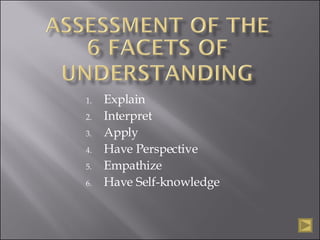
Explain Interpret Apply Have Perspective Empathize Have Self-knowledge
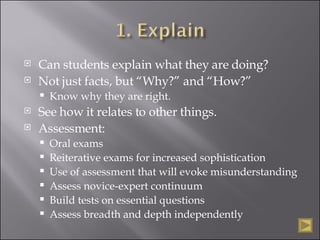
Can students explain what they are doing? Not just facts, but “Why?” and “How?” Know why they are right. See how it relates to other things. Assessment: Oral exams Reiterative exams for increased sophistication Use of assessment that will evoke misunderstanding Assess novice-expert continuum  Build tests on essential questions Assess breadth and depth independently
Provide stories that give meaning. Especially answer “Why?” Interpret a conclusion from data. Assessment: Can students put together a sophisticated story? Assess story underlying a concept
Apply to NEW situations. Students will mimic professional problem solving through real world problems. Assessment: Contextualized Performance Tasks Assess whether students can respond to their errors or feedback Do not just assess the performance (luck?), but understanding
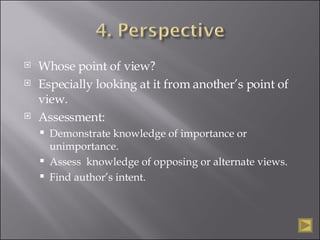
Whose point of view? Especially looking at it from another’s point of view. Assessment: Demonstrate knowledge of importance or unimportance. Assess  knowledge of opposing or alternate views. Find author’s intent.
Feel what someone else feels Change of heart Respect for others Assessment: Demonstrate being in “someone else’s shoes.” Empathize with an undesirable. Teach others (empathize with their ability)
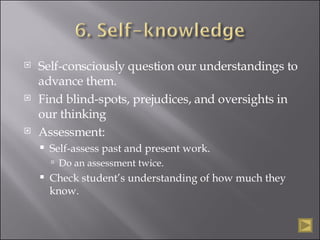
Self-consciously question our understandings to advance them. Find blind-spots, prejudices, and oversights in our thinking Assessment: Self-assess past and present work. Do an assessment twice. Check student’s understanding of how much they know.
Backward Design, continued
Thinking Like an Assessor Thinking Like an Activity Designer What would be sufficient and revealing evidence of understanding? What would be interesting and engaging activities on this topic? What performance tasks must anchor the unit and focus the instructional work? What resources and materials are available on this topic? How will I be able to distinguish between those who really understand and those who don’t (though they may seem to)? What will students be doing in and out of class?  What assignments will be given? Against what criteria will I distinguish work? How will I give students a grade (and justify it to their parents)? What misunderstandings are likely?  How will I check for those? Did the activities work?  Why or why not?
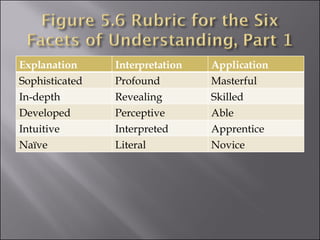
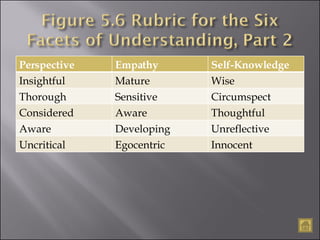
Judging students on the continuum of understanding. Rubrics are helpful. Recurring tasks with longitudinal rubrics.
Explanation Interpretation Application Sophisticated Profound Masterful In-depth Revealing Skilled Developed Perceptive Able Intuitive Interpreted Apprentice Naïve Literal Novice
Perspective Empathy Self-Knowledge Insightful Mature Wise Thorough Sensitive Circumspect Considered Aware Thoughtful Aware Developing Unreflective Uncritical Egocentric Innocent

6 Facets Of Understanding

  • 1.
    Explain Interpret ApplyHave Perspective Empathize Have Self-knowledge
  • 2.
    Can students explainwhat they are doing? Not just facts, but “Why?” and “How?” Know why they are right. See how it relates to other things. Assessment: Oral exams Reiterative exams for increased sophistication Use of assessment that will evoke misunderstanding Assess novice-expert continuum Build tests on essential questions Assess breadth and depth independently
  • 3.
    Provide stories thatgive meaning. Especially answer “Why?” Interpret a conclusion from data. Assessment: Can students put together a sophisticated story? Assess story underlying a concept
  • 4.
    Apply to NEWsituations. Students will mimic professional problem solving through real world problems. Assessment: Contextualized Performance Tasks Assess whether students can respond to their errors or feedback Do not just assess the performance (luck?), but understanding
  • 5.
    Whose point ofview? Especially looking at it from another’s point of view. Assessment: Demonstrate knowledge of importance or unimportance. Assess knowledge of opposing or alternate views. Find author’s intent.
  • 6.
    Feel what someoneelse feels Change of heart Respect for others Assessment: Demonstrate being in “someone else’s shoes.” Empathize with an undesirable. Teach others (empathize with their ability)
  • 7.
    Self-consciously question ourunderstandings to advance them. Find blind-spots, prejudices, and oversights in our thinking Assessment: Self-assess past and present work. Do an assessment twice. Check student’s understanding of how much they know.
  • 8.
  • 9.
    Thinking Like anAssessor Thinking Like an Activity Designer What would be sufficient and revealing evidence of understanding? What would be interesting and engaging activities on this topic? What performance tasks must anchor the unit and focus the instructional work? What resources and materials are available on this topic? How will I be able to distinguish between those who really understand and those who don’t (though they may seem to)? What will students be doing in and out of class? What assignments will be given? Against what criteria will I distinguish work? How will I give students a grade (and justify it to their parents)? What misunderstandings are likely? How will I check for those? Did the activities work? Why or why not?
  • 10.
    Judging students onthe continuum of understanding. Rubrics are helpful. Recurring tasks with longitudinal rubrics.
  • 11.
    Explanation Interpretation ApplicationSophisticated Profound Masterful In-depth Revealing Skilled Developed Perceptive Able Intuitive Interpreted Apprentice Naïve Literal Novice
  • 12.
    Perspective Empathy Self-KnowledgeInsightful Mature Wise Thorough Sensitive Circumspect Considered Aware Thoughtful Aware Developing Unreflective Uncritical Egocentric Innocent