Challenge-Based Learning
     for Responsible
 and Engaged Learners
                         Bill Dolton
                  Adjunct Faculty, Wilkes University
        Educational Technology Consultant, William Dolton LLC
         Retired Supervisor of Educational Technology, LMSD


                    bill@doltonroad.com
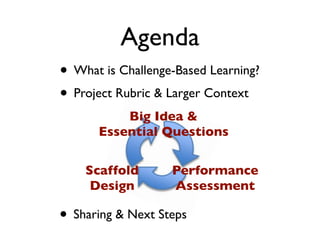
Agenda
• What is Challenge-Based Learning?
• Project Rubric & Larger Context
          Big Idea &
      Essential Questions

    Scaffold       Performance
     Design        Assessment

• Sharing & Next Steps
?
What Is Challenge-
 Based Learning?
creative commons attribution:
http://www.flickr.com/photos/ronsho/587483238/


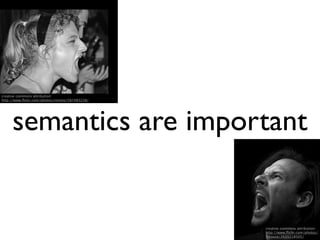
     semantics are important


                                                creative commons attribution:
                                                http://www.flickr.com/photos/
                                                fchouse/2635218505/
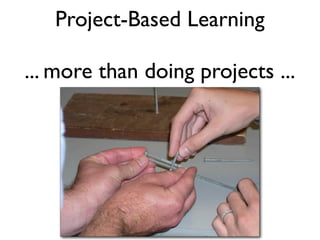
Project-Based Learning

... more than doing projects ...
Problem-Based Learning

focus on problem-solution
Challenge-Based Learning


broader range of inquiry
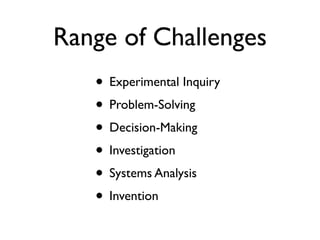
Range of Challenges
   • Experimental Inquiry
   • Problem-Solving
   • Decision-Making
   • Investigation
   • Systems Analysis
   • Invention
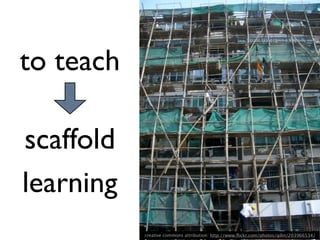
to teach

scaffold
learning
           creative commons attribution: http://www.flickr.com/photos/qilin/203966534/
engaging
authentic
challenging
significant
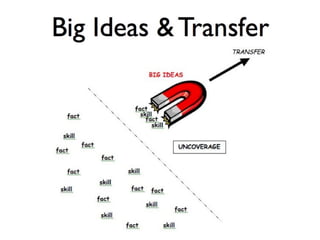
Big Ideas
        and
Essential Questions
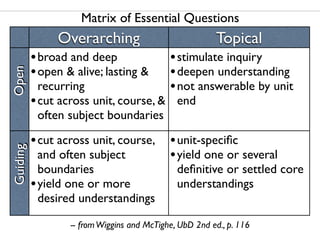
Matrix of Essential Questions
               Overarching                              Topical
          • broad and deep                  • stimulate inquiry
          • open & alive; lasting &         • deepen understanding
Open


            recurring                       • not answerable by unit
          • cut across unit, course, & end
            often subject boundaries

          • cut across unit, course, • unit-specific
Guiding


            and often subject        • yield one or several
            boundaries                        definitive or settled core
          • yield one or more                 understandings
            desired understandings

                  -- from Wiggins and McTighe, UbD 2nd ed., p. 116
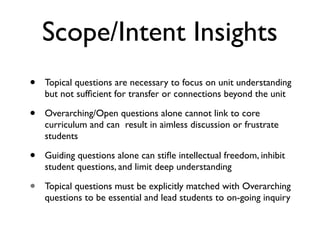
Scope/Intent Insights
•   Topical questions are necessary to focus on unit understanding
    but not sufficient for transfer or connections beyond the unit

•   Overarching/Open questions alone cannot link to core
    curriculum and can result in aimless discussion or frustrate
    students

•   Guiding questions alone can stifle intellectual freedom, inhibit
    student questions, and limit deep understanding

•   Topical questions must be explicitly matched with Overarching
    questions to be essential and lead students to on-going inquiry
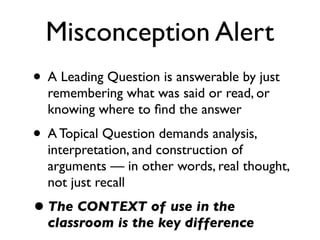
Misconception Alert
• A Leading Question is answerable by just
  remembering what was said or read, or
  knowing where to find the answer
• A Topical Question demands analysis,
  interpretation, and construction of
  arguments — in other words, real thought,
  not just recall
• The CONTEXT of use in the
  classroom is the key difference
The best units offer
 “a delicate mix of open and
guiding as well as topical and
    overarching inquiries ...
  show[ing] that intellectual
  freedom and creativity are
  valued alongside the most
powerful insights of experts.”
    –Wiggins and McTighe, UbD 2nd ed., p. 118
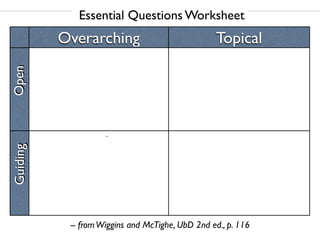
Essential Questions Questions
                    Matrix of Essential Worksheet
               Overarching                              Topical
          • broad and deep                  • stimulate inquiry
          • open & alive; lasting &         • deepen understanding
Open


            recurring                       • not answerable by unit
          • cut across unit, course, & end
            often subject boundaries

          • cut across unit, course, • unit-specific
Guiding


            and often subject        • yield one or several
            boundaries                        definitive or settled core
          • yield one or more                 understandings
            desired understandings

                  -- from Wiggins and McTighe, UbD 2nd ed., p. 116
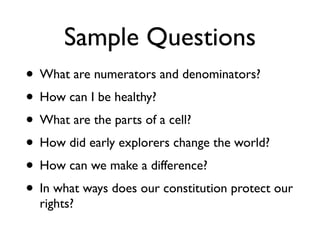
Sample Questions
• What are numerators and denominators?
• How can I be healthy?
• What are the parts of a cell?
• How did early explorers change the world?
• How can we make a difference?
• In what ways does our constitution protect our
  rights?
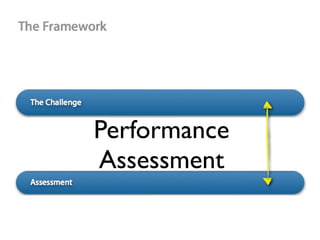
Performance
Assessment
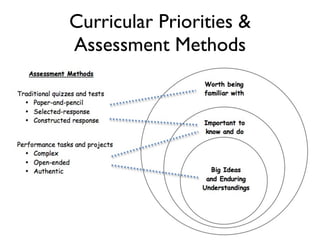
Curricular Priorities &
Assessment Methods
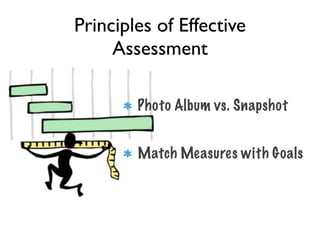
Principles of Effective
     Assessment

        Photo Album vs. Snapshot


        Match Measures with Goals
Principles of Effective
     Assessment

        Photo Album vs. Snapshot


        Match Measures with Goals

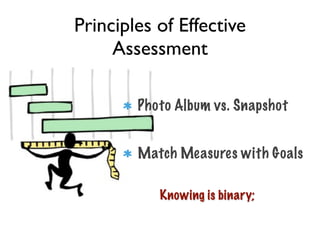
           Knowing is binary;
Principles of Effective
     Assessment

         Photo Album vs. Snapshot


         Match Measures with Goals

             Knowing is binary;
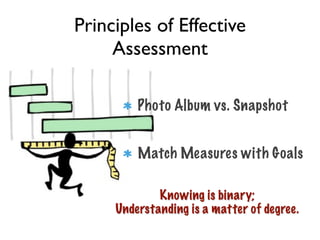
     Understanding is a matter of degree.
Like the judicial system,
         we need a
“preponderance of evidence”
  to convict students of
         learning!
                       –Jay McTighe
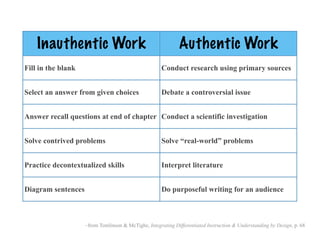
Inauthentic Work                                         Authentic Work
Fill in the blank                                    Conduct research using primary sources


Select an answer from given choices                  Debate a controversial issue


Answer recall questions at end of chapter Conduct a scientific investigation


Solve contrived problems                             Solve “real-world” problems


Practice decontextualized skills                     Interpret literature


Diagram sentences                                    Do purposeful writing for an audience


                    –from Tomlinson & McTighe, Integrating Differentiated Instruction & Understanding by Design, p. 68
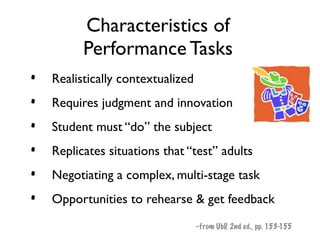
Characteristics of
          Performance Tasks
•   Realistically contextualized
•   Requires judgment and innovation
•   Student must “do” the subject
•   Replicates situations that “test” adults
•   Negotiating a complex, multi-stage task
•   Opportunities to rehearse & get feedback
                                   –from UbD, 2nd ed., pp. 153-155
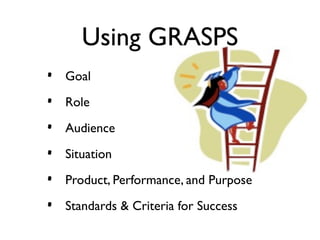
Using GRASPS
•   Goal

•   Role

•   Audience

•   Situation

•   Product, Performance, and Purpose

•   Standards & Criteria for Success
Validity
•   Criterion-referenced

•   Directly aligned with standards, benchmarks,
    understandings, questions

•   Rubric development

•   Self-Test of Assessment
Reliability


•   Replicable results

•   Common assessment tool
Significance of Results
•   Criterion-referenced against standards and
    benchmarks

•   Comparison with Diagnostic Assessment to
    demonstrate growth

•   Both contribute to significance
Assessment Checklist
•   Aligned with Standards, Understandings, &
    Essential Questions
•   Performance-based context
•   Authentic situation (student perspective)
•   Variety of formats or modes of response
    involving some student choices
•   Established criteria
•   Tasks demonstrate understanding
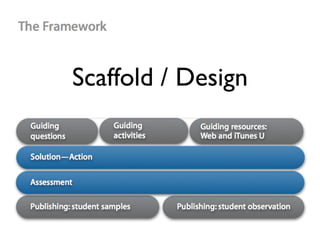
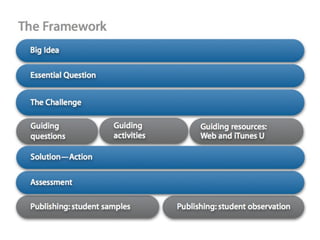
Scaffold / Design
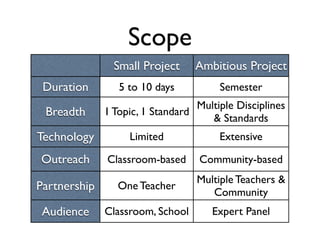
Scope
                Small Project     Ambitious Project
 Duration        5 to 10 days          Semester
                                  Multiple Disciplines
 Breadth      1 Topic, 1 Standard
                                     & Standards
Technology         Limited             Extensive

Outreach      Classroom-based      Community-based
                                  Multiple Teachers &
Partnership      One Teacher
                                     Community
 Audience     Classroom, School      Expert Panel
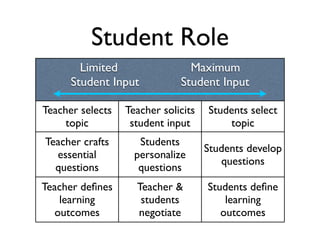
Student Role
        Limited                 Maximum
      Student Input           Student Input

Teacher selects   Teacher solicits   Students select
     topic         student input         topic
Teacher crafts       Students
                                     Students develop
  essential         personalize
                                        questions
  questions          questions
Teacher defines      Teacher &        Students define
   learning          students            learning
  outcomes          negotiate           outcomes
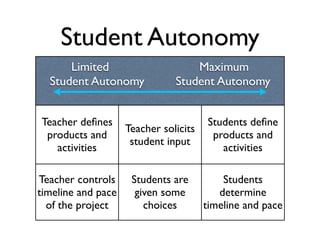
Student Autonomy
      Limited                      Maximum
  Student Autonomy             Student Autonomy


Teacher defines                         Students define
                    Teacher solicits
 products and                           products and
                     student input
   activities                             activities

Teacher controls     Students are          Students
timeline and pace     given some          determine
  of the project        choices        timeline and pace
Sharing /
Next Steps
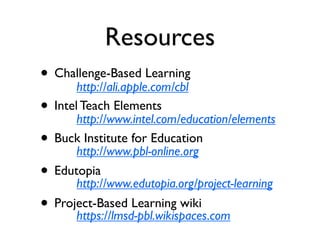
Resources
• Challenge-Based Learning
       http://ali.apple.com/cbl
• Intelhttp://www.intel.com/education/elements
        Teach Elements

• Buckhttp://www.pbl-online.org
         Institute for Education

• Edutopia
       http://www.edutopia.org/project-learning
• Project-Based Learning wiki
       https://lmsd-pbl.wikispaces.com
Challenge-Based Learning
     for Responsible
 and Engaged Learners
                         Bill Dolton
                  Adjunct Faculty, Wilkes University
        Educational Technology Consultant, William Dolton LLC
         Retired Supervisor of Educational Technology, LMSD


                    bill@doltonroad.com

Challenge-Based Learning

  • 1.
    Challenge-Based Learning for Responsible and Engaged Learners Bill Dolton Adjunct Faculty, Wilkes University Educational Technology Consultant, William Dolton LLC Retired Supervisor of Educational Technology, LMSD bill@doltonroad.com
  • 2.
    Agenda • What isChallenge-Based Learning? • Project Rubric & Larger Context Big Idea & Essential Questions Scaffold Performance Design Assessment • Sharing & Next Steps
  • 3.
    ? What Is Challenge- Based Learning?
  • 4.
    creative commons attribution: http://www.flickr.com/photos/ronsho/587483238/ semantics are important creative commons attribution: http://www.flickr.com/photos/ fchouse/2635218505/
  • 5.
    Project-Based Learning ... morethan doing projects ...
  • 6.
  • 7.
  • 8.
  • 9.
    Range of Challenges • Experimental Inquiry • Problem-Solving • Decision-Making • Investigation • Systems Analysis • Invention
  • 10.
    to teach scaffold learning creative commons attribution: http://www.flickr.com/photos/qilin/203966534/
  • 11.
  • 13.
    Big Ideas and Essential Questions
  • 14.
    Matrix of EssentialQuestions Overarching Topical • broad and deep • stimulate inquiry • open & alive; lasting & • deepen understanding Open recurring • not answerable by unit • cut across unit, course, & end often subject boundaries • cut across unit, course, • unit-specific Guiding and often subject • yield one or several boundaries definitive or settled core • yield one or more understandings desired understandings -- from Wiggins and McTighe, UbD 2nd ed., p. 116
  • 15.
    Scope/Intent Insights • Topical questions are necessary to focus on unit understanding but not sufficient for transfer or connections beyond the unit • Overarching/Open questions alone cannot link to core curriculum and can result in aimless discussion or frustrate students • Guiding questions alone can stifle intellectual freedom, inhibit student questions, and limit deep understanding • Topical questions must be explicitly matched with Overarching questions to be essential and lead students to on-going inquiry
  • 16.
    Misconception Alert • ALeading Question is answerable by just remembering what was said or read, or knowing where to find the answer • A Topical Question demands analysis, interpretation, and construction of arguments — in other words, real thought, not just recall • The CONTEXT of use in the classroom is the key difference
  • 17.
    The best unitsoffer “a delicate mix of open and guiding as well as topical and overarching inquiries ... show[ing] that intellectual freedom and creativity are valued alongside the most powerful insights of experts.” –Wiggins and McTighe, UbD 2nd ed., p. 118
  • 19.
    Essential Questions Questions Matrix of Essential Worksheet Overarching Topical • broad and deep • stimulate inquiry • open & alive; lasting & • deepen understanding Open recurring • not answerable by unit • cut across unit, course, & end often subject boundaries • cut across unit, course, • unit-specific Guiding and often subject • yield one or several boundaries definitive or settled core • yield one or more understandings desired understandings -- from Wiggins and McTighe, UbD 2nd ed., p. 116
  • 20.
    Sample Questions • Whatare numerators and denominators? • How can I be healthy? • What are the parts of a cell? • How did early explorers change the world? • How can we make a difference? • In what ways does our constitution protect our rights?
  • 21.
  • 22.
  • 23.
    Principles of Effective Assessment Photo Album vs. Snapshot Match Measures with Goals
  • 24.
    Principles of Effective Assessment Photo Album vs. Snapshot Match Measures with Goals Knowing is binary;
  • 25.
    Principles of Effective Assessment Photo Album vs. Snapshot Match Measures with Goals Knowing is binary; Understanding is a matter of degree.
  • 26.
    Like the judicialsystem, we need a “preponderance of evidence” to convict students of learning! –Jay McTighe
  • 27.
    Inauthentic Work Authentic Work Fill in the blank Conduct research using primary sources Select an answer from given choices Debate a controversial issue Answer recall questions at end of chapter Conduct a scientific investigation Solve contrived problems Solve “real-world” problems Practice decontextualized skills Interpret literature Diagram sentences Do purposeful writing for an audience –from Tomlinson & McTighe, Integrating Differentiated Instruction & Understanding by Design, p. 68
  • 28.
    Characteristics of Performance Tasks • Realistically contextualized • Requires judgment and innovation • Student must “do” the subject • Replicates situations that “test” adults • Negotiating a complex, multi-stage task • Opportunities to rehearse & get feedback –from UbD, 2nd ed., pp. 153-155
  • 29.
    Using GRASPS • Goal • Role • Audience • Situation • Product, Performance, and Purpose • Standards & Criteria for Success
  • 30.
    Validity • Criterion-referenced • Directly aligned with standards, benchmarks, understandings, questions • Rubric development • Self-Test of Assessment
  • 31.
    Reliability • Replicable results • Common assessment tool
  • 32.
    Significance of Results • Criterion-referenced against standards and benchmarks • Comparison with Diagnostic Assessment to demonstrate growth • Both contribute to significance
  • 33.
    Assessment Checklist • Aligned with Standards, Understandings, & Essential Questions • Performance-based context • Authentic situation (student perspective) • Variety of formats or modes of response involving some student choices • Established criteria • Tasks demonstrate understanding
  • 34.
  • 36.
    Scope Small Project Ambitious Project Duration 5 to 10 days Semester Multiple Disciplines Breadth 1 Topic, 1 Standard & Standards Technology Limited Extensive Outreach Classroom-based Community-based Multiple Teachers & Partnership One Teacher Community Audience Classroom, School Expert Panel
  • 37.
    Student Role Limited Maximum Student Input Student Input Teacher selects Teacher solicits Students select topic student input topic Teacher crafts Students Students develop essential personalize questions questions questions Teacher defines Teacher & Students define learning students learning outcomes negotiate outcomes
  • 38.
    Student Autonomy Limited Maximum Student Autonomy Student Autonomy Teacher defines Students define Teacher solicits products and products and student input activities activities Teacher controls Students are Students timeline and pace given some determine of the project choices timeline and pace
  • 39.
  • 40.
    Resources • Challenge-Based Learning http://ali.apple.com/cbl • Intelhttp://www.intel.com/education/elements Teach Elements • Buckhttp://www.pbl-online.org Institute for Education • Edutopia http://www.edutopia.org/project-learning • Project-Based Learning wiki https://lmsd-pbl.wikispaces.com
  • 41.
    Challenge-Based Learning for Responsible and Engaged Learners Bill Dolton Adjunct Faculty, Wilkes University Educational Technology Consultant, William Dolton LLC Retired Supervisor of Educational Technology, LMSD bill@doltonroad.com

Editor's Notes

  • #23 In effective assessments, we see a match between the type or format of the assessment and the needed evidence of achieving the desired results. If the goal is for students to learn basic facts and skills, then paper-and-pencil tests and quizzes generally provide adequate and efficient measures. However, when the goal is deep understanding, we rely on more complex performances to determine whether our goal has been reached. The graphic below reveals the general relationship between assessment types and the evidence they provide for different curriculum targets.
  • #24 Click for “Knowing is binary” Click again for “Understanding is a matter of degree”
  • #25 Click for “Knowing is binary” Click again for “Understanding is a matter of degree”
  • #29 See handout (no page number) on rear of next sheet following p. 190
  • #33 Assessment checklist immediately following Slide p. 52.
  • #36 Often projects involve field research, interviews, library visits, and community inquiry. Scope should be determined before projects start. Consider student experience/readiness, schedule, subject/content, teacher comfort/expertise from Buck Institute
  • #37 Developmental and readiness considerations from Buck Institute
  • #38 from Buck Institute