Construction Essay
Questions
Objectives
• Discuss the use of essay questions
• Compare two types of essay questions
• Hypothesize the advantages and disadvantages of using essay
questions
• Compare two types of scoring rubrics
• Evaluate sample essays using a scoring rubric
• Create examples of two types of essay questions
What’s So Great About Essay Questions?
They allow assessment of students’ abilities to:
• Formulate problems
• Organize, integrate, and evaluate ideas and information
• Apply knowledge and skills
Forms and Uses of Essay Questions
• May be used to measure knowledge of factual information
• Full potential realized with more higher-order thinking problems
• Useful in meeting learning outcomes
concerned with the abilities to
conceptualize, construct, organize,
integrate, relate, and evaluate ideas in
content areas such as: history, civics,
literature, science, math, etc.
• Most widely used when the main focus is
on student writing in any subject
• Examples: distinguishing between narrative
essays, expository essays, and persuasive
essays or focusing on writing process
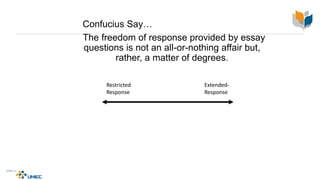
Confucius Say…
The freedom of response provided by essay
questions is not an all-or-nothing affair but,
rather, a matter of degrees.
Restricted
Response
Extended-
Response
Restricted Response Essay Questions
• Usually limits both the content and the response by restricting the
scope of the topic to be discussed, generally indicated in the
question
• Useful for measuring learning outcomes requiring interpretation
and application of data in a specific area
• Any outcomes measured by an objective interpretive exercise can
be measured by a restricted response essay question
Examples of Restricted Response Essay Questions
• Describe two situations that demonstrate the application of the law
of supply and demand. Do not use those examples discussed in
class.
• State the main differences between the Vietnam War and previous
wars in which the United States has participated.
• Why is the barometer one of the most useful instruments for
forecasting weather? Answer in a brief paragraph.
The Restricted Response essay question
provides for more ease of assessment,
but it restricts the scope of the topic to be
discussed and indicates the nature of the
desired response to the student which
limits his or her opportunity to
demonstrate these behaviors on their
own.
Is there a better method for evaluating
complex achievement…
Extended-Response Essay Questions
• Freedom of response allows student to select information that they
think is pertinent, to organize the answer in accordance with their
best judgment, and to integrate and evaluate ideas as they deem
appropriate
• Places value on higher-order thinking skills
Examples of Extended-Response Essay Questions
• Imagine that you and a friend found a magic wand. Write a story
about an adventure that you and your friend had with the magic
wand.
• Compare developments in international relations in the
administrations of President William Clinton and President George
W. Bush. Cite examples when possible.
To Keep Things Simple…
• Objective Interpretive- select
• Restricted Response Essay- supply
• Extended-Response Essay- write
Pros & Cons of Essay Questions
• Apply your knowledge
• They give student the options to chose what
they want to write about
• reasoning
• The teacher can tell if the student studies or
not
• Can often prepare in advance what to write
• Time consuming
• Grading: grammar usage vs. content
• Legibility
• Hard to formulate ideas in time
• Takes longer to grade
How Can We Change Those Cons to Pros?
• Unreliability- clearly defining learning outcomes to be measured,
properly framing questions, carefully following scoring rules, and
obtaining practice in scoring
• Amount of time- reserve use of extended-response questions for
learning outcomes that cannot be measured well objectively
• Limited Sampling- try to obtain as
representative a sample of learning
outcomes as possible (accumulate a
series of essays throughout the school
year to be included in a writing portfolio)
Suggestions for Constructing Essay Questions
• Restrict use of essays to learning outcomes that cannot be
measured well objectively
• Construct questions that call forth skills specified in learning
standards
Example box on page 235
• Phrase the question so that the students’
task is clearly indicated
Example:
Poor: Compare the Democratic and
Republican parties.
• Better: Compare the current policies of
the Democratic and Republican parties
with regard to the role of government in
private business. Support your
statements with examples when possible.
(Your answer should be confined to two
pages. It will be evaluated in terms of the
appropriateness of the facts and
examples presented and the skill with
which it is organized.)
• Indicate an approximate time limit for
each question
• Avoid the use of optional questions
• Example Box page 239
Now that we have essay questions how do
we score them?
Scoring Essay Questions
Tips to remember…
• Use clear specifications of scoring criteria
• Inform students of scoring criteria
• Use an initial review to find “anchor” responses for comparison
• Use descriptive rather than judgmental scores or levels (“writing is
clear and thoughts are complete” vs. “excellent”)
Scoring for Restricted Response Essay Questions
• In most instances, the teacher should write an example of an
expected response
• For example, if the student is asked to describe three factors that
contributed to the start of the Civil War, the teacher would construct a list of
acceptable reasons and give the student 1 point for each of up to three
reasons given from the list
Scoring for Extended-Response Essay Questions
Analytic Scoring Rubrics
• Consist of a rubric broken down into key dimensions that will be
evaluated
• Enables teacher to focus on one characteristic of a response at a
time
• Provides maximum feedback for students
Holistic Scoring Rubrics
• Yield a single overall score taking into
account the entire response
• Can be used to grade essays more
quickly
• Does not provide as much specific
feedback as analytic rubric
• Should not consist of scores alone, but
rather contain scores accompanied by
statements of the characteristics of the
response
Suggestions for Scoring Essay Questions
• Prepare an outline of the expected answer in advance and use a
clear scoring rubric
• Use the scoring rubric that is most appropriate
• Decide how to handle factors that are irrelevant to the learning
outcomes being measured
• Evaluate all responses to one question
before going on to the next one
• When possible, evaluate answers without
looking at the student’s name
• If especially important decisions are to be
based on the results, obtain two or more
independent ratings
Quantitative Research
• Formal, objective, rigorous, systematic process for generating
information
• Describes new situations, events, or concepts
• Examines relationships among variables
• Determines the effectiveness of treatments
27
28

Essay question construction

  • 1.
  • 2.
    Objectives • Discuss theuse of essay questions • Compare two types of essay questions • Hypothesize the advantages and disadvantages of using essay questions • Compare two types of scoring rubrics • Evaluate sample essays using a scoring rubric • Create examples of two types of essay questions
  • 3.
    What’s So GreatAbout Essay Questions? They allow assessment of students’ abilities to: • Formulate problems • Organize, integrate, and evaluate ideas and information • Apply knowledge and skills
  • 4.
    Forms and Usesof Essay Questions • May be used to measure knowledge of factual information • Full potential realized with more higher-order thinking problems
  • 5.
    • Useful inmeeting learning outcomes concerned with the abilities to conceptualize, construct, organize, integrate, relate, and evaluate ideas in content areas such as: history, civics, literature, science, math, etc. • Most widely used when the main focus is on student writing in any subject • Examples: distinguishing between narrative essays, expository essays, and persuasive essays or focusing on writing process
  • 6.
    Confucius Say… The freedomof response provided by essay questions is not an all-or-nothing affair but, rather, a matter of degrees. Restricted Response Extended- Response
  • 7.
    Restricted Response EssayQuestions • Usually limits both the content and the response by restricting the scope of the topic to be discussed, generally indicated in the question • Useful for measuring learning outcomes requiring interpretation and application of data in a specific area • Any outcomes measured by an objective interpretive exercise can be measured by a restricted response essay question
  • 8.
    Examples of RestrictedResponse Essay Questions • Describe two situations that demonstrate the application of the law of supply and demand. Do not use those examples discussed in class. • State the main differences between the Vietnam War and previous wars in which the United States has participated. • Why is the barometer one of the most useful instruments for forecasting weather? Answer in a brief paragraph.
  • 9.
    The Restricted Responseessay question provides for more ease of assessment, but it restricts the scope of the topic to be discussed and indicates the nature of the desired response to the student which limits his or her opportunity to demonstrate these behaviors on their own. Is there a better method for evaluating complex achievement…
  • 10.
    Extended-Response Essay Questions •Freedom of response allows student to select information that they think is pertinent, to organize the answer in accordance with their best judgment, and to integrate and evaluate ideas as they deem appropriate • Places value on higher-order thinking skills
  • 11.
    Examples of Extended-ResponseEssay Questions • Imagine that you and a friend found a magic wand. Write a story about an adventure that you and your friend had with the magic wand. • Compare developments in international relations in the administrations of President William Clinton and President George W. Bush. Cite examples when possible.
  • 12.
    To Keep ThingsSimple… • Objective Interpretive- select • Restricted Response Essay- supply • Extended-Response Essay- write
  • 13.
    Pros & Consof Essay Questions • Apply your knowledge • They give student the options to chose what they want to write about • reasoning • The teacher can tell if the student studies or not • Can often prepare in advance what to write • Time consuming • Grading: grammar usage vs. content • Legibility • Hard to formulate ideas in time • Takes longer to grade
  • 14.
    How Can WeChange Those Cons to Pros? • Unreliability- clearly defining learning outcomes to be measured, properly framing questions, carefully following scoring rules, and obtaining practice in scoring • Amount of time- reserve use of extended-response questions for learning outcomes that cannot be measured well objectively
  • 15.
    • Limited Sampling-try to obtain as representative a sample of learning outcomes as possible (accumulate a series of essays throughout the school year to be included in a writing portfolio)
  • 16.
    Suggestions for ConstructingEssay Questions • Restrict use of essays to learning outcomes that cannot be measured well objectively • Construct questions that call forth skills specified in learning standards Example box on page 235
  • 17.
    • Phrase thequestion so that the students’ task is clearly indicated Example: Poor: Compare the Democratic and Republican parties.
  • 18.
    • Better: Comparethe current policies of the Democratic and Republican parties with regard to the role of government in private business. Support your statements with examples when possible. (Your answer should be confined to two pages. It will be evaluated in terms of the appropriateness of the facts and examples presented and the skill with which it is organized.)
  • 19.
    • Indicate anapproximate time limit for each question • Avoid the use of optional questions • Example Box page 239 Now that we have essay questions how do we score them?
  • 20.
    Scoring Essay Questions Tipsto remember… • Use clear specifications of scoring criteria • Inform students of scoring criteria • Use an initial review to find “anchor” responses for comparison • Use descriptive rather than judgmental scores or levels (“writing is clear and thoughts are complete” vs. “excellent”)
  • 21.
    Scoring for RestrictedResponse Essay Questions • In most instances, the teacher should write an example of an expected response • For example, if the student is asked to describe three factors that contributed to the start of the Civil War, the teacher would construct a list of acceptable reasons and give the student 1 point for each of up to three reasons given from the list
  • 22.
    Scoring for Extended-ResponseEssay Questions Analytic Scoring Rubrics • Consist of a rubric broken down into key dimensions that will be evaluated • Enables teacher to focus on one characteristic of a response at a time • Provides maximum feedback for students
  • 23.
    Holistic Scoring Rubrics •Yield a single overall score taking into account the entire response • Can be used to grade essays more quickly • Does not provide as much specific feedback as analytic rubric • Should not consist of scores alone, but rather contain scores accompanied by statements of the characteristics of the response
  • 24.
    Suggestions for ScoringEssay Questions • Prepare an outline of the expected answer in advance and use a clear scoring rubric • Use the scoring rubric that is most appropriate • Decide how to handle factors that are irrelevant to the learning outcomes being measured
  • 25.
    • Evaluate allresponses to one question before going on to the next one • When possible, evaluate answers without looking at the student’s name • If especially important decisions are to be based on the results, obtain two or more independent ratings
  • 26.
    Quantitative Research • Formal,objective, rigorous, systematic process for generating information • Describes new situations, events, or concepts • Examines relationships among variables • Determines the effectiveness of treatments
  • 27.
  • 28.