Metal Spinning
• Spinning is a sheet metal forming of parts over a
rotating mandrel using rollers.
• It is used for axis symmetric products.
• It uses a Lathe, Mandrel (die), Tailstock and
Rollers(tool).
• It may be either manual or computer controlled.
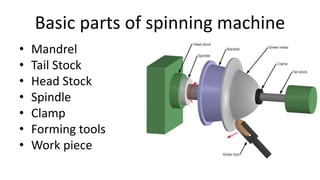
Basic parts of spinning machine
• Mandrel
• Tail Stock
• Head Stock
• Spindle
• Clamp
• Forming tools
• Work piece
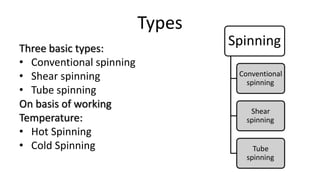
Types
Three basic types:
• Conventional spinning
• Shear spinning
• Tube spinning
On basis of working
Temperature:
• Hot Spinning
• Cold Spinning
Spinning
Conventional
spinning
Shear
spinning
Tube
spinning
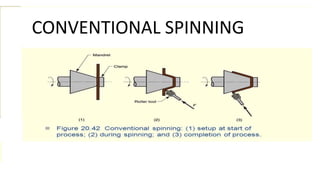
CONVENTIONAL SPINNING
• A conventional spinning is a cold forming process
in which the blank metal appears to flow
somewhat like a piece of clay on a potter’s wheel.
• A conventional spinning has a circular blank of flat
or preformed sheet metal is placed and held
against a mandrel and rotated while a rigid tool
deforms and shape the material over the mandrel.
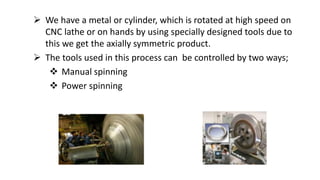
 We have a metal or cylinder, which is rotated at high speed on
CNC lathe or on hands by using specially designed tools due to
this we get the axially symmetric product.
 The tools used in this process can be controlled by two ways;
 Manual spinning
 Power spinning
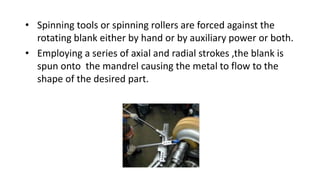
• Spinning tools or spinning rollers are forced against the
rotating blank either by hand or by auxiliary power or both.
• Employing a series of axial and radial strokes ,the blank is
spun onto the mandrel causing the metal to flow to the
shape of the desired part.
CONVENTIONAL SPINNING
Tube Spinning
• In tube spinning, the thickness of hollow,
cylindrical blanks is reduced or shaped by
spinning them on a solid, round mandrel.
• The reduction in wall thickness results in a longer
tube.
• This operation may be carried out externally or
internally.
• The parts may be spun forward or backward.
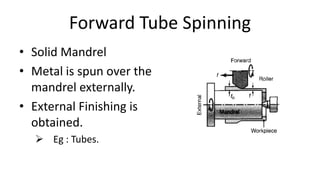
Forward Tube Spinning
• Solid Mandrel
• Metal is spun over the
mandrel externally.
• External Finishing is
obtained.
 Eg : Tubes.
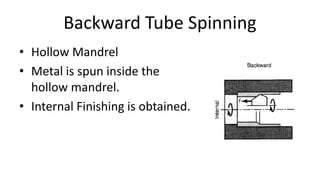
Backward Tube Spinning
• Hollow Mandrel
• Metal is spun inside the
hollow mandrel.
• Internal Finishing is obtained.
Applications of Tube Spinning
• Tube spinning can be used to make
• Rocket
• Missile
• Pressure vessels
• Automotive components, such as car and truck
Wheels.
Shear Spinning
• Shear spinning, also referred as shear
forming is similar to conventional metal
spinning.
• Shear spinning the diameter of the final
piece is approximately equal to that of
the flat sheet metal blank.
• The wall thickness is maintained by
controlling the gap between the roller
and the mandrel.
• In shear forming a reduction of the wall
thickness occurs.
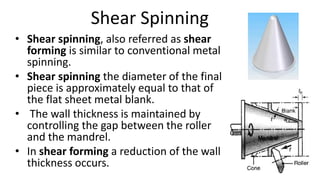
Shear Spinning
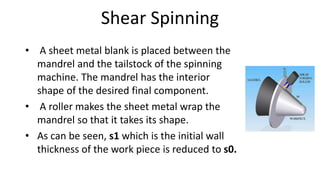
• A sheet metal blank is placed between the
mandrel and the tailstock of the spinning
machine. The mandrel has the interior
shape of the desired final component.
• A roller makes the sheet metal wrap the
mandrel so that it takes its shape.
• As can be seen, s1 which is the initial wall
thickness of the work piece is reduced to s0.
Shear Spinning
• A shear forming machine will look very much like a
conventional spinning machine, except for that it has
to be much more robust to withstand the higher forces
necessary to perform the shearing operation.
• The design of the roller must be considered carefully,
because it affects the shape of the component, the wall
thickness, and dimensional accuracy.
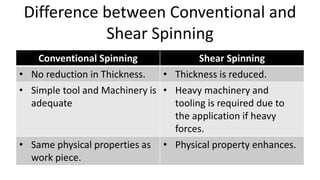
Difference between Conventional and
Shear Spinning
Conventional Spinning Shear Spinning
• No reduction in Thickness. • Thickness is reduced.
• Simple tool and Machinery is
adequate
• Heavy machinery and
tooling is required due to
the application if heavy
forces.
• Same physical properties as
work piece.
• Physical property enhances.
Hot Spinning
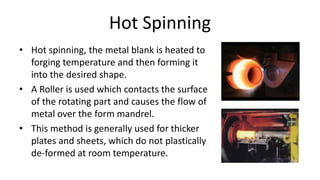
• Hot spinning, the metal blank is heated to
forging temperature and then forming it
into the desired shape.
• A Roller is used which contacts the surface
of the rotating part and causes the flow of
metal over the form mandrel.
• This method is generally used for thicker
plates and sheets, which do not plastically
de-formed at room temperature.
Merits and De-merits of Hot Spinning
• Larger deformation can be accomplished and more rapidly
by hot working since the metal is in plastic state.
• Grain structure of the metal is refined and physical
properties improved.
• Due to high temperature a rapid oxidation takes place.
• It involves excessive expenditure on account of high cost of
tooling.
Cold Spinning
• Cold spinning process is similar to hot spinning except
that the metal blank is worked at room temperature.
• This method is generally best suited for thin plates and
sheets of aluminum and other soft metals.
• Examples : light reflectors, cooking utensils, liquid
containers, radial engine cowling, domestic use hollow
parts etc.
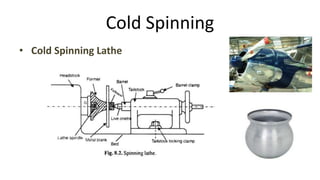
Cold Spinning
• Cold Spinning Lathe
Merits and De-merits of Cold Spinning
• Surface finish of the component is better because no
oxidation takes place during the process.
• It is an ideal method for increasing hardness of those
metals which do not respond to the heat treatment.
• Only ductile metals can be shaped through cold spinning.
• Subsequent heat treatment is mostly needed to remove
the residual stresses set up during cold working.
Tools and Equipments
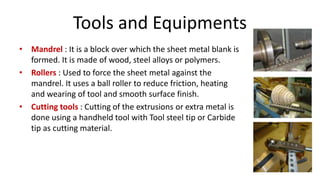
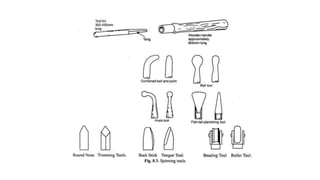
• Mandrel : It is a block over which the sheet metal blank is
formed. It is made of wood, steel alloys or polymers.
• Rollers : Used to force the sheet metal against the
mandrel. It uses a ball roller to reduce friction, heating
and wearing of tool and smooth surface finish.
• Cutting tools : Cutting of the extrusions or extra metal is
done using a handheld tool with Tool steel tip or Carbide
tip as cutting material.
Tools and Equipments
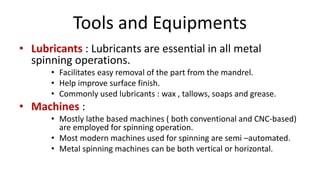
• Lubricants : Lubricants are essential in all metal
spinning operations.
• Facilitates easy removal of the part from the mandrel.
• Help improve surface finish.
• Commonly used lubricants : wax , tallows, soaps and grease.
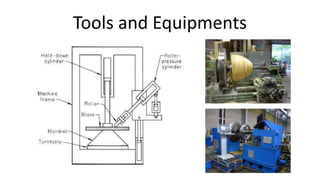
• Machines :
• Mostly lathe based machines ( both conventional and CNC-based)
are employed for spinning operation.
• Most modern machines used for spinning are semi –automated.
• Metal spinning machines can be both vertical or horizontal.
Tools and Equipments
Applications
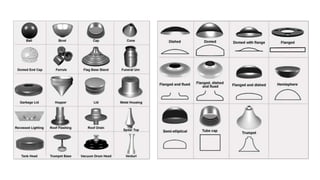
The following are examples of products that can be
manufactured by metal spinning:
• Baskets, basins and bowls.
• Hoppers and kettles.
• Nozzles, venturis and tank outlets.
• Cones and cups.
• Funnels, cylinders, domes and drums.
• Rings, hemispheres and shells.
• Materials that can be spun : Copper, Brass, Aluminium, Stainless
Steel, Sheet Metal.
Applications
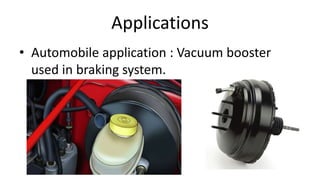
• Automobile application : Vacuum booster
used in braking system.
Merits
• The tooling costs and capital investments are relatively small.
• Design changes in the work piece can be accommodated at
relatively low costs.
• Since there is no removal of metal, there is no material wastage and
the process is economical. It is a chip less process.
• Can be easily automated and as well as high production rates can
be achieved.
• Spun parts usually have high tensile strength and can be used for
high pressure applications. eg. Scuba driving tanks.
De-merits
• Manual metal spinning is usually significantly slower than press
forging.
• Deformation loads allowable are much lower in metal spinning than
in press forging.
• Requirement of highly trained operators in manual spinning
process.
Conclusion
• Spinning is forming of axis-symmetrical products over a mandrel.
• It is similar to that of forming clay on a potter’s wheel.
• Three types
1. Conventional spinning
2. Shear spinning
3. Tube spinning
• Can be both Hot worked and Cold worked.
• Machine used is LATHE.
• Process can be either manual or can be automated.
• Less expensive and various applications.
References
 Serope Kalpakjian and Steven R. Schmid. Manufacturing Processes for
Engineering Materials. 2015
 http://www.smartclima.com/metal-spinning-fabrication.htm
 Debapriya M. Spinning of Metals: Process, Advantages and Uses.
Retrieved from http://www.yourarticlelibrary.com/metallurgy/spinning-of-
metals-process-advantages-and-uses

Metal spinning

  • 2.
    Metal Spinning • Spinningis a sheet metal forming of parts over a rotating mandrel using rollers. • It is used for axis symmetric products. • It uses a Lathe, Mandrel (die), Tailstock and Rollers(tool). • It may be either manual or computer controlled.
  • 3.
    Basic parts ofspinning machine • Mandrel • Tail Stock • Head Stock • Spindle • Clamp • Forming tools • Work piece
  • 4.
    Types Three basic types: •Conventional spinning • Shear spinning • Tube spinning On basis of working Temperature: • Hot Spinning • Cold Spinning Spinning Conventional spinning Shear spinning Tube spinning
  • 5.
    CONVENTIONAL SPINNING • Aconventional spinning is a cold forming process in which the blank metal appears to flow somewhat like a piece of clay on a potter’s wheel. • A conventional spinning has a circular blank of flat or preformed sheet metal is placed and held against a mandrel and rotated while a rigid tool deforms and shape the material over the mandrel.
  • 6.
     We havea metal or cylinder, which is rotated at high speed on CNC lathe or on hands by using specially designed tools due to this we get the axially symmetric product.  The tools used in this process can be controlled by two ways;  Manual spinning  Power spinning
  • 7.
    • Spinning toolsor spinning rollers are forced against the rotating blank either by hand or by auxiliary power or both. • Employing a series of axial and radial strokes ,the blank is spun onto the mandrel causing the metal to flow to the shape of the desired part.
  • 8.
  • 9.
    Tube Spinning • Intube spinning, the thickness of hollow, cylindrical blanks is reduced or shaped by spinning them on a solid, round mandrel. • The reduction in wall thickness results in a longer tube. • This operation may be carried out externally or internally. • The parts may be spun forward or backward.
  • 10.
    Forward Tube Spinning •Solid Mandrel • Metal is spun over the mandrel externally. • External Finishing is obtained.  Eg : Tubes.
  • 11.
    Backward Tube Spinning •Hollow Mandrel • Metal is spun inside the hollow mandrel. • Internal Finishing is obtained.
  • 12.
    Applications of TubeSpinning • Tube spinning can be used to make • Rocket • Missile • Pressure vessels • Automotive components, such as car and truck Wheels.
  • 13.
    Shear Spinning • Shearspinning, also referred as shear forming is similar to conventional metal spinning. • Shear spinning the diameter of the final piece is approximately equal to that of the flat sheet metal blank. • The wall thickness is maintained by controlling the gap between the roller and the mandrel. • In shear forming a reduction of the wall thickness occurs.
  • 14.
    Shear Spinning • Asheet metal blank is placed between the mandrel and the tailstock of the spinning machine. The mandrel has the interior shape of the desired final component. • A roller makes the sheet metal wrap the mandrel so that it takes its shape. • As can be seen, s1 which is the initial wall thickness of the work piece is reduced to s0.
  • 15.
    Shear Spinning • Ashear forming machine will look very much like a conventional spinning machine, except for that it has to be much more robust to withstand the higher forces necessary to perform the shearing operation. • The design of the roller must be considered carefully, because it affects the shape of the component, the wall thickness, and dimensional accuracy.
  • 16.
    Difference between Conventionaland Shear Spinning Conventional Spinning Shear Spinning • No reduction in Thickness. • Thickness is reduced. • Simple tool and Machinery is adequate • Heavy machinery and tooling is required due to the application if heavy forces. • Same physical properties as work piece. • Physical property enhances.
  • 17.
    Hot Spinning • Hotspinning, the metal blank is heated to forging temperature and then forming it into the desired shape. • A Roller is used which contacts the surface of the rotating part and causes the flow of metal over the form mandrel. • This method is generally used for thicker plates and sheets, which do not plastically de-formed at room temperature.
  • 18.
    Merits and De-meritsof Hot Spinning • Larger deformation can be accomplished and more rapidly by hot working since the metal is in plastic state. • Grain structure of the metal is refined and physical properties improved. • Due to high temperature a rapid oxidation takes place. • It involves excessive expenditure on account of high cost of tooling.
  • 19.
    Cold Spinning • Coldspinning process is similar to hot spinning except that the metal blank is worked at room temperature. • This method is generally best suited for thin plates and sheets of aluminum and other soft metals. • Examples : light reflectors, cooking utensils, liquid containers, radial engine cowling, domestic use hollow parts etc.
  • 20.
    Cold Spinning • ColdSpinning Lathe
  • 21.
    Merits and De-meritsof Cold Spinning • Surface finish of the component is better because no oxidation takes place during the process. • It is an ideal method for increasing hardness of those metals which do not respond to the heat treatment. • Only ductile metals can be shaped through cold spinning. • Subsequent heat treatment is mostly needed to remove the residual stresses set up during cold working.
  • 22.
    Tools and Equipments •Mandrel : It is a block over which the sheet metal blank is formed. It is made of wood, steel alloys or polymers. • Rollers : Used to force the sheet metal against the mandrel. It uses a ball roller to reduce friction, heating and wearing of tool and smooth surface finish. • Cutting tools : Cutting of the extrusions or extra metal is done using a handheld tool with Tool steel tip or Carbide tip as cutting material.
  • 24.
    Tools and Equipments •Lubricants : Lubricants are essential in all metal spinning operations. • Facilitates easy removal of the part from the mandrel. • Help improve surface finish. • Commonly used lubricants : wax , tallows, soaps and grease. • Machines : • Mostly lathe based machines ( both conventional and CNC-based) are employed for spinning operation. • Most modern machines used for spinning are semi –automated. • Metal spinning machines can be both vertical or horizontal.
  • 25.
  • 26.
    Applications The following areexamples of products that can be manufactured by metal spinning: • Baskets, basins and bowls. • Hoppers and kettles. • Nozzles, venturis and tank outlets. • Cones and cups. • Funnels, cylinders, domes and drums. • Rings, hemispheres and shells. • Materials that can be spun : Copper, Brass, Aluminium, Stainless Steel, Sheet Metal.
  • 27.
    Applications • Automobile application: Vacuum booster used in braking system.
  • 29.
    Merits • The toolingcosts and capital investments are relatively small. • Design changes in the work piece can be accommodated at relatively low costs. • Since there is no removal of metal, there is no material wastage and the process is economical. It is a chip less process. • Can be easily automated and as well as high production rates can be achieved. • Spun parts usually have high tensile strength and can be used for high pressure applications. eg. Scuba driving tanks.
  • 30.
    De-merits • Manual metalspinning is usually significantly slower than press forging. • Deformation loads allowable are much lower in metal spinning than in press forging. • Requirement of highly trained operators in manual spinning process.
  • 31.
    Conclusion • Spinning isforming of axis-symmetrical products over a mandrel. • It is similar to that of forming clay on a potter’s wheel. • Three types 1. Conventional spinning 2. Shear spinning 3. Tube spinning • Can be both Hot worked and Cold worked. • Machine used is LATHE. • Process can be either manual or can be automated. • Less expensive and various applications.
  • 32.
    References  Serope Kalpakjianand Steven R. Schmid. Manufacturing Processes for Engineering Materials. 2015  http://www.smartclima.com/metal-spinning-fabrication.htm  Debapriya M. Spinning of Metals: Process, Advantages and Uses. Retrieved from http://www.yourarticlelibrary.com/metallurgy/spinning-of- metals-process-advantages-and-uses