Febrile Seizures
Definition, Epidemiology, Etiology,
Clinical Presentation, Complications,
Investigations, Management
Prof. Imran Iqbal
Fellowship in Pediatric Neurology (Australia)
Prof of Paediatrics (2003-2018)
Prof of Pediatrics Emeritus, CHICH
Prof of Pediatrics, CIMS
Multan, Pakistan
(God Almighty speaking to Prophet Muhammad (PBUH)
The Rahman (The All-Merciful Allah) has taught the Qur‘an.
He has created man. He has taught him (how) to express himself.
The Holy Quran; surah Al-Rahman 55:1-4
In the name of Our Creator Allah, the most Gracious, the most Merciful
CNS
Brain
Our perceptions and Movements
Clinical Presentation
of
CNS diseases
CNS disease – Clinical Presentation
• Seizures / Convulsions / Fits
• Impaired Conscious level
• Developmental delay
• Intellectual handicap
• Neurological Paralysis / Paresis (motor weakness )
• Neuromuscular disorders / Hypotonia
• Movement disorders
• Headache
• Regression of acquired milestones
• Behaviour problems
Seizures / Convulsions / Epilepsy
Definition, Clinical Presentation, Etiology
Seizures in Children
Definition
• Seizure is a paroxysmal involuntary disturbance of brain
function that may manifest as impaired conscious level,
abnormal motor activity, behavioral abnormalities, sensory
disturbances or autonomic dysfunction
• Convulsion is a generalized seizure with increased tone and
tonic - clonic movements of the body
• Epilepsy is a disorder of the brain characterized by an
enduring predisposition to generate seizures
• Epilepsy is recurrent seizures unrelated to fever or an acute
cerebral insult
Seizures in Children (Clinical Presentation)
Convulsions
Seizures in Children
Etiology - Acute Symptomatic Seizures
• Febrile Seizures (age 6 months to 5 years)
• CNS infections (Meningitis / Encephalitis / Cerebral malaria)
• Intracranial hemorrhage
• Hypoglycemia / Electrolyte imbalance (Na,Ca,Mg)
• Drugs / Chemical Poisoning / Encephalopathy
• Trauma
• Hypoxia
• PNES (Psychological Non-epileptic Seizures)
• Tetanus (spasms not seizures)
Seizures in Children
Etiology - Recurrent Seizures
• Epilepsy
 Idiopathic Epilepsy in children has a genetic basis
 Epilepsy in children may be secondary to:
 Hypoxic-ischemic injury to Brain
 Cerebral Malformations
 Degenerative Brain diseases
 Epilepsy in children may be associated with:
Cerebral palsy
Intellectual disability / Mental handicap
Febrile Seizures in Children
Definition, Epidemiology, Etiology
Febrile Seizures
Definition
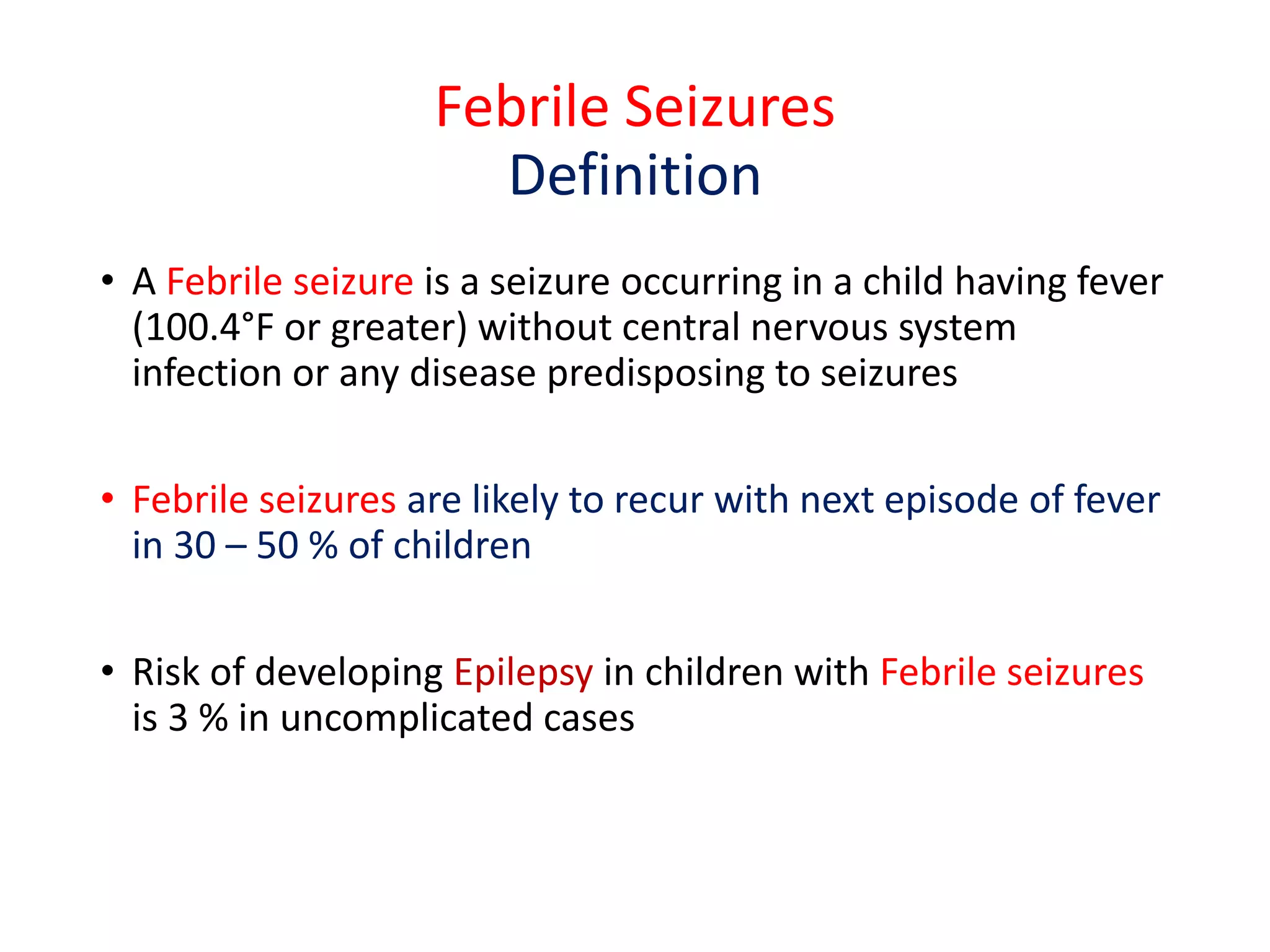
• A Febrile seizure is a seizure occurring in a child having fever
(100.4°F or greater) without central nervous system
infection or any disease predisposing to seizures
• Febrile seizures are likely to recur with next episode of fever
in 30 – 50 % of children
• Risk of developing Epilepsy in children with Febrile seizures
is 3 % in uncomplicated cases
Febrile Seizures
Epidemiology
• Febrile seizures are the most common seizure disorder and
most common neurological disorder in childhood
• Febrile seizures are seen in children aged 6 months to 5
years (rarely, 3 months and 6 years)
• Febrile seizures are seen in 3 % of children
Febrile Seizures
Etiology
• The exact underlying mechanism of febrile seizures is
unknown
• The increased activity of neurons during rapid brain
development may predispose to seizures in younger
children
• Inflammatory mediators, and cytokines, released during a
fever may contribute to the pathogenesis of febrile seizures
• There is a genetic basis to febrile seizures which are more
common in families
Febrile Seizures
Clinical Presentation, Types
Febrile Seizures
Case Scenario
• An 18 months old child presents to the pediatric emergency
with sudden onset of jerky tonic-clonic movements of body
which lasted five minutes.
• Parents say the child was having runny nose and cough since
yesterday
• On examination, his weight is 10 kg and he has a
temperature of 102 F. Now he has no seizure activity but is
lethargic
• Mother mentions that the child did not have any such event
before.
• What will be your most likely initial diagnosis in this child ?
Febrile Seizures
Clinical Features - Fever
• Febrile seizures are associated with an abrupt rise of fever in
genetically-predisposed children
• Fever is usually more than 102 F (39 C)
• Most febrile seizures will occur during the first 24 hours of
developing a fever
• In many children, parents may not have noticed the fever till
the seizure occurs
• The cause of fever is usually a viral infection
Febrile Seizures
Clinical Features - Seizure
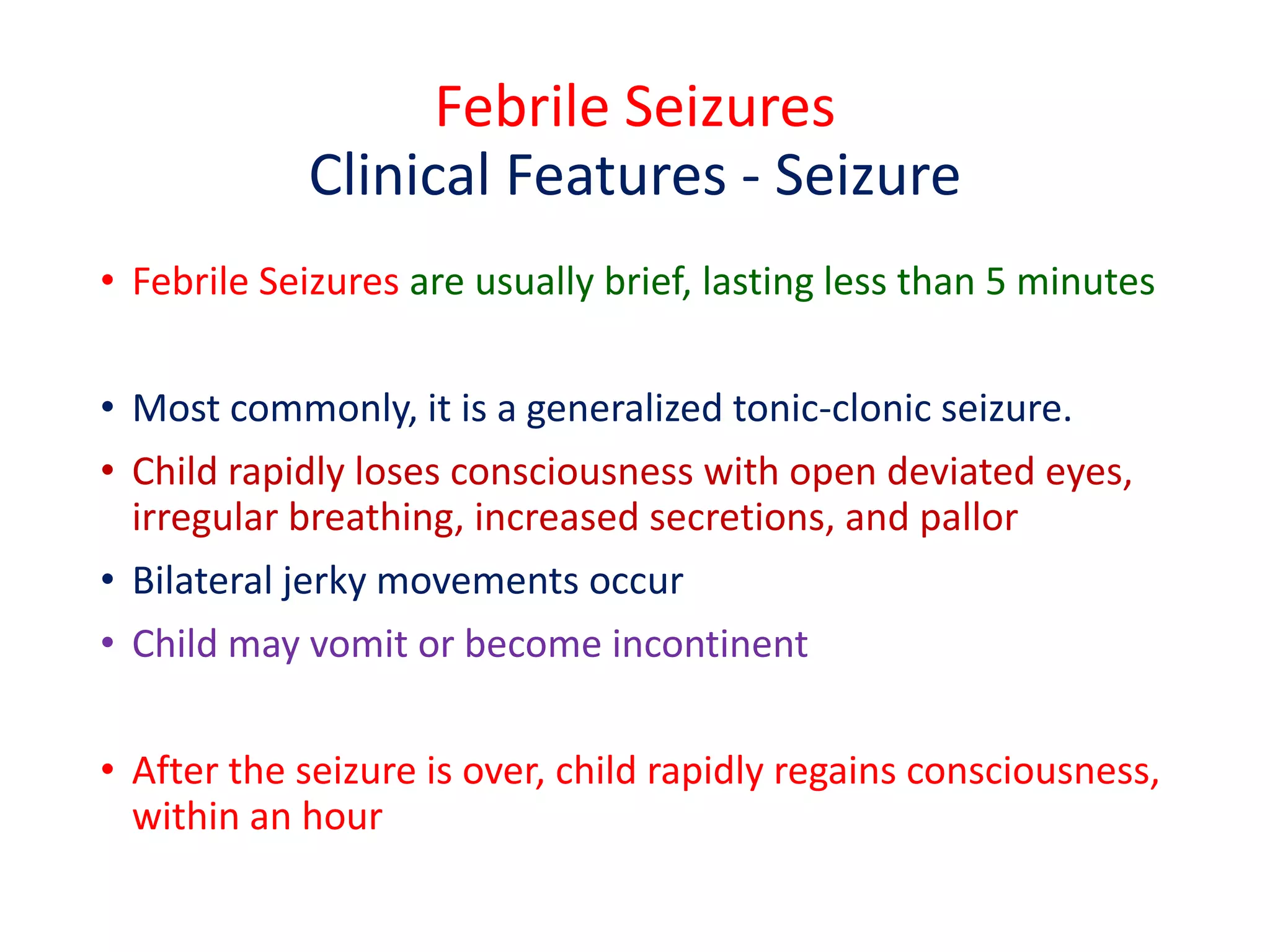
• Febrile Seizures are usually brief, lasting less than 5 minutes
• Most commonly, it is a generalized tonic-clonic seizure.
• Child rapidly loses consciousness with open deviated eyes,
irregular breathing, increased secretions, and pallor
• Bilateral jerky movements occur
• Child may vomit or become incontinent
• After the seizure is over, child rapidly regains consciousness,
within an hour
Febrile Seizures
Types
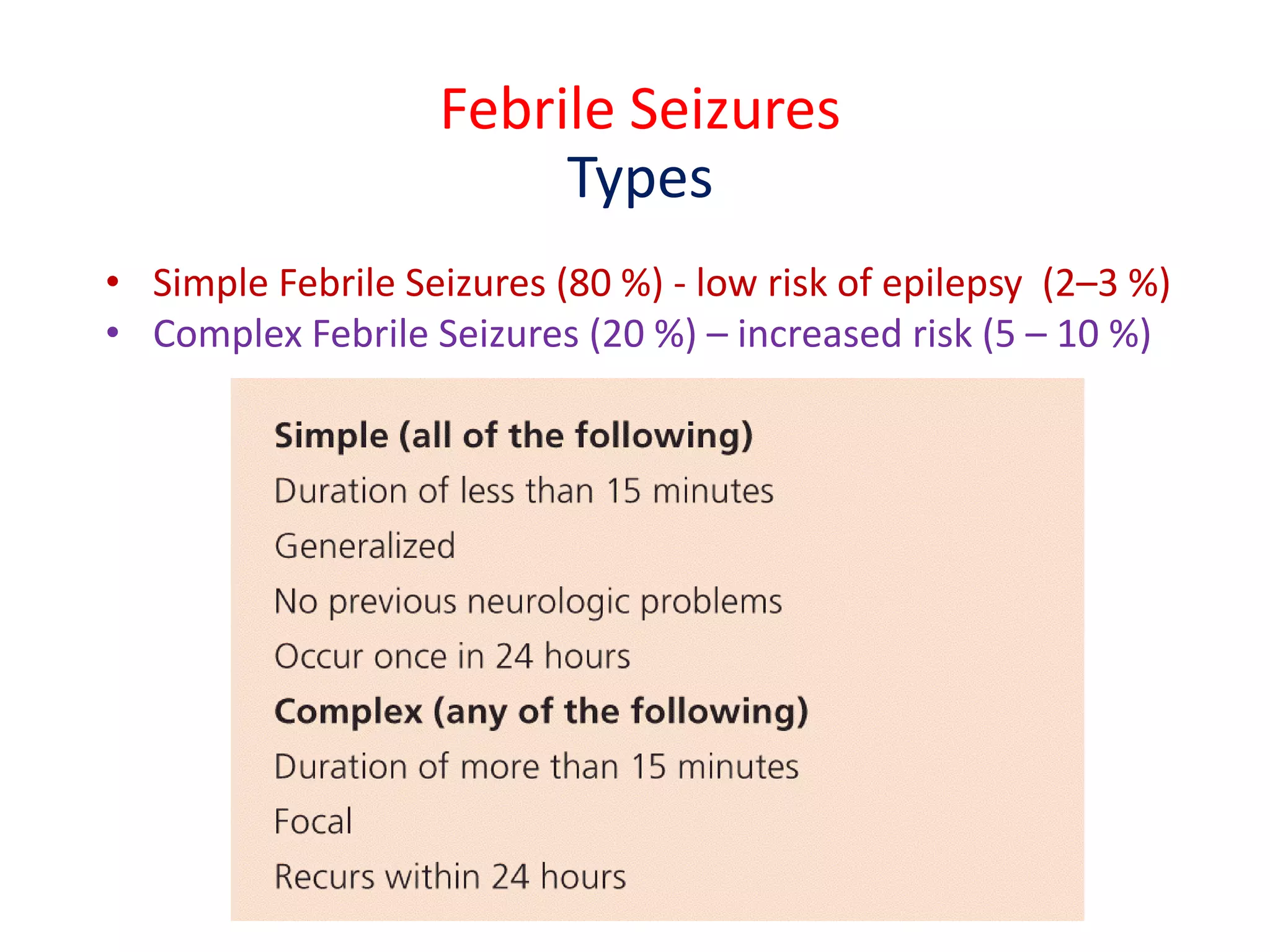
• Simple Febrile Seizures (80 %) - low risk of epilepsy (2–3 %)
• Complex Febrile Seizures (20 %) – increased risk (5 – 10 %)
Febrile Seizures
Diagnosis, Complications, Investigations
Febrile Seizures
Evaluation
• History:
• Present illness – symptoms and signs
• Past History – seizures
• Development history – milestones
• Family History – epilepsy
• Physical Examination:
• General Physical Examination – cause of fever
• Neurological Examination – abnormal findings, SOMI
Febrile Seizures
Differential Diagnosis
• CNS infections (Meningitis / Encephalitis )
• Intracranial hemorrhage
• Hypoglycemia / Electrolyte imbalance (Na,Ca,Mg)
• Drugs / Poisoning / Metabolic Encephalopathy
• Idiopathic Epilepsy
Febrile Seizures
Diagnosis
• Febrile Seizures – fever often high
• Febrile Seizures – infectious cause of fever usually present
• Febrile Seizures – past history of Febrile seizures often
present in the child or siblings
• Febrile Seizures – child is neurologically normal before the
seizure
• Febrile Seizures – child regains consciousness quickly
• Febrile Seizures – child is neurologically normal after the
seizure
• Febrile Seizures – no other disease explains for the seizure
Febrile Seizures
Complications
• Acute complications:
• Hypoxia
• Hypoglycemia
• Hyperpyrexia
• Aspiration pneumonia
• Status epilepticus
• Chronic complications:
• Recurrence – further Febrile Seizures
• Epilepsy
Febrile Seizures
Investigations
• Typical case of Febrile seizures – investigations not needed
• Atypical cases or uncertain diagnosis – investigate as needed
(keeping in view other diseases)
• CBC, CRP, ICT malaria, X-ray Chest (infection)
• CSF examination and microbiology (meningitis)
• Serum glucose, electrolytes, calcium, and BUN (metabolic)
• Neuroimaging - CT / MRI Brain (neurological disease)
• EEG – electroencephalography (epilepsy)
Febrile Seizures
Management
Febrile Seizures
Acute Management
• General Management:
• Airway – Breathing – Circulation
• Oxygen by mask / nasal prongs
• Monitoring – GCS, Vitals, SaO2,
• Seizure Management:
• IV diazepam or IV midazolam (benzodiazepines)
• IV Leviteracetam (if needed)
• Fever Management:
• IV Paracetamol
• Sponging with water
Febrile Seizures
Long Term Management
• Control of Fever :
• Oral Paracetamol or Oral Ibuprofen (keep fever low)
• Sponging with water
• Seizure Management at home:
• Rectal diazepam
• Oral Midazolam
• Prevention of Seizures:
• Oral diazepam during febrile episodes
• Oral Phenobarbitone daily till 5 years of age

Febrile seizures in children 2021

  • 1.
    Febrile Seizures Definition, Epidemiology,Etiology, Clinical Presentation, Complications, Investigations, Management Prof. Imran Iqbal Fellowship in Pediatric Neurology (Australia) Prof of Paediatrics (2003-2018) Prof of Pediatrics Emeritus, CHICH Prof of Pediatrics, CIMS Multan, Pakistan
  • 2.
    (God Almighty speakingto Prophet Muhammad (PBUH) The Rahman (The All-Merciful Allah) has taught the Qur‘an. He has created man. He has taught him (how) to express himself. The Holy Quran; surah Al-Rahman 55:1-4 In the name of Our Creator Allah, the most Gracious, the most Merciful
  • 3.
  • 4.
  • 5.
  • 6.
  • 7.
    CNS disease –Clinical Presentation • Seizures / Convulsions / Fits • Impaired Conscious level • Developmental delay • Intellectual handicap • Neurological Paralysis / Paresis (motor weakness ) • Neuromuscular disorders / Hypotonia • Movement disorders • Headache • Regression of acquired milestones • Behaviour problems
  • 8.
    Seizures / Convulsions/ Epilepsy Definition, Clinical Presentation, Etiology
  • 9.
    Seizures in Children Definition •Seizure is a paroxysmal involuntary disturbance of brain function that may manifest as impaired conscious level, abnormal motor activity, behavioral abnormalities, sensory disturbances or autonomic dysfunction • Convulsion is a generalized seizure with increased tone and tonic - clonic movements of the body • Epilepsy is a disorder of the brain characterized by an enduring predisposition to generate seizures • Epilepsy is recurrent seizures unrelated to fever or an acute cerebral insult
  • 10.
    Seizures in Children(Clinical Presentation)
  • 11.
  • 12.
    Seizures in Children Etiology- Acute Symptomatic Seizures • Febrile Seizures (age 6 months to 5 years) • CNS infections (Meningitis / Encephalitis / Cerebral malaria) • Intracranial hemorrhage • Hypoglycemia / Electrolyte imbalance (Na,Ca,Mg) • Drugs / Chemical Poisoning / Encephalopathy • Trauma • Hypoxia • PNES (Psychological Non-epileptic Seizures) • Tetanus (spasms not seizures)
  • 13.
    Seizures in Children Etiology- Recurrent Seizures • Epilepsy  Idiopathic Epilepsy in children has a genetic basis  Epilepsy in children may be secondary to:  Hypoxic-ischemic injury to Brain  Cerebral Malformations  Degenerative Brain diseases  Epilepsy in children may be associated with: Cerebral palsy Intellectual disability / Mental handicap
  • 14.
    Febrile Seizures inChildren Definition, Epidemiology, Etiology
  • 15.
    Febrile Seizures Definition • AFebrile seizure is a seizure occurring in a child having fever (100.4°F or greater) without central nervous system infection or any disease predisposing to seizures • Febrile seizures are likely to recur with next episode of fever in 30 – 50 % of children • Risk of developing Epilepsy in children with Febrile seizures is 3 % in uncomplicated cases
  • 16.
    Febrile Seizures Epidemiology • Febrileseizures are the most common seizure disorder and most common neurological disorder in childhood • Febrile seizures are seen in children aged 6 months to 5 years (rarely, 3 months and 6 years) • Febrile seizures are seen in 3 % of children
  • 17.
    Febrile Seizures Etiology • Theexact underlying mechanism of febrile seizures is unknown • The increased activity of neurons during rapid brain development may predispose to seizures in younger children • Inflammatory mediators, and cytokines, released during a fever may contribute to the pathogenesis of febrile seizures • There is a genetic basis to febrile seizures which are more common in families
  • 18.
  • 19.
    Febrile Seizures Case Scenario •An 18 months old child presents to the pediatric emergency with sudden onset of jerky tonic-clonic movements of body which lasted five minutes. • Parents say the child was having runny nose and cough since yesterday • On examination, his weight is 10 kg and he has a temperature of 102 F. Now he has no seizure activity but is lethargic • Mother mentions that the child did not have any such event before. • What will be your most likely initial diagnosis in this child ?
  • 20.
    Febrile Seizures Clinical Features- Fever • Febrile seizures are associated with an abrupt rise of fever in genetically-predisposed children • Fever is usually more than 102 F (39 C) • Most febrile seizures will occur during the first 24 hours of developing a fever • In many children, parents may not have noticed the fever till the seizure occurs • The cause of fever is usually a viral infection
  • 21.
    Febrile Seizures Clinical Features- Seizure • Febrile Seizures are usually brief, lasting less than 5 minutes • Most commonly, it is a generalized tonic-clonic seizure. • Child rapidly loses consciousness with open deviated eyes, irregular breathing, increased secretions, and pallor • Bilateral jerky movements occur • Child may vomit or become incontinent • After the seizure is over, child rapidly regains consciousness, within an hour
  • 22.
    Febrile Seizures Types • SimpleFebrile Seizures (80 %) - low risk of epilepsy (2–3 %) • Complex Febrile Seizures (20 %) – increased risk (5 – 10 %)
  • 23.
  • 24.
    Febrile Seizures Evaluation • History: •Present illness – symptoms and signs • Past History – seizures • Development history – milestones • Family History – epilepsy • Physical Examination: • General Physical Examination – cause of fever • Neurological Examination – abnormal findings, SOMI
  • 25.
    Febrile Seizures Differential Diagnosis •CNS infections (Meningitis / Encephalitis ) • Intracranial hemorrhage • Hypoglycemia / Electrolyte imbalance (Na,Ca,Mg) • Drugs / Poisoning / Metabolic Encephalopathy • Idiopathic Epilepsy
  • 26.
    Febrile Seizures Diagnosis • FebrileSeizures – fever often high • Febrile Seizures – infectious cause of fever usually present • Febrile Seizures – past history of Febrile seizures often present in the child or siblings • Febrile Seizures – child is neurologically normal before the seizure • Febrile Seizures – child regains consciousness quickly • Febrile Seizures – child is neurologically normal after the seizure • Febrile Seizures – no other disease explains for the seizure
  • 27.
    Febrile Seizures Complications • Acutecomplications: • Hypoxia • Hypoglycemia • Hyperpyrexia • Aspiration pneumonia • Status epilepticus • Chronic complications: • Recurrence – further Febrile Seizures • Epilepsy
  • 28.
    Febrile Seizures Investigations • Typicalcase of Febrile seizures – investigations not needed • Atypical cases or uncertain diagnosis – investigate as needed (keeping in view other diseases) • CBC, CRP, ICT malaria, X-ray Chest (infection) • CSF examination and microbiology (meningitis) • Serum glucose, electrolytes, calcium, and BUN (metabolic) • Neuroimaging - CT / MRI Brain (neurological disease) • EEG – electroencephalography (epilepsy)
  • 29.
  • 30.
    Febrile Seizures Acute Management •General Management: • Airway – Breathing – Circulation • Oxygen by mask / nasal prongs • Monitoring – GCS, Vitals, SaO2, • Seizure Management: • IV diazepam or IV midazolam (benzodiazepines) • IV Leviteracetam (if needed) • Fever Management: • IV Paracetamol • Sponging with water
  • 31.
    Febrile Seizures Long TermManagement • Control of Fever : • Oral Paracetamol or Oral Ibuprofen (keep fever low) • Sponging with water • Seizure Management at home: • Rectal diazepam • Oral Midazolam • Prevention of Seizures: • Oral diazepam during febrile episodes • Oral Phenobarbitone daily till 5 years of age