DR. RASHMIN CECIL
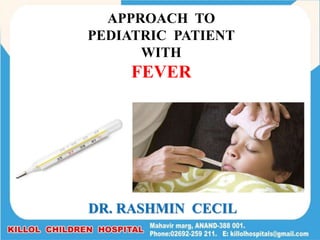
APPROACH TO
PEDIATRIC PATIENT
WITH
FEVER
• WHAT IS FEVER ?
• “Fever is controlled increase
in the body temperature over
normal value for an
individual.”
• DEFINITION OF FEVER :
• Fever is defined as a core temperature of > 38c.
• Temperatures in infants and children should be
measured rectally as axillary and tympanic
membrane temperatures are unreliable.
• An infant or child with a recent history of
documented fever but afebrile at the time of
presentation should be considered a febrile child.
• Range of normal body temperature:
(36 - 38º C) or (97 - 99 º F)
• PUO : [Pyrexia Unknown Origin]
• Children with a fever documented by
healthcare provider & for which cause could
not be identified after 3 weeks of evaluation
in O.P.D or in hospital admitted cases after
1 week of evaluation are known as PUO.
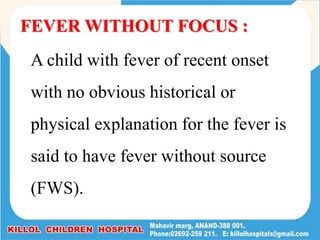
FEVER WITHOUT FOCUS :
A child with fever of recent onset
with no obvious historical or
physical explanation for the fever is
said to have fever without source
(FWS).
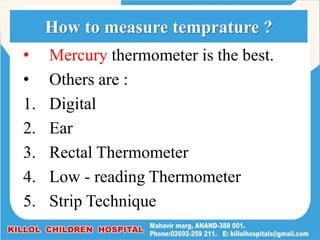
• Mercury thermometer is the best.
• Others are :
1. Digital
2. Ear
3. Rectal Thermometer
4. Low - reading Thermometer
5. Strip Technique
How to measure temprature ?
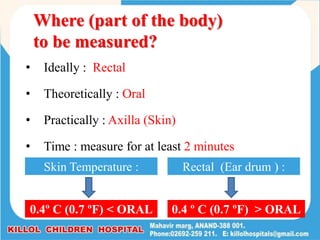
Where (part of the body)
to be measured?
• Ideally : Rectal
• Theoretically : Oral
• Practically : Axilla (Skin)
• Time : measure for at least 2 minutes
0.4º C (0.7 ºF) < ORAL 0.4 º C (0.7 ºF) > ORAL
Skin Temperature : Rectal (Ear drum ) :
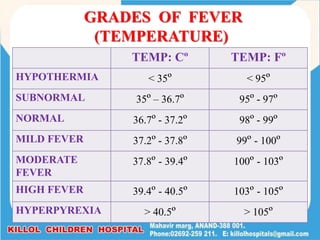
GRADES OF FEVER
(TEMPERATURE)
TEMP: Cº TEMP: Fº
HYPOTHERMIA < 35º < 95º
SUBNORMAL 35º – 36.7º 95º - 97º
NORMAL 36.7º - 37.2º 98º - 99º
MILD FEVER 37.2º - 37.8º 99º - 100º
MODERATE
FEVER
37.8º - 39.4º 100º - 103º
HIGH FEVER 39.4º - 40.5º 103º - 105º
HYPERPYREXIA > 40.5º > 105º
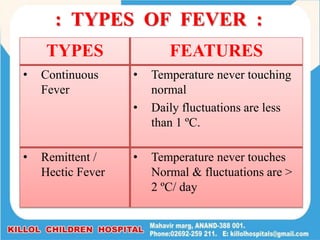
: TYPES OF FEVER :
TYPES FEATURES
• Continuous
Fever
• Temperature never touching
normal
• Daily fluctuations are less
than 1 ºC.
• Remittent /
Hectic Fever
• Temperature never touches
Normal & fluctuations are >
2 ºC/ day
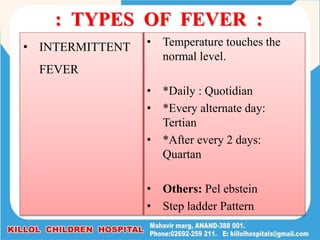
• INTERMITTENT
FEVER
• Temperature touches the
normal level.
• *Daily : Quotidian
• *Every alternate day:
Tertian
• *After every 2 days:
Quartan
• Others: Pel ebstein
• Step ladder Pattern
: TYPES OF FEVER :
STAGES OF FEVER
• [1] The PRODROMAL Stage : (may be Absent)
• [2] The Stage of ONSET or INVASION : (Initial
or pyrogenetic phase)
• [3] The Stage of Fever DEVELOPMENT :
(Fastigium)
• [4] The Stage of DECLINE : ( Defervescence or
Termination)
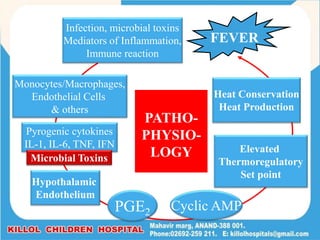
Infection, microbial toxins
Mediators of Inflammation,
Immune reaction
Pyrogenic cytokines
IL-1, IL-6, TNF, IFN
Microbial Toxins
FEVER
Heat Conservation
Heat Production
Elevated
Thermoregulatory
Set point
Hypothalamic
Endothelium
PGE2 Cyclic AMP
PATHO-
PHYSIO-
LOGY
Monocytes/Macrophages,
Endothelial Cells
& others
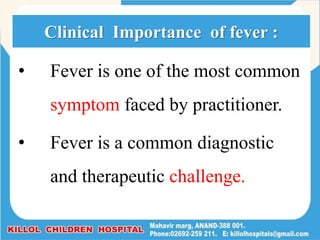
• Fever is one of the most common
symptom faced by practitioner.
• Fever is a common diagnostic
and therapeutic challenge.
Clinical Importance of fever :
• Parents expect correct diagnosis and
prompt control of fever.
• As against this, for the treating doctor,
it is almost impossible to diagnose the
cause of fever for the first 2-3 days.
• In this common scenario,
irrational antibiotic use and
unnecessary laboratory tests are
rules in routine office practice,
triggered by the fear of missing
serious illness.
• Identifying the cause of fever
depends on localization, which
takes 2-5 days
Inquire about
1. Behavior
2. Urine output
3. Convulsions
4. Profuse vomiting
5. Severe Abdominal pain
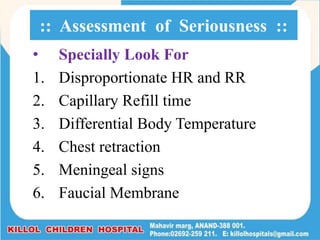
:: Assessment of Seriousness ::
• Specially Look For
1. Disproportionate HR and RR
2. Capillary Refill time
3. Differential Body Temperature
4. Chest retraction
5. Meningeal signs
6. Faucial Membrane
:: Assessment of Seriousness ::
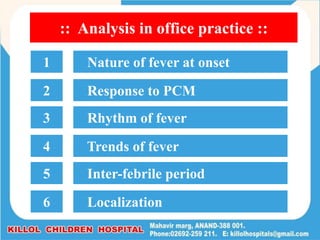
:: Analysis in office practice ::
Nature of fever at onset
Response to PCM
Rhythm of fever
Trends of fever
Inter-febrile period
Localization
1
2
3
4
5
6
• [1] High fever :
• Viral Fever
• Bacterial infection
• Acute tonsillitis, Acute Bacillary Dysentery,
UTI
• Malaria
• [2] Moderate Fever :
• Pneumonia, Meningitis, Typhoid
1. Nauure of fever at onset :
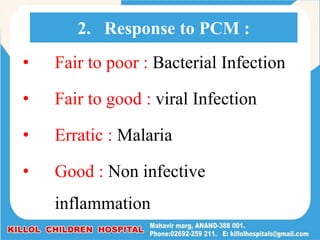
• Fair to poor : Bacterial Infection
• Fair to good : viral Infection
• Erratic : Malaria
• Good : Non infective
inflammation
2. Response to PCM :
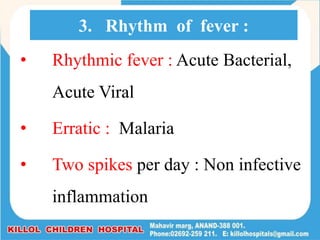
• Rhythmic fever : Acute Bacterial,
Acute Viral
• Erratic : Malaria
• Two spikes per day : Non infective
inflammation
3. Rhythm of fever :
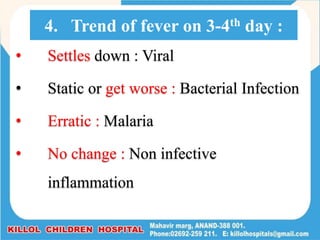
• Settles down : Viral
• Static or get worse : Bacterial Infection
• Erratic : Malaria
• No change : Non infective
inflammation
4. Trend of fever on 3-4th day :
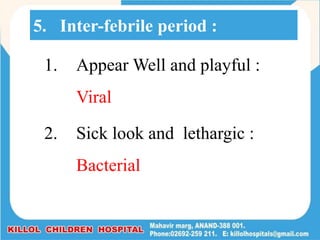
1. Appear Well and playful :
Viral
2. Sick look and lethargic :
Bacterial
5. Inter-febrile period :
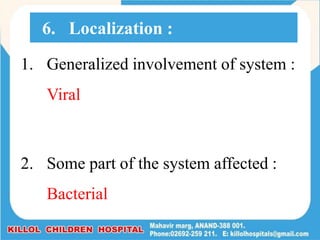
1. Generalized involvement of system :
Viral
2. Some part of the system affected :
Bacterial
6. Localization :
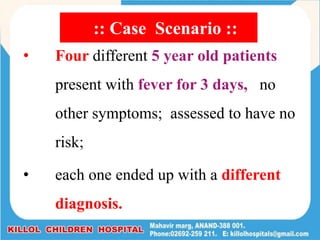
• Four different 5 year old patients
present with fever for 3 days, no
other symptoms; assessed to have no
risk;
• each one ended up with a different
diagnosis.
:: Case Scenario ::
• How would you separate them out
clinically?
1. Onset of fever;
2. Response to paracetamol;
3. Behavior during inter febrile period;
4. Rhythm, trend, accompanying
symptoms if any.
1. High fever at onset, fair/variable
2. Response to paracetamol,
3. Inter febrile period normal,
4. Fever comes up every 5-6 hours
5. On day-2 : cold and cough appears,
6. On Day - 3 : fever seems to be abating
:: Patient : 1
• What do we infer from the
onset of fever?
• High fever at the onset could
be viral, bacterial, or malaria.
• What does the response to antipyretic and
the inter febrile behavior tell us?
• Fair response to antipyretic : Less likely
to be a severe bacterial infection.
• Normal behavior in the inter febrile phase
: Suggests that it is less likely to be a
bacterial infection.
• So then, is it viral fever or malaria?
• Since the fever is rhythmic, coming up
every 5-6 hours, once antipyretic
effect wears off, it is equivalent to
continuous fever.
• This would make malaria less likely.
• Any other points to favor a diagnosis
of viral fever?
• Appearance of mild cold and cough on
day 2 : Suggesting generalized
involvement of respiratory system.
• Downward trend of fever on day - 3
Suggests a self-limiting disease.
1. High fever at onset,
2. Poor response to paracetamol,
3. Interfebrile period sick,
4. Fever rises every 4 hrs,
5. On Day – 3, fever trend worsening -
look for…
:: Patient : 2
• Like the previous child, even in
this child the fever is high at
onset,
• Suggesting viral, bacterial or
malarial fever.
• What else can we infer?
• Poor response to paracetamol & child
sick in inter febrile phase : Suggests a
bacterial infection.
• High at onset, bacterial infection at
the site of entry of germs.
• So what should we be looking for?
• Localization in the form of
tonsillitis, lymphadenitis, UTI
• We need to ask for relevant
symptoms
• High fever at onset,
• Erratic fever irrespective of
Paracetamol,
• Inter febrile period normal,
• Same trend continues on Day -3
:: Patient : 3
• Once again, high fever at onset and
inter febrile period normal suggests
viral fever or malaria,
• but in this child the fever is erratic,
with no downward trend visible so
far, suggesting malaria.
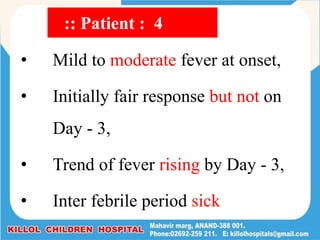
• Mild to moderate fever at onset,
• Initially fair response but not on
Day - 3,
• Trend of fever rising by Day - 3,
• Inter febrile period sick
:: Patient : 4
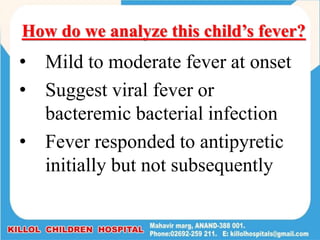
How do we analyze this child’s fever?
• Mild to moderate fever at onset
• Suggest viral fever or
bacteremic bacterial infection
• Fever responded to antipyretic
initially but not subsequently
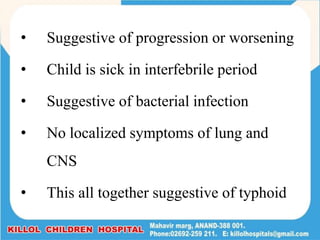
• Suggestive of progression or worsening
• Child is sick in interfebrile period
• Suggestive of bacterial infection
• No localized symptoms of lung and
CNS
• This all together suggestive of typhoid
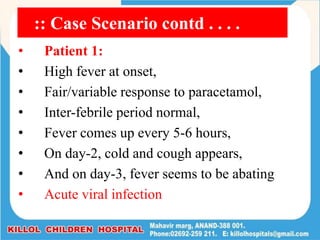
• Patient 1:
• High fever at onset,
• Fair/variable response to paracetamol,
• Inter-febrile period normal,
• Fever comes up every 5-6 hours,
• On day-2, cold and cough appears,
• And on day-3, fever seems to be abating
• Acute viral infection
:: Case Scenario contd . . . .
• Patient 2: high fever at onset,
• Poor response to paracetamol,
• Inter febrile period sick, fever rises every
4 hrs,
• On Day- 3 fever trend worsening- look
for…
• Bacterial tonsillopharyngitis
• Patient 3: high fever at onset,
• Erratic fever irrespective of
paracetamsol,
• Inter febrile period normal,
• Same trend continues even on Day-3.
• Malaria
• Patient 4 : mild to moderate fever at
onset,
• Initially fair response but not on Day-3
• Trend of fever rising by Day-3
• Inter febrile period sick
• likely be Typhoid fever
• Provisional diagnosis possible even without
physical signs; analyses fever pattern &
document it
• No fever = no acute bacterial infection = no
antibiotics
• No Antibiotics for first 3 – 4 days of fever
till disease localizes
:: FEVER RULES ::
• If empirical Antiboitics has to be
started, send relevant
investigations before starting
• Drug resistance is rare in
common community infections
• If rationally selected antibiotic fails,
look for alternate diagnosis while
trying second antibiotic
• If two antibiotics fail, acute bacterial
infection is ruled out – do not try third
antibiotic
Approach to fever as it evolves
• Day 1 - 2 : Rule out seriousness,
observe and paracetamol only
• Day 3 - 4 : Look for localization,
clinically or by relevant tests,
consider pneumonia, meningitis,
UTI, consider antibiotic therapy
after tests
• Day 5 – 7 : Assess progress of
fever, review, repeat tests,
observe and paracetamol only
• Day 8 – 10 : Reassess
periodically
• Additional relevant tests
consider change of Ab therapy
• Beyond 2 weeks
• Search for non infective cause /
chronic infection by relevant
tests TB at any age, SOJIA,
neuroblastoma
Fever - Approach to Paediatric Patient

Fever - Approach to Paediatric Patient

  • 2.
    DR. RASHMIN CECIL APPROACHTO PEDIATRIC PATIENT WITH FEVER
  • 3.
    • WHAT ISFEVER ? • “Fever is controlled increase in the body temperature over normal value for an individual.”
  • 4.
    • DEFINITION OFFEVER : • Fever is defined as a core temperature of > 38c. • Temperatures in infants and children should be measured rectally as axillary and tympanic membrane temperatures are unreliable. • An infant or child with a recent history of documented fever but afebrile at the time of presentation should be considered a febrile child.
  • 5.
    • Range ofnormal body temperature: (36 - 38º C) or (97 - 99 º F) • PUO : [Pyrexia Unknown Origin] • Children with a fever documented by healthcare provider & for which cause could not be identified after 3 weeks of evaluation in O.P.D or in hospital admitted cases after 1 week of evaluation are known as PUO.
  • 6.
    FEVER WITHOUT FOCUS: A child with fever of recent onset with no obvious historical or physical explanation for the fever is said to have fever without source (FWS).
  • 7.
    • Mercury thermometeris the best. • Others are : 1. Digital 2. Ear 3. Rectal Thermometer 4. Low - reading Thermometer 5. Strip Technique How to measure temprature ?
  • 8.
    Where (part ofthe body) to be measured? • Ideally : Rectal • Theoretically : Oral • Practically : Axilla (Skin) • Time : measure for at least 2 minutes 0.4º C (0.7 ºF) < ORAL 0.4 º C (0.7 ºF) > ORAL Skin Temperature : Rectal (Ear drum ) :
  • 9.
    GRADES OF FEVER (TEMPERATURE) TEMP:Cº TEMP: Fº HYPOTHERMIA < 35º < 95º SUBNORMAL 35º – 36.7º 95º - 97º NORMAL 36.7º - 37.2º 98º - 99º MILD FEVER 37.2º - 37.8º 99º - 100º MODERATE FEVER 37.8º - 39.4º 100º - 103º HIGH FEVER 39.4º - 40.5º 103º - 105º HYPERPYREXIA > 40.5º > 105º
  • 10.
    : TYPES OFFEVER : TYPES FEATURES • Continuous Fever • Temperature never touching normal • Daily fluctuations are less than 1 ºC. • Remittent / Hectic Fever • Temperature never touches Normal & fluctuations are > 2 ºC/ day
  • 11.
    • INTERMITTENT FEVER • Temperaturetouches the normal level. • *Daily : Quotidian • *Every alternate day: Tertian • *After every 2 days: Quartan • Others: Pel ebstein • Step ladder Pattern : TYPES OF FEVER :
  • 12.
    STAGES OF FEVER •[1] The PRODROMAL Stage : (may be Absent) • [2] The Stage of ONSET or INVASION : (Initial or pyrogenetic phase) • [3] The Stage of Fever DEVELOPMENT : (Fastigium) • [4] The Stage of DECLINE : ( Defervescence or Termination)
  • 13.
    Infection, microbial toxins Mediatorsof Inflammation, Immune reaction Pyrogenic cytokines IL-1, IL-6, TNF, IFN Microbial Toxins FEVER Heat Conservation Heat Production Elevated Thermoregulatory Set point Hypothalamic Endothelium PGE2 Cyclic AMP PATHO- PHYSIO- LOGY Monocytes/Macrophages, Endothelial Cells & others
  • 14.
    • Fever isone of the most common symptom faced by practitioner. • Fever is a common diagnostic and therapeutic challenge. Clinical Importance of fever :
  • 15.
    • Parents expectcorrect diagnosis and prompt control of fever. • As against this, for the treating doctor, it is almost impossible to diagnose the cause of fever for the first 2-3 days.
  • 16.
    • In thiscommon scenario, irrational antibiotic use and unnecessary laboratory tests are rules in routine office practice, triggered by the fear of missing serious illness.
  • 17.
    • Identifying thecause of fever depends on localization, which takes 2-5 days
  • 18.
    Inquire about 1. Behavior 2.Urine output 3. Convulsions 4. Profuse vomiting 5. Severe Abdominal pain :: Assessment of Seriousness ::
  • 19.
    • Specially LookFor 1. Disproportionate HR and RR 2. Capillary Refill time 3. Differential Body Temperature 4. Chest retraction 5. Meningeal signs 6. Faucial Membrane :: Assessment of Seriousness ::
  • 20.
    :: Analysis inoffice practice :: Nature of fever at onset Response to PCM Rhythm of fever Trends of fever Inter-febrile period Localization 1 2 3 4 5 6
  • 21.
    • [1] Highfever : • Viral Fever • Bacterial infection • Acute tonsillitis, Acute Bacillary Dysentery, UTI • Malaria • [2] Moderate Fever : • Pneumonia, Meningitis, Typhoid 1. Nauure of fever at onset :
  • 22.
    • Fair topoor : Bacterial Infection • Fair to good : viral Infection • Erratic : Malaria • Good : Non infective inflammation 2. Response to PCM :
  • 23.
    • Rhythmic fever: Acute Bacterial, Acute Viral • Erratic : Malaria • Two spikes per day : Non infective inflammation 3. Rhythm of fever :
  • 24.
    • Settles down: Viral • Static or get worse : Bacterial Infection • Erratic : Malaria • No change : Non infective inflammation 4. Trend of fever on 3-4th day :
  • 25.
    1. Appear Welland playful : Viral 2. Sick look and lethargic : Bacterial 5. Inter-febrile period :
  • 26.
    1. Generalized involvementof system : Viral 2. Some part of the system affected : Bacterial 6. Localization :
  • 27.
    • Four different5 year old patients present with fever for 3 days, no other symptoms; assessed to have no risk; • each one ended up with a different diagnosis. :: Case Scenario ::
  • 28.
    • How wouldyou separate them out clinically? 1. Onset of fever; 2. Response to paracetamol; 3. Behavior during inter febrile period; 4. Rhythm, trend, accompanying symptoms if any.
  • 29.
    1. High feverat onset, fair/variable 2. Response to paracetamol, 3. Inter febrile period normal, 4. Fever comes up every 5-6 hours 5. On day-2 : cold and cough appears, 6. On Day - 3 : fever seems to be abating :: Patient : 1
  • 30.
    • What dowe infer from the onset of fever? • High fever at the onset could be viral, bacterial, or malaria.
  • 31.
    • What doesthe response to antipyretic and the inter febrile behavior tell us? • Fair response to antipyretic : Less likely to be a severe bacterial infection. • Normal behavior in the inter febrile phase : Suggests that it is less likely to be a bacterial infection.
  • 32.
    • So then,is it viral fever or malaria? • Since the fever is rhythmic, coming up every 5-6 hours, once antipyretic effect wears off, it is equivalent to continuous fever. • This would make malaria less likely.
  • 33.
    • Any otherpoints to favor a diagnosis of viral fever? • Appearance of mild cold and cough on day 2 : Suggesting generalized involvement of respiratory system. • Downward trend of fever on day - 3 Suggests a self-limiting disease.
  • 34.
    1. High feverat onset, 2. Poor response to paracetamol, 3. Interfebrile period sick, 4. Fever rises every 4 hrs, 5. On Day – 3, fever trend worsening - look for… :: Patient : 2
  • 35.
    • Like theprevious child, even in this child the fever is high at onset, • Suggesting viral, bacterial or malarial fever.
  • 36.
    • What elsecan we infer? • Poor response to paracetamol & child sick in inter febrile phase : Suggests a bacterial infection. • High at onset, bacterial infection at the site of entry of germs.
  • 37.
    • So whatshould we be looking for? • Localization in the form of tonsillitis, lymphadenitis, UTI • We need to ask for relevant symptoms
  • 38.
    • High feverat onset, • Erratic fever irrespective of Paracetamol, • Inter febrile period normal, • Same trend continues on Day -3 :: Patient : 3
  • 39.
    • Once again,high fever at onset and inter febrile period normal suggests viral fever or malaria, • but in this child the fever is erratic, with no downward trend visible so far, suggesting malaria.
  • 40.
    • Mild tomoderate fever at onset, • Initially fair response but not on Day - 3, • Trend of fever rising by Day - 3, • Inter febrile period sick :: Patient : 4
  • 41.
    How do weanalyze this child’s fever? • Mild to moderate fever at onset • Suggest viral fever or bacteremic bacterial infection • Fever responded to antipyretic initially but not subsequently
  • 42.
    • Suggestive ofprogression or worsening • Child is sick in interfebrile period • Suggestive of bacterial infection • No localized symptoms of lung and CNS • This all together suggestive of typhoid
  • 43.
    • Patient 1: •High fever at onset, • Fair/variable response to paracetamol, • Inter-febrile period normal, • Fever comes up every 5-6 hours, • On day-2, cold and cough appears, • And on day-3, fever seems to be abating • Acute viral infection :: Case Scenario contd . . . .
  • 44.
    • Patient 2:high fever at onset, • Poor response to paracetamol, • Inter febrile period sick, fever rises every 4 hrs, • On Day- 3 fever trend worsening- look for… • Bacterial tonsillopharyngitis
  • 45.
    • Patient 3:high fever at onset, • Erratic fever irrespective of paracetamsol, • Inter febrile period normal, • Same trend continues even on Day-3. • Malaria
  • 46.
    • Patient 4: mild to moderate fever at onset, • Initially fair response but not on Day-3 • Trend of fever rising by Day-3 • Inter febrile period sick • likely be Typhoid fever
  • 47.
    • Provisional diagnosispossible even without physical signs; analyses fever pattern & document it • No fever = no acute bacterial infection = no antibiotics • No Antibiotics for first 3 – 4 days of fever till disease localizes :: FEVER RULES ::
  • 48.
    • If empiricalAntiboitics has to be started, send relevant investigations before starting • Drug resistance is rare in common community infections
  • 49.
    • If rationallyselected antibiotic fails, look for alternate diagnosis while trying second antibiotic • If two antibiotics fail, acute bacterial infection is ruled out – do not try third antibiotic
  • 50.
    Approach to feveras it evolves • Day 1 - 2 : Rule out seriousness, observe and paracetamol only • Day 3 - 4 : Look for localization, clinically or by relevant tests, consider pneumonia, meningitis, UTI, consider antibiotic therapy after tests
  • 51.
    • Day 5– 7 : Assess progress of fever, review, repeat tests, observe and paracetamol only • Day 8 – 10 : Reassess periodically
  • 52.
    • Additional relevanttests consider change of Ab therapy • Beyond 2 weeks • Search for non infective cause / chronic infection by relevant tests TB at any age, SOJIA, neuroblastoma