Movement disorders
in Children
Types, Clinical Presentation, Diagnosis, Management
Prof. Imran Iqbal
Fellowship in Pediatric Neurology (Australia)
Prof of Paediatrics (2003-2018)
Prof of Pediatrics Emeritus, CHICH
Prof of Pediatrics, CIMS
Multan, Pakistan
(God Almighty revealed to Prophet Muhammad (PBUH) for all mankind)
Alif, Lam, Ra. These are the verses of the clear Book.
Indeed, We have sent it down as an Arabic Quran,
so that you may understand.
We narrate to you, the best of stories
The Holy Quran surah Yusuf 12:1 - 3
Al- Quran
A new Muslim from Tamil Nadu, India says:
“You people have
Wonderful Amazing Book (Quran)
hiding in your homes.
World must read this (Quran)”
Clinical Presentation
of
CNS diseases
CNS disease – Clinical Presentation
• Seizures / Convulsions / Fits
• Impaired Conscious level
• Developmental delay
• Intellectual handicap
• Neurological Paralysis / Paresis
• Neuromuscular disorders
• Movement disorders
• Headache
• Regression of acquired milestones
• Behaviour problems
Movement disorders
 Ataxia
 Dystonia
 Involuntary movements
ATAXIA
(incoordination)
in children
Clinical Presentation, Types, Causes
Ataxia
Definition
• Inability to make smooth, accurate, coordinated movements
• Usually due to dysfunction of Cerebellum or its connections
Ataxia
Clinical Presentation
• Broad based gait
• Falls in walking
• Clumsiness of hand movements
• Difficult fine movements
• Dysmetria (lack of precision in movements)
• Intention tremors
• Dysarthria
• Nystagmus
Ataxia
Clinical Types
• Motor Ataxia – (with open eyes)
Cerebellum and its connections
• Differentiate from:
• Sensory Ataxia – (with closed eyes only)
Posterior columns (proprioceptive sensations)
Motor Ataxia
Clinical Presentation (Video)
Sensory Ataxia
Romberg sign (Video)
Acute Ataxia - Etiology
(Sudden Onset)
• Drugs / Poisoning / Intoxication
• Muscle Weakness - (GBS)
• Acute Cerebellar Inflammation – Acute Cerebellar Ataxia
Acute Cerebellar Ataxia
• Age – One to three years
• Sudden onset of severe ataxia
• Post - viral illness (Varicella)
• Auto-immune response
• Improves spontaneously in weeks to months
• Corticosteroids may help in recovery
Chronic Ataxia - Etiology
(Slow Onset)
• Brain tumors
• Neuroblastoma
• Cerebellar malformations
• Genetic causes
• Friedrich’s Ataxia
• Ataxia Telangiectasia
Friedrich’s Ataxia
Dysfunctions
• Autosomal Recessive Genetic disease
• Ataxia – starts before 10 years of age
• Slowly progressive
• Spinal Cord - Corticospinal tract, Spinocerebellar Tract and
Dorsal columns affected
• Cardiomyopathy
• Scoliosis
• Pes cavus
Ataxia Telangiectasia
• Autosomal Recessive Genetic disease
• Ataxia – starts around 2 years of age
• Immunodeficiency – frequent sino-pulmonary infections
• Telangiectasia (on bulbar conjunctiva) – develop later
Ataxia Telangiectasia
Dystonia
(tonic muscle contraction)
in children
Clinical Presentation, Causes, Management
Dystonia
Clinical Presentation
• Involuntary, sustained skeletal muscle contraction
• Twisting movements
• Abnormal postures
• Contraction of agonist and antagonist muscles
• Failure to relax
• Painful muscle contractions
Dystonia
Pictures
Dystonia
Etiology – Basal Ganglia
• Acute Dystonia –
• Drugs – Metoclopramide, Haloperidol
• Encephalitis
• Chronic Dystonia –
• Cerebral Palsy (dyskinetic type) - due to Kernicterus
• Wilson disease
• Genetic disorders
Dystonia
Management
• Muscle relaxants – Baclofen
• Sedatives – Diazepam, Clonazepam
• Anti-cholinergics - Procyclidine
• Dopamine agonists – Levodopa
• Paralytics – Botulinum toxin injection
Involuntary movements
in children
Types, Clinical Presentation, Causes
Involuntary movements
• Chorea – small amplitude peripheral movement
• Athetosis – writhing movement
• Tremors – oscillating movement
• Tics – habitual repetitive movements
• Myoclonus – sudden small jerky movements
• Ballismus – large amplitude jerky movement
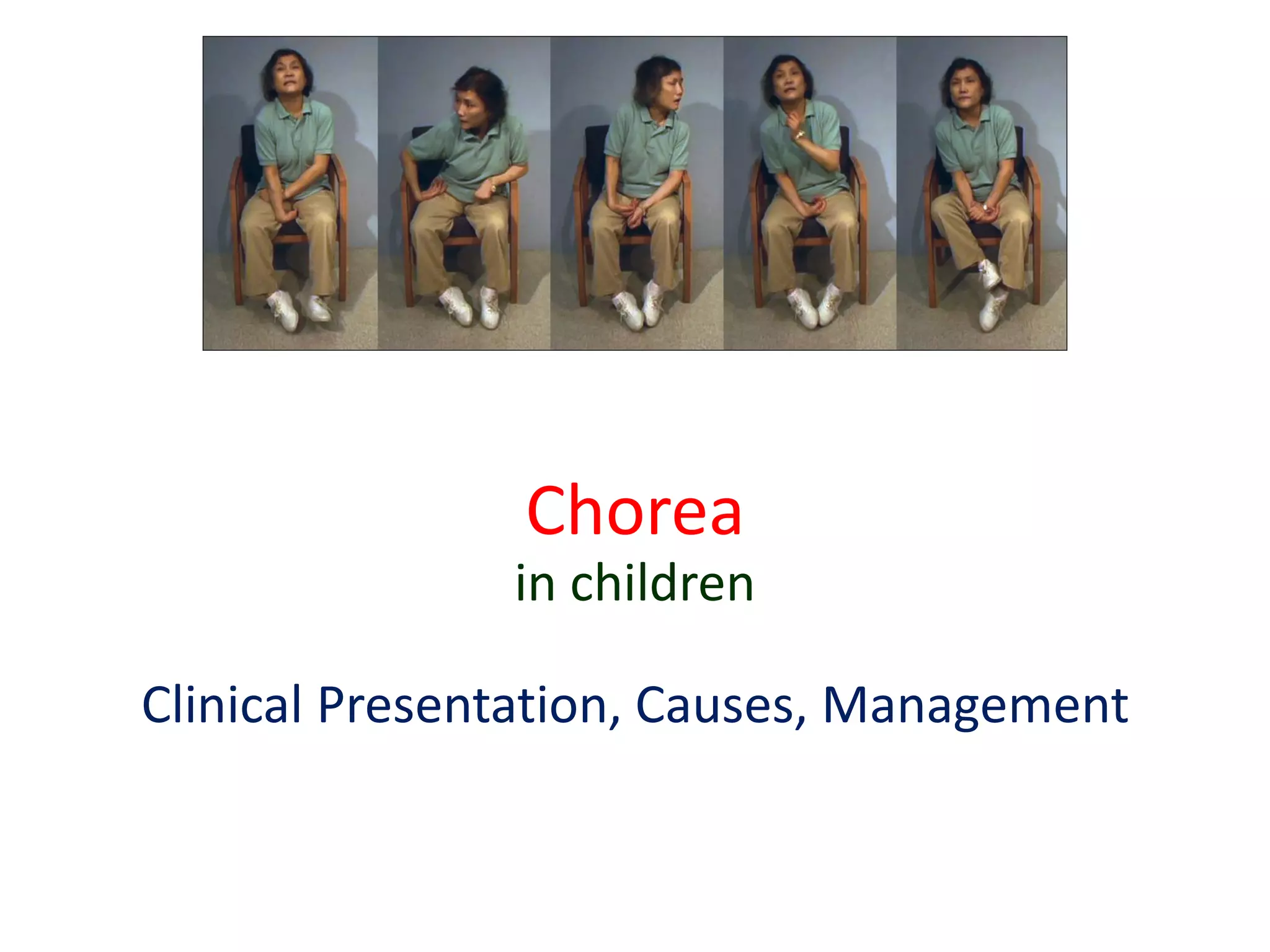
Chorea
in children
Clinical Presentation, Causes, Management
Chorea
• Involuntary movements
• Semi-purposive
• Random
• Variable movements
• Movements at rest
• Movements usually involve peripheral parts of body
• Inability to maintain static posture
Chorea (Video)
Chorea
Tongue sign
Chorea
Etiology
• Rheumatic Fever - Sydenham’s Chorea
• SLE
• Genetic disorders
Chorea
Management
• Sedatives – Diazepam, Clonazepam
• Anti-epileptics – Phenobarbitone, SodiumValproate
• Anti-Psychotics – Haloperidol, Chlorpromazine
Tic disorder
in children
Clinical Presentation, Causes
Motor Tics (Video)
Tics (Stereotype Movements)
• Motor movements or Vocalisations
• Involuntary, abrupt, repetitive, non-rhythmic
• Simple or complex
• Can be suppressed by voluntary effort
• often associated with other Behavior disorders
Myoclonus
in children
Clinical Presentation, Types, Causes
Myoclonus
Video
Myoclonus
• Muscle jerks – Involuntary, Sudden, Quick
• ETIOLOGY
• Physiological myoclonus – in sleep
• Essential myoclonus – aggravated by stress
• Epilepsy (myoclonic epilepsy)
• Acute Encephalopathy
• Degenerative Brain disorders
• MANGEMENT
• No treatment needed for Physiological myoclonus
Prof Imran Iqbal
Fellowship Pediatric Neurology-1991
Royal Children Hospital, Melbourne, Australia

Movement disorders in Children 2022.pdf