Cerebral Palsy
in Children
Definition, Epidemiology, Etiology, Clinical Features,
Diagnosis, Assessment, Management, Prognosis and Prevention
Prof. Imran Iqbal
Fellowship in Pediatric Neurology (Australia)
Prof of Paediatrics (2003-2018)
Prof of Pediatrics Emeritus, CHICH
Prof of Pediatrics, CIMS
Multan, Pakistan
(God Almighty speaking to Prophet Muhammad (PBUH)
Say, “It is He who created and nurtured you;
and given you the hearing, the vision, and the thinking.
But rarely do you pay gratitude.”
The Holy Quran; surah Al-Mulk 67:23
In the name of Our Creator Allah, the most Gracious, the most Merciful
CNS
Brain
Our perceptions and Movements
Evaluation
of the Child with
Neurological Symptoms
CNS – Abnormal Symptoms
• Convulsions
• Altered Consciousness
• Delayed development
• Intellectual handicap
• Speech problem
• Motor weakness / Walking problem
• Sensory changes
• Headache
• Unable to see / listen
History – Ask about Symptoms
• Neurological Symptoms –
• Onset
• Frequency
• Severity
• Progression
• Birth history
• Development history
• Family history
CNS – Abnormal Signs
• Developmental milestones (in relation to age)
• Impaired Conscious level (GCS)
• Convulsions
• Intellectual impairment (retardation / handicap)
• Motor weakness / Paralysis / Paresis
• Abnormal gait
• Abnormal movements
• Visual impairment
• Auditory impairment
CNS Examination
in Children
Examination of CNS in Children
• OBSERVE – observe the child
• General Physical Examination
• Developmental Examination
• NEUROLOGICAL EXAMINATION –
• Higher Mental Functions
• Cranial Nerves
• Motor System
• Sensory system
• Skull and Spine
• SOMI
Developmental Examination
Child Development
Areas of Development
 Posture and locomotion
 Vision and manipulation
 Hearing and speech
 Personal and social
Areas of Development
 Posture and locomotion
 Vision and manipulation
 Hearing and speech
 Personal and social
Milestones of Development
Posture and locomotion
 3 months – Head control
 6 months – Roll over
 9 months -– sit without support
 12 months – stand / walk held
Milestones of Development
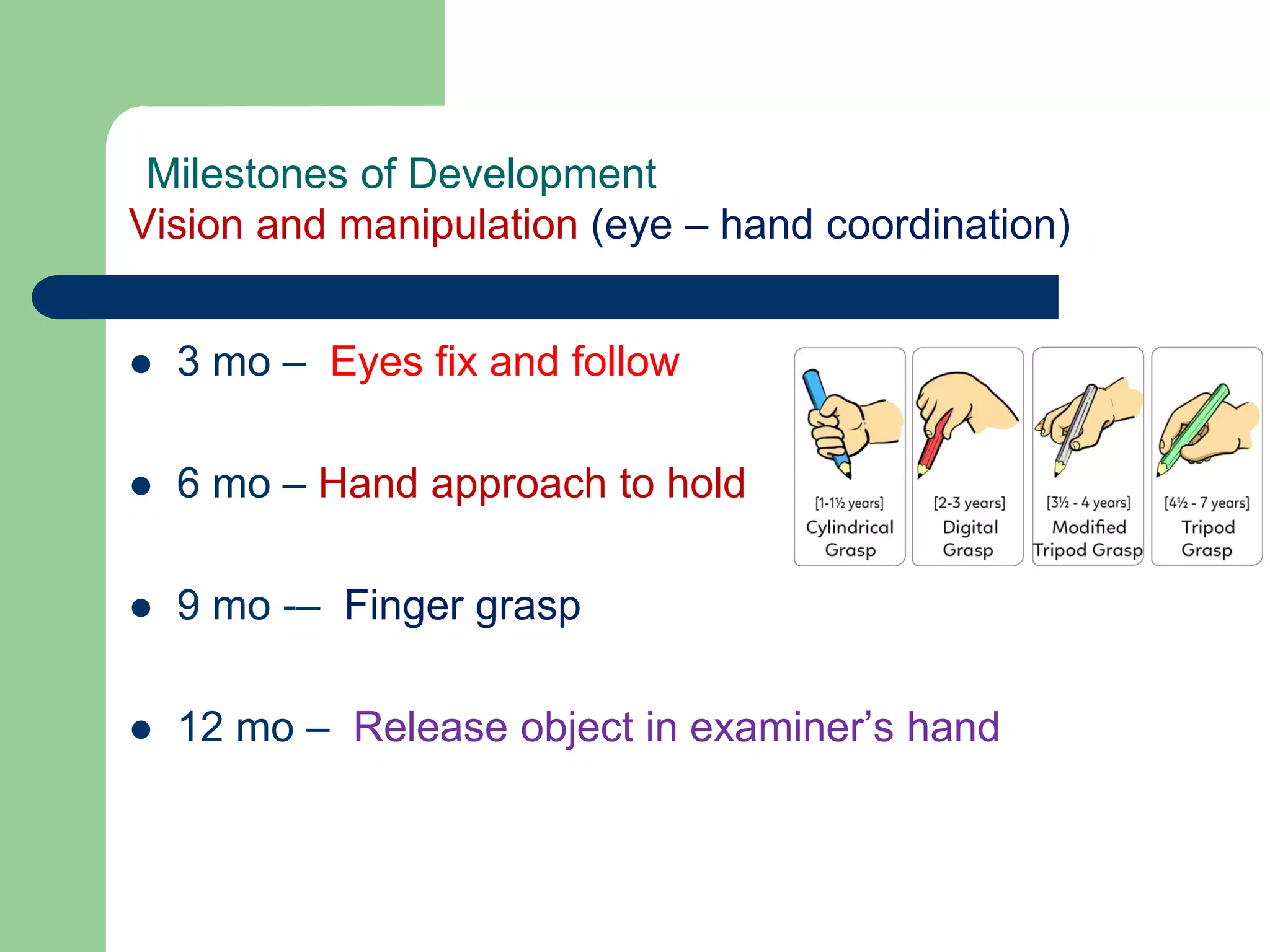
Vision and manipulation (eye – hand coordination)
 3 mo – Eyes fix and follow
 6 mo – Hand approach to hold
 9 mo -– Finger grasp
 12 mo – Release object in examiner’s hand
Milestones of Development
Hearing and Speech
 3 mo – Response to voice
 6 mo – Turn to sound
 9 mo -– Babbles
 12 mo – One word
Milestones of Development
Personal Social
 3 mo – Smile
 6 mo – Shows likes and dislikes
 9 mo – Stranger anxiety
 12 mo – Waves bye-bye
Neurological Examination
NEUROLOGICAL EXAMINATION
• Higher Mental Functions
• Cranial Nerves
• Motor System
• Sensory system
• Skull and Spine
• SOMI
Higher Mental Functions
• Conscious Level (Glasgow Coma Scale)
• Recognition and Response
• Behavior and activity
• Speech
• Memory
Cranial Nerves
• Visual focusing and following
• Light reflex
• Facial Movements
• Response to sound
• Sucking and Swallowing
• Palate movement and Gag reflex
Motor System
• Presence of spontaneous voluntary movements in
infant
• Size and Nutrition of muscles
• Tone
• Power
• Deep Tendon Reflexes
• Planter Reflex
• Gait
• Co-ordination
• Involuntary Movements
Sensory System
• Touch
• Pain
• Temperature
• Position
• Vibration
Skull & Spine
• Shape of skull
• Anterior fontanel
• Occipito-frontal Circumference (OFC)
• Spine – Curvature, local swelling
SOMI – Signs of Meningeal Irritation
• Bulging Anterior fontanel
• Neck rigidity
• Kernig's sign
• Brudzinski's sign
Clinical Presentation
of
CNS diseases
CNS disease – Clinical Presentation
• Seizures / Convulsions / Fits
• Impaired Conscious level
• Developmental delay
• Intellectual handicap
• Neurological Paralysis / Paresis (motor weakness )
• Neuromuscular disorders / Hypotonia
• Movement disorders
• Headache
• Regression of acquired milestones
• Behaviour problems
Developmental delay
and
Intellectual handicap
Developmental delay / Intellectual handicap
Etiology
• Perinatal Brain Damage (HIE) (Hypoxic Ischemic
Encephalopathy)
• Postnatal Brain damage (e.g. Meningitis)
• Cerebral Malformations (e.g. agenesis of corpus callosum)
• Chromosomal disorders (e.g. Down syndrome)
• Genetic syndromes (single gene defects)
• Degenerative brain diseases (Leukodystrophy)
• Hypothyroidism (Cretinism)
• Severe Systemic Diseases (cardiac, renal, malnutrition)
Developmental delay / Intellectual handicap
Clinical Presentation
• Cerebral Palsy
• Delayed development
• Intellectual disability
Cerebral Palsy
in Children
Definition, Epidemiology, Etiology,
Clinical Features, Diagnosis, Assessment,
Management, Prognosis and Prevention
Friday, October 29, 2021 CEREBRAL PALSY by DR. NAVEED ANJUM 34
Cerebral Palsy – Clinical Description
Damage to
Developing Brain
Disorder of
Movement
and Posture
Non-
progressive
Cerebral Palsy
Definition
• Cerebral Palsy is a group of disorders of movement and
posture causing activity limitation due to non-progressive
disturbances in the developing fetal or infant brain.
• Cerebral Palsy affects mainly movement produced by
skeletal muscles and posture of the body
• Cerebral Palsy results in delayed development
• Cerebral Palsy causes activity limitation
• Cerebral Palsy is produced by damage to developing fetal or
infant brain
Cerebral Palsy
Epidemiology
• Incidence: 3 / 1000 children
• Predisposing Factors / Etiology
• Most common cause in developed countries is a Cerebral
malformation
• Most common cause in developing countries is Perinatal
Asphyxia
Cerebral Palsy
Etiology
Pre – natal
Cerebral
malformations
Chorio-
amnionitis
TORCH
infections
Peri – natal
Perinatal
asphyxia
Preterm
VLBW
Post –natal
Meningitis
Intra-cranial
hemorrhage
Cerebrovascular
accidents
Kernicterus
Cerebral Palsy
Types
• Spastic CP – 80 %
-- (Hypertonia, hyper-reflexia)
– Cerebral cortex, Upper Motor Neurons most affected
• Dyskinetic CP – 10 %
-- (Choreo-athetoid movements) – Basal ganglia most affected
• Ataxic / Hypotonic CP – 5 %
- (hypotonia, ataxia) – Cerebellum most affected
• Mixed CP – 5 %
Cerebral Palsy
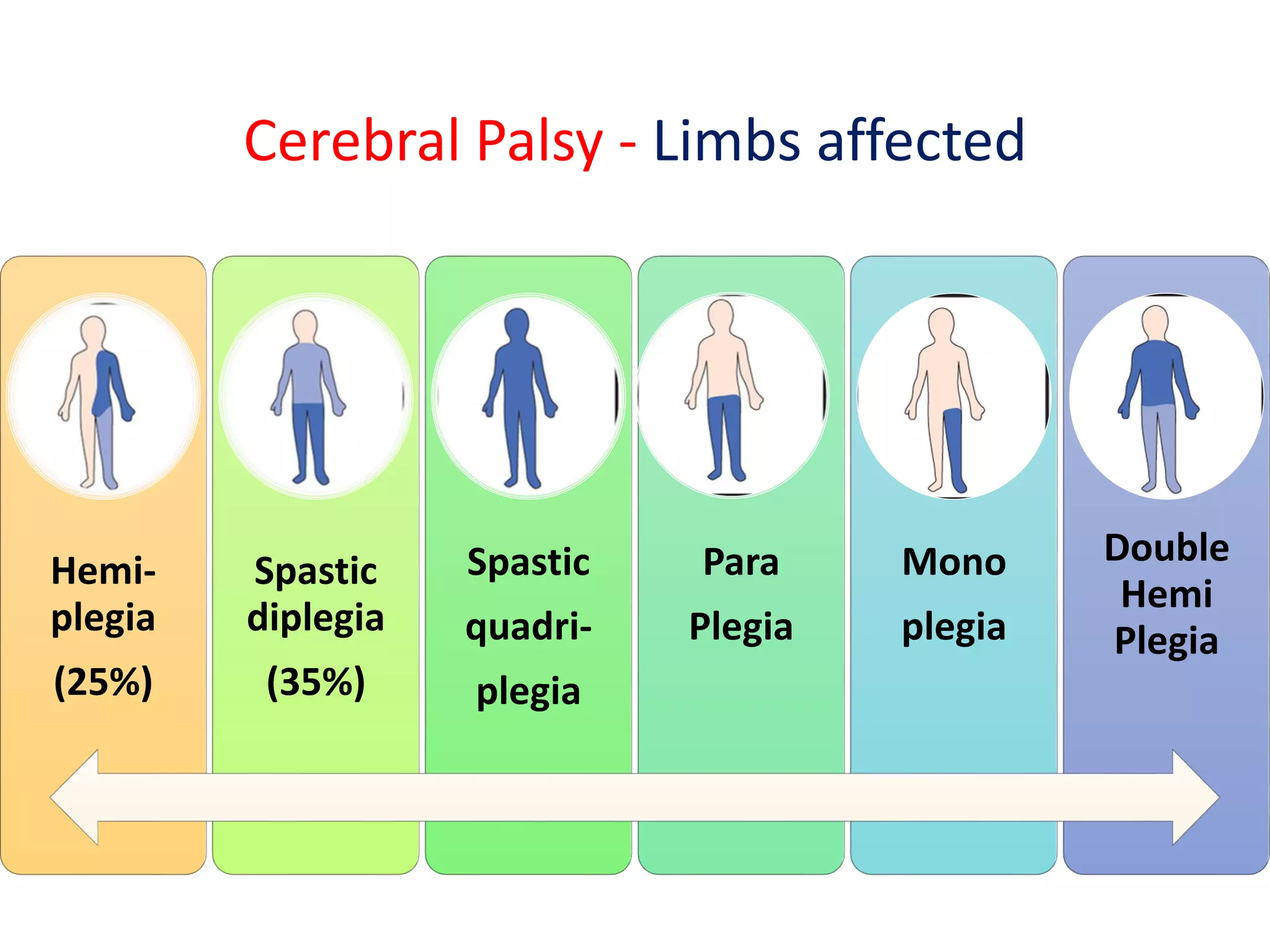
Spastic Type
Hemi-
plegia
(25%)
Spastic
diplegia
(35%)
Spastic
quadri-
plegia
Para
Plegia
Mono
plegia
Double
Hemi
Plegia
Cerebral Palsy - Limbs affected
Cerebral Palsy
Clinical Features, Diagnosis,
Associated Problems,
Case Scenario
Clinical History
• A 3 year old child presents with inability to walk.
• Development History
• Child started sitting at 18 months of age. He has not started
walking
• He is able to move forward in a sitting position with help of his
arms
• He recognizes his parents and has started speaking few words
• Birth History
• He was born at a clinic after a term pregnancy
• He had delayed cry after birth, and remained in hospital for few
days
• There is history of seizures in first week of life, and later during
febrile illnesses
Case Scenario
Clinical Examination
• On examination, his OFC is 46 cm
• Internal squint is seen in eyes
• There is drooling of saliva from the mouth
• Motor system examination shows hypertonia and hyper-reflexia
• He stands with support on his toes with legs crossed
• He can take a few steps sideways holding on to furniture
• What is your most likely diagnosis ?
• Cerebral Palsy (spastic type)
Cerebral Palsy
Clinical Features - Symptoms
• Delayed development
Posture and locomotion
Vision and manipulation
Hearing and speech
Personal and social
• Stiffness of muscles / neck extended / arching of back
• Seizures
• Unable to take solid foods
• Constipation
Cerebral Palsy
Clinical Features - Signs
• Microcephaly
• Drooling of saliva, difficulty in swallowing
• Neck extended / arching of back
• Fisting of hands
• Scissoring of legs
• Spasticity of muscles – hypertonia, hyper-reflexia
• Reduced range of movement of skeletal muscles
• Persistence of primitive reflexes
• Abnormal position and posture of the body
• Secondary musculoskeletal problems
Cerebral Palsy
Diagnosis
• History –
• Patient complaints – Delayed Development
• Birth History – fetal distress, delayed cry, meningitis in infancy
• Family History – No H/O delayed development in other sibs
• Physical signs –
• Microcephaly
• Drooling of saliva, difficulty in swallowing
• Fisting of hands
• Scissoring of legs
• Spasticity of muscles – hypertonia, hyper-reflexia
Cerebral Palsy
Differential Diagnosis
• Neuro-muscular disorders (Infantile spinal muscular
atrophy)
• Myopathies and muscular dystrophies (congenital
myopathy, Duchene muscular dystrophy)
• Genetic diseases – syndromes (chromosomal disorders,
single gene defects)
• Neuro-metabolic disorders (e.g. biotinidase deficiency)
• CNS degenerative disorders (leukodystrophy, hereditary
spastic paraplegia)
• Hypothyroidism (Cretinism)
Cerebral Palsy
Patient Evaluation
• Birth History – Perinatal hypoxia
• Development history – delay in one or more areas
• Developmental disabilities of child
• Posture, movements and mobility
• Vision
• Hearing and speech
• Behavior
• Associated problems
Cerebral Palsy
Associated problems
• Epilepsy – 50%
• Intellectual disability – 50%
• Learning problems
• Squint
• Poor response to sound
• Poor speech and communication
• Swallowing difficulties
• Constipation
• Altered somatic sensations
• Behavior problems
• Positional deformities and contractures
Cerebral Palsy
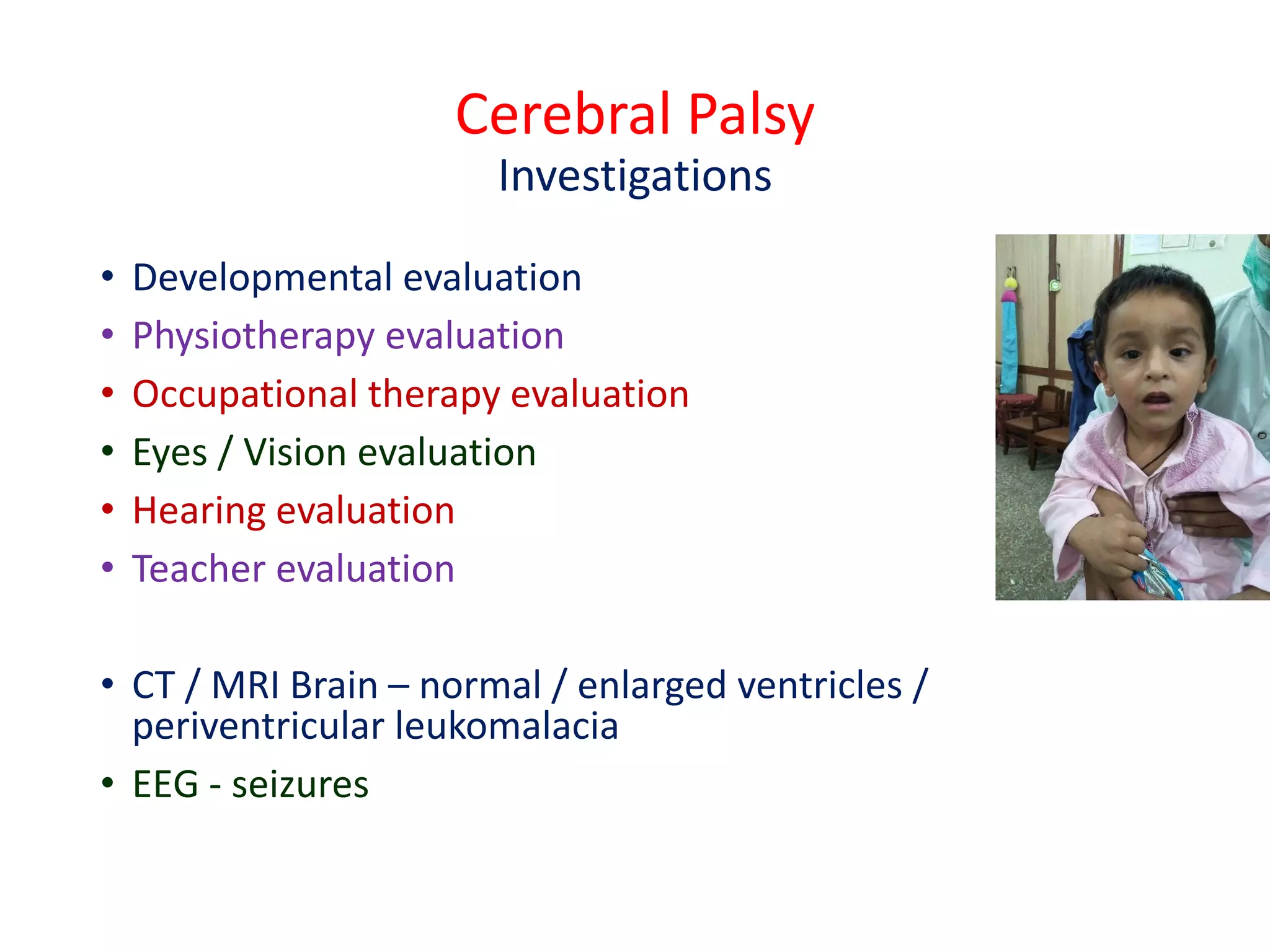
Investigations
• Developmental evaluation
• Physiotherapy evaluation
• Occupational therapy evaluation
• Eyes / Vision evaluation
• Hearing evaluation
• Teacher evaluation
• CT / MRI Brain – normal / enlarged ventricles /
periventricular leukomalacia
• EEG - seizures
Cerebral Palsy – CT Brain
Atrophy and Infarctions
Cerebral Palsy
Management, Prognosis and Prevention
Cerebral Palsy
Multi-disciplinary Management
• Pediatrician / Pediatric Neurologist
• Psychologist / Developmental therapist
• Physiotherapist
• Occupational therapist
• Ophthalmologist
• Audiologist
• Teacher
• Rehabilitation specialist
• Orthopedic surgeon
Cerebral Palsy
Medications
• Seizures: Anti-epileptics
-- Phenobarbitone, Leviteracetam, Sodium valproate,
• Spasticity: Muscle Relaxants
-- Baclofen
-- Tizanidine
• Constipation: Laxatives
-- Mineral oil / Prune juice
-- Lactulose / Lactitol
• Micronutrients – Vitamins and minerals
Cerebral Palsy
Physiotherapy and Rehabilitation
Physiotherapy
• Positioning of body – to relax the muscles
• Passive Exercises – range of motion
• Active movements – teaching daily activities
Occupational therapy
• Hand function techniques, Feeding techniques
Speech therapy
• Language and Communication skills
Rehabilitation therapy
• Splints / Orthotic supports, Walking aids
Cerebral Palsy
Surgery
• Usually performed by 10 years of age
• Relieve the contractures –
= Tendo-achilles
= Adductors
• Strengthen the weak movements – tendon transfer
Cerebral Palsy
Prognosis
• Severity – of neurological deficits
• Management – Early diagnosis and Effective Management
• Progress of child – if the child is able to sit by 2 years of age,
he is expected to walk by 5 years of age
Cerebral Palsy
Prevention
 Efficient medical care during Pregnancy
 Prevention of Birth asphyxia during birth of baby
 Early management of Neonatal disorders
 Effective management of Neurological diseases in infancy
UN Convention on the Rights of the Child
1989
“A disabled child has the right to enjoy
a full and decent life,
in conditions which
ensure dignity,
promote self-reliance
and
facilitate the child’s active participation
in the community.”
Prof Imran Iqbal
Fellowship Pediatric Neurology-1991
Royal Children Hospital, Melbourne, Australia

Cerebral palsy in children 2021

  • 1.
    Cerebral Palsy in Children Definition,Epidemiology, Etiology, Clinical Features, Diagnosis, Assessment, Management, Prognosis and Prevention Prof. Imran Iqbal Fellowship in Pediatric Neurology (Australia) Prof of Paediatrics (2003-2018) Prof of Pediatrics Emeritus, CHICH Prof of Pediatrics, CIMS Multan, Pakistan
  • 2.
    (God Almighty speakingto Prophet Muhammad (PBUH) Say, “It is He who created and nurtured you; and given you the hearing, the vision, and the thinking. But rarely do you pay gratitude.” The Holy Quran; surah Al-Mulk 67:23 In the name of Our Creator Allah, the most Gracious, the most Merciful
  • 3.
  • 4.
  • 5.
  • 6.
    Evaluation of the Childwith Neurological Symptoms
  • 7.
    CNS – AbnormalSymptoms • Convulsions • Altered Consciousness • Delayed development • Intellectual handicap • Speech problem • Motor weakness / Walking problem • Sensory changes • Headache • Unable to see / listen
  • 8.
    History – Askabout Symptoms • Neurological Symptoms – • Onset • Frequency • Severity • Progression • Birth history • Development history • Family history
  • 9.
    CNS – AbnormalSigns • Developmental milestones (in relation to age) • Impaired Conscious level (GCS) • Convulsions • Intellectual impairment (retardation / handicap) • Motor weakness / Paralysis / Paresis • Abnormal gait • Abnormal movements • Visual impairment • Auditory impairment
  • 10.
  • 11.
    Examination of CNSin Children • OBSERVE – observe the child • General Physical Examination • Developmental Examination • NEUROLOGICAL EXAMINATION – • Higher Mental Functions • Cranial Nerves • Motor System • Sensory system • Skull and Spine • SOMI
  • 12.
  • 13.
  • 14.
    Areas of Development Posture and locomotion  Vision and manipulation  Hearing and speech  Personal and social
  • 15.
    Areas of Development Posture and locomotion  Vision and manipulation  Hearing and speech  Personal and social
  • 16.
    Milestones of Development Postureand locomotion  3 months – Head control  6 months – Roll over  9 months -– sit without support  12 months – stand / walk held
  • 17.
    Milestones of Development Visionand manipulation (eye – hand coordination)  3 mo – Eyes fix and follow  6 mo – Hand approach to hold  9 mo -– Finger grasp  12 mo – Release object in examiner’s hand
  • 18.
    Milestones of Development Hearingand Speech  3 mo – Response to voice  6 mo – Turn to sound  9 mo -– Babbles  12 mo – One word
  • 19.
    Milestones of Development PersonalSocial  3 mo – Smile  6 mo – Shows likes and dislikes  9 mo – Stranger anxiety  12 mo – Waves bye-bye
  • 20.
  • 21.
    NEUROLOGICAL EXAMINATION • HigherMental Functions • Cranial Nerves • Motor System • Sensory system • Skull and Spine • SOMI
  • 22.
    Higher Mental Functions •Conscious Level (Glasgow Coma Scale) • Recognition and Response • Behavior and activity • Speech • Memory
  • 23.
    Cranial Nerves • Visualfocusing and following • Light reflex • Facial Movements • Response to sound • Sucking and Swallowing • Palate movement and Gag reflex
  • 24.
    Motor System • Presenceof spontaneous voluntary movements in infant • Size and Nutrition of muscles • Tone • Power • Deep Tendon Reflexes • Planter Reflex • Gait • Co-ordination • Involuntary Movements
  • 25.
    Sensory System • Touch •Pain • Temperature • Position • Vibration
  • 26.
    Skull & Spine •Shape of skull • Anterior fontanel • Occipito-frontal Circumference (OFC) • Spine – Curvature, local swelling
  • 27.
    SOMI – Signsof Meningeal Irritation • Bulging Anterior fontanel • Neck rigidity • Kernig's sign • Brudzinski's sign
  • 28.
  • 29.
    CNS disease –Clinical Presentation • Seizures / Convulsions / Fits • Impaired Conscious level • Developmental delay • Intellectual handicap • Neurological Paralysis / Paresis (motor weakness ) • Neuromuscular disorders / Hypotonia • Movement disorders • Headache • Regression of acquired milestones • Behaviour problems
  • 30.
  • 31.
    Developmental delay /Intellectual handicap Etiology • Perinatal Brain Damage (HIE) (Hypoxic Ischemic Encephalopathy) • Postnatal Brain damage (e.g. Meningitis) • Cerebral Malformations (e.g. agenesis of corpus callosum) • Chromosomal disorders (e.g. Down syndrome) • Genetic syndromes (single gene defects) • Degenerative brain diseases (Leukodystrophy) • Hypothyroidism (Cretinism) • Severe Systemic Diseases (cardiac, renal, malnutrition)
  • 32.
    Developmental delay /Intellectual handicap Clinical Presentation • Cerebral Palsy • Delayed development • Intellectual disability
  • 33.
    Cerebral Palsy in Children Definition,Epidemiology, Etiology, Clinical Features, Diagnosis, Assessment, Management, Prognosis and Prevention
  • 34.
    Friday, October 29,2021 CEREBRAL PALSY by DR. NAVEED ANJUM 34 Cerebral Palsy – Clinical Description Damage to Developing Brain Disorder of Movement and Posture Non- progressive
  • 35.
    Cerebral Palsy Definition • CerebralPalsy is a group of disorders of movement and posture causing activity limitation due to non-progressive disturbances in the developing fetal or infant brain. • Cerebral Palsy affects mainly movement produced by skeletal muscles and posture of the body • Cerebral Palsy results in delayed development • Cerebral Palsy causes activity limitation • Cerebral Palsy is produced by damage to developing fetal or infant brain
  • 36.
    Cerebral Palsy Epidemiology • Incidence:3 / 1000 children • Predisposing Factors / Etiology • Most common cause in developed countries is a Cerebral malformation • Most common cause in developing countries is Perinatal Asphyxia
  • 37.
    Cerebral Palsy Etiology Pre –natal Cerebral malformations Chorio- amnionitis TORCH infections Peri – natal Perinatal asphyxia Preterm VLBW Post –natal Meningitis Intra-cranial hemorrhage Cerebrovascular accidents Kernicterus
  • 38.
    Cerebral Palsy Types • SpasticCP – 80 % -- (Hypertonia, hyper-reflexia) – Cerebral cortex, Upper Motor Neurons most affected • Dyskinetic CP – 10 % -- (Choreo-athetoid movements) – Basal ganglia most affected • Ataxic / Hypotonic CP – 5 % - (hypotonia, ataxia) – Cerebellum most affected • Mixed CP – 5 %
  • 40.
  • 41.
  • 42.
    Cerebral Palsy Clinical Features,Diagnosis, Associated Problems,
  • 43.
    Case Scenario Clinical History •A 3 year old child presents with inability to walk. • Development History • Child started sitting at 18 months of age. He has not started walking • He is able to move forward in a sitting position with help of his arms • He recognizes his parents and has started speaking few words • Birth History • He was born at a clinic after a term pregnancy • He had delayed cry after birth, and remained in hospital for few days • There is history of seizures in first week of life, and later during febrile illnesses
  • 44.
    Case Scenario Clinical Examination •On examination, his OFC is 46 cm • Internal squint is seen in eyes • There is drooling of saliva from the mouth • Motor system examination shows hypertonia and hyper-reflexia • He stands with support on his toes with legs crossed • He can take a few steps sideways holding on to furniture • What is your most likely diagnosis ? • Cerebral Palsy (spastic type)
  • 45.
    Cerebral Palsy Clinical Features- Symptoms • Delayed development Posture and locomotion Vision and manipulation Hearing and speech Personal and social • Stiffness of muscles / neck extended / arching of back • Seizures • Unable to take solid foods • Constipation
  • 46.
    Cerebral Palsy Clinical Features- Signs • Microcephaly • Drooling of saliva, difficulty in swallowing • Neck extended / arching of back • Fisting of hands • Scissoring of legs • Spasticity of muscles – hypertonia, hyper-reflexia • Reduced range of movement of skeletal muscles • Persistence of primitive reflexes • Abnormal position and posture of the body • Secondary musculoskeletal problems
  • 47.
    Cerebral Palsy Diagnosis • History– • Patient complaints – Delayed Development • Birth History – fetal distress, delayed cry, meningitis in infancy • Family History – No H/O delayed development in other sibs • Physical signs – • Microcephaly • Drooling of saliva, difficulty in swallowing • Fisting of hands • Scissoring of legs • Spasticity of muscles – hypertonia, hyper-reflexia
  • 48.
    Cerebral Palsy Differential Diagnosis •Neuro-muscular disorders (Infantile spinal muscular atrophy) • Myopathies and muscular dystrophies (congenital myopathy, Duchene muscular dystrophy) • Genetic diseases – syndromes (chromosomal disorders, single gene defects) • Neuro-metabolic disorders (e.g. biotinidase deficiency) • CNS degenerative disorders (leukodystrophy, hereditary spastic paraplegia) • Hypothyroidism (Cretinism)
  • 49.
    Cerebral Palsy Patient Evaluation •Birth History – Perinatal hypoxia • Development history – delay in one or more areas • Developmental disabilities of child • Posture, movements and mobility • Vision • Hearing and speech • Behavior • Associated problems
  • 50.
    Cerebral Palsy Associated problems •Epilepsy – 50% • Intellectual disability – 50% • Learning problems • Squint • Poor response to sound • Poor speech and communication • Swallowing difficulties • Constipation • Altered somatic sensations • Behavior problems • Positional deformities and contractures
  • 51.
    Cerebral Palsy Investigations • Developmentalevaluation • Physiotherapy evaluation • Occupational therapy evaluation • Eyes / Vision evaluation • Hearing evaluation • Teacher evaluation • CT / MRI Brain – normal / enlarged ventricles / periventricular leukomalacia • EEG - seizures
  • 52.
    Cerebral Palsy –CT Brain Atrophy and Infarctions
  • 53.
  • 54.
    Cerebral Palsy Multi-disciplinary Management •Pediatrician / Pediatric Neurologist • Psychologist / Developmental therapist • Physiotherapist • Occupational therapist • Ophthalmologist • Audiologist • Teacher • Rehabilitation specialist • Orthopedic surgeon
  • 55.
    Cerebral Palsy Medications • Seizures:Anti-epileptics -- Phenobarbitone, Leviteracetam, Sodium valproate, • Spasticity: Muscle Relaxants -- Baclofen -- Tizanidine • Constipation: Laxatives -- Mineral oil / Prune juice -- Lactulose / Lactitol • Micronutrients – Vitamins and minerals
  • 56.
    Cerebral Palsy Physiotherapy andRehabilitation Physiotherapy • Positioning of body – to relax the muscles • Passive Exercises – range of motion • Active movements – teaching daily activities Occupational therapy • Hand function techniques, Feeding techniques Speech therapy • Language and Communication skills Rehabilitation therapy • Splints / Orthotic supports, Walking aids
  • 57.
    Cerebral Palsy Surgery • Usuallyperformed by 10 years of age • Relieve the contractures – = Tendo-achilles = Adductors • Strengthen the weak movements – tendon transfer
  • 58.
    Cerebral Palsy Prognosis • Severity– of neurological deficits • Management – Early diagnosis and Effective Management • Progress of child – if the child is able to sit by 2 years of age, he is expected to walk by 5 years of age
  • 59.
    Cerebral Palsy Prevention  Efficientmedical care during Pregnancy  Prevention of Birth asphyxia during birth of baby  Early management of Neonatal disorders  Effective management of Neurological diseases in infancy
  • 60.
    UN Convention onthe Rights of the Child 1989 “A disabled child has the right to enjoy a full and decent life, in conditions which ensure dignity, promote self-reliance and facilitate the child’s active participation in the community.”
  • 61.
    Prof Imran Iqbal FellowshipPediatric Neurology-1991 Royal Children Hospital, Melbourne, Australia