Stem cell Therapy
Aakifah Amreen H.
Content
• Introduction
• Source
• Properties of stem cells
• Types of stem cells
• How stem cells work
• Current stem cells therapy
• Advantages
• Conclusion
• References
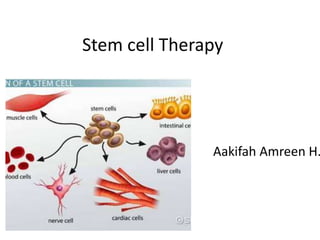
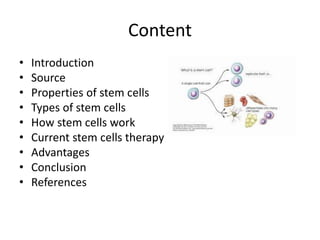
What is stem cells
• Cells in the body have specific purposes, but
stem cells are cells that do not yet have a
specific role and can become almost any cell
that is required.
• Stem cells are undifferentiated cells that can
turn into specific cells, as the body needs
them.
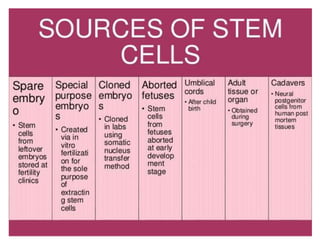
Source
• A person's body contains stem cells throughout
their life. The body can use these stem cells
whenever it needs them.
• Also called tissue-specific or somatic stem cells,
adult stem cells exist throughout the body from the
time an embryo develops.
• The cells are in a non-specific state, but they are
more specialized than embryonic stem cells. They
remain in this state until the body needs them for a
specific purpose
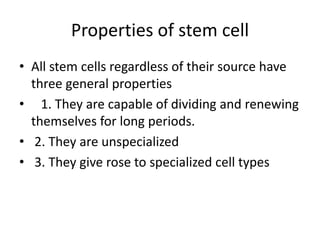
Properties of stem cell
• All stem cells regardless of their source have
three general properties
• 1. They are capable of dividing and renewing
themselves for long periods.
• 2. They are unspecialized
• 3. They give rose to specialized cell types
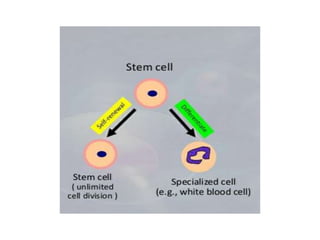
Self renewable
• Stem cells are capable of dividing & renewing
themselves for long periods
• - This is unlike muscle, blood or nerve cells-
which don't normally replicate themselves
• - This cells are capable of long term self
renewal
Unspecialization
• Stem cells are unspecialized
• They do not have any tissue - specific
structures that allow for specialized function
Specialization
• Differentiation : unspecialized stem cells give
rise to specialized (differentiated) cells in
response to external and internal chemical
agents
Types of stem cells
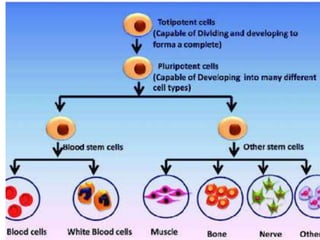
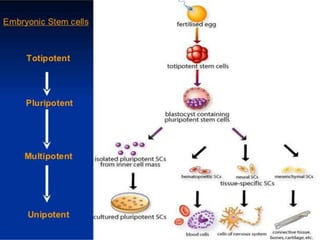
• Totipotent
• The ability to differentiate into all types of
cells;can form any cell of the embryo as well
as the placenta
• Pluripotent
• The ability to differentiate into almost all
types of tissues except placental tissue
• Multipotent
• Can differentiate into multiple specialized cells
of a closely related family of cells
• Oligopotent
• ability to differentiate into a few cells
• Unipotent
• these cells produce only one cell type , but
have the property of self renewal which
distinguish them from non stem cells
Types of stem cells
• Embryonic stem cells
• Embryonic stem cells come from human embryos that are
three to five days old.
• They are harvested during a process called in-vitro
fertilization.
• This involves fertilizing an embryo in a laboratory instead of
inside the female body.
• Embryonic stem cells are known as pluripotent stem cells.
• These cells can give rise to virtually any other type of cell in
the body.
• Adult stem cells derived from mature
organisms that can divide to form
differentiated cells, but are less versatile &
more difficult to identify, isolate, purify. ex-
stem cells found in blood, bone marrow liver,
etc
• Fetal derived from aborted Fetal tissue
• Umbilical derived from Umbilical cords- all
blood cells
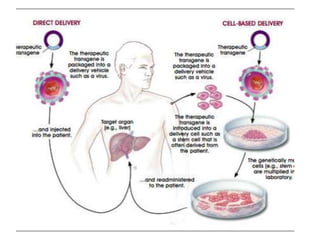
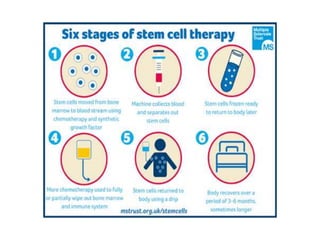
How stem cells therapy work
• When stem cells are transplanted into the
body and arrive into the injured part they are
targeted for tissue regeneration, the stem cells
come in contact with growth factors or
chemicals in he body. Those chemicals
program the stem cells to differentiate into
the tissue surrounding it.
Current stem cell Therapy
Brain damage
• Stroke and traumatic brain injury lead to celldeath,
characterized bya loss of neurons
andoligodendrocytes within the brain.
• Healthy adult brains contain neural stem cells
which divide tomaintain general stem cell numbers,
or become progenitor cells.
• Stem cells may also be used to treat brain
degeneration, such as in Parkinson's and
Alzheimer's disease.
Cancer
• Stem cell therapies may serve as potential treatments
for cancer as current cancer treatments are designed
to kill cancer cells however The stem cells neither
differentiated nor turned tumorigenic.
• Essentially, chemotherapy is used to completely
destroy the patients own lymphocytes, and stem cells
injected, eventually replacing the immune system of
the patient with that of the healthy donor.
Spinal cord injury
• Multipotent isolated adult stem cells from umbilical cord
blood were injected into the damaged part of the spinal cord
of a patient suffering from a spinal cord injury and following
the procedure, patient could walk on their own,without
difficulty.
• The observed recovery was associated with differentiation of
transplanted cells into new neurons and oligodendrocytes
• ‐ thelatter of which forms the myelin sheath around axons of
the central nervous system, thus insulating neural impulses
and facilitating communication with the brain.
Heart Damage
• Several clinical trials targeting heart disease have shown that
adult stem cell therapy is safe, effective,and equally efficient
in treating old and recent infarcts
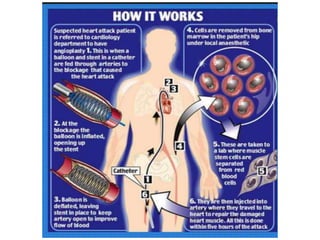
• Stem cell therapy for treatment of myocardial infarction
usually makes use of bone marrow stem cells
• Possible mechanisms of recovery include:
• – Generation of heart muscle cells
• – Stimulation of growth of new blood vessels to repopulate
• damaged heart tissue
• – Secretion of growth factors
Diabetes
• Diabetes patients lose the function of insulin producing beta cells within the pancreas. Human embryonic
stem cells may be grown in cell culture and stimulated to form insulin‐producing cells that can be
transplanted into the patient.
• However, clinical success is highly dependent on the development of the following procedures:
• – Transplanted cells should proliferate
• – Transplanted cells should differentiate in
• a site
• ‐specific manner
• – Transplanted cells should survive in the recipient (prevention of
• transplant rejection)
• – Transplanted cells should integrate within the targeted tissue
• – Transplanted cells should integrate into the host circuitry and
• restore function
Advantages of stem cell therapy
• May be done under local anesthesia
• • No cutting or stitches
• • Your own natural fat and stem cells
• • Minimal risk of complications
• • Minimal recovery time
• • Natural looking results
• • Helps to correct defect by filling and restoring symmetry
• • Helps improve appearance of skin
• • Regenerates and heals tissues
• • Improves blood flow to the area
• • Softens scars
• • Long lasting results
• • No foreign materials
• • At a fraction of the cost of older methods
Conclusion
• Stem cell Therapy is done using unspecialized
cell which has capacity to differentiate into
different cells.
• It is painless and effective therapy
Reference
• https://www.healthline.com/health/stem-cell-
research
• https://www.mayoclinic.org/tests-
procedures/bone-marrow-transplant/in-
depth/stem-cells/art-20048117
• https://www.researchgate.net/publication/240396
00_Introduction_to_Stem_Cell_Therapy
• https://www.karger.com/Article/Fulltext/345615
Stem cell Therapy

Stem cell Therapy

  • 1.
  • 2.
    Content • Introduction • Source •Properties of stem cells • Types of stem cells • How stem cells work • Current stem cells therapy • Advantages • Conclusion • References
  • 3.
    What is stemcells • Cells in the body have specific purposes, but stem cells are cells that do not yet have a specific role and can become almost any cell that is required. • Stem cells are undifferentiated cells that can turn into specific cells, as the body needs them.
  • 4.
    Source • A person'sbody contains stem cells throughout their life. The body can use these stem cells whenever it needs them. • Also called tissue-specific or somatic stem cells, adult stem cells exist throughout the body from the time an embryo develops. • The cells are in a non-specific state, but they are more specialized than embryonic stem cells. They remain in this state until the body needs them for a specific purpose
  • 6.
    Properties of stemcell • All stem cells regardless of their source have three general properties • 1. They are capable of dividing and renewing themselves for long periods. • 2. They are unspecialized • 3. They give rose to specialized cell types
  • 8.
    Self renewable • Stemcells are capable of dividing & renewing themselves for long periods • - This is unlike muscle, blood or nerve cells- which don't normally replicate themselves • - This cells are capable of long term self renewal
  • 9.
    Unspecialization • Stem cellsare unspecialized • They do not have any tissue - specific structures that allow for specialized function
  • 10.
    Specialization • Differentiation :unspecialized stem cells give rise to specialized (differentiated) cells in response to external and internal chemical agents
  • 11.
    Types of stemcells • Totipotent • The ability to differentiate into all types of cells;can form any cell of the embryo as well as the placenta • Pluripotent • The ability to differentiate into almost all types of tissues except placental tissue
  • 12.
    • Multipotent • Candifferentiate into multiple specialized cells of a closely related family of cells • Oligopotent • ability to differentiate into a few cells • Unipotent • these cells produce only one cell type , but have the property of self renewal which distinguish them from non stem cells
  • 15.
    Types of stemcells • Embryonic stem cells • Embryonic stem cells come from human embryos that are three to five days old. • They are harvested during a process called in-vitro fertilization. • This involves fertilizing an embryo in a laboratory instead of inside the female body. • Embryonic stem cells are known as pluripotent stem cells. • These cells can give rise to virtually any other type of cell in the body.
  • 16.
    • Adult stemcells derived from mature organisms that can divide to form differentiated cells, but are less versatile & more difficult to identify, isolate, purify. ex- stem cells found in blood, bone marrow liver, etc • Fetal derived from aborted Fetal tissue • Umbilical derived from Umbilical cords- all blood cells
  • 17.
    How stem cellstherapy work • When stem cells are transplanted into the body and arrive into the injured part they are targeted for tissue regeneration, the stem cells come in contact with growth factors or chemicals in he body. Those chemicals program the stem cells to differentiate into the tissue surrounding it.
  • 20.
  • 21.
    Brain damage • Strokeand traumatic brain injury lead to celldeath, characterized bya loss of neurons andoligodendrocytes within the brain. • Healthy adult brains contain neural stem cells which divide tomaintain general stem cell numbers, or become progenitor cells. • Stem cells may also be used to treat brain degeneration, such as in Parkinson's and Alzheimer's disease.
  • 22.
    Cancer • Stem celltherapies may serve as potential treatments for cancer as current cancer treatments are designed to kill cancer cells however The stem cells neither differentiated nor turned tumorigenic. • Essentially, chemotherapy is used to completely destroy the patients own lymphocytes, and stem cells injected, eventually replacing the immune system of the patient with that of the healthy donor.
  • 23.
    Spinal cord injury •Multipotent isolated adult stem cells from umbilical cord blood were injected into the damaged part of the spinal cord of a patient suffering from a spinal cord injury and following the procedure, patient could walk on their own,without difficulty. • The observed recovery was associated with differentiation of transplanted cells into new neurons and oligodendrocytes • ‐ thelatter of which forms the myelin sheath around axons of the central nervous system, thus insulating neural impulses and facilitating communication with the brain.
  • 24.
    Heart Damage • Severalclinical trials targeting heart disease have shown that adult stem cell therapy is safe, effective,and equally efficient in treating old and recent infarcts • Stem cell therapy for treatment of myocardial infarction usually makes use of bone marrow stem cells • Possible mechanisms of recovery include: • – Generation of heart muscle cells • – Stimulation of growth of new blood vessels to repopulate • damaged heart tissue • – Secretion of growth factors
  • 26.
    Diabetes • Diabetes patientslose the function of insulin producing beta cells within the pancreas. Human embryonic stem cells may be grown in cell culture and stimulated to form insulin‐producing cells that can be transplanted into the patient. • However, clinical success is highly dependent on the development of the following procedures: • – Transplanted cells should proliferate • – Transplanted cells should differentiate in • a site • ‐specific manner • – Transplanted cells should survive in the recipient (prevention of • transplant rejection) • – Transplanted cells should integrate within the targeted tissue • – Transplanted cells should integrate into the host circuitry and • restore function
  • 27.
    Advantages of stemcell therapy • May be done under local anesthesia • • No cutting or stitches • • Your own natural fat and stem cells • • Minimal risk of complications • • Minimal recovery time • • Natural looking results • • Helps to correct defect by filling and restoring symmetry • • Helps improve appearance of skin • • Regenerates and heals tissues • • Improves blood flow to the area • • Softens scars • • Long lasting results • • No foreign materials • • At a fraction of the cost of older methods
  • 28.
    Conclusion • Stem cellTherapy is done using unspecialized cell which has capacity to differentiate into different cells. • It is painless and effective therapy
  • 29.
    Reference • https://www.healthline.com/health/stem-cell- research • https://www.mayoclinic.org/tests- procedures/bone-marrow-transplant/in- depth/stem-cells/art-20048117 •https://www.researchgate.net/publication/240396 00_Introduction_to_Stem_Cell_Therapy • https://www.karger.com/Article/Fulltext/345615