University of Engineering & Technology Lahore
(Narowal Campus)
Name : Talha Ahsan
Reg.No : 2018-BME-138
Course Subject : Biochemistry
Topic of Presentation : Hormones & Cell signaling Agents
Submitted To : Mr. Habib Hussain
1
Hormones & Cell Signaling
Agents
2
Learning Outcomes
• To learn how the cells actually differentiate, grow & adapt to the changing conditions.
• To learn how the cells communicate with one another.
• To learn about the agents involved in cell signaling , the receptor site & signal transduction.
• To learn how a response is produced due to some stimulus.
3
4
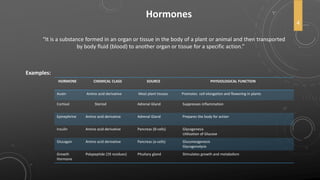
“It is a substance formed in an organ or tissue in the body of a plant or animal and then transported
by body fluid (blood) to another organ or tissue for a specific action.”
Hormones
Examples:
HORMONE CHEMICAL CLASS SOURCE PHYSIOLOGICAL FUNCTION
Auxin Amino acid derivative Most plant tissues Promotes cell elongation and flowering in plants
Cortisol Steriod Adrenal Gland Suppresses inflammation
Epinephrine Amino acid derivative Adrenal Gland Prepares the body for action
Insulin Amino acid derivative Pancreas (B-cells) Glycogenesis
Utilization of Glucose
Glucagon Amino acid derivative Pancreas (a-cells) Gluconeogenesis
Glycogenolysis
Growth
Hormone
Polypeptide (19 residues) Pituitary gland Stimulates growth and metabolism
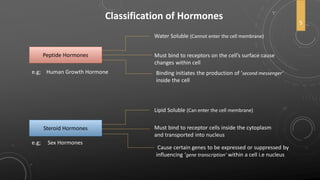
Classification of Hormones
Peptide Hormones
Water Soluble (Cannot enter the cell membrane)
Must bind to receptors on the cell’s surface cause
changes within cell
Binding initiates the production of ‘second messenger’
inside the cell
e.g; Human Growth Hormone
Steroid Hormones
Lipid Soluble (Can enter the cell membrane)
Must bind to receptor cells inside the cytoplasm
and transported into nucleus
Cause certain genes to be expressed or suppressed by
influencing ‘gene transcription’ within a cell i.e nucleus
e.g; Sex Hormones
5
CellSignaling
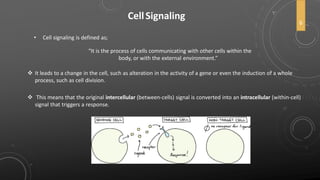
• Cell signaling is defined as;
“It is the process of cells communicating with other cells within the
body, or with the external environment.”
 This means that the original intercellular (between-cells) signal is converted into an intracellular (within-cell)
signal that triggers a response.
 It leads to a change in the cell, such as alteration in the activity of a gene or even the induction of a whole
process, such as cell division.
6
Chemical Messengers
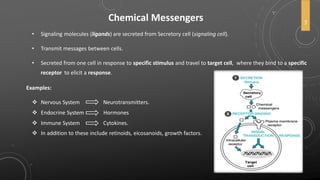
• Signaling molecules (ligands) are secreted from Secretory cell (signaling cell).
• Transmit messages between cells.
• Secreted from one cell in response to specific stimulus and travel to target cell, where they bind to a specific
receptor to elicit a response.
Examples:
 Nervous System Neurotransmitters.
 Endocrine System Hormones
 Immune System Cytokines.
 In addition to these include retinoids, eicosanoids, growth factors.
7
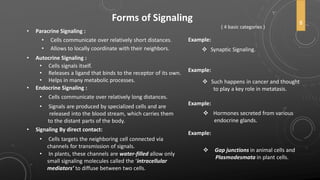
Forms of Signaling
( 4 basic categories )
• Paracrine Signaling :
• Endocrine Signaling :
• Autocrine Signaling :
• Signaling By direct contact:
• Cells communicate over relatively short distances.
• Allows to locally coordinate with their neighbors.
Example:
 Synaptic Signaling.
• Cells signals itself.
• Releases a ligand that binds to the receptor of its own.
• Helps in many metabolic processes.
Example:
 Such happens in cancer and thought
to play a key role in metatasis.
• Cells communicate over relatively long distances.
• Signals are produced by specialized cells and are
released into the blood stream, which carries them
to the distant parts of the body.
Example:
 Hormones secreted from various
endocrine glands.
Example:
 Gap junctions in animal cells and
Plasmodesmata in plant cells.
• Cells targets the neighboring cell connected via
channels for transmission of signals.
• In plants, these channels are water-filled allow only
small signaling molecules called the ‘intracellular
mediators’ to diffuse between two cells.
8
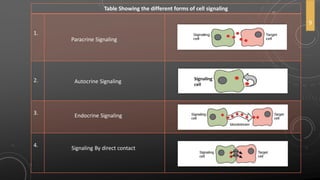
Table Showing the different forms of cell signaling
1.
2.
3.
4.
Paracrine Signaling
Autocrine Signaling
Endocrine Signaling
Signaling By direct contact
Signaling
cell
9
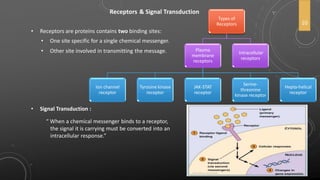
Receptors & Signal Transduction
• Receptors are proteins contains two binding sites:
• One site specific for a single chemical messenger.
• Other site involved in transmitting the message.
• Signal Transduction :
“ When a chemical messenger binds to a receptor,
the signal it is carrying must be converted into an
intracellular response.”
10
Types of
Receptors
Plasma
membrane
receptors
Ion channel
receptor
Tyrosine kinase
receptor
JAK-STAT
receptor
Serine-
threonine
kinase receptor
Hepta-helical
receptor
Intracellular
receptors
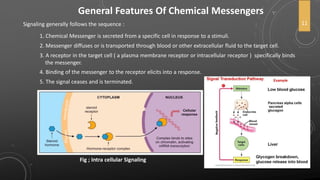
General Features Of Chemical Messengers
Signaling generally follows the sequence :
1. Chemical Messenger is secreted from a specific cell in response to a stimuli.
2. Messenger diffuses or is transported through blood or other extracellular fluid to the target cell.
3. A receptor in the target cell ( a plasma membrane receptor or intracellular receptor ) specifically binds
the messenger.
11
4. Binding of the messenger to the receptor elicits into a response.
5. The signal ceases and is terminated.
Fig ; Intra cellular Signaling
Synapse – Nictoinic Acetylcholine Receptor
• Neuro-transmitter (acetyl-choline) that acts on nicotinic acetylcholine receptors on the plasma
membrane of certain muscle cells.
• They are secreted from neurons in response to an electrical stimulus called “action potential”.
• They diffuse across the synapse to another excitable cell, where they elicit a response.
• Before release, acetylcholine is sequestered in vesicles clustered near an active zone in the
presynaptic membrane.
• Membrane also have voltage-gained Ca+2 channels that open when the action potential reaches
them, resulting in an influx of Ca+2
• Ca+2 triggers the fusion of vesicles with the plasma membrane and ACh is released into the synaptic
cleft.
• ACh diffuses across the synaptic cleft and bind to the plasma membrane receptors on the muscle cells
called the “nicotinic acetylcholine receptors”.
12
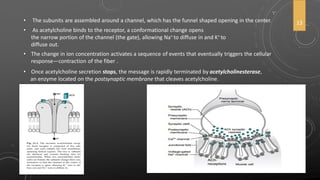
• The subunits are assembled around a channel, which has the funnel shaped opening in the center.
• As acetylcholine binds to the receptor, a conformational change opens
the narrow portion of the channel (the gate), allowing Na+ to diffuse in and K+ to
diffuse out.
• The change in ion concentration activates a sequence of events that eventually triggers the cellular
response—contraction of the fiber .
• Once acetylcholine secretion stops, the message is rapidly terminated by acetylcholinesterase,
an enzyme located on the postsynaptic membrane that cleaves acetylcholine.
13

Hormones & Cell Signaling Agents

  • 1.
    University of Engineering& Technology Lahore (Narowal Campus) Name : Talha Ahsan Reg.No : 2018-BME-138 Course Subject : Biochemistry Topic of Presentation : Hormones & Cell signaling Agents Submitted To : Mr. Habib Hussain 1
  • 2.
    Hormones & CellSignaling Agents 2
  • 3.
    Learning Outcomes • Tolearn how the cells actually differentiate, grow & adapt to the changing conditions. • To learn how the cells communicate with one another. • To learn about the agents involved in cell signaling , the receptor site & signal transduction. • To learn how a response is produced due to some stimulus. 3
  • 4.
    4 “It is asubstance formed in an organ or tissue in the body of a plant or animal and then transported by body fluid (blood) to another organ or tissue for a specific action.” Hormones Examples: HORMONE CHEMICAL CLASS SOURCE PHYSIOLOGICAL FUNCTION Auxin Amino acid derivative Most plant tissues Promotes cell elongation and flowering in plants Cortisol Steriod Adrenal Gland Suppresses inflammation Epinephrine Amino acid derivative Adrenal Gland Prepares the body for action Insulin Amino acid derivative Pancreas (B-cells) Glycogenesis Utilization of Glucose Glucagon Amino acid derivative Pancreas (a-cells) Gluconeogenesis Glycogenolysis Growth Hormone Polypeptide (19 residues) Pituitary gland Stimulates growth and metabolism
  • 5.
    Classification of Hormones PeptideHormones Water Soluble (Cannot enter the cell membrane) Must bind to receptors on the cell’s surface cause changes within cell Binding initiates the production of ‘second messenger’ inside the cell e.g; Human Growth Hormone Steroid Hormones Lipid Soluble (Can enter the cell membrane) Must bind to receptor cells inside the cytoplasm and transported into nucleus Cause certain genes to be expressed or suppressed by influencing ‘gene transcription’ within a cell i.e nucleus e.g; Sex Hormones 5
  • 6.
    CellSignaling • Cell signalingis defined as; “It is the process of cells communicating with other cells within the body, or with the external environment.”  This means that the original intercellular (between-cells) signal is converted into an intracellular (within-cell) signal that triggers a response.  It leads to a change in the cell, such as alteration in the activity of a gene or even the induction of a whole process, such as cell division. 6
  • 7.
    Chemical Messengers • Signalingmolecules (ligands) are secreted from Secretory cell (signaling cell). • Transmit messages between cells. • Secreted from one cell in response to specific stimulus and travel to target cell, where they bind to a specific receptor to elicit a response. Examples:  Nervous System Neurotransmitters.  Endocrine System Hormones  Immune System Cytokines.  In addition to these include retinoids, eicosanoids, growth factors. 7
  • 8.
    Forms of Signaling (4 basic categories ) • Paracrine Signaling : • Endocrine Signaling : • Autocrine Signaling : • Signaling By direct contact: • Cells communicate over relatively short distances. • Allows to locally coordinate with their neighbors. Example:  Synaptic Signaling. • Cells signals itself. • Releases a ligand that binds to the receptor of its own. • Helps in many metabolic processes. Example:  Such happens in cancer and thought to play a key role in metatasis. • Cells communicate over relatively long distances. • Signals are produced by specialized cells and are released into the blood stream, which carries them to the distant parts of the body. Example:  Hormones secreted from various endocrine glands. Example:  Gap junctions in animal cells and Plasmodesmata in plant cells. • Cells targets the neighboring cell connected via channels for transmission of signals. • In plants, these channels are water-filled allow only small signaling molecules called the ‘intracellular mediators’ to diffuse between two cells. 8
  • 9.
    Table Showing thedifferent forms of cell signaling 1. 2. 3. 4. Paracrine Signaling Autocrine Signaling Endocrine Signaling Signaling By direct contact Signaling cell 9
  • 10.
    Receptors & SignalTransduction • Receptors are proteins contains two binding sites: • One site specific for a single chemical messenger. • Other site involved in transmitting the message. • Signal Transduction : “ When a chemical messenger binds to a receptor, the signal it is carrying must be converted into an intracellular response.” 10 Types of Receptors Plasma membrane receptors Ion channel receptor Tyrosine kinase receptor JAK-STAT receptor Serine- threonine kinase receptor Hepta-helical receptor Intracellular receptors
  • 11.
    General Features OfChemical Messengers Signaling generally follows the sequence : 1. Chemical Messenger is secreted from a specific cell in response to a stimuli. 2. Messenger diffuses or is transported through blood or other extracellular fluid to the target cell. 3. A receptor in the target cell ( a plasma membrane receptor or intracellular receptor ) specifically binds the messenger. 11 4. Binding of the messenger to the receptor elicits into a response. 5. The signal ceases and is terminated. Fig ; Intra cellular Signaling
  • 12.
    Synapse – NictoinicAcetylcholine Receptor • Neuro-transmitter (acetyl-choline) that acts on nicotinic acetylcholine receptors on the plasma membrane of certain muscle cells. • They are secreted from neurons in response to an electrical stimulus called “action potential”. • They diffuse across the synapse to another excitable cell, where they elicit a response. • Before release, acetylcholine is sequestered in vesicles clustered near an active zone in the presynaptic membrane. • Membrane also have voltage-gained Ca+2 channels that open when the action potential reaches them, resulting in an influx of Ca+2 • Ca+2 triggers the fusion of vesicles with the plasma membrane and ACh is released into the synaptic cleft. • ACh diffuses across the synaptic cleft and bind to the plasma membrane receptors on the muscle cells called the “nicotinic acetylcholine receptors”. 12
  • 13.
    • The subunitsare assembled around a channel, which has the funnel shaped opening in the center. • As acetylcholine binds to the receptor, a conformational change opens the narrow portion of the channel (the gate), allowing Na+ to diffuse in and K+ to diffuse out. • The change in ion concentration activates a sequence of events that eventually triggers the cellular response—contraction of the fiber . • Once acetylcholine secretion stops, the message is rapidly terminated by acetylcholinesterase, an enzyme located on the postsynaptic membrane that cleaves acetylcholine. 13