CELL COMMUNICATION
AND SIGNALING
BY:
SHRUSHTI JOSHI
164551
CELL COMMUNICATION
Definition: Any of several ways in
which living cells of an organism
communicate with one another,
whether by direct contact between
cells or by means of chemical signals
carried by neurotransmitter
substances, hormones, and cyclic
AMP.
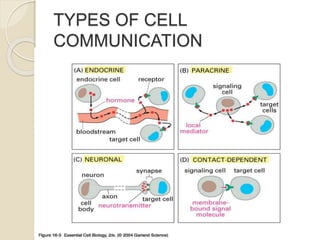
TYPES OF CELL
COMMUNICATION
CELL SIGNALLING
 Cell signaling is part of any
communication process that governs
basic activities of cells and
coordinates all cell actions.
 The ability of cells to perceive and
correctly respond to their
microenvironment is the basis of
development, tissue repair, and
immunity as well as normal tissue
homeostasis
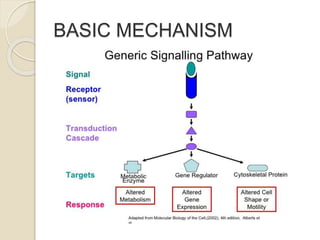
 Cells detect signals with Cell
Receptors on their plasma
membrane, which are usually
Glycoproteins or Glycolipids. The
signalling molecule binds to the
Repeptor because its shape is
complementary. This then instigates
a chain of reaction within the cell,
leading to a response.
BASIC MECHANISM
CASE STUDY
Cell Communication Discovery Opens
up new Possibilities for Cancer
Research
NCBES
National Centre for
Biomedical Engineering
Science
Dr. Afshin-Samali
PERK opens line of
communication between
inside and outside of the cell
PERK is known to detect protein folding
errors in the cell. Researchers at the
Laboratory of Cell Death Research &
Therapy at KU Leuven have now
revealed a hidden perk: the protein also
coordinates the communication between
the inside and the outside of the cell.
These findings open up new avenues for
further research into treatments for
cancer, Alzheimer’s, and diabetes.
PERK BACKGROUND
 Protein kinase-like endoplasmic
reticulum kinase (PERK) is an eIF2α
kinase and transmembrane protein
resident in the endoplasmic reticulum
(ER) membrane that couples ER
stress signals to translation inhibition
(1-3). ER stress increases the activity
of PERK, which then phosphorylates
eIF2α to promote reduced translation.
CONCLUSION
 PERK protein is known to play a
crucial role in maintaining ER
functions and restoring them if
necessary
 It also coordinates the communication
between the protein folding factory
(the ER) and the plasma membrane.
 the protein establishes contact
between the two cell components so
that they can work together to restore
the calcium level.
REFERENCES
 Molecular Biology of the Cell. 4th
edition.
 http://ncbes.nuigalway.ie
 .lumenlearning.com
 University of Kent
 reference.md
THANK YOU

Cell communication and signaling

  • 1.
  • 2.
    CELL COMMUNICATION Definition: Anyof several ways in which living cells of an organism communicate with one another, whether by direct contact between cells or by means of chemical signals carried by neurotransmitter substances, hormones, and cyclic AMP.
  • 3.
  • 4.
    CELL SIGNALLING  Cellsignaling is part of any communication process that governs basic activities of cells and coordinates all cell actions.  The ability of cells to perceive and correctly respond to their microenvironment is the basis of development, tissue repair, and immunity as well as normal tissue homeostasis
  • 5.
     Cells detectsignals with Cell Receptors on their plasma membrane, which are usually Glycoproteins or Glycolipids. The signalling molecule binds to the Repeptor because its shape is complementary. This then instigates a chain of reaction within the cell, leading to a response.
  • 6.
  • 7.
    CASE STUDY Cell CommunicationDiscovery Opens up new Possibilities for Cancer Research NCBES National Centre for Biomedical Engineering Science Dr. Afshin-Samali
  • 8.
    PERK opens lineof communication between inside and outside of the cell PERK is known to detect protein folding errors in the cell. Researchers at the Laboratory of Cell Death Research & Therapy at KU Leuven have now revealed a hidden perk: the protein also coordinates the communication between the inside and the outside of the cell. These findings open up new avenues for further research into treatments for cancer, Alzheimer’s, and diabetes.
  • 10.
    PERK BACKGROUND  Proteinkinase-like endoplasmic reticulum kinase (PERK) is an eIF2α kinase and transmembrane protein resident in the endoplasmic reticulum (ER) membrane that couples ER stress signals to translation inhibition (1-3). ER stress increases the activity of PERK, which then phosphorylates eIF2α to promote reduced translation.
  • 11.
    CONCLUSION  PERK proteinis known to play a crucial role in maintaining ER functions and restoring them if necessary  It also coordinates the communication between the protein folding factory (the ER) and the plasma membrane.  the protein establishes contact between the two cell components so that they can work together to restore the calcium level.
  • 12.
    REFERENCES  Molecular Biologyof the Cell. 4th edition.  http://ncbes.nuigalway.ie  .lumenlearning.com  University of Kent  reference.md
  • 13.