RELATIVEAND
ABSOLUTEDATING
OBJECTIVES:
Differentiate relative and absolute
dating;
Describe the different methods (relative
and absolute dating) of determining the
age of stratified rocks; and
Understand and appreciate the
importance of the relative and absolute
dating in determining the age of
stratified rocks.
Earth’s history concealed in rocks
Goal of geology: unraveling Earth’s history
Principle time keeping devices:
Relative dating - putting rocks/events in proper order
Absolute dating - determining event’s actual time
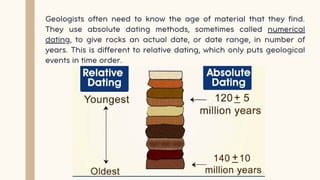
Geologists often need to know the age of material that they find.
They use absolute dating methods, sometimes called numerical
dating, to give rocks an actual date, or date range, in number of
years. This is different to relative dating, which only puts geological
events in time order.
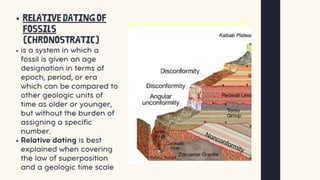
Relativedatingof
fossils
(chronostratic)
is a system in which a
fossil is given an age
designation in terms of
epoch, period, or era
which can be compared to
other geologic units of
time as older or younger,
but without the burden of
assigning a specific
number.
Relative dating is best
explained when covering
the law of superposition
and a geologic time scale
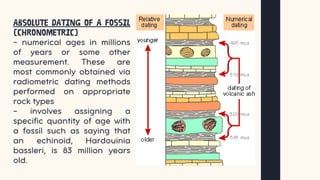
Absolute dating of a fossil
(chronometric)
– numerical ages in millions
of years or some other
measurement. These are
most commonly obtained via
radiometric dating methods
performed on appropriate
rock types
- involves assigning a
specific quantity of age with
a fossil such as saying that
an echinoid, Hardouinia
bassleri, is 83 million years
old.
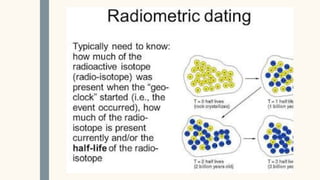
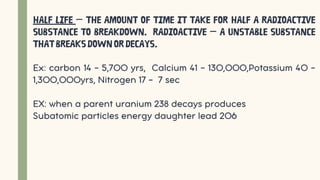
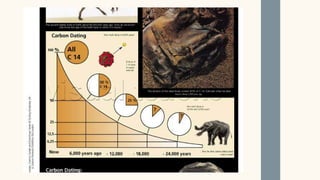
Half life – the amount of time it take for half a radioactive
substance to breakdown. Radioactive – a unstable substance
thatbreaksdownordecays.
Ex: carbon 14 – 5,700 yrs, Calcium 41 – 130,000,Potassium 40 –
1,300,000yrs, Nitrogen 17 - 7 sec
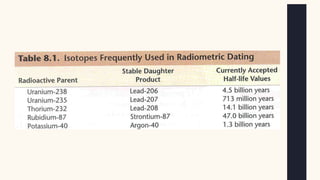
EX: when a parent uranium 238 decays produces
Subatomic particles energy daughter lead 206
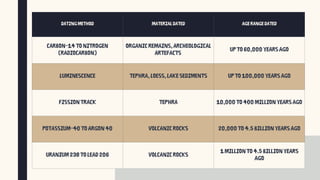
DatingMethod MaterialDated AgeRangeDated
Carbon-14toNitrogen
(radiocarbon)
Organicremains,archeological
artefacts
Upto60,000yearsago
Luminescence Tephra,loess,lakesediments Upto100,000yearsago
FissionTrack Tephra 10,000to400millionyearsago
Potassium-40toargon40 Volcanicrocks 20,000to4.5billionyearsago
Uranium238tolead206 VolcanicRocks
1millionto4.5billionyears
ago
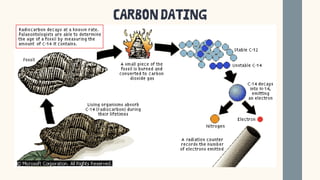
Carbon Dating
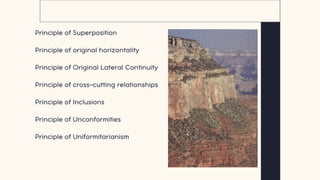
Relative Dating: Key principles
Principle of Superposition
Principle of original horizontality
Principle of Original Lateral Continuity
Principle of cross-cutting relationships
Principle of Inclusions
Principle of Unconformities
Principle of Uniformitarianism
ENDOFTHELESSON

Absolute Dating..POWERPOINT PRESENTATION

  • 1.
  • 2.
    OBJECTIVES: Differentiate relative andabsolute dating; Describe the different methods (relative and absolute dating) of determining the age of stratified rocks; and Understand and appreciate the importance of the relative and absolute dating in determining the age of stratified rocks.
  • 3.
    Earth’s history concealedin rocks Goal of geology: unraveling Earth’s history Principle time keeping devices: Relative dating - putting rocks/events in proper order Absolute dating - determining event’s actual time
  • 4.
    Geologists often needto know the age of material that they find. They use absolute dating methods, sometimes called numerical dating, to give rocks an actual date, or date range, in number of years. This is different to relative dating, which only puts geological events in time order.
  • 5.
    Relativedatingof fossils (chronostratic) is a systemin which a fossil is given an age designation in terms of epoch, period, or era which can be compared to other geologic units of time as older or younger, but without the burden of assigning a specific number. Relative dating is best explained when covering the law of superposition and a geologic time scale
  • 6.
    Absolute dating ofa fossil (chronometric) – numerical ages in millions of years or some other measurement. These are most commonly obtained via radiometric dating methods performed on appropriate rock types - involves assigning a specific quantity of age with a fossil such as saying that an echinoid, Hardouinia bassleri, is 83 million years old.
  • 8.
    Half life –the amount of time it take for half a radioactive substance to breakdown. Radioactive – a unstable substance thatbreaksdownordecays. Ex: carbon 14 – 5,700 yrs, Calcium 41 – 130,000,Potassium 40 – 1,300,000yrs, Nitrogen 17 - 7 sec EX: when a parent uranium 238 decays produces Subatomic particles energy daughter lead 206
  • 10.
    DatingMethod MaterialDated AgeRangeDated Carbon-14toNitrogen (radiocarbon) Organicremains,archeological artefacts Upto60,000yearsago LuminescenceTephra,loess,lakesediments Upto100,000yearsago FissionTrack Tephra 10,000to400millionyearsago Potassium-40toargon40 Volcanicrocks 20,000to4.5billionyearsago Uranium238tolead206 VolcanicRocks 1millionto4.5billionyears ago
  • 11.
  • 14.
    Relative Dating: Keyprinciples Principle of Superposition Principle of original horizontality Principle of Original Lateral Continuity Principle of cross-cutting relationships Principle of Inclusions Principle of Unconformities Principle of Uniformitarianism
  • 15.