Rocks and the Rock Cycle
Rock Cycle Song
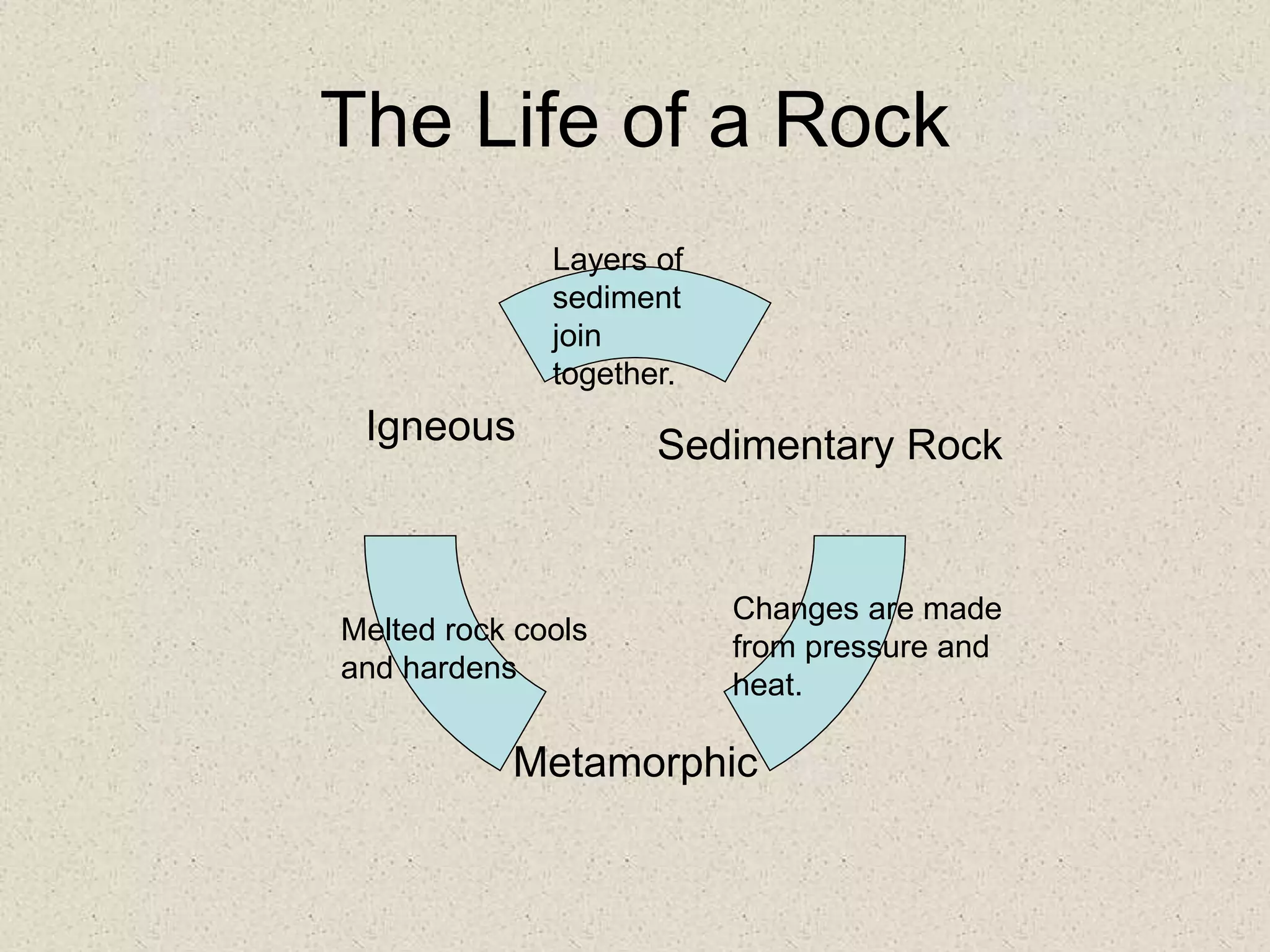
The Life of a Rock
Sedimentary Rock
Metamorphic
Igneous
Changes are made
from pressure and
heat.
Layers of
sediment
join
together.
Melted rock cools
and hardens
Rocks become smaller, and smaller,
and smaller, and smaller. . .
• By erosion
• By wind
• By earthquake
• By floods
• By rain
• By slides
• By man
Terms to Know
• Weathering: the breaking up of
rocks and soil
• Erosion: the moving of weathered
rock and soil. Weathering allows
erosion to take place.
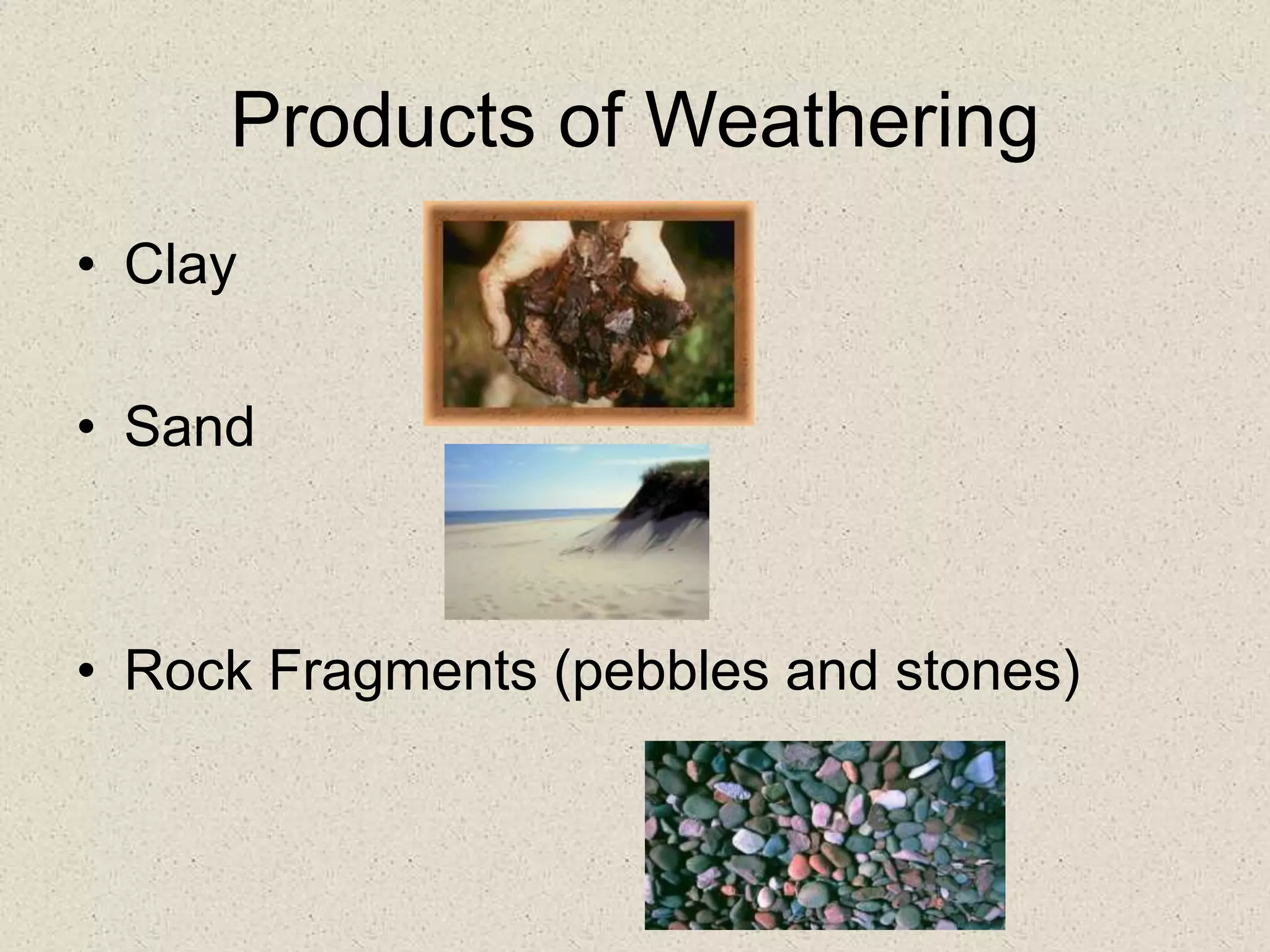
Products of Weathering
• Clay
• Sand
• Rock Fragments (pebbles and stones)
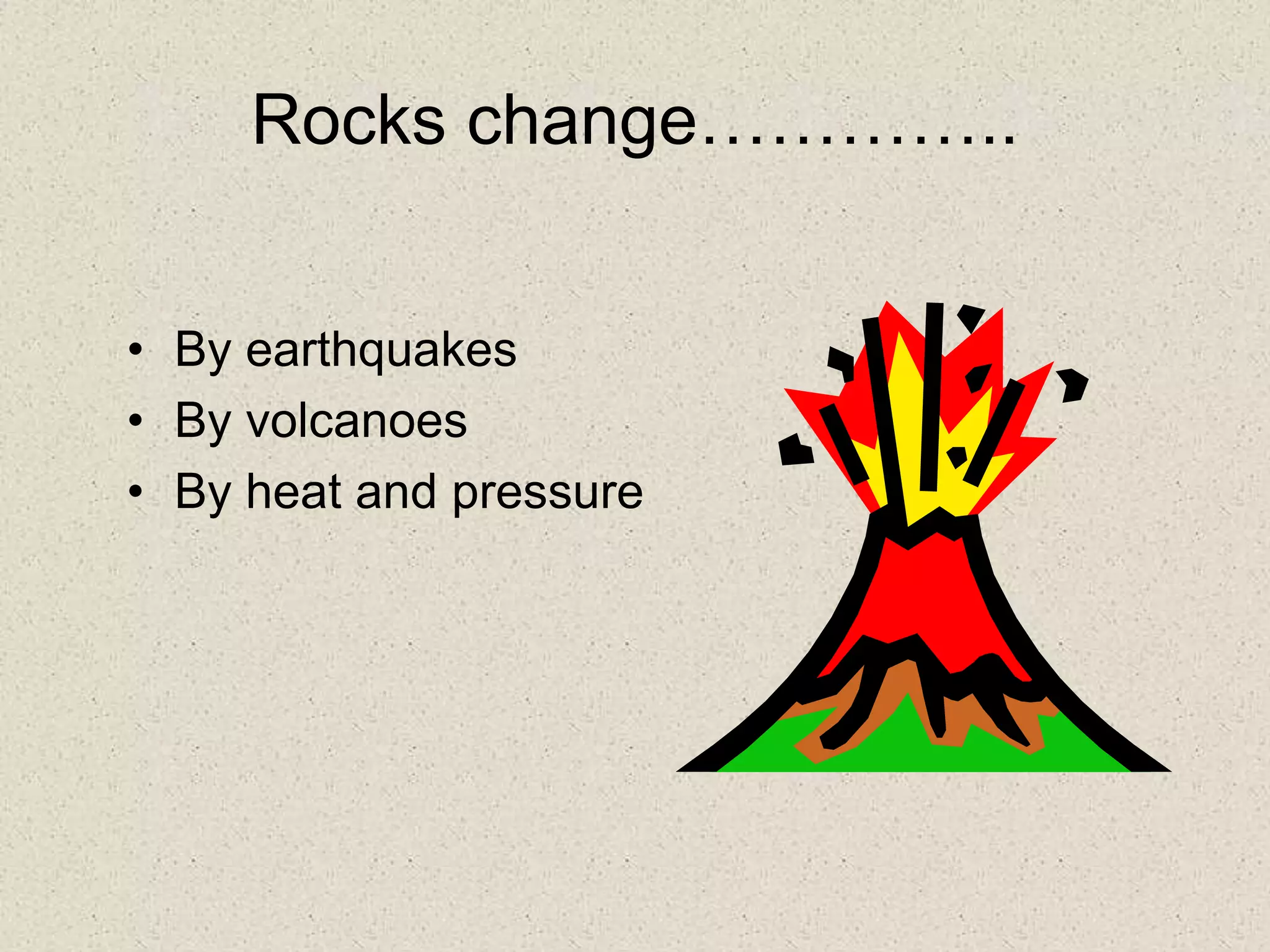
Rocks change…………..
• By earthquakes
• By volcanoes
• By heat and pressure
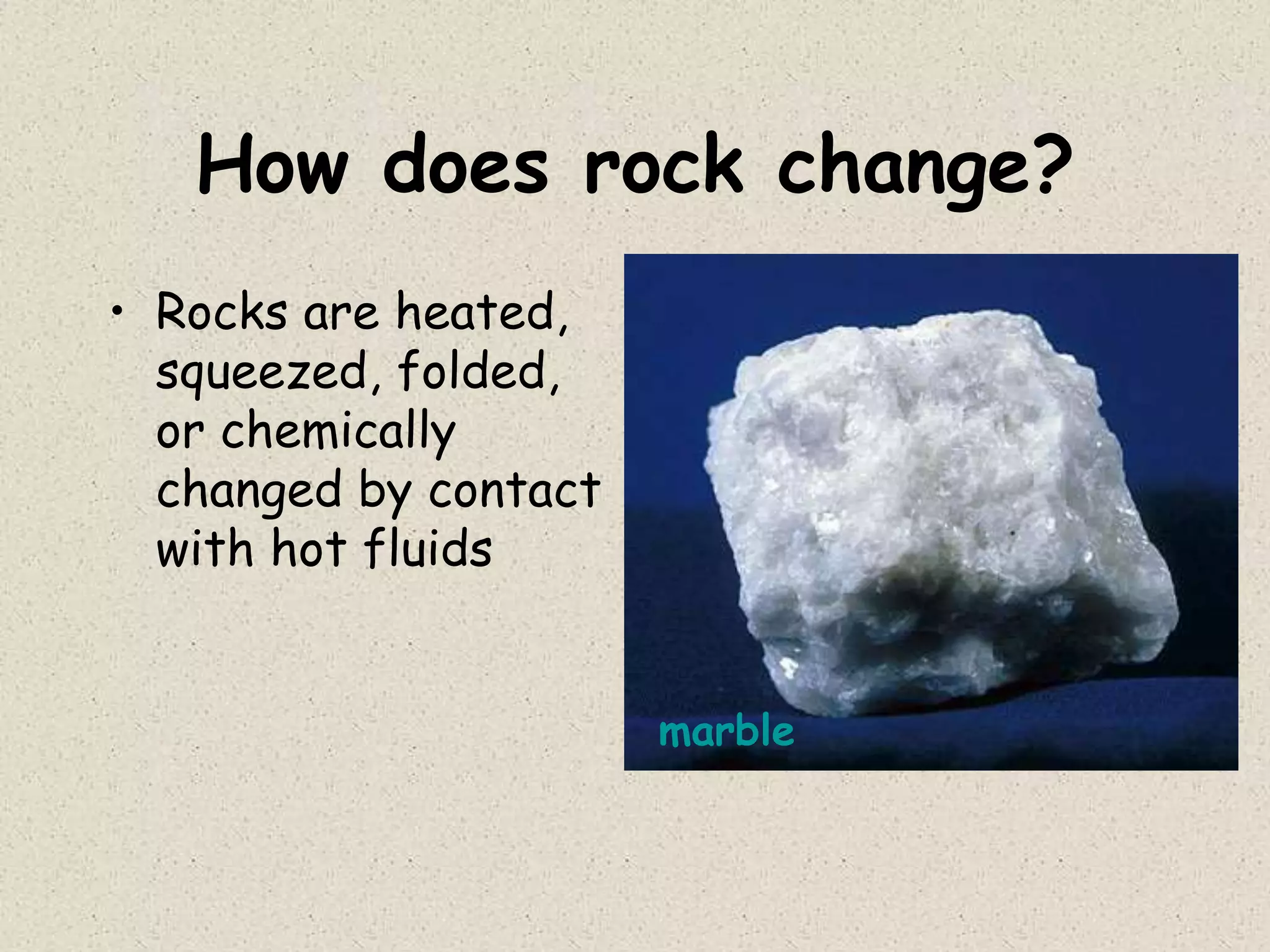
How does rock change?
• Rocks are heated,
squeezed, folded,
or chemically
changed by contact
with hot fluids
marble
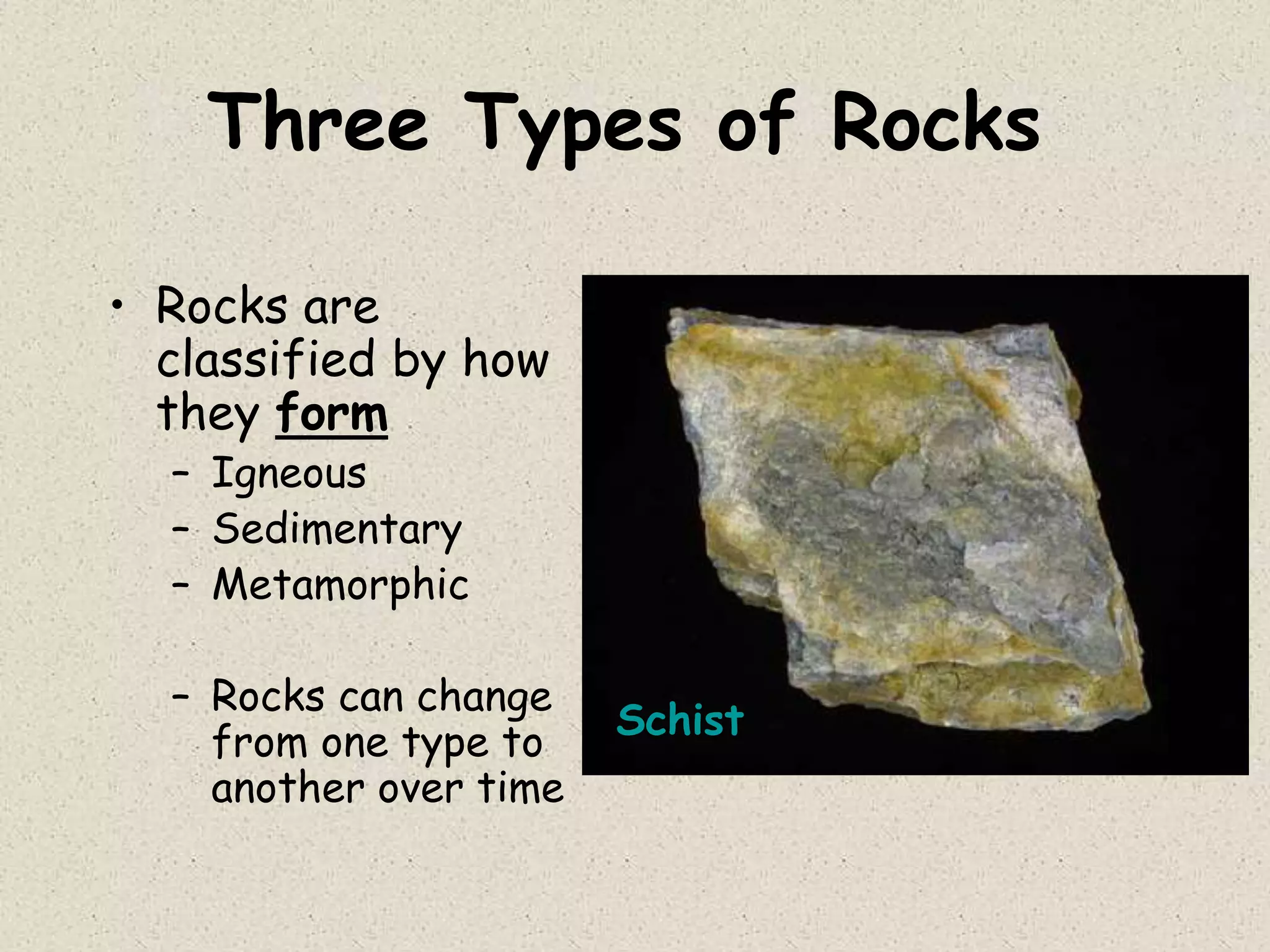
Three Types of Rocks
• Rocks are
classified by how
they form
– Igneous
– Sedimentary
– Metamorphic
– Rocks can change
from one type to
another over time
Schist
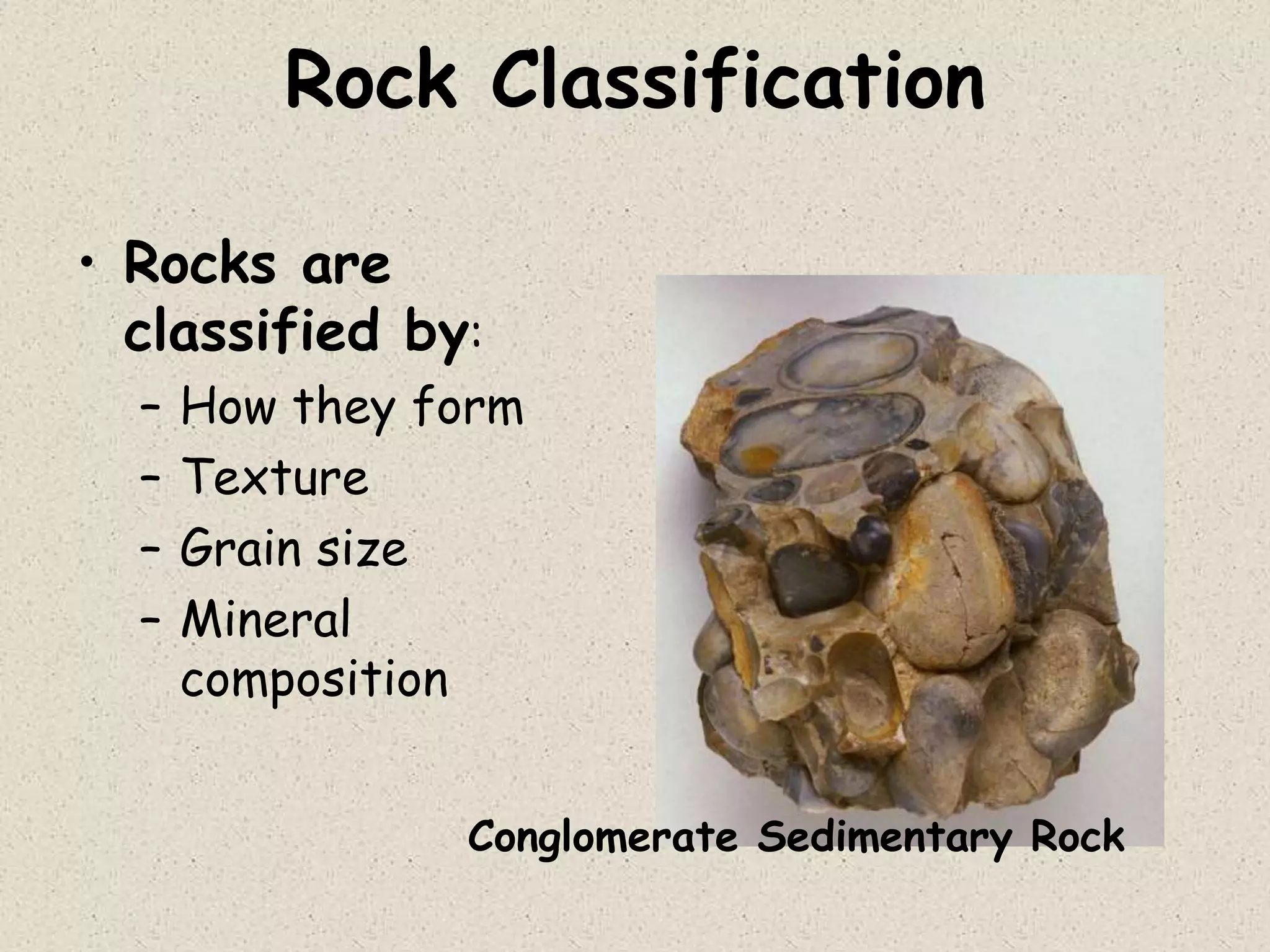
Rock Classification
• Rocks are
classified by:
– How they form
– Texture
– Grain size
– Mineral
composition
Conglomerate Sedimentary Rock
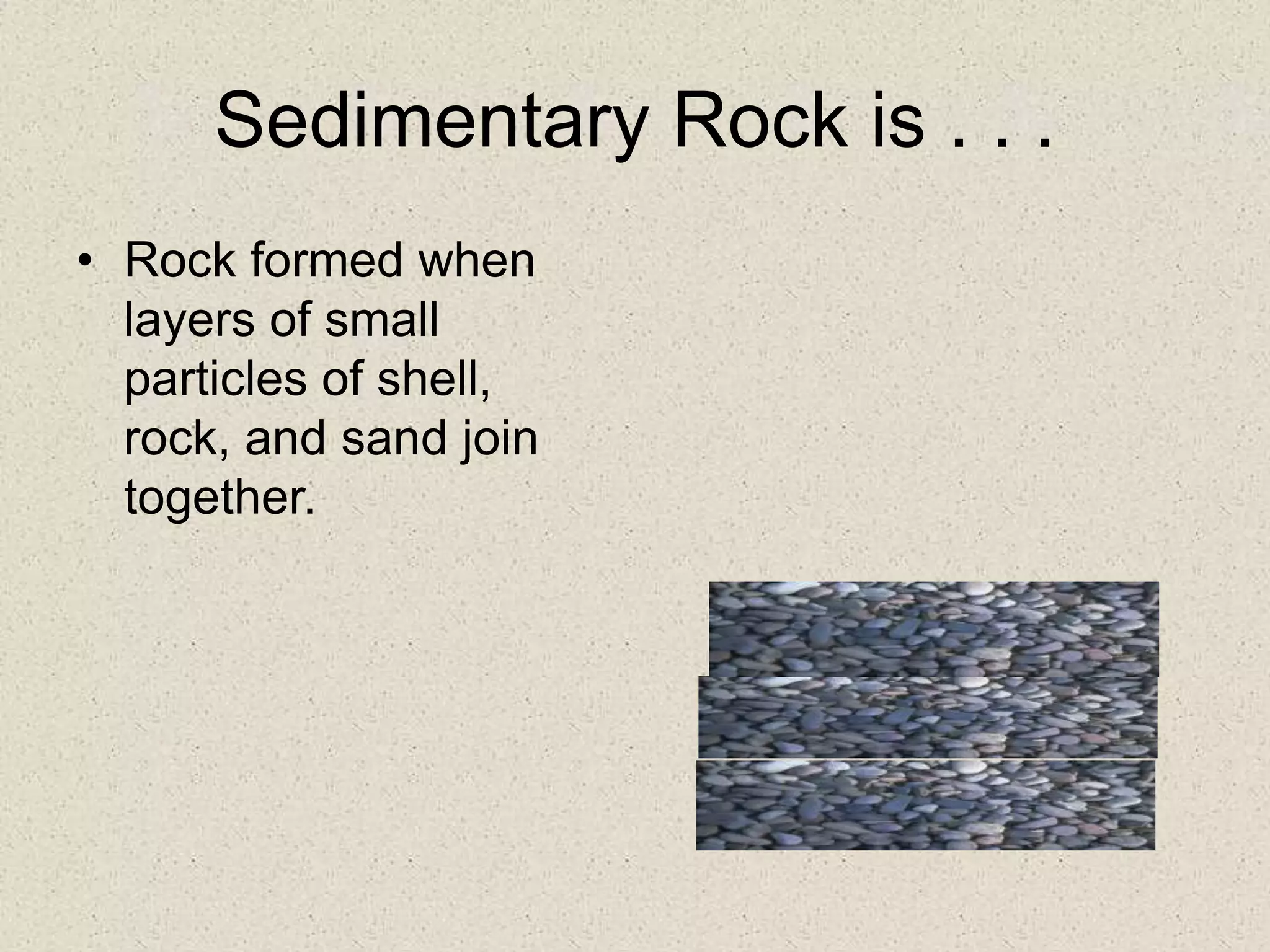
Sedimentary Rock is . . .
• Rock formed when
layers of small
particles of shell,
rock, and sand join
together.
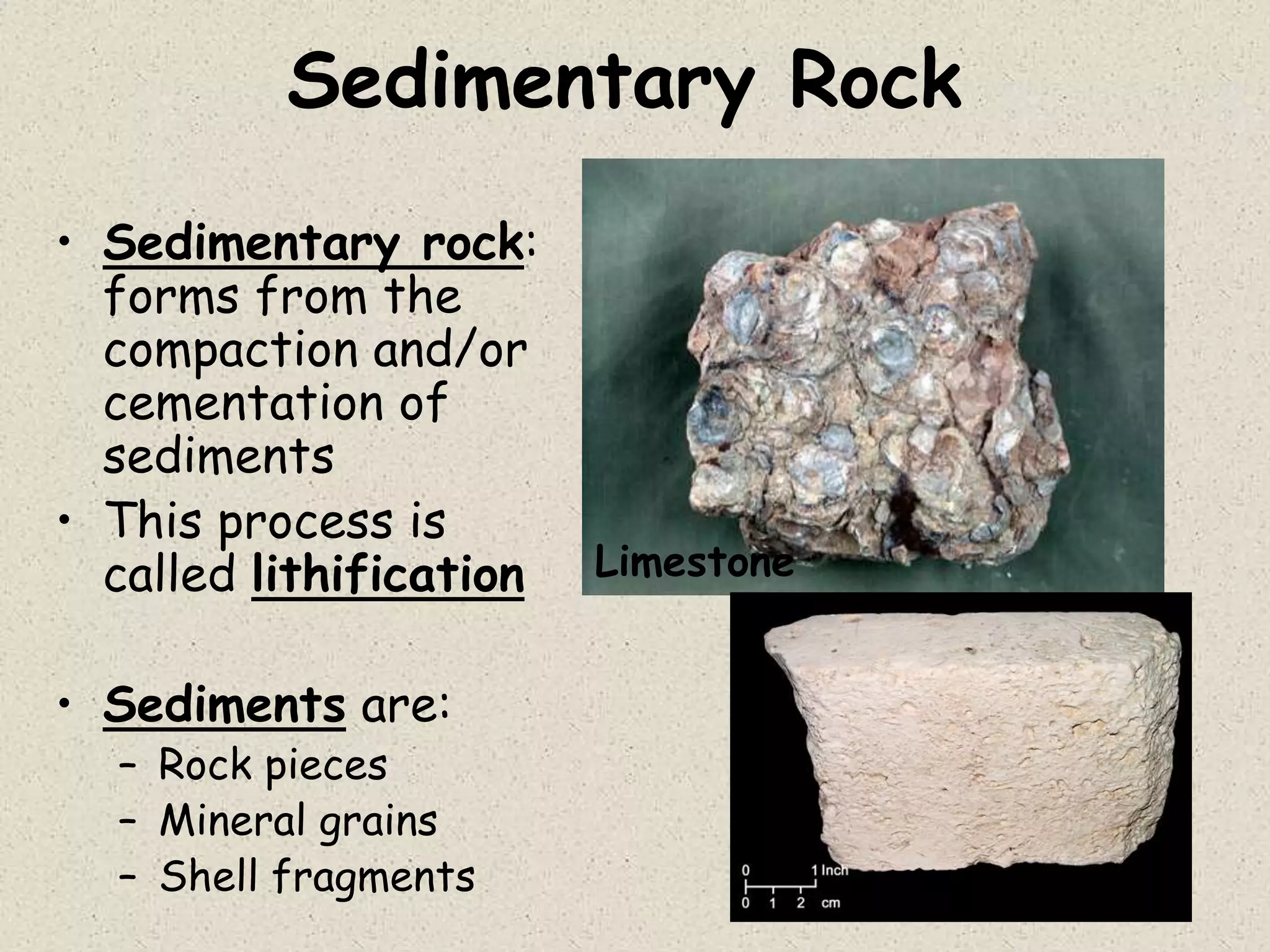
Sedimentary Rock
• Sedimentary rock:
forms from the
compaction and/or
cementation of
sediments
• This process is
called lithification
• Sediments are:
– Rock pieces
– Mineral grains
– Shell fragments
Limestone
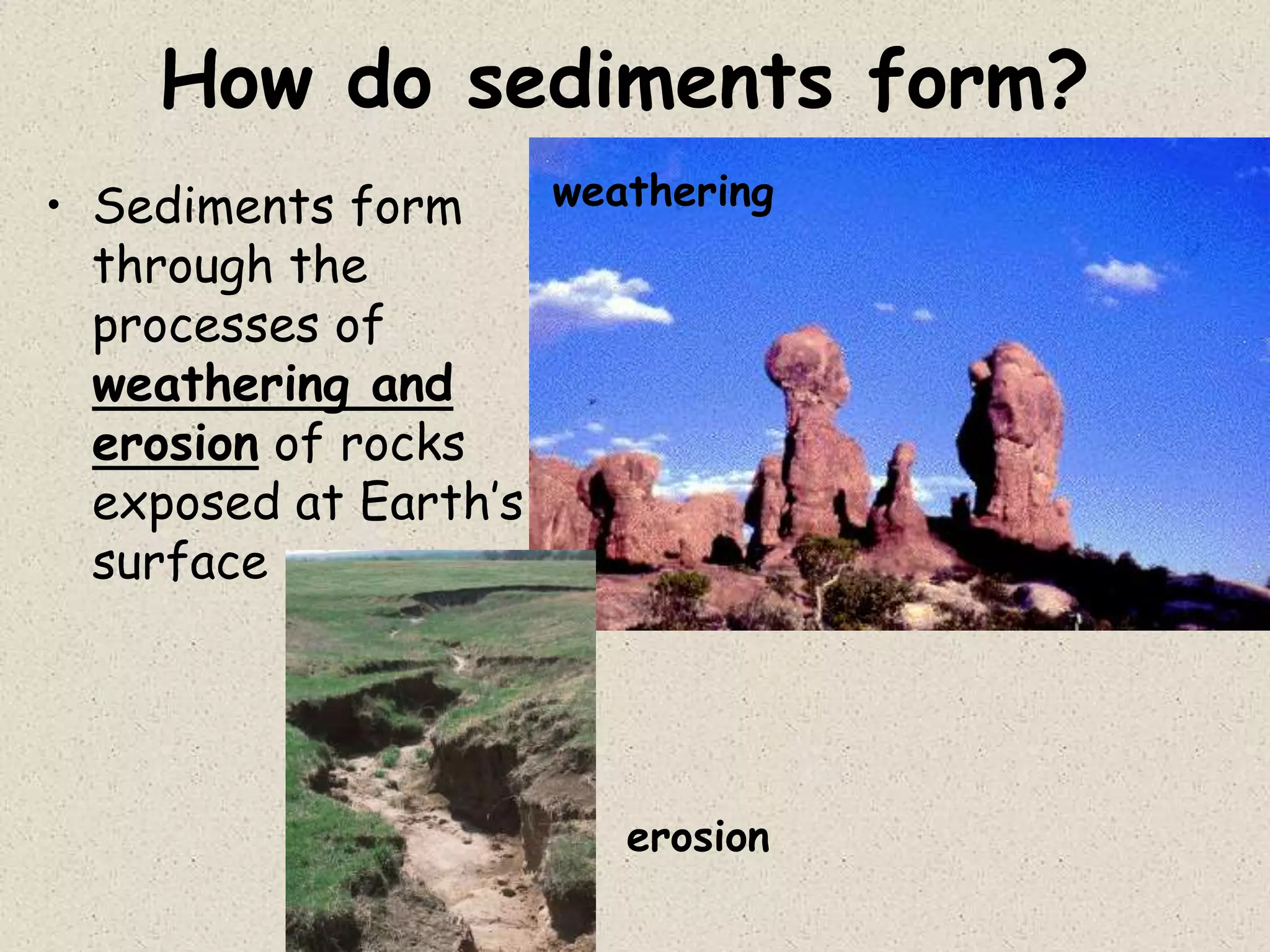
How do sediments form?
• Sediments form
through the
processes of
weathering and
erosion of rocks
exposed at Earth’s
surface
weathering
erosion
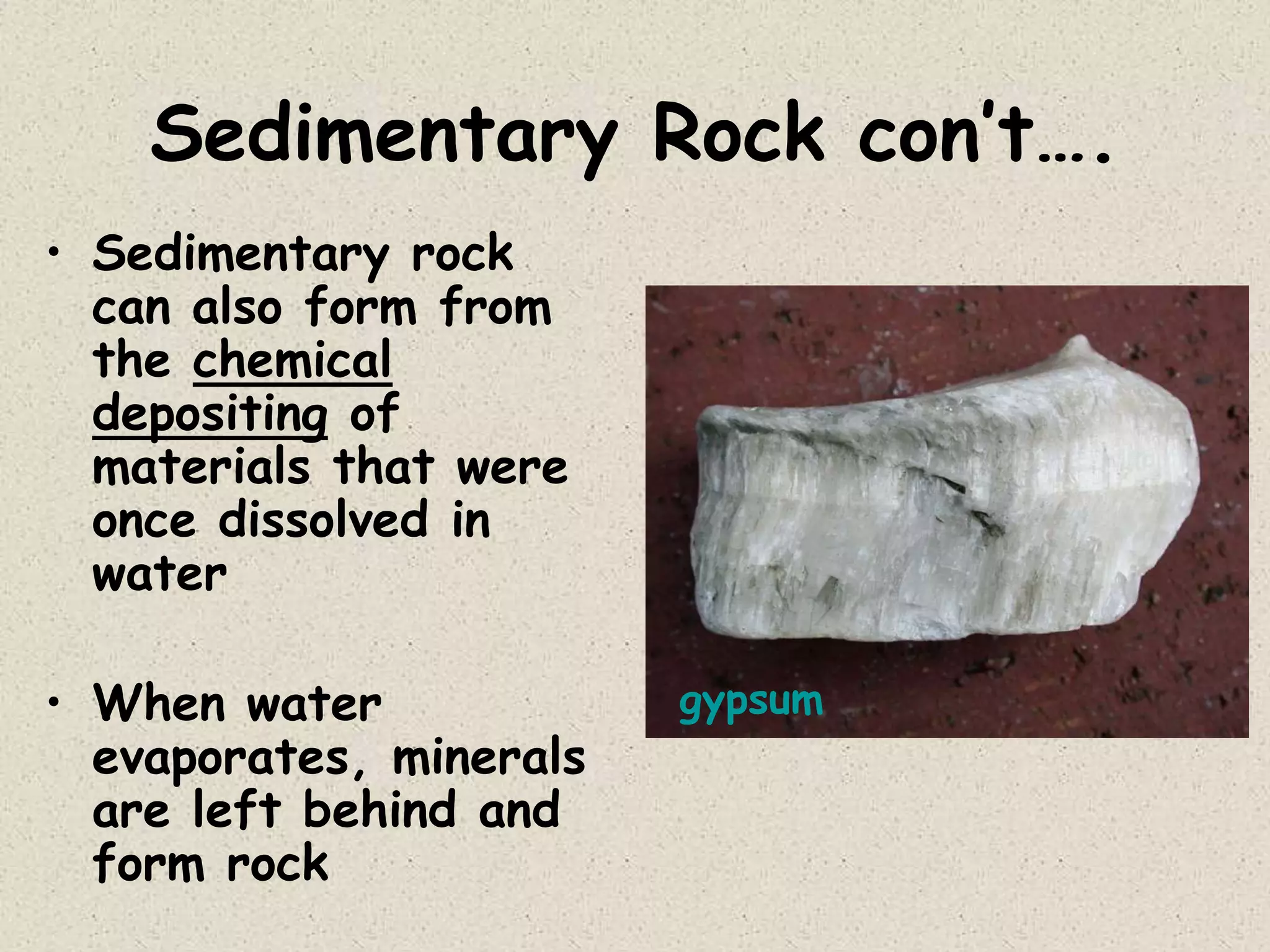
Sedimentary Rock con’t….
• Sedimentary rock
can also form from
the chemical
depositing of
materials that were
once dissolved in
water
• When water
evaporates, minerals
are left behind and
form rock
gypsum
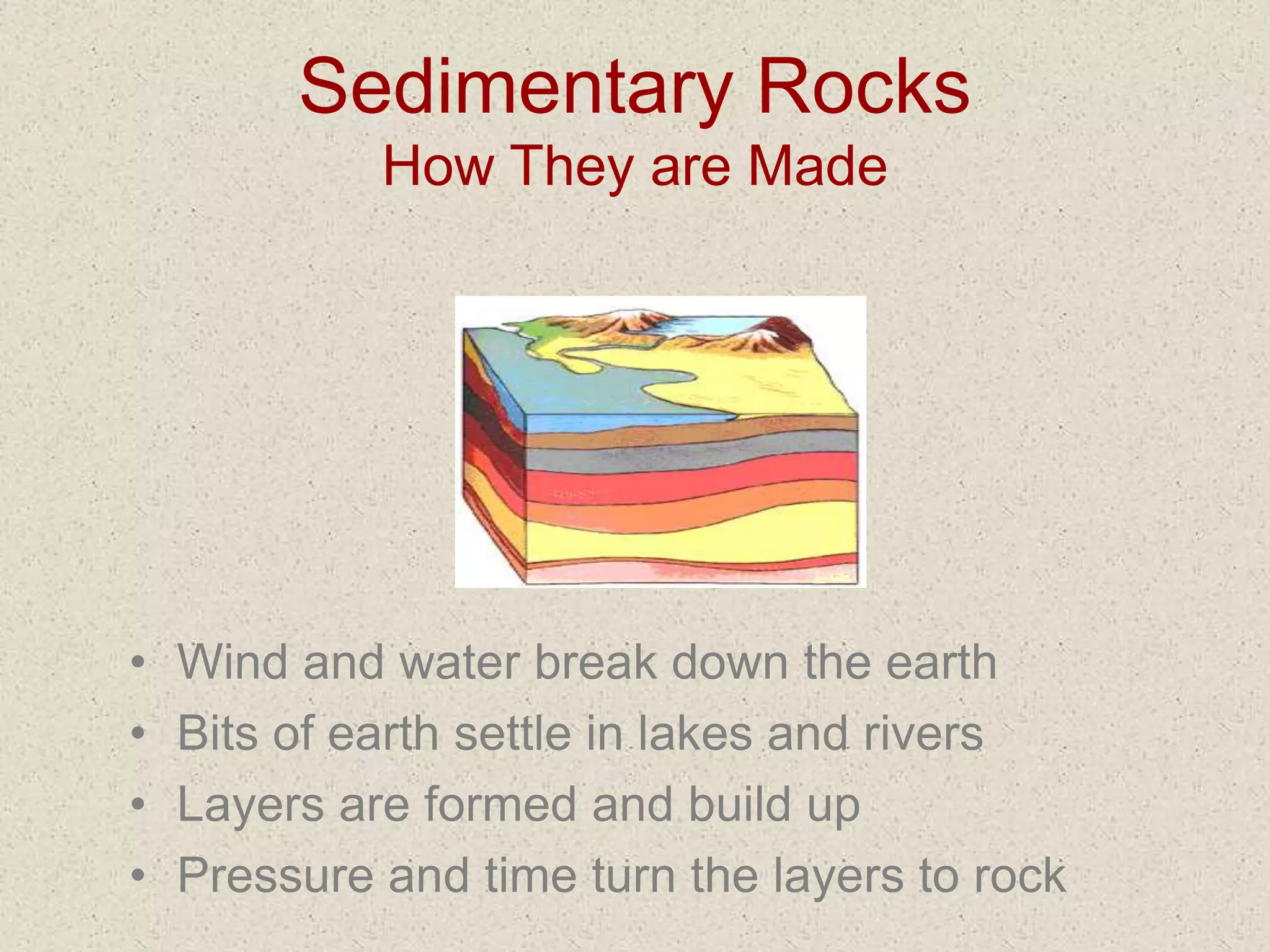
Sedimentary Rocks
How They are Made
• Wind and water break down the earth
• Bits of earth settle in lakes and rivers
• Layers are formed and build up
• Pressure and time turn the layers to rock
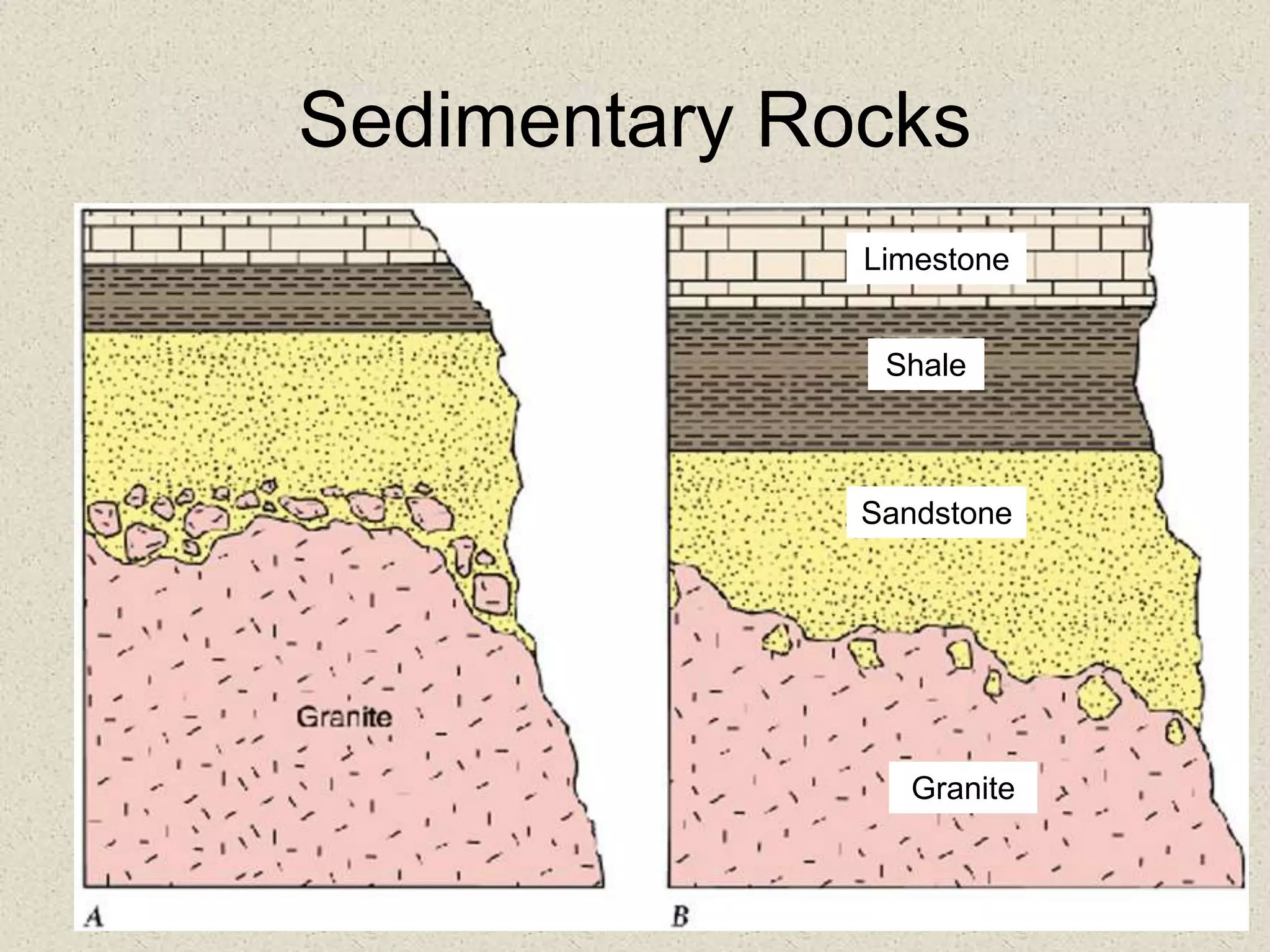
Sedimentary Rocks
Limestone
Shale
Sandstone
Granite
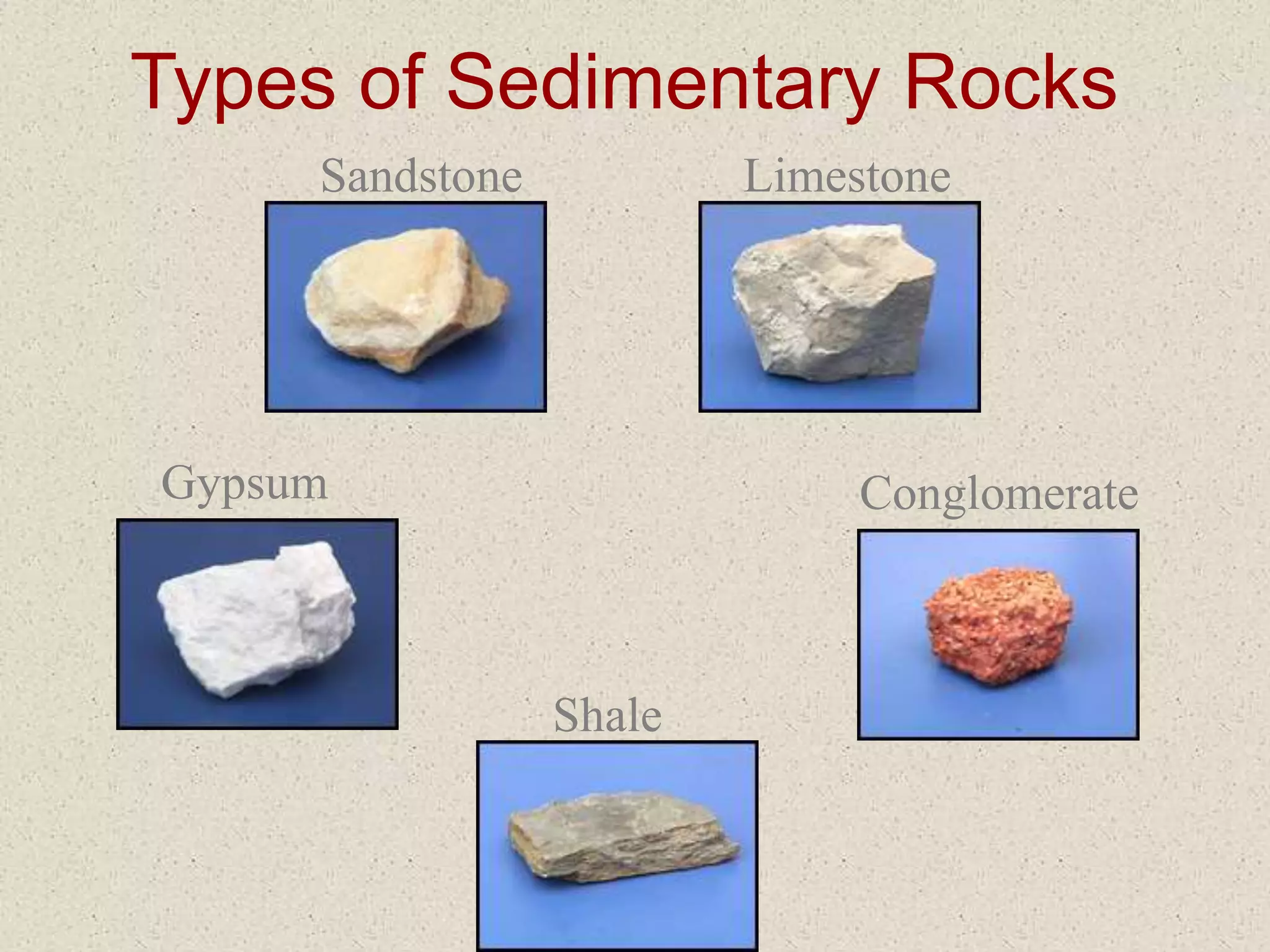
Types of Sedimentary Rocks
Gypsum
Sandstone
Shale
Limestone
Conglomerate
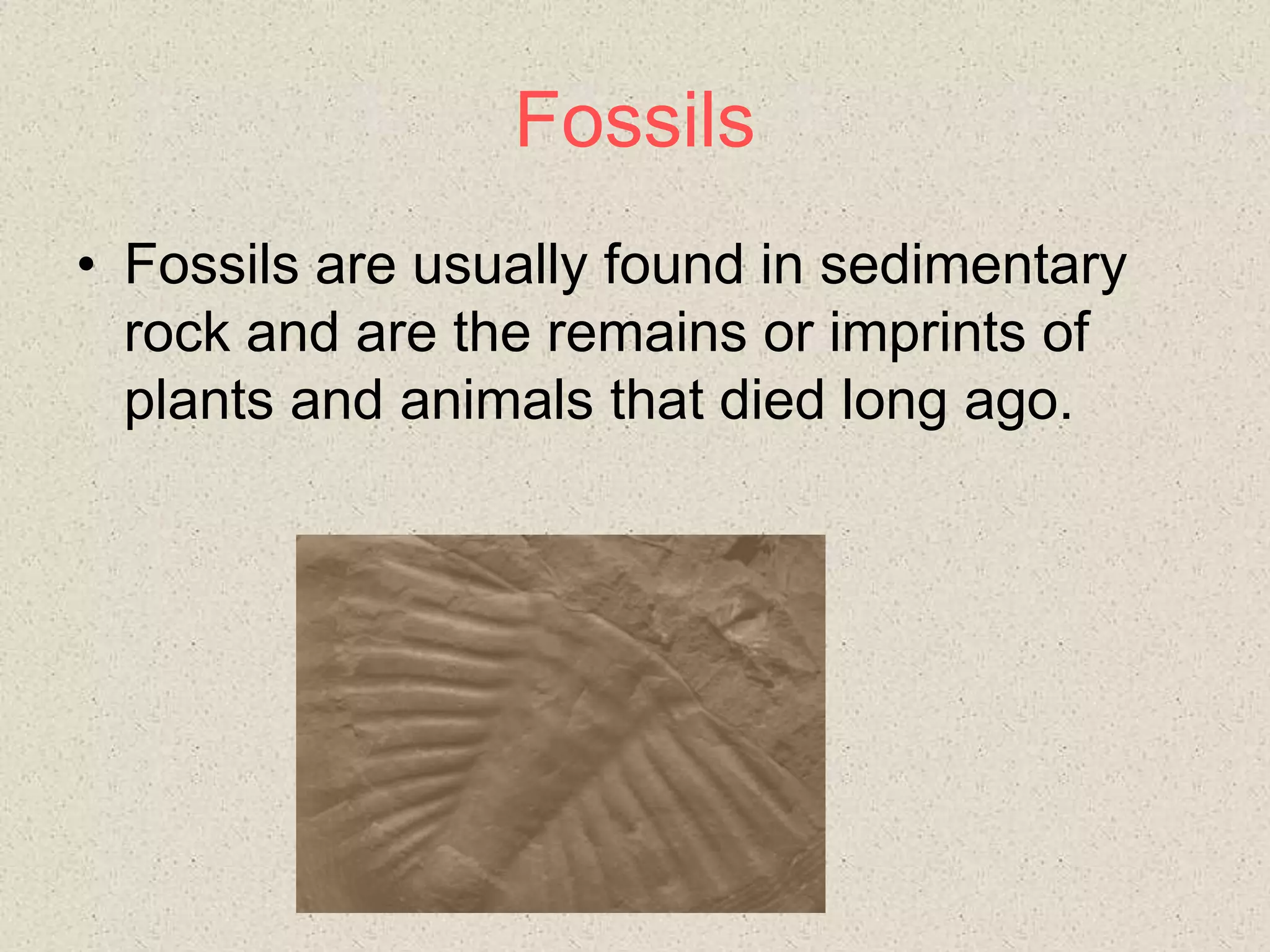
Fossils
• Fossils are usually found in sedimentary
rock and are the remains or imprints of
plants and animals that died long ago.
Fossils-Life From the Past
• Fossils provide information about life and
conditions of the past.
• Scientific evidence shows that the Earth is
approximately 4.5 billion years old
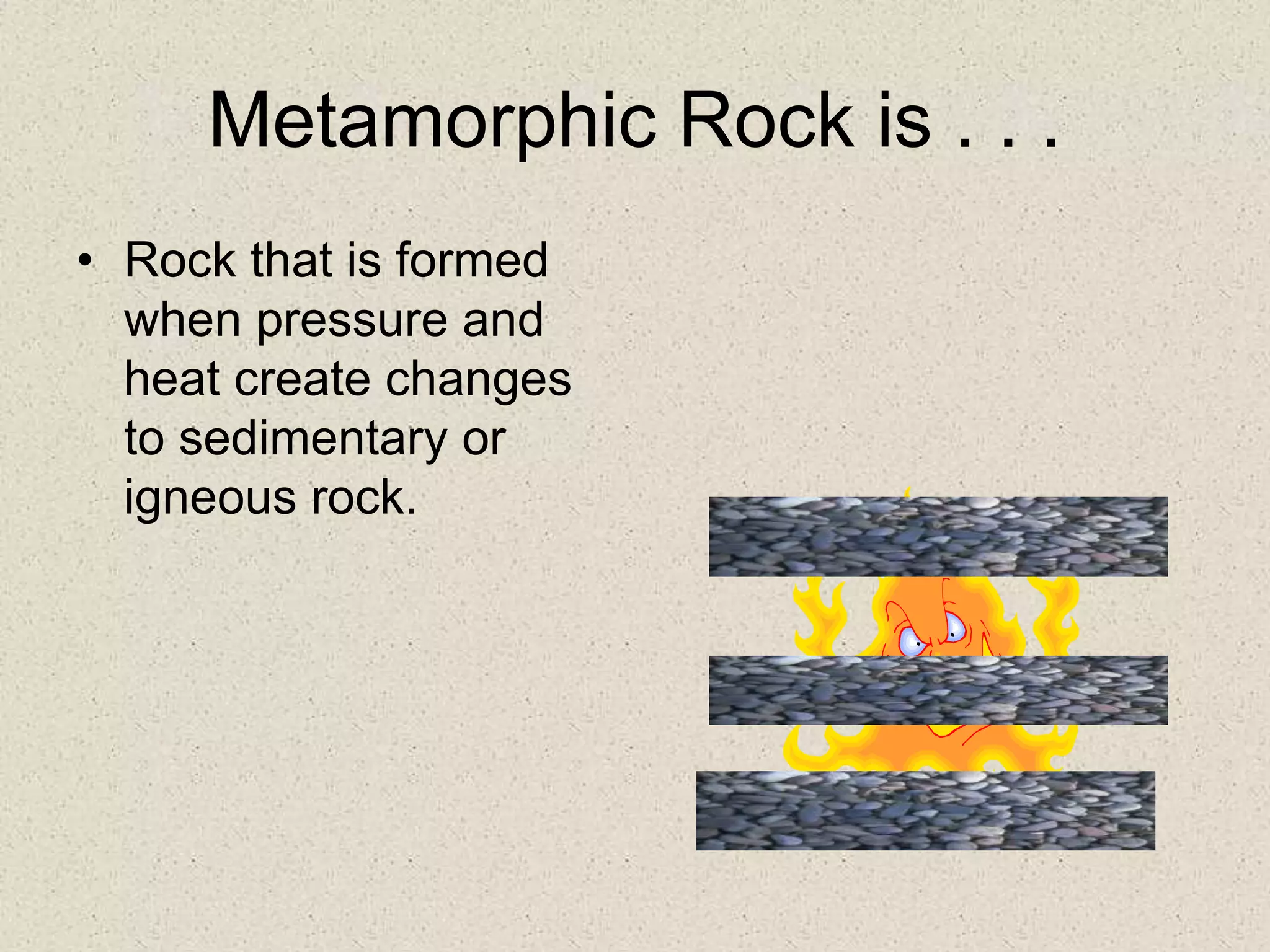
Metamorphic Rock is . . .
• Rock that is formed
when pressure and
heat create changes
to sedimentary or
igneous rock.
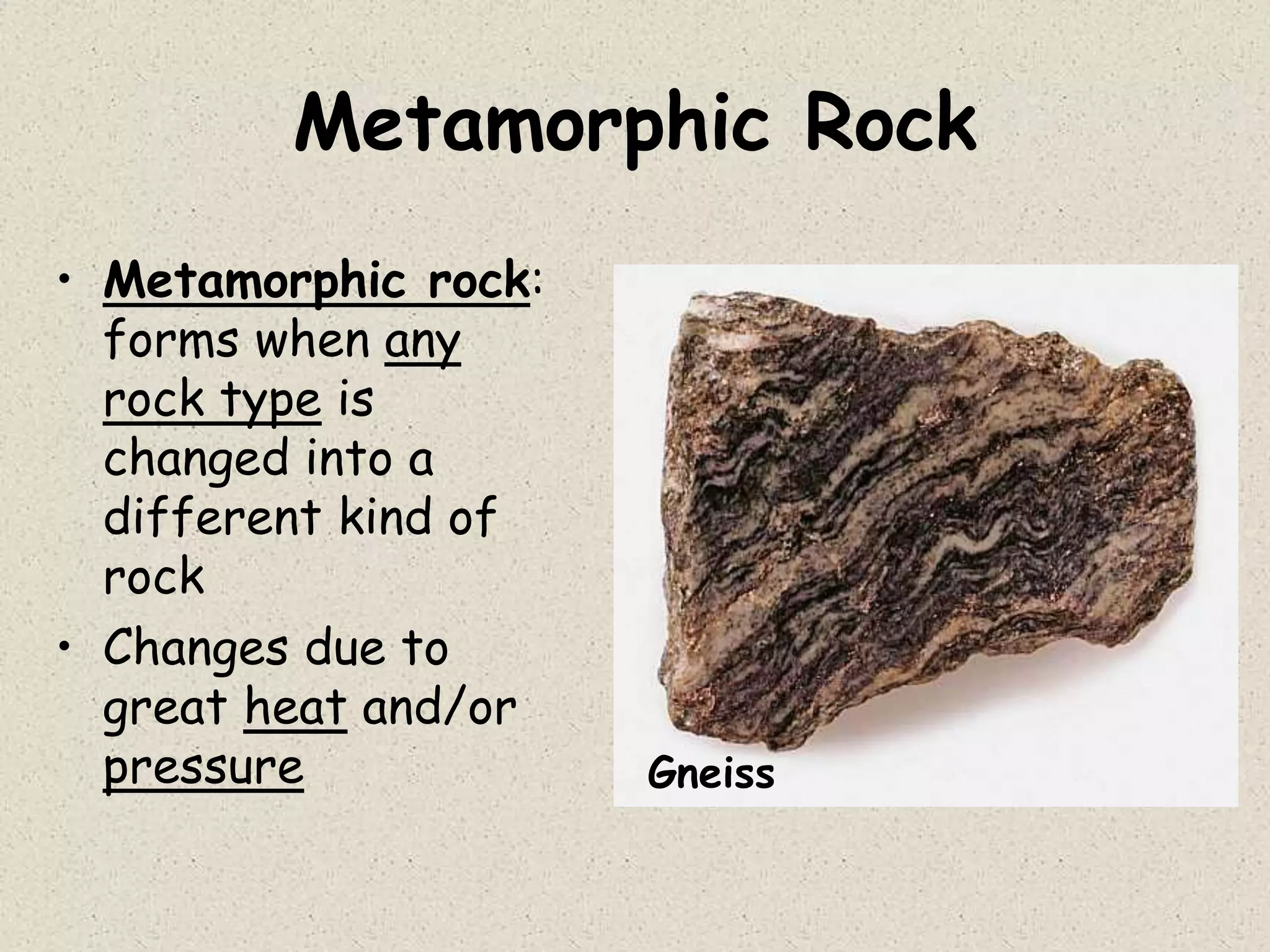
Metamorphic Rock
• Metamorphic rock:
forms when any
rock type is
changed into a
different kind of
rock
• Changes due to
great heat and/or
pressure Gneiss
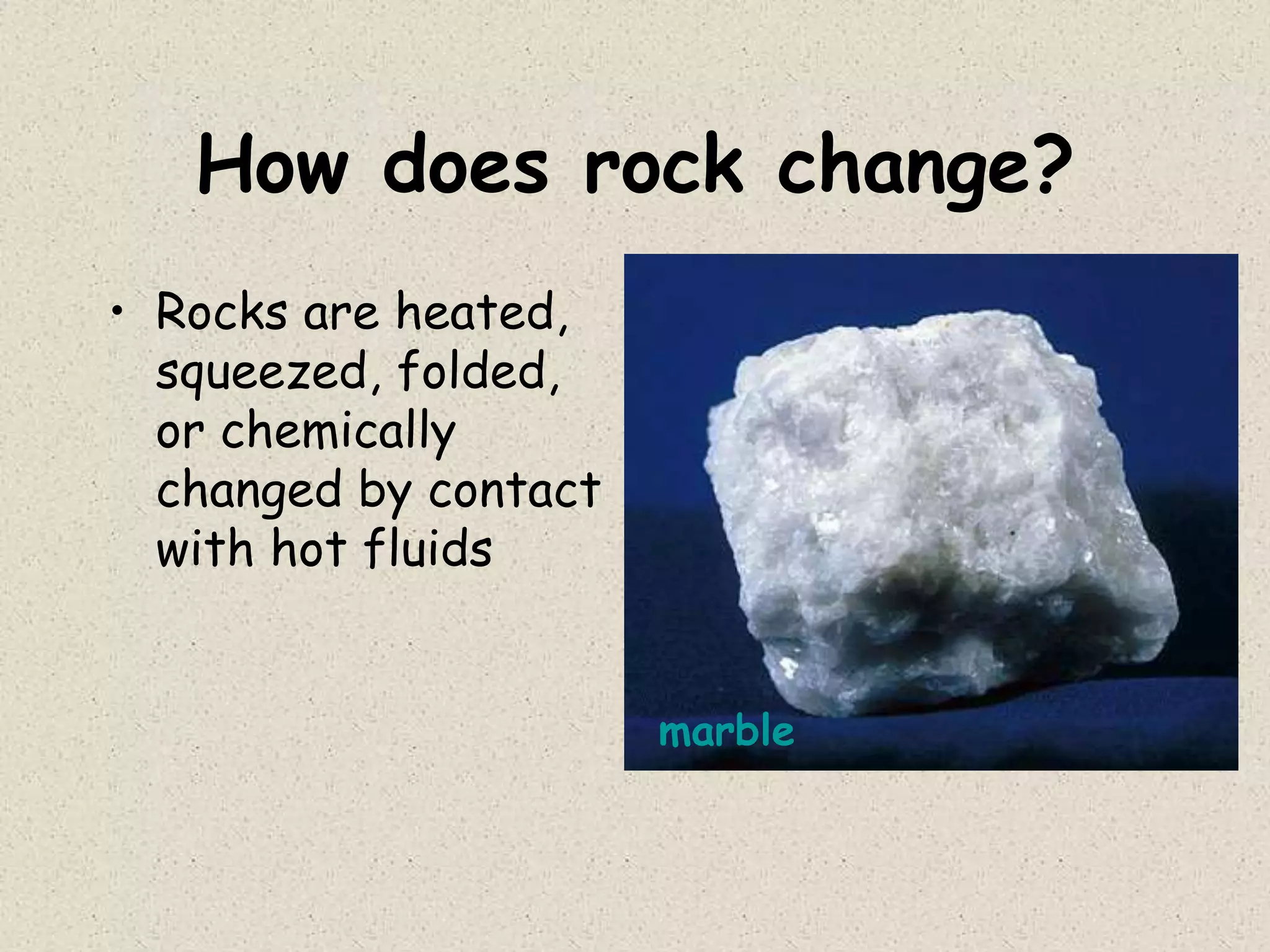
How does rock change?
• Rocks are heated,
squeezed, folded,
or chemically
changed by contact
with hot fluids
marble
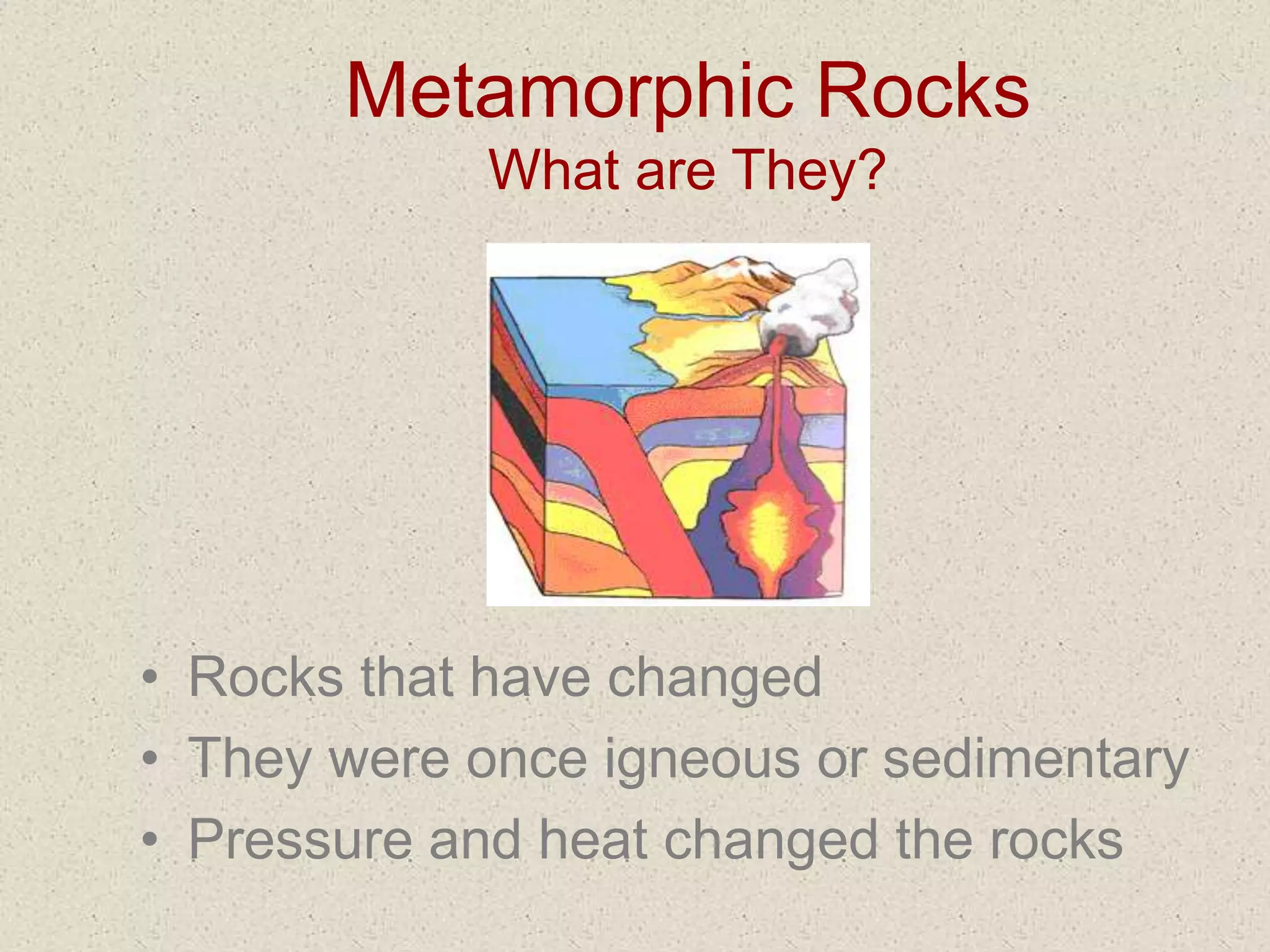
Metamorphic Rocks
What are They?
• Rocks that have changed
• They were once igneous or sedimentary
• Pressure and heat changed the rocks
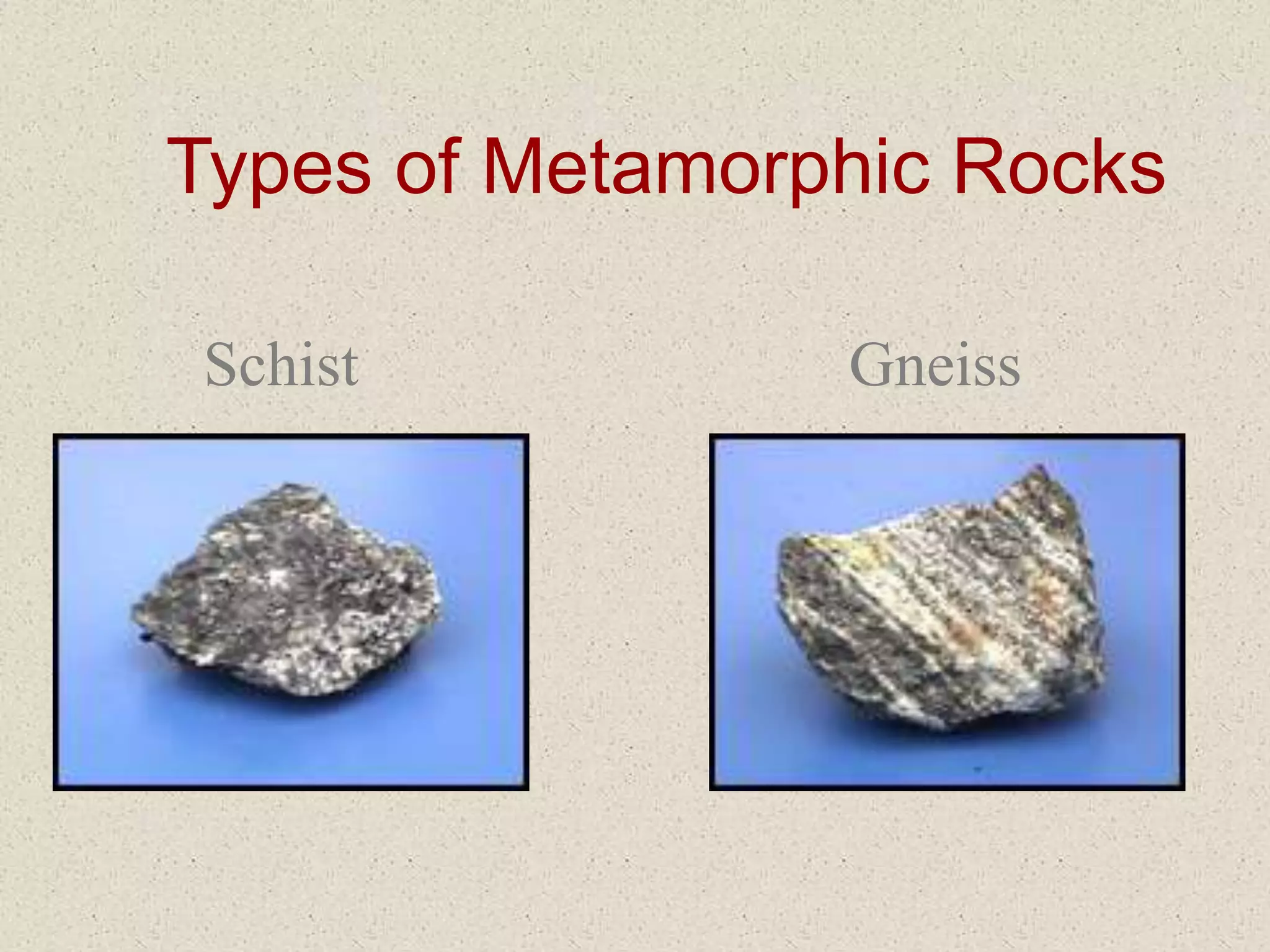
Types of Metamorphic Rocks
Schist Gneiss
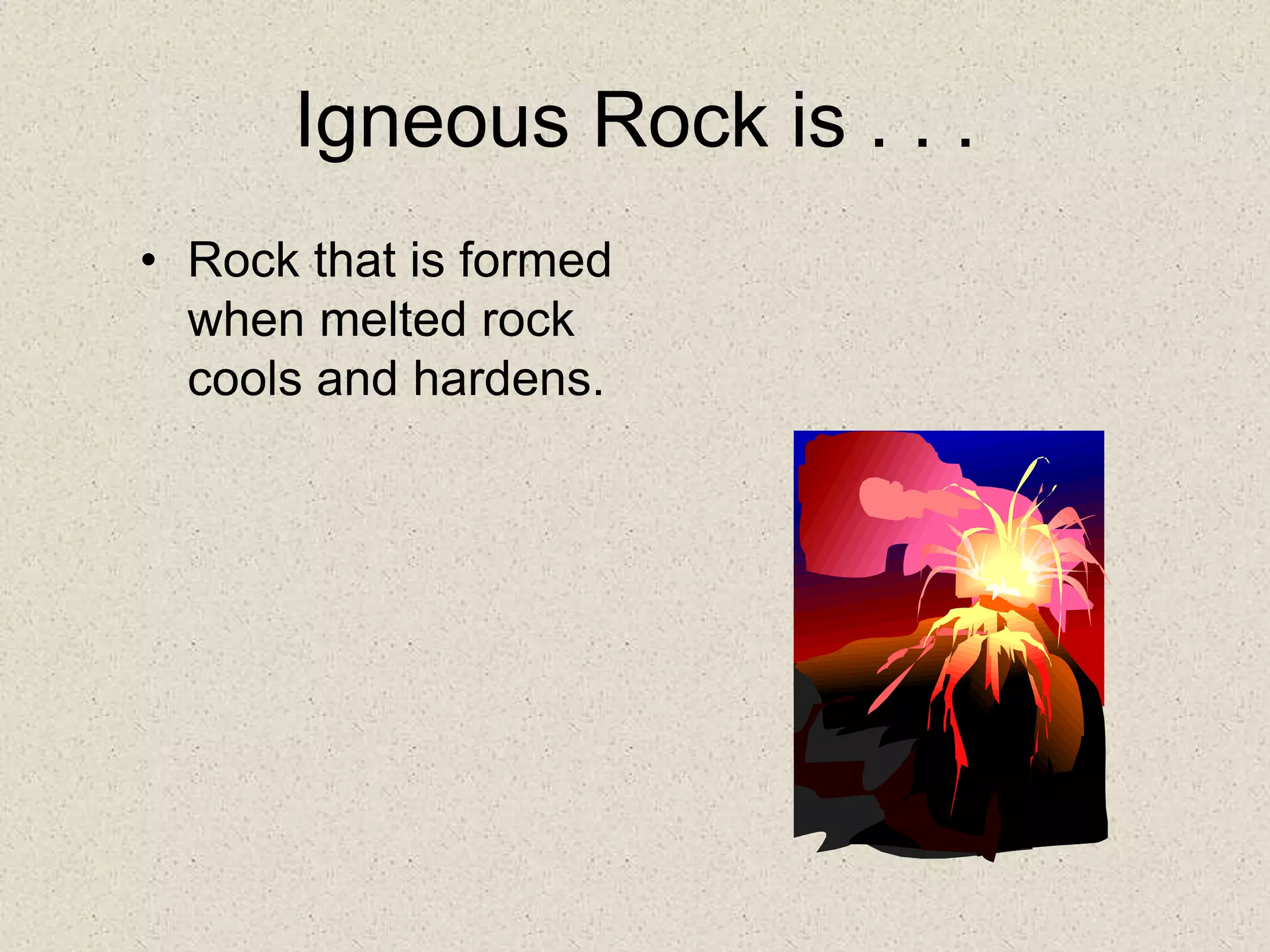
Igneous Rock is . . .
• Rock that is formed
when melted rock
cools and hardens.
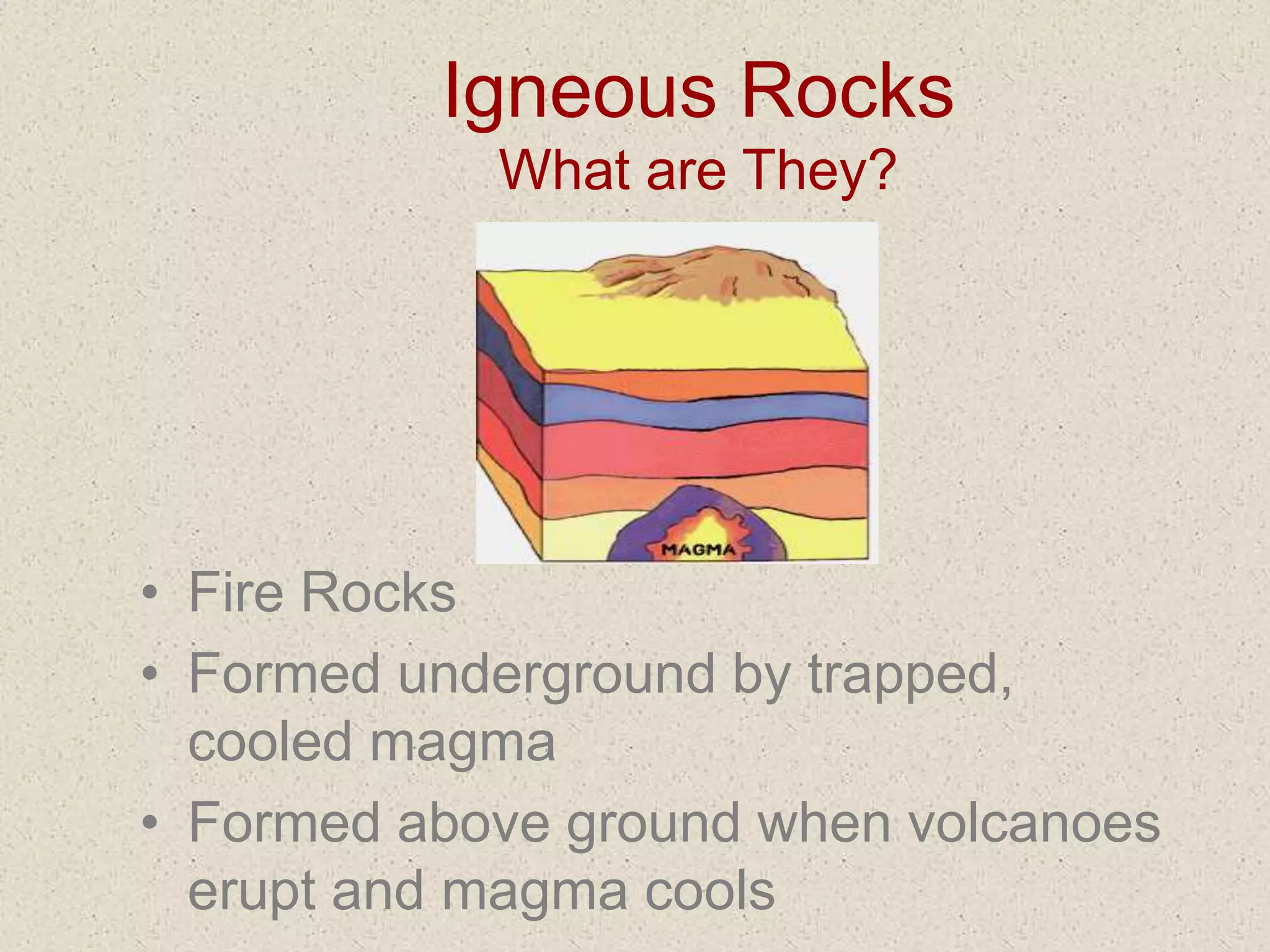
Igneous Rocks
What are They?
• Fire Rocks
• Formed underground by trapped,
cooled magma
• Formed above ground when volcanoes
erupt and magma cools
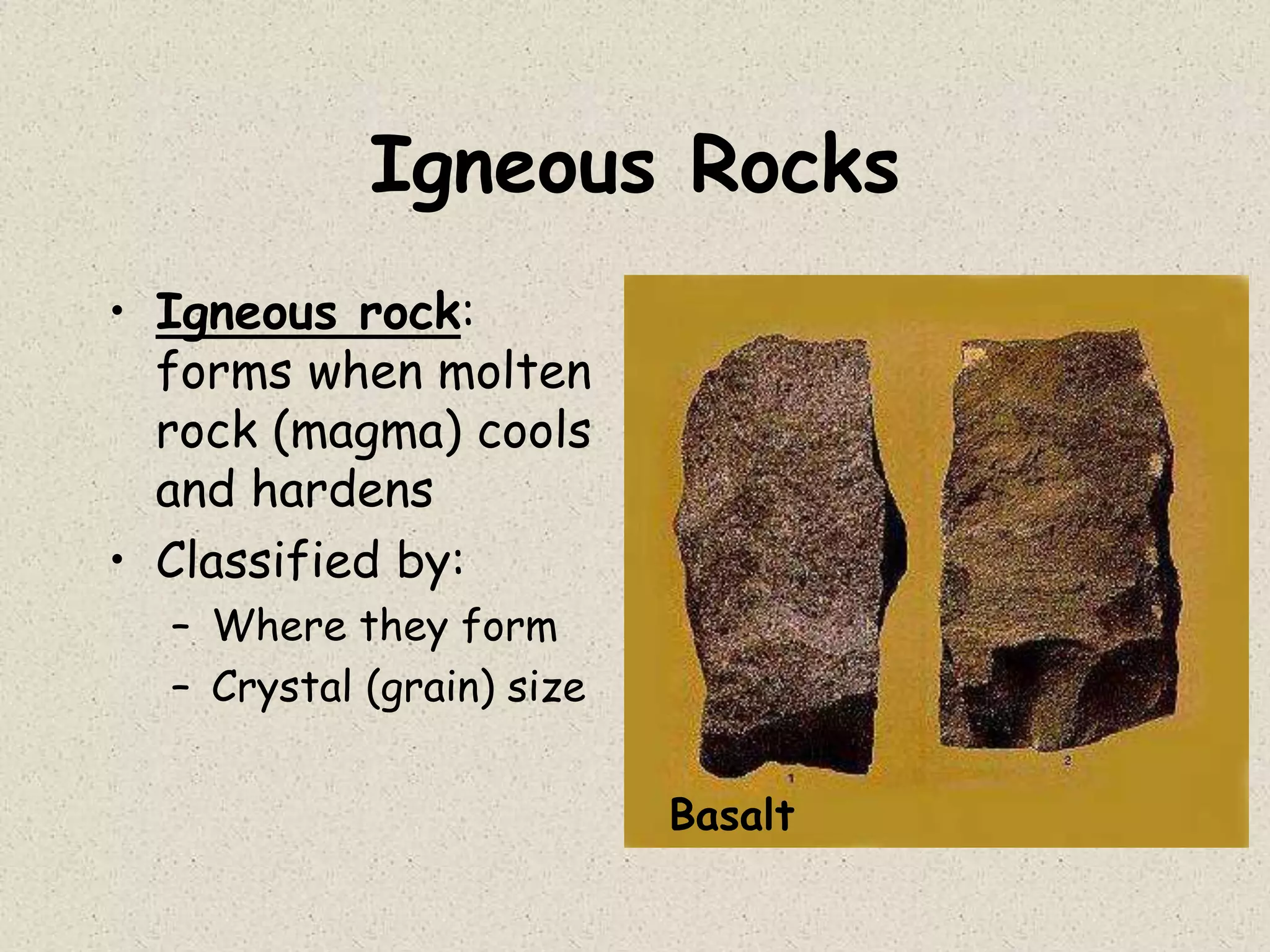
Igneous Rocks
• Igneous rock:
forms when molten
rock (magma) cools
and hardens
• Classified by:
– Where they form
– Crystal (grain) size
Basalt
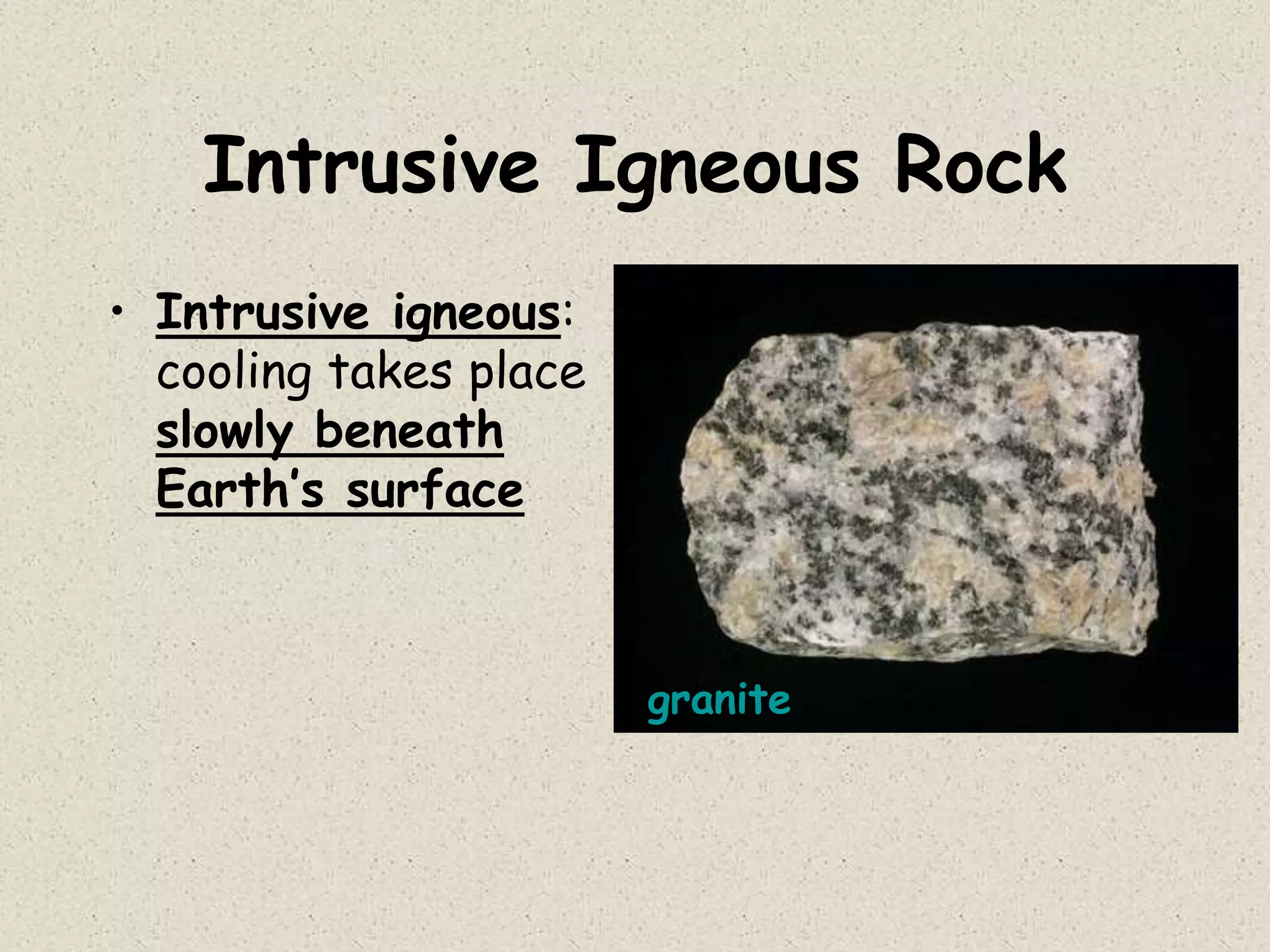
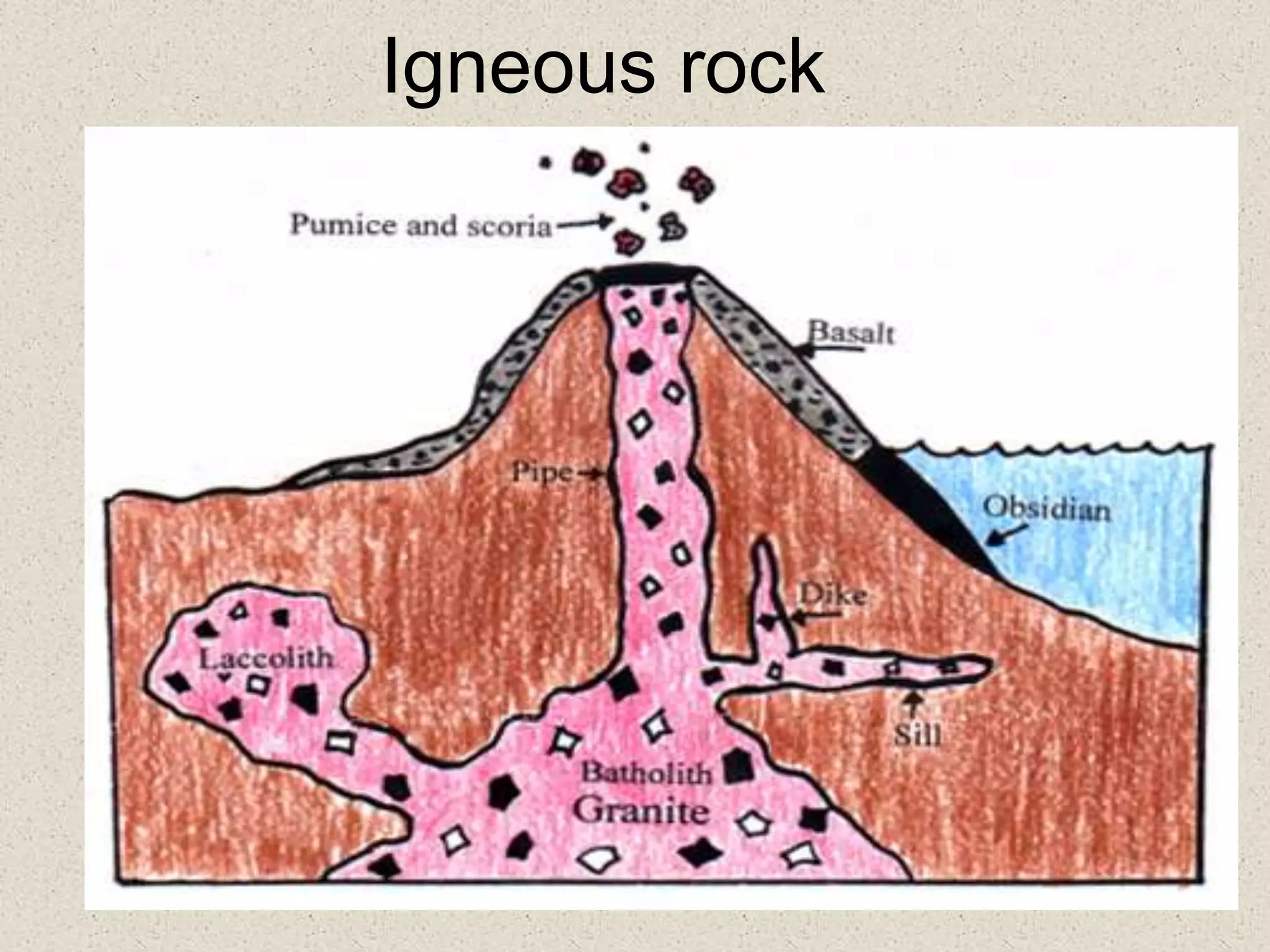
Intrusive Igneous Rock
• Intrusive igneous:
cooling takes place
slowly beneath
Earth’s surface
granite
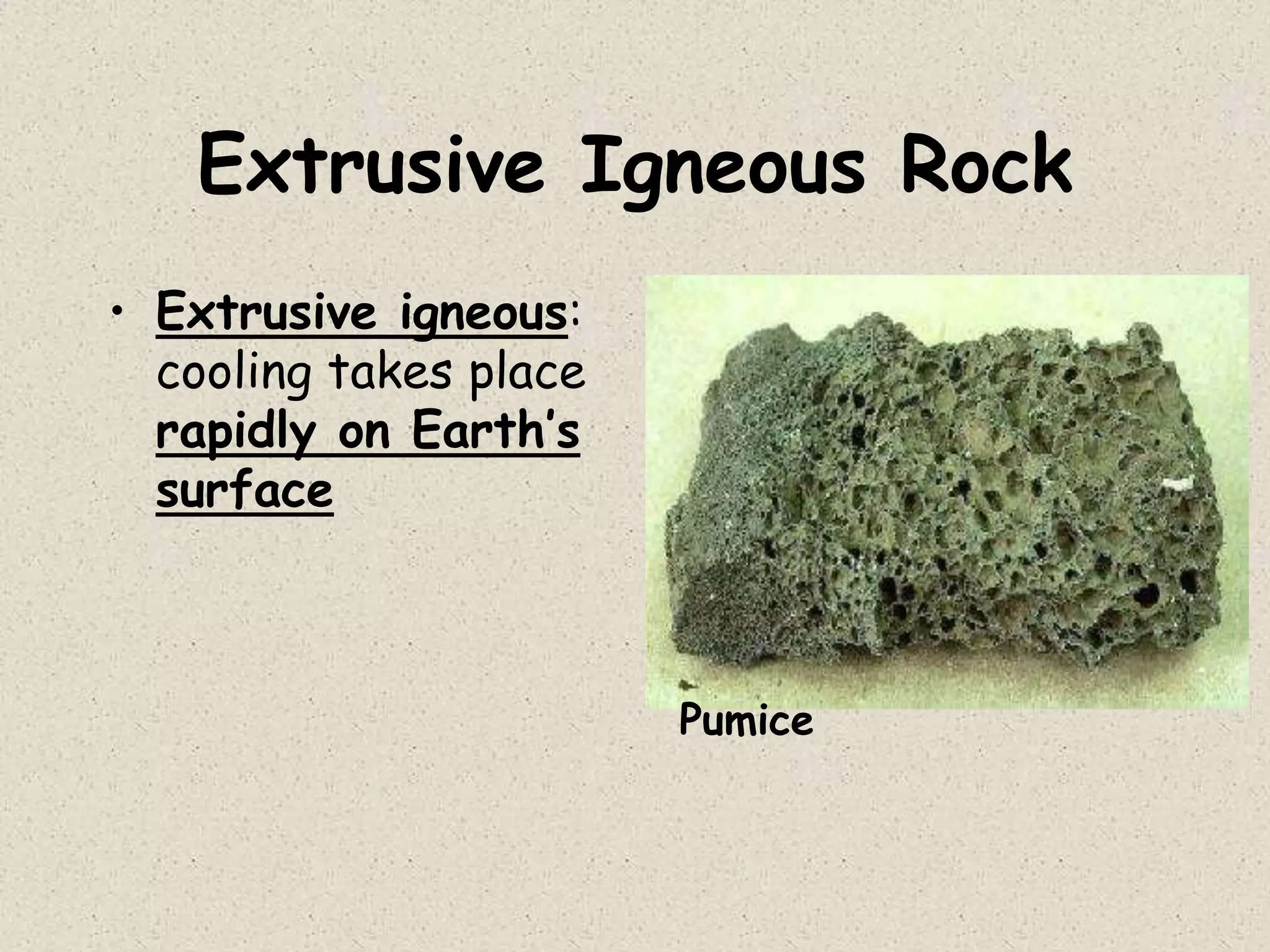
Extrusive Igneous Rock
• Extrusive igneous:
cooling takes place
rapidly on Earth’s
surface
Pumice
Igneous rock
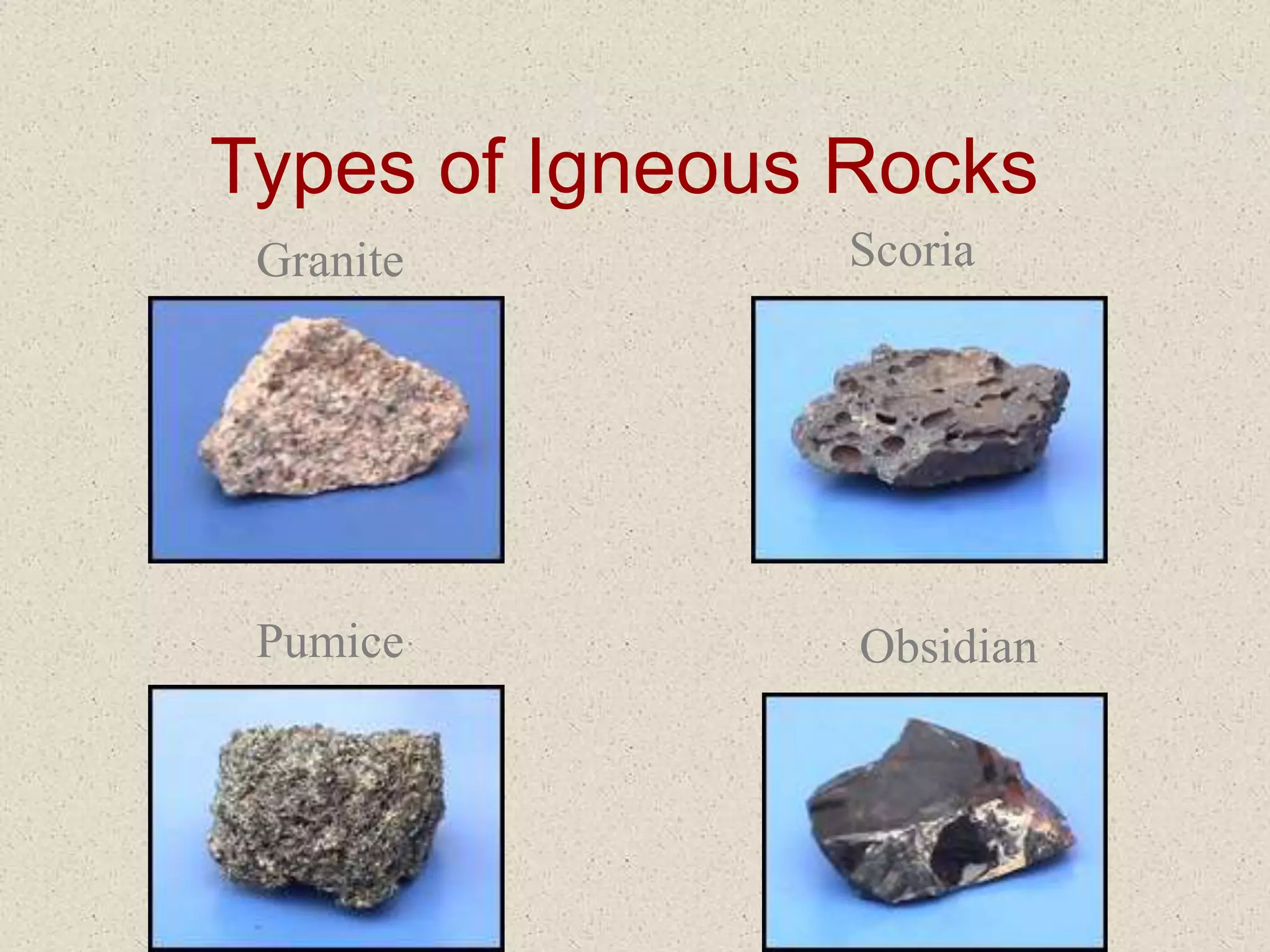
Types of Igneous Rocks
Granite Scoria
Pumice Obsidian
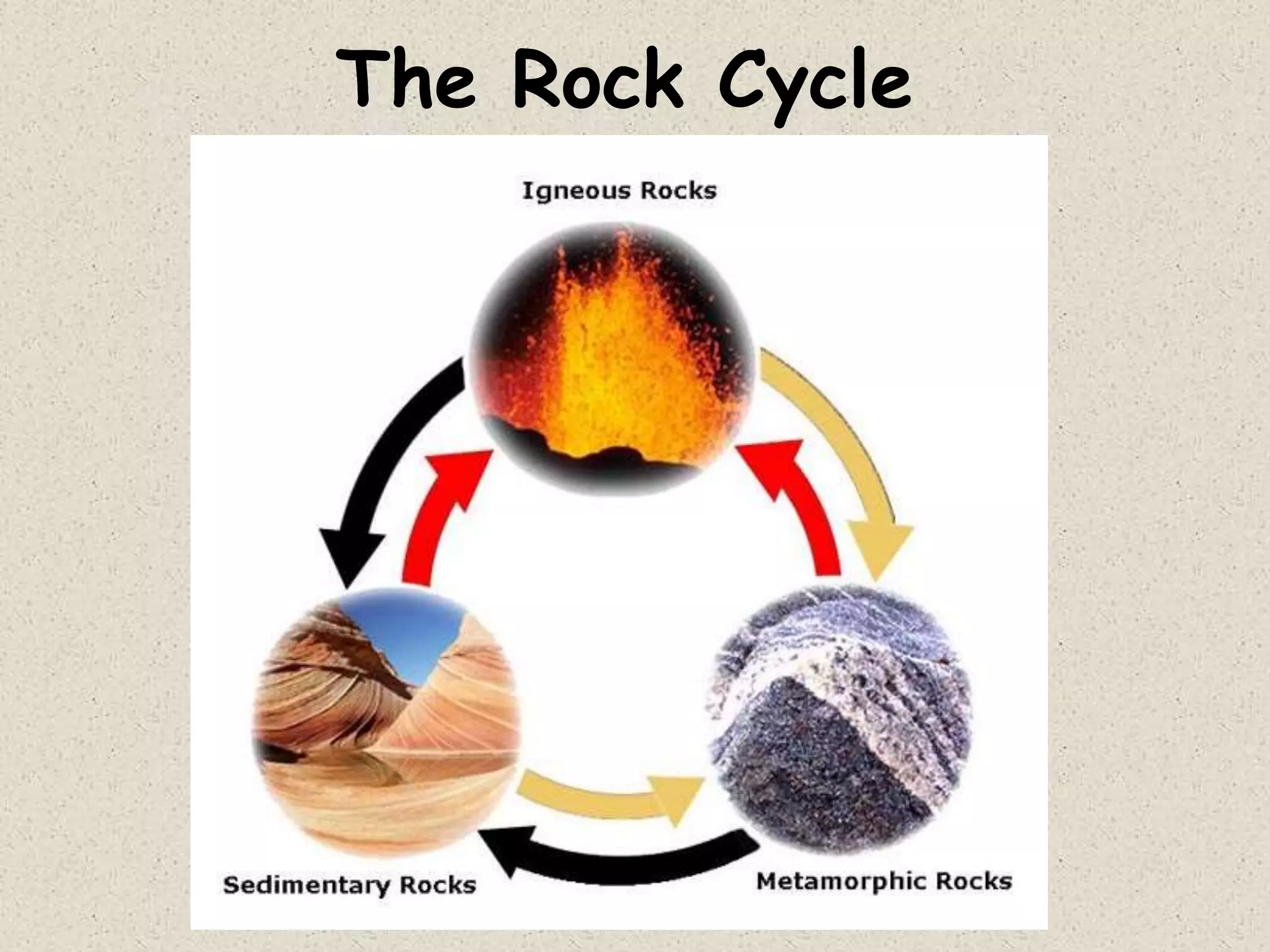
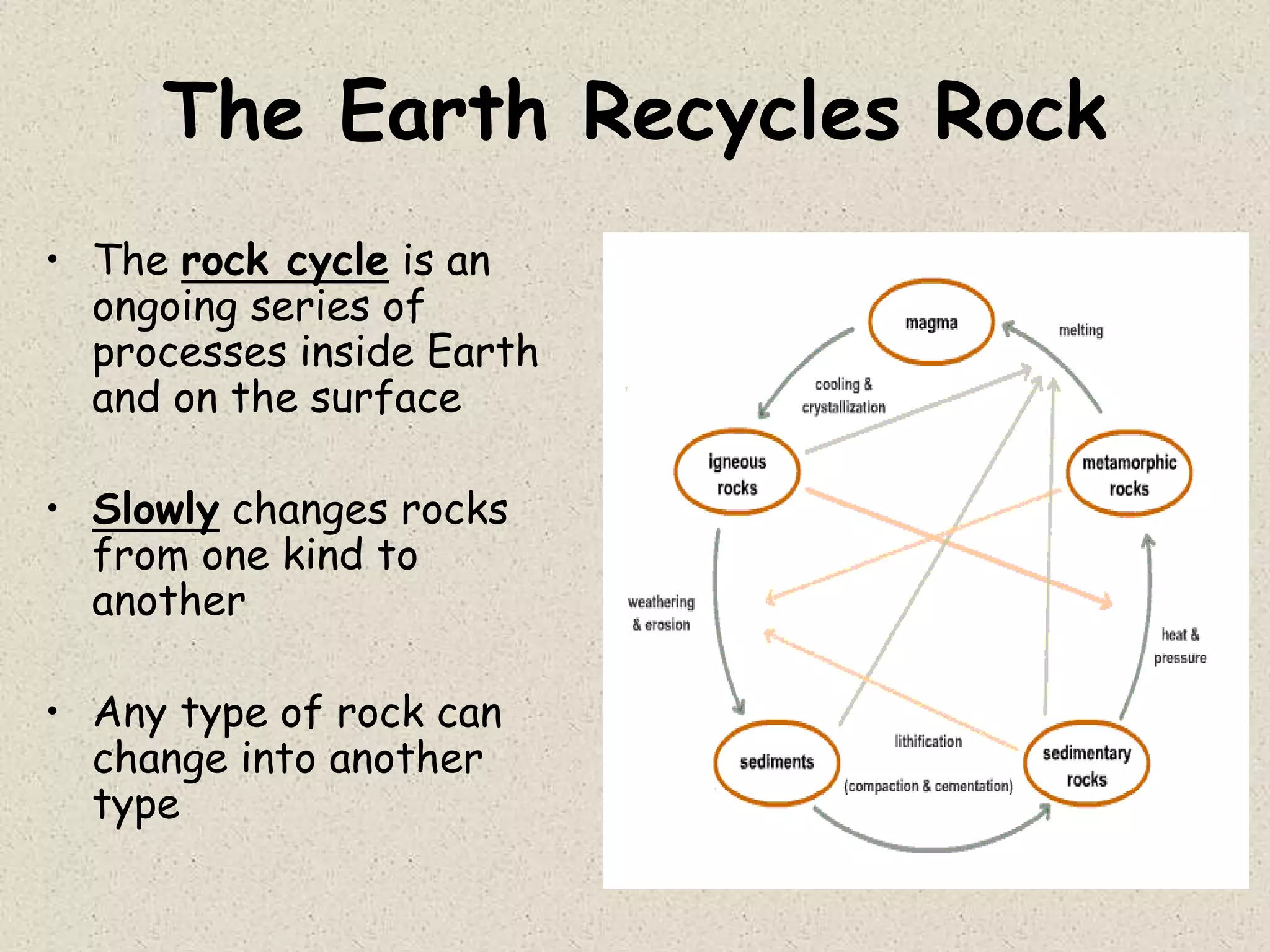
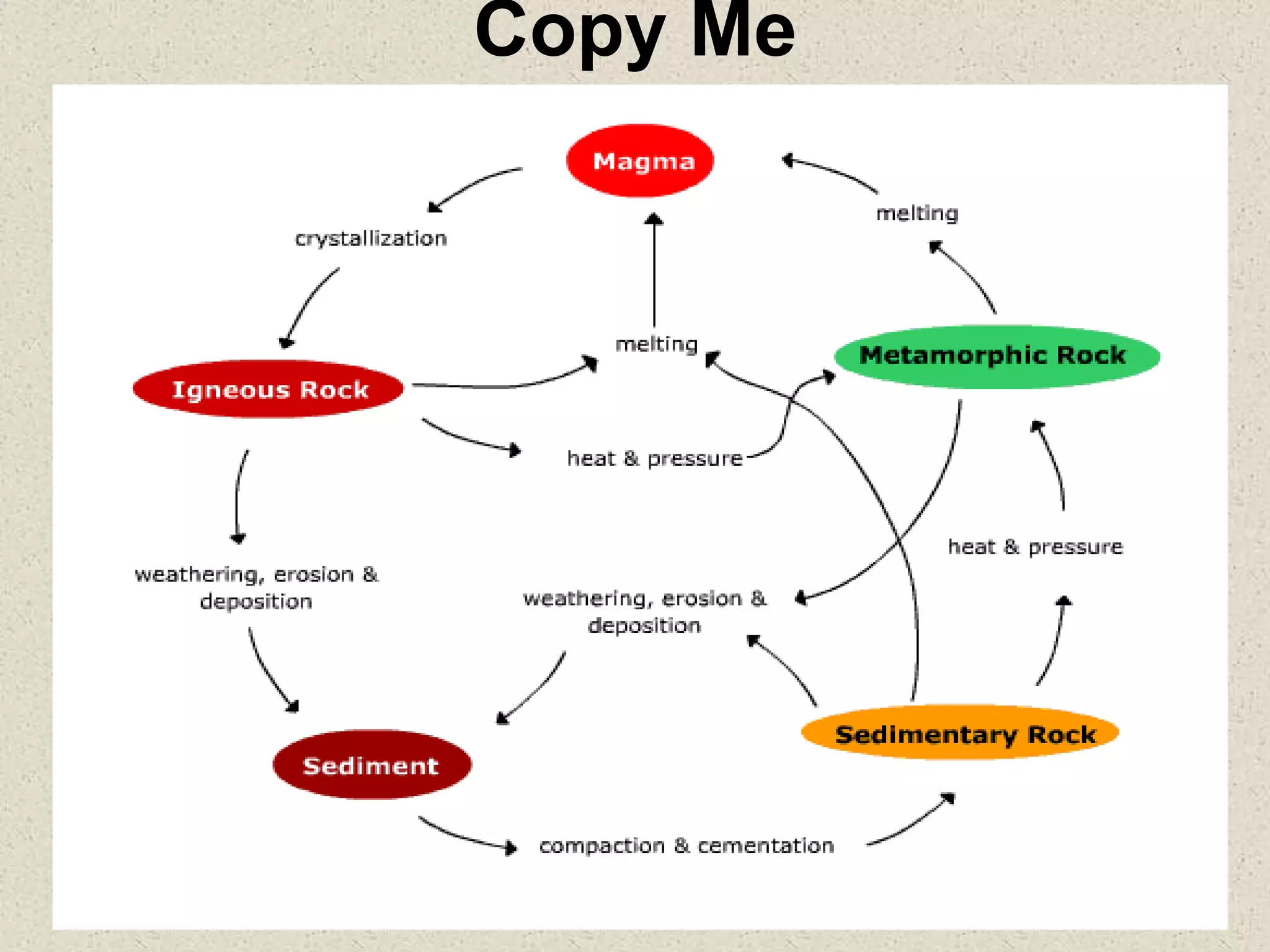
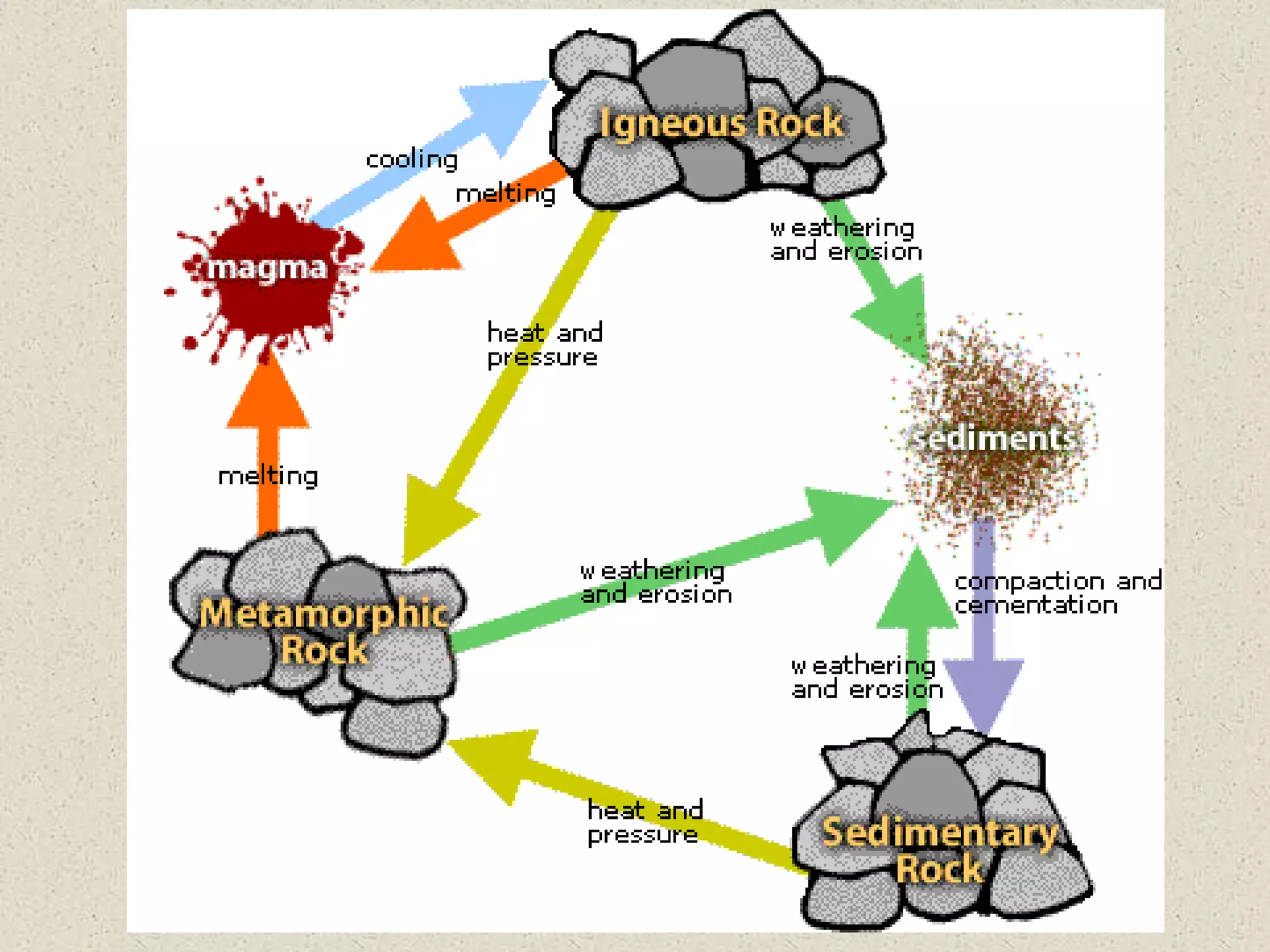
The Rock Cycle
The Earth Recycles Rock
• The rock cycle is an
ongoing series of
processes inside Earth
and on the surface
• Slowly changes rocks
from one kind to
another
• Any type of rock can
change into another
type
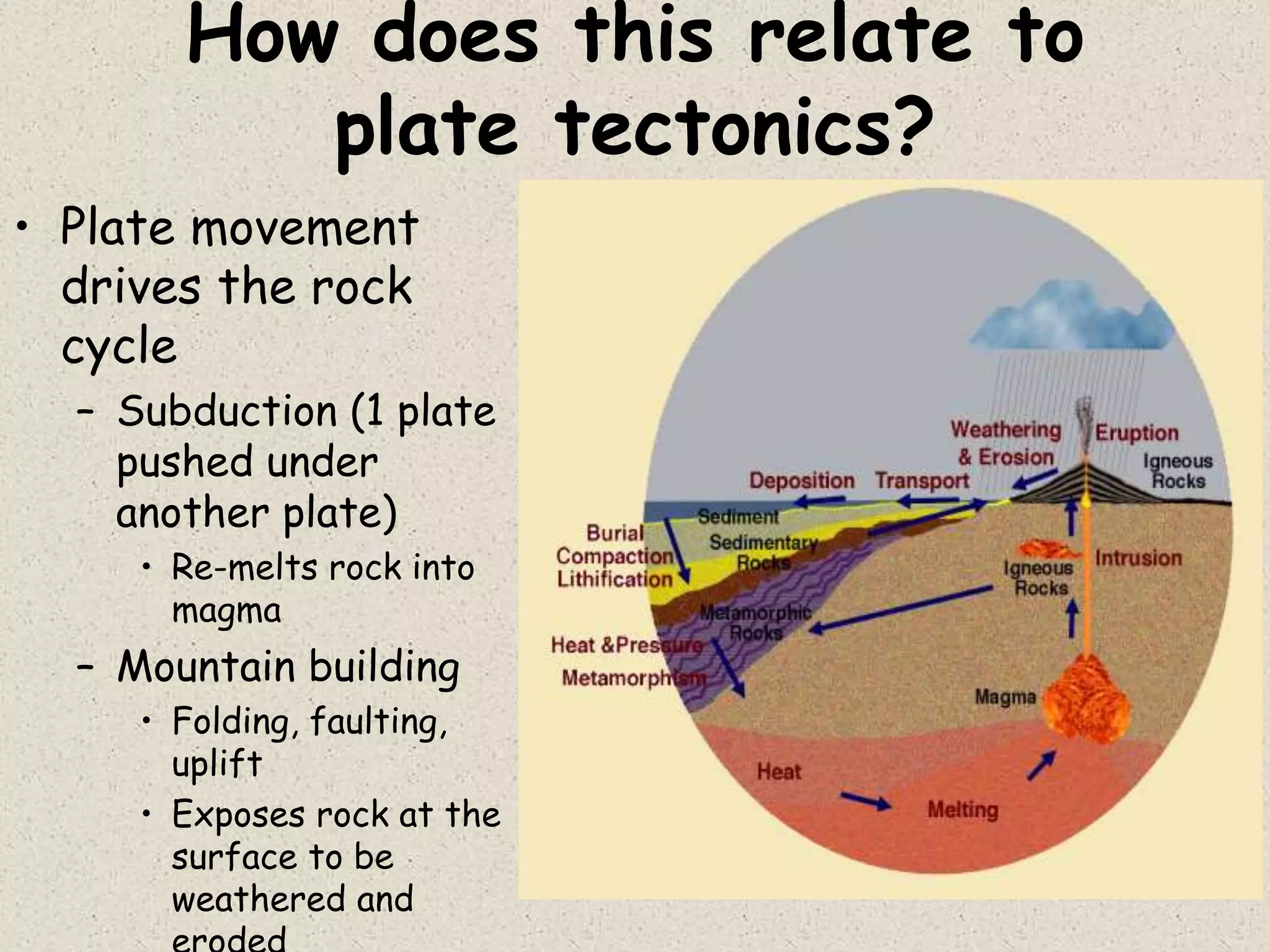
How does this relate to
plate tectonics?
• Plate movement
drives the rock
cycle
– Subduction (1 plate
pushed under
another plate)
• Re-melts rock into
magma
– Mountain building
• Folding, faulting,
uplift
• Exposes rock at the
surface to be
weathered and
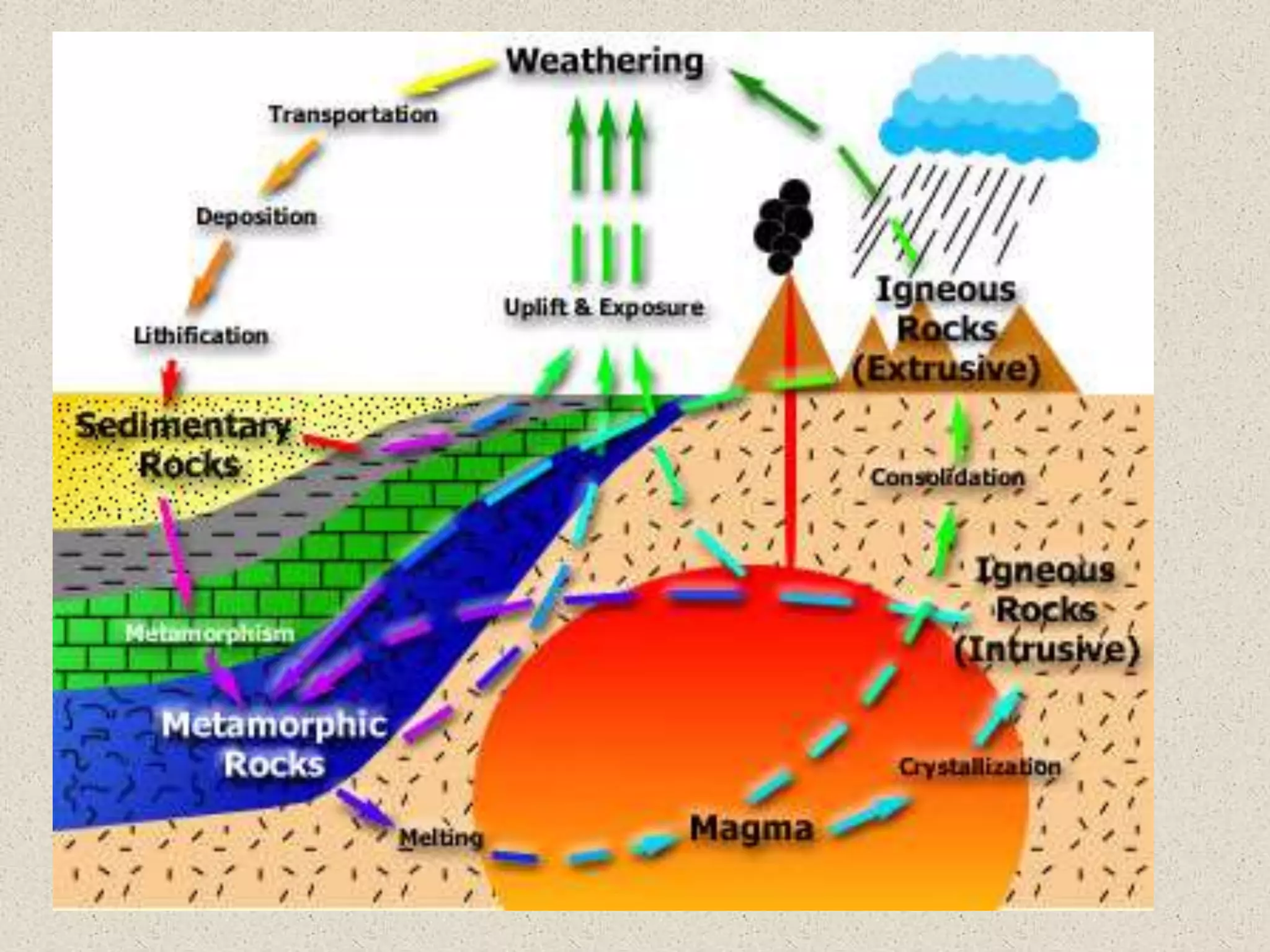
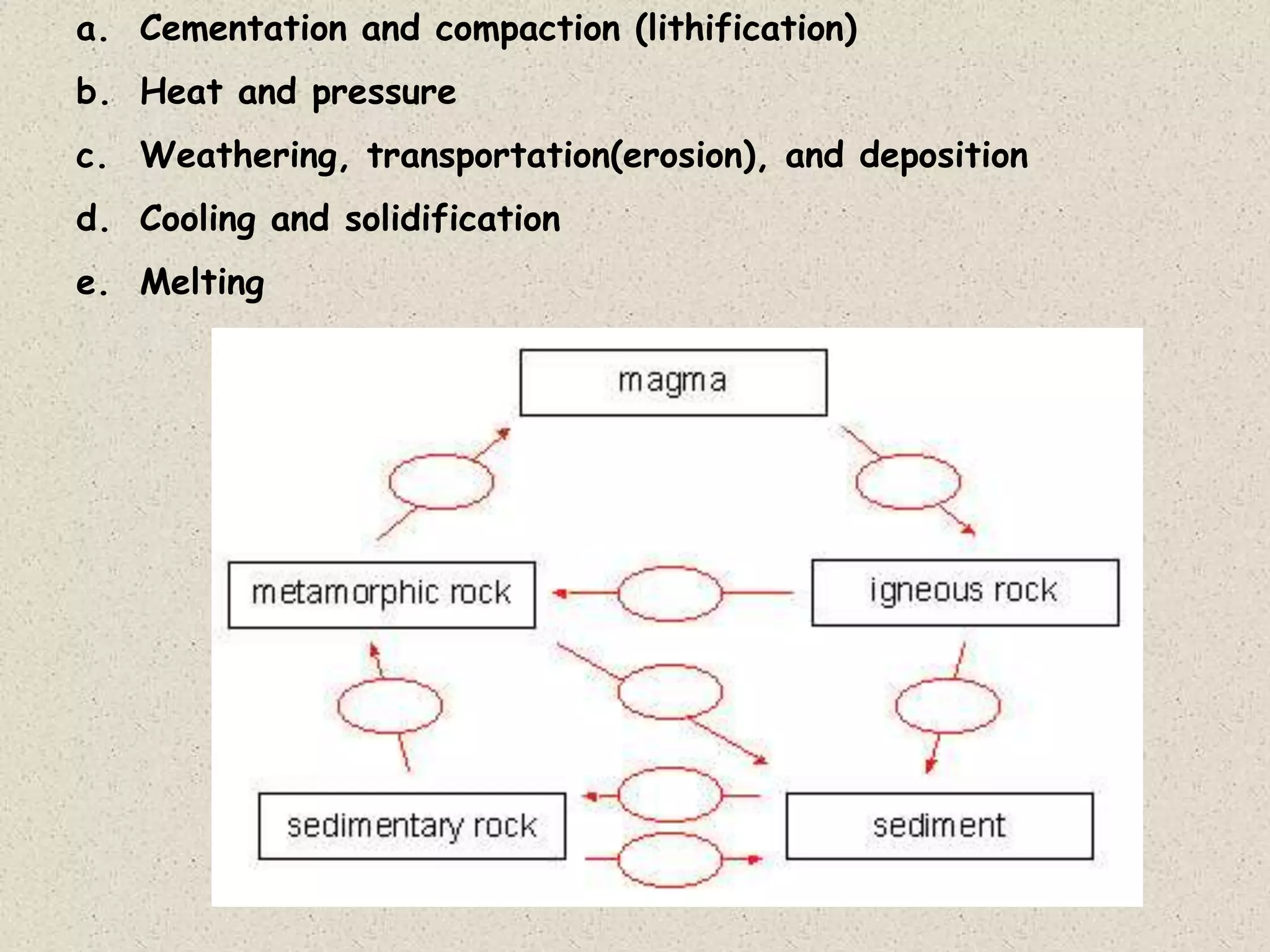
a. Cementation and compaction (lithification)
b. Heat and pressure
c. Weathering, transportation(erosion), and deposition
d. Cooling and solidification
e. Melting
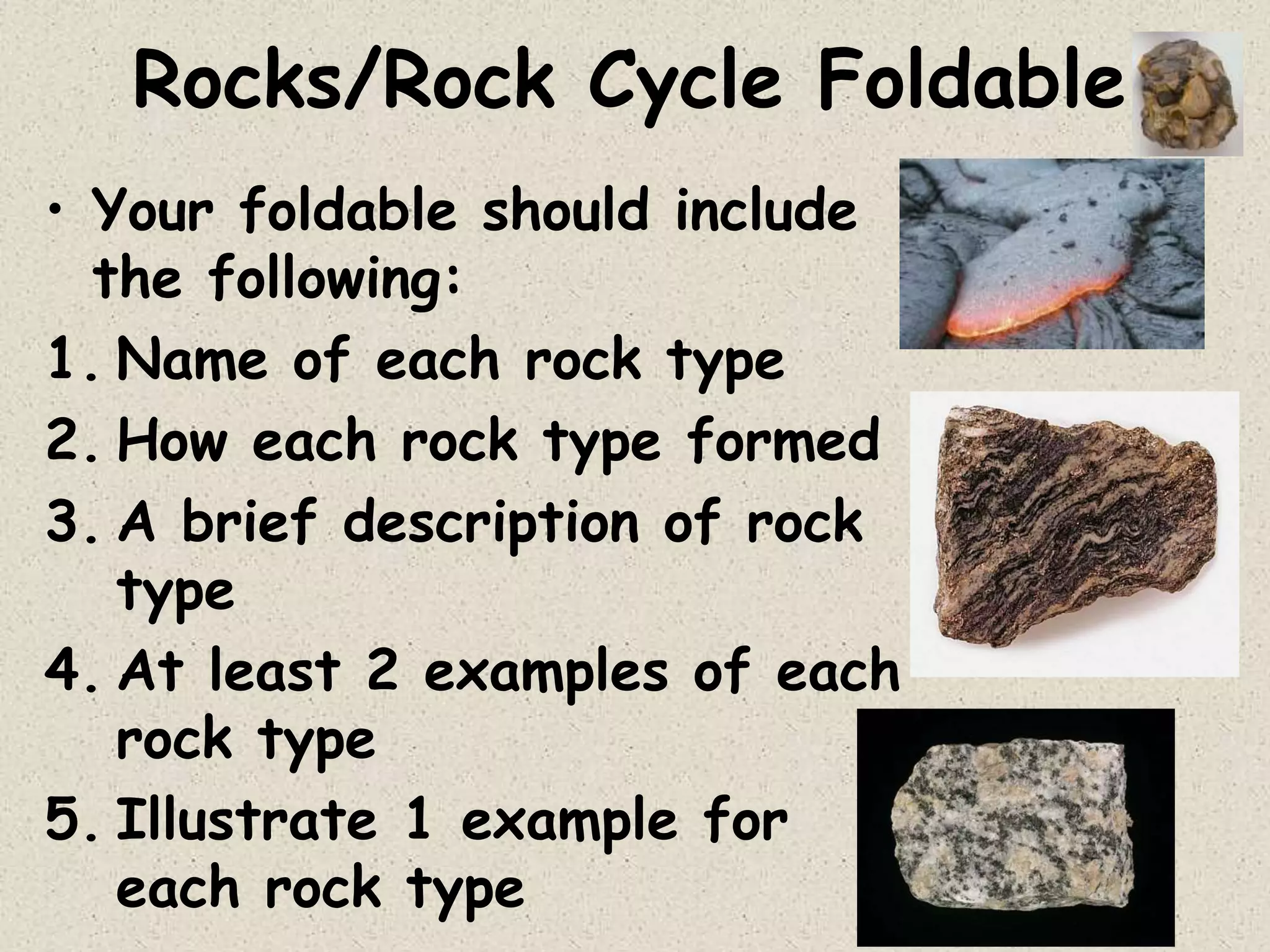
Rocks/Rock Cycle Foldable
• Your foldable should include
the following:
1. Name of each rock type
2. How each rock type formed
3. A brief description of rock
type
4. At least 2 examples of each
rock type
5. Illustrate 1 example for
each rock type
Copy Me
Review of the Rock Cycle
• How are sedimentary rocks formed?
• What is a fossil?
• How are metamorphic rocks formed?
• How are igneous rocks formed?
• Give an example of each type of rock.
• What is weathering?
• Explain what erosion is.

Rock-Cycle-Power-Point-1.ppt

  • 1.
    Rocks and theRock Cycle
  • 2.
  • 3.
    The Life ofa Rock Sedimentary Rock Metamorphic Igneous Changes are made from pressure and heat. Layers of sediment join together. Melted rock cools and hardens
  • 4.
    Rocks become smaller,and smaller, and smaller, and smaller. . . • By erosion • By wind • By earthquake • By floods • By rain • By slides • By man
  • 5.
    Terms to Know •Weathering: the breaking up of rocks and soil • Erosion: the moving of weathered rock and soil. Weathering allows erosion to take place.
  • 6.
    Products of Weathering •Clay • Sand • Rock Fragments (pebbles and stones)
  • 7.
    Rocks change………….. • Byearthquakes • By volcanoes • By heat and pressure
  • 8.
    How does rockchange? • Rocks are heated, squeezed, folded, or chemically changed by contact with hot fluids marble
  • 9.
    Three Types ofRocks • Rocks are classified by how they form – Igneous – Sedimentary – Metamorphic – Rocks can change from one type to another over time Schist
  • 10.
    Rock Classification • Rocksare classified by: – How they form – Texture – Grain size – Mineral composition Conglomerate Sedimentary Rock
  • 11.
    Sedimentary Rock is. . . • Rock formed when layers of small particles of shell, rock, and sand join together.
  • 13.
    Sedimentary Rock • Sedimentaryrock: forms from the compaction and/or cementation of sediments • This process is called lithification • Sediments are: – Rock pieces – Mineral grains – Shell fragments Limestone
  • 14.
    How do sedimentsform? • Sediments form through the processes of weathering and erosion of rocks exposed at Earth’s surface weathering erosion
  • 15.
    Sedimentary Rock con’t…. •Sedimentary rock can also form from the chemical depositing of materials that were once dissolved in water • When water evaporates, minerals are left behind and form rock gypsum
  • 16.
    Sedimentary Rocks How Theyare Made • Wind and water break down the earth • Bits of earth settle in lakes and rivers • Layers are formed and build up • Pressure and time turn the layers to rock
  • 17.
  • 18.
    Types of SedimentaryRocks Gypsum Sandstone Shale Limestone Conglomerate
  • 19.
    Fossils • Fossils areusually found in sedimentary rock and are the remains or imprints of plants and animals that died long ago.
  • 20.
    Fossils-Life From thePast • Fossils provide information about life and conditions of the past. • Scientific evidence shows that the Earth is approximately 4.5 billion years old
  • 21.
    Metamorphic Rock is. . . • Rock that is formed when pressure and heat create changes to sedimentary or igneous rock.
  • 23.
    Metamorphic Rock • Metamorphicrock: forms when any rock type is changed into a different kind of rock • Changes due to great heat and/or pressure Gneiss
  • 24.
    How does rockchange? • Rocks are heated, squeezed, folded, or chemically changed by contact with hot fluids marble
  • 25.
    Metamorphic Rocks What areThey? • Rocks that have changed • They were once igneous or sedimentary • Pressure and heat changed the rocks
  • 26.
    Types of MetamorphicRocks Schist Gneiss
  • 27.
    Igneous Rock is. . . • Rock that is formed when melted rock cools and hardens.
  • 29.
    Igneous Rocks What areThey? • Fire Rocks • Formed underground by trapped, cooled magma • Formed above ground when volcanoes erupt and magma cools
  • 30.
    Igneous Rocks • Igneousrock: forms when molten rock (magma) cools and hardens • Classified by: – Where they form – Crystal (grain) size Basalt
  • 31.
    Intrusive Igneous Rock •Intrusive igneous: cooling takes place slowly beneath Earth’s surface granite
  • 32.
    Extrusive Igneous Rock •Extrusive igneous: cooling takes place rapidly on Earth’s surface Pumice
  • 33.
  • 34.
    Types of IgneousRocks Granite Scoria Pumice Obsidian
  • 35.
  • 36.
    The Earth RecyclesRock • The rock cycle is an ongoing series of processes inside Earth and on the surface • Slowly changes rocks from one kind to another • Any type of rock can change into another type
  • 37.
    How does thisrelate to plate tectonics? • Plate movement drives the rock cycle – Subduction (1 plate pushed under another plate) • Re-melts rock into magma – Mountain building • Folding, faulting, uplift • Exposes rock at the surface to be weathered and
  • 41.
    a. Cementation andcompaction (lithification) b. Heat and pressure c. Weathering, transportation(erosion), and deposition d. Cooling and solidification e. Melting
  • 42.
    Rocks/Rock Cycle Foldable •Your foldable should include the following: 1. Name of each rock type 2. How each rock type formed 3. A brief description of rock type 4. At least 2 examples of each rock type 5. Illustrate 1 example for each rock type
  • 43.
  • 44.
    Review of theRock Cycle • How are sedimentary rocks formed? • What is a fossil? • How are metamorphic rocks formed? • How are igneous rocks formed? • Give an example of each type of rock. • What is weathering? • Explain what erosion is.