1. Types of reactions
2. Acids and bases
properties
definition
conjugate acid base pair

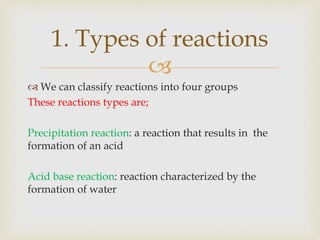
 We can classify reactions into four groups
These reactions types are;
Precipitation reaction: a reaction that results in the
formation of an acid
Acid base reaction: reaction characterized by the
formation of water
1. Types of reactions

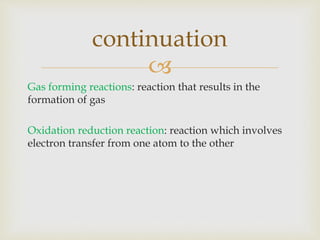
Gas forming reactions: reaction that results in the
formation of gas
Oxidation reduction reaction: reaction which involves
electron transfer from one atom to the other
continuation

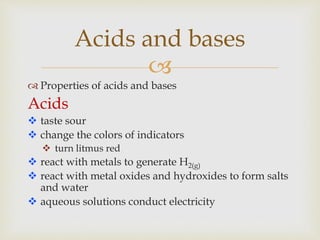
 Properties of acids and bases
Acids
 taste sour
 change the colors of indicators
 turn litmus red
 react with metals to generate H2(g)
 react with metal oxides and hydroxides to form salts
and water
 aqueous solutions conduct electricity
Acids and bases

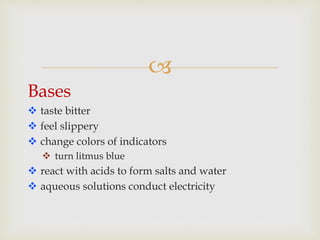
Bases
 taste bitter
 feel slippery
 change colors of indicators
 turn litmus blue
 react with acids to form salts and water
 aqueous solutions conduct electricity

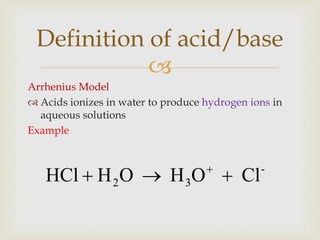
Arrhenius Model
 Acids ionizes in water to produce hydrogen ions in
aqueous solutions
Example
Definition of acid/base
-
32 ClOHOHHCl  

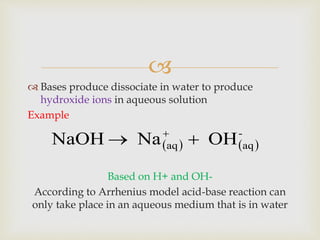
 Bases produce dissociate in water to produce
hydroxide ions in aqueous solution
Example
Based on H+ and OH-
According to Arrhenius model acid-base reaction can
only take place in an aqueous medium that is in water
   
-
aqaq OHNaNaOH  

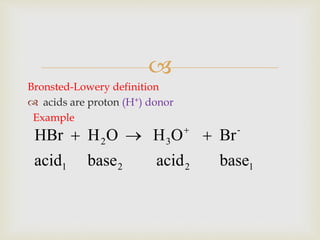
Bronsted-Lowery definition
 acids are proton (H+) donor
Example
1221
-
32
baseacidbaseacid
BrOHOHHBr  

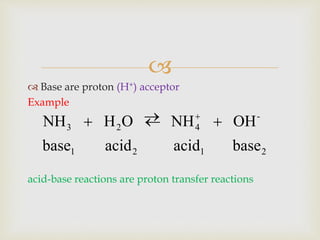
 Base are proton (H+) acceptor
Example
acid-base reactions are proton transfer reactions
2121
-
423
baseacidacidbase
OHNHOHNH   

 Comes from Brønsted-Lowry acid–base reaction.
Whereby
 the original base becomes an acid in the reverse
reaction.
 the original acid becomes a base in the reverse
process.
Conjugate acid-base pair

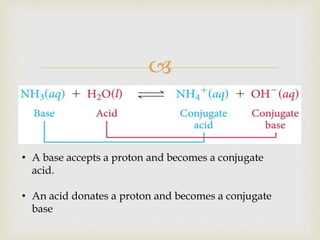
• A base accepts a proton and becomes a conjugate
acid.
• An acid donates a proton and becomes a conjugate
base

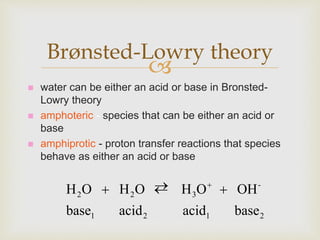
 water can be either an acid or base in Bronsted-
Lowry theory
 amphoteric - species that can be either an acid or
base
 amphiprotic - proton transfer reactions that species
behave as either an acid or base
Brønsted-Lowry theory
2121
-
322
baseacidacidbase
OHOHOHOH   

Types of reactions_i

  • 1.
    1. Types ofreactions 2. Acids and bases properties definition conjugate acid base pair
  • 2.
      We canclassify reactions into four groups These reactions types are; Precipitation reaction: a reaction that results in the formation of an acid Acid base reaction: reaction characterized by the formation of water 1. Types of reactions
  • 3.
     Gas forming reactions:reaction that results in the formation of gas Oxidation reduction reaction: reaction which involves electron transfer from one atom to the other continuation
  • 4.
      Properties ofacids and bases Acids  taste sour  change the colors of indicators  turn litmus red  react with metals to generate H2(g)  react with metal oxides and hydroxides to form salts and water  aqueous solutions conduct electricity Acids and bases
  • 5.
     Bases  taste bitter feel slippery  change colors of indicators  turn litmus blue  react with acids to form salts and water  aqueous solutions conduct electricity
  • 6.
     Arrhenius Model  Acidsionizes in water to produce hydrogen ions in aqueous solutions Example Definition of acid/base - 32 ClOHOHHCl  
  • 7.
      Bases producedissociate in water to produce hydroxide ions in aqueous solution Example Based on H+ and OH- According to Arrhenius model acid-base reaction can only take place in an aqueous medium that is in water     - aqaq OHNaNaOH  
  • 8.
     Bronsted-Lowery definition  acidsare proton (H+) donor Example 1221 - 32 baseacidbaseacid BrOHOHHBr  
  • 9.
      Base areproton (H+) acceptor Example acid-base reactions are proton transfer reactions 2121 - 423 baseacidacidbase OHNHOHNH   
  • 10.
      Comes fromBrønsted-Lowry acid–base reaction. Whereby  the original base becomes an acid in the reverse reaction.  the original acid becomes a base in the reverse process. Conjugate acid-base pair
  • 11.
     • A baseaccepts a proton and becomes a conjugate acid. • An acid donates a proton and becomes a conjugate base
  • 12.
      water canbe either an acid or base in Bronsted- Lowry theory  amphoteric - species that can be either an acid or base  amphiprotic - proton transfer reactions that species behave as either an acid or base Brønsted-Lowry theory 2121 - 322 baseacidacidbase OHOHOHOH   