Atmospheric Environment. 45, (2011), 6197-6203

Chemical mechanism and kinetic
study on the ocimene ozonolysis
reaction in atmosphere
Xiamin Sun[a,b], Jing Bai[a], Yuyang Zhao[a], Chenxi
Zhang[a], Yudong Wang[a], jingtian Hu[a]
a. Environment Research Institute, Shandong University, Jinan 250100, PR China
b. State Key Laboratory of Solid Lubrication, Lanzhou Institute of Chemical Physics,
Chinese Academy of Science, Lanzhou 730000, PR China
Main objective of the paper.
Obtain theoretical kinetic constants of ocimene
ozonolysis and its reaction pathway, in order to estimate
atmospheric lifetimes of the reaction species.
Background information:
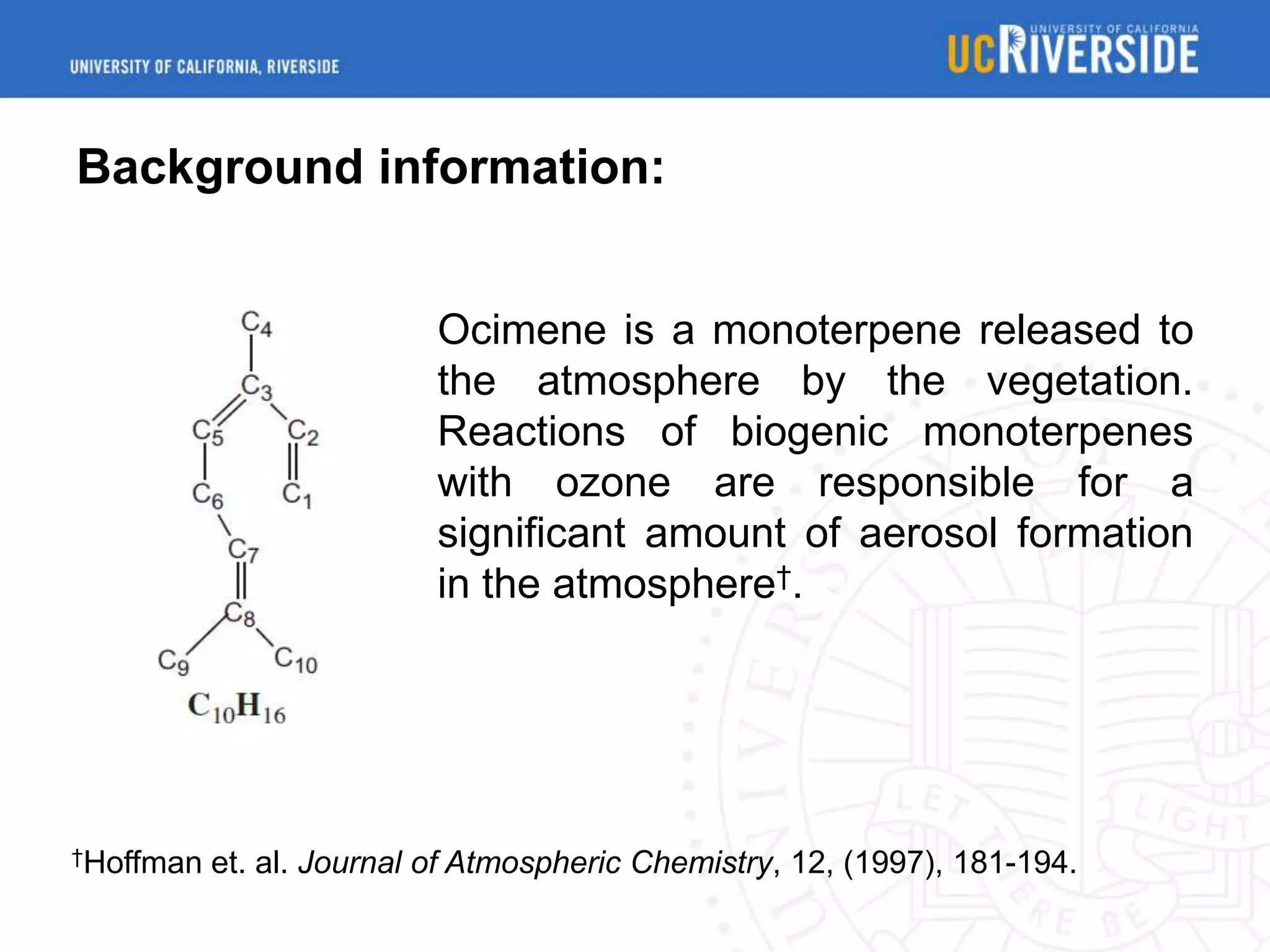
Ocimene is a monoterpene released to
the atmosphere by the vegetation.
Reactions of biogenic monoterpenes
with ozone are responsible for a
significant amount of aerosol formation
in the atmosphere†.

†Hoffman

et. al. Journal of Atmospheric Chemistry, 12, (1997), 181-194.
Atkinson† describes ozonolysis in the following schemes:
†R.

Atkinson. Atmospheric
Environment, 34, (2000), 2
063-2101.
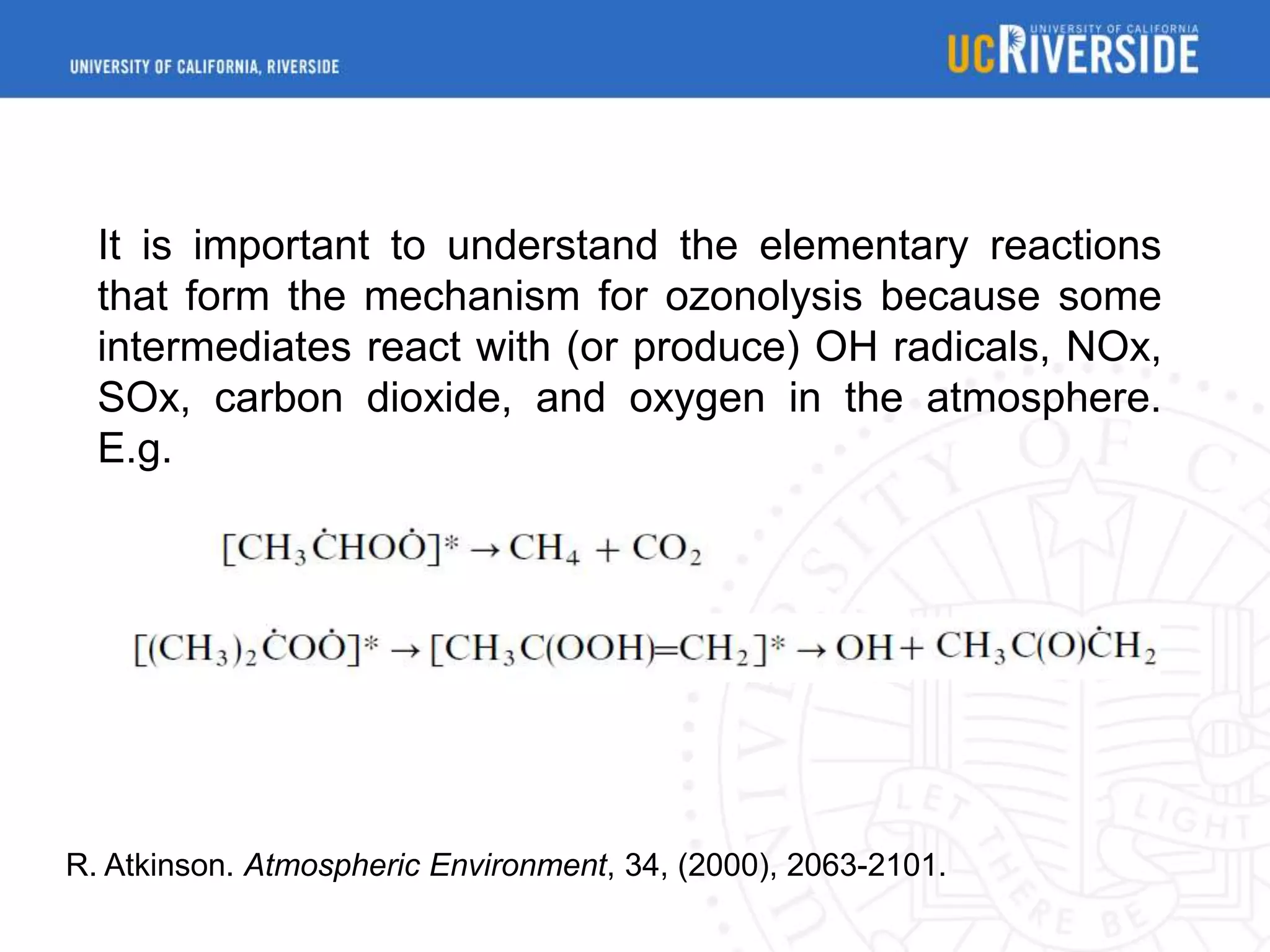
It is important to understand the elementary reactions
that form the mechanism for ozonolysis because some
intermediates react with (or produce) OH radicals, NOx,
SOx, carbon dioxide, and oxygen in the atmosphere.
E.g.

R. Atkinson. Atmospheric Environment, 34, (2000), 2063-2101.
Computational methods:
The paper is purely computational, therefore, no
experiments are made. The computational methods can
be divided in two parts:
-

Geometry optimization of intermediates and transition
states using a hybrid DFT model (MPWB1K) using
Gaussian 03. Used to get the potential energy profile.

-

Kinetic calculations using Rice-Ramsperher-KasselMarcus Theory, and Canonical Variational TST (with
the computer program PLYRATE v9.7)
Results:
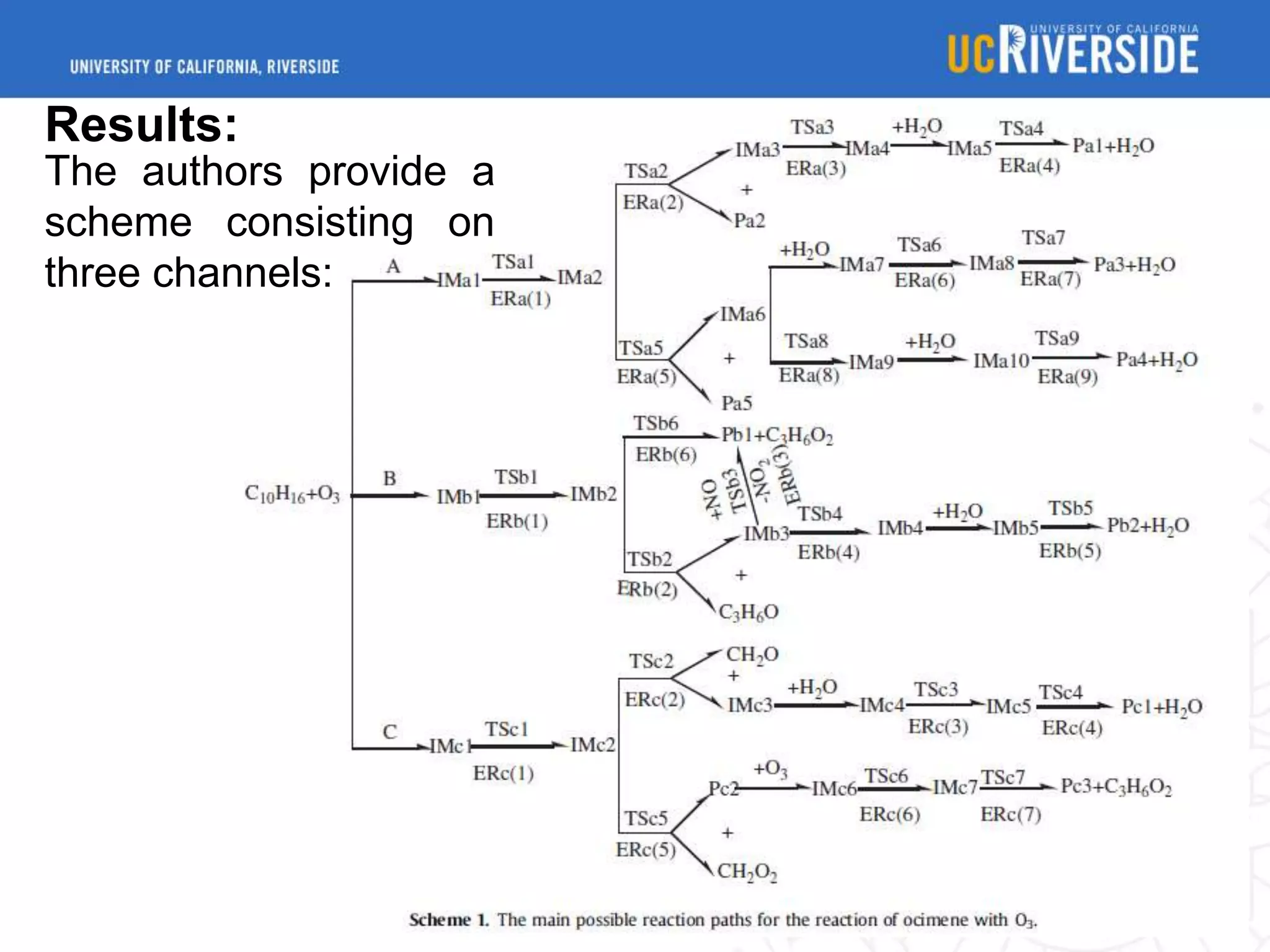
The authors provide a
scheme consisting on
three channels:
Let’s focus on channel A:

ERa(1)

ERa(2)
ERa(3)

ERa(4)
ERa(5)

ERa(6)
ERa(7)

ERa(8)
ERa(9)
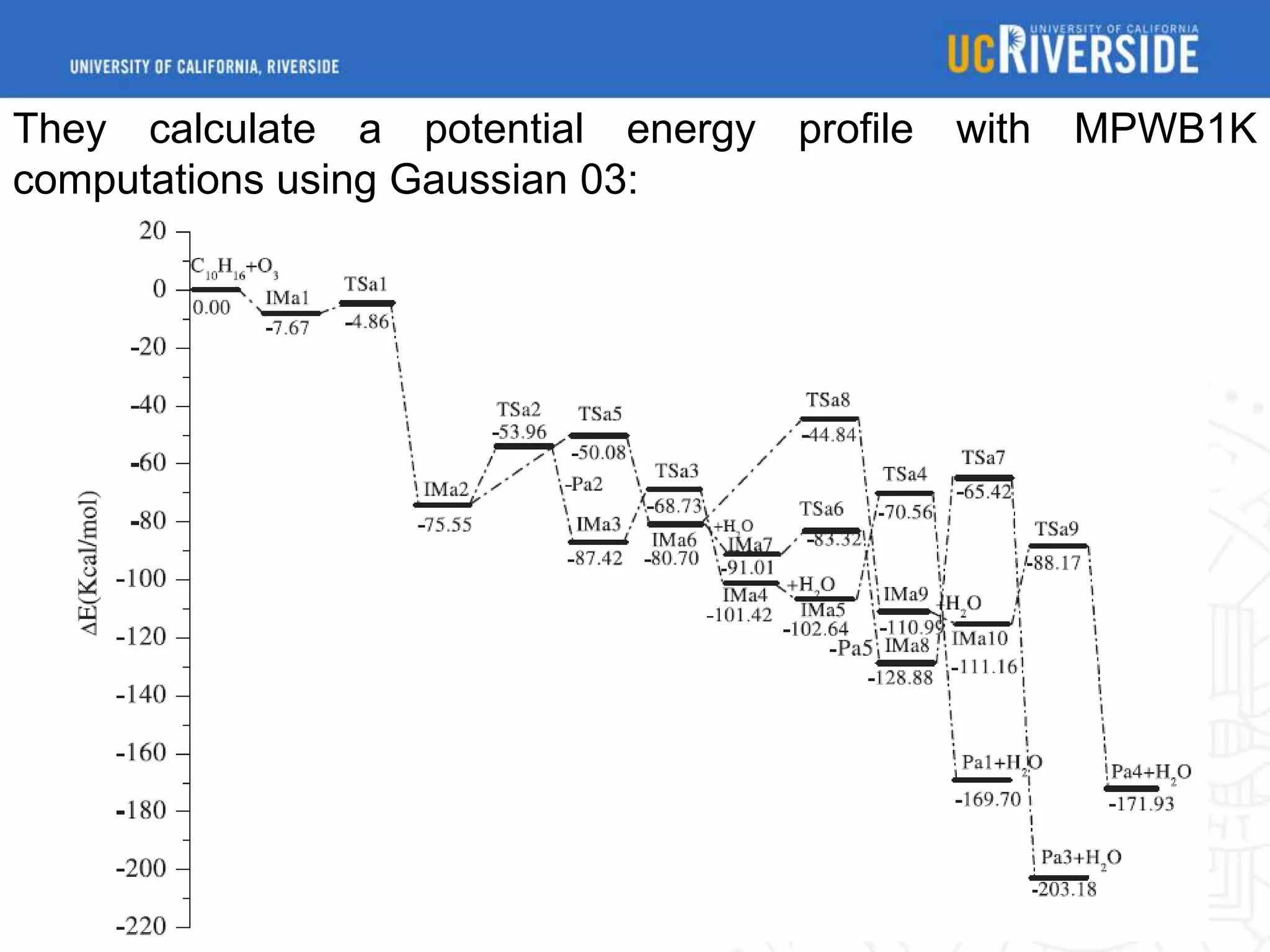
They calculate a potential energy
computations using Gaussian 03:

profile

with

MPWB1K
RRKM Theory is used for the following elementary reactions:

CVTST is used for the following isomerizations:
Derivation of kinetic equations:
RRKM Theory:
RRKM Theory traces its origins to Lindemann-Christensen
approach to unimolecular reactions:
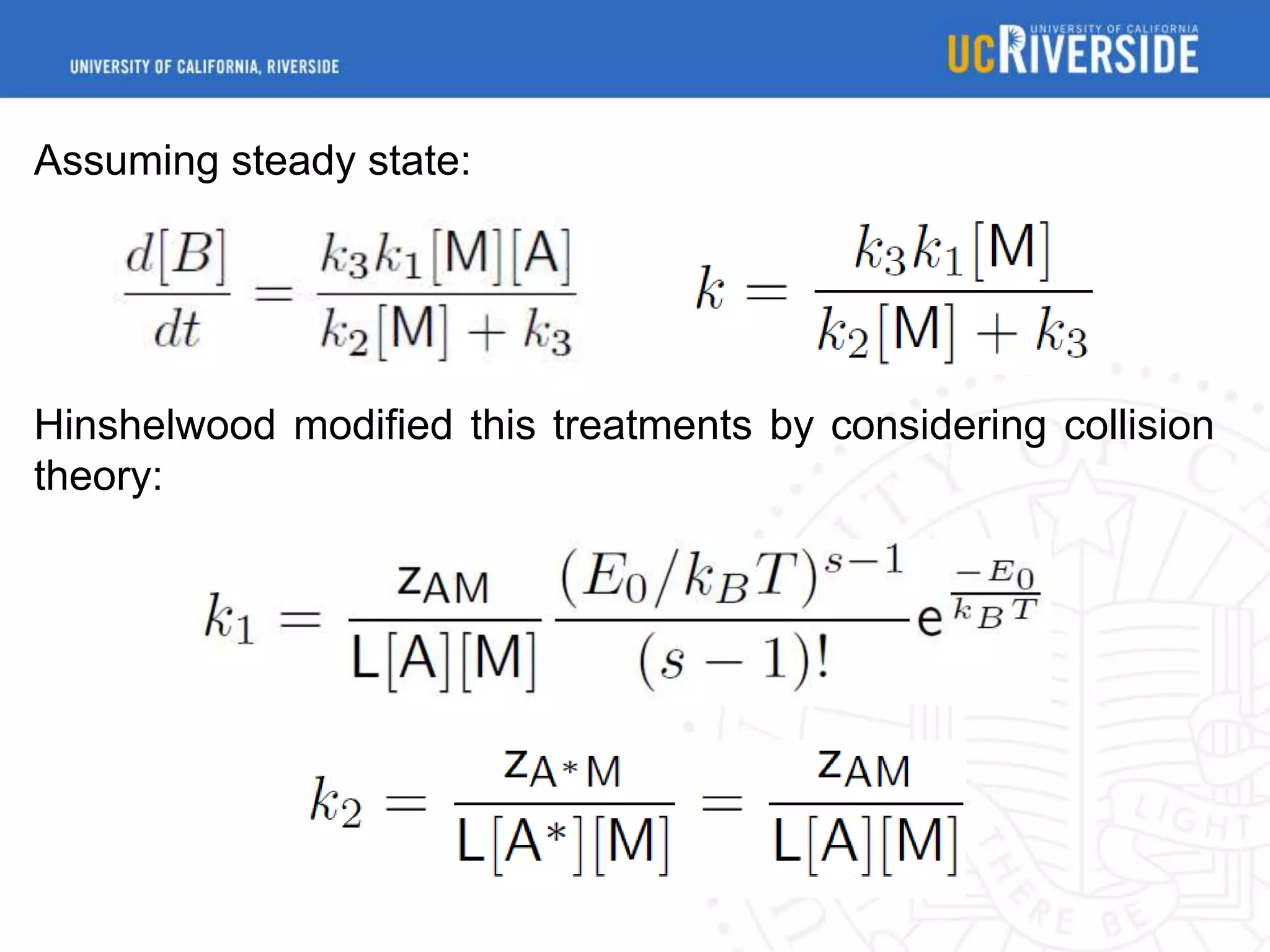
Assuming steady state:

Hinshelwood modified this treatments by considering collision
theory:
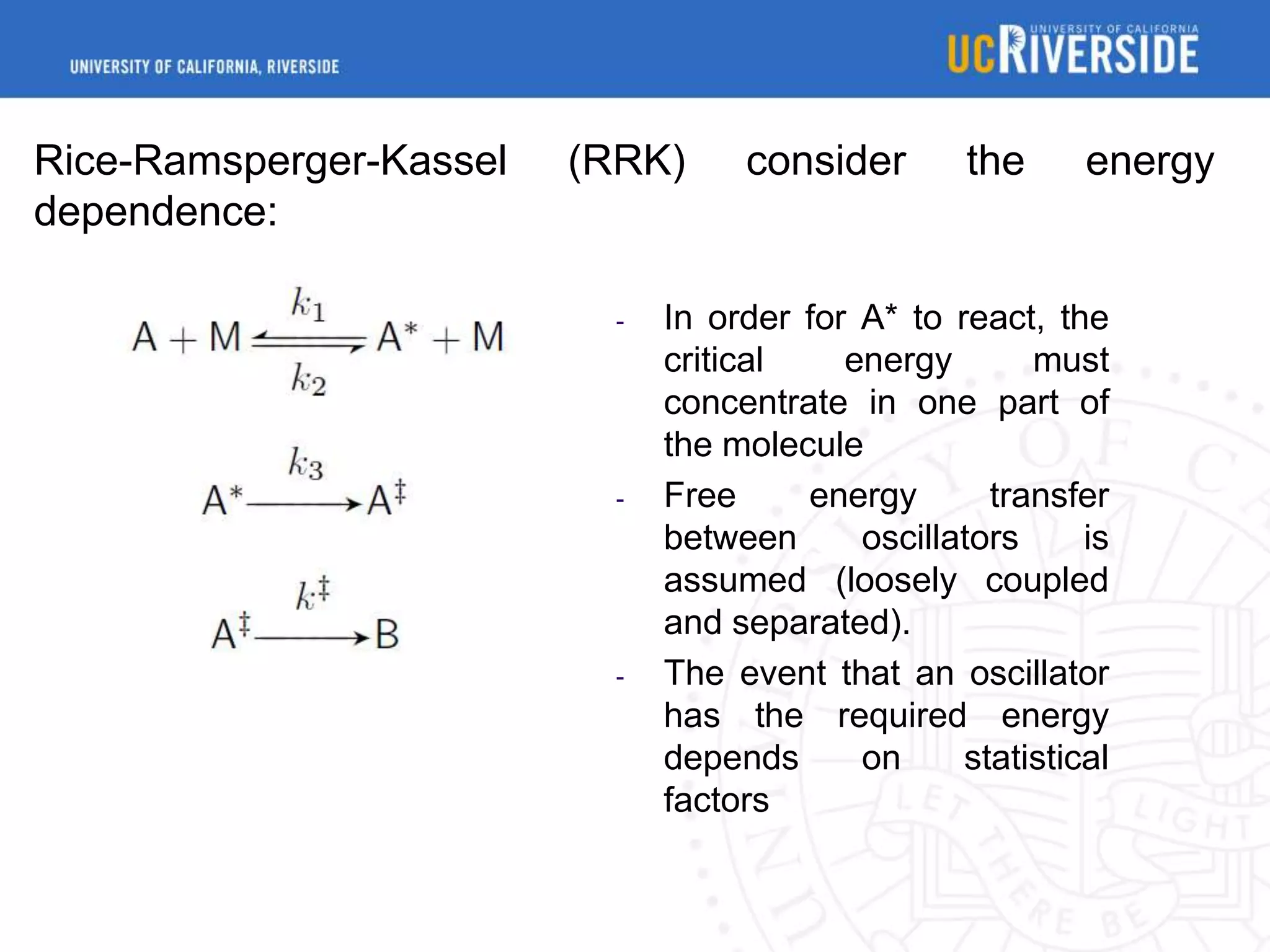
Rice-Ramsperger-Kassel
dependence:

(RRK)

-

-

-

consider

the

energy

In order for A* to react, the
critical
energy
must
concentrate in one part of
the molecule
Free
energy
transfer
between
oscillators
is
assumed (loosely coupled
and separated).
The event that an oscillator
has the required energy
depends
on
statistical
factors
The probability of an oscillator to have enough energy is
calculated accordingly:

The rate constant for the conversion of the energized molecule
into the activated complex will be proportional to this
probability
The ratio between activation and de-activation rates of A now
follows a distribution function:

The “first-order” rate is now calculated by integration:

With a high pressure limit, it reduces to:
Energy diagram of the
different energies that are
involved in RRKM theory

www.chem.purdue.edu/mcluckey/.../2011_Prentice_SL_RRKM.pdf
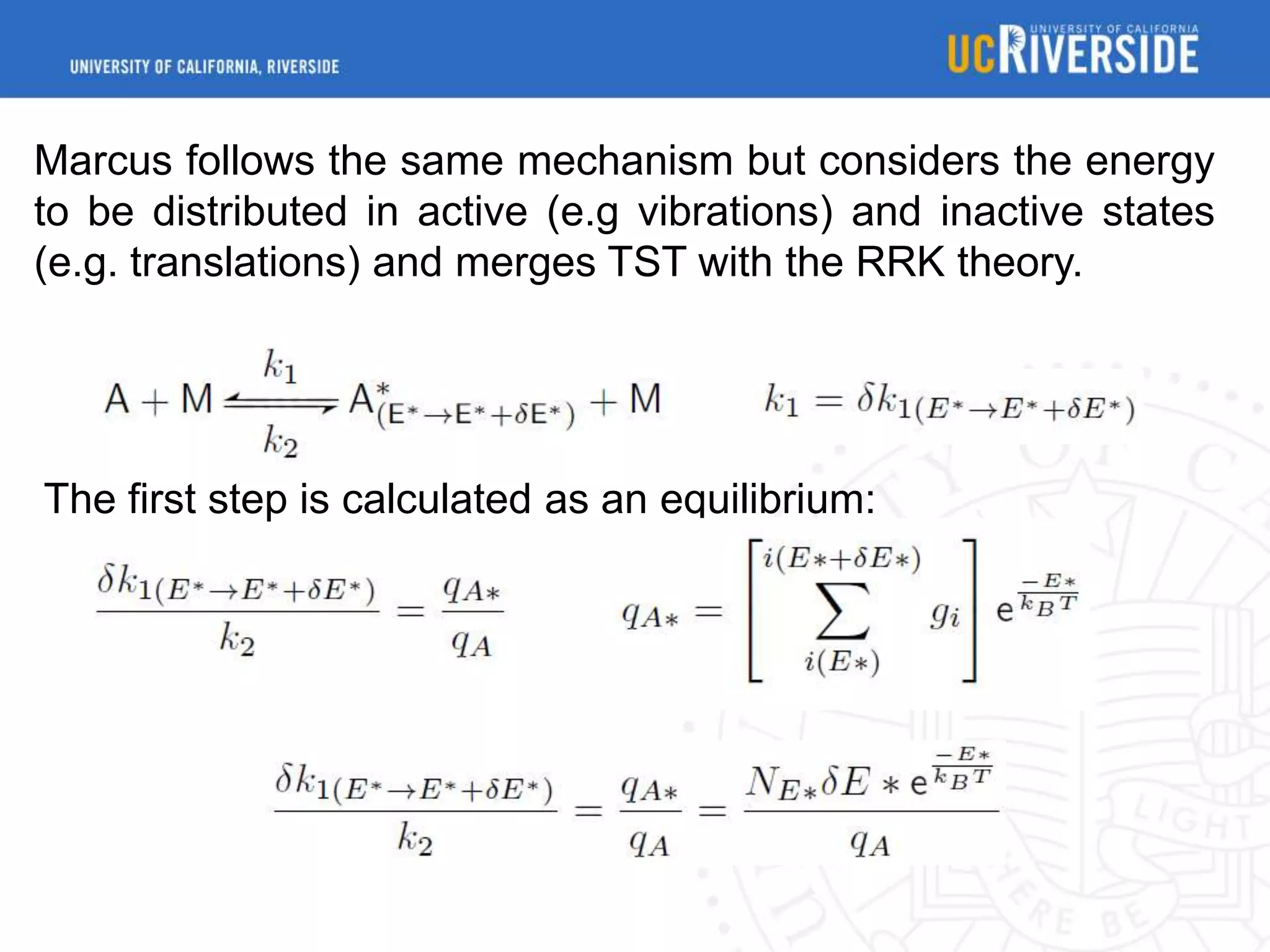
Marcus follows the same mechanism but considers the energy
to be distributed in active (e.g vibrations) and inactive states
(e.g. translations) and merges TST with the RRK theory.

The first step is calculated as an equilibrium:
Assume that the activated complex to be in steady-state.

The ½ factor is accounted to lack of reversibility in the last step.
The rate constant of the energized molecule depends on the
energy of translation along the reaction coordinate:
Assume that the activated complex to be in steady-state.

The ½ factor is accounted to lack of reversibility in the last step.
The rate constant of the energized molecule depends on the
energy of translation along the reaction coordinate:
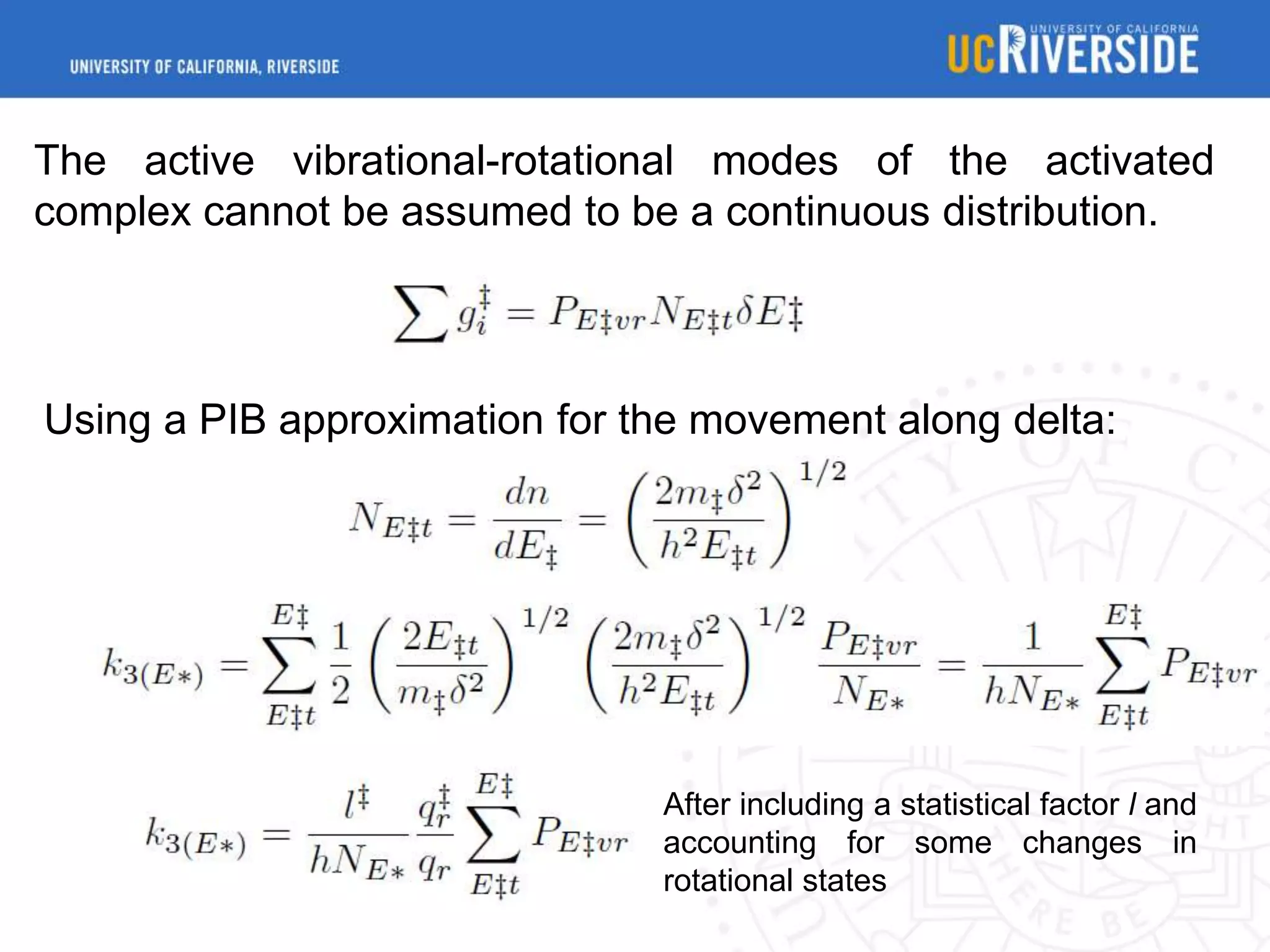
The active vibrational-rotational modes of the activated
complex cannot be assumed to be a continuous distribution.

Using a PIB approximation for the movement along delta:

After including a statistical factor l and
accounting for some changes in
rotational states
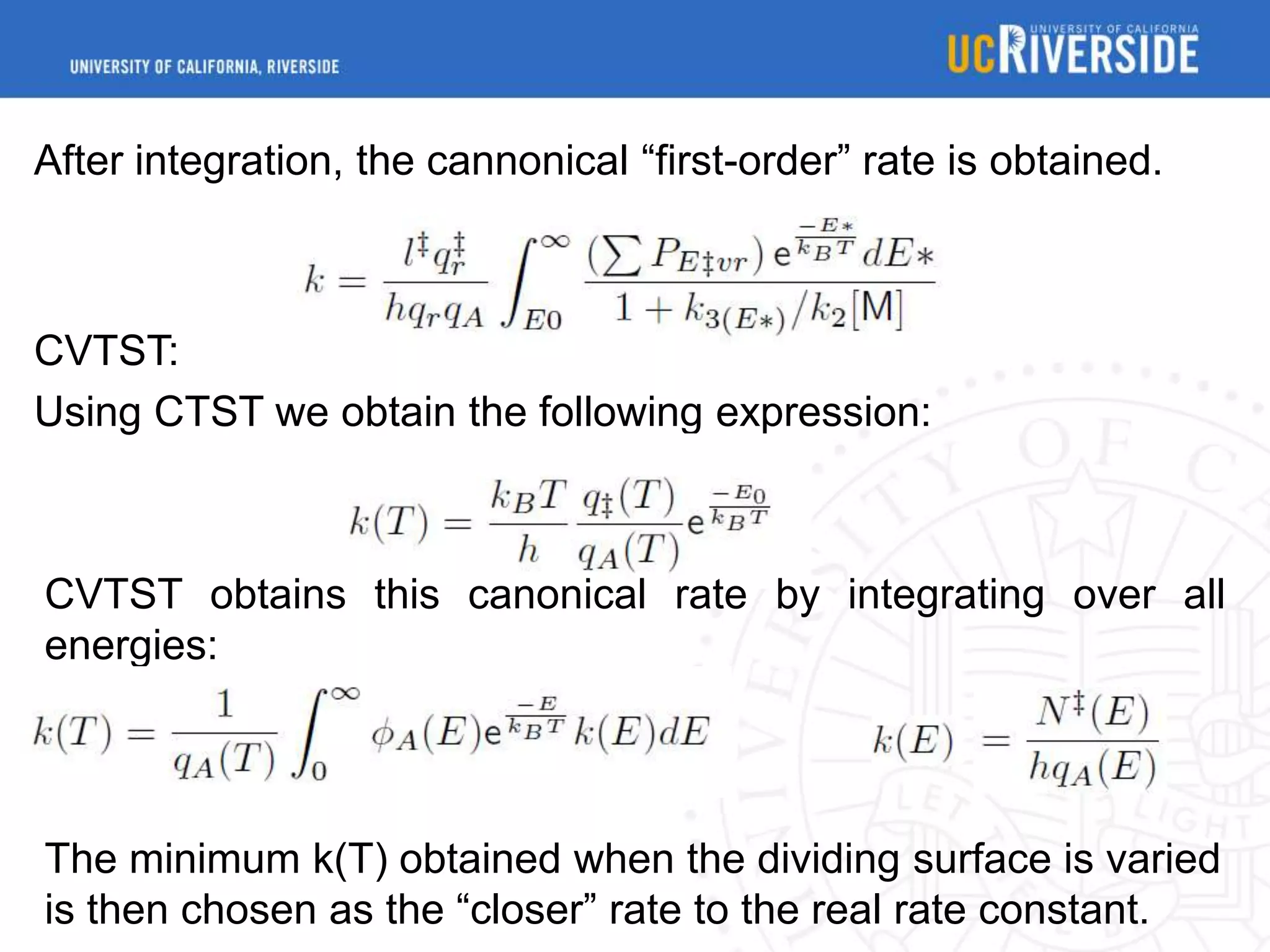
After integration, the cannonical “first-order” rate is obtained.

CVTST:
Using CTST we obtain the following expression:

CVTST obtains this canonical rate by integrating over all
energies:

The minimum k(T) obtained when the dividing surface is varied
is then chosen as the “closer” rate to the real rate constant.
The RRKM microcanonical k(3) rate is obtained from the
following.

The collision deactivation is calculated by the following:

The Beyer-Swinehart algorithm is used to calculate the
number of states and the density of states†. The POLYRATE
program is used for CVTST calculations‡.
†Moon

et al. J Am Soc Mass Spectrom, 18, (2007), 1063-1069.
‡Corchado et al., 2007. POLYRATE Version 9.7. University of Minnesota
Minneapolis.
The calculated rates are shown in this table:
The lifetimes are obtained:
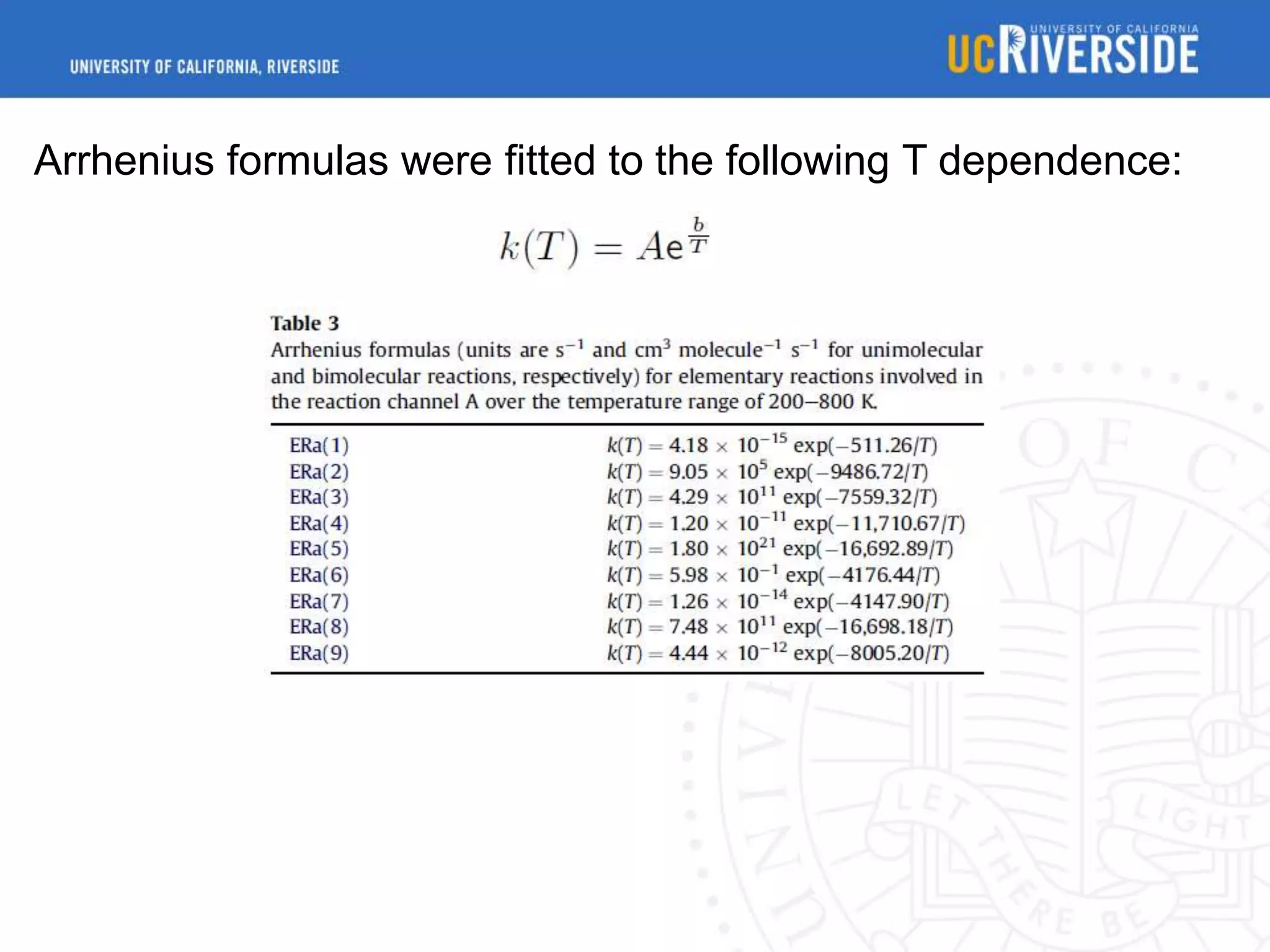
Arrhenius formulas were fitted to the following T dependence:
Conclusions:
›

›

›

›

The authors that the lifetime for ocimene was 86 min
(short lifetime). IMa2 and IMa9 belong to middle
lifetime species (2.56 and 2.60 d). IMa4 and IMa8
belong to long lifetime species.
The authors conclude that the kinetic information
obtained is useful to understand the formation of
secondary organic aerosols.
Water acts as an activator for OH transfer and
promotes further reaction.
Oxidation occurs spontaneously once it is initiated by
ozone.

RRKM

  • 1.
    Atmospheric Environment. 45,(2011), 6197-6203 Chemical mechanism and kinetic study on the ocimene ozonolysis reaction in atmosphere Xiamin Sun[a,b], Jing Bai[a], Yuyang Zhao[a], Chenxi Zhang[a], Yudong Wang[a], jingtian Hu[a] a. Environment Research Institute, Shandong University, Jinan 250100, PR China b. State Key Laboratory of Solid Lubrication, Lanzhou Institute of Chemical Physics, Chinese Academy of Science, Lanzhou 730000, PR China
  • 2.
    Main objective ofthe paper. Obtain theoretical kinetic constants of ocimene ozonolysis and its reaction pathway, in order to estimate atmospheric lifetimes of the reaction species.
  • 3.
    Background information: Ocimene isa monoterpene released to the atmosphere by the vegetation. Reactions of biogenic monoterpenes with ozone are responsible for a significant amount of aerosol formation in the atmosphere†. †Hoffman et. al. Journal of Atmospheric Chemistry, 12, (1997), 181-194.
  • 4.
    Atkinson† describes ozonolysisin the following schemes: †R. Atkinson. Atmospheric Environment, 34, (2000), 2 063-2101.
  • 5.
    It is importantto understand the elementary reactions that form the mechanism for ozonolysis because some intermediates react with (or produce) OH radicals, NOx, SOx, carbon dioxide, and oxygen in the atmosphere. E.g. R. Atkinson. Atmospheric Environment, 34, (2000), 2063-2101.
  • 6.
    Computational methods: The paperis purely computational, therefore, no experiments are made. The computational methods can be divided in two parts: - Geometry optimization of intermediates and transition states using a hybrid DFT model (MPWB1K) using Gaussian 03. Used to get the potential energy profile. - Kinetic calculations using Rice-Ramsperher-KasselMarcus Theory, and Canonical Variational TST (with the computer program PLYRATE v9.7)
  • 7.
    Results: The authors providea scheme consisting on three channels:
  • 8.
    Let’s focus onchannel A: ERa(1) ERa(2)
  • 9.
  • 10.
  • 11.
  • 12.
  • 13.
    They calculate apotential energy computations using Gaussian 03: profile with MPWB1K
  • 14.
    RRKM Theory isused for the following elementary reactions: CVTST is used for the following isomerizations:
  • 15.
    Derivation of kineticequations: RRKM Theory: RRKM Theory traces its origins to Lindemann-Christensen approach to unimolecular reactions:
  • 16.
    Assuming steady state: Hinshelwoodmodified this treatments by considering collision theory:
  • 17.
    Rice-Ramsperger-Kassel dependence: (RRK) - - - consider the energy In order forA* to react, the critical energy must concentrate in one part of the molecule Free energy transfer between oscillators is assumed (loosely coupled and separated). The event that an oscillator has the required energy depends on statistical factors
  • 18.
    The probability ofan oscillator to have enough energy is calculated accordingly: The rate constant for the conversion of the energized molecule into the activated complex will be proportional to this probability
  • 19.
    The ratio betweenactivation and de-activation rates of A now follows a distribution function: The “first-order” rate is now calculated by integration: With a high pressure limit, it reduces to:
  • 20.
    Energy diagram ofthe different energies that are involved in RRKM theory www.chem.purdue.edu/mcluckey/.../2011_Prentice_SL_RRKM.pdf
  • 21.
    Marcus follows thesame mechanism but considers the energy to be distributed in active (e.g vibrations) and inactive states (e.g. translations) and merges TST with the RRK theory. The first step is calculated as an equilibrium:
  • 22.
    Assume that theactivated complex to be in steady-state. The ½ factor is accounted to lack of reversibility in the last step. The rate constant of the energized molecule depends on the energy of translation along the reaction coordinate:
  • 23.
    Assume that theactivated complex to be in steady-state. The ½ factor is accounted to lack of reversibility in the last step. The rate constant of the energized molecule depends on the energy of translation along the reaction coordinate:
  • 24.
    The active vibrational-rotationalmodes of the activated complex cannot be assumed to be a continuous distribution. Using a PIB approximation for the movement along delta: After including a statistical factor l and accounting for some changes in rotational states
  • 25.
    After integration, thecannonical “first-order” rate is obtained. CVTST: Using CTST we obtain the following expression: CVTST obtains this canonical rate by integrating over all energies: The minimum k(T) obtained when the dividing surface is varied is then chosen as the “closer” rate to the real rate constant.
  • 26.
    The RRKM microcanonicalk(3) rate is obtained from the following. The collision deactivation is calculated by the following: The Beyer-Swinehart algorithm is used to calculate the number of states and the density of states†. The POLYRATE program is used for CVTST calculations‡. †Moon et al. J Am Soc Mass Spectrom, 18, (2007), 1063-1069. ‡Corchado et al., 2007. POLYRATE Version 9.7. University of Minnesota Minneapolis.
  • 27.
    The calculated ratesare shown in this table:
  • 28.
  • 29.
    Arrhenius formulas werefitted to the following T dependence:
  • 30.
    Conclusions: › › › › The authors thatthe lifetime for ocimene was 86 min (short lifetime). IMa2 and IMa9 belong to middle lifetime species (2.56 and 2.60 d). IMa4 and IMa8 belong to long lifetime species. The authors conclude that the kinetic information obtained is useful to understand the formation of secondary organic aerosols. Water acts as an activator for OH transfer and promotes further reaction. Oxidation occurs spontaneously once it is initiated by ozone.