ACIDS AND BASES
By:M.Divya
ACID
● Produce H+ ions in water
● Have a sour taste
● Breakdown metals
● Formula starts with H
● Poisonous and corrosive to skin
● PH less than 7
ACID
● Turns blue litmus to red
● Dissolve in water to form solution which conduct electricity
● React with reactive metals to form salt and hydrogen
● Acid reacts with carbonates and hydrogen carbonates to
form a salt,water and carbon dioxide
● Acid reacts with metal oxides and hydroxides to form a salt
and water
BASE
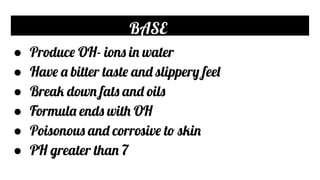
● Produce OH- ions in water
● Have a bitter taste and slippery feel
● Break down fats and oils
● Formula ends with OH
● Poisonous and corrosive to skin
● PH greater than 7
BASE
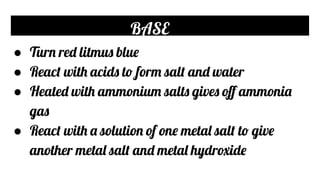
● Turn red litmus blue
● React with acids to form salt and water
● Heated with ammonium salts gives off ammonia
gas
● React with a solution of one metal salt to give
another metal salt and metal hydroxide
THEORIES OF ACIDS
AND BASES
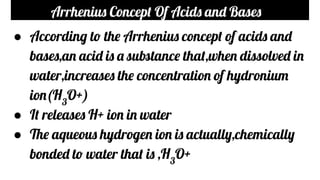
Arrhenius Concept Of Acids and Bases
● According to the Arrhenius concept of acids and
bases,an acid is a substance that,when dissolved in
water,increases the concentration of hydronium
ion(H3
O+)
● It releases H+ ion in water
● The aqueous hydrogen ion is actually,chemically
bonded to water that is ,H3
O+
Arrhenius Concept Of Acids and Bases
● A base,in the Arrhenius concept,is a substance
that,when dissolved in water,increases the
concentration of hydroxide ion,OH-(aq)
● It releases OH- ion in water
Limitations Of Arrhenius Theory
● This theory does not explains the acidic
and basic behaviour of substance in
non-aqueous solvent
Bronsted-Lowry Acid and Bases
● Bronsted-Lowry acid can donate a proton
● Bronsted-Lowry base can accept a proton
● Must contain a non-bonding pairs of electrons
● Conjugate base of an acid is the species
remaining after the acid has lost a proton
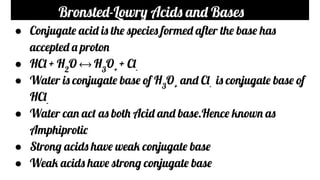
Bronsted-Lowry Acids and Bases
● Conjugate acid is the species formed after the base has
accepted a proton
● HCl + H2
O ⟷ H3
O+
+ Cl-
● Water is conjugate base of H3
O+
and Cl-
is conjugate base of
HCl-
● Water can act as both Acid and base.Hence known as
Amphiprotic
● Strong acids have weak conjugate base
● Weak acids have strong conjugate base
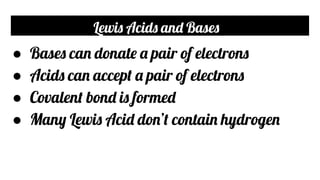
Lewis Acids and Bases
● Bases can donate a pair of electrons
● Acids can accept a pair of electrons
● Covalent bond is formed
● Many Lewis Acid don’t contain hydrogen
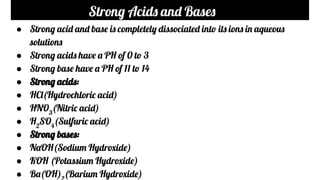
Strong Acids and Bases
● Strong acid and base is completely dissociated into its ions in aqueous
solutions
● Strong acids have a PH of 0 to 3
● Strong base have a PH of 11 to 14
● Strong acids:
● HCl(Hydrochloric acid)
● HNO3
(Nitric acid)
● H2
SO4
(Sulfuric acid)
● Strong bases:
● NaOH(Sodium Hydroxide)
● KOH (Potassium Hydroxide)
● Ba(OH) (Barium Hydroxide)
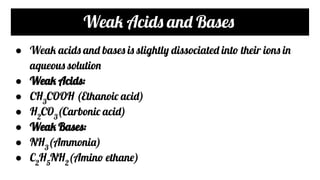
Weak Acids and Bases
● Weak acids and bases is slightly dissociated into their ions in
aqueous solution
● Weak Acids:
● CH3
COOH (Ethanoic acid)
● H2
CO3
(Carbonic acid)
● Weak Bases:
● NH3
(Ammonia)
● C2
H5
NH2
(Amino ethane)
THANK YOU

Acid and base

  • 1.
  • 2.
    ACID ● Produce H+ions in water ● Have a sour taste ● Breakdown metals ● Formula starts with H ● Poisonous and corrosive to skin ● PH less than 7
  • 3.
    ACID ● Turns bluelitmus to red ● Dissolve in water to form solution which conduct electricity ● React with reactive metals to form salt and hydrogen ● Acid reacts with carbonates and hydrogen carbonates to form a salt,water and carbon dioxide ● Acid reacts with metal oxides and hydroxides to form a salt and water
  • 4.
    BASE ● Produce OH-ions in water ● Have a bitter taste and slippery feel ● Break down fats and oils ● Formula ends with OH ● Poisonous and corrosive to skin ● PH greater than 7
  • 5.
    BASE ● Turn redlitmus blue ● React with acids to form salt and water ● Heated with ammonium salts gives off ammonia gas ● React with a solution of one metal salt to give another metal salt and metal hydroxide
  • 6.
  • 7.
    Arrhenius Concept OfAcids and Bases ● According to the Arrhenius concept of acids and bases,an acid is a substance that,when dissolved in water,increases the concentration of hydronium ion(H3 O+) ● It releases H+ ion in water ● The aqueous hydrogen ion is actually,chemically bonded to water that is ,H3 O+
  • 8.
    Arrhenius Concept OfAcids and Bases ● A base,in the Arrhenius concept,is a substance that,when dissolved in water,increases the concentration of hydroxide ion,OH-(aq) ● It releases OH- ion in water
  • 9.
    Limitations Of ArrheniusTheory ● This theory does not explains the acidic and basic behaviour of substance in non-aqueous solvent
  • 10.
    Bronsted-Lowry Acid andBases ● Bronsted-Lowry acid can donate a proton ● Bronsted-Lowry base can accept a proton ● Must contain a non-bonding pairs of electrons ● Conjugate base of an acid is the species remaining after the acid has lost a proton
  • 11.
    Bronsted-Lowry Acids andBases ● Conjugate acid is the species formed after the base has accepted a proton ● HCl + H2 O ⟷ H3 O+ + Cl- ● Water is conjugate base of H3 O+ and Cl- is conjugate base of HCl- ● Water can act as both Acid and base.Hence known as Amphiprotic ● Strong acids have weak conjugate base ● Weak acids have strong conjugate base
  • 12.
    Lewis Acids andBases ● Bases can donate a pair of electrons ● Acids can accept a pair of electrons ● Covalent bond is formed ● Many Lewis Acid don’t contain hydrogen
  • 13.
    Strong Acids andBases ● Strong acid and base is completely dissociated into its ions in aqueous solutions ● Strong acids have a PH of 0 to 3 ● Strong base have a PH of 11 to 14 ● Strong acids: ● HCl(Hydrochloric acid) ● HNO3 (Nitric acid) ● H2 SO4 (Sulfuric acid) ● Strong bases: ● NaOH(Sodium Hydroxide) ● KOH (Potassium Hydroxide) ● Ba(OH) (Barium Hydroxide)
  • 14.
    Weak Acids andBases ● Weak acids and bases is slightly dissociated into their ions in aqueous solution ● Weak Acids: ● CH3 COOH (Ethanoic acid) ● H2 CO3 (Carbonic acid) ● Weak Bases: ● NH3 (Ammonia) ● C2 H5 NH2 (Amino ethane)
  • 15.