Rough Cut Capacity Planning(RCCP)
Presented by-
Pankaj Khode (16308)
Nikhil Deore (16350)
Gaurav Kapse (16105)
Kunal Mohite (16345)
What is Rough-cut capacity planning?
• Rough cut capacity planning is a control technique used by
manufacturing companies. As company management develops a
manufacturing production schedule (MPS), they base their schedule
on the belief that all required materials needed to meet this schedule
will be available
• RCCP is a long-term plan capacity planning tool that marketing and
production use to balance required and available capacity, and to
negotiate changes to the master schedule and/or available capacity..
contd
• Rough-cut capacity planning (RCCP) calculates a rough
estimate of the workload placed on critical resources
by the proposed MPS. This workload is compared
against demonstrated capacity for each critical
resource. This comparison enables the master
scheduler to develop a feasible MPS.
• During planning, staff members make a list of all
resources needed to produce the quota listed in the
MPS. This includes equipment and machinery, as well
as raw materials and supplies.
• Based on the results of rough cut capacity planning,
the company can add more machinery or reconfigure
existing assembly lines to better meet its goals
How Does it Work?
• Rough cut capacity planning(RCCP) calculates rough estimate of
workload placed on critical resources by proposed MPS
• This workload is compared against the demonstrated capacity for
each critical resource.
• This comparison enables the master scheduler to develop feasible
MPS
What is Master Production Schedule(MPS) ?
• The master production schedule is a plan for future production of end
items over a short –range planning horizon that usually spans from a
few weeks to several months
• The MPS sets the quantity of each end item (finished product) to be
produced in each time period (week/month or quarter) of the short-
range planning horizon.
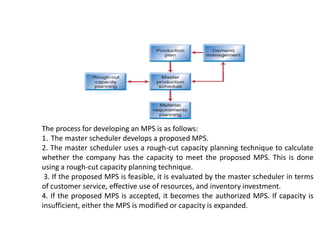
The process for developing an MPS is as follows:
1. The master scheduler develops a proposed MPS.
2. The master scheduler uses a rough-cut capacity planning technique to calculate
whether the company has the capacity to meet the proposed MPS. This is done
using a rough-cut capacity planning technique.
3. If the proposed MPS is feasible, it is evaluated by the master scheduler in terms
of customer service, effective use of resources, and inventory investment.
4. If the proposed MPS is accepted, it becomes the authorized MPS. If capacity is
insufficient, either the MPS is modified or capacity is expanded.
Importance of RCCP
• MRP system assumes that needed capacity is always available
• RCCP helps to identify the key resources and to test the feasibility of
the supply plan, production plan master schedule before doing any
capacity
• It also helps to initiate the action for making mid to long term
capacity adjustments
Rough Cut Capacity Planning(RCCP) Functions
Shows Consumption of critical Resources
Enable Master Scheduler to:
 Test end-item production Plan
Calculate Capacity to meet the master schedule
Compare and modify required and planned capacity
Analyse load on key resources by time period
Isolate and resolve potential problems
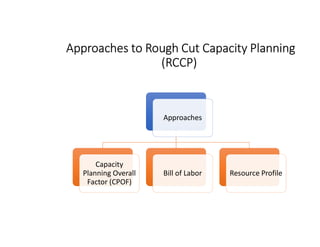
Approaches to Rough Cut Capacity Planning
(RCCP)
Approaches
Capacity
Planning Overall
Factor (CPOF)
Bill of Labor Resource Profile
Capacity planning using overall factors (CPOF)
• Simplest rough-cut capacity planning approach
• Data inputs from Master Production Schedule
• Based on planning factors from historical data (work center
utilization, production standards)
• Overall labor - or machine-hour capacity requirements are estimated
from MPS data – Estimate is allocated to work centers based on
historical workloads
• Inaccuracies may limit usefulness
Bill of Labor
• It involves multiplying two matrices, “the bill of labor” and the
“master production schedule”.
• This approach picks up shifts in product mix, but does not consider
lead time offsets.
• It strictly assumes a lot-for-lot policy for setting lot sizes.
• When other techniques, such as economic order quantity etc is used,
then this approach gives a very rough estimate.
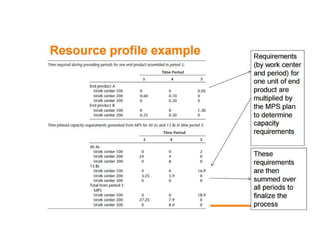
Resource Profiles
• It is exactly same as “Bill of labor approach”, except that it takes lead-
time offsets into account.
• Rough-cut capacity planning technique that includes production lead
time information
• Provides time-phased projections of capacity requirements for
individual work centers
• More sophisticated approach but requires tracking of relatively short
lead time periods compared to the planning horizon
Role of RCCP in PPC
Production and inventory Planning
Priority Planning
Priority Control
Capacity Planning
Capacity Control
Production and Inventory Planning:
 Production and inventory planning is the process of dealing with
flexibility to meet the desires of customer, the need for stability in
manufacturing and the resultant inventory levels to compensate to
mismatch
 The process involves preforming three functions:
1) Developing an achievable Master Production Schedule(MPS)
2) Planning and Controlling priorities
3) Planning and Controlling Capacities
Priority Planning:
It is the process of specifying batch quantities and their
start and finish dates for all items where procurement and
manufacturing involved.
 Priority Control:
Priority Control is making the right things at right time.
It is completely dependent on maintaining a balance between
MPS requirements and output rates
Capacity Planning:
Capacity planning is task of determining how much output is
needed from plant facilities and suppliers.
If less-than-adequate capacity is available, the problem is
unmanageable
Capacity Control:
Capacity Control is the comparison between planned levels
and actual outputs achieved and the identification of
significant variances above or below plan

Rough cut planning

  • 1.
    Rough Cut CapacityPlanning(RCCP) Presented by- Pankaj Khode (16308) Nikhil Deore (16350) Gaurav Kapse (16105) Kunal Mohite (16345)
  • 2.
    What is Rough-cutcapacity planning? • Rough cut capacity planning is a control technique used by manufacturing companies. As company management develops a manufacturing production schedule (MPS), they base their schedule on the belief that all required materials needed to meet this schedule will be available • RCCP is a long-term plan capacity planning tool that marketing and production use to balance required and available capacity, and to negotiate changes to the master schedule and/or available capacity..
  • 3.
    contd • Rough-cut capacityplanning (RCCP) calculates a rough estimate of the workload placed on critical resources by the proposed MPS. This workload is compared against demonstrated capacity for each critical resource. This comparison enables the master scheduler to develop a feasible MPS. • During planning, staff members make a list of all resources needed to produce the quota listed in the MPS. This includes equipment and machinery, as well as raw materials and supplies. • Based on the results of rough cut capacity planning, the company can add more machinery or reconfigure existing assembly lines to better meet its goals
  • 4.
    How Does itWork? • Rough cut capacity planning(RCCP) calculates rough estimate of workload placed on critical resources by proposed MPS • This workload is compared against the demonstrated capacity for each critical resource. • This comparison enables the master scheduler to develop feasible MPS
  • 5.
    What is MasterProduction Schedule(MPS) ? • The master production schedule is a plan for future production of end items over a short –range planning horizon that usually spans from a few weeks to several months • The MPS sets the quantity of each end item (finished product) to be produced in each time period (week/month or quarter) of the short- range planning horizon.
  • 6.
    The process fordeveloping an MPS is as follows: 1. The master scheduler develops a proposed MPS. 2. The master scheduler uses a rough-cut capacity planning technique to calculate whether the company has the capacity to meet the proposed MPS. This is done using a rough-cut capacity planning technique. 3. If the proposed MPS is feasible, it is evaluated by the master scheduler in terms of customer service, effective use of resources, and inventory investment. 4. If the proposed MPS is accepted, it becomes the authorized MPS. If capacity is insufficient, either the MPS is modified or capacity is expanded.
  • 7.
    Importance of RCCP •MRP system assumes that needed capacity is always available • RCCP helps to identify the key resources and to test the feasibility of the supply plan, production plan master schedule before doing any capacity • It also helps to initiate the action for making mid to long term capacity adjustments
  • 8.
    Rough Cut CapacityPlanning(RCCP) Functions Shows Consumption of critical Resources Enable Master Scheduler to:  Test end-item production Plan Calculate Capacity to meet the master schedule Compare and modify required and planned capacity Analyse load on key resources by time period Isolate and resolve potential problems
  • 9.
    Approaches to RoughCut Capacity Planning (RCCP) Approaches Capacity Planning Overall Factor (CPOF) Bill of Labor Resource Profile
  • 10.
    Capacity planning usingoverall factors (CPOF) • Simplest rough-cut capacity planning approach • Data inputs from Master Production Schedule • Based on planning factors from historical data (work center utilization, production standards) • Overall labor - or machine-hour capacity requirements are estimated from MPS data – Estimate is allocated to work centers based on historical workloads • Inaccuracies may limit usefulness
  • 11.
    Bill of Labor •It involves multiplying two matrices, “the bill of labor” and the “master production schedule”. • This approach picks up shifts in product mix, but does not consider lead time offsets. • It strictly assumes a lot-for-lot policy for setting lot sizes. • When other techniques, such as economic order quantity etc is used, then this approach gives a very rough estimate.
  • 12.
    Resource Profiles • Itis exactly same as “Bill of labor approach”, except that it takes lead- time offsets into account. • Rough-cut capacity planning technique that includes production lead time information • Provides time-phased projections of capacity requirements for individual work centers • More sophisticated approach but requires tracking of relatively short lead time periods compared to the planning horizon
  • 14.
    Role of RCCPin PPC Production and inventory Planning Priority Planning Priority Control Capacity Planning Capacity Control
  • 15.
    Production and InventoryPlanning:  Production and inventory planning is the process of dealing with flexibility to meet the desires of customer, the need for stability in manufacturing and the resultant inventory levels to compensate to mismatch  The process involves preforming three functions: 1) Developing an achievable Master Production Schedule(MPS) 2) Planning and Controlling priorities 3) Planning and Controlling Capacities
  • 16.
    Priority Planning: It isthe process of specifying batch quantities and their start and finish dates for all items where procurement and manufacturing involved.  Priority Control: Priority Control is making the right things at right time. It is completely dependent on maintaining a balance between MPS requirements and output rates
  • 17.
    Capacity Planning: Capacity planningis task of determining how much output is needed from plant facilities and suppliers. If less-than-adequate capacity is available, the problem is unmanageable Capacity Control: Capacity Control is the comparison between planned levels and actual outputs achieved and the identification of significant variances above or below plan