Design of Process Layout
Presented By: Sagar Y. Pawar
Suryakant S. Yadav
TYPES OF LAYOUTS
• Process layout: A layout that organizes resources
(employees) and equipment by function
rather than by service or product.
• Product layout: A layout in which workstations or
departments are arranged in a linear path.
• Hybrid layout: An arrangement in which some portions of
the facility have a flexible-flow and others
have a line-flow layout.
• Fixed-position An arrangement in which service or
layout: manufacturing site is fixed in place;
employees along with their
equipment, come to the site to do
their work.
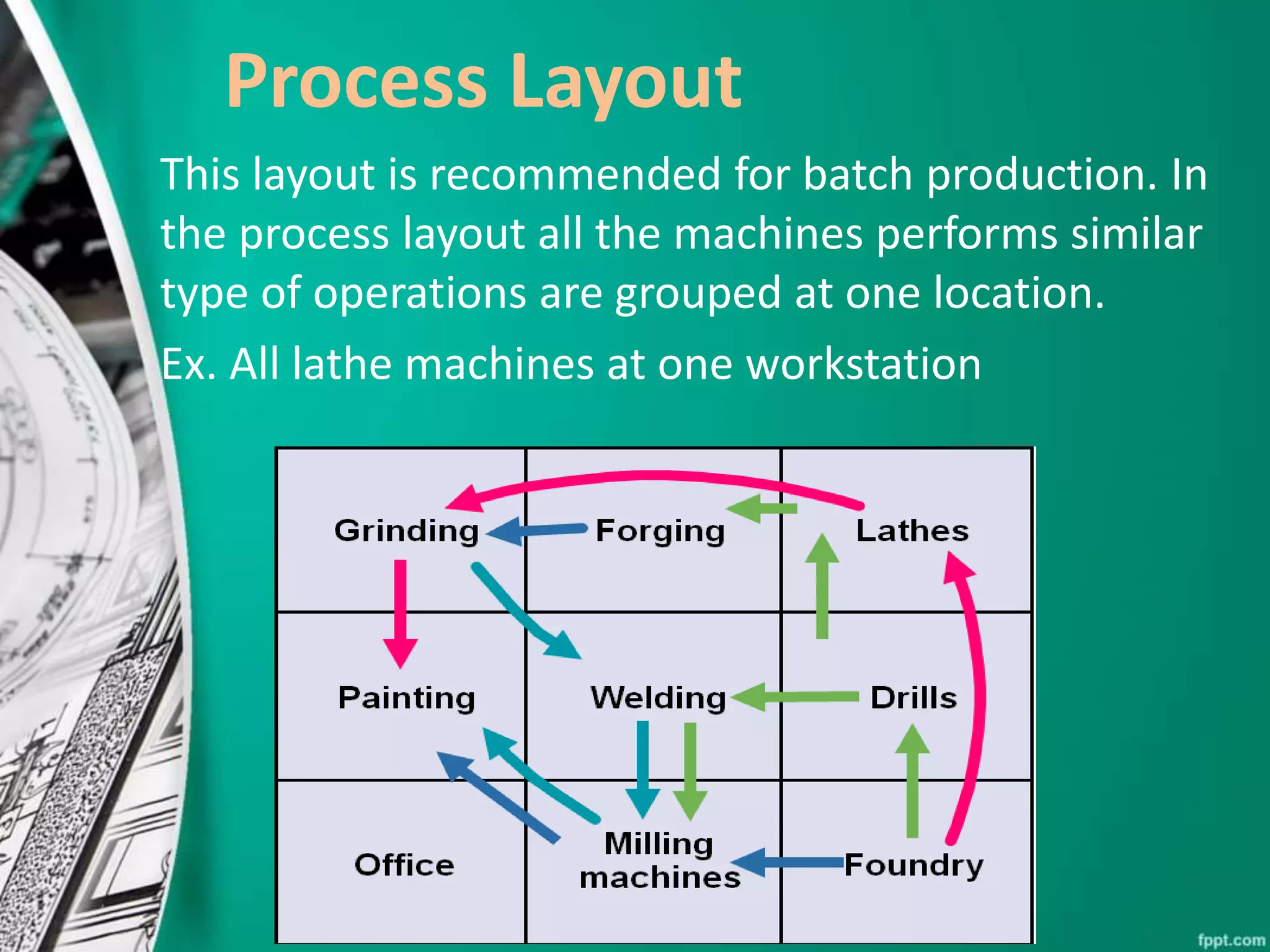
Process Layout
This layout is recommended for batch production. In
the process layout all the machines performs similar
type of operations are grouped at one location.
Ex. All lathe machines at one workstation
Designing Process Layouts
Step 1: Gather information
 Space requirements by center
 Available space
 Closeness factors: which centers need to be located
close to one another.
• Closeness matrix: A table that gives a measure of the
relative importance of each pair of centers being located
close together.
Step 2: Develop a Block plan
 A plan that allocates space and indicates placement of
each department.
Step 3: Design a detailed layout.
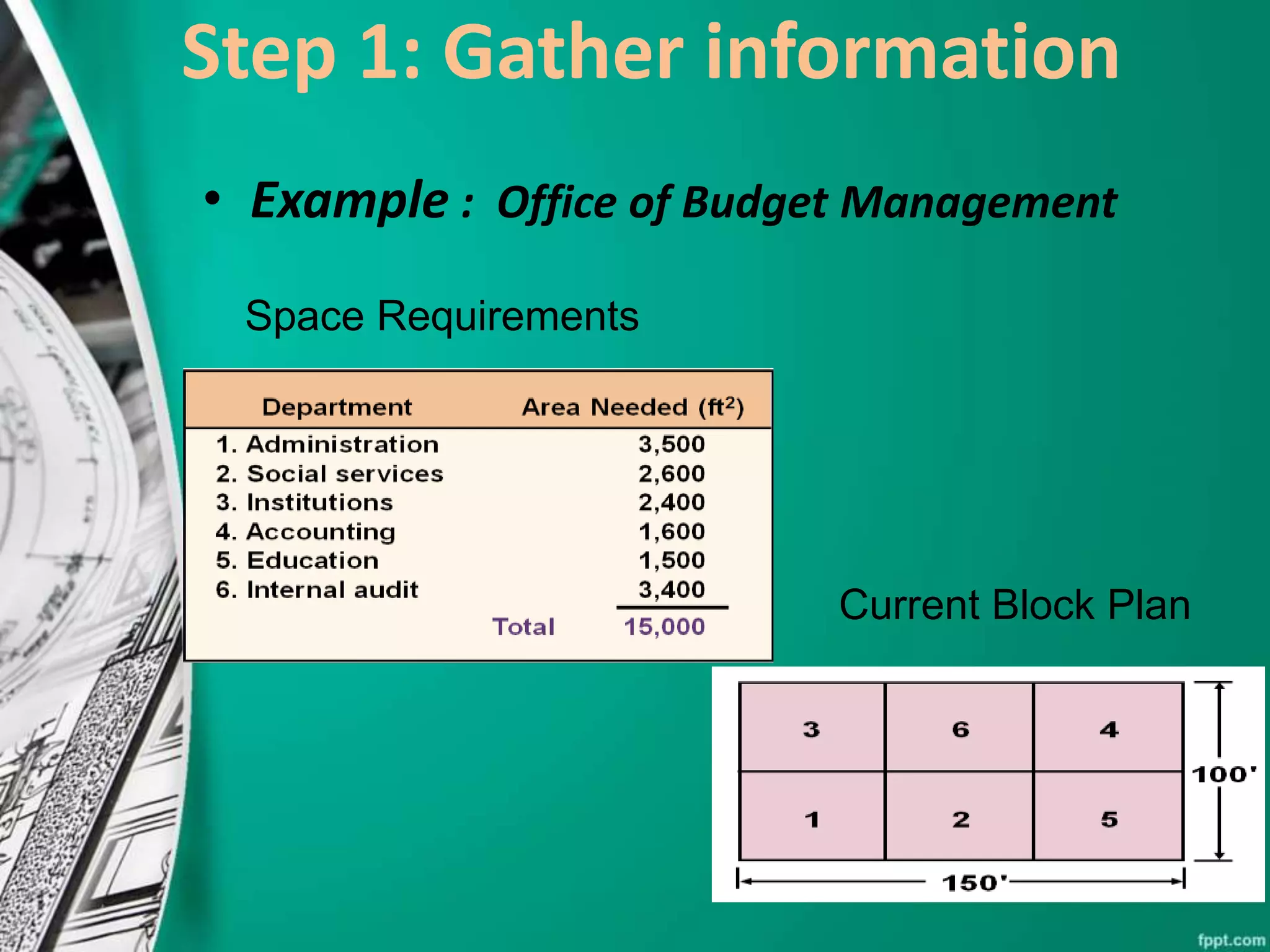
Step 1: Gather information
• Example : Office of Budget Management
Space Requirements
Current Block Plan
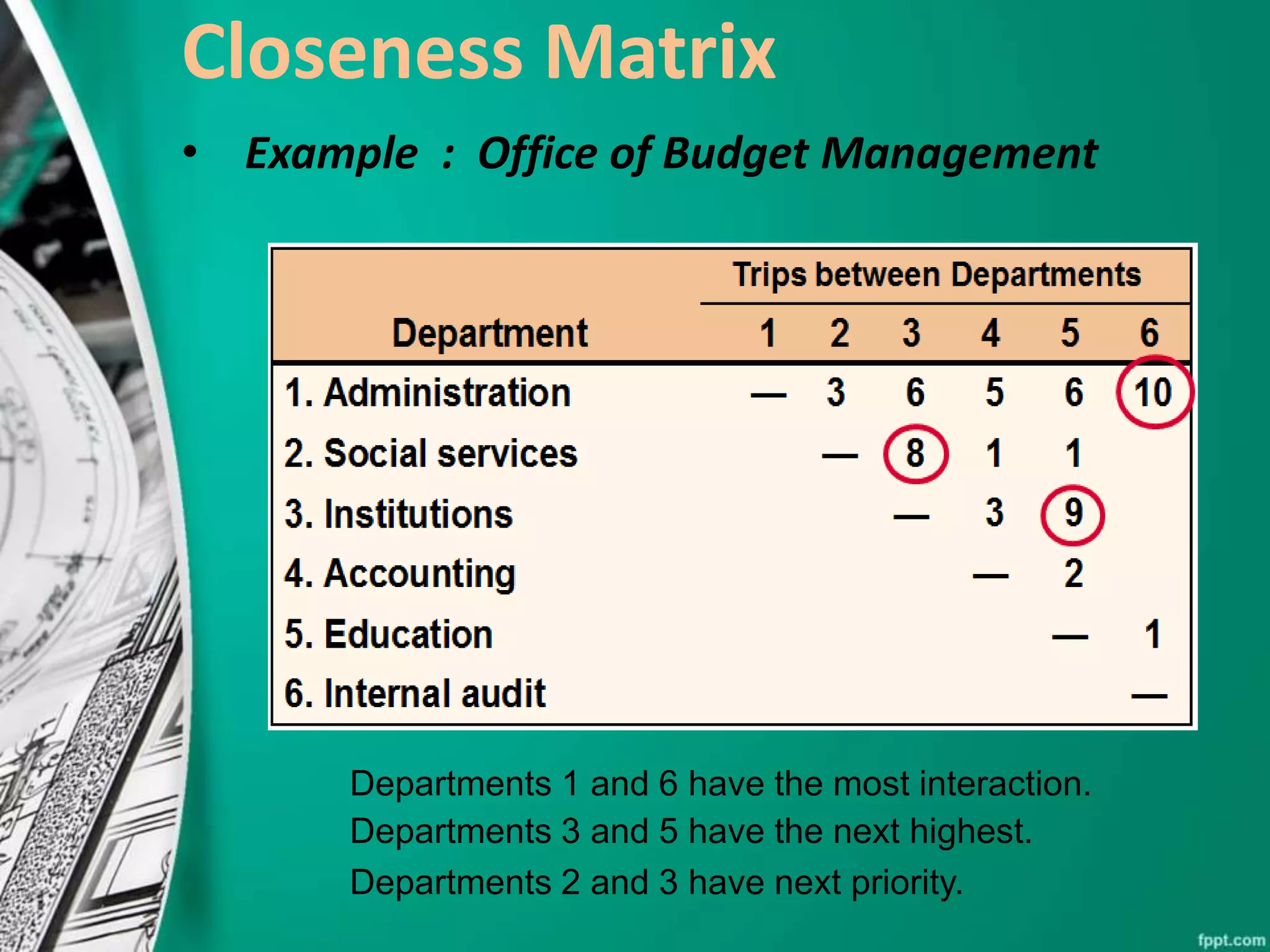
Closeness Matrix
• Example : Office of Budget Management
Departments 1 and 6 have the most interaction.
Departments 3 and 5 have the next highest.
Departments 2 and 3 have next priority.
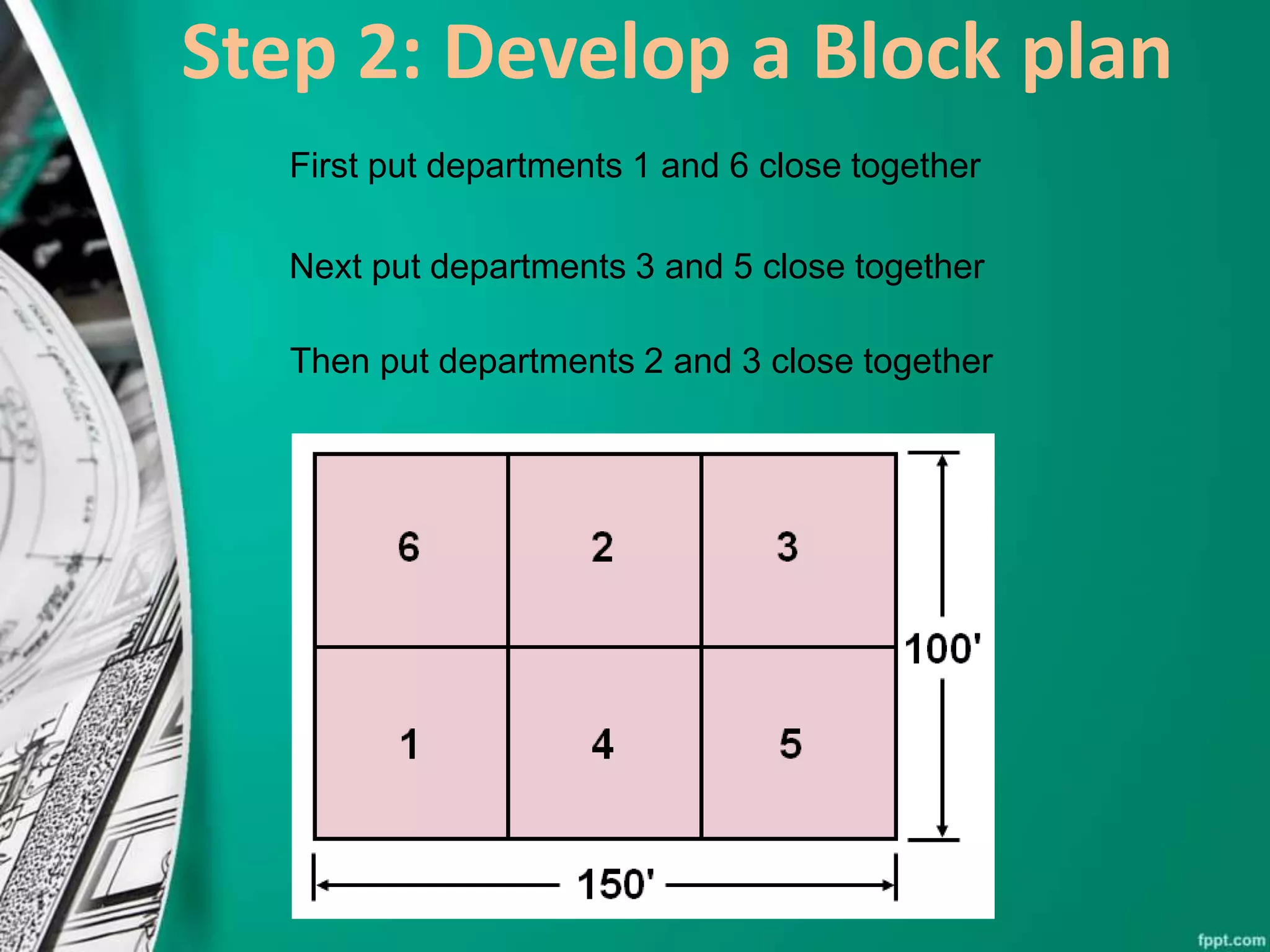
Step 2: Develop a Block plan
First put departments 1 and 6 close together
Next put departments 3 and 5 close together
Then put departments 2 and 3 close together
Applying the
Weighted- Distance Method
Weighted-distance method: A mathematical model
used to evaluate process-flow layouts based on
proximity factors.
Euclidean distance : is the straight-line distance, or
shortest possible path, between two points.
Rectilinear distance: The distance between two
points with a series of 90 degree turns, as along
city blocks.
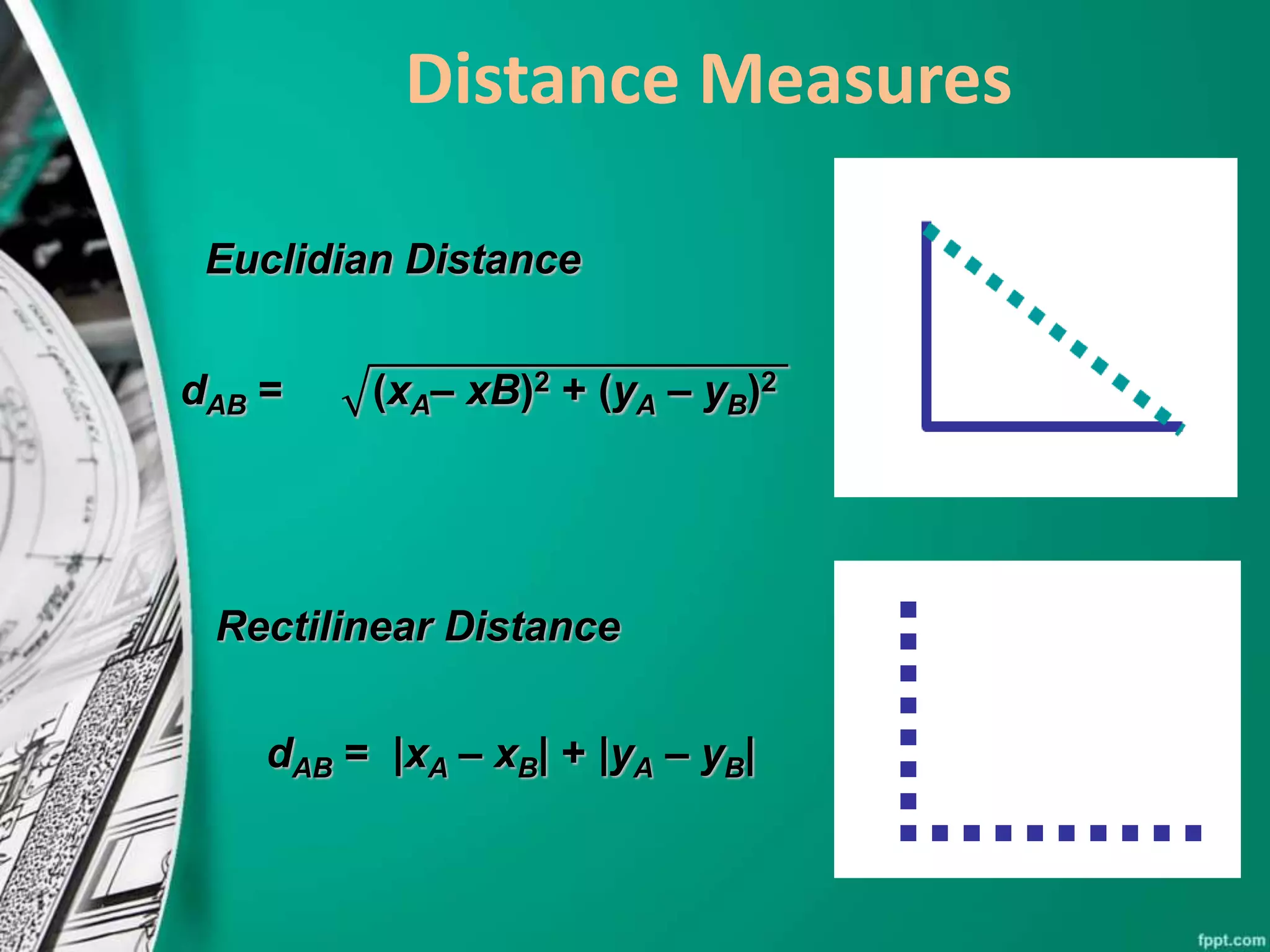
Distance Measures
Euclidian Distance
dAB = (xA– xB)2 + (yA – yB)2
Rectilinear Distance
dAB = |xA – xB| + |yA – yB|
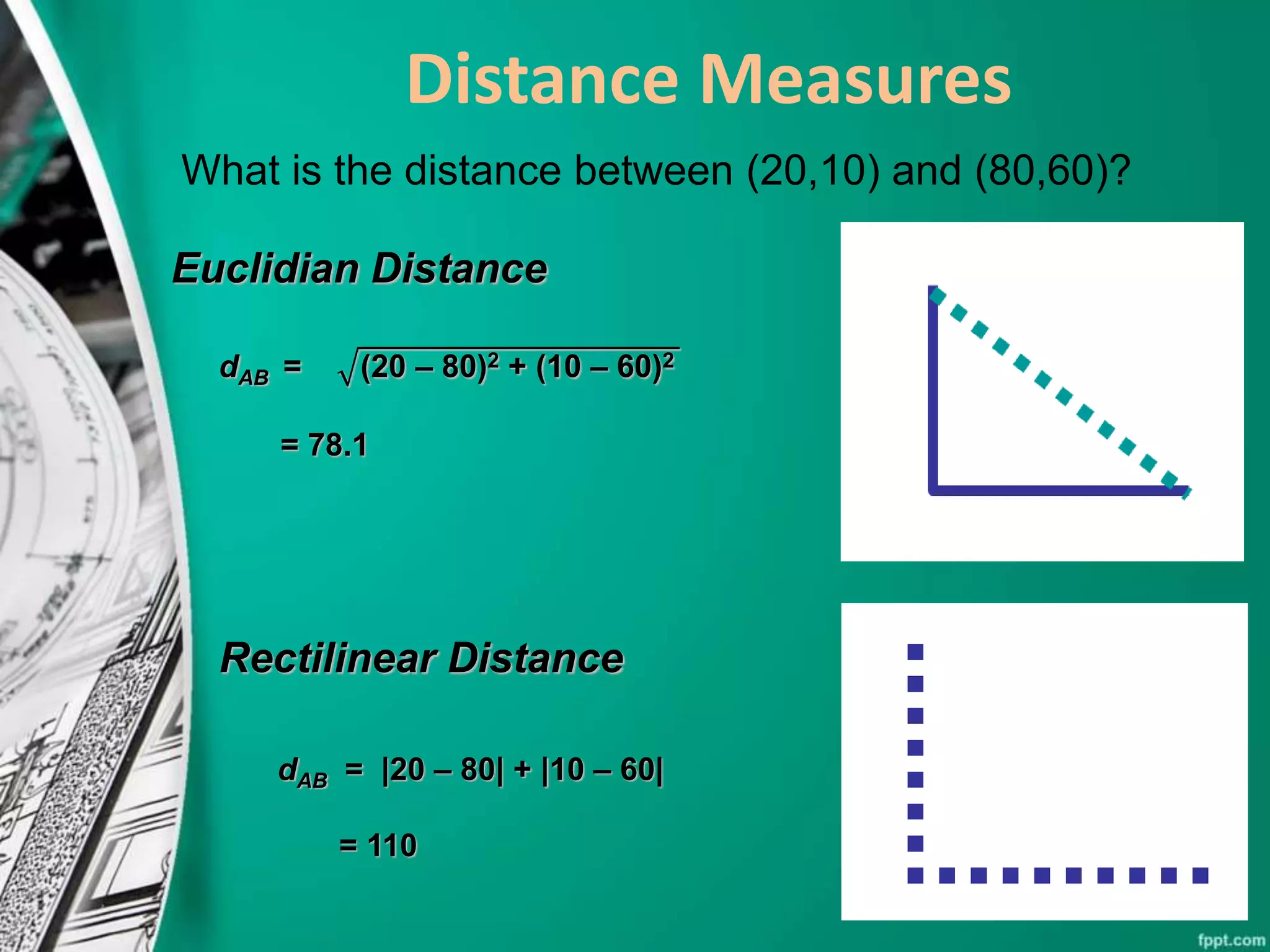
Distance Measures
What is the distance between (20,10) and (80,60)?
Euclidian Distance
dAB = (20 – 80)2 + (10 – 60)2
= 78.1
Rectilinear Distance
dAB = |20 – 80| + |10 – 60|
= 110
Special Case of Process Layout
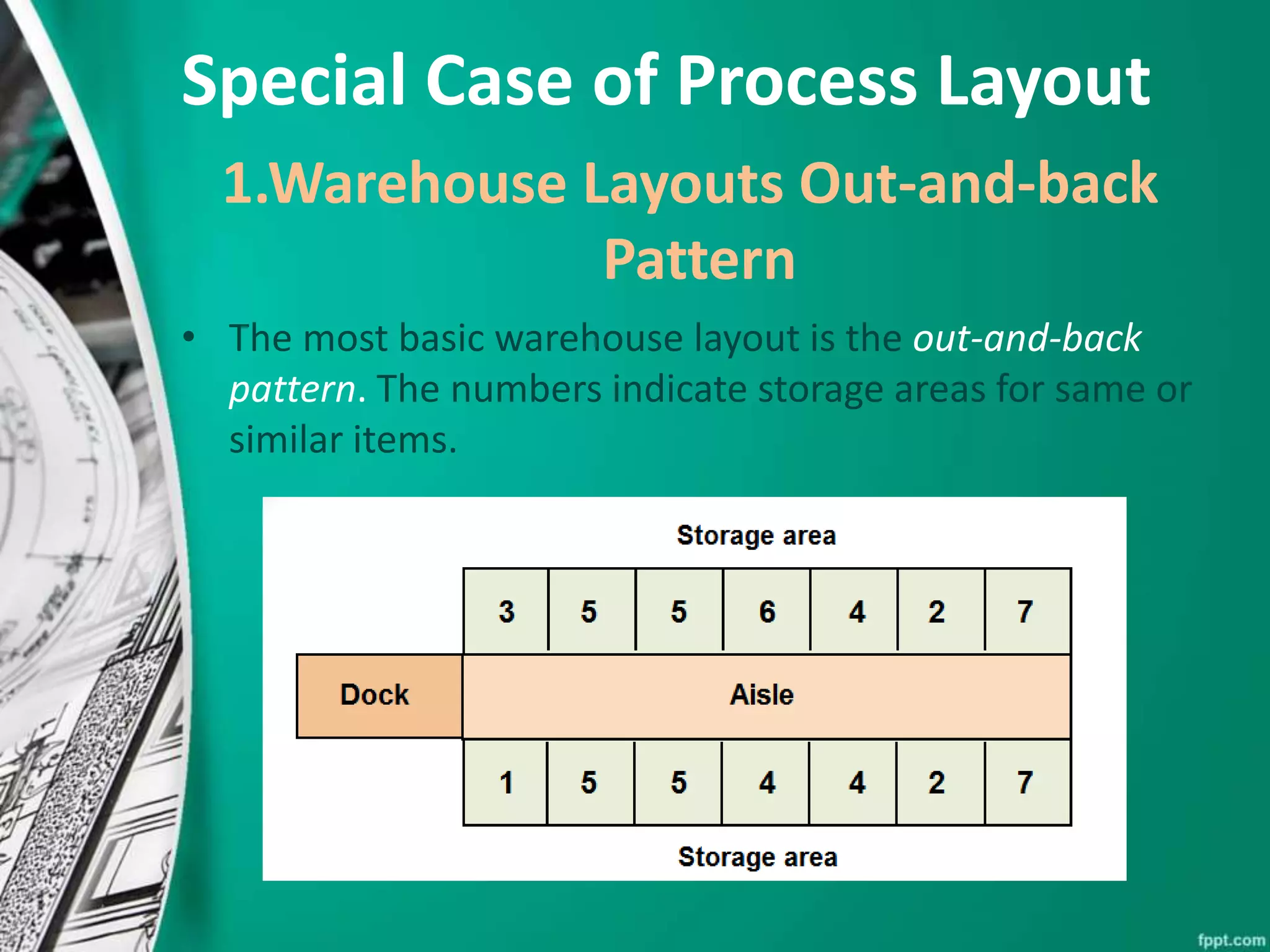
1.Warehouse Layouts Out-and-back
Pattern
• The most basic warehouse layout is the out-and-back
pattern. The numbers indicate storage areas for same or
similar items.
Special Case of Process Layout
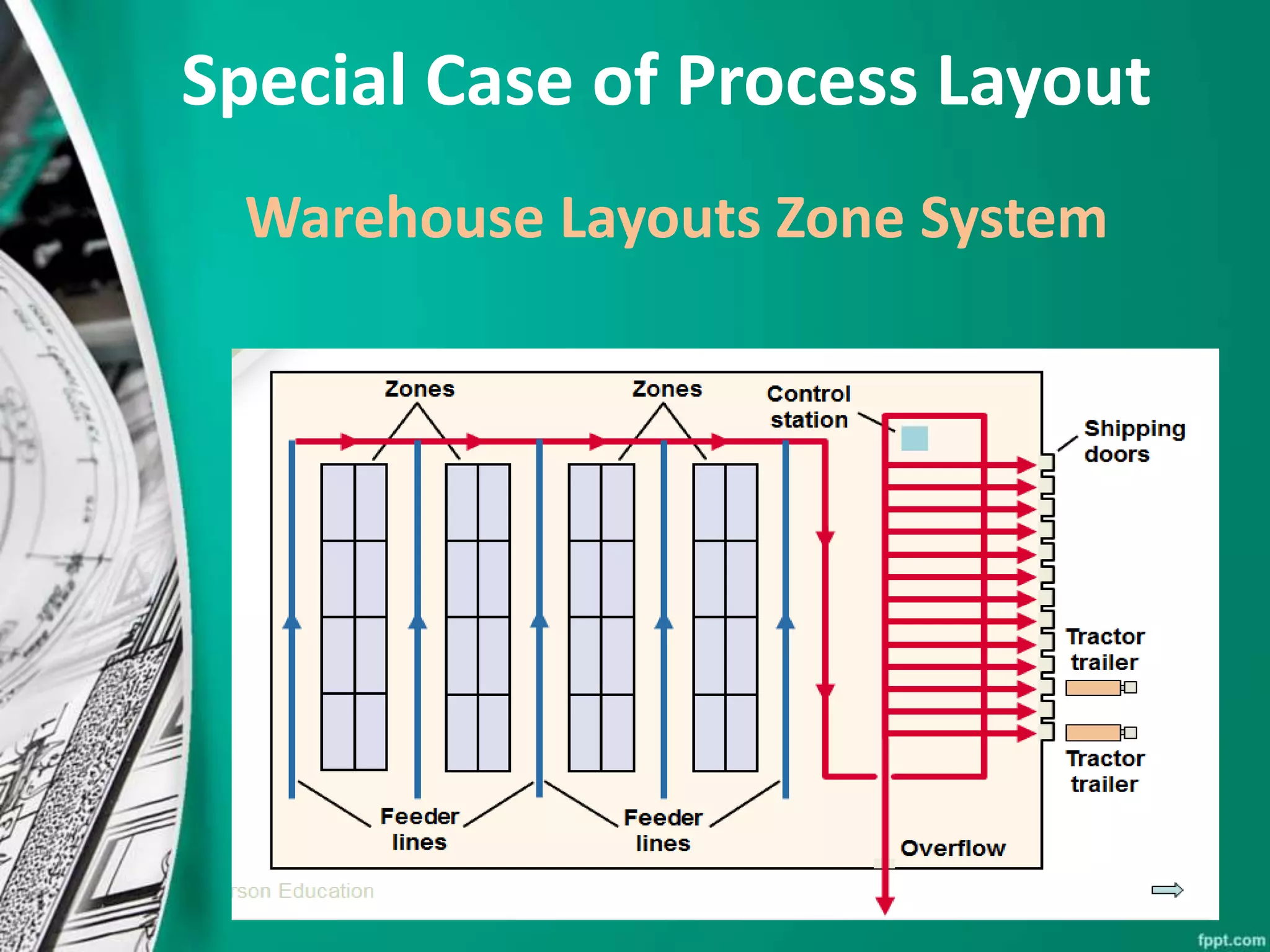
Warehouse Layouts Zone System
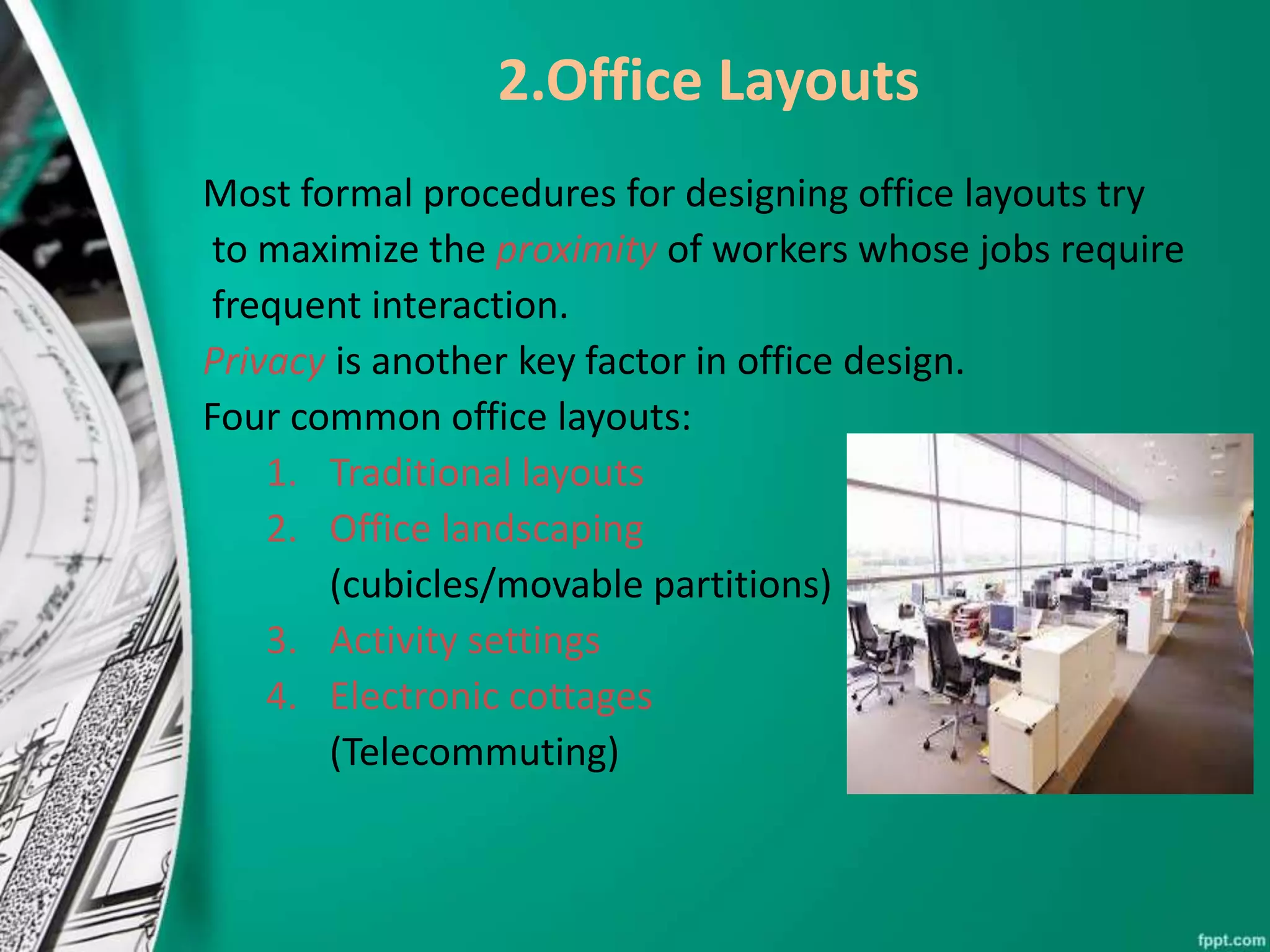
2.Office Layouts
Most formal procedures for designing office layouts try
to maximize the proximity of workers whose jobs require
frequent interaction.
Privacy is another key factor in office design.
Four common office layouts:
1. Traditional layouts
2. Office landscaping
(cubicles/movable partitions)
3. Activity settings
4. Electronic cottages
(Telecommuting)
Advantages of Process Layout
 Flexibility of equipment and personnel.
 Higher utilization of production facility.
 Greater flexibility with regards to work distribution
to machineries and workers.
 Varity of job makes job challenging and interesting.
 Supervisor become highly knowledgeable about
the function under their department.
 Backtracking and long movement may occur in
handling of material thus reduces the material
handling efficiency.
 Material handling can not be mechanised
because it adds the cost.
 Production planning and control is difficult.
 More space is required.
 Lower productivity due to number of setups.
Disadvantages of Process Layout
THANK YOU

Design of process layout

  • 1.
    Design of ProcessLayout Presented By: Sagar Y. Pawar Suryakant S. Yadav
  • 2.
    TYPES OF LAYOUTS •Process layout: A layout that organizes resources (employees) and equipment by function rather than by service or product. • Product layout: A layout in which workstations or departments are arranged in a linear path. • Hybrid layout: An arrangement in which some portions of the facility have a flexible-flow and others have a line-flow layout. • Fixed-position An arrangement in which service or layout: manufacturing site is fixed in place; employees along with their equipment, come to the site to do their work.
  • 3.
    Process Layout This layoutis recommended for batch production. In the process layout all the machines performs similar type of operations are grouped at one location. Ex. All lathe machines at one workstation
  • 4.
    Designing Process Layouts Step1: Gather information  Space requirements by center  Available space  Closeness factors: which centers need to be located close to one another. • Closeness matrix: A table that gives a measure of the relative importance of each pair of centers being located close together. Step 2: Develop a Block plan  A plan that allocates space and indicates placement of each department. Step 3: Design a detailed layout.
  • 5.
    Step 1: Gatherinformation • Example : Office of Budget Management Space Requirements Current Block Plan
  • 6.
    Closeness Matrix • Example: Office of Budget Management Departments 1 and 6 have the most interaction. Departments 3 and 5 have the next highest. Departments 2 and 3 have next priority.
  • 7.
    Step 2: Developa Block plan First put departments 1 and 6 close together Next put departments 3 and 5 close together Then put departments 2 and 3 close together
  • 8.
    Applying the Weighted- DistanceMethod Weighted-distance method: A mathematical model used to evaluate process-flow layouts based on proximity factors. Euclidean distance : is the straight-line distance, or shortest possible path, between two points. Rectilinear distance: The distance between two points with a series of 90 degree turns, as along city blocks.
  • 9.
    Distance Measures Euclidian Distance dAB= (xA– xB)2 + (yA – yB)2 Rectilinear Distance dAB = |xA – xB| + |yA – yB|
  • 10.
    Distance Measures What isthe distance between (20,10) and (80,60)? Euclidian Distance dAB = (20 – 80)2 + (10 – 60)2 = 78.1 Rectilinear Distance dAB = |20 – 80| + |10 – 60| = 110
  • 11.
    Special Case ofProcess Layout 1.Warehouse Layouts Out-and-back Pattern • The most basic warehouse layout is the out-and-back pattern. The numbers indicate storage areas for same or similar items.
  • 12.
    Special Case ofProcess Layout Warehouse Layouts Zone System
  • 13.
    2.Office Layouts Most formalprocedures for designing office layouts try to maximize the proximity of workers whose jobs require frequent interaction. Privacy is another key factor in office design. Four common office layouts: 1. Traditional layouts 2. Office landscaping (cubicles/movable partitions) 3. Activity settings 4. Electronic cottages (Telecommuting)
  • 14.
    Advantages of ProcessLayout  Flexibility of equipment and personnel.  Higher utilization of production facility.  Greater flexibility with regards to work distribution to machineries and workers.  Varity of job makes job challenging and interesting.  Supervisor become highly knowledgeable about the function under their department.
  • 15.
     Backtracking andlong movement may occur in handling of material thus reduces the material handling efficiency.  Material handling can not be mechanised because it adds the cost.  Production planning and control is difficult.  More space is required.  Lower productivity due to number of setups. Disadvantages of Process Layout
  • 16.