2005 Pearson Education South Asia Pte Ltd
Forming and Shaping Processes and
Equipment
Manufacturing Engineering and Technology
13.Rolling of Metals
14.Forging of Metals
15.Extrusion and Drawing of Metals
16.Sheet-Metal Forming Processes
17.Processing of Metal Powders
18.Processing of Ceramics, Glass and
Superconductors
19.Forming and Shaping Plastics and Composite
Materials
20.Rapid-Prototyping Operations
19. Forming and Shaping Plastics and Composite Materials
2005 Pearson Education South Asia Pte Ltd
Chapter Objectives
• Extrusion as a basic process for producing rods,
tubing, and pellets for subsequent use.
• How discrete plastic parts (such as bottles,
automotive parts, and electrical parts with metal
components) are made.
• Production of plastic sheets and films.
• How reinforced plastics and various composite
materials are produced.
• Characteristics of machinery used, mold design,
and economic considerations.
19. Forming and Shaping Plastics and Composite Materials
2005 Pearson Education South Asia Pte Ltd
Chapter Outline
1. Introduction
2. Extrusion
3. Injection Molding
4. Blow Molding
5. Rotational Molding
6. Thermoforming
7. Compression Molding
8. Transfer Molding
9. Casting
10.Foam Molding
19. Forming and Shaping Plastics and Composite Materials
2005 Pearson Education South Asia Pte Ltd
Chapter Outline
11.Cold Forming and Solid-Phase Forming
12.Processing Elastomers
13.Processing Polymer-Matrix Composites Processing
Metal-Matrix and Ceramic-Matrix
14.Composites Design
15.Considerations
16.Economics of Processing Plastics and Composite
Materials
19. Forming and Shaping Plastics and Composite Materials
2005 Pearson Education South Asia Pte Ltd
19.1 Introduction
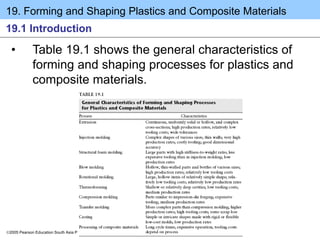
• Table 19.1 shows the general characteristics of
forming and shaping processes for plastics and
composite materials.
19. Forming and Shaping Plastics and Composite Materials
2005 Pearson Education South Asia Pte Ltd
19.1 Introduction
• Plastics usually are shipped to manufacturing
plants as pellets, granules, or powders and are
melted (for thermoplastics) just before the
shaping process.
• With increasing awareness of our environment,
raw materials also may consist of reground or
chopped plastics obtained from recycling centers.
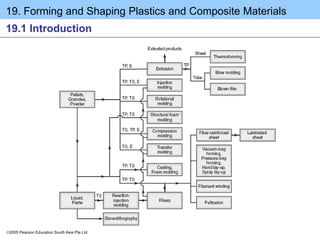
• Fig 19.1 shows the outline of forming and shaping
processes for plastics, elastomers, and composite
materials.
19. Forming and Shaping Plastics and Composite Materials
2005 Pearson Education South Asia Pte Ltd
19.1 Introduction
19. Forming and Shaping Plastics and Composite Materials
2005 Pearson Education South Asia Pte Ltd
19.2 Extrusion
• In extrusion, which constitutes the largest volume
of plastics produced, raw materials in the form of
thermoplastic pellets, granules, or powder are
placed into a hopper and fed into the barrel of a
screw extruder.
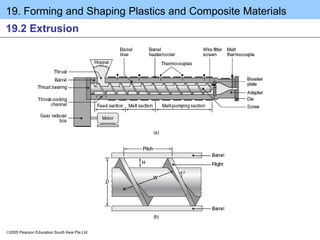
• Fig 19.2(a) shows the schematic illustration of a
typical screw extruder. (b) Geometry of an
extruder screw. Complex shapes can be extruded
with relatively simple and inexpensive dies.
19. Forming and Shaping Plastics and Composite Materials
2005 Pearson Education South Asia Pte Ltd
19.2 Extrusion
19. Forming and Shaping Plastics and Composite Materials
2005 Pearson Education South Asia Pte Ltd
19.2 Extrusion
• Screws have three distinct sections:
1. Feed section: Conveys the material from the
hopper into the central region of the barrel.
2. Melt section (also called compression or transition
section): Where the heat generated by the
viscous shearing of the plastic pellets and by the
external heaters causes melting to begin.
3. Metering or pumping section: Where additional
shearing (at a high rate) and melting occur with
pressure building up at the die.
19. Forming and Shaping Plastics and Composite Materials
2005 Pearson Education South Asia Pte Ltd
19.2 Extrusion
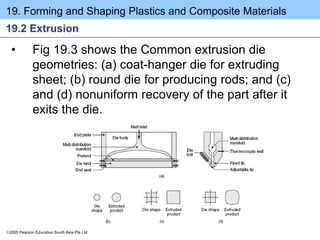
• Fig 19.3 shows the Common extrusion die
geometries: (a) coat-hanger die for extruding
sheet; (b) round die for producing rods; and (c)
and (d) nonuniform recovery of the part after it
exits the die.
19. Forming and Shaping Plastics and Composite Materials
2005 Pearson Education South Asia Pte Ltd
19.2 Extrusion
• The control of processing parameters such as
extruder-screw rotational speed, barrel-wall
temperatures, die design, and rate of cooling and
drawing speeds are important in order to ensure
product integrity and uniform dimensional
accuracy.
• Die shape is important, as it can induce high
stresses in the product, causing it to develop
surface fractures (as also occur in metals).
19. Forming and Shaping Plastics and Composite Materials
2005 Pearson Education South Asia Pte Ltd
19.2.1 Miscellaneous extrusion processes
Plastic tubes and pipes
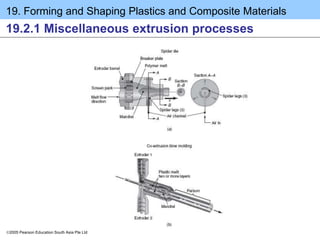
• These are produced in an extruder with a spider
die.
• Fiber or wire reinforcements also may be fed
through specially designed dies in this operation for
the production of reinforced hoses that need to
withstand higher pressures.
• The extrusion of tubes is also a necessary first step
for related processes, such as extrusion blow
molding and blown film.
• Fig 19.4 shows the extrusion of tubes. (a) Extrusion
using a spider die and pressurized air. (b)
Coextrusion for producing a bottle.
19. Forming and Shaping Plastics and Composite Materials
2005 Pearson Education South Asia Pte Ltd
19.2.1 Miscellaneous extrusion processes
19. Forming and Shaping Plastics and Composite Materials
2005 Pearson Education South Asia Pte Ltd
19.2.1 Miscellaneous extrusion processes
Rigid plastic tubing
• Extruded by a process in which the die is rotated,
rigid plastic tubing causes the polymer to be
sheared and biaxially oriented during extrusion.
• As a result, the tube has a higher crushing
strength and a higher strength-to-weight ratio
than conventionally extruded tubes.
19. Forming and Shaping Plastics and Composite Materials
2005 Pearson Education South Asia Pte Ltd
19.2.1 Miscellaneous extrusion processes
Coextrusion
• Coextrusion involves simultaneous extrusion of two
or more polymers through a single die.
• The product cross-section thus contains different
polymers—each with its own characteristics and
function.
• Coextrusion commonly is performed in shapes such
as flat sheets, films, and tubes, and is used
especially in food packaging where different layers
of polymers have different functions, such as (a)
inertness for food, (b) serving as barriers to fluids
such as water or oil, and (c) labeling of the product.
19. Forming and Shaping Plastics and Composite Materials
2005 Pearson Education South Asia Pte Ltd
19.2.1 Miscellaneous extrusion processes
Plastic-coated electrical wire
• Electrical wire cable, and strips also are extruded
and coated with plastic by this process.
• The wire is fed into the die opening at a controlled
rate with the extruded plastic in order to produce a
uniform coating.
• Plasticcoated paper clips also are made by
coextrusion.
• To ensure proper insulation, extruded electrical
wires are checked continuously for their resistance
as they exit the die; they also are marked
automatically with a roller to identify the specific
type of wire.
19. Forming and Shaping Plastics and Composite Materials
2005 Pearson Education South Asia Pte Ltd
19.2.1 Miscellaneous extrusion processes
Polymer sheets and films
• These can be produced by using a specially
designed flat-extrusion die.
• Also known as the coathanger die, it is designed
to distribute the polymer melt evenly throughout
the width.
• The polymer is extruded by forcing it through the
die, after which the extruded sheet is taken up.
• Generally, polymer sheet is considered to be
thicker than 0.5 mm, and film is thinner than 0.5
mm.
19. Forming and Shaping Plastics and Composite Materials
2005 Pearson Education South Asia Pte Ltd
19.2.1 Miscellaneous extrusion processes
Thin polymer films
• Common plastic bags and other thin polymer film
products are made from blown film, which is
made from a thin-walled tube produced by an
extruder.
• In this process, a tube is extruded continuously
vertically upward and then expanded into a
balloon shape by blowing air through the center of
the extrusion die until the desired film thickness is
reached.
19. Forming and Shaping Plastics and Composite Materials
2005 Pearson Education South Asia Pte Ltd
19.2.1 Miscellaneous extrusion processes
Thin polymer films
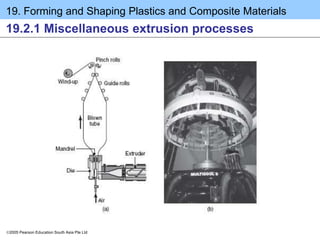
• Fig 19.5(a) shows the schematic illustration of the
production of thin film and plastic bags from
tube—first produced by an extruder and then
blown by air. (b) A blown-film operation. This
process is well developed, producing inexpensive
and very large quantities of plastic film and
shopping bags.
19. Forming and Shaping Plastics and Composite Materials
2005 Pearson Education South Asia Pte Ltd
19.2.1 Miscellaneous extrusion processes
19. Forming and Shaping Plastics and Composite Materials
2005 Pearson Education South Asia Pte Ltd
19.2.1 Miscellaneous extrusion processes
Plastic films
• Plastic films, especially polytetrafluoroethylene
(PTFE; trade name: Teflon), can be produced by
shaving the circumference of a solid, round
plastic billet using specially designed knives in a
manner similar to producing veneer from a large
piece of round wood.
• The process is called skiving.
19. Forming and Shaping Plastics and Composite Materials
2005 Pearson Education South Asia Pte Ltd
19.2.1 Miscellaneous extrusion processes
Pallets
• Used as raw material for other plastics-
processing methods described in this chapter,
pellets also are made by extrusion.
• A small-diameter, solid rod is extruded
continuously and then chopped into short lengths
(pellets).
• With some modifications, extruders also can be
used as simple melters for other shaping
processes, such as for injection molding and blow
molding.
19. Forming and Shaping Plastics and Composite Materials
2005 Pearson Education South Asia Pte Ltd
Example 19.1 Blown film
Assume that a typical plastic shopping bag made by
blown film has a lateral dimension (width) of 400 mm. (a)
What should be the extrusion-die diameter? (b) These
bags are relatively strong in use. How is this strength
achieved?
19. Forming and Shaping Plastics and Composite Materials
2005 Pearson Education South Asia Pte Ltd
Example 19.1 Blown film
Solution
a. The perimeter of the flat bag is (2)(400) = 800 mm.
Since the original cross-section of the film is round, the
blown diameter should be (Pi)D = 800, thus D = 225
mm. Recall that in this process, a tube is expanded from
1.5 to 2.5 times the extrusion-die diameter. Taking the
maximum value of 2.5, we calculate the die diameter as
225/2.5 = 100 mm.
19. Forming and Shaping Plastics and Composite Materials
2005 Pearson Education South Asia Pte Ltd
Example 19.1 Blown film
Solution
b. Note in Fig. 19.5a that after being extruded, the
balloon is being pulled upward by the pinch rolls. Thus,
in addition to diametral stretching and the attendant
molecular orientation, the film is stretched and oriented
in the longitudinal direction. The resulting biaxial
orientation of the polymer molecules significantly
improves the strength and toughness of the plastic bag.
19. Forming and Shaping Plastics and Composite Materials
2005 Pearson Education South Asia Pte Ltd
19.2.2 Production of polymer reinforcing fibers
• Most synthetic fibers used in reinforced plastics
are polymers that are extruded through the tiny
holes of a device called a spinneret (resembling
a shower head) to form continuous filaments of
semi-solid polymer.
• This process of extrusion and solidification of
continuous filaments is called spinning.
• There are four methods of spinning fibers: melt,
wet, dry, and gel spinning.
19. Forming and Shaping Plastics and Composite Materials
2005 Pearson Education South Asia Pte Ltd
19.2.2 Production of polymer reinforcing fibers
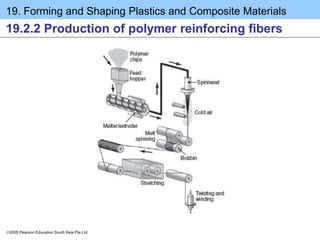
1. In melt spinning, the polymer is melted for
extrusion through the spinneret and then solidified
directly by cooling. Fig 19.6 shows the melt-
spinning process for producing polymer fibers.
The fibers are then used in a variety of
applications, including fabrics and as
reinforcements for composite materials.
2. Wet spinning is the oldest process for fiber
production and is used for polymers that have
been dissolved in a solvent. Acrylic, rayon, and
aramid fibers can be produced by this process.
19. Forming and Shaping Plastics and Composite Materials
2005 Pearson Education South Asia Pte Ltd
19.2.2 Production of polymer reinforcing fibers
19. Forming and Shaping Plastics and Composite Materials
2005 Pearson Education South Asia Pte Ltd
19.2.2 Production of polymer reinforcing fibers
3. Dry spinning is used for thermosets carried by a
solvent. Dry spinning may be used for the
production of acetate, triacetate, polyether-based
elastane, and acrylic fibers.
4. Gel spinning is a special process used to obtain
high-strength or special fiber properties. bath.
Some high-strength polyethylene and aramid
fibers are produced by gel spinning.
19. Forming and Shaping Plastics and Composite Materials
2005 Pearson Education South Asia Pte Ltd
19.2.2 Production of polymer reinforcing fibers
• A necessary step in the production of most fibers
is the application of significant stretching to
induce orientation of the polymer molecules in the
fiber direction.
• This orientation is the main reason for the high
strength of the fibers compared to the polymer in
bulk form.
• Graphite fibers are produced from different
polymer fibers by pyrolysis.
19. Forming and Shaping Plastics and Composite Materials
2005 Pearson Education South Asia Pte Ltd
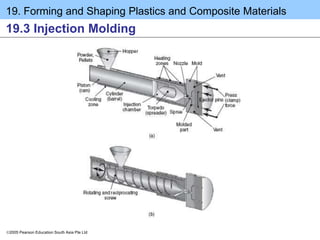
19.3 Injection Molding
• Injection molding is similar to hot-chamber die
casting.
• The pellets or granules are fed into the heated
cylinder, and the melt is forced into the mold
either by a hydraulic plunger or by the rotating
screw system of an extruder.
• Fig 19.7 shows the schematic illustration of
injection molding with (a) plunger and (b)
reciprocating rotating screw.
19. Forming and Shaping Plastics and Composite Materials
2005 Pearson Education South Asia Pte Ltd
19.3 Injection Molding
19. Forming and Shaping Plastics and Composite Materials
2005 Pearson Education South Asia Pte Ltd
19.3 Injection Molding
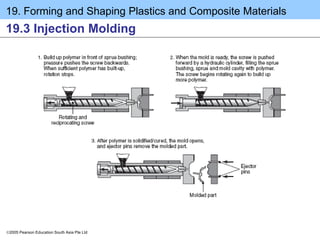
• Fig 19.8 shows the sequence of operations in the
injection molding of a part with a reciprocating
screw. This process is used widely for numerous
consumer and commercial products, such as
toys, containers, knobs, and electrical equipment.
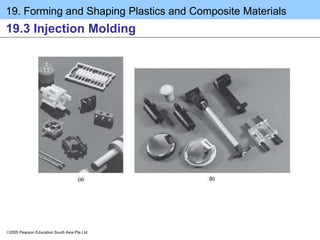
• Fig 19.9 shows the typical products made by
injection molding, including examples of insert
molding.
19. Forming and Shaping Plastics and Composite Materials
2005 Pearson Education South Asia Pte Ltd
19.3 Injection Molding
19. Forming and Shaping Plastics and Composite Materials
2005 Pearson Education South Asia Pte Ltd
19.3 Injection Molding
19. Forming and Shaping Plastics and Composite Materials
2005 Pearson Education South Asia Pte Ltd
19.3 Injection Molding
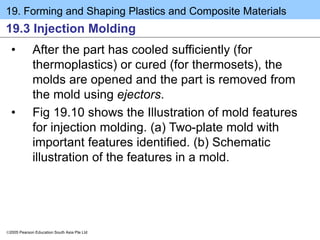
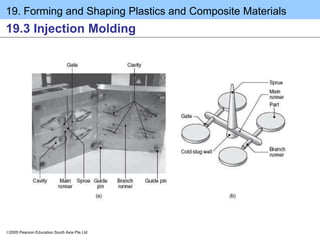
• After the part has cooled sufficiently (for
thermoplastics) or cured (for thermosets), the
molds are opened and the part is removed from
the mold using ejectors.
• Fig 19.10 shows the Illustration of mold features
for injection molding. (a) Two-plate mold with
important features identified. (b) Schematic
illustration of the features in a mold.
19. Forming and Shaping Plastics and Composite Materials
2005 Pearson Education South Asia Pte Ltd
19.3 Injection Molding
19. Forming and Shaping Plastics and Composite Materials
2005 Pearson Education South Asia Pte Ltd
19.3 Injection Molding
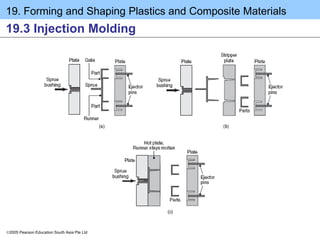
• There are three basic types of molds:
1. Cold-runner, two-plate mold: this design is the
simplest and most common, as shown in Fig.
19.11a.
2. Cold-runner, three-plate mold (Fig. 19.11b): the
runner system is separated from the part when
the mold is opened.
3. Hot-runner mold (Fig. 19.11c), also called
runnerless mold: the molten plastic is kept hot in
a heated runner plate.
19. Forming and Shaping Plastics and Composite Materials
2005 Pearson Education South Asia Pte Ltd
19.3 Injection Molding
19. Forming and Shaping Plastics and Composite Materials
2005 Pearson Education South Asia Pte Ltd
19.3 Injection Molding
• Multicomponent injection molding (also called
coinjection or sandwich molding) allows the
forming of parts with a combination of various
colors and shapes.
• Insert molding involves metallic components
(such as screws, pins, and strips) that are placed
in the mold cavity prior to injection and then
become an integral part of the molded product.
19. Forming and Shaping Plastics and Composite Materials
2005 Pearson Education South Asia Pte Ltd
Case Study 19.1 EPOCH Hip Replacement
Each year, over one million artificial joints are replaced
world-wide, thus eliminating pain and greatly improving
the quality of life of their recipients. A total hip
replacement usually is comprised of two major
components: (a) a femoral component placed in the leg
and (b) an acetabular component for the hip. The
manufacture of hip stems was described in Example I.5
of the General Introduction; the EPOCH hip stem is a
recent development based on polymer processing
technology.
19. Forming and Shaping Plastics and Composite Materials
2005 Pearson Education South Asia Pte Ltd
Case Study 19.1 EPOCH Hip Replacement
One of the problems that has been encountered with total hip
replacements is that of bone resorption. To keep it from breaking
down and being reassimilated into the body, healthy bone must be
stressed to maintain its strength and vigor. However, metal
implants that are very stiff tend to transfer loads to the femur
differently than the patient’s natural hip, and much of the bone
towards the top of the femur is subjected to very little stress. The
body reacts to this low-stress state by resorbing the bone. This
loss of bone mass can result in failure of the bone and lead to
fatigue failure of the implant because of the new and harmful
loading environment. This is serious, because repairing or revising
an implant is significantly more painful for the patient and involves
significantly more rehabilitation, and revisions usually are not as
successful as the first implant.
19. Forming and Shaping Plastics and Composite Materials
2005 Pearson Education South Asia Pte Ltd
Case Study 19.1 EPOCH Hip Replacement
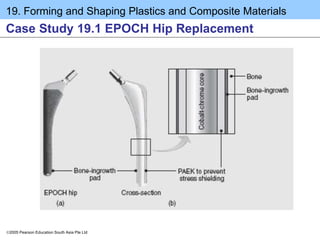
A new and innovative implant design is the EPOCH
system, shown in Fig. 19.12. In this system, the hip
consists of three layers: (1) an outermost layer
comprised of a diffusion-bonded (see Section 31.7)
titanium-alloy mesh for bone in-growth, (2) a
thermoplastic polymer layer intended to provide a
stiffness similar to bone, and (3) a cobalt-alloy core to
provide static and fatigue strength. The polymer used in
this hip is from the polyaryletherketone (PAEK) family,
and the layers are sized to mimic bone stiffness while
maximizing fatigue strength.
19. Forming and Shaping Plastics and Composite Materials
2005 Pearson Education South Asia Pte Ltd
Case Study 19.1 EPOCH Hip Replacement
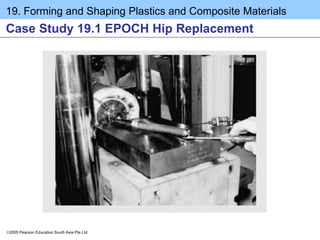
The EPOCH hip is manufactured through an insert injection-
molding operation, as shown in Fig. 19.13. A 0.75-MN vertical
injection-molding machine is used (as opposed to a horizontal
injection-molding machine) in order to facilitate locating the
inserts. Two flexible pads are placed into seats on the mold
halves. A machined cobalt-alloy insert is preheated and placed in
the bottom half of the mold. The mold is closed, and the polymer
is injected into the cavity, thus adhering to the insert, partially
permeating into the porous pad, and integrally locking all
components together. After the part is ejected from the mold, the
flash is trimmed, and the hip stem is finished to obtain the desired
surface finish. A cross-section of the resulting structure is shown
in Fig. 19.12(b).
19. Forming and Shaping Plastics and Composite Materials
2005 Pearson Education South Asia Pte Ltd
Case Study 19.1 EPOCH Hip Replacement
19. Forming and Shaping Plastics and Composite Materials
2005 Pearson Education South Asia Pte Ltd
Case Study 19.1 EPOCH Hip Replacement
19. Forming and Shaping Plastics and Composite Materials
2005 Pearson Education South Asia Pte Ltd
19.3 Injection Molding
Overmolding
• This is a process for making products (such as
hinge joints and ball-and-socket joints) in one
operation and without the need for post-molding
assembly.
• In ice-cold molding, the same type of plastic is
used to form both components of the joint.
19. Forming and Shaping Plastics and Composite Materials
2005 Pearson Education South Asia Pte Ltd
19.3 Injection Molding
Process capabilities
• Injection molding is a high-rate production
process and permits good dimensional control.
• Injection molding is a versatile process capable of
producing complex shapes with good dimensional
accuracy and at high production rates.
• Methods of avoiding defects consist of the proper
control of temperatures,
• pressures, and mold design modifications usin
simulation software.
19. Forming and Shaping Plastics and Composite Materials
2005 Pearson Education South Asia Pte Ltd
19.3 Injection Molding
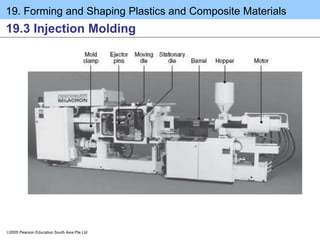
Machines
• Injection-molding machines are usually horizontal.
• Vertical machines are used for making small,
close-tolerance parts and for insert molding.
• Fig 19.14 shows a 2.2-MN injection-molding
machine.
• The tonnage is the force applied to keep the dies
closed during the injection of molten plastic into
the mold cavities and hold it there until the parts
are cool and stiff enough to be removed from the
die.
19. Forming and Shaping Plastics and Composite Materials
2005 Pearson Education South Asia Pte Ltd
19.3 Injection Molding
19. Forming and Shaping Plastics and Composite Materials
2005 Pearson Education South Asia Pte Ltd
Example 19.2 Force required in injection molding
A 2-MN injection-molding machine is to be used to make
spur gears 110 mm in diameter and 12 mm thick. The
gears have a fine-tooth profile. How many gears can be
injection-molded in one set of molds? Does the
thickness of the gears influence your answer?
19. Forming and Shaping Plastics and Composite Materials
2005 Pearson Education South Asia Pte Ltd
Example 19.2 Force required in injection molding
Solution
Because of the fine detail involved (fine gear teeth), let’s
assume that the pressures required in the mold cavity
will be on the order of 100 MPa. The cross-sectional
(projected) area of the gear is (Pi)(110)2/4=9500 mm2. If
we assume that the parting plane of the two halves of
the mold is in the middle of the gear, the force required
is (9500)(100)=950 kN.
19. Forming and Shaping Plastics and Composite Materials
2005 Pearson Education South Asia Pte Ltd
Example 19.2 Force required in injection molding
Solution
Since the capacity of the machine is 2 MN, we have 2
MN of clamping force available. Hence, the mold can
accommodate two cavities and produce two gears
per cycle. Because it does not influence the cross-
sectional area of the gear, the thickness of the gear does
not influence directly the pressures involved, and thus, it
does not change the answer.
19. Forming and Shaping Plastics and Composite Materials
2005 Pearson Education South Asia Pte Ltd
19.3.1 Reaction-injection molding
• In the reaction-injection molding (RIM) process, a
monomer and two or more reactive fluids are
forced at high speed into a mixing chamber at a
pressure of 10 to 20 MPa and then into the mold
cavity.
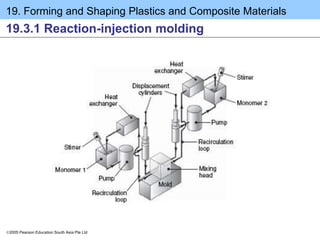
• Fig 19.15 shows the schematic illustration of the
reaction-injection molding process. Typical parts
made are automotive-body panels, water skis,
and thermal insulation for refrigerators and
freezers.
19. Forming and Shaping Plastics and Composite Materials
2005 Pearson Education South Asia Pte Ltd
19.3.1 Reaction-injection molding
19. Forming and Shaping Plastics and Composite Materials
2005 Pearson Education South Asia Pte Ltd
19.3.1 Reaction-injection molding
• Major applications of this process include
automotive parts (such as bumpers and fenders,
steering wheels and instrument panels), thermal
insulation for refrigerators and freezers, water
skis, and stiffeners for structural components.
19. Forming and Shaping Plastics and Composite Materials
2005 Pearson Education South Asia Pte Ltd
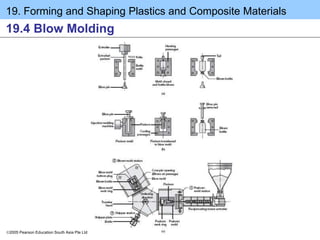
19.4 Blow Molding
• Blow molding is a modified extrusion- and
injection-molding process.
• In extrusion blow molding, a tube or preform
(usually oriented so that it is vertical) is first
extruded.
• Fig 19.16(a) shows the schematic illustrations of
(a) the extrusion blow-molding process for making
plastic beverage bottles; (b) the injection blow-
molding process; and (c) a three-station injection
blow-molding machine for making plastic bottles.
19. Forming and Shaping Plastics and Composite Materials
2005 Pearson Education South Asia Pte Ltd
19.4 Blow Molding
19. Forming and Shaping Plastics and Composite Materials
2005 Pearson Education South Asia Pte Ltd
19.4 Blow Molding
• In some operations, the extrusion is continuous,
and the molds move with the tubing.
• In injection blow molding, a short tubular piece
(parison) first is injection molded into cool dies
(parisons may be made and stored for later use).
• A related process is stretch blow molding,
where the parison is expanded and elongated
simultaneously, subjecting the polymer to biaxial
stretching and thus enhancing its properties.
• Multilayer blow molding involves the use of
coextruded tubes or parisons and thus permits
the production of a multilayer structure.
19. Forming and Shaping Plastics and Composite Materials
2005 Pearson Education South Asia Pte Ltd
19.5 Rotational Molding
• Most thermoplastics and some thermosets can be
formed into large, hollow parts by rotational
molding.
• In this process, a thin-walled metal mold is made
in two pieces (split-female mold) and is designed
to be rotated about two perpendicular axes.
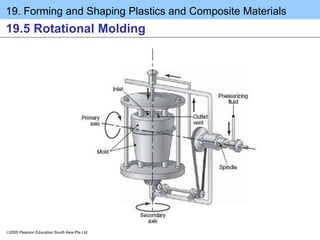
• Fig 19.17 shows the the rotational molding
(rotomolding or rotocasting) process. Trash cans,
buckets, and plastic footballs can be made by this
process.
19. Forming and Shaping Plastics and Composite Materials
2005 Pearson Education South Asia Pte Ltd
19.5 Rotational Molding
19. Forming and Shaping Plastics and Composite Materials
2005 Pearson Education South Asia Pte Ltd
19.5 Rotational Molding
• A large variety of parts are made by rotational
molding, such as storage tanks of various sizes,
trash cans, boat hulls, buckets, housings, large
hollow toys, carrying cases, and footballs. Various
metallic or plastic inserts or components also may
be molded integrally into the parts being made by
this process.
• In addition to powders, liquid polymers
(plastisols) also can be used in rotational
molding—PVC plastisols being the most common
material.
19. Forming and Shaping Plastics and Composite Materials
2005 Pearson Education South Asia Pte Ltd
19.5 Rotational Molding
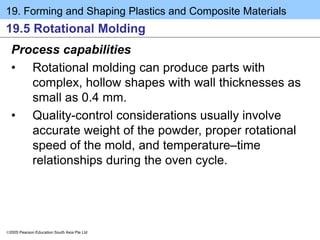
Process capabilities
• Rotational molding can produce parts with
complex, hollow shapes with wall thicknesses as
small as 0.4 mm.
• Quality-control considerations usually involve
accurate weight of the powder, proper rotational
speed of the mold, and temperature–time
relationships during the oven cycle.

Plastic forming.ppt

  • 1.
    2005 Pearson EducationSouth Asia Pte Ltd Forming and Shaping Processes and Equipment Manufacturing Engineering and Technology 13.Rolling of Metals 14.Forging of Metals 15.Extrusion and Drawing of Metals 16.Sheet-Metal Forming Processes 17.Processing of Metal Powders 18.Processing of Ceramics, Glass and Superconductors 19.Forming and Shaping Plastics and Composite Materials 20.Rapid-Prototyping Operations
  • 2.
    19. Forming andShaping Plastics and Composite Materials 2005 Pearson Education South Asia Pte Ltd Chapter Objectives • Extrusion as a basic process for producing rods, tubing, and pellets for subsequent use. • How discrete plastic parts (such as bottles, automotive parts, and electrical parts with metal components) are made. • Production of plastic sheets and films. • How reinforced plastics and various composite materials are produced. • Characteristics of machinery used, mold design, and economic considerations.
  • 3.
    19. Forming andShaping Plastics and Composite Materials 2005 Pearson Education South Asia Pte Ltd Chapter Outline 1. Introduction 2. Extrusion 3. Injection Molding 4. Blow Molding 5. Rotational Molding 6. Thermoforming 7. Compression Molding 8. Transfer Molding 9. Casting 10.Foam Molding
  • 4.
    19. Forming andShaping Plastics and Composite Materials 2005 Pearson Education South Asia Pte Ltd Chapter Outline 11.Cold Forming and Solid-Phase Forming 12.Processing Elastomers 13.Processing Polymer-Matrix Composites Processing Metal-Matrix and Ceramic-Matrix 14.Composites Design 15.Considerations 16.Economics of Processing Plastics and Composite Materials
  • 5.
    19. Forming andShaping Plastics and Composite Materials 2005 Pearson Education South Asia Pte Ltd 19.1 Introduction • Table 19.1 shows the general characteristics of forming and shaping processes for plastics and composite materials.
  • 6.
    19. Forming andShaping Plastics and Composite Materials 2005 Pearson Education South Asia Pte Ltd 19.1 Introduction • Plastics usually are shipped to manufacturing plants as pellets, granules, or powders and are melted (for thermoplastics) just before the shaping process. • With increasing awareness of our environment, raw materials also may consist of reground or chopped plastics obtained from recycling centers. • Fig 19.1 shows the outline of forming and shaping processes for plastics, elastomers, and composite materials.
  • 7.
    19. Forming andShaping Plastics and Composite Materials 2005 Pearson Education South Asia Pte Ltd 19.1 Introduction
  • 8.
    19. Forming andShaping Plastics and Composite Materials 2005 Pearson Education South Asia Pte Ltd 19.2 Extrusion • In extrusion, which constitutes the largest volume of plastics produced, raw materials in the form of thermoplastic pellets, granules, or powder are placed into a hopper and fed into the barrel of a screw extruder. • Fig 19.2(a) shows the schematic illustration of a typical screw extruder. (b) Geometry of an extruder screw. Complex shapes can be extruded with relatively simple and inexpensive dies.
  • 9.
    19. Forming andShaping Plastics and Composite Materials 2005 Pearson Education South Asia Pte Ltd 19.2 Extrusion
  • 10.
    19. Forming andShaping Plastics and Composite Materials 2005 Pearson Education South Asia Pte Ltd 19.2 Extrusion • Screws have three distinct sections: 1. Feed section: Conveys the material from the hopper into the central region of the barrel. 2. Melt section (also called compression or transition section): Where the heat generated by the viscous shearing of the plastic pellets and by the external heaters causes melting to begin. 3. Metering or pumping section: Where additional shearing (at a high rate) and melting occur with pressure building up at the die.
  • 11.
    19. Forming andShaping Plastics and Composite Materials 2005 Pearson Education South Asia Pte Ltd 19.2 Extrusion • Fig 19.3 shows the Common extrusion die geometries: (a) coat-hanger die for extruding sheet; (b) round die for producing rods; and (c) and (d) nonuniform recovery of the part after it exits the die.
  • 12.
    19. Forming andShaping Plastics and Composite Materials 2005 Pearson Education South Asia Pte Ltd 19.2 Extrusion • The control of processing parameters such as extruder-screw rotational speed, barrel-wall temperatures, die design, and rate of cooling and drawing speeds are important in order to ensure product integrity and uniform dimensional accuracy. • Die shape is important, as it can induce high stresses in the product, causing it to develop surface fractures (as also occur in metals).
  • 13.
    19. Forming andShaping Plastics and Composite Materials 2005 Pearson Education South Asia Pte Ltd 19.2.1 Miscellaneous extrusion processes Plastic tubes and pipes • These are produced in an extruder with a spider die. • Fiber or wire reinforcements also may be fed through specially designed dies in this operation for the production of reinforced hoses that need to withstand higher pressures. • The extrusion of tubes is also a necessary first step for related processes, such as extrusion blow molding and blown film. • Fig 19.4 shows the extrusion of tubes. (a) Extrusion using a spider die and pressurized air. (b) Coextrusion for producing a bottle.
  • 14.
    19. Forming andShaping Plastics and Composite Materials 2005 Pearson Education South Asia Pte Ltd 19.2.1 Miscellaneous extrusion processes
  • 15.
    19. Forming andShaping Plastics and Composite Materials 2005 Pearson Education South Asia Pte Ltd 19.2.1 Miscellaneous extrusion processes Rigid plastic tubing • Extruded by a process in which the die is rotated, rigid plastic tubing causes the polymer to be sheared and biaxially oriented during extrusion. • As a result, the tube has a higher crushing strength and a higher strength-to-weight ratio than conventionally extruded tubes.
  • 16.
    19. Forming andShaping Plastics and Composite Materials 2005 Pearson Education South Asia Pte Ltd 19.2.1 Miscellaneous extrusion processes Coextrusion • Coextrusion involves simultaneous extrusion of two or more polymers through a single die. • The product cross-section thus contains different polymers—each with its own characteristics and function. • Coextrusion commonly is performed in shapes such as flat sheets, films, and tubes, and is used especially in food packaging where different layers of polymers have different functions, such as (a) inertness for food, (b) serving as barriers to fluids such as water or oil, and (c) labeling of the product.
  • 17.
    19. Forming andShaping Plastics and Composite Materials 2005 Pearson Education South Asia Pte Ltd 19.2.1 Miscellaneous extrusion processes Plastic-coated electrical wire • Electrical wire cable, and strips also are extruded and coated with plastic by this process. • The wire is fed into the die opening at a controlled rate with the extruded plastic in order to produce a uniform coating. • Plasticcoated paper clips also are made by coextrusion. • To ensure proper insulation, extruded electrical wires are checked continuously for their resistance as they exit the die; they also are marked automatically with a roller to identify the specific type of wire.
  • 18.
    19. Forming andShaping Plastics and Composite Materials 2005 Pearson Education South Asia Pte Ltd 19.2.1 Miscellaneous extrusion processes Polymer sheets and films • These can be produced by using a specially designed flat-extrusion die. • Also known as the coathanger die, it is designed to distribute the polymer melt evenly throughout the width. • The polymer is extruded by forcing it through the die, after which the extruded sheet is taken up. • Generally, polymer sheet is considered to be thicker than 0.5 mm, and film is thinner than 0.5 mm.
  • 19.
    19. Forming andShaping Plastics and Composite Materials 2005 Pearson Education South Asia Pte Ltd 19.2.1 Miscellaneous extrusion processes Thin polymer films • Common plastic bags and other thin polymer film products are made from blown film, which is made from a thin-walled tube produced by an extruder. • In this process, a tube is extruded continuously vertically upward and then expanded into a balloon shape by blowing air through the center of the extrusion die until the desired film thickness is reached.
  • 20.
    19. Forming andShaping Plastics and Composite Materials 2005 Pearson Education South Asia Pte Ltd 19.2.1 Miscellaneous extrusion processes Thin polymer films • Fig 19.5(a) shows the schematic illustration of the production of thin film and plastic bags from tube—first produced by an extruder and then blown by air. (b) A blown-film operation. This process is well developed, producing inexpensive and very large quantities of plastic film and shopping bags.
  • 21.
    19. Forming andShaping Plastics and Composite Materials 2005 Pearson Education South Asia Pte Ltd 19.2.1 Miscellaneous extrusion processes
  • 22.
    19. Forming andShaping Plastics and Composite Materials 2005 Pearson Education South Asia Pte Ltd 19.2.1 Miscellaneous extrusion processes Plastic films • Plastic films, especially polytetrafluoroethylene (PTFE; trade name: Teflon), can be produced by shaving the circumference of a solid, round plastic billet using specially designed knives in a manner similar to producing veneer from a large piece of round wood. • The process is called skiving.
  • 23.
    19. Forming andShaping Plastics and Composite Materials 2005 Pearson Education South Asia Pte Ltd 19.2.1 Miscellaneous extrusion processes Pallets • Used as raw material for other plastics- processing methods described in this chapter, pellets also are made by extrusion. • A small-diameter, solid rod is extruded continuously and then chopped into short lengths (pellets). • With some modifications, extruders also can be used as simple melters for other shaping processes, such as for injection molding and blow molding.
  • 24.
    19. Forming andShaping Plastics and Composite Materials 2005 Pearson Education South Asia Pte Ltd Example 19.1 Blown film Assume that a typical plastic shopping bag made by blown film has a lateral dimension (width) of 400 mm. (a) What should be the extrusion-die diameter? (b) These bags are relatively strong in use. How is this strength achieved?
  • 25.
    19. Forming andShaping Plastics and Composite Materials 2005 Pearson Education South Asia Pte Ltd Example 19.1 Blown film Solution a. The perimeter of the flat bag is (2)(400) = 800 mm. Since the original cross-section of the film is round, the blown diameter should be (Pi)D = 800, thus D = 225 mm. Recall that in this process, a tube is expanded from 1.5 to 2.5 times the extrusion-die diameter. Taking the maximum value of 2.5, we calculate the die diameter as 225/2.5 = 100 mm.
  • 26.
    19. Forming andShaping Plastics and Composite Materials 2005 Pearson Education South Asia Pte Ltd Example 19.1 Blown film Solution b. Note in Fig. 19.5a that after being extruded, the balloon is being pulled upward by the pinch rolls. Thus, in addition to diametral stretching and the attendant molecular orientation, the film is stretched and oriented in the longitudinal direction. The resulting biaxial orientation of the polymer molecules significantly improves the strength and toughness of the plastic bag.
  • 27.
    19. Forming andShaping Plastics and Composite Materials 2005 Pearson Education South Asia Pte Ltd 19.2.2 Production of polymer reinforcing fibers • Most synthetic fibers used in reinforced plastics are polymers that are extruded through the tiny holes of a device called a spinneret (resembling a shower head) to form continuous filaments of semi-solid polymer. • This process of extrusion and solidification of continuous filaments is called spinning. • There are four methods of spinning fibers: melt, wet, dry, and gel spinning.
  • 28.
    19. Forming andShaping Plastics and Composite Materials 2005 Pearson Education South Asia Pte Ltd 19.2.2 Production of polymer reinforcing fibers 1. In melt spinning, the polymer is melted for extrusion through the spinneret and then solidified directly by cooling. Fig 19.6 shows the melt- spinning process for producing polymer fibers. The fibers are then used in a variety of applications, including fabrics and as reinforcements for composite materials. 2. Wet spinning is the oldest process for fiber production and is used for polymers that have been dissolved in a solvent. Acrylic, rayon, and aramid fibers can be produced by this process.
  • 29.
    19. Forming andShaping Plastics and Composite Materials 2005 Pearson Education South Asia Pte Ltd 19.2.2 Production of polymer reinforcing fibers
  • 30.
    19. Forming andShaping Plastics and Composite Materials 2005 Pearson Education South Asia Pte Ltd 19.2.2 Production of polymer reinforcing fibers 3. Dry spinning is used for thermosets carried by a solvent. Dry spinning may be used for the production of acetate, triacetate, polyether-based elastane, and acrylic fibers. 4. Gel spinning is a special process used to obtain high-strength or special fiber properties. bath. Some high-strength polyethylene and aramid fibers are produced by gel spinning.
  • 31.
    19. Forming andShaping Plastics and Composite Materials 2005 Pearson Education South Asia Pte Ltd 19.2.2 Production of polymer reinforcing fibers • A necessary step in the production of most fibers is the application of significant stretching to induce orientation of the polymer molecules in the fiber direction. • This orientation is the main reason for the high strength of the fibers compared to the polymer in bulk form. • Graphite fibers are produced from different polymer fibers by pyrolysis.
  • 32.
    19. Forming andShaping Plastics and Composite Materials 2005 Pearson Education South Asia Pte Ltd 19.3 Injection Molding • Injection molding is similar to hot-chamber die casting. • The pellets or granules are fed into the heated cylinder, and the melt is forced into the mold either by a hydraulic plunger or by the rotating screw system of an extruder. • Fig 19.7 shows the schematic illustration of injection molding with (a) plunger and (b) reciprocating rotating screw.
  • 33.
    19. Forming andShaping Plastics and Composite Materials 2005 Pearson Education South Asia Pte Ltd 19.3 Injection Molding
  • 34.
    19. Forming andShaping Plastics and Composite Materials 2005 Pearson Education South Asia Pte Ltd 19.3 Injection Molding • Fig 19.8 shows the sequence of operations in the injection molding of a part with a reciprocating screw. This process is used widely for numerous consumer and commercial products, such as toys, containers, knobs, and electrical equipment. • Fig 19.9 shows the typical products made by injection molding, including examples of insert molding.
  • 35.
    19. Forming andShaping Plastics and Composite Materials 2005 Pearson Education South Asia Pte Ltd 19.3 Injection Molding
  • 36.
    19. Forming andShaping Plastics and Composite Materials 2005 Pearson Education South Asia Pte Ltd 19.3 Injection Molding
  • 37.
    19. Forming andShaping Plastics and Composite Materials 2005 Pearson Education South Asia Pte Ltd 19.3 Injection Molding • After the part has cooled sufficiently (for thermoplastics) or cured (for thermosets), the molds are opened and the part is removed from the mold using ejectors. • Fig 19.10 shows the Illustration of mold features for injection molding. (a) Two-plate mold with important features identified. (b) Schematic illustration of the features in a mold.
  • 38.
    19. Forming andShaping Plastics and Composite Materials 2005 Pearson Education South Asia Pte Ltd 19.3 Injection Molding
  • 39.
    19. Forming andShaping Plastics and Composite Materials 2005 Pearson Education South Asia Pte Ltd 19.3 Injection Molding • There are three basic types of molds: 1. Cold-runner, two-plate mold: this design is the simplest and most common, as shown in Fig. 19.11a. 2. Cold-runner, three-plate mold (Fig. 19.11b): the runner system is separated from the part when the mold is opened. 3. Hot-runner mold (Fig. 19.11c), also called runnerless mold: the molten plastic is kept hot in a heated runner plate.
  • 40.
    19. Forming andShaping Plastics and Composite Materials 2005 Pearson Education South Asia Pte Ltd 19.3 Injection Molding
  • 41.
    19. Forming andShaping Plastics and Composite Materials 2005 Pearson Education South Asia Pte Ltd 19.3 Injection Molding • Multicomponent injection molding (also called coinjection or sandwich molding) allows the forming of parts with a combination of various colors and shapes. • Insert molding involves metallic components (such as screws, pins, and strips) that are placed in the mold cavity prior to injection and then become an integral part of the molded product.
  • 42.
    19. Forming andShaping Plastics and Composite Materials 2005 Pearson Education South Asia Pte Ltd Case Study 19.1 EPOCH Hip Replacement Each year, over one million artificial joints are replaced world-wide, thus eliminating pain and greatly improving the quality of life of their recipients. A total hip replacement usually is comprised of two major components: (a) a femoral component placed in the leg and (b) an acetabular component for the hip. The manufacture of hip stems was described in Example I.5 of the General Introduction; the EPOCH hip stem is a recent development based on polymer processing technology.
  • 43.
    19. Forming andShaping Plastics and Composite Materials 2005 Pearson Education South Asia Pte Ltd Case Study 19.1 EPOCH Hip Replacement One of the problems that has been encountered with total hip replacements is that of bone resorption. To keep it from breaking down and being reassimilated into the body, healthy bone must be stressed to maintain its strength and vigor. However, metal implants that are very stiff tend to transfer loads to the femur differently than the patient’s natural hip, and much of the bone towards the top of the femur is subjected to very little stress. The body reacts to this low-stress state by resorbing the bone. This loss of bone mass can result in failure of the bone and lead to fatigue failure of the implant because of the new and harmful loading environment. This is serious, because repairing or revising an implant is significantly more painful for the patient and involves significantly more rehabilitation, and revisions usually are not as successful as the first implant.
  • 44.
    19. Forming andShaping Plastics and Composite Materials 2005 Pearson Education South Asia Pte Ltd Case Study 19.1 EPOCH Hip Replacement A new and innovative implant design is the EPOCH system, shown in Fig. 19.12. In this system, the hip consists of three layers: (1) an outermost layer comprised of a diffusion-bonded (see Section 31.7) titanium-alloy mesh for bone in-growth, (2) a thermoplastic polymer layer intended to provide a stiffness similar to bone, and (3) a cobalt-alloy core to provide static and fatigue strength. The polymer used in this hip is from the polyaryletherketone (PAEK) family, and the layers are sized to mimic bone stiffness while maximizing fatigue strength.
  • 45.
    19. Forming andShaping Plastics and Composite Materials 2005 Pearson Education South Asia Pte Ltd Case Study 19.1 EPOCH Hip Replacement The EPOCH hip is manufactured through an insert injection- molding operation, as shown in Fig. 19.13. A 0.75-MN vertical injection-molding machine is used (as opposed to a horizontal injection-molding machine) in order to facilitate locating the inserts. Two flexible pads are placed into seats on the mold halves. A machined cobalt-alloy insert is preheated and placed in the bottom half of the mold. The mold is closed, and the polymer is injected into the cavity, thus adhering to the insert, partially permeating into the porous pad, and integrally locking all components together. After the part is ejected from the mold, the flash is trimmed, and the hip stem is finished to obtain the desired surface finish. A cross-section of the resulting structure is shown in Fig. 19.12(b).
  • 46.
    19. Forming andShaping Plastics and Composite Materials 2005 Pearson Education South Asia Pte Ltd Case Study 19.1 EPOCH Hip Replacement
  • 47.
    19. Forming andShaping Plastics and Composite Materials 2005 Pearson Education South Asia Pte Ltd Case Study 19.1 EPOCH Hip Replacement
  • 48.
    19. Forming andShaping Plastics and Composite Materials 2005 Pearson Education South Asia Pte Ltd 19.3 Injection Molding Overmolding • This is a process for making products (such as hinge joints and ball-and-socket joints) in one operation and without the need for post-molding assembly. • In ice-cold molding, the same type of plastic is used to form both components of the joint.
  • 49.
    19. Forming andShaping Plastics and Composite Materials 2005 Pearson Education South Asia Pte Ltd 19.3 Injection Molding Process capabilities • Injection molding is a high-rate production process and permits good dimensional control. • Injection molding is a versatile process capable of producing complex shapes with good dimensional accuracy and at high production rates. • Methods of avoiding defects consist of the proper control of temperatures, • pressures, and mold design modifications usin simulation software.
  • 50.
    19. Forming andShaping Plastics and Composite Materials 2005 Pearson Education South Asia Pte Ltd 19.3 Injection Molding Machines • Injection-molding machines are usually horizontal. • Vertical machines are used for making small, close-tolerance parts and for insert molding. • Fig 19.14 shows a 2.2-MN injection-molding machine. • The tonnage is the force applied to keep the dies closed during the injection of molten plastic into the mold cavities and hold it there until the parts are cool and stiff enough to be removed from the die.
  • 51.
    19. Forming andShaping Plastics and Composite Materials 2005 Pearson Education South Asia Pte Ltd 19.3 Injection Molding
  • 52.
    19. Forming andShaping Plastics and Composite Materials 2005 Pearson Education South Asia Pte Ltd Example 19.2 Force required in injection molding A 2-MN injection-molding machine is to be used to make spur gears 110 mm in diameter and 12 mm thick. The gears have a fine-tooth profile. How many gears can be injection-molded in one set of molds? Does the thickness of the gears influence your answer?
  • 53.
    19. Forming andShaping Plastics and Composite Materials 2005 Pearson Education South Asia Pte Ltd Example 19.2 Force required in injection molding Solution Because of the fine detail involved (fine gear teeth), let’s assume that the pressures required in the mold cavity will be on the order of 100 MPa. The cross-sectional (projected) area of the gear is (Pi)(110)2/4=9500 mm2. If we assume that the parting plane of the two halves of the mold is in the middle of the gear, the force required is (9500)(100)=950 kN.
  • 54.
    19. Forming andShaping Plastics and Composite Materials 2005 Pearson Education South Asia Pte Ltd Example 19.2 Force required in injection molding Solution Since the capacity of the machine is 2 MN, we have 2 MN of clamping force available. Hence, the mold can accommodate two cavities and produce two gears per cycle. Because it does not influence the cross- sectional area of the gear, the thickness of the gear does not influence directly the pressures involved, and thus, it does not change the answer.
  • 55.
    19. Forming andShaping Plastics and Composite Materials 2005 Pearson Education South Asia Pte Ltd 19.3.1 Reaction-injection molding • In the reaction-injection molding (RIM) process, a monomer and two or more reactive fluids are forced at high speed into a mixing chamber at a pressure of 10 to 20 MPa and then into the mold cavity. • Fig 19.15 shows the schematic illustration of the reaction-injection molding process. Typical parts made are automotive-body panels, water skis, and thermal insulation for refrigerators and freezers.
  • 56.
    19. Forming andShaping Plastics and Composite Materials 2005 Pearson Education South Asia Pte Ltd 19.3.1 Reaction-injection molding
  • 57.
    19. Forming andShaping Plastics and Composite Materials 2005 Pearson Education South Asia Pte Ltd 19.3.1 Reaction-injection molding • Major applications of this process include automotive parts (such as bumpers and fenders, steering wheels and instrument panels), thermal insulation for refrigerators and freezers, water skis, and stiffeners for structural components.
  • 58.
    19. Forming andShaping Plastics and Composite Materials 2005 Pearson Education South Asia Pte Ltd 19.4 Blow Molding • Blow molding is a modified extrusion- and injection-molding process. • In extrusion blow molding, a tube or preform (usually oriented so that it is vertical) is first extruded. • Fig 19.16(a) shows the schematic illustrations of (a) the extrusion blow-molding process for making plastic beverage bottles; (b) the injection blow- molding process; and (c) a three-station injection blow-molding machine for making plastic bottles.
  • 59.
    19. Forming andShaping Plastics and Composite Materials 2005 Pearson Education South Asia Pte Ltd 19.4 Blow Molding
  • 60.
    19. Forming andShaping Plastics and Composite Materials 2005 Pearson Education South Asia Pte Ltd 19.4 Blow Molding • In some operations, the extrusion is continuous, and the molds move with the tubing. • In injection blow molding, a short tubular piece (parison) first is injection molded into cool dies (parisons may be made and stored for later use). • A related process is stretch blow molding, where the parison is expanded and elongated simultaneously, subjecting the polymer to biaxial stretching and thus enhancing its properties. • Multilayer blow molding involves the use of coextruded tubes or parisons and thus permits the production of a multilayer structure.
  • 61.
    19. Forming andShaping Plastics and Composite Materials 2005 Pearson Education South Asia Pte Ltd 19.5 Rotational Molding • Most thermoplastics and some thermosets can be formed into large, hollow parts by rotational molding. • In this process, a thin-walled metal mold is made in two pieces (split-female mold) and is designed to be rotated about two perpendicular axes. • Fig 19.17 shows the the rotational molding (rotomolding or rotocasting) process. Trash cans, buckets, and plastic footballs can be made by this process.
  • 62.
    19. Forming andShaping Plastics and Composite Materials 2005 Pearson Education South Asia Pte Ltd 19.5 Rotational Molding
  • 63.
    19. Forming andShaping Plastics and Composite Materials 2005 Pearson Education South Asia Pte Ltd 19.5 Rotational Molding • A large variety of parts are made by rotational molding, such as storage tanks of various sizes, trash cans, boat hulls, buckets, housings, large hollow toys, carrying cases, and footballs. Various metallic or plastic inserts or components also may be molded integrally into the parts being made by this process. • In addition to powders, liquid polymers (plastisols) also can be used in rotational molding—PVC plastisols being the most common material.
  • 64.
    19. Forming andShaping Plastics and Composite Materials 2005 Pearson Education South Asia Pte Ltd 19.5 Rotational Molding Process capabilities • Rotational molding can produce parts with complex, hollow shapes with wall thicknesses as small as 0.4 mm. • Quality-control considerations usually involve accurate weight of the powder, proper rotational speed of the mold, and temperature–time relationships during the oven cycle.