GOOD MORNING
PRESENTATION BY UNDER THE GUIDANCE
Dr. JAYESH TIWARI Dr. KIRTI PATTANASHETTY
PG 1ST
YEAR READER
GLASS IONOMER CEMENT
MAITRI COLLEGE OF DENTISTRY AND RESEARCH
CENTRE
DEPARTMENT OF PEDODONTICS AND
PREVENTIVE DENTISTRY
CONTENT
PART 1
INTRODUCTION
HISTORY AND DEVELOPMENT
CLASSIFICATIONS
 COMPOSITION
SETTING REACTION OF GIC
MANIPULATION
PROPERTIES OF GLASS IONOMER CEMENT
WORKING TIME & SETTING TIME
ADVANTAGES DISADVANTAGES,INDICATIONS
,CONTRAINDICATIONS
MODIFICATIONS OF GIC
EFFECT OF WATER ON CEMENT
SURFACE CONDITIONING
3
PART 2
Recent advancement in glass ionomer cements
Studies comparing gic and other restorative materials used in
pediatric dentistry
4
INTRODUCTION
DEFINITION OF CEMENT
A cement is a substance that hardens to act as a base , liner ,
filling material or adhesive to bind devices or prosthesis to the
tooth structure or to each other.
- PHILIPS’ SCIENCE OF DENTAL MATERIALS (12th
ed)
• Glass ionomer cement is a water based cement.
• ADA specification number: 96
5
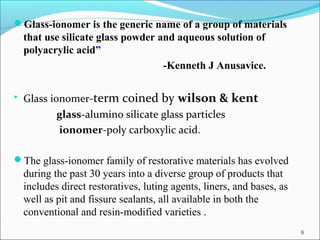
Glass-ionomer is the generic name of a group of materials
that use silicate glass powder and aqueous solution of
polyacrylic acid”
-Kenneth J Anusavice.
• Glass ionomer-term coined by wilson & kent
glass-alumino silicate glass particles
ionomer-poly carboxylic acid.
The glass-ionomer family of restorative materials has evolved
during the past 30 years into a diverse group of products that
includes direct restoratives, luting agents, liners, and bases, as
well as pit and fissure sealants, all available in both the
conventional and resin-modified varieties .
6
HISTORY AND DEVELOPMENT
7
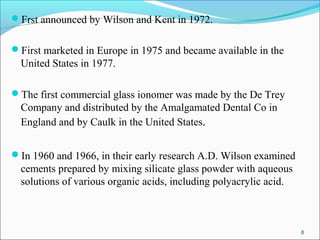
Frst announced by Wilson and Kent in 1972.
First marketed in Europe in 1975 and became available in the
United States in 1977.
The first commercial glass ionomer was made by the De Trey
Company and distributed by the Amalgamated Dental Co in
England and by Caulk in the United States.
In 1960 and 1966, in their early research A.D. Wilson examined
cements prepared by mixing silicate glass powder with aqueous
solutions of various organic acids, including polyacrylic acid.
8
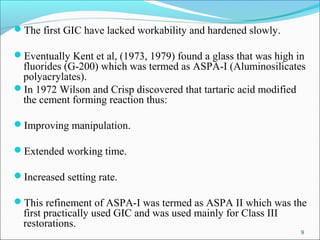
The first GIC have lacked workability and hardened slowly.
Eventually Kent et al, (1973, 1979) found a glass that was high in
fluorides (G-200) which was termed as ASPA-I (Aluminosilicates
polyacrylates).
In 1972 Wilson and Crisp discovered that tartaric acid modified
the cement forming reaction thus:
Improving manipulation.
Extended working time.
Increased setting rate.
This refinement of ASPA-I was termed as ASPA II which was the
first practically used GIC and was used mainly for Class III
restorations.
9
CLASSIFICATIONS
10
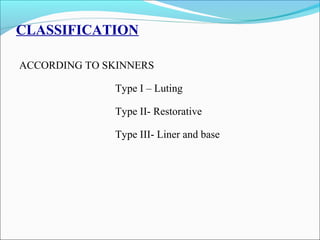
CLASSIFICATION
ACCORDING TO SKINNERS
Type I – Luting
Type II- Restorative
Type III- Liner and base
12
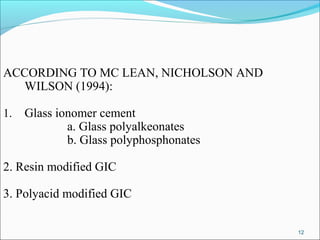
ACCORDING TO MC LEAN, NICHOLSON AND
WILSON (1994):
1. Glass ionomer cement
a. Glass polyalkeonates
b. Glass polyphosphonates
2. Resin modified GIC
3. Polyacid modified GIC
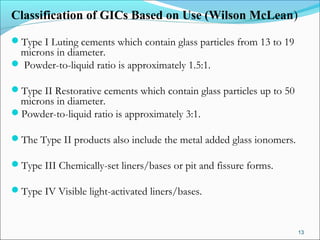
Classification of GICs Based on Use (Wilson McLean)
Type I Luting cements which contain glass particles from 13 to 19
microns in diameter.
 Powder-to-liquid ratio is approximately 1.5:1.
Type II Restorative cements which contain glass particles up to 50
microns in diameter.
Powder-to-liquid ratio is approximately 3:1.
The Type II products also include the metal added glass ionomers.
Type III Chemically-set liners/bases or pit and fissure forms.
Type IV Visible light-activated liners/bases.
13
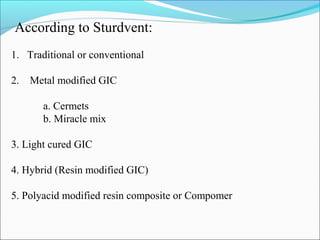
According to Sturdvent:
1. Traditional or conventional
2. Metal modified GIC
a. Cermets
b. Miracle mix
3. Light cured GIC
4. Hybrid (Resin modified GIC)
5. Polyacid modified resin composite or Compomer
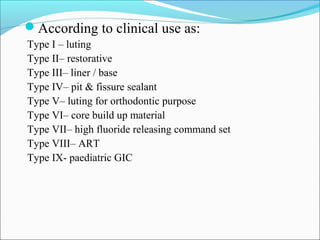
According to clinical use as:
Type I – luting
Type II– restorative
Type III– liner / base
Type IV– pit & fissure sealant
Type V– luting for orthodontic purpose
Type VI– core build up material
Type VII– high fluoride releasing command set
Type VIII– ART
Type IX- paediatric GIC
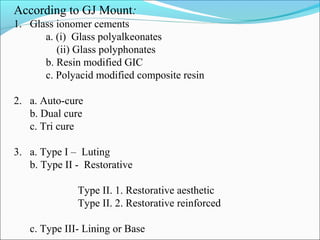
According to GJ Mount:
1. Glass ionomer cements
a. (i) Glass polyalkeonates
(ii) Glass polyphonates
b. Resin modified GIC
c. Polyacid modified composite resin
2. a. Auto-cure
b. Dual cure
c. Tri cure
3. a. Type I – Luting
b. Type II - Restorative
Type II. 1. Restorative aesthetic
Type II. 2. Restorative reinforced
c. Type III- Lining or Base
17
COMPOSITION
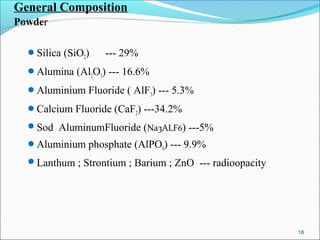
General Composition
Powder
Silica (SiO2) --- 29%
Alumina (Al2O3) --- 16.6%
Aluminium Fluoride ( AlF3) --- 5.3%
Calcium Fluoride (CaF2) ---34.2%
Sod AluminumFluoride (Na3ALF6) ---5%
Aluminium phosphate (AlPO4) --- 9.9%
Lanthum ; Strontium ; Barium ; ZnO --- radioopacity
18
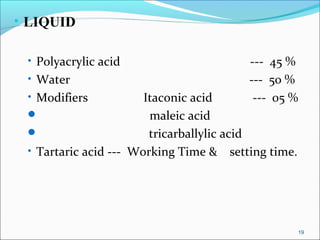
• LIQUID
• Polyacrylic acid --- 45 %
• Water --- 50 %
• Modifiers Itaconic acid --- 05 %
 maleic acid
 tricarballylic acid
• Tartaric acid --- Working Time & setting time.
19
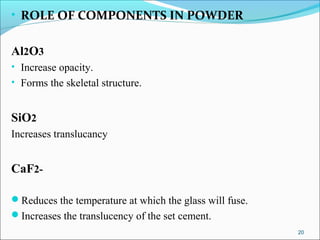
• ROLE OF COMPONENTS IN POWDER
Al2O3
• Increase opacity.
• Forms the skeletal structure.
SiO2
Increases translucancy
CaF2-
Reduces the temperature at which the glass will fuse.
Increases the translucency of the set cement.
20
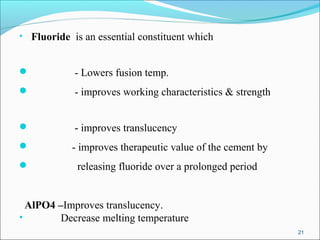
• Fluoride is an essential constituent which
 - Lowers fusion temp.
 - improves working characteristics & strength
 - improves translucency
 - improves therapeutic value of the cement by
 releasing fluoride over a prolonged period
AlPO4 –Improves translucency.
• Decrease melting temperature
21
• The liquid is an aqueous solution of polymers and copolymers of
acrylic acid.
• In most of the current cements,the acid in the form of a
coploymer with itaconic ,maleic ,or tricarboxylic acids.
Polyacrylic acid-
The most important acid contributing to formation of the cement
matrix.
.
22
Maleic acid
• A stronger acid than polyacrylic acid
• Causes the cement to harden and lose its moisture
sensitivity faster.
Water-
• It is reaction medium.
• It is essential part of the cement structure. If water
is lost from the cement by desiccation while it is
setting, the cement-forming reactions will stop
23
ITACONIC ACID
• Itaconic acid promotes reactivity between the glass and the
liquid.
• It also prevents gelation of the liquid which can result from
hydrogen bonding between two polyacrylic acid chains
Tartaric acid
• It controls the PH of the set cement during setting process,
which in turn controls the rate of dissolution of the glass.
• It typically increases the working time
24
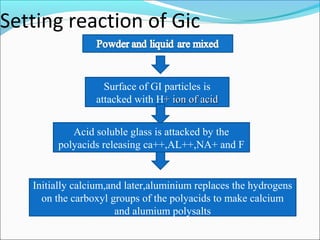
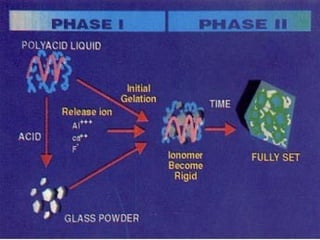
Setting reaction of Gic
Surface of GI particles is
attacked with H+ ion of acid+ ion of acid
Acid soluble glass is attacked by the
polyacids releasing ca++,AL++,NA+ and F
Initially calcium,and later,aluminium replaces the hydrogens
on the carboxyl groups of the polyacids to make calcium
and alumium polysalts
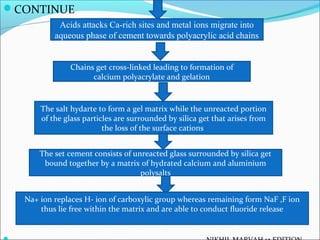
CONTINUE
Acids attacks Ca-rich sites and metal ions migrate into
aqueous phase of cement towards polyacrylic acid chains
Chains get cross-linked leading to formation of
calcium polyacrylate and gelation
The salt hydarte to form a gel matrix while the unreacted portion
of the glass particles are surrounded by silica get that arises from
the loss of the surface cations
The set cement consists of unreacted glass surrounded by silica get
bound together by a matrix of hydrated calcium and aluminium
polysalts
Na+ ion replaces H- ion of carboxylic group whereas remaining form NaF ,F ion
thus lie free within the matrix and are able to conduct fluoride release
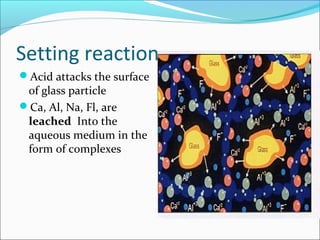
Setting reaction
Acid attacks the surface
of glass particle
Ca, Al, Na, Fl, are
leached Into the
aqueous medium in the
form of complexes
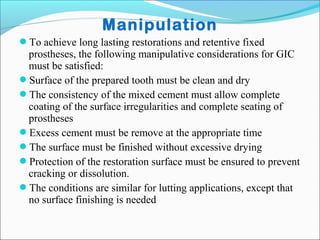
Manipulation
To achieve long lasting restorations and retentive fixed
prostheses, the following manipulative considerations for GIC
must be satisfied:
Surface of the prepared tooth must be clean and dry
The consistency of the mixed cement must allow complete
coating of the surface irregularities and complete seating of
prostheses
Excess cement must be remove at the appropriate time
The surface must be finished without excessive drying
Protection of the restoration surface must be ensured to prevent
cracking or dissolution.
The conditions are similar for lutting applications, except that
no surface finishing is needed
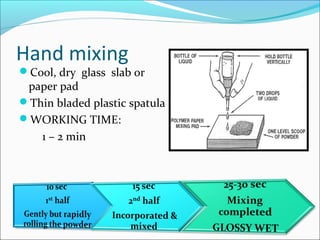
Hand mixing
Cool, dry glass slab or
paper pad
Thin bladed plastic spatula
WORKING TIME:
1 – 2 min
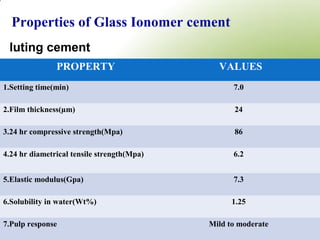
Properties of Glass Ionomer cement
luting cement
PROPERTY VALUES
1.Setting time(min) 7.0
2.Film thickness(µm) 24
3.24 hr compressive strength(Mpa) 86
4.24 hr diametrical tensile strength(Mpa) 6.2
5.Elastic modulus(Gpa) 7.3
6.Solubility in water(Wt%) 1.25
7.Pulp response Mild to moderate
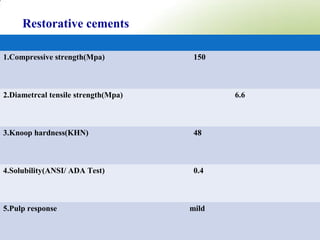
Restorative cements
1.Compressive strength(Mpa) 150
2.Diametrcal tensile strength(Mpa) 6.6
3.Knoop hardness(KHN) 48
4.Solubility(ANSI/ ADA Test) 0.4
5.Pulp response mild
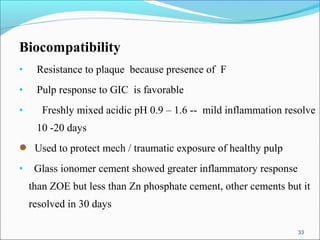
Biocompatibility
• Resistance to plaque because presence of F
• Pulp response to GIC is favorable
• Freshly mixed acidic pH 0.9 – 1.6 -- mild inflammation resolve
10 -20 days
 Used to protect mech / traumatic exposure of healthy pulp
• Glass ionomer cement showed greater inflammatory response
than ZOE but less than Zn phosphate cement, other cements but it
resolved in 30 days
33
Fluoride release
• The influence of fluoride action is seen of at least 3 mm
around the glass ionomer restoration
• Released for a sustained period of 18 months (Wilson et al
1985)
• Thickly mixed cements release more flouride than thinly
mixed ones.
• Fluoride release is restricted by sodium and to some extent by
calcium content and not the total fluoride content of the glass.
34
Thermal Properties:
• The thermal diffusivity value of GIC is close to that for dentin.
• The material has an adequate thermal insulating effect on the pulp
and helps to protect it from thermal trauma
Solubility & disintegration
 lower than ----Zn phosphate
 Zn polycarboxylate
 In water --- less than Silicate cement
 Resin-modified GIC is less resistant to solubility
35
• Compressive strength < silicate cement
• Tensile strength is higher than silicates
• Hardness < silicates
• Wear resistance < composites
ESTHETICS
• Glass ionomer cement has got a degree of translucency
because of its glass filler
• Unlike composite resins, glass ionomer cement will not be
affected by oral fluids
36
Durability
Affected by the factors
• Inadequate preparation of the cement
• Inadequate protection of restoration
• Variable conditions of mouth
Failure rate is more a measure of clinician’s skill than inherent quality
of the material
• One of the longest observation periods for the conventional glass
ionomers in non-carious cervical lesions showed retention in the order
of 90% after 10 yrs for KetacFil
37
Some other properties
• Low exothermic reaction
• Adheres chemically to the tooth structure
• Less shrinkage than polymerizing resins
• Dimensional stability at high humidity
• F release discourages microbial infiltration
• Early moisture sensitive --- requires protection
• Poor abrasion resistance
• Average esthetic
38
Working time & setting time
• It sets rapidly in the mouth that is within 3-5 min and
hardens to form a body having translucency that
matches enamel
• Setting time for type I –GIC – 5 -7 min
• Setting time for type II–GIC --10 min
• Film thickness should not exceed 20µm for luting
agents
39
Indications
• Restoring of erosion/ abrasion lesions without cavity
preparation.
• Sealing and filling of occlusal pits and fissures
• Restoration of deciduous teeth.
• Restoration of class III lesions, preferably using a lingual
approach with labial plate intact.
• Repair of defective margins in restorations
• Minimal cavity preparations – Approximal lesions, Buccal and
Occlusal approach (tunnel preparation)
• Core build-up
40
• Replacement of carious dentin the attachment of composite
resins using the acid etch technique
• Sealing and filling of occlusal fissures showing early signs
of caries.
• Fine grain versions of the glass ionomer Cements are used.
• Useful in patients with high caries index
41
Advantages
• Polymerisation shrinkage is less,due to reduced bulk of
composite.
• Favorable pulpal response.
• Chemical bond to the tooth.
• Anticariogenic property.
• Better strength,finishing,esthetics of overlying composite
resin.
• Microleakage is reduced
• Minimization of no. of composite increments,
therefore time is saved
42
Disadvantages
Brittle
Soluble
Abrasive
Water sensitive during setting phase.
Some products release less fluoride than conventional
GIC
Not inherently radiopaque though addition of
radiodense additives such as barium can alter
radiodensity
Less aesthetic than composite
GIC IN ENDODONTICS
They are used for:
• Sealing root canals
• Restoring pulp chamber
• Perforation repair
• Sometimes for repairing vertical fracture
GIC was used because of :
• Its capacity to bond which enhances seal & reinforce the tooth
• Its good bio compatibility, which would minimize irritation to
periradicular tissues
• Its F release, which imports an anti microbial effect to combat
root canal infection
44
Contraindications
• Class IV carious lesions or fractured incisors.
• Lesions involving large areas of labial enamel where
esthetics is of major importance
• class II carious lesions where conventional
cavities are prepared.
• replacement of existing amalgam restorations.
• Lost cusp areas.
45
46
Modifications of GIC
Water Hardening Cements / Anhydrous
Cements
 To solve the problems associated with the instability
of polyacrylic acid, copolymer of acids were
introduced which although stable in water might not
yield the best cements.
 Thus in 1973 Wilson and Kent described the use of
polyacrylic acid in dry form blended with Glass
powder. Liquid consisted of water or an aqueous
solution of tartaric acid.
 This was termed as ASPA V by Prosser et al 1984.
Advantages:
 Developed very low viscosity in early mixing stages.
 Rapid set at minimal temperature.
 Easy manipulation.
 Excellent shelf life.
47
The liquid component of the water-mixed cements is
distilled water or an aqueous solution of tartaric acid.
Products of this type include
 Chelon-Fil (3M ESPE)
and the nonencapsulated forms of Ketac-Cem (3M
ESPE) and Ketac-Bond (3M ESPE
48
METAL MODIFIED GIC
MIRACLE MIX / SILVER ALLOY ADMIX GIC
• Sced and Wilson in 1980 incorporated spherical
silver amalgam alloy into Type II GIC powder in
a ratio of 7:1
Powder
• Glass –17.5%
• Silver –82.5%
Particle size of silver is 3 – 4µm
Liquid
• Aqueous solution of copolymer of acrylic acid and
or maleic acid—37%
• Tartaric acid 9%
49
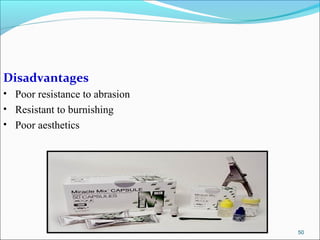
50
Disadvantages
• Poor resistance to abrasion
• Resistant to burnishing
• Poor aesthetics
Properties of Metal Modified GIC
The strength of miracle mix GIC is higher than that of
conventional GIC.
Increased flexural strength.
Increased resistance to abrasion.
Increased fracture resistance.
Low thermal conductivity.
Coefficient of thermal expansion same as dentine.
Decreased anticariogenic property due to decrease of fluorides.
Chemical adhesion to tooth surface.
51
GLASS CERMET
• Also called as cermet ionomer cements
• McLean and Gasser in 1985 first developed
• Fusing the glass powder to silver particles through sintering that can
be made to react with polyacid to form the cement
• Sintering is done at high pressure more than 300MPa and at a
temperature of 8000
C which is ground to fine powder particle size
of 3.5 µm
• 5%titanium dioxide is added to improve aesthetics
• It has excellent handling characteristics
52
Indications
• Core build –up material
• Root caps of teeth under over dentures
• class I cavities in primary teeth
• Preventive restoration
• Temporary posterior restoration
Contraindications
• Anterior restorations.
• Areas subjected to high occlusal loading
53
RESIN MODIFIED GLASS IONOMER CEMENTS
• Developed by Antonucci, Mc Kinney and SB Mitra.
• Addition of polymerizable resins to the formulation to import
additional curing process to the original acid base reactions.
Definition: RMGIC can be defined as a hybrid cement that sets via
an acid base reaction and partly via a photo- chemical
polymerization reaction.
Eg:Fuji II LC, Vitrebond, Photac –Fil, Vitremer, FujiV.
54
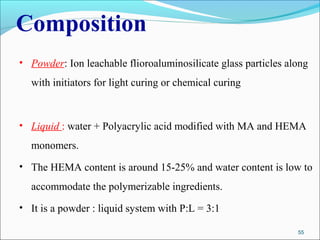
Composition
• Powder: Ion leachable flioroaluminosilicate glass particles along
with initiators for light curing or chemical curing
• Liquid : water + Polyacrylic acid modified with MA and HEMA
monomers.
• The HEMA content is around 15-25% and water content is low to
accommodate the polymerizable ingredients.
• It is a powder : liquid system with P:L = 3:1
55
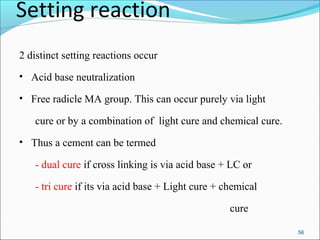
Setting reaction
2 distinct setting reactions occur
• Acid base neutralization
• Free radicle MA group. This can occur purely via light
cure or by a combination of light cure and chemical cure.
• Thus a cement can be termed
- dual cure if cross linking is via acid base + LC or
- tri cure if its via acid base + Light cure + chemical
cure
56
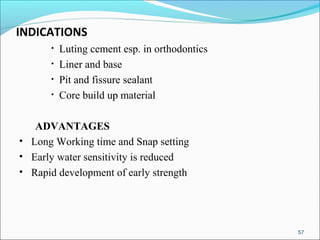
INDICATIONS
• Luting cement esp. in orthodontics
• Liner and base
• Pit and fissure sealant
• Core build up material
ADVANTAGES
• Long Working time and Snap setting
• Early water sensitivity is reduced
• Rapid development of early strength
57
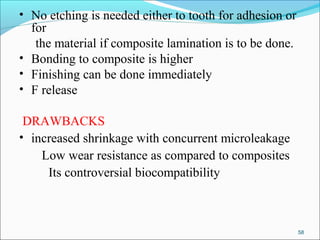
• No etching is needed either to tooth for adhesion or
for
the material if composite lamination is to be done.
• Bonding to composite is higher
• Finishing can be done immediately
• F release
DRAWBACKS
• increased shrinkage with concurrent microleakage
Low wear resistance as compared to composites
Its controversial biocompatibility
58
properties
• Esthetics: According to the Phillips’ science of dental
materials 12th
ed, there is a definite improvement in
translucency as the monomer brings the refractive index of
the liquid close to that of the glass particle.
• Fluoride release: is same as that of the conventional
but the lining version shows higher F release
• Strength: The diametrical tensile strength is much
higher but compressive strength and hardness is lesser.
59
• Adhesion: to tooth is reduced. This is expected because of
reduction in carboxylic acid in the liquid and interruption of
chemical bonding due to the resin matrix.
-Adhesion to composites is increased due to the presence of
residual non-polymerized functional groups within the
RMGIC
• Micro leakage: A higher degree of Microleakage is
seen due to polymerization shrinkage also due to reduced
water and carboxylic acid content and reduces its wetting
capacity
60
• Water sensitivity is considerably reduced.
• The biocompatibility is controversial and precautions
such as placing Ca (OH)2 in deep preparations should
be taken. The transient temp. rise during setting is also a concern.
61
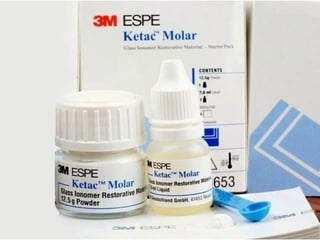
Packable (Condensable) GIC (Fuji IX GIC / Ketac
Molar)
This is a new high viscosity GIC launched in early 1990’s.
This material was developed largely as a need for filling
materials
These glass ionomers are particularly useful for ART.
ART refers to the restoration of teeth under conditions of
minimal instrumentation.
62
Advantages:
Packable and condensable.
Easy placement.
Non-sticky.
Early moisture sensitivity is reduced.
Rapid finishing can be carried out.
Improved wear resistance.
Solubility in oral fluids is very low
63
Indications:
Ideal material for molar restoration in deciduous teeth.
Core build up.
• As a final restorative material in class I and Class II primary
teeth
• restorative material for class I,II,III,IV cavities and cervical
erosion
• Final restorative material in permanent teeth in non stress
bearing areas 64
65
EFFECT OF WATER ON CEMENT
Dehydration of cement causes fissuring and cracking as
the water of hydration is lost.
Exposure of cement to saliva causes the surface to
soften as the vital cement forming ions are lost.
66
Moisture contamination:
Although at least some suggests that GICs are sensitive to
moisture contamination for up to 24 hours, others
recommend protecting them from moisture for 10 to 30
minutes after placement.
67
SURFACE CONDITIONING – As a mechanism of
bonding.
 This is an important step in promoting good adhesion of
glass ionomers.
 Treatment of surface was first introduced by Mclean and
Wilson in 1977 and they termed it as surface conditioning.
68
Purpose: Dentin conditioning prior to placement of a Type
II, III, or IV GIC is done primarily to remove the smear
layer.
This promotes stronger bonding for several reasons: by
removing the smear layer, the GIC is better able to wet the
dentin surface; the cement also bonds to dentin and not to
the smear layer.
69
Conditioning is also recommended because it promotes
ion exchange, chemically cleans the dentin, and increases
surface energy.
The goal is to remove the smear layer without removing
smear layer plugs from the dentin tubule orifices or
reducing bond strength through depletion of surface
ions.
70
Many practitioners use polyacrylic acid for dentin
conditioning. Either a 10% (GC Conditioner), 25%
(Ketac- Conditioner), or a 40% (Durelon liquid)
concentration can be used.
Many researchers recommend a passive 10-second
application of 10% polyacrylic acid, however a passive
10- to 15-second application of a polyacrylic acid solution
having a 10% to 25% concentration is acceptable.
71
Different acids used are:
10% citric acid.
3% hydrogen peroxide
Tannic acid 25%
10% EDTA
72
73
PART 2
Recent advancement in glass ionomer cements
Studies comparing Glass ionomer cement and other restorative materials
used in pediatric dentistry
74
CONTENT
Recent advances in
Glass ionomer cement
75
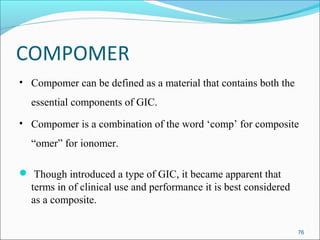
COMPOMER
• Compomer can be defined as a material that contains both the
essential components of GIC.
• Compomer is a combination of the word ‘comp’ for composite
“omer” for ionomer.
 Though introduced a type of GIC, it became apparent that
terms in of clinical use and performance it is best considered
as a composite.
76
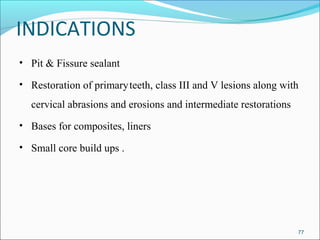
INDICATIONS
• Pit & Fissure sealant
• Restoration of primaryteeth, class III and V lesions along with
cervical abrasions and erosions and intermediate restorations
• Bases for composites, liners
• Small core build ups .
77
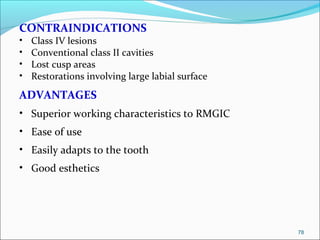
CONTRAINDICATIONS
• Class IV lesions
• Conventional class II cavities
• Lost cusp areas
• Restorations involving large labial surface
ADVANTAGES
• Superior working characteristics to RMGIC
• Ease of use
• Easily adapts to the tooth
• Good esthetics
78
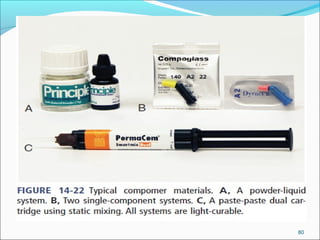
• Recently, a 2 component compomer is being marketed as a P: L
system or 2 paste system meant exclusively for luting.
• These are self adhesive due to the presence of water which starts
off the acid base reaction.
• The powder contains the glasses, fluoride & chemical / light
initiators .
• liquid contains the monomers, Poly acrylic acid, water . These set
via light chemical polymer as well acid base reaction.
79
80
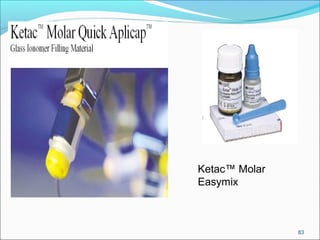
Condensable / Self hardening GIC Ketac Molar)
• This is a new high viscosity GIC launched in early 1990’s. This material
was developed largely as a need for filling materials in the atraumatic
restoration therapy “ART”. ART refers to the restoration of teeth under
conditions of minimal instrumentation’
• It is used mainly in paediatric dentistry for cementation of stainless
steel crowns,space maintainers, bands and brackets
81
• According to J Leirskar et al 2001, the high viscosity occurs to the
material by adding poly acrylic acid to the powder and finer
grain
size distribution.
ADVANTAGES
• Easy placement
• Non sticky
• Improved wear resistance
• Solubility in oral fluids is very low
82
83
Ketac™ Molar
Easymix
INDICATION
• As a final restorative material in class I and Class II primary teeth
• Restorative material for class I,II,III,IV cavities and cervical
erosion
• Final restorative material in permanent teeth in non stress bearing
areas
• Intermediate restorative material in class I and class II cavities
• Core build up material
• Fissure sealing material for permanent teeth
84
The low viscosity/flowable GIC
• For lining, pit and fissure sealing
• Endodontic sealers
• For sealing of hypersensitive cervical areas
• These had a low P:L ratio and possessed increase flow.
eg: Fuji lining LC, Fuji III and IV, Ketac – Endo.
85
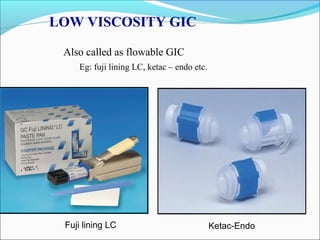
LOW VISCOSITY GIC
Also called as flowable GIC
Eg: fuji lining LC, ketac – endo etc.
Fuji lining LC Ketac-Endo
THE BIOACTIVE GLASS
• This idea was developed by Hench and co in 1973.
• It takes into account the fact that on acid dissolution
of glass, there is formation of a layer rich in Ca around the
glass such a glass can form intimate bioactive bonds with the
bone cells and get fully integrated with the bone.
87
It is being used experimentally as
• Bone cement
• Retrograde filling material
• For perforation repair
• Augmentation of alveolar ridges in edentulous ridges
• implant cementation
• Infra- bony pocket correction
88
FIBER REINFORCED GIC
• Incorporation of alumina fibres into the glass powder to
improve upon its flexural strength
• This technology called the Polymeric Rigid Inorganic Matrix
Material or PRIMM developed by Dr. Lars Ehrnsford
• It involves incorporation of a continuous network / scaffold of
alumina and SiO2 ceramic fibres
89
ADVANTAGES
• Due to the ceramic fibers there is increased depth of cure as light
conduction and penetration is enhanced.
• Polymerization shrinkage is reduced as resin is confined within the
chambers.
• There is also improved wear resistance Increase in flexural strength.
90
GIOMER
• Developed by Shofu
• Giomer is a fluoride-releasing, resin-based dental adhesive material that
comprises PRG fillers
• Giomer is a specialized restorative material which the properties of both glass
ionomer cement and composites
• The S-PRG technology not only provides the benefits of mechanical strength of a
composite material but also provides release of multiple ions i.e Sodium ions,
Silicate ions, Aluminium ions, Fluoride ions
91
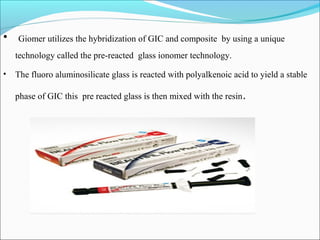
• Giomer utilizes the hybridization of GIC and composite by using a unique
technology called the pre-reacted glass ionomer technology.
• The fluoro aluminosilicate glass is reacted with polyalkenoic acid to yield a stable
phase of GIC this pre reacted glass is then mixed with the resin.
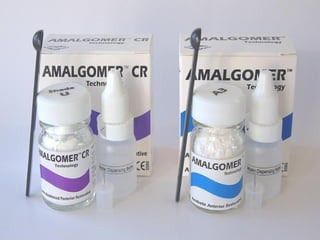
AMALGOMERS
• These are restoratives which are glass ionomer based but with
the strength of amalgam.
• They also provide F-
release, natural adhesion to tooth
structure, good compatibility and prevent shrinkage, corrosion
or thermal conductivity problems associated with other filling
materials
• They have been found to have exceptional wear
characteristics, along with other advantages of GIC
93
94
HAINOMERS
• These are newer bioactive materials developed by
incorporating hydroxyapatite within glass ionomer
powder.
• These are mainly being used as bone cements in oral
maxillofacial surgery and may a future role as retrograde
filling material.
• Studies have shown that they have a role in bonding
directly to bone and affect its growth and developement
95
CHLORHEXIDINE IMPREGNATED GIC
• To increase the anticariogenic action of GIC
• Still under experimental stage.
• Studies have revealed that the higher the concentration of CHX added to the
GIC, the greater the decrease in its physical-mechanical propertie.
• For clinical use of GIC with CHX, the best option is the addition of CHX at
a concentration of 0.5%, since this combination increased the antibacterial
activity without changing the physical-mechanical properties of the material
96
Smart Mat / F Charged Materials
The development of fluoride releasing material was made in
order to overcome the shortcomings faced by fluoride releasing
materials.
Increases the fluoride release more open is the structure of the
material. This is associated with low strength.
In order to improve the strength of these fluoride containing
materials, if they are made more dense and strong the efficiency
of ion release is reduced only after placement of restoration there
is a sudden burst of fluoride release followed by a rapid decline
in ion release rate.
97
Low pH smart materials
 The second approach is to optimize the efficacy of fluoride
materials.
 This material is based on the fact that fluoride should be
released at a low pH i.e. when caries attack may be most
threatening.
 Hence, these materials are developed to release fluoride at a
low oral pH. Hence termed as smart materials. Hence in these
fluorides is not released all the time the episodic release
prolongs the usefulness of the material.
98
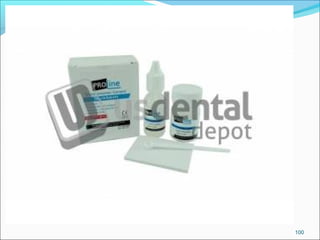
PROLINE CONTAINING GLASS IONOMER
CEMENT
• An amino acid-containing GIC had better surface
hardness properties than commercial Fuji IX GIC.
• This formulation of fast-set glass ionomer showed
increased water sorption without adversely affecting the
amount of fluoride release.
• Considering its biocompatibility, this material shows
promise not only as a dental restorative material but also
as a bone cement with low cytotoxicity
99
100
ZIRCONIA CONTAINING GIC
• Zirconia containing GIC – A potential substitute for miracle
mix.
• The tensile strength of zirconia containing GIC significantly
Greater than that of Miracle mix due to better bonding
Between the particles and matrix.
Scripta Materialia volume 52, issue 2. Y.W. Gu et
al.
101
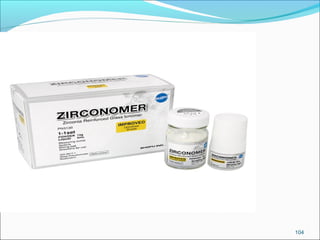
Zirconomer Benefits
 Reinforced with special zirconia fillers to match the
strength and durability of amalgam
Sustained high fluoride release for anti-cariogenic
benefits especially in cases with high caries risk
 Easy mixing and handling characteristics minimize
chair time and enables ease of bulk placement
 Excellent resistance to abrasion and erosion
Indications :
Class I and II restorations in deciduous teeth.
Class I and II Restorations in selected permanent
teeth
As a base under permanent restorationts.
In all classes of cavity where radiopacity is a prime
requirement.
Core Build Up.
Repair of Crown margin.
104
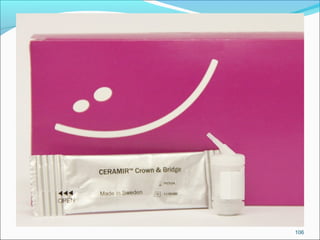
Calcium Aluminate GIC
• A hybrid product with a composition between that of calcium
aluminate and GIC, designed for luting fixed prostheses.
• The main ingredients in the powder of this hybrid cementare
calcium aluminate, polyacrylic acid, tartaric acid,strontium-
fluoro-alumino-glass, and strontium fluoride. The liquid
component contains 99.6% water and 0.4% additivesfor
controlling setting.
• The calcium aluminate contributes to a basic pH during curing,
reduction in microleakage, excellent biocompatibility, and long-
term stability and strength.
105
106
GIC WITH ANTIBIOTICS
According to Jainara Maria Soares Ferreira
Incorporation of low quantity antibiotics into glass ionomer
cement for use with ART approach.
When conventional GIC was added with 1.5, 3.0 and 4.5% of
ciprofloxacin, metronidazole and minocycline it was effective
for inhibiting S. Mutans
Braz. Dent. J. vol.24 no.1
 A GIC with antibiotics (metronidazole, ciprofloxacin,
cefaclor) was chosen because of good preliminary laboratory
results and its possible use for the treatment of caries in
primary teeth.
The combination of metronidazole, ciprofloxacin and cefaclor
with other dental materials has shown biocompatibility and an
antibacterial effect in laboratory.
NANO GIC
The incorporation of nanoparticles into glass powder of glass
ionomers led to wider particle size distribution, which resulted
in higher mechanical values.
 Consequently they can occupy the empty spaces between the
Glass ionomer particles and act as reinforcing material in the
composition of the glass ionomer cements.
 The nanofiller components of nano ionomers also enhance
some physical properties of the hardened restorative.
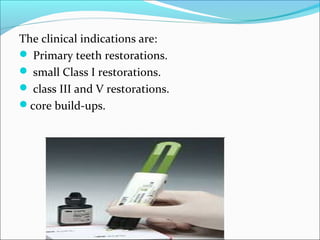
The clinical indications are:
 Primary teeth restorations.
 small Class I restorations.
 class III and V restorations.
core build-ups.
“STUDIES COMPARING WITHIN
GIC’S AND OTHER RESTORATIVE
MATERIALS USED IN PEDIATRIC
DENTISTRY”
111
S. Hubel (2003) conducted a study on Conventional versus
resin-modified glass-ionomer cement for Class II restorations
in primary molars. A 3-year clinical study. It was concluded
that The resin-modified GICs offered advantages over the
conventional GICs for restoring approximal caries in primary
molars. The risk of a failed restoration with Fuji II was more
than five times higher than with Vitremer. For both types of
GICs, loss of retention and secondary caries were the main
reasons for failure.
International Journal of Paediatric Dentistry 2003; 13: 2–8
Oba AA et al.(2009) conducted a study on comparison of
caries prevention with glass ionomer and composite resin
fissure sealants. It was concluded that under field conditions in
which moisture control was not effective, a high-viscosity and
less technique-sensitive glass ionomer material can be used as
an effective sealant material, rather than resin.
Journal of the Formosan Medical Association
Volume 108, Issue 11, November 2009, Pages 844-848
113
Aykut-Yetkiner A. et al (2014) conducted a study on
comparison of the remineralisation effect of a glass ionomer
cement versus a resin composite on dentin of primary teeth .It
was concluded that GIC resulted to be a better restorative
material for the remineralization of caries affected dentin. The
GIC restored primary molar dentin had a higher level of
remineralization and GIC could be the material of choice in
pediatric dentistry.
European Journal of Paediatric Dentistry vol. 15/2-
2014
115
 Ruchika Bansal (2015)conducted a study on A Comparative
Evaluation of the Amount of Fluoride Release and Re-Release after
Recharging from Aesthetic Restorative Materials: An in vitro
Study .It was concluded that, the initial Fluoride release was highest
from Conventional GIC followed by Resin Modified GIC, Giomer
and Compomer. Conventional GIC had a greater recharging ability
followed by Resin Modified GIC, Giomer and Compomer.
Journal of Clinical and Diagnostic Research. 2015 Aug, Vol-9(8)
Ayesha Sabeen Mufti (2016) conducted a study on clinical
efficacy of the conventional glass ionomer cement and resin
modified glass ionomer cement in primary molars.It was
concluded that use of resin modified glass ionomer cured by
chargeable curing lights in primary molars can provide a good
alternative to conventional gic, may have slight edge of better
restoration survival rates and may be a factor for caries control
in our population.
J Ayub Med Coll Abbottabad 2014;26(4)
Shipra et al (2016) conducted a study on Comparative evaluation
of compressive strength, diametral tensile strength and shear bond
strength of GIC type IX, chlorhexidine-incorporated GIC and
triclosan-incorporated GIC: An in vitro study.It was concluded
that the compressive strength, tensile strength, and shear bond
strength of 0.5% triclosan-glass ionomer cement and 0.5%
chlorhexidine-glass ionomer cement were similar to those of the
glass ionomer cement type IX, signifying that these can be
considered as viable options for use in pediatric dentistry with the
additional value of antimicrobial property along with physical
properties within the higher acceptable range.
J Int Soc Prev Community Dent. 2016 Apr; 6(Suppl 1): S64–S69.
Summary and
conclusion
Many years have passed by since the glass ionomer
cement was first invented and it has been a popular
material from the time it was introduced into the
market.
Even though the stronger and more esthetic materials
were available, glass ionomer restorations still
remained the choice of many practitioners because
they satisfy many of the characteristics of ideal
cement.
Proper use of these materials with proper
understanding of the clinical limitation of these
materials can give best results.
Prediction is that glass ionomer cements will be the
material of choice in the future.
121
References
• Glass ionomer cement by Alan D.Wilson and John W. Mclean
• Ramya Raghu clinical operative dentistry 2nd
edition
• Philips science of dental materials 12th
edition
• Nikhil Marvah Textbook Pediatric Dentistry3rd
edition
• Sturdvent’s Art and science of operative dentistry, Fifth edition
• Craig’s Restorative dental materials, Twelfth edition
Glass ionomer cement

Glass ionomer cement

  • 1.
  • 2.
    PRESENTATION BY UNDERTHE GUIDANCE Dr. JAYESH TIWARI Dr. KIRTI PATTANASHETTY PG 1ST YEAR READER GLASS IONOMER CEMENT MAITRI COLLEGE OF DENTISTRY AND RESEARCH CENTRE DEPARTMENT OF PEDODONTICS AND PREVENTIVE DENTISTRY
  • 3.
    CONTENT PART 1 INTRODUCTION HISTORY ANDDEVELOPMENT CLASSIFICATIONS  COMPOSITION SETTING REACTION OF GIC MANIPULATION PROPERTIES OF GLASS IONOMER CEMENT WORKING TIME & SETTING TIME ADVANTAGES DISADVANTAGES,INDICATIONS ,CONTRAINDICATIONS MODIFICATIONS OF GIC EFFECT OF WATER ON CEMENT SURFACE CONDITIONING 3
  • 4.
    PART 2 Recent advancementin glass ionomer cements Studies comparing gic and other restorative materials used in pediatric dentistry 4
  • 5.
    INTRODUCTION DEFINITION OF CEMENT Acement is a substance that hardens to act as a base , liner , filling material or adhesive to bind devices or prosthesis to the tooth structure or to each other. - PHILIPS’ SCIENCE OF DENTAL MATERIALS (12th ed) • Glass ionomer cement is a water based cement. • ADA specification number: 96 5
  • 6.
    Glass-ionomer is thegeneric name of a group of materials that use silicate glass powder and aqueous solution of polyacrylic acid” -Kenneth J Anusavice. • Glass ionomer-term coined by wilson & kent glass-alumino silicate glass particles ionomer-poly carboxylic acid. The glass-ionomer family of restorative materials has evolved during the past 30 years into a diverse group of products that includes direct restoratives, luting agents, liners, and bases, as well as pit and fissure sealants, all available in both the conventional and resin-modified varieties . 6
  • 7.
  • 8.
    Frst announced byWilson and Kent in 1972. First marketed in Europe in 1975 and became available in the United States in 1977. The first commercial glass ionomer was made by the De Trey Company and distributed by the Amalgamated Dental Co in England and by Caulk in the United States. In 1960 and 1966, in their early research A.D. Wilson examined cements prepared by mixing silicate glass powder with aqueous solutions of various organic acids, including polyacrylic acid. 8
  • 9.
    The first GIChave lacked workability and hardened slowly. Eventually Kent et al, (1973, 1979) found a glass that was high in fluorides (G-200) which was termed as ASPA-I (Aluminosilicates polyacrylates). In 1972 Wilson and Crisp discovered that tartaric acid modified the cement forming reaction thus: Improving manipulation. Extended working time. Increased setting rate. This refinement of ASPA-I was termed as ASPA II which was the first practically used GIC and was used mainly for Class III restorations. 9
  • 10.
  • 11.
    CLASSIFICATION ACCORDING TO SKINNERS TypeI – Luting Type II- Restorative Type III- Liner and base
  • 12.
    12 ACCORDING TO MCLEAN, NICHOLSON AND WILSON (1994): 1. Glass ionomer cement a. Glass polyalkeonates b. Glass polyphosphonates 2. Resin modified GIC 3. Polyacid modified GIC
  • 13.
    Classification of GICsBased on Use (Wilson McLean) Type I Luting cements which contain glass particles from 13 to 19 microns in diameter.  Powder-to-liquid ratio is approximately 1.5:1. Type II Restorative cements which contain glass particles up to 50 microns in diameter. Powder-to-liquid ratio is approximately 3:1. The Type II products also include the metal added glass ionomers. Type III Chemically-set liners/bases or pit and fissure forms. Type IV Visible light-activated liners/bases. 13
  • 14.
    According to Sturdvent: 1.Traditional or conventional 2. Metal modified GIC a. Cermets b. Miracle mix 3. Light cured GIC 4. Hybrid (Resin modified GIC) 5. Polyacid modified resin composite or Compomer
  • 15.
    According to clinicaluse as: Type I – luting Type II– restorative Type III– liner / base Type IV– pit & fissure sealant Type V– luting for orthodontic purpose Type VI– core build up material Type VII– high fluoride releasing command set Type VIII– ART Type IX- paediatric GIC
  • 16.
    According to GJMount: 1. Glass ionomer cements a. (i) Glass polyalkeonates (ii) Glass polyphonates b. Resin modified GIC c. Polyacid modified composite resin 2. a. Auto-cure b. Dual cure c. Tri cure 3. a. Type I – Luting b. Type II - Restorative Type II. 1. Restorative aesthetic Type II. 2. Restorative reinforced c. Type III- Lining or Base
  • 17.
  • 18.
    General Composition Powder Silica (SiO2)--- 29% Alumina (Al2O3) --- 16.6% Aluminium Fluoride ( AlF3) --- 5.3% Calcium Fluoride (CaF2) ---34.2% Sod AluminumFluoride (Na3ALF6) ---5% Aluminium phosphate (AlPO4) --- 9.9% Lanthum ; Strontium ; Barium ; ZnO --- radioopacity 18
  • 19.
    • LIQUID • Polyacrylicacid --- 45 % • Water --- 50 % • Modifiers Itaconic acid --- 05 %  maleic acid  tricarballylic acid • Tartaric acid --- Working Time & setting time. 19
  • 20.
    • ROLE OFCOMPONENTS IN POWDER Al2O3 • Increase opacity. • Forms the skeletal structure. SiO2 Increases translucancy CaF2- Reduces the temperature at which the glass will fuse. Increases the translucency of the set cement. 20
  • 21.
    • Fluoride isan essential constituent which  - Lowers fusion temp.  - improves working characteristics & strength  - improves translucency  - improves therapeutic value of the cement by  releasing fluoride over a prolonged period AlPO4 –Improves translucency. • Decrease melting temperature 21
  • 22.
    • The liquidis an aqueous solution of polymers and copolymers of acrylic acid. • In most of the current cements,the acid in the form of a coploymer with itaconic ,maleic ,or tricarboxylic acids. Polyacrylic acid- The most important acid contributing to formation of the cement matrix. . 22
  • 23.
    Maleic acid • Astronger acid than polyacrylic acid • Causes the cement to harden and lose its moisture sensitivity faster. Water- • It is reaction medium. • It is essential part of the cement structure. If water is lost from the cement by desiccation while it is setting, the cement-forming reactions will stop 23
  • 24.
    ITACONIC ACID • Itaconicacid promotes reactivity between the glass and the liquid. • It also prevents gelation of the liquid which can result from hydrogen bonding between two polyacrylic acid chains Tartaric acid • It controls the PH of the set cement during setting process, which in turn controls the rate of dissolution of the glass. • It typically increases the working time 24
  • 25.
    Setting reaction ofGic Surface of GI particles is attacked with H+ ion of acid+ ion of acid Acid soluble glass is attacked by the polyacids releasing ca++,AL++,NA+ and F Initially calcium,and later,aluminium replaces the hydrogens on the carboxyl groups of the polyacids to make calcium and alumium polysalts
  • 26.
    CONTINUE Acids attacks Ca-richsites and metal ions migrate into aqueous phase of cement towards polyacrylic acid chains Chains get cross-linked leading to formation of calcium polyacrylate and gelation The salt hydarte to form a gel matrix while the unreacted portion of the glass particles are surrounded by silica get that arises from the loss of the surface cations The set cement consists of unreacted glass surrounded by silica get bound together by a matrix of hydrated calcium and aluminium polysalts Na+ ion replaces H- ion of carboxylic group whereas remaining form NaF ,F ion thus lie free within the matrix and are able to conduct fluoride release
  • 27.
    Setting reaction Acid attacksthe surface of glass particle Ca, Al, Na, Fl, are leached Into the aqueous medium in the form of complexes
  • 29.
    Manipulation To achieve longlasting restorations and retentive fixed prostheses, the following manipulative considerations for GIC must be satisfied: Surface of the prepared tooth must be clean and dry The consistency of the mixed cement must allow complete coating of the surface irregularities and complete seating of prostheses Excess cement must be remove at the appropriate time The surface must be finished without excessive drying Protection of the restoration surface must be ensured to prevent cracking or dissolution. The conditions are similar for lutting applications, except that no surface finishing is needed
  • 30.
    Hand mixing Cool, dryglass slab or paper pad Thin bladed plastic spatula WORKING TIME: 1 – 2 min
  • 31.
    Properties of GlassIonomer cement luting cement PROPERTY VALUES 1.Setting time(min) 7.0 2.Film thickness(µm) 24 3.24 hr compressive strength(Mpa) 86 4.24 hr diametrical tensile strength(Mpa) 6.2 5.Elastic modulus(Gpa) 7.3 6.Solubility in water(Wt%) 1.25 7.Pulp response Mild to moderate
  • 32.
    Restorative cements 1.Compressive strength(Mpa)150 2.Diametrcal tensile strength(Mpa) 6.6 3.Knoop hardness(KHN) 48 4.Solubility(ANSI/ ADA Test) 0.4 5.Pulp response mild
  • 33.
    Biocompatibility • Resistance toplaque because presence of F • Pulp response to GIC is favorable • Freshly mixed acidic pH 0.9 – 1.6 -- mild inflammation resolve 10 -20 days  Used to protect mech / traumatic exposure of healthy pulp • Glass ionomer cement showed greater inflammatory response than ZOE but less than Zn phosphate cement, other cements but it resolved in 30 days 33
  • 34.
    Fluoride release • Theinfluence of fluoride action is seen of at least 3 mm around the glass ionomer restoration • Released for a sustained period of 18 months (Wilson et al 1985) • Thickly mixed cements release more flouride than thinly mixed ones. • Fluoride release is restricted by sodium and to some extent by calcium content and not the total fluoride content of the glass. 34
  • 35.
    Thermal Properties: • Thethermal diffusivity value of GIC is close to that for dentin. • The material has an adequate thermal insulating effect on the pulp and helps to protect it from thermal trauma Solubility & disintegration  lower than ----Zn phosphate  Zn polycarboxylate  In water --- less than Silicate cement  Resin-modified GIC is less resistant to solubility 35
  • 36.
    • Compressive strength< silicate cement • Tensile strength is higher than silicates • Hardness < silicates • Wear resistance < composites ESTHETICS • Glass ionomer cement has got a degree of translucency because of its glass filler • Unlike composite resins, glass ionomer cement will not be affected by oral fluids 36
  • 37.
    Durability Affected by thefactors • Inadequate preparation of the cement • Inadequate protection of restoration • Variable conditions of mouth Failure rate is more a measure of clinician’s skill than inherent quality of the material • One of the longest observation periods for the conventional glass ionomers in non-carious cervical lesions showed retention in the order of 90% after 10 yrs for KetacFil 37
  • 38.
    Some other properties •Low exothermic reaction • Adheres chemically to the tooth structure • Less shrinkage than polymerizing resins • Dimensional stability at high humidity • F release discourages microbial infiltration • Early moisture sensitive --- requires protection • Poor abrasion resistance • Average esthetic 38
  • 39.
    Working time &setting time • It sets rapidly in the mouth that is within 3-5 min and hardens to form a body having translucency that matches enamel • Setting time for type I –GIC – 5 -7 min • Setting time for type II–GIC --10 min • Film thickness should not exceed 20µm for luting agents 39
  • 40.
    Indications • Restoring oferosion/ abrasion lesions without cavity preparation. • Sealing and filling of occlusal pits and fissures • Restoration of deciduous teeth. • Restoration of class III lesions, preferably using a lingual approach with labial plate intact. • Repair of defective margins in restorations • Minimal cavity preparations – Approximal lesions, Buccal and Occlusal approach (tunnel preparation) • Core build-up 40
  • 41.
    • Replacement ofcarious dentin the attachment of composite resins using the acid etch technique • Sealing and filling of occlusal fissures showing early signs of caries. • Fine grain versions of the glass ionomer Cements are used. • Useful in patients with high caries index 41
  • 42.
    Advantages • Polymerisation shrinkageis less,due to reduced bulk of composite. • Favorable pulpal response. • Chemical bond to the tooth. • Anticariogenic property. • Better strength,finishing,esthetics of overlying composite resin. • Microleakage is reduced • Minimization of no. of composite increments, therefore time is saved 42
  • 43.
    Disadvantages Brittle Soluble Abrasive Water sensitive duringsetting phase. Some products release less fluoride than conventional GIC Not inherently radiopaque though addition of radiodense additives such as barium can alter radiodensity Less aesthetic than composite
  • 44.
    GIC IN ENDODONTICS Theyare used for: • Sealing root canals • Restoring pulp chamber • Perforation repair • Sometimes for repairing vertical fracture GIC was used because of : • Its capacity to bond which enhances seal & reinforce the tooth • Its good bio compatibility, which would minimize irritation to periradicular tissues • Its F release, which imports an anti microbial effect to combat root canal infection 44
  • 45.
    Contraindications • Class IVcarious lesions or fractured incisors. • Lesions involving large areas of labial enamel where esthetics is of major importance • class II carious lesions where conventional cavities are prepared. • replacement of existing amalgam restorations. • Lost cusp areas. 45
  • 46.
  • 47.
    Water Hardening Cements/ Anhydrous Cements  To solve the problems associated with the instability of polyacrylic acid, copolymer of acids were introduced which although stable in water might not yield the best cements.  Thus in 1973 Wilson and Kent described the use of polyacrylic acid in dry form blended with Glass powder. Liquid consisted of water or an aqueous solution of tartaric acid.  This was termed as ASPA V by Prosser et al 1984. Advantages:  Developed very low viscosity in early mixing stages.  Rapid set at minimal temperature.  Easy manipulation.  Excellent shelf life. 47
  • 48.
    The liquid componentof the water-mixed cements is distilled water or an aqueous solution of tartaric acid. Products of this type include  Chelon-Fil (3M ESPE) and the nonencapsulated forms of Ketac-Cem (3M ESPE) and Ketac-Bond (3M ESPE 48
  • 49.
    METAL MODIFIED GIC MIRACLEMIX / SILVER ALLOY ADMIX GIC • Sced and Wilson in 1980 incorporated spherical silver amalgam alloy into Type II GIC powder in a ratio of 7:1 Powder • Glass –17.5% • Silver –82.5% Particle size of silver is 3 – 4µm Liquid • Aqueous solution of copolymer of acrylic acid and or maleic acid—37% • Tartaric acid 9% 49
  • 50.
    50 Disadvantages • Poor resistanceto abrasion • Resistant to burnishing • Poor aesthetics
  • 51.
    Properties of MetalModified GIC The strength of miracle mix GIC is higher than that of conventional GIC. Increased flexural strength. Increased resistance to abrasion. Increased fracture resistance. Low thermal conductivity. Coefficient of thermal expansion same as dentine. Decreased anticariogenic property due to decrease of fluorides. Chemical adhesion to tooth surface. 51
  • 52.
    GLASS CERMET • Alsocalled as cermet ionomer cements • McLean and Gasser in 1985 first developed • Fusing the glass powder to silver particles through sintering that can be made to react with polyacid to form the cement • Sintering is done at high pressure more than 300MPa and at a temperature of 8000 C which is ground to fine powder particle size of 3.5 µm • 5%titanium dioxide is added to improve aesthetics • It has excellent handling characteristics 52
  • 53.
    Indications • Core build–up material • Root caps of teeth under over dentures • class I cavities in primary teeth • Preventive restoration • Temporary posterior restoration Contraindications • Anterior restorations. • Areas subjected to high occlusal loading 53
  • 54.
    RESIN MODIFIED GLASSIONOMER CEMENTS • Developed by Antonucci, Mc Kinney and SB Mitra. • Addition of polymerizable resins to the formulation to import additional curing process to the original acid base reactions. Definition: RMGIC can be defined as a hybrid cement that sets via an acid base reaction and partly via a photo- chemical polymerization reaction. Eg:Fuji II LC, Vitrebond, Photac –Fil, Vitremer, FujiV. 54
  • 55.
    Composition • Powder: Ionleachable flioroaluminosilicate glass particles along with initiators for light curing or chemical curing • Liquid : water + Polyacrylic acid modified with MA and HEMA monomers. • The HEMA content is around 15-25% and water content is low to accommodate the polymerizable ingredients. • It is a powder : liquid system with P:L = 3:1 55
  • 56.
    Setting reaction 2 distinctsetting reactions occur • Acid base neutralization • Free radicle MA group. This can occur purely via light cure or by a combination of light cure and chemical cure. • Thus a cement can be termed - dual cure if cross linking is via acid base + LC or - tri cure if its via acid base + Light cure + chemical cure 56
  • 57.
    INDICATIONS • Luting cementesp. in orthodontics • Liner and base • Pit and fissure sealant • Core build up material ADVANTAGES • Long Working time and Snap setting • Early water sensitivity is reduced • Rapid development of early strength 57
  • 58.
    • No etchingis needed either to tooth for adhesion or for the material if composite lamination is to be done. • Bonding to composite is higher • Finishing can be done immediately • F release DRAWBACKS • increased shrinkage with concurrent microleakage Low wear resistance as compared to composites Its controversial biocompatibility 58
  • 59.
    properties • Esthetics: Accordingto the Phillips’ science of dental materials 12th ed, there is a definite improvement in translucency as the monomer brings the refractive index of the liquid close to that of the glass particle. • Fluoride release: is same as that of the conventional but the lining version shows higher F release • Strength: The diametrical tensile strength is much higher but compressive strength and hardness is lesser. 59
  • 60.
    • Adhesion: totooth is reduced. This is expected because of reduction in carboxylic acid in the liquid and interruption of chemical bonding due to the resin matrix. -Adhesion to composites is increased due to the presence of residual non-polymerized functional groups within the RMGIC • Micro leakage: A higher degree of Microleakage is seen due to polymerization shrinkage also due to reduced water and carboxylic acid content and reduces its wetting capacity 60
  • 61.
    • Water sensitivityis considerably reduced. • The biocompatibility is controversial and precautions such as placing Ca (OH)2 in deep preparations should be taken. The transient temp. rise during setting is also a concern. 61
  • 62.
    Packable (Condensable) GIC(Fuji IX GIC / Ketac Molar) This is a new high viscosity GIC launched in early 1990’s. This material was developed largely as a need for filling materials These glass ionomers are particularly useful for ART. ART refers to the restoration of teeth under conditions of minimal instrumentation. 62
  • 63.
    Advantages: Packable and condensable. Easyplacement. Non-sticky. Early moisture sensitivity is reduced. Rapid finishing can be carried out. Improved wear resistance. Solubility in oral fluids is very low 63
  • 64.
    Indications: Ideal material formolar restoration in deciduous teeth. Core build up. • As a final restorative material in class I and Class II primary teeth • restorative material for class I,II,III,IV cavities and cervical erosion • Final restorative material in permanent teeth in non stress bearing areas 64
  • 65.
  • 66.
    EFFECT OF WATERON CEMENT Dehydration of cement causes fissuring and cracking as the water of hydration is lost. Exposure of cement to saliva causes the surface to soften as the vital cement forming ions are lost. 66
  • 67.
    Moisture contamination: Although atleast some suggests that GICs are sensitive to moisture contamination for up to 24 hours, others recommend protecting them from moisture for 10 to 30 minutes after placement. 67
  • 68.
    SURFACE CONDITIONING –As a mechanism of bonding.  This is an important step in promoting good adhesion of glass ionomers.  Treatment of surface was first introduced by Mclean and Wilson in 1977 and they termed it as surface conditioning. 68
  • 69.
    Purpose: Dentin conditioningprior to placement of a Type II, III, or IV GIC is done primarily to remove the smear layer. This promotes stronger bonding for several reasons: by removing the smear layer, the GIC is better able to wet the dentin surface; the cement also bonds to dentin and not to the smear layer. 69
  • 70.
    Conditioning is alsorecommended because it promotes ion exchange, chemically cleans the dentin, and increases surface energy. The goal is to remove the smear layer without removing smear layer plugs from the dentin tubule orifices or reducing bond strength through depletion of surface ions. 70
  • 71.
    Many practitioners usepolyacrylic acid for dentin conditioning. Either a 10% (GC Conditioner), 25% (Ketac- Conditioner), or a 40% (Durelon liquid) concentration can be used. Many researchers recommend a passive 10-second application of 10% polyacrylic acid, however a passive 10- to 15-second application of a polyacrylic acid solution having a 10% to 25% concentration is acceptable. 71
  • 72.
    Different acids usedare: 10% citric acid. 3% hydrogen peroxide Tannic acid 25% 10% EDTA 72
  • 73.
  • 74.
    PART 2 Recent advancementin glass ionomer cements Studies comparing Glass ionomer cement and other restorative materials used in pediatric dentistry 74 CONTENT
  • 75.
    Recent advances in Glassionomer cement 75
  • 76.
    COMPOMER • Compomer canbe defined as a material that contains both the essential components of GIC. • Compomer is a combination of the word ‘comp’ for composite “omer” for ionomer.  Though introduced a type of GIC, it became apparent that terms in of clinical use and performance it is best considered as a composite. 76
  • 77.
    INDICATIONS • Pit &Fissure sealant • Restoration of primaryteeth, class III and V lesions along with cervical abrasions and erosions and intermediate restorations • Bases for composites, liners • Small core build ups . 77
  • 78.
    CONTRAINDICATIONS • Class IVlesions • Conventional class II cavities • Lost cusp areas • Restorations involving large labial surface ADVANTAGES • Superior working characteristics to RMGIC • Ease of use • Easily adapts to the tooth • Good esthetics 78
  • 79.
    • Recently, a2 component compomer is being marketed as a P: L system or 2 paste system meant exclusively for luting. • These are self adhesive due to the presence of water which starts off the acid base reaction. • The powder contains the glasses, fluoride & chemical / light initiators . • liquid contains the monomers, Poly acrylic acid, water . These set via light chemical polymer as well acid base reaction. 79
  • 80.
  • 81.
    Condensable / Selfhardening GIC Ketac Molar) • This is a new high viscosity GIC launched in early 1990’s. This material was developed largely as a need for filling materials in the atraumatic restoration therapy “ART”. ART refers to the restoration of teeth under conditions of minimal instrumentation’ • It is used mainly in paediatric dentistry for cementation of stainless steel crowns,space maintainers, bands and brackets 81
  • 82.
    • According toJ Leirskar et al 2001, the high viscosity occurs to the material by adding poly acrylic acid to the powder and finer grain size distribution. ADVANTAGES • Easy placement • Non sticky • Improved wear resistance • Solubility in oral fluids is very low 82
  • 83.
  • 84.
    INDICATION • As afinal restorative material in class I and Class II primary teeth • Restorative material for class I,II,III,IV cavities and cervical erosion • Final restorative material in permanent teeth in non stress bearing areas • Intermediate restorative material in class I and class II cavities • Core build up material • Fissure sealing material for permanent teeth 84
  • 85.
    The low viscosity/flowableGIC • For lining, pit and fissure sealing • Endodontic sealers • For sealing of hypersensitive cervical areas • These had a low P:L ratio and possessed increase flow. eg: Fuji lining LC, Fuji III and IV, Ketac – Endo. 85
  • 86.
    LOW VISCOSITY GIC Alsocalled as flowable GIC Eg: fuji lining LC, ketac – endo etc. Fuji lining LC Ketac-Endo
  • 87.
    THE BIOACTIVE GLASS •This idea was developed by Hench and co in 1973. • It takes into account the fact that on acid dissolution of glass, there is formation of a layer rich in Ca around the glass such a glass can form intimate bioactive bonds with the bone cells and get fully integrated with the bone. 87
  • 88.
    It is beingused experimentally as • Bone cement • Retrograde filling material • For perforation repair • Augmentation of alveolar ridges in edentulous ridges • implant cementation • Infra- bony pocket correction 88
  • 89.
    FIBER REINFORCED GIC •Incorporation of alumina fibres into the glass powder to improve upon its flexural strength • This technology called the Polymeric Rigid Inorganic Matrix Material or PRIMM developed by Dr. Lars Ehrnsford • It involves incorporation of a continuous network / scaffold of alumina and SiO2 ceramic fibres 89
  • 90.
    ADVANTAGES • Due tothe ceramic fibers there is increased depth of cure as light conduction and penetration is enhanced. • Polymerization shrinkage is reduced as resin is confined within the chambers. • There is also improved wear resistance Increase in flexural strength. 90
  • 91.
    GIOMER • Developed byShofu • Giomer is a fluoride-releasing, resin-based dental adhesive material that comprises PRG fillers • Giomer is a specialized restorative material which the properties of both glass ionomer cement and composites • The S-PRG technology not only provides the benefits of mechanical strength of a composite material but also provides release of multiple ions i.e Sodium ions, Silicate ions, Aluminium ions, Fluoride ions 91
  • 92.
    • Giomer utilizesthe hybridization of GIC and composite by using a unique technology called the pre-reacted glass ionomer technology. • The fluoro aluminosilicate glass is reacted with polyalkenoic acid to yield a stable phase of GIC this pre reacted glass is then mixed with the resin.
  • 93.
    AMALGOMERS • These arerestoratives which are glass ionomer based but with the strength of amalgam. • They also provide F- release, natural adhesion to tooth structure, good compatibility and prevent shrinkage, corrosion or thermal conductivity problems associated with other filling materials • They have been found to have exceptional wear characteristics, along with other advantages of GIC 93
  • 94.
  • 95.
    HAINOMERS • These arenewer bioactive materials developed by incorporating hydroxyapatite within glass ionomer powder. • These are mainly being used as bone cements in oral maxillofacial surgery and may a future role as retrograde filling material. • Studies have shown that they have a role in bonding directly to bone and affect its growth and developement 95
  • 96.
    CHLORHEXIDINE IMPREGNATED GIC •To increase the anticariogenic action of GIC • Still under experimental stage. • Studies have revealed that the higher the concentration of CHX added to the GIC, the greater the decrease in its physical-mechanical propertie. • For clinical use of GIC with CHX, the best option is the addition of CHX at a concentration of 0.5%, since this combination increased the antibacterial activity without changing the physical-mechanical properties of the material 96
  • 97.
    Smart Mat /F Charged Materials The development of fluoride releasing material was made in order to overcome the shortcomings faced by fluoride releasing materials. Increases the fluoride release more open is the structure of the material. This is associated with low strength. In order to improve the strength of these fluoride containing materials, if they are made more dense and strong the efficiency of ion release is reduced only after placement of restoration there is a sudden burst of fluoride release followed by a rapid decline in ion release rate. 97
  • 98.
    Low pH smartmaterials  The second approach is to optimize the efficacy of fluoride materials.  This material is based on the fact that fluoride should be released at a low pH i.e. when caries attack may be most threatening.  Hence, these materials are developed to release fluoride at a low oral pH. Hence termed as smart materials. Hence in these fluorides is not released all the time the episodic release prolongs the usefulness of the material. 98
  • 99.
    PROLINE CONTAINING GLASSIONOMER CEMENT • An amino acid-containing GIC had better surface hardness properties than commercial Fuji IX GIC. • This formulation of fast-set glass ionomer showed increased water sorption without adversely affecting the amount of fluoride release. • Considering its biocompatibility, this material shows promise not only as a dental restorative material but also as a bone cement with low cytotoxicity 99
  • 100.
  • 101.
    ZIRCONIA CONTAINING GIC •Zirconia containing GIC – A potential substitute for miracle mix. • The tensile strength of zirconia containing GIC significantly Greater than that of Miracle mix due to better bonding Between the particles and matrix. Scripta Materialia volume 52, issue 2. Y.W. Gu et al. 101
  • 102.
    Zirconomer Benefits  Reinforcedwith special zirconia fillers to match the strength and durability of amalgam Sustained high fluoride release for anti-cariogenic benefits especially in cases with high caries risk  Easy mixing and handling characteristics minimize chair time and enables ease of bulk placement  Excellent resistance to abrasion and erosion
  • 103.
    Indications : Class Iand II restorations in deciduous teeth. Class I and II Restorations in selected permanent teeth As a base under permanent restorationts. In all classes of cavity where radiopacity is a prime requirement. Core Build Up. Repair of Crown margin.
  • 104.
  • 105.
    Calcium Aluminate GIC •A hybrid product with a composition between that of calcium aluminate and GIC, designed for luting fixed prostheses. • The main ingredients in the powder of this hybrid cementare calcium aluminate, polyacrylic acid, tartaric acid,strontium- fluoro-alumino-glass, and strontium fluoride. The liquid component contains 99.6% water and 0.4% additivesfor controlling setting. • The calcium aluminate contributes to a basic pH during curing, reduction in microleakage, excellent biocompatibility, and long- term stability and strength. 105
  • 106.
  • 107.
    GIC WITH ANTIBIOTICS Accordingto Jainara Maria Soares Ferreira Incorporation of low quantity antibiotics into glass ionomer cement for use with ART approach. When conventional GIC was added with 1.5, 3.0 and 4.5% of ciprofloxacin, metronidazole and minocycline it was effective for inhibiting S. Mutans Braz. Dent. J. vol.24 no.1
  • 108.
     A GICwith antibiotics (metronidazole, ciprofloxacin, cefaclor) was chosen because of good preliminary laboratory results and its possible use for the treatment of caries in primary teeth. The combination of metronidazole, ciprofloxacin and cefaclor with other dental materials has shown biocompatibility and an antibacterial effect in laboratory.
  • 109.
    NANO GIC The incorporationof nanoparticles into glass powder of glass ionomers led to wider particle size distribution, which resulted in higher mechanical values.  Consequently they can occupy the empty spaces between the Glass ionomer particles and act as reinforcing material in the composition of the glass ionomer cements.  The nanofiller components of nano ionomers also enhance some physical properties of the hardened restorative.
  • 110.
    The clinical indicationsare:  Primary teeth restorations.  small Class I restorations.  class III and V restorations. core build-ups.
  • 111.
    “STUDIES COMPARING WITHIN GIC’SAND OTHER RESTORATIVE MATERIALS USED IN PEDIATRIC DENTISTRY” 111
  • 112.
    S. Hubel (2003)conducted a study on Conventional versus resin-modified glass-ionomer cement for Class II restorations in primary molars. A 3-year clinical study. It was concluded that The resin-modified GICs offered advantages over the conventional GICs for restoring approximal caries in primary molars. The risk of a failed restoration with Fuji II was more than five times higher than with Vitremer. For both types of GICs, loss of retention and secondary caries were the main reasons for failure. International Journal of Paediatric Dentistry 2003; 13: 2–8
  • 113.
    Oba AA etal.(2009) conducted a study on comparison of caries prevention with glass ionomer and composite resin fissure sealants. It was concluded that under field conditions in which moisture control was not effective, a high-viscosity and less technique-sensitive glass ionomer material can be used as an effective sealant material, rather than resin. Journal of the Formosan Medical Association Volume 108, Issue 11, November 2009, Pages 844-848 113
  • 115.
    Aykut-Yetkiner A. etal (2014) conducted a study on comparison of the remineralisation effect of a glass ionomer cement versus a resin composite on dentin of primary teeth .It was concluded that GIC resulted to be a better restorative material for the remineralization of caries affected dentin. The GIC restored primary molar dentin had a higher level of remineralization and GIC could be the material of choice in pediatric dentistry. European Journal of Paediatric Dentistry vol. 15/2- 2014 115
  • 116.
     Ruchika Bansal(2015)conducted a study on A Comparative Evaluation of the Amount of Fluoride Release and Re-Release after Recharging from Aesthetic Restorative Materials: An in vitro Study .It was concluded that, the initial Fluoride release was highest from Conventional GIC followed by Resin Modified GIC, Giomer and Compomer. Conventional GIC had a greater recharging ability followed by Resin Modified GIC, Giomer and Compomer. Journal of Clinical and Diagnostic Research. 2015 Aug, Vol-9(8)
  • 117.
    Ayesha Sabeen Mufti(2016) conducted a study on clinical efficacy of the conventional glass ionomer cement and resin modified glass ionomer cement in primary molars.It was concluded that use of resin modified glass ionomer cured by chargeable curing lights in primary molars can provide a good alternative to conventional gic, may have slight edge of better restoration survival rates and may be a factor for caries control in our population. J Ayub Med Coll Abbottabad 2014;26(4)
  • 118.
    Shipra et al(2016) conducted a study on Comparative evaluation of compressive strength, diametral tensile strength and shear bond strength of GIC type IX, chlorhexidine-incorporated GIC and triclosan-incorporated GIC: An in vitro study.It was concluded that the compressive strength, tensile strength, and shear bond strength of 0.5% triclosan-glass ionomer cement and 0.5% chlorhexidine-glass ionomer cement were similar to those of the glass ionomer cement type IX, signifying that these can be considered as viable options for use in pediatric dentistry with the additional value of antimicrobial property along with physical properties within the higher acceptable range. J Int Soc Prev Community Dent. 2016 Apr; 6(Suppl 1): S64–S69.
  • 119.
    Summary and conclusion Many yearshave passed by since the glass ionomer cement was first invented and it has been a popular material from the time it was introduced into the market. Even though the stronger and more esthetic materials were available, glass ionomer restorations still remained the choice of many practitioners because they satisfy many of the characteristics of ideal cement.
  • 120.
    Proper use ofthese materials with proper understanding of the clinical limitation of these materials can give best results. Prediction is that glass ionomer cements will be the material of choice in the future.
  • 121.
    121 References • Glass ionomercement by Alan D.Wilson and John W. Mclean • Ramya Raghu clinical operative dentistry 2nd edition • Philips science of dental materials 12th edition • Nikhil Marvah Textbook Pediatric Dentistry3rd edition • Sturdvent’s Art and science of operative dentistry, Fifth edition • Craig’s Restorative dental materials, Twelfth edition

Editor's Notes