
Dental Composite
Lecture no.1
Done by
Assistant lecturer
Ahmed Ali Jasim
Operative Dentistry Department
College of Dentistry / Mustansiriyah University
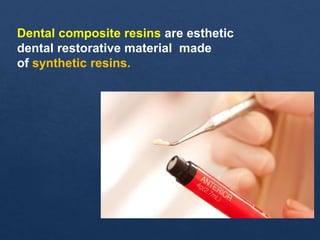
Dental composite resins are esthetic
dental restorative material made
of synthetic resins.
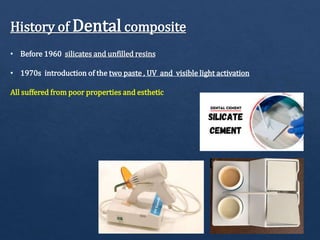
History of Dental composite
• Before 1960 silicates and unfilled resins
• 1970s introduction of the two paste , UV and visible light activation
All suffered from poor properties and esthetic
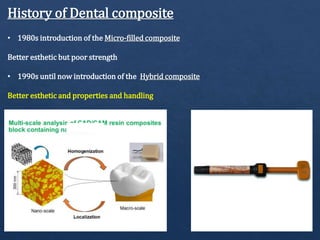
History of Dental composite
• 1980s introduction of the Micro-filled composite
Better esthetic but poor strength
• 1990s until now introduction of the Hybrid composite
Better esthetic and properties and handling
Composition of Dental composite
Composite resins are most commonly composed of :
• Monomers (synthetic resin) organic phase
I. Photo initiator
II. Coupling agent
III. Matrix
• Filler material such as (silica / glass ) inorganic phase
Further tailoring of physical properties is achieved by formulating unique
concentrations of each constituent.
Filler types and particle size
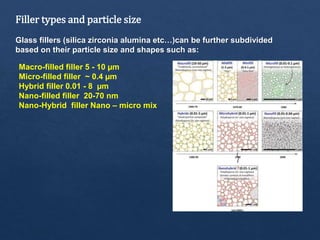
Glass fillers (silica zirconia alumina etc…)can be further subdivided
based on their particle size and shapes such as:
Macro-filled filler 5 - 10 µm
Micro-filled filler ~ 0.4 µm
Hybrid filler 0.01 - 8 µm
Nano-filled filler 20-70 nm
Nano-Hybrid filler Nano – micro mix
Setting mechanisms of Dental composite
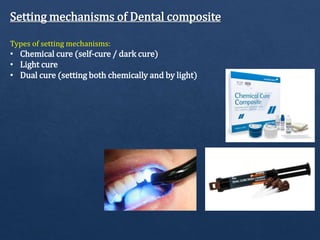
Types of setting mechanisms:
• Chemical cure (self-cure / dark cure)
• Light cure
• Dual cure (setting both chemically and by light)
Advantages of Dental composite :
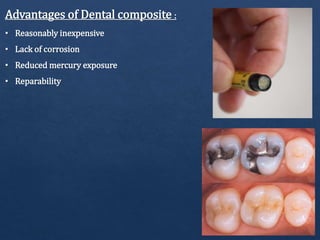
• Reasonably inexpensive
• Lack of corrosion
• Reduced mercury exposure
• Reparability
Advantages of Dental composite :
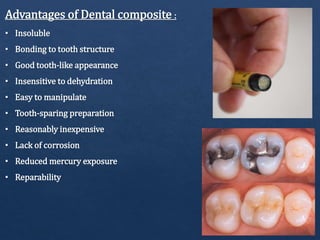
• Insoluble
• Bonding to tooth structure
• Good tooth-like appearance
• Insensitive to dehydration
• Easy to manipulate
• Tooth-sparing preparation
• Reasonably inexpensive
• Lack of corrosion
• Reduced mercury exposure
• Reparability
Disadvantages of Dental composite
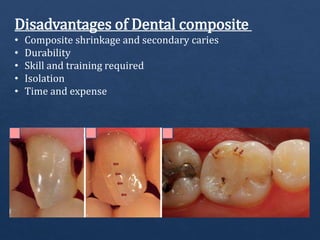
• Composite shrinkage and secondary caries
• Durability
• Skill and training required
• Isolation
• Time and expense
Classification of Dental composite according to
handling characteristics
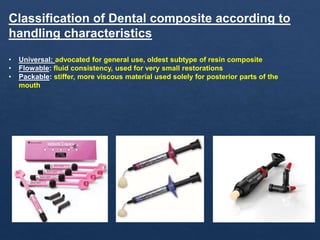
• Universal: advocated for general use, oldest subtype of resin composite
• Flowable: fluid consistency, used for very small restorations
• Packable: stiffer, more viscous material used solely for posterior parts of the
mouth
Classification of Dental composite according to location
of fabrication of the restoration
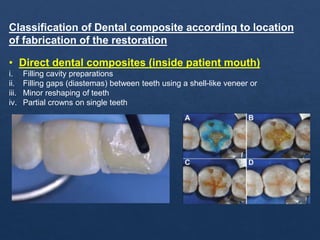
• Direct dental composites (inside patient mouth)
i. Filling cavity preparations
ii. Filling gaps (diastemas) between teeth using a shell-like veneer or
iii. Minor reshaping of teeth
iv. Partial crowns on single teeth
Classification of Dental composite according to
location of fabrication of the restoration
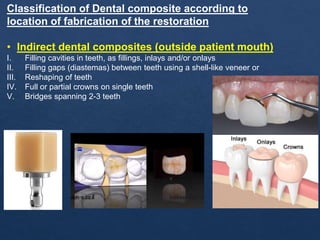
• Indirect dental composites (outside patient mouth)
I. Filling cavities in teeth, as fillings, inlays and/or onlays
II. Filling gaps (diastemas) between teeth using a shell-like veneer or
III. Reshaping of teeth
IV. Full or partial crowns on single teeth
V. Bridges spanning 2-3 teeth
Method and clinical application of Dental composite
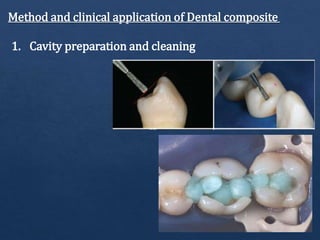
1. Cavity preparation and cleaning
Method and clinical application of Dental composite
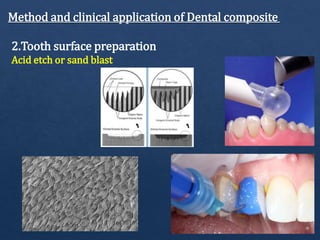
2.Tooth surface preparation
Acid etch or sand blast
Method and clinical application of Dental composite
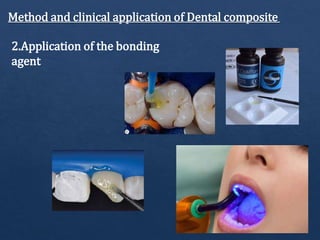
2.Application of the bonding
agent
Method and clinical application of Dental composite
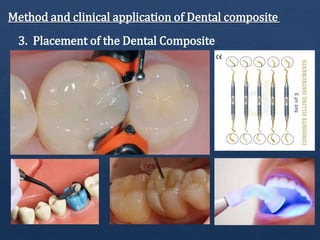
3. Placement of the Dental Composite
Method and clinical application of Dental composite
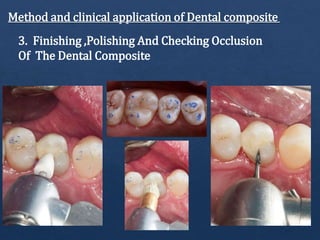
3. Finishing ,Polishing And Checking Occlusion
Of The Dental Composite
Dental Composite

Dental Composite

  • 1.
    Dental Composite Lecture no.1 Doneby Assistant lecturer Ahmed Ali Jasim Operative Dentistry Department College of Dentistry / Mustansiriyah University
  • 2.
    Dental composite resinsare esthetic dental restorative material made of synthetic resins.
  • 3.
    History of Dentalcomposite • Before 1960 silicates and unfilled resins • 1970s introduction of the two paste , UV and visible light activation All suffered from poor properties and esthetic
  • 4.
    History of Dentalcomposite • 1980s introduction of the Micro-filled composite Better esthetic but poor strength • 1990s until now introduction of the Hybrid composite Better esthetic and properties and handling
  • 5.
    Composition of Dentalcomposite Composite resins are most commonly composed of : • Monomers (synthetic resin) organic phase I. Photo initiator II. Coupling agent III. Matrix • Filler material such as (silica / glass ) inorganic phase Further tailoring of physical properties is achieved by formulating unique concentrations of each constituent.
  • 6.
    Filler types andparticle size Glass fillers (silica zirconia alumina etc…)can be further subdivided based on their particle size and shapes such as: Macro-filled filler 5 - 10 µm Micro-filled filler ~ 0.4 µm Hybrid filler 0.01 - 8 µm Nano-filled filler 20-70 nm Nano-Hybrid filler Nano – micro mix
  • 7.
    Setting mechanisms ofDental composite Types of setting mechanisms: • Chemical cure (self-cure / dark cure) • Light cure • Dual cure (setting both chemically and by light)
  • 8.
    Advantages of Dentalcomposite : • Reasonably inexpensive • Lack of corrosion • Reduced mercury exposure • Reparability
  • 9.
    Advantages of Dentalcomposite : • Insoluble • Bonding to tooth structure • Good tooth-like appearance • Insensitive to dehydration • Easy to manipulate • Tooth-sparing preparation • Reasonably inexpensive • Lack of corrosion • Reduced mercury exposure • Reparability
  • 10.
    Disadvantages of Dentalcomposite • Composite shrinkage and secondary caries • Durability • Skill and training required • Isolation • Time and expense
  • 11.
    Classification of Dentalcomposite according to handling characteristics • Universal: advocated for general use, oldest subtype of resin composite • Flowable: fluid consistency, used for very small restorations • Packable: stiffer, more viscous material used solely for posterior parts of the mouth
  • 12.
    Classification of Dentalcomposite according to location of fabrication of the restoration • Direct dental composites (inside patient mouth) i. Filling cavity preparations ii. Filling gaps (diastemas) between teeth using a shell-like veneer or iii. Minor reshaping of teeth iv. Partial crowns on single teeth
  • 13.
    Classification of Dentalcomposite according to location of fabrication of the restoration • Indirect dental composites (outside patient mouth) I. Filling cavities in teeth, as fillings, inlays and/or onlays II. Filling gaps (diastemas) between teeth using a shell-like veneer or III. Reshaping of teeth IV. Full or partial crowns on single teeth V. Bridges spanning 2-3 teeth
  • 14.
    Method and clinicalapplication of Dental composite 1. Cavity preparation and cleaning
  • 15.
    Method and clinicalapplication of Dental composite 2.Tooth surface preparation Acid etch or sand blast
  • 16.
    Method and clinicalapplication of Dental composite 2.Application of the bonding agent
  • 17.
    Method and clinicalapplication of Dental composite 3. Placement of the Dental Composite
  • 18.
    Method and clinicalapplication of Dental composite 3. Finishing ,Polishing And Checking Occlusion Of The Dental Composite