ADVANCES IN COMPOSITE
AMISHA KIRAN N P
FINAL YEAR PART 2
INTRODUCTION
The concept of the esthetic restorations is not new. The translucent silicate cement used earlier had certain
disadvantages such as their solubility, pulp irritation potential and dessication etc.These disadvantages lead to the
advent of acrylics which could overcome some of the problems associated with silicates but did not last long
because of inherent drawbacks of higher coefficient of thermal expansion and higher polymerization shrinkage.To
improve upon these drawbacks, filler particles were added to the acrylic resin matrix.Various types of fillers
ranging from plastic fillers to glass fillers were added, but the fillers could not bind with the matrix and remained
isolated. The course of inventions and developments lead to the introduction of composites by R.L. Bowen in
1962. Composite is basically a botanical term, where the clusters of flowers are clubbed giving shape to a different
flower. Metallurgically, composite is a combination of two or more materials having chemically distinct interface
between them.
The resin matrix of Bowen’s formulation was BiSGMA (Bisphenol Glycidyl methacrylate which is a
reaction product of Bisphenol A and Glycidyl methacrylate). Bowen also gave the concept of coupling
agents, which help the filler particles to bind with the resin matrix.The composites at this time were
chemically cured, a reaction similar to monomer polymer reaction along with activators and inhibitors.
‘ COMPOSITE ‘ = Mixture
Organic resin matrix Inorganic Fillers
Discovered by Dr.Rafael Bowen and Dr. Michael Buonocore
DEFINITION
 ‘Composite material is a compound of two or more distinctly different
materials with properties that are superior to or intermediate to those
of the individual constituent.’
According to Anusavice,
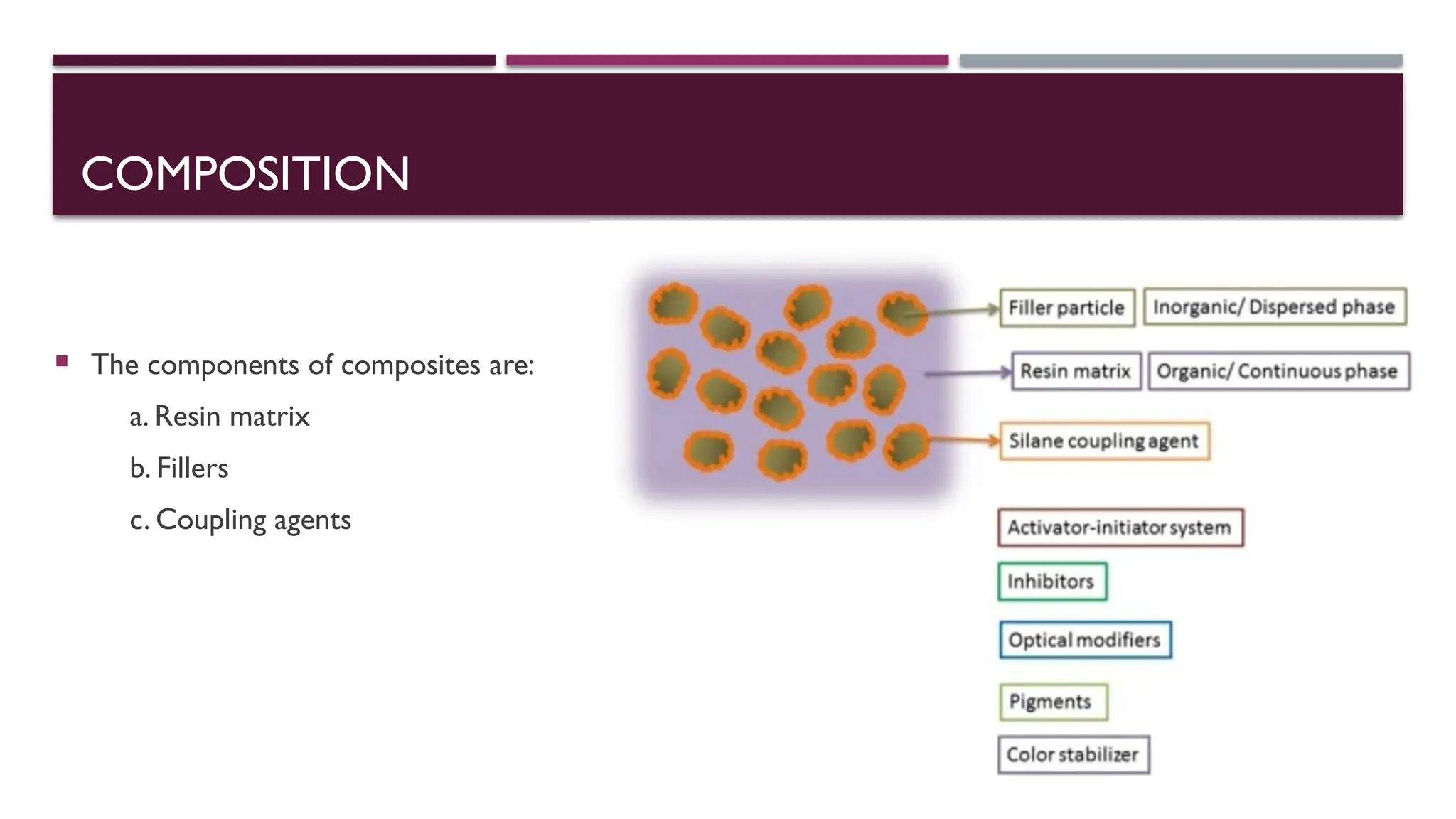
COMPOSITION
 The components of composites are:
a. Resin matrix
b. Fillers
c. Coupling agents
EVOLUTION OF COMPOSITES
 1962 – Conventional Type 1
 1968 - Conventional Type II
 1975 - Microfilled
 1978 - Organic
 1989 - Hybrid
 1996 - Flowable
 1996 - Packable
 2000 - Modified Hybrid
ADVANCES IN COMPOSITES
1. Flowable Composites
2. Packable/Condensable composites
3. Antibacterial Composites
4. Expanding Matrix Resins for Composites
5. Bioactive Composites
6. Ormocer
7. Silorane
8. Fibre-reinforced Composite
9. Nanocomposite
1.FLOWABLE COMPOSITES
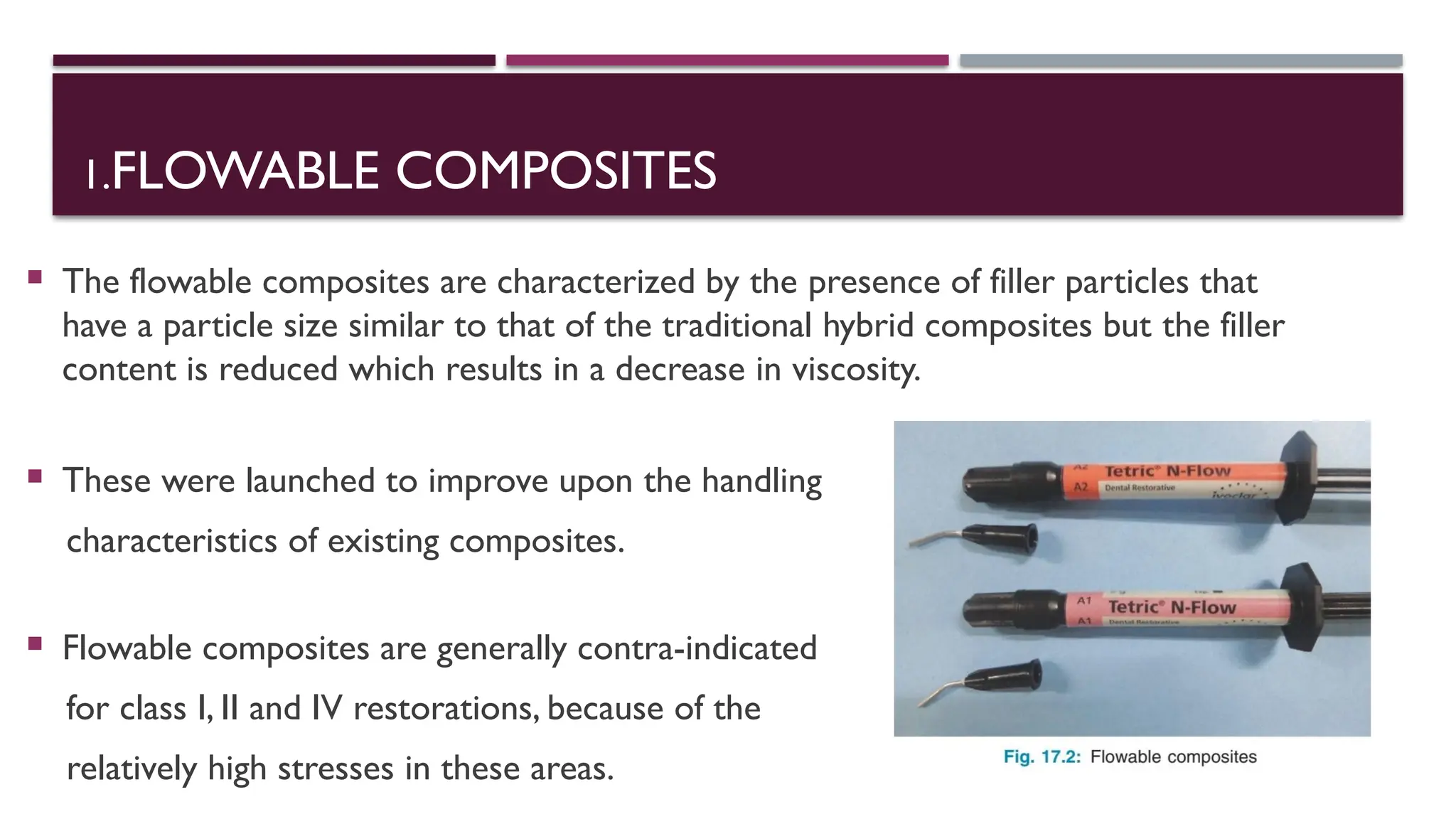
 The flowable composites are characterized by the presence of filler particles that
have a particle size similar to that of the traditional hybrid composites but the filler
content is reduced which results in a decrease in viscosity.
 These were launched to improve upon the handling
characteristics of existing composites.
 Flowable composites are generally contra-indicated
for class I, II and IV restorations, because of the
relatively high stresses in these areas.
FEATURES :
 The filler content is 20–25% less than that of the traditional hybrid composites.
 Because of the lesser amount of fillers loading, the flow is increased.
 The depth of cure is approximately 6.0 mm.
 Stickiness to the instrument, which makes it difficult to smoothen the material.
 Mechanical properties like compressive strength, tensile strength, flexure strength
and toughness values are generally much less than those of the conventional
composites
USES :
 As filling materials in low stress areas.
 As pit and fissure sealants and preventive resin restorations
 As liners in proximal boxes of class II preparations.
 For repairing porcelain.
 For rebuilding worn contact areas in composite restorations.
 Tunnel restorations.
 Core build-up.
 Cementing agents for porcelain restorations.
DISADVANTAGES :
 Curing shrinkage
 Reduced compressive strength
 Low elastic modulus
 Increased wear resistance
 Water sorption
Recently, self adhering flowable composite (Vertise Flow) was developed.
2.PACKABLE/CONDENSABLE COMPOSITES
 Packable/condensable composites are based on the newly introduced concept, called
PRIMM (Polymer Rigid Inorganic Matrix Material).
 This system consists of a resin and a ceramic component.
 The filler/inorganic phase instead of being incorporated into composites as ground
particles is present as a continuous network/scaffold of ceramic fibers.The fibers are
composed of alumina and silicon dioxide. The diameter of the individual ceramic
fiber is less than 2.0 μm.
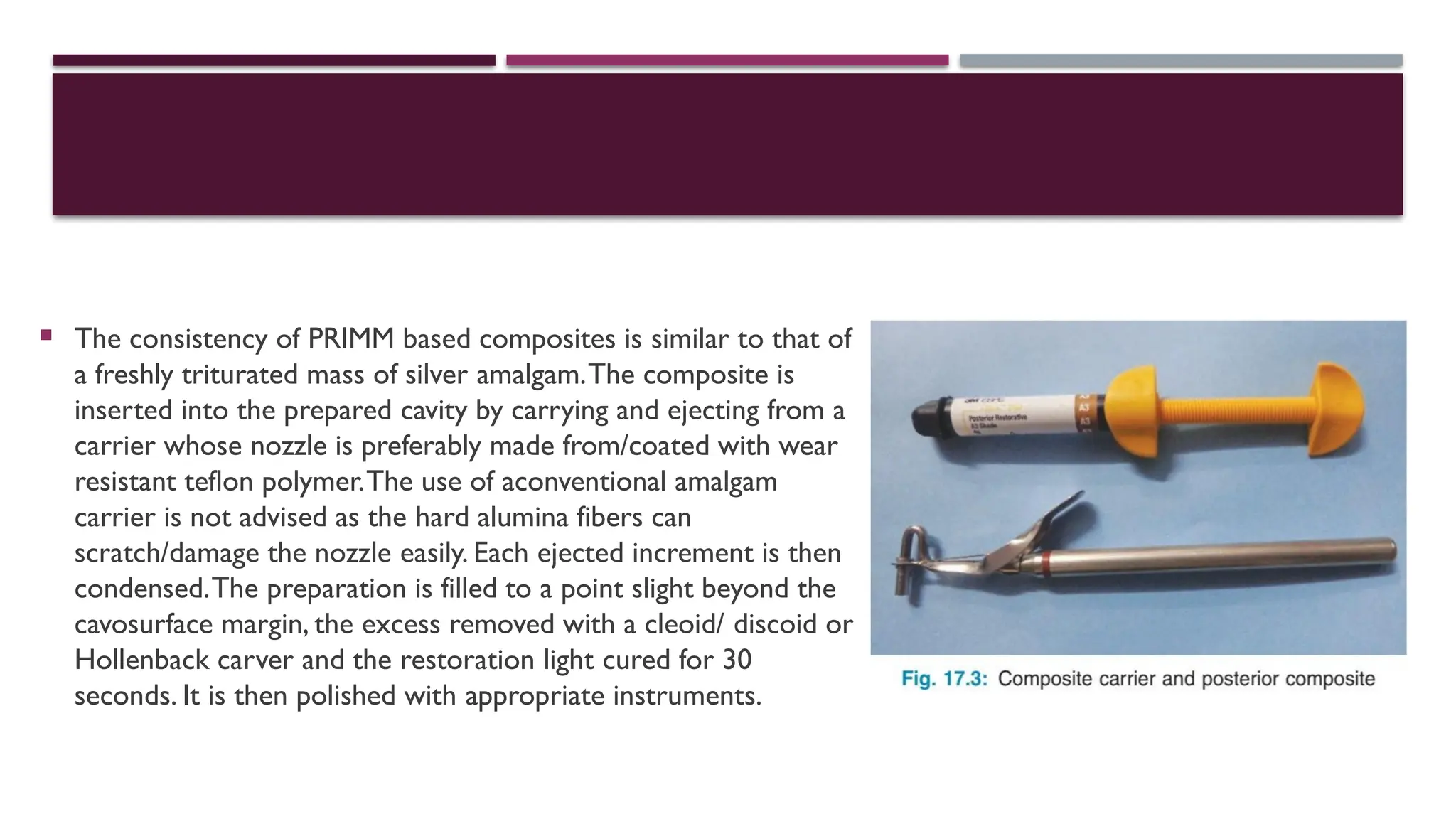
 The consistency of PRIMM based composites is similar to that of
a freshly triturated mass of silver amalgam.The composite is
inserted into the prepared cavity by carrying and ejecting from a
carrier whose nozzle is preferably made from/coated with wear
resistant teflon polymer.The use of aconventional amalgam
carrier is not advised as the hard alumina fibers can
scratch/damage the nozzle easily. Each ejected increment is then
condensed.The preparation is filled to a point slight beyond the
cavosurface margin, the excess removed with a cleoid/ discoid or
Hollenback carver and the restoration light cured for 30
seconds. It is then polished with appropriate instruments.
Packable composites present improved properties over conventional ones, like:
 Increased flexural modulus
 Increased resistance to wear
 Non-stickiness
Examples of condensable composites include
 Solitaire (Heraeus-Kulzer),
 Alert (Jeneric/Pentron),
 Surefil (Caulk,Dentsply),
 Filtek P60 (3M) and etc.)
3. ANTIBACTERIAL COMPOSITES
 Several studies have shown that a greater amount of bacteria and plaque accumulate on the surface of
the resin composites than on the surface of other restorative materials/enamel surface.The more the
plaque accumulates, greater is the incidence of recurrent caries around these restorations.
 Chlorhexidine : Chlorhexidine was tried in an attempt to reduce plaque accumulation around
composite restorations. However, that was not successful since the release was not uniform and lead
to certain disadvantages like -
• Toxic effects of the released material
• Population shifts of the micro-organisms
• Antibacterial activity is short-lived
• Deterioration of the physical and mechanical properties of the material.
Silver :
 The catalytic action of silver and the hydroxyl radicals under the effect of water and air, these products
result in the structural damage of bacteria (phenomenon is referred to as the oligodynamic action).
 Silver can be added either:
1. Silver ions are incorporated to inorganic oxides like silicon dioxide.
2. Silver ions may be hydrothermally supported into the space between the crystal lattice network of filler
particles.
3. Silver ions may be incorporated into the silica gel and thin films are coated over the surface of
composite.
The inclusion of silver into composite does not adversely affect the mechanical properties like strength,
translucency, color stability and depth of cure.
 Another antimicrobial agent used is Halo, which is added up to 1% by weight to commercial
composite.
 MDPB (methacryloxydecyl pyridinium bromide) : The antibacterial activity of this compound has been
found to be comparable to that of triclosan.
The methacryloyl structure of the MDPB molecule co-polymerizes with other methacrylate
monomers and hence is chemically bound to the matrix resin on curing.
MDPB was found to be effective against various streptococci.
 ZnO nanoparticles (ZnO-NPs) : Effective against both against gram negative and gram positive micro-organisms.
 MECHANISM – 1. ZnO-NPs generate active oxygen species such as H2O2 which inhibit growth of planktonic
microbes.
 2 .Another potential mechanism of ZnO-NP occurs via leaching of Zn2+ into the growth
media.Toxicological mechanisms of zinc ions play an important role in biofilm inhibition by inhibiting the active
transport and metabolism of sugars as well as disrupting enzyme systems of dental biofilms by displacing magnesium
ions essential for enzymatic activity of plaque.
 Caries prevention fillers : ●Ca phosphate ion releasing fillers have been developed such as nanoparticles of
dicalcium phosphate anhydrous (DCPA) and tetracalcium phosphate (TTCP) whiskers.
● Fluoride releasing nanocomposites have been developed to increase
remineralization and inhibit caries development.
4. EXPANDING MATRIX RESINS FOR COMPOSITES
 The epoxy resins contract approximately 3.4% and SOCs (Spiro-ortho-carbonates) expand approximately 3.6%;
therefore, combining these two will achieve a net polymerization expansion. It is observed that spiro-
orthocarbonate in combination with epoxy resin decreases polymerization shrinkage, increases toughness and
decreases water permeation.
Composite resins that expand slightly during polymerization are highly desirable as these would facilitate
bulk placement of the material, and reduce post operative sensitivity. Spiro-ortho-carbonates(SOCs) have
been tried as a possible solution
5. BIOACTIVE COMPOSITES
 Calcium phosphate and its modified varieties are being used as filler in recent composites.These composites
serve as bioactive liners and bases to enhance the remineralization.When the pH of saliva becomes less, the
calcium and phosphate ions are released which act as remineralizing agent. Amorphous calcium phosphate
hybridized with glass forming agents is also used as filler, known as ‘Smart Composite’ also called ‘Intelligent
composites’
6. ORMOCER
 Ormocer, the acronym of ORganically MOdified CERamic, can be used as a restorative material for both anterior
and posterior teeth. Ormocer can virtually replace amalgam and composites.
• Biocompatible
• Reduced polymerization shrinkage
• High abrasion resistance, can be used in stress bearing areas
• Esthetically pleasing, available in different shades
• Anticaries properties due to fluoride release
• Safe handling and easy manipulation
• Cost effective
ADVANTAGES
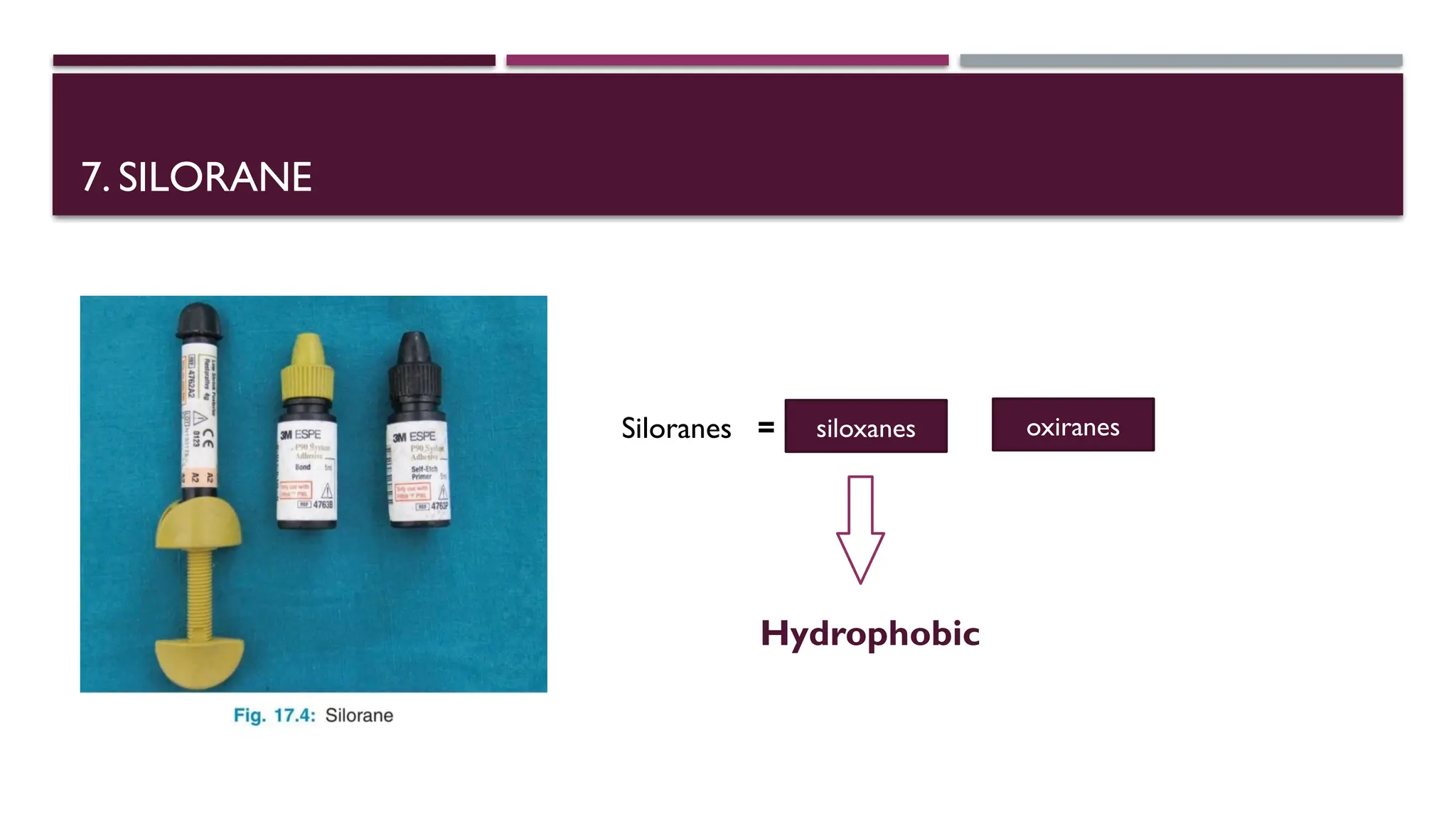
7. SILORANE
Siloranes = +
siloxanes oxiranes
Hydrophobic
• The network of Siloranes is generated by
the cationic ring opening polymerization of the
cycloaliphatic oxiranes.
• The cationic cure starts with the initiation process of
an acidic cation which opens the oxirane ring and
generates a new acidic center, a carbocation.After the
addition to an oxirane monomer, the epoxy ring is
opened to form a chain.
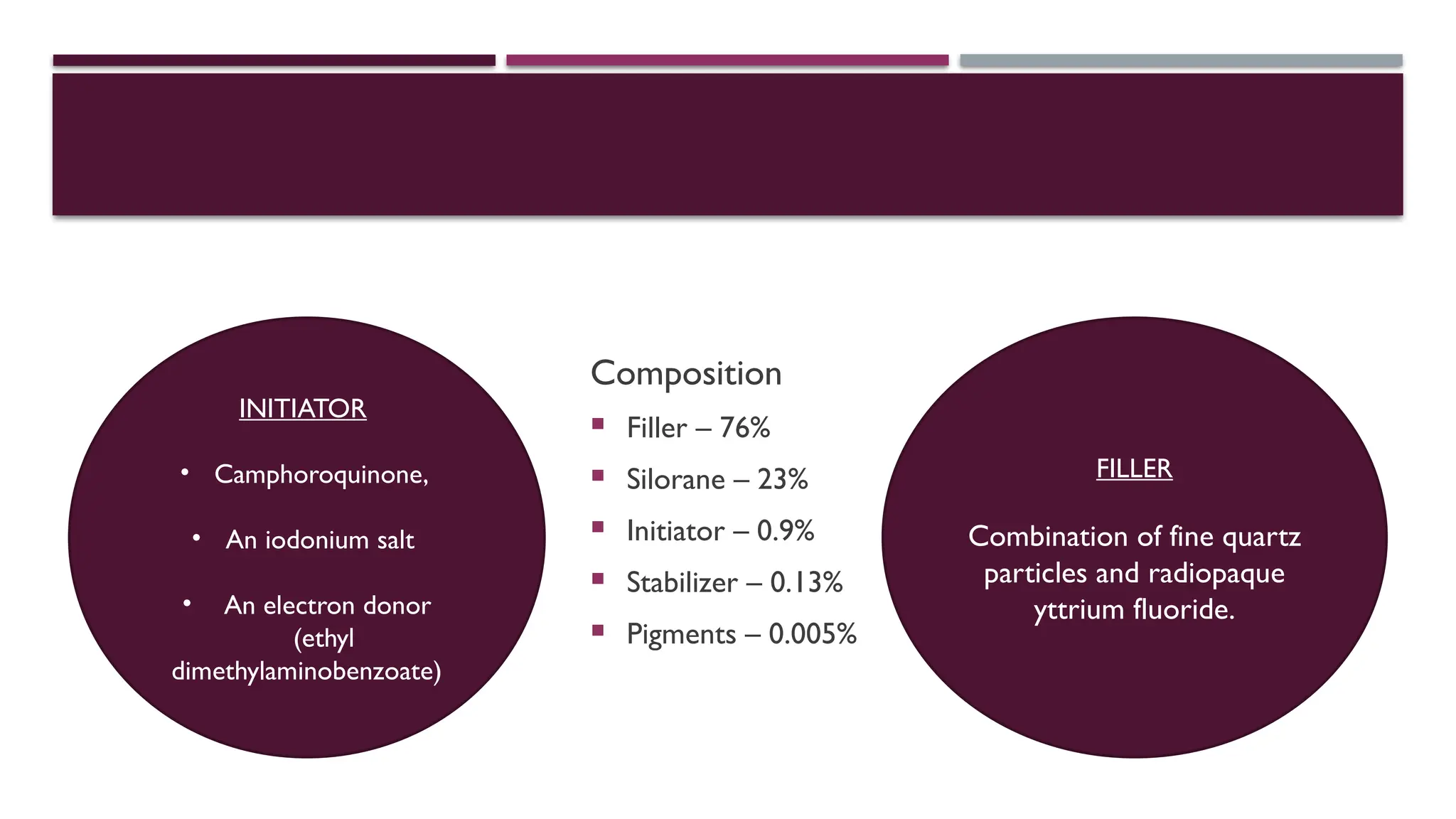
Composition
 Filler – 76%
 Silorane – 23%
 Initiator – 0.9%
 Stabilizer – 0.13%
 Pigments – 0.005%
INITIATOR
• Camphoroquinone,
• An iodonium salt
• An electron donor
(ethyl
dimethylaminobenzoate)
FILLER
Combination of fine quartz
particles and radiopaque
yttrium fluoride.
8. FIBRE-REINFORCED COMPOSITE
 Composites are reinforced by fibers.
 Fiber reinforced composites are structural materials that have atleast two distinct constituents.
 The reinforcing component provides strength and stiffness, while surrounding matrix support the reinforcement
and provides workability. Polymer matrix also protects the fibers from the effect of mechanical damage and
moisture.
Commonly used reinforcing fiber : Glass fiber
Carbon/graphite,
Aramid boron,
Metal fibers
ADVANTAGE
• Non-corrosiveness
• Translucency
• Good bonding properties
• Repair facility
• Facility for both office and laboratory
preparation
USES
• Periodontal splinting
• Orthodontic retention
• Fiber reinforced post crowns
• Reinforcement and repair of removable partial
Denture
• Repair of fixed partial denture
9. NANOCOMPOSITE
 When inorganic phases in an organic/inorganic composite become nanosized (range 0.1–100 nm),
they are called nanocomposites.
 Nanofillers can be prepared by various techniques, such as flame pyrolysis, flame spray pyrolysis, and
solgel processes.
 Nanofillers are extremely small filler particles, have dimensions belowthe wavelength of visible light
(0.4–0.8 μm), they are unable to scatter or absorb visible light. Thus, nanofillers are usually invisible
and offer the advantage of optical property improvement.
 Nanofillers are capable of increasing the overall filler level due to their small particlesizes.
 Increase in filler level results in significant reduction of polymerization shrinkage and dramatically
improve the physical properties of nanocomposites.
 Example : Filtek Supreme contains nanometric particles (nanomers) and nanoclusters(NCs).
 Nanomers are monodispersed, non-agglomerated, and non-aggregated silica particles of 20 and 75
nm in diameter.
 Nanocluster fillers are loosely bound agglomerates of nanosized particles (less than 0.6 μm).
REFERENCE
 TEXTBOOK OF OPERATIVE DENTISTRY-VIMAL K SIKRI ( FOURTH EDITION )
Thank You

advances in composite.pptx definition characterstics

  • 1.
    ADVANCES IN COMPOSITE AMISHAKIRAN N P FINAL YEAR PART 2
  • 2.
    INTRODUCTION The concept ofthe esthetic restorations is not new. The translucent silicate cement used earlier had certain disadvantages such as their solubility, pulp irritation potential and dessication etc.These disadvantages lead to the advent of acrylics which could overcome some of the problems associated with silicates but did not last long because of inherent drawbacks of higher coefficient of thermal expansion and higher polymerization shrinkage.To improve upon these drawbacks, filler particles were added to the acrylic resin matrix.Various types of fillers ranging from plastic fillers to glass fillers were added, but the fillers could not bind with the matrix and remained isolated. The course of inventions and developments lead to the introduction of composites by R.L. Bowen in 1962. Composite is basically a botanical term, where the clusters of flowers are clubbed giving shape to a different flower. Metallurgically, composite is a combination of two or more materials having chemically distinct interface between them. The resin matrix of Bowen’s formulation was BiSGMA (Bisphenol Glycidyl methacrylate which is a reaction product of Bisphenol A and Glycidyl methacrylate). Bowen also gave the concept of coupling agents, which help the filler particles to bind with the resin matrix.The composites at this time were chemically cured, a reaction similar to monomer polymer reaction along with activators and inhibitors.
  • 3.
    ‘ COMPOSITE ‘= Mixture Organic resin matrix Inorganic Fillers Discovered by Dr.Rafael Bowen and Dr. Michael Buonocore
  • 4.
    DEFINITION  ‘Composite materialis a compound of two or more distinctly different materials with properties that are superior to or intermediate to those of the individual constituent.’ According to Anusavice,
  • 5.
    COMPOSITION  The componentsof composites are: a. Resin matrix b. Fillers c. Coupling agents
  • 6.
    EVOLUTION OF COMPOSITES 1962 – Conventional Type 1  1968 - Conventional Type II  1975 - Microfilled  1978 - Organic  1989 - Hybrid  1996 - Flowable  1996 - Packable  2000 - Modified Hybrid
  • 7.
    ADVANCES IN COMPOSITES 1.Flowable Composites 2. Packable/Condensable composites 3. Antibacterial Composites 4. Expanding Matrix Resins for Composites 5. Bioactive Composites 6. Ormocer 7. Silorane 8. Fibre-reinforced Composite 9. Nanocomposite
  • 8.
    1.FLOWABLE COMPOSITES  Theflowable composites are characterized by the presence of filler particles that have a particle size similar to that of the traditional hybrid composites but the filler content is reduced which results in a decrease in viscosity.  These were launched to improve upon the handling characteristics of existing composites.  Flowable composites are generally contra-indicated for class I, II and IV restorations, because of the relatively high stresses in these areas.
  • 9.
    FEATURES :  Thefiller content is 20–25% less than that of the traditional hybrid composites.  Because of the lesser amount of fillers loading, the flow is increased.  The depth of cure is approximately 6.0 mm.  Stickiness to the instrument, which makes it difficult to smoothen the material.  Mechanical properties like compressive strength, tensile strength, flexure strength and toughness values are generally much less than those of the conventional composites
  • 10.
    USES :  Asfilling materials in low stress areas.  As pit and fissure sealants and preventive resin restorations  As liners in proximal boxes of class II preparations.  For repairing porcelain.  For rebuilding worn contact areas in composite restorations.  Tunnel restorations.  Core build-up.  Cementing agents for porcelain restorations.
  • 11.
    DISADVANTAGES :  Curingshrinkage  Reduced compressive strength  Low elastic modulus  Increased wear resistance  Water sorption Recently, self adhering flowable composite (Vertise Flow) was developed.
  • 12.
    2.PACKABLE/CONDENSABLE COMPOSITES  Packable/condensablecomposites are based on the newly introduced concept, called PRIMM (Polymer Rigid Inorganic Matrix Material).  This system consists of a resin and a ceramic component.  The filler/inorganic phase instead of being incorporated into composites as ground particles is present as a continuous network/scaffold of ceramic fibers.The fibers are composed of alumina and silicon dioxide. The diameter of the individual ceramic fiber is less than 2.0 μm.
  • 13.
     The consistencyof PRIMM based composites is similar to that of a freshly triturated mass of silver amalgam.The composite is inserted into the prepared cavity by carrying and ejecting from a carrier whose nozzle is preferably made from/coated with wear resistant teflon polymer.The use of aconventional amalgam carrier is not advised as the hard alumina fibers can scratch/damage the nozzle easily. Each ejected increment is then condensed.The preparation is filled to a point slight beyond the cavosurface margin, the excess removed with a cleoid/ discoid or Hollenback carver and the restoration light cured for 30 seconds. It is then polished with appropriate instruments.
  • 14.
    Packable composites presentimproved properties over conventional ones, like:  Increased flexural modulus  Increased resistance to wear  Non-stickiness Examples of condensable composites include  Solitaire (Heraeus-Kulzer),  Alert (Jeneric/Pentron),  Surefil (Caulk,Dentsply),  Filtek P60 (3M) and etc.)
  • 15.
    3. ANTIBACTERIAL COMPOSITES Several studies have shown that a greater amount of bacteria and plaque accumulate on the surface of the resin composites than on the surface of other restorative materials/enamel surface.The more the plaque accumulates, greater is the incidence of recurrent caries around these restorations.  Chlorhexidine : Chlorhexidine was tried in an attempt to reduce plaque accumulation around composite restorations. However, that was not successful since the release was not uniform and lead to certain disadvantages like - • Toxic effects of the released material • Population shifts of the micro-organisms • Antibacterial activity is short-lived • Deterioration of the physical and mechanical properties of the material.
  • 16.
    Silver :  Thecatalytic action of silver and the hydroxyl radicals under the effect of water and air, these products result in the structural damage of bacteria (phenomenon is referred to as the oligodynamic action).  Silver can be added either: 1. Silver ions are incorporated to inorganic oxides like silicon dioxide. 2. Silver ions may be hydrothermally supported into the space between the crystal lattice network of filler particles. 3. Silver ions may be incorporated into the silica gel and thin films are coated over the surface of composite. The inclusion of silver into composite does not adversely affect the mechanical properties like strength, translucency, color stability and depth of cure.
  • 17.
     Another antimicrobialagent used is Halo, which is added up to 1% by weight to commercial composite.  MDPB (methacryloxydecyl pyridinium bromide) : The antibacterial activity of this compound has been found to be comparable to that of triclosan. The methacryloyl structure of the MDPB molecule co-polymerizes with other methacrylate monomers and hence is chemically bound to the matrix resin on curing. MDPB was found to be effective against various streptococci.
  • 18.
     ZnO nanoparticles(ZnO-NPs) : Effective against both against gram negative and gram positive micro-organisms.  MECHANISM – 1. ZnO-NPs generate active oxygen species such as H2O2 which inhibit growth of planktonic microbes.  2 .Another potential mechanism of ZnO-NP occurs via leaching of Zn2+ into the growth media.Toxicological mechanisms of zinc ions play an important role in biofilm inhibition by inhibiting the active transport and metabolism of sugars as well as disrupting enzyme systems of dental biofilms by displacing magnesium ions essential for enzymatic activity of plaque.
  • 19.
     Caries preventionfillers : ●Ca phosphate ion releasing fillers have been developed such as nanoparticles of dicalcium phosphate anhydrous (DCPA) and tetracalcium phosphate (TTCP) whiskers. ● Fluoride releasing nanocomposites have been developed to increase remineralization and inhibit caries development.
  • 20.
    4. EXPANDING MATRIXRESINS FOR COMPOSITES  The epoxy resins contract approximately 3.4% and SOCs (Spiro-ortho-carbonates) expand approximately 3.6%; therefore, combining these two will achieve a net polymerization expansion. It is observed that spiro- orthocarbonate in combination with epoxy resin decreases polymerization shrinkage, increases toughness and decreases water permeation. Composite resins that expand slightly during polymerization are highly desirable as these would facilitate bulk placement of the material, and reduce post operative sensitivity. Spiro-ortho-carbonates(SOCs) have been tried as a possible solution
  • 21.
    5. BIOACTIVE COMPOSITES Calcium phosphate and its modified varieties are being used as filler in recent composites.These composites serve as bioactive liners and bases to enhance the remineralization.When the pH of saliva becomes less, the calcium and phosphate ions are released which act as remineralizing agent. Amorphous calcium phosphate hybridized with glass forming agents is also used as filler, known as ‘Smart Composite’ also called ‘Intelligent composites’
  • 22.
    6. ORMOCER  Ormocer,the acronym of ORganically MOdified CERamic, can be used as a restorative material for both anterior and posterior teeth. Ormocer can virtually replace amalgam and composites.
  • 23.
    • Biocompatible • Reducedpolymerization shrinkage • High abrasion resistance, can be used in stress bearing areas • Esthetically pleasing, available in different shades • Anticaries properties due to fluoride release • Safe handling and easy manipulation • Cost effective ADVANTAGES
  • 24.
    7. SILORANE Siloranes =+ siloxanes oxiranes Hydrophobic
  • 25.
    • The networkof Siloranes is generated by the cationic ring opening polymerization of the cycloaliphatic oxiranes. • The cationic cure starts with the initiation process of an acidic cation which opens the oxirane ring and generates a new acidic center, a carbocation.After the addition to an oxirane monomer, the epoxy ring is opened to form a chain.
  • 26.
    Composition  Filler –76%  Silorane – 23%  Initiator – 0.9%  Stabilizer – 0.13%  Pigments – 0.005% INITIATOR • Camphoroquinone, • An iodonium salt • An electron donor (ethyl dimethylaminobenzoate) FILLER Combination of fine quartz particles and radiopaque yttrium fluoride.
  • 27.
    8. FIBRE-REINFORCED COMPOSITE Composites are reinforced by fibers.  Fiber reinforced composites are structural materials that have atleast two distinct constituents.  The reinforcing component provides strength and stiffness, while surrounding matrix support the reinforcement and provides workability. Polymer matrix also protects the fibers from the effect of mechanical damage and moisture. Commonly used reinforcing fiber : Glass fiber Carbon/graphite, Aramid boron, Metal fibers
  • 28.
    ADVANTAGE • Non-corrosiveness • Translucency •Good bonding properties • Repair facility • Facility for both office and laboratory preparation USES • Periodontal splinting • Orthodontic retention • Fiber reinforced post crowns • Reinforcement and repair of removable partial Denture • Repair of fixed partial denture
  • 29.
    9. NANOCOMPOSITE  Wheninorganic phases in an organic/inorganic composite become nanosized (range 0.1–100 nm), they are called nanocomposites.  Nanofillers can be prepared by various techniques, such as flame pyrolysis, flame spray pyrolysis, and solgel processes.  Nanofillers are extremely small filler particles, have dimensions belowthe wavelength of visible light (0.4–0.8 μm), they are unable to scatter or absorb visible light. Thus, nanofillers are usually invisible and offer the advantage of optical property improvement.  Nanofillers are capable of increasing the overall filler level due to their small particlesizes.  Increase in filler level results in significant reduction of polymerization shrinkage and dramatically improve the physical properties of nanocomposites.
  • 30.
     Example :Filtek Supreme contains nanometric particles (nanomers) and nanoclusters(NCs).  Nanomers are monodispersed, non-agglomerated, and non-aggregated silica particles of 20 and 75 nm in diameter.  Nanocluster fillers are loosely bound agglomerates of nanosized particles (less than 0.6 μm).
  • 32.
    REFERENCE  TEXTBOOK OFOPERATIVE DENTISTRY-VIMAL K SIKRI ( FOURTH EDITION )
  • 33.