Dr. A. YOGHA PADHMA
1ST YEAR POSTGRADUATE
DEPT OF CONSERVATIVE DENTISTRY
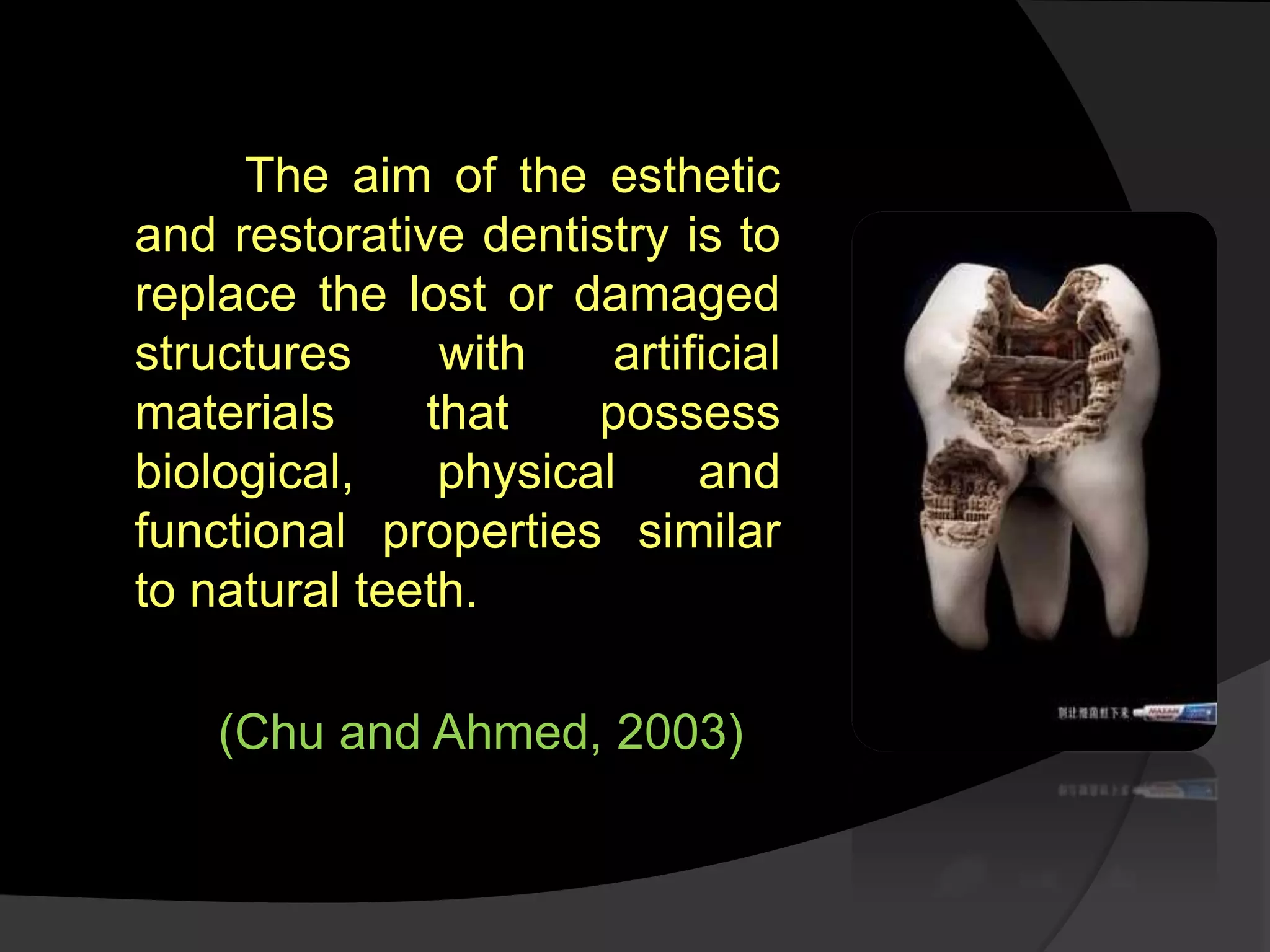
The aim of the esthetic
and restorative dentistry is to
replace the lost or damaged
structures with artificial
materials that possess
biological, physical and
functional properties similar
to natural teeth.
(Chu and Ahmed, 2003)
TRENDS IN
COMPOSITE
DENTISTRY
Composite resins occupy a
paramount position because they offer
excellent esthetic potential and
acceptable longevity without the need
for extensive sound structure
preparation.
(Dietschi et al., 2006)
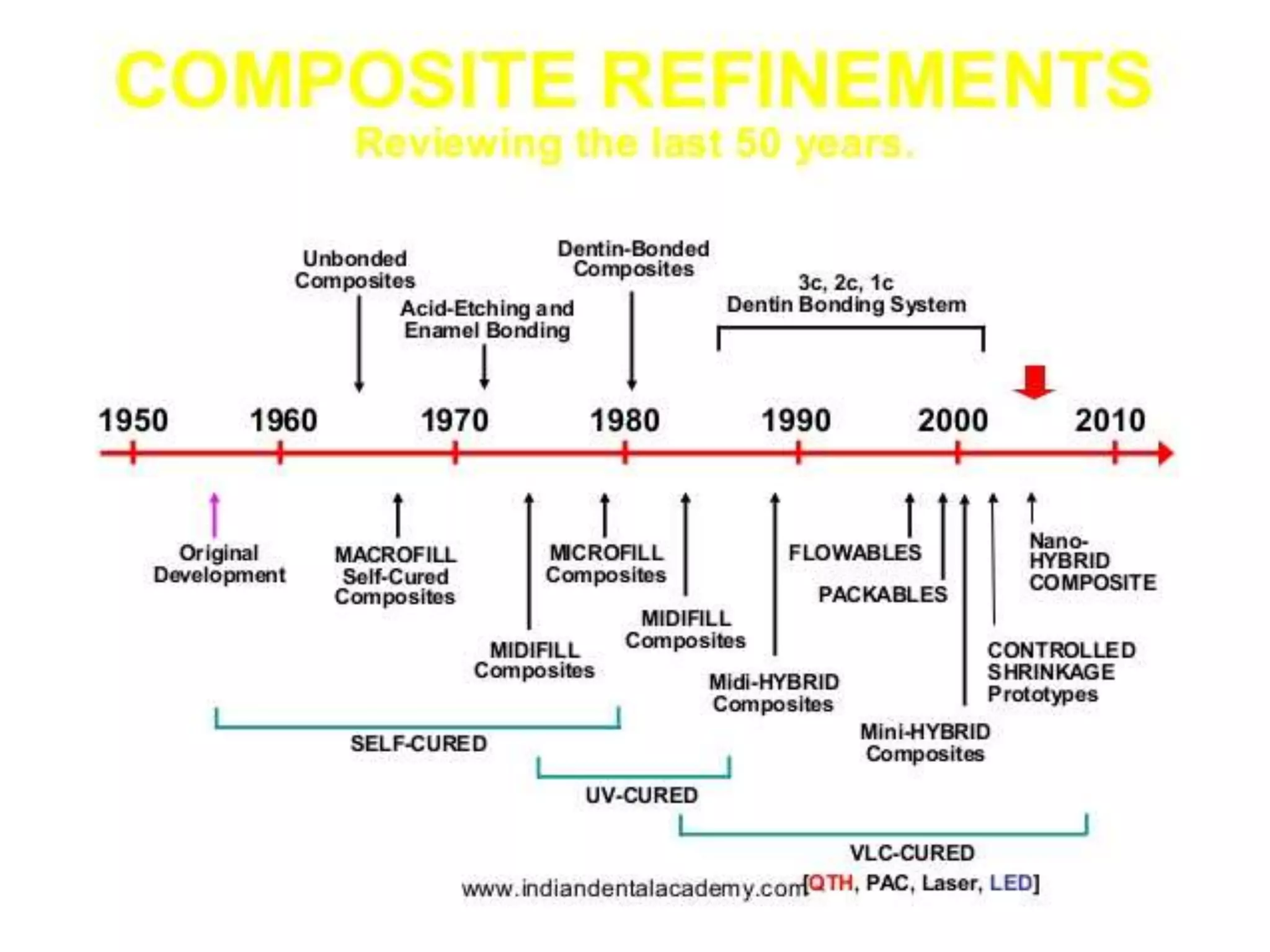
HISTORY
DIRECT COMPOSITE RESIN
MATERIALS
INDIRECT COMPOSITE RESIN
MATERIALS
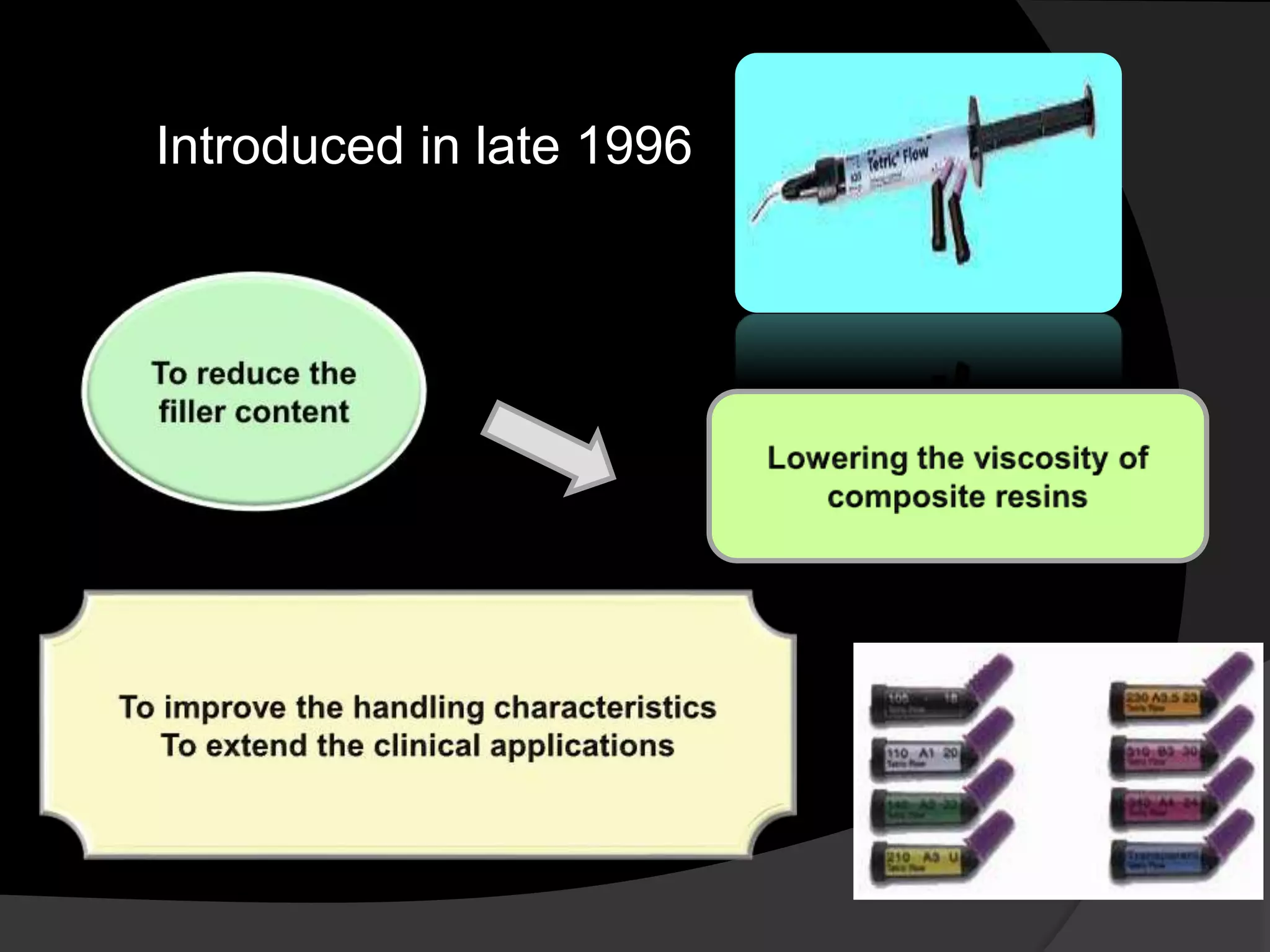
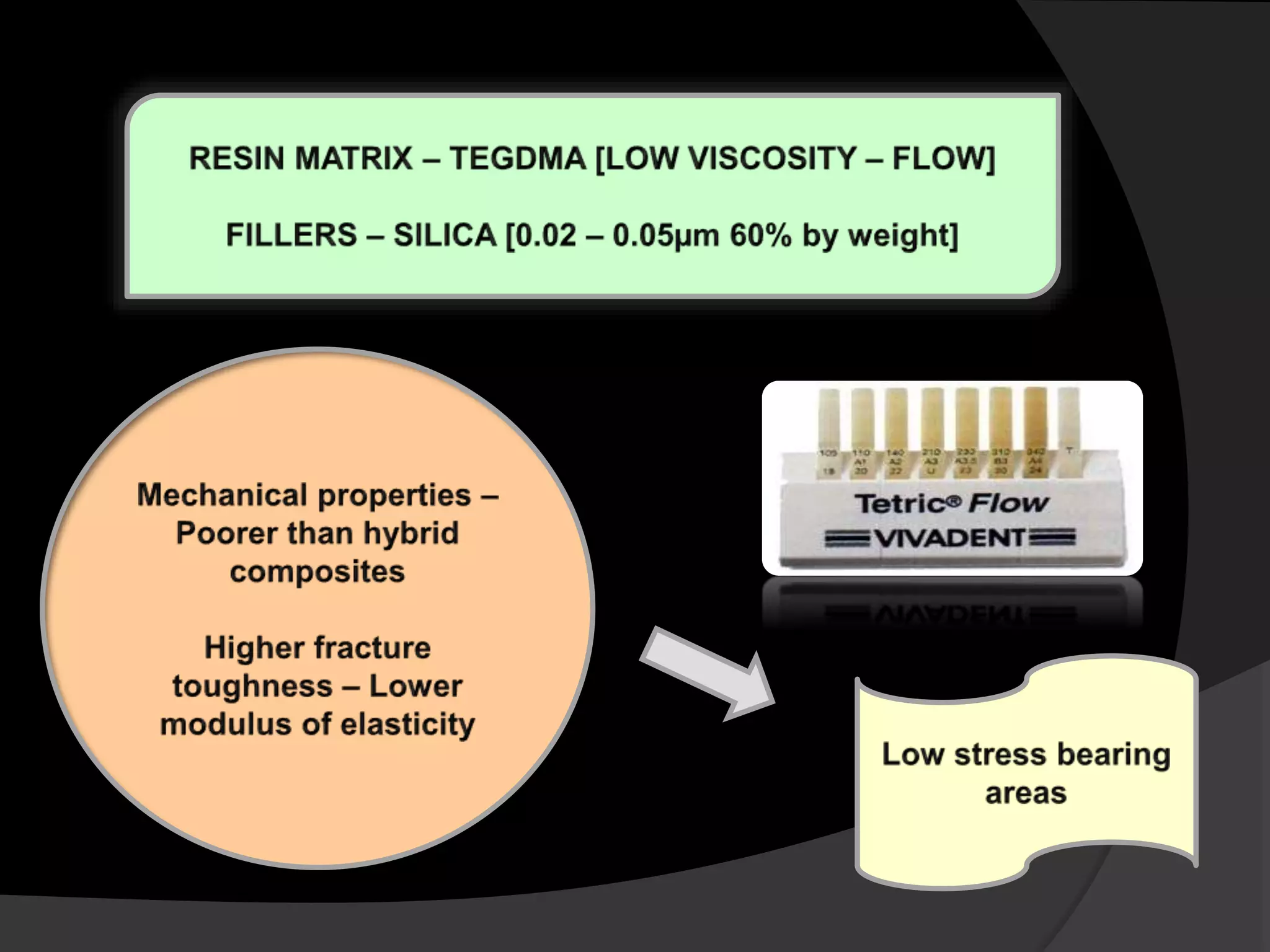
FLOWABLE COMPOSITES
Introduced in late 1996
• Amalgam margin repair.
• Class I, II, III, IV and V
• Composite repairs.
• Core build up.
• Crown margin repair.
• Enamel defect repair.
• Incisal edge repair.
• Liners in class I & II
• Preventive resin restorations
• Pit and fissure.
• Porcelain repairs.
I
N
D
I
C
A
T
I
O
N
S
NANO-FILLED FLOWABLE COMPOSITES
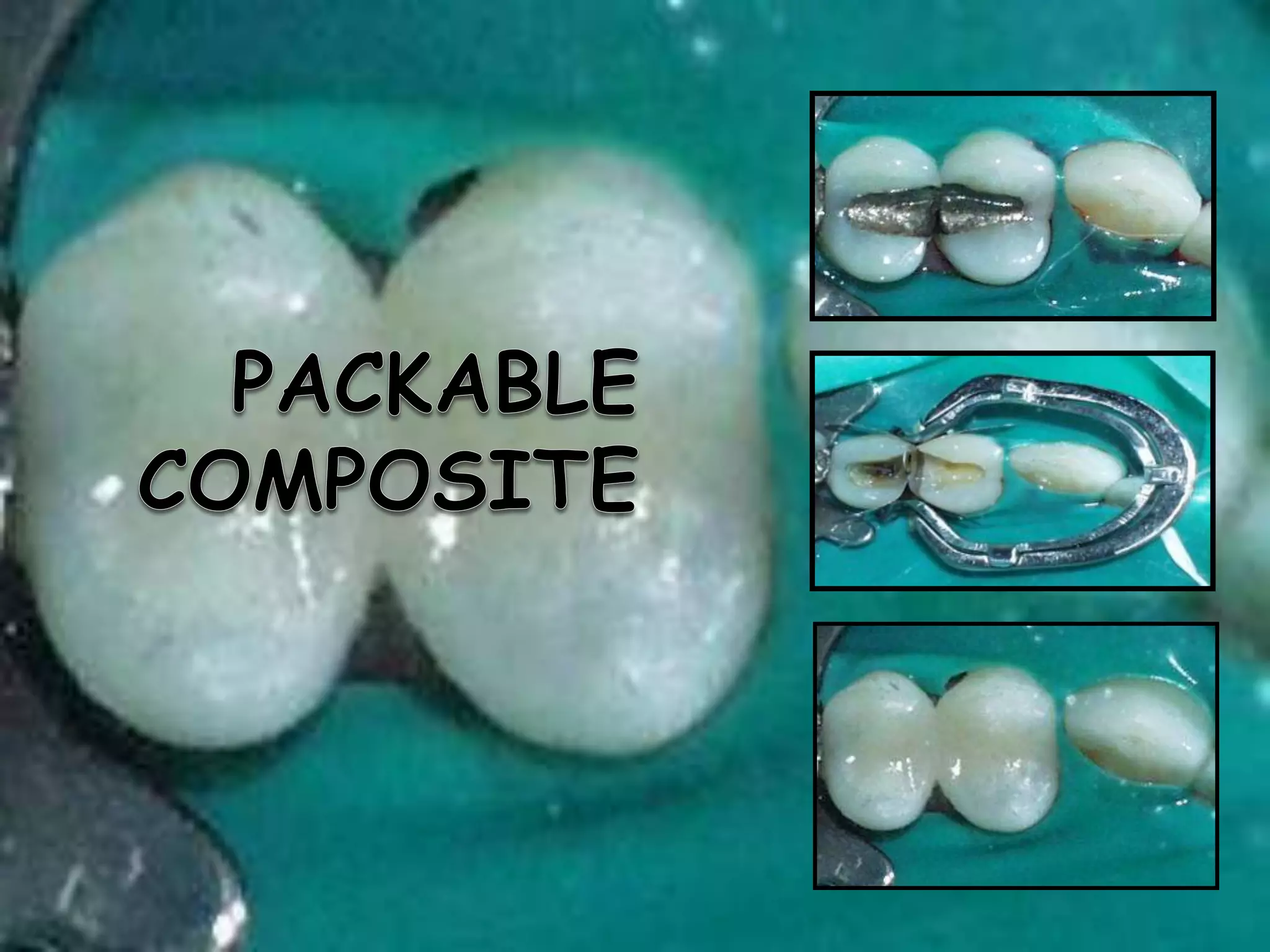
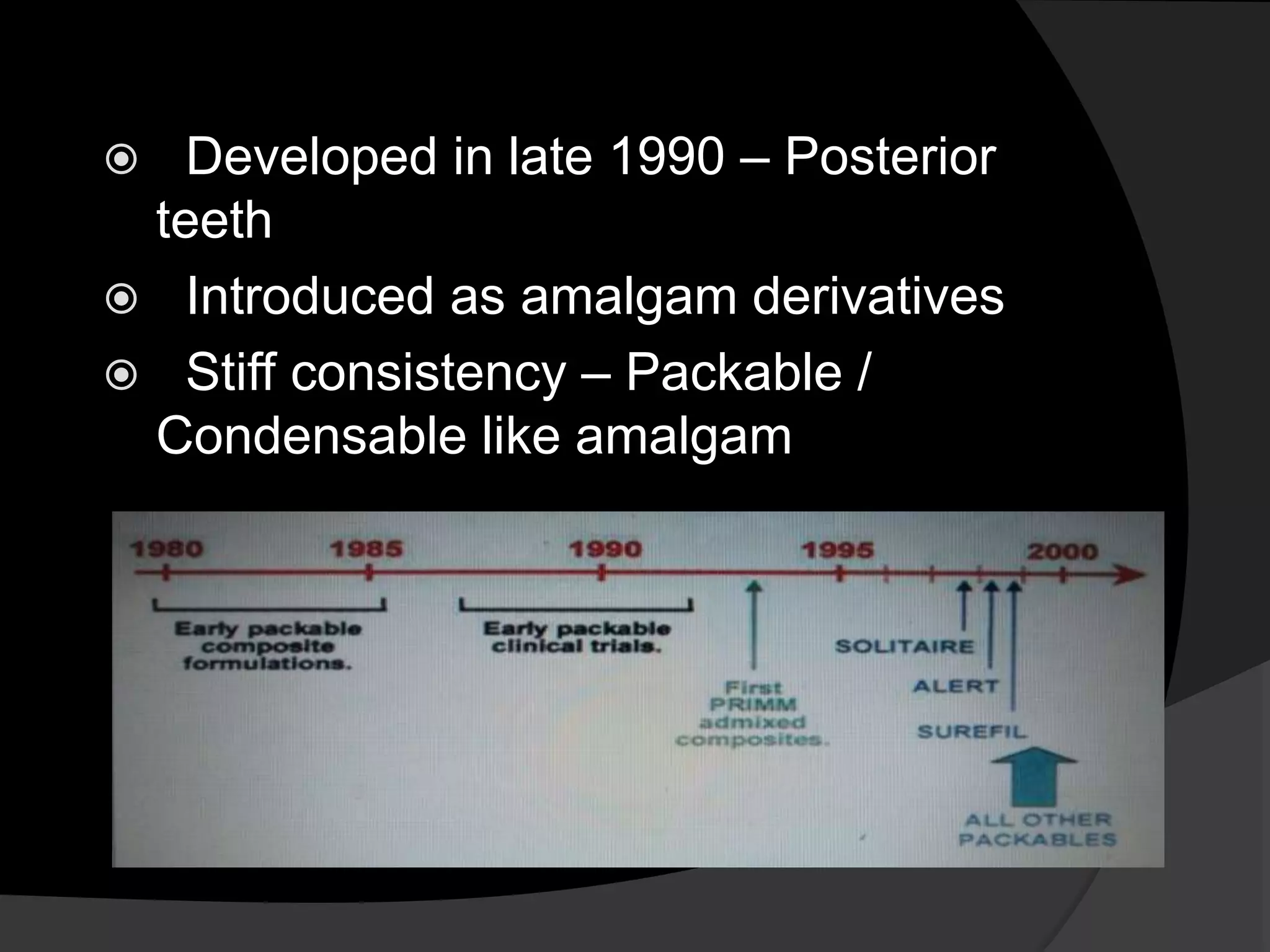
 Developed in late 1990 – Posterior
teeth
 Introduced as amalgam derivatives
 Stiff consistency – Packable /
Condensable like amalgam
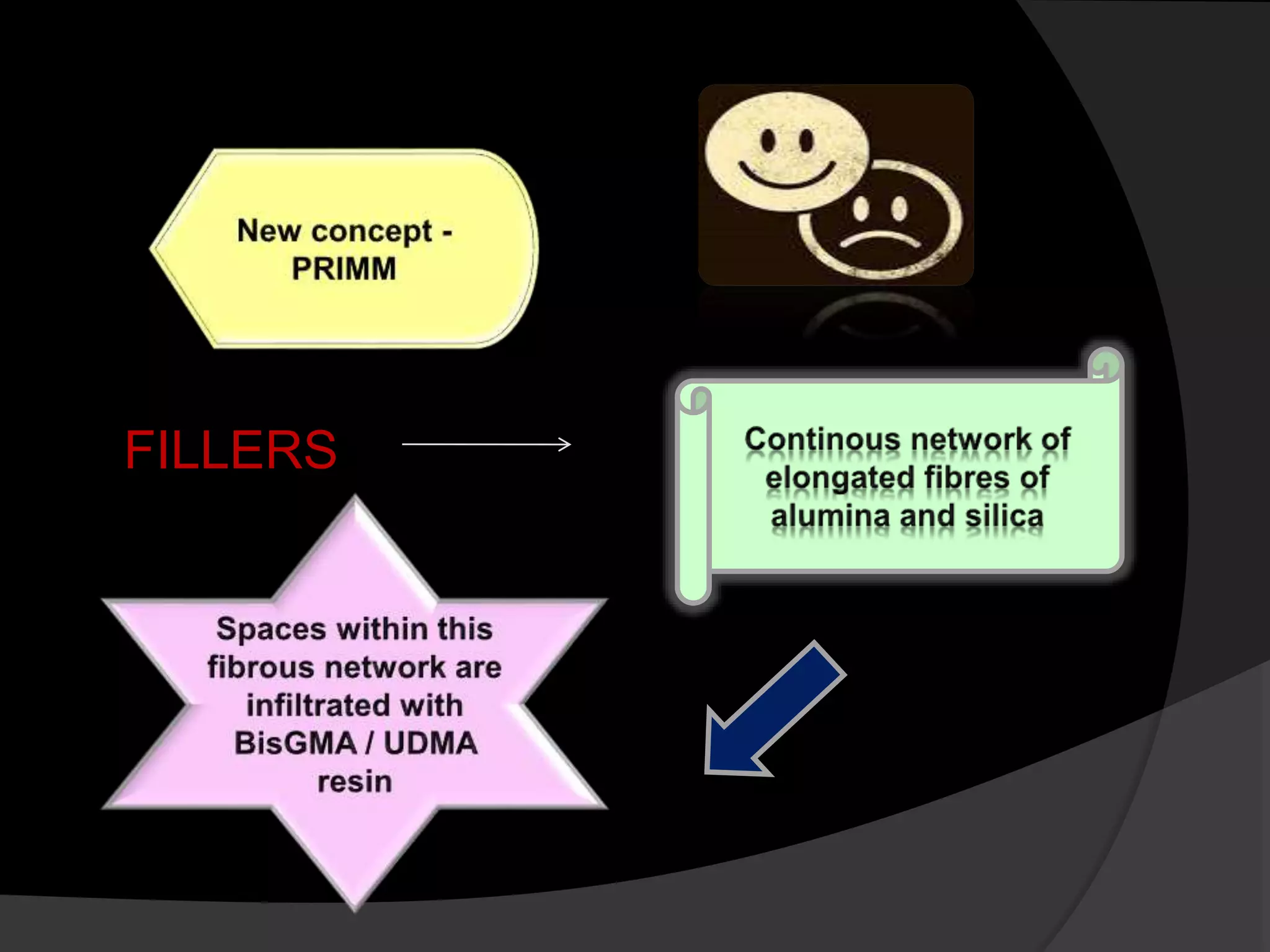
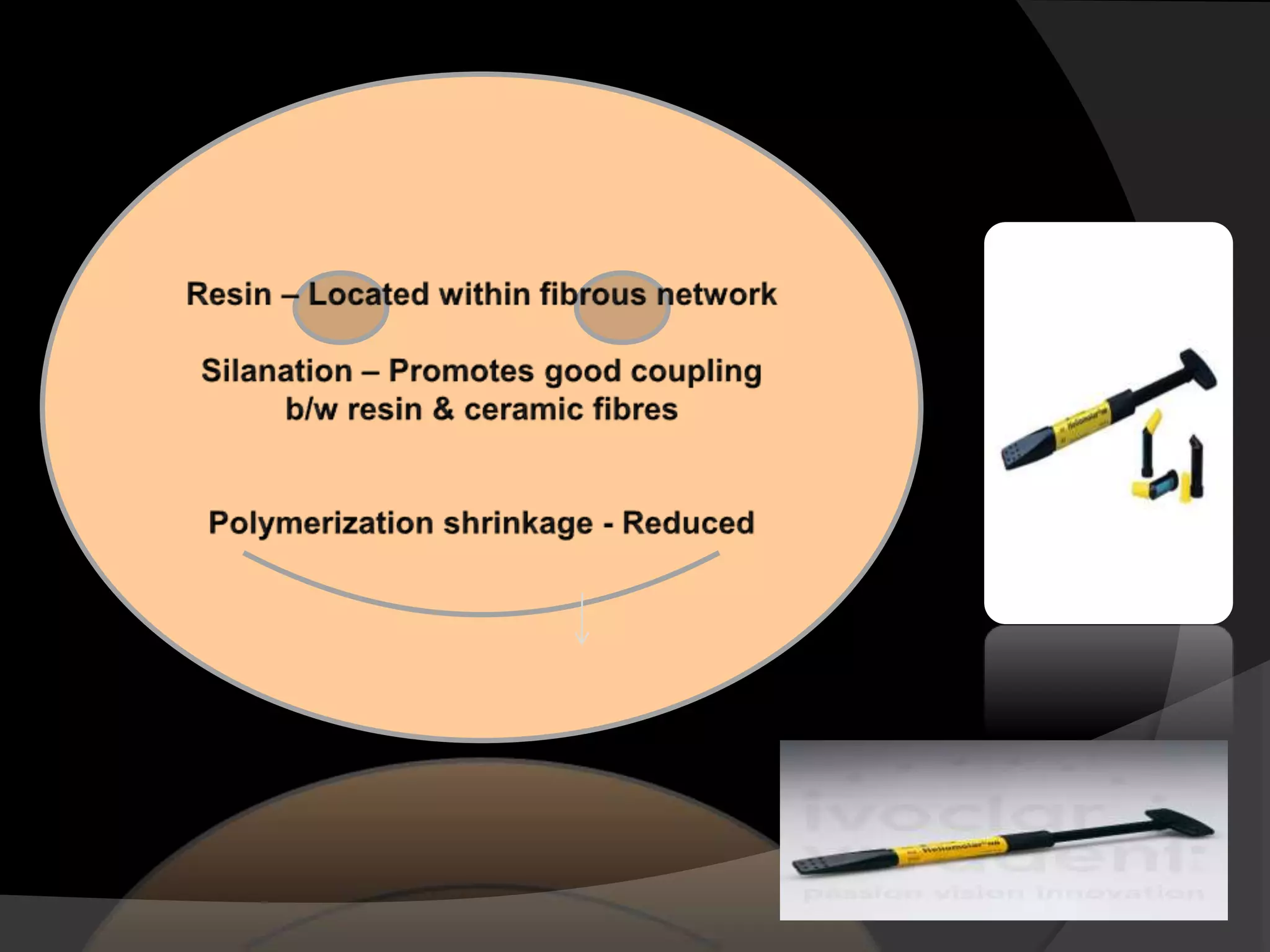
FILLERS
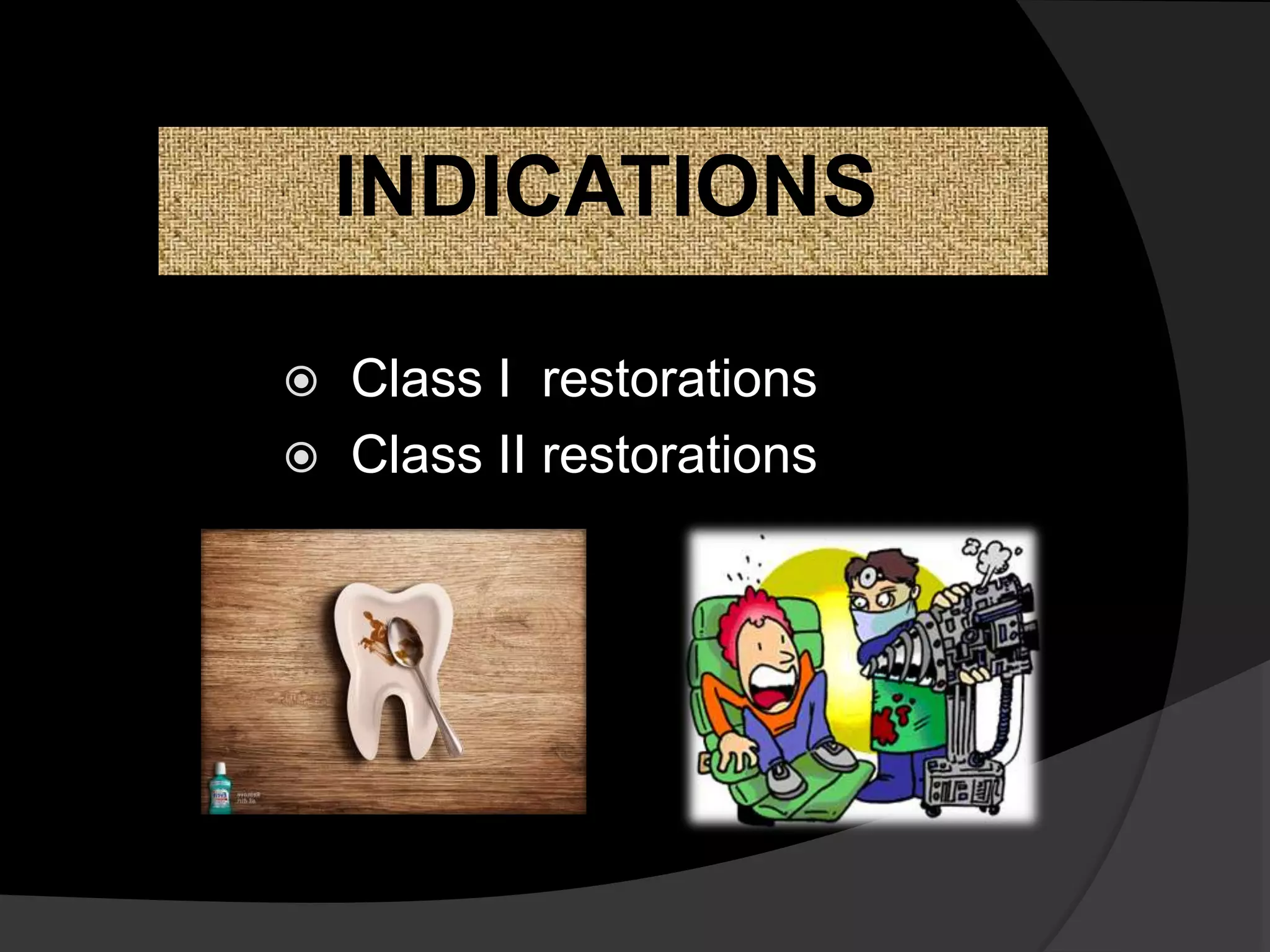
 Class I restorations
 Class II restorations
INDICATIONS
BULKFILL
COMPOSITES
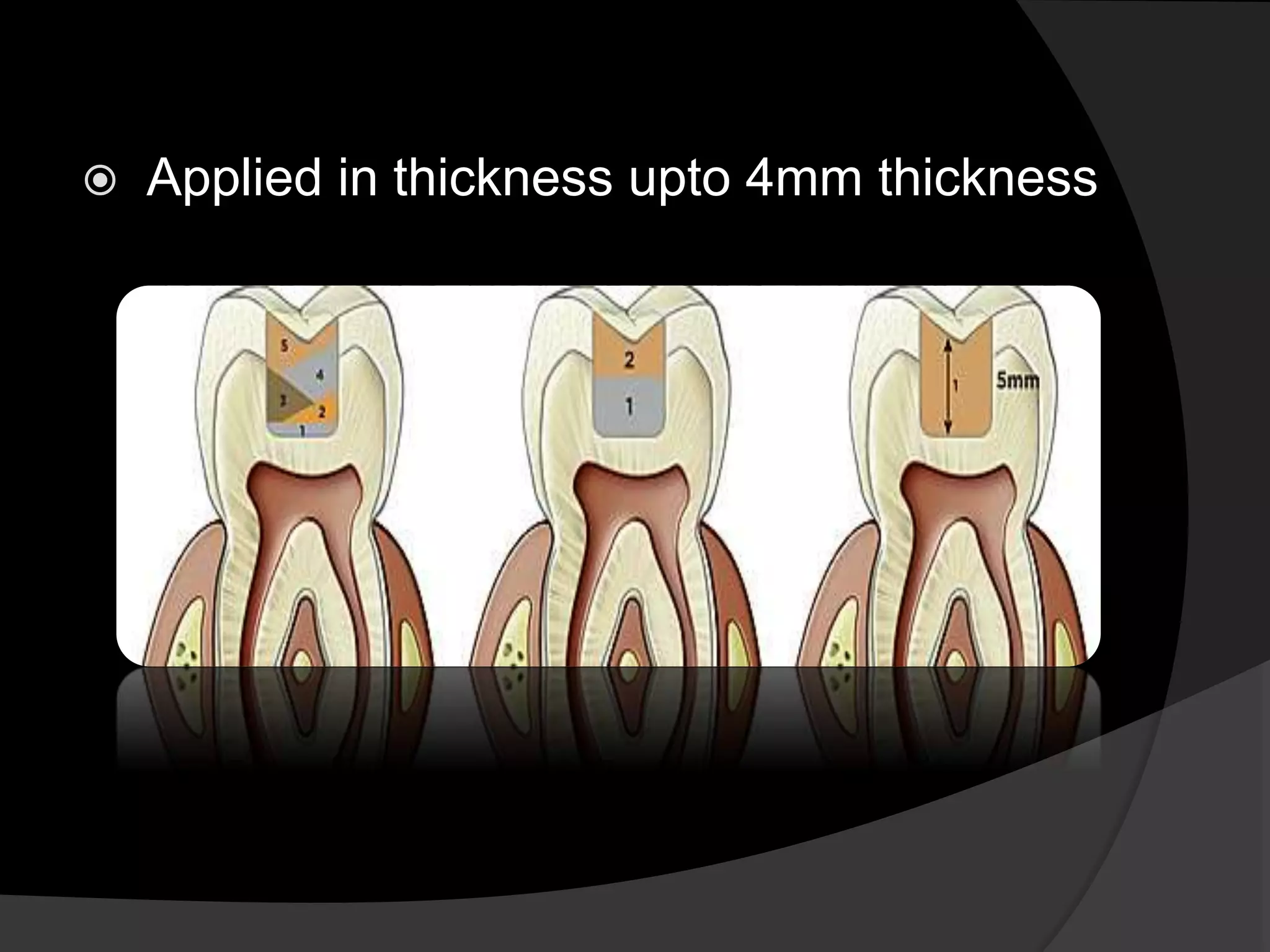
 Applied in thickness upto 4mm thickness
SONICFIL BULKFILL
Filtek Bulfill
Contains two novel methacrylate monomers that in combination
act to lower polymerization stress.
FILTEK
BULKFILL
TETRIC EVO CERAM
BULKFILL
29
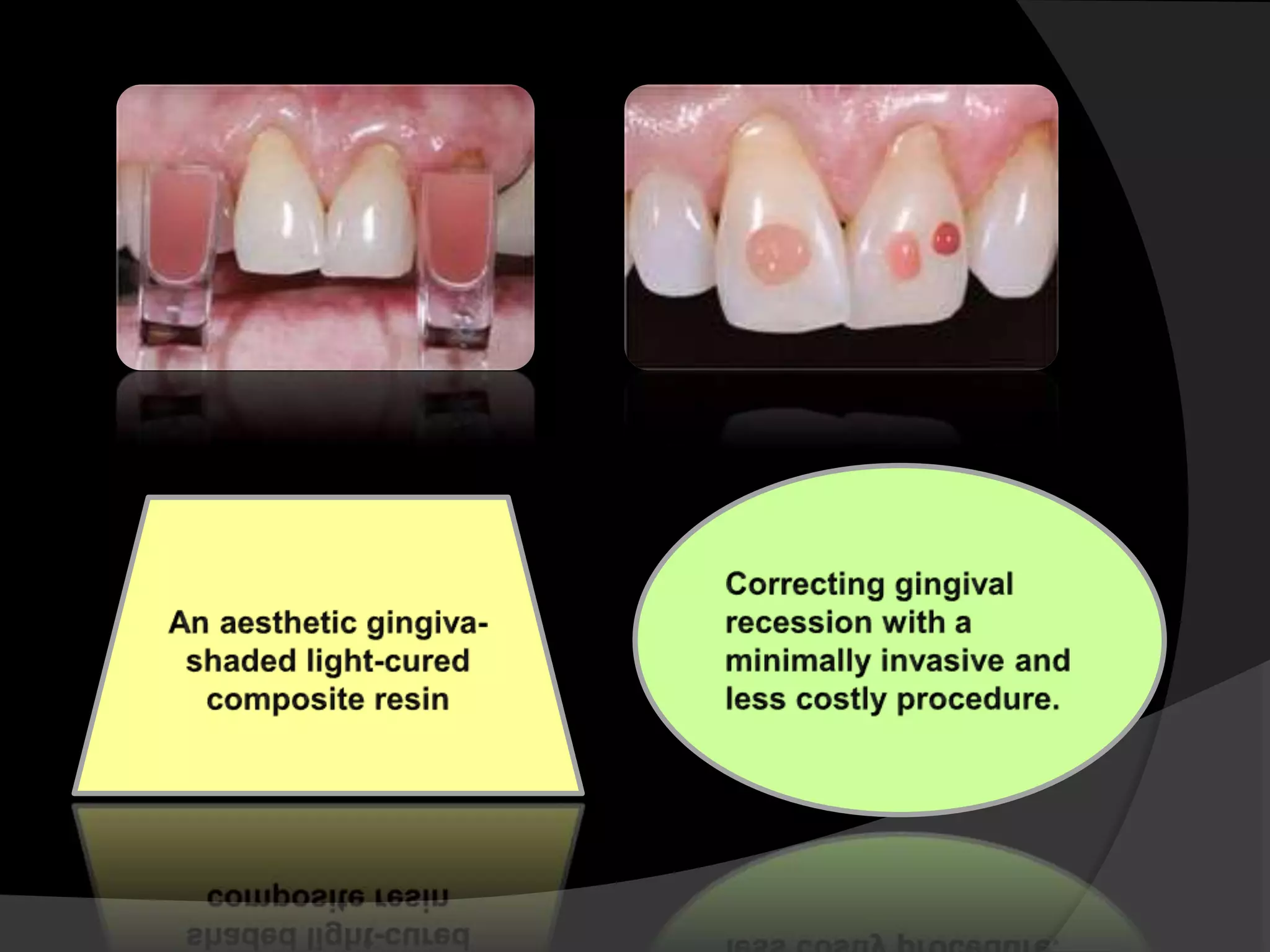
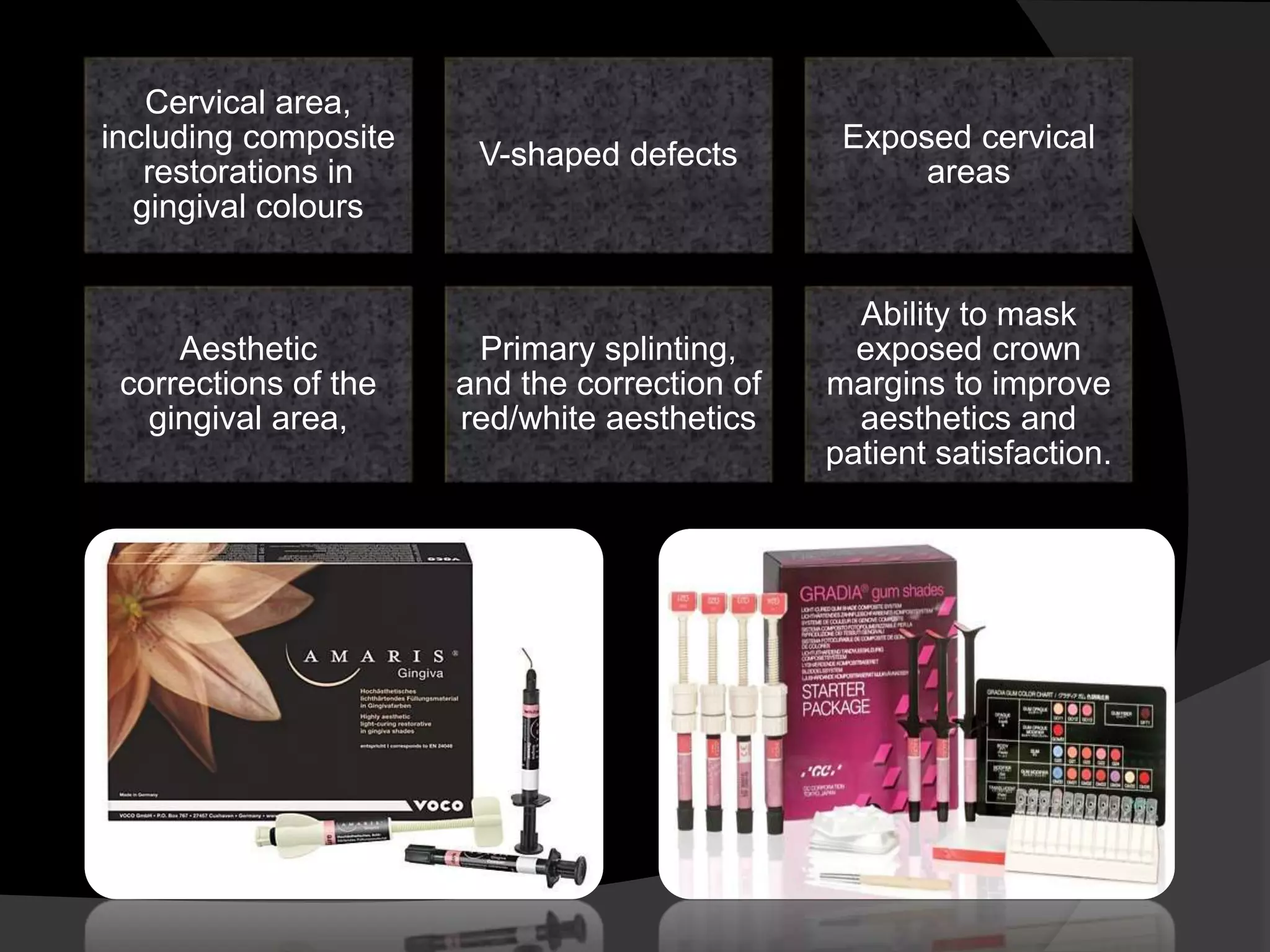
GINGIVAL MASKING
COMPOSITES
Cervical area,
including composite
restorations in
gingival colours
V-shaped defects
Exposed cervical
areas
Aesthetic
corrections of the
gingival area,
Primary splinting,
and the correction of
red/white aesthetics
Ability to mask
exposed crown
margins to improve
aesthetics and
patient satisfaction.
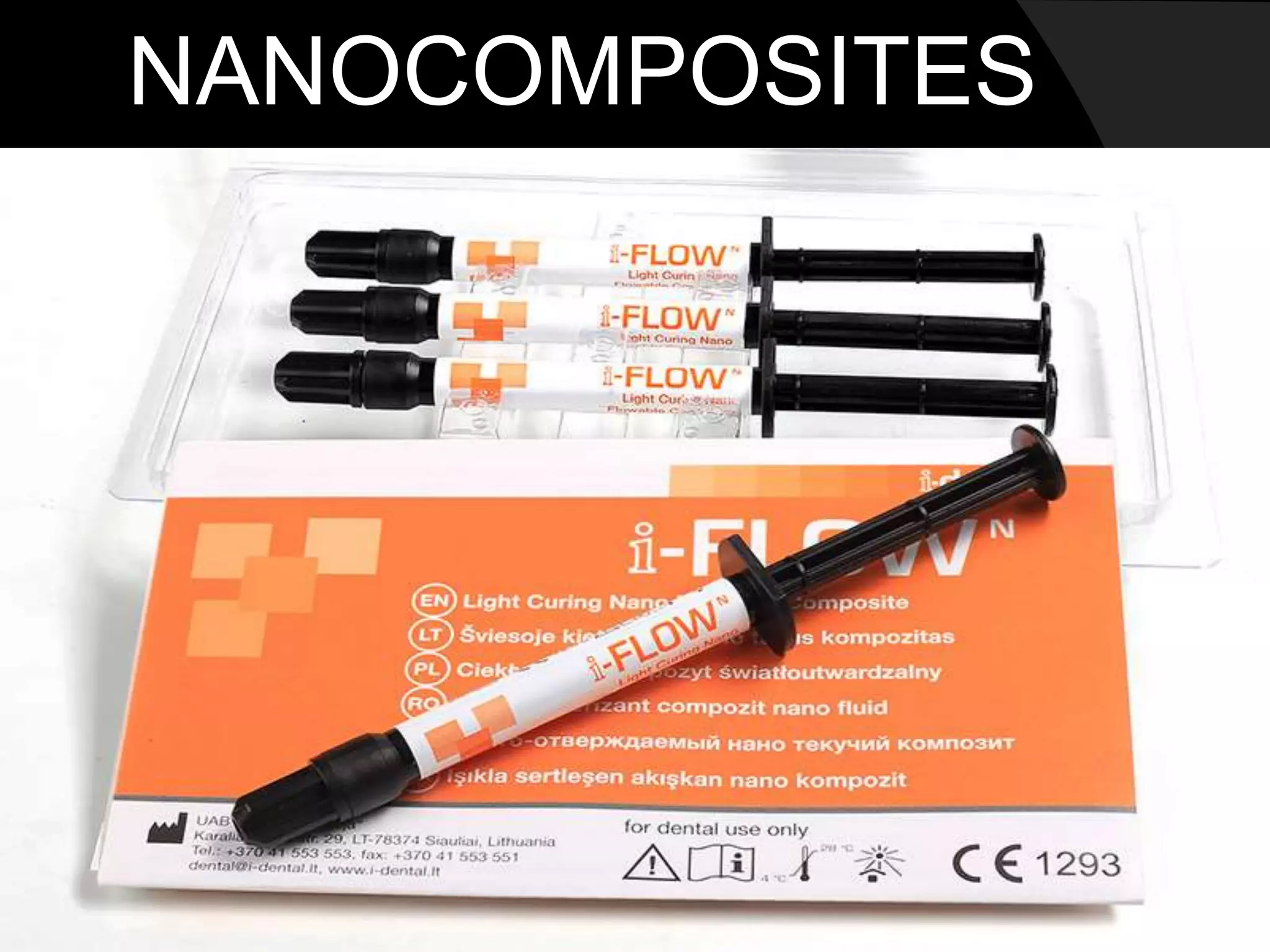
NANOCOMPOSITES
 Nanotechnology consists of reducing components of a
material to the nanometric scale for use in a new material to
improve the final characteristics.
 To establish polish of a microfill but the strength and wear
resistance of hybrid composites
 Particles of size  1-100 nm
Swift, J Esth Rest Dent, 2005
ORMOCERS
 Was introduced to overcome the
limitations and concerns of traditional and
new packable restorative material
 Dr. Herbert Wolters from Fraunhofer
Institute for Silicate Research introduced
this in 1994
Cunha et al., 2003
ORGANICALLY
MODIFIED
CERAMICS
Inorganic-organic co-polymers with
inorganic silanated fillers.
Described as 3-dimensionally cross-linked
copolymers with multi-polymerization with no
residual unreacted monomer
Manufactured by a Sol-Gel Process from Multifunctional Urethane and
thioether(meth)acrylate alkoxy silanes.
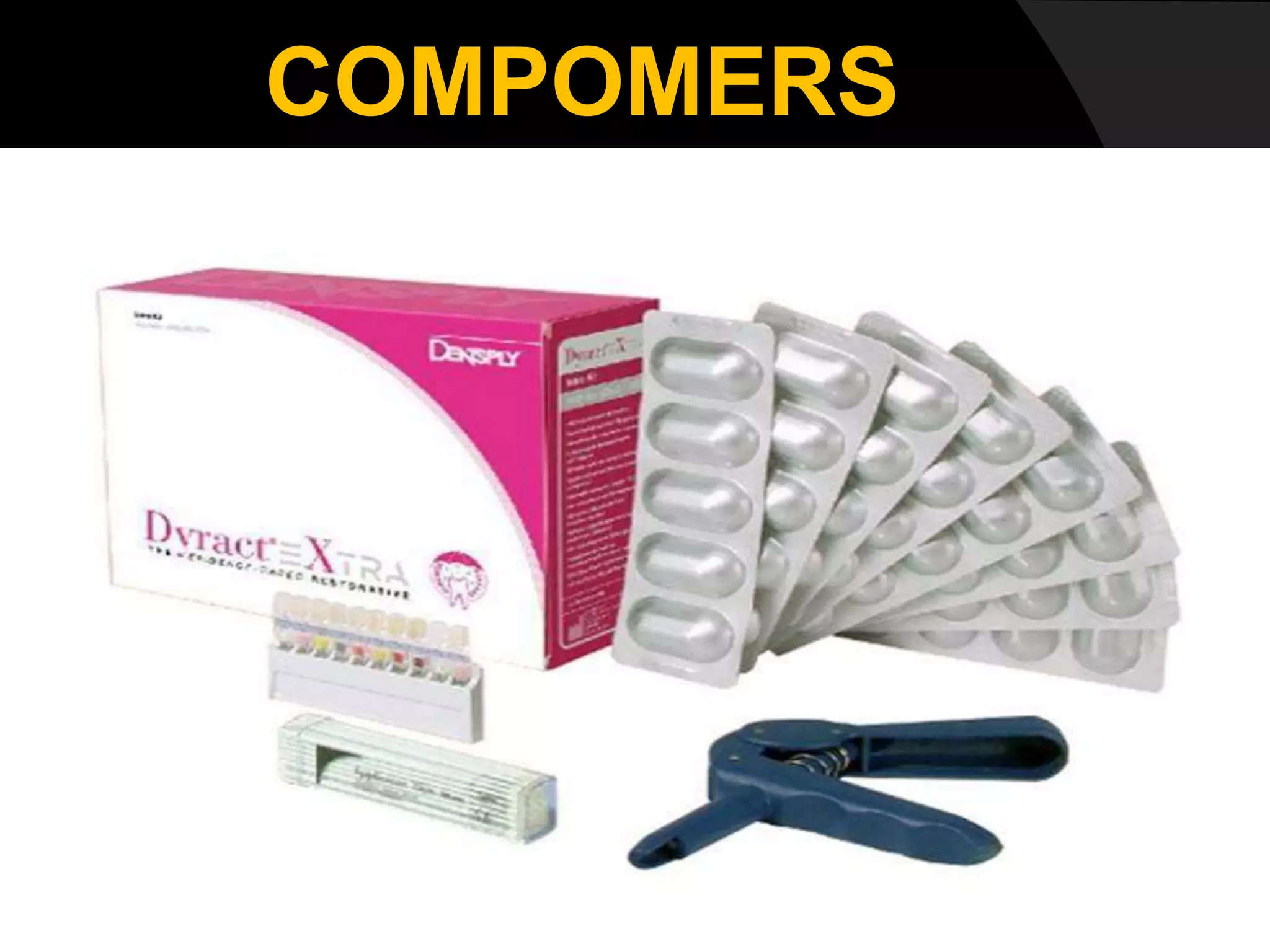
COMPOMERS
• Introduced in 1994.
• An acronym of the words compo site and glass
ionomer.
 Polyacid modified resin composite
 Primarily composite resin-like materials that
contain one or more basic GIC components.
To have a kind of modified composite having the
main advantages of glass ionomer cement.
Compositional modifications
 Certain liquid monomer (HEMA) is modified by polyacrylic acid grafts
 Filler particles similar to the powder of glass ionomer cement
(calcium- fluoro-alumino-silicate- glass)
Drawbacks:
 Using bonding systems still mandatory
 Lower wear resistant < regular composites
 Insignificant release of fluoride
Indications
Sealing
occlusal pits
and fissures Restorations
of primary
teeth
Minimal
cavity
preparations
Lining and
Core build-
up
Repair of
defective
margins in
restorations
Class III,
Class V,
Erosion
lesion -
Restorations
Sealing of
root surface
Potential
root canal
sealers
Retrograde
filing
materials
INDICATIONS
GIOMERS
To overcome some drawbacks of compomers
The filler particles are a kind of
pre-polymerized glass ionomer
agglomerates
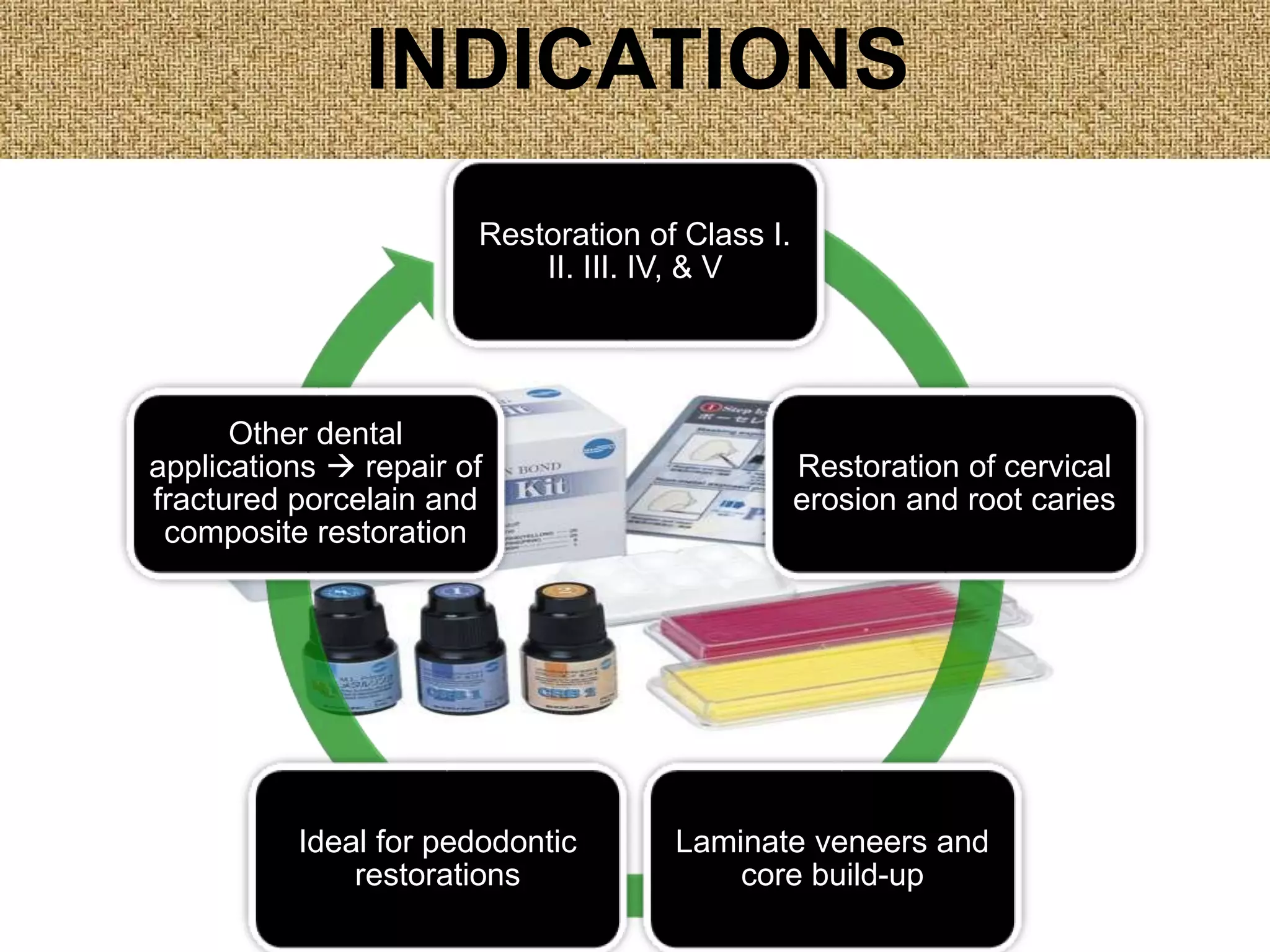
Restoration of Class I.
II. III. IV, & V
Restoration of cervical
erosion and root caries
Laminate veneers and
core build-up
Ideal for pedodontic
restorations
Other dental
applications  repair of
fractured porcelain and
composite restoration
INDICATIONS
SMART COMPOSITES
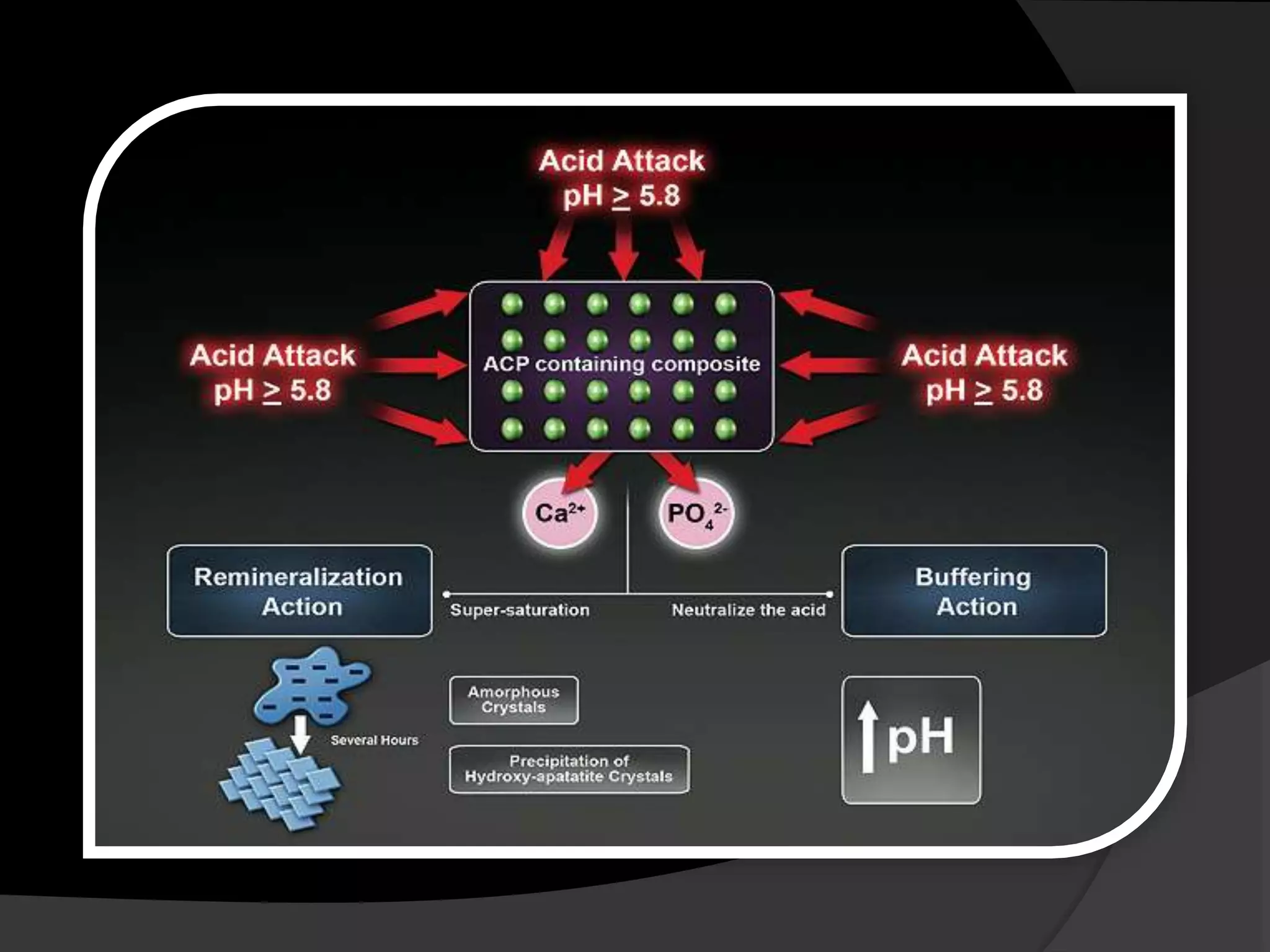
 Smart Composites are active
dental polymers that contain
bioactive amorphous calcium
phosphate (ACP) filler capable of
responding to environmental pH
changes by releasing calcium
and phosphate ions and thus
become adaptable to the
surroundings.
 These are also called as
Intelligent composite
49
 Ivoclair introduced a material named Ariston
pHC (pH control).
 Releases Fluoride & Ca Hydroxide when the pH in
restoration in the material is less than 5.5
 Ariston is an ion releasing composite
material, which releases fluoride, hydroxyl
and calcium ions as the pH drops in the
areas immediately adjacent to the restorative
material. This is said to neutralize the acid
and counteract the decalcification of enamel /
dentin.
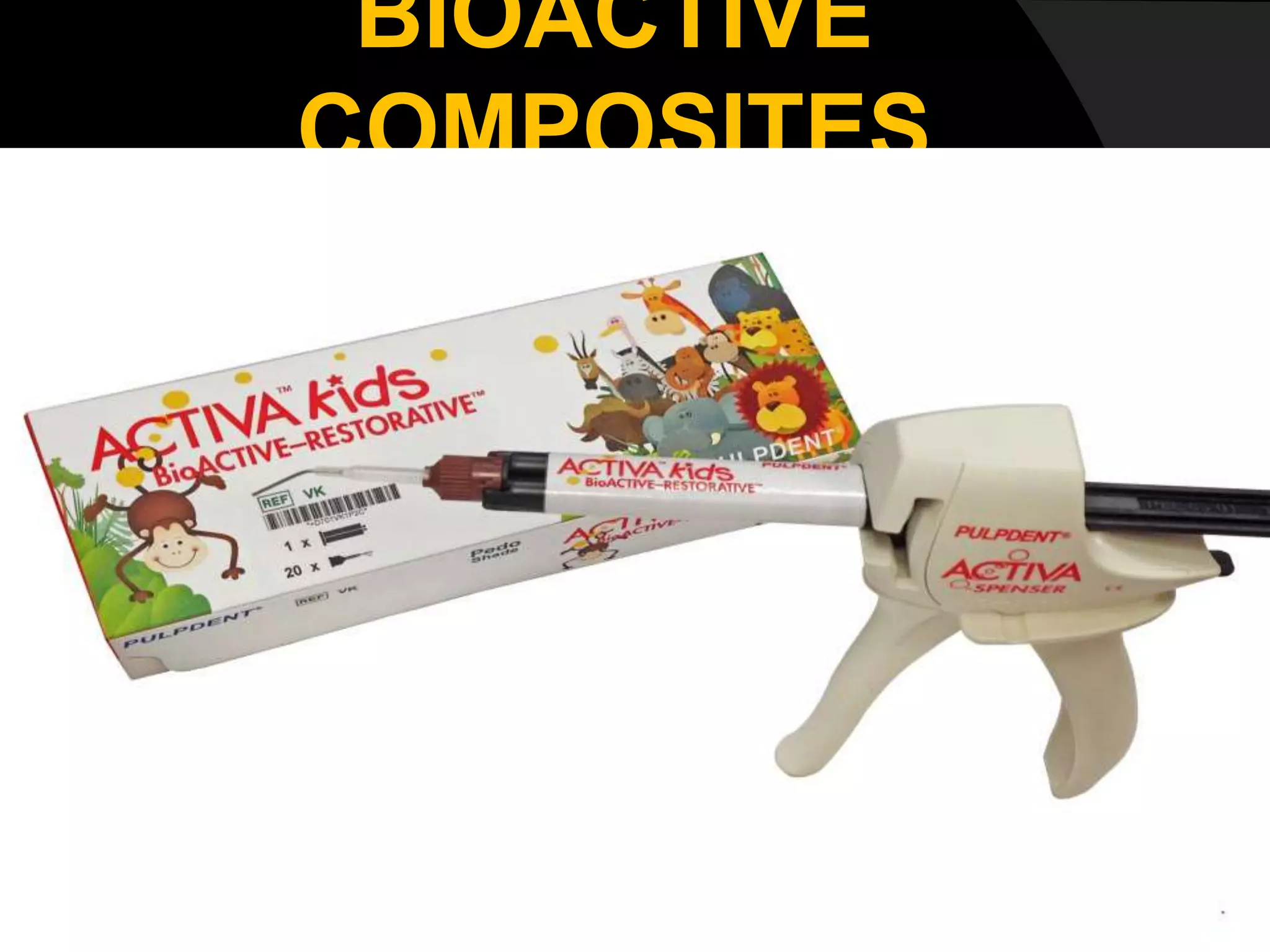
BIOACTIVE
COMPOSITES
BIOACTIVE FORMULATIONS
 -ACP (amorphous calcium phosphate)-2000
 -ACP + BIS-GMA /TEGDMA/HEMA with Zirconyl
methacrylate
 Fluorinated Bis-GMA analogues
 Liquid crystalline monomers
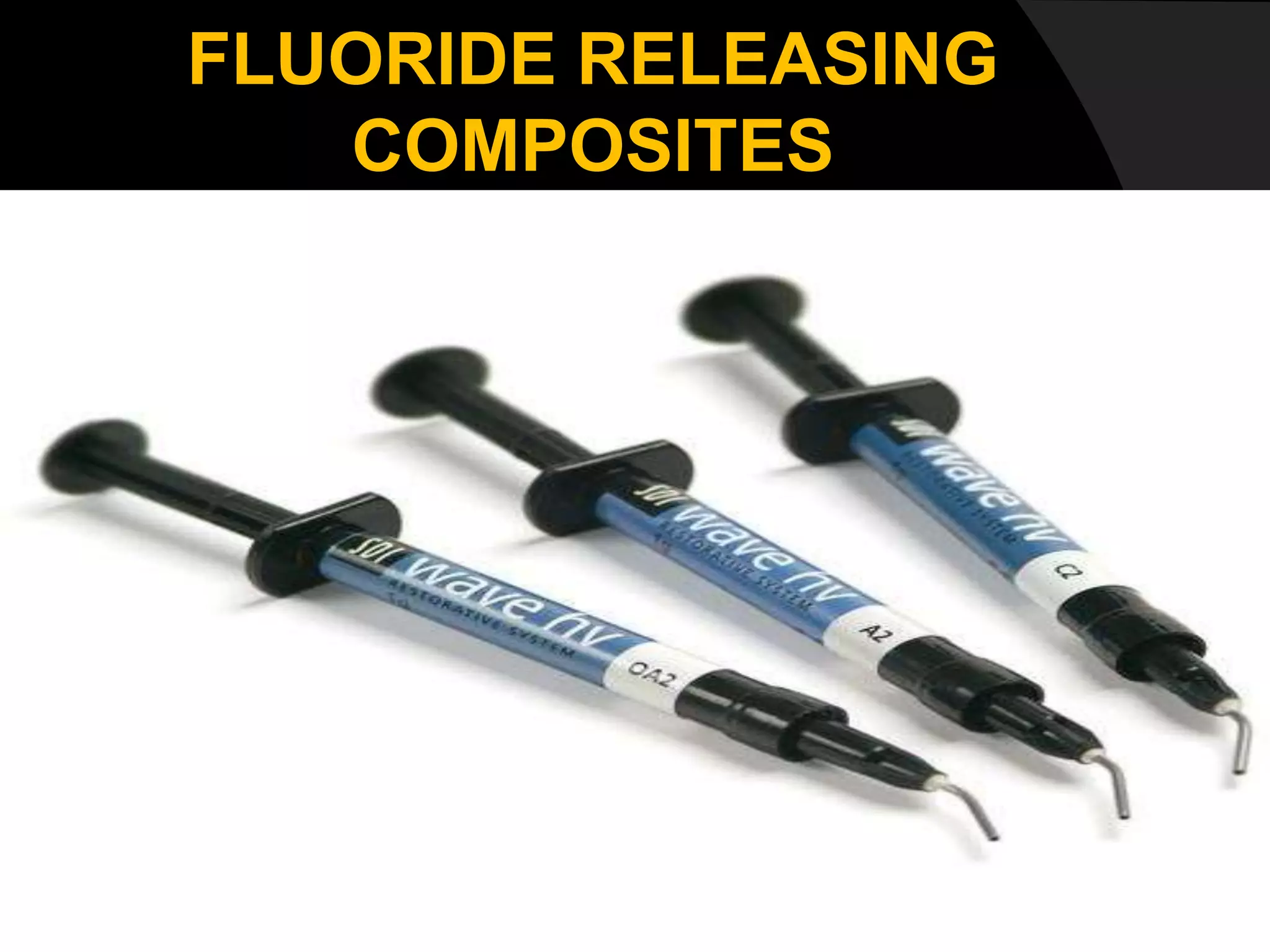
FLUORIDE RELEASING
COMPOSITES
Methacryloyl fluoride –
Methyl methacrylate
copolymer in pit and fissure
sealant where fluoride
delivery lasted for 2 years
Diethylaminoethyl
methacrylate into dental resin
system - Fluoride is released
by hydrolysis at a rate of 2-
5µg/cm2/day for 1 year.
CEROMERS
 Class I and II posterior restorations (stress
bearing areas)
 Class III and IV anterior restorations
 Class V restorations cervical caries, root erosion,
abfraction, wedge-shaped defects
 Inlays/onlays with extraoral post-tempering
INDICATIONS
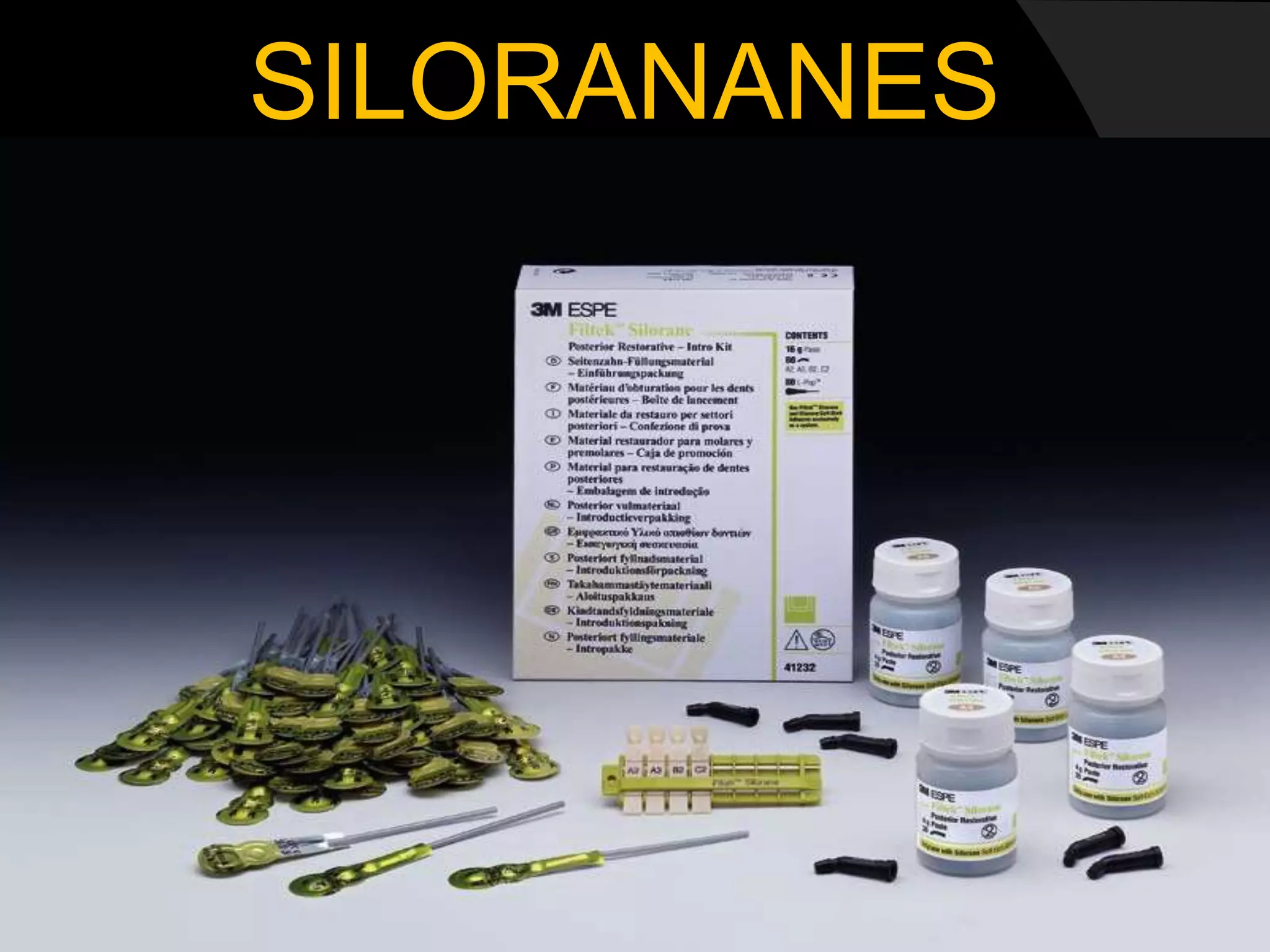
SILORANANES
 Guggenburger and Weinmann (2000)
 Siloxane + oxiranes
 Siloxane backbone – hydrophobic nature
 Ring opening monomers, cationic cure
As silorane-based
composite polymerizes,
“ring-opening”
monomers connect by
opening, flattening and
extending toward each
other.
As methacrylate-based
composites cure, the
molecules of these
“linear monomers”
connect by actually
SHIFTING closer
together in a linear
response.
ANTI BACTERIAL
COMPOSITES
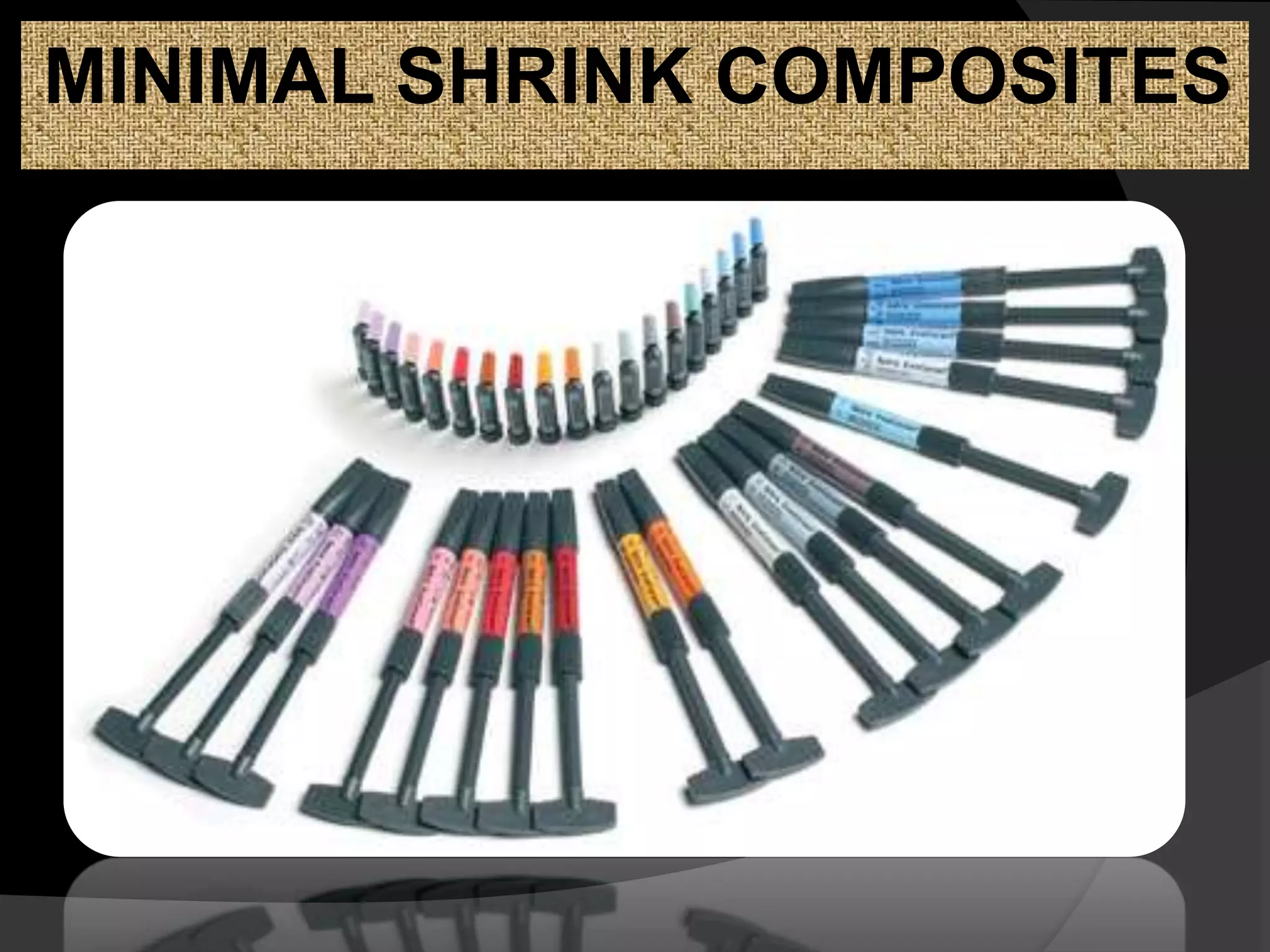
MINIMAL SHRINK COMPOSITES
The development of minimal-shrink composites
was based on ….
1. INCREASING THE FILLER LOAD
 Using prepolymerized composite fillers
 Using nano-sized fillers (Tetric
Evoceram, Ivoclar-Vivadent)
2. USING ORGANIC MATRICES WITH
LOWER POLYMERIZATION SHRINKAGE
 Spiro-orthocarbonate, can produce
composites with no setting contraction,
 Oxy bis-methacrylates (bifunctional
monomer) shows also a reduced rate of
the polymerization contraction
 Oxirane and silorane-based monomers
(Feltick LS, 3M-ESPE)
CHITOSAN
COMPOSITES
 Chitosan and chitosan derivatives appear to be good
candidates for the elastomeric matrix
 These natural biopolymers – Biocompatible,
Biodegradable and Osteoconductive.
 CPC–chitosan composites - Stable in a wet environment
 Have sufficient physical strength
SELF HEALING
COMPOSITES
One material – Showed similarities to resin based dental material
If a crack occurs in the epoxy resin material, some of the
microcapsules are destroyed near the the crack & release the resin.
The resin fills the crack & reacts with Grubbs catalyst dispersed in the
epoxy composite resulting in polymerization of resin & repair of crack
P. Benly et al., 2016
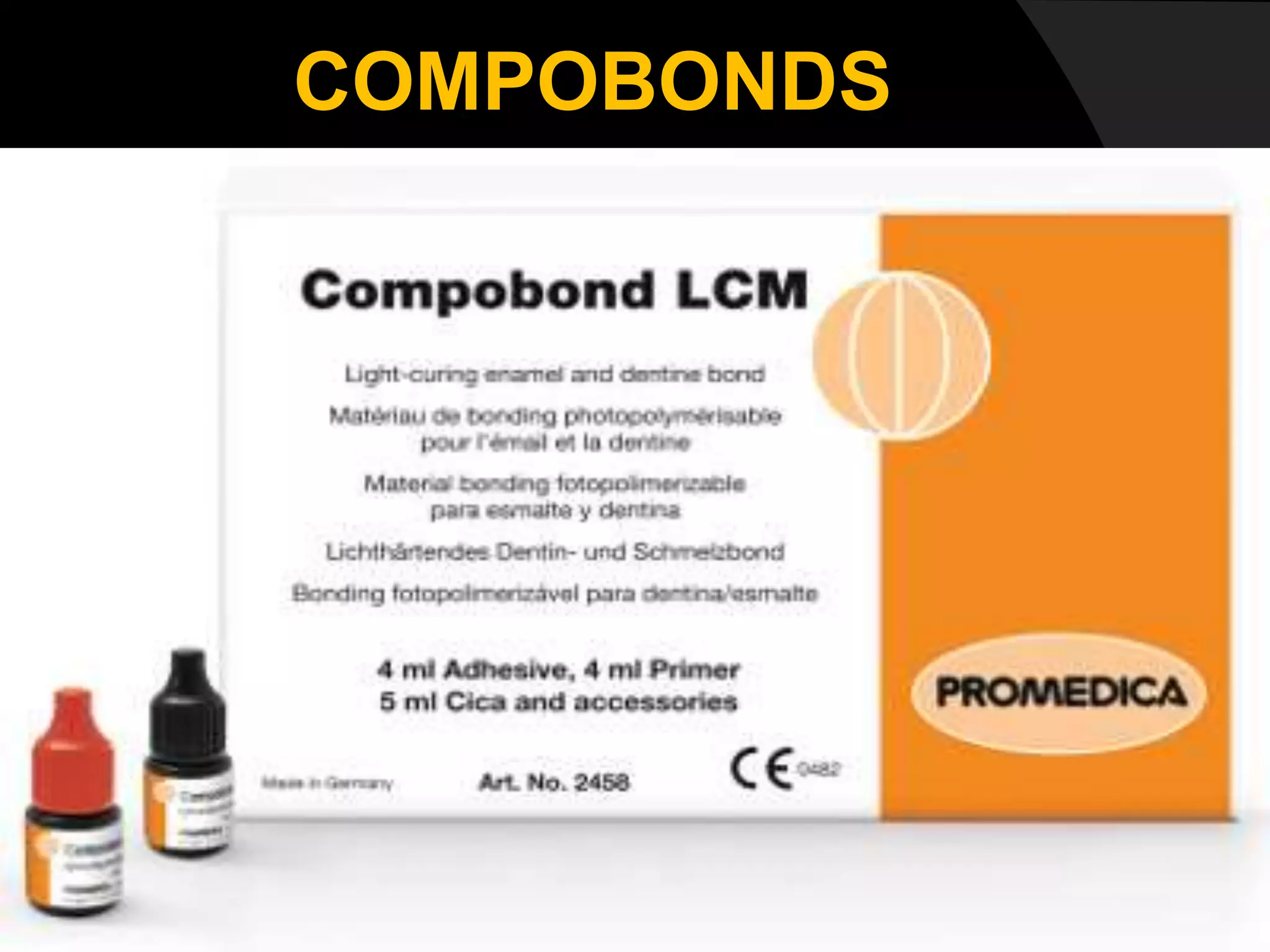
COMPOBONDS
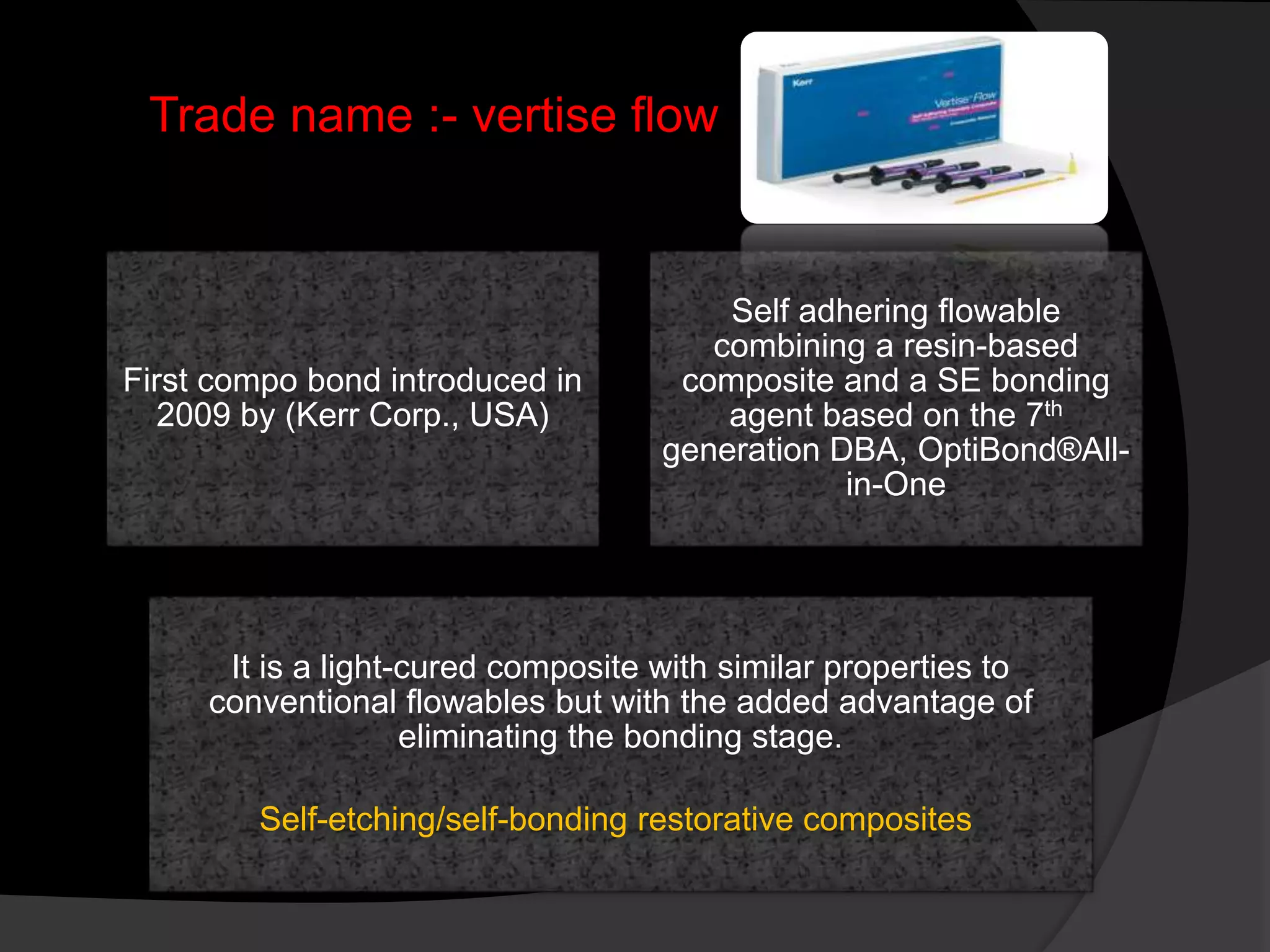
Trade name :- vertise flow
First compo bond introduced in
2009 by (Kerr Corp., USA)
Self adhering flowable
combining a resin-based
composite and a SE bonding
agent based on the 7th
generation DBA, OptiBond®All-
in-One
It is a light-cured composite with similar properties to
conventional flowables but with the added advantage of
eliminating the bonding stage.
Self-etching/self-bonding restorative composites
Rationale
 To get restorations with higher mechanical properties
 To reduce the subsequent effect of the polymerization shrinkage
(i.e. weak bonding, microleakage, improper contact)
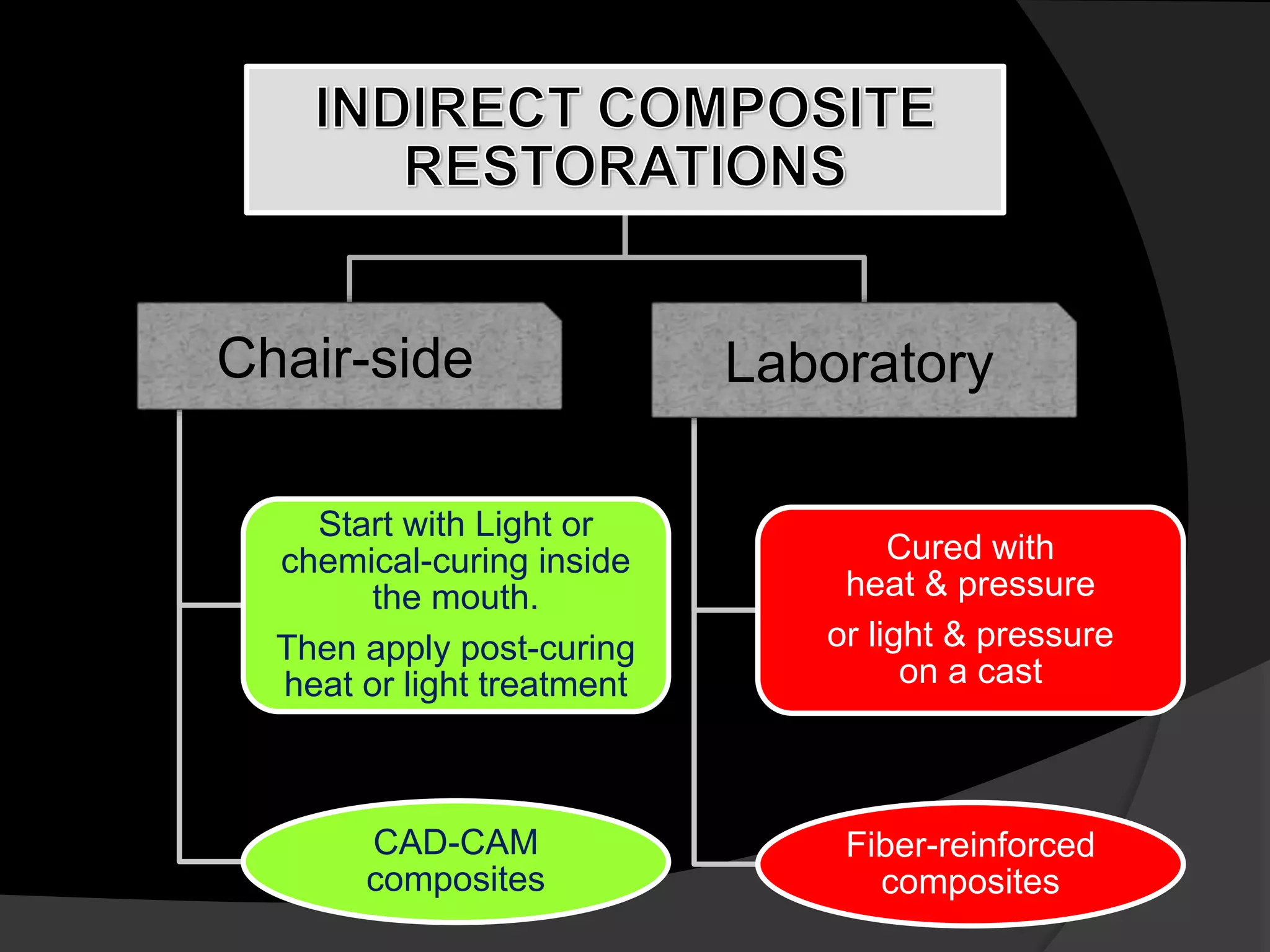
Chair-side
Start with Light or
chemical-curing inside
the mouth.
Then apply post-curing
heat or light treatment
CAD-CAM
composites
Laboratory
Cured with
heat & pressure
or light & pressure
on a cast
Fiber-reinforced
composites
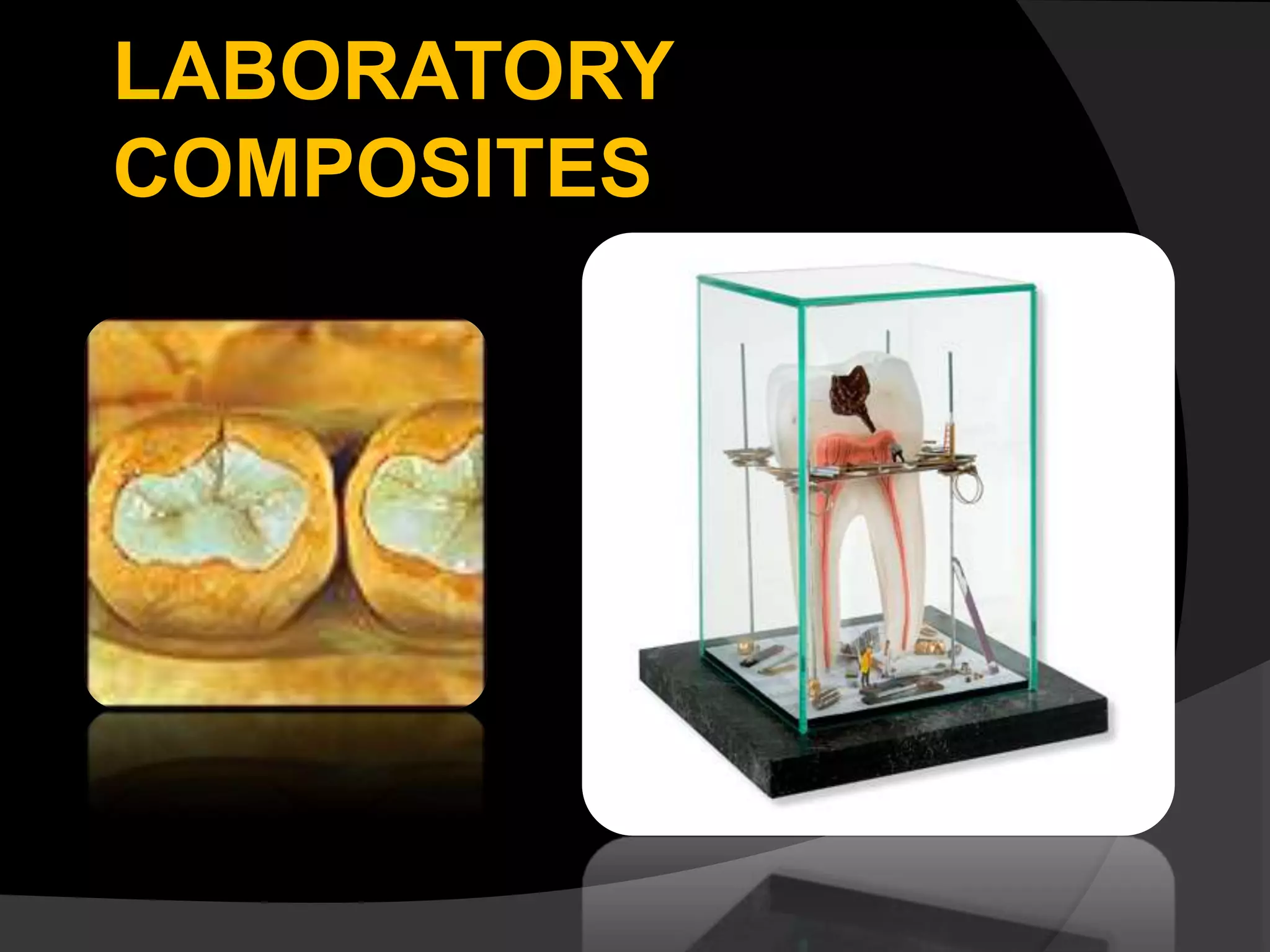
LABORATORY
COMPOSITES
FIRST GENERATION
Introduced in 1980s as an attempt to decrease the
rate of the polymerization shrinkage and Improve the wear
resistance of the restoration.
MANUFACTURERPRODUCT COMMERCIAL NAME
3M-ESPE1. Visio-gem
Kulzer2. Denta Color
Ivoclar-Vivadent3. Concept
Ivoclar-Vivadent4. Isoset
SECOND GENERATION
Appeared in 1990s and named ceromers, most of
these materials are light-cured over a cast for 60 seconds and
then followed with heat treatment.
MANUFACTURERPRODUCT COMMERCIAL NAME
Heraeus-Kulzer1. Artglass
Kerr2. BelleGlass
Ivoclar-Vivadent3. Targis
3M-ESPE4. Simphony
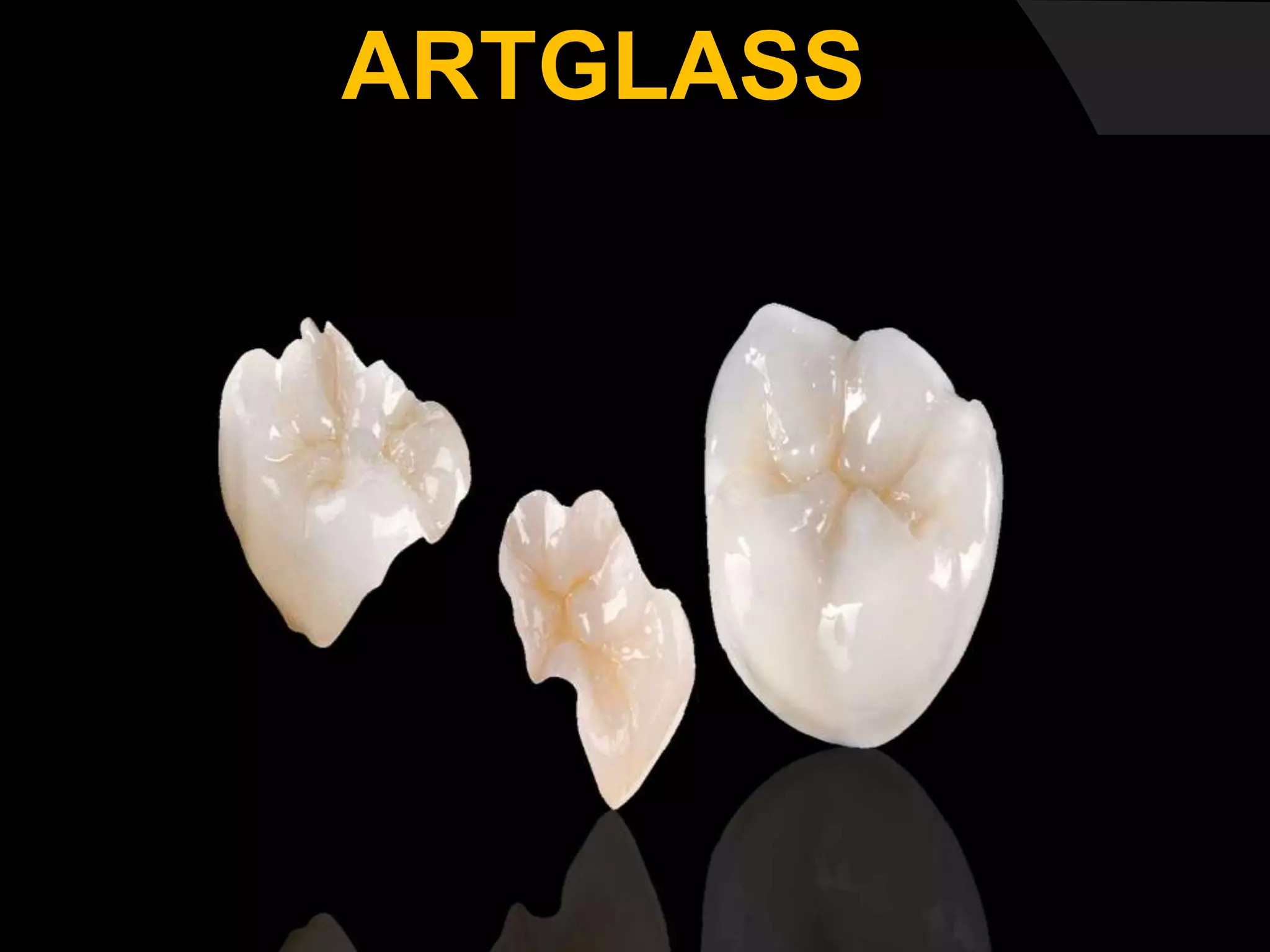
ARTGLASS
 Launched in 1995 by Heraeus-kulzer
MATRIX FILLER
Organic resin matrix
[BisGMA / UDMA]
Barium silicate glass
0.7µ
ADVANTAGES
 Wear resistant
 Better marginal adaptation
 Better esthetics
 Superior proximal contact
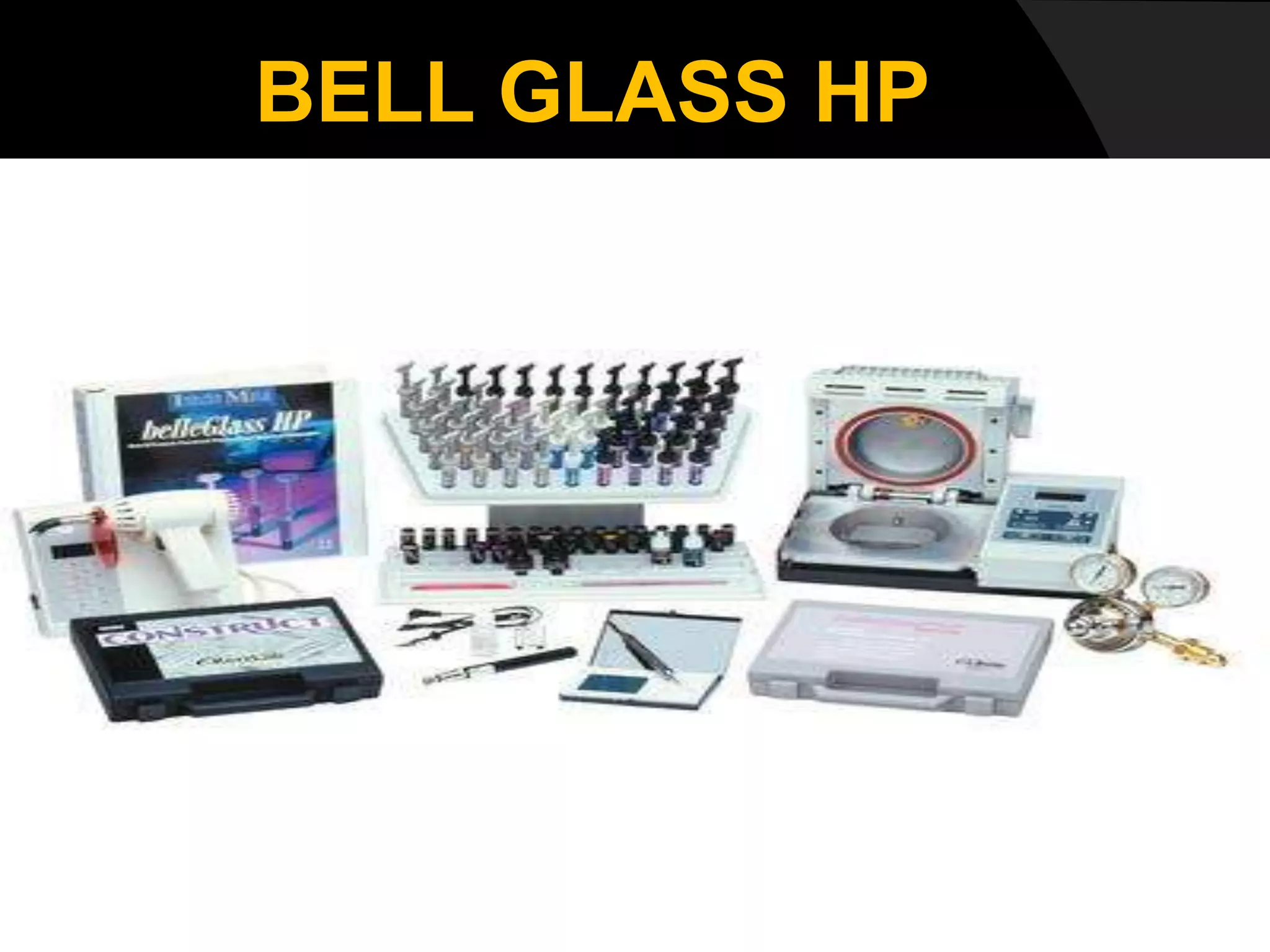
BELL GLASS HP
 Introduced by Belle de St. Claire in 1996
 Resin matrix – BisGMA & fillers
 Belleglass
Polymerized
Esthetically appealing & wear resistant
Pressure – 29psi Reduces the
vaporization potential
of monomers
Temperature – 138ºC Increases the
polymerization rate
Nitrogen – Inert gas Increase in wear
resistance
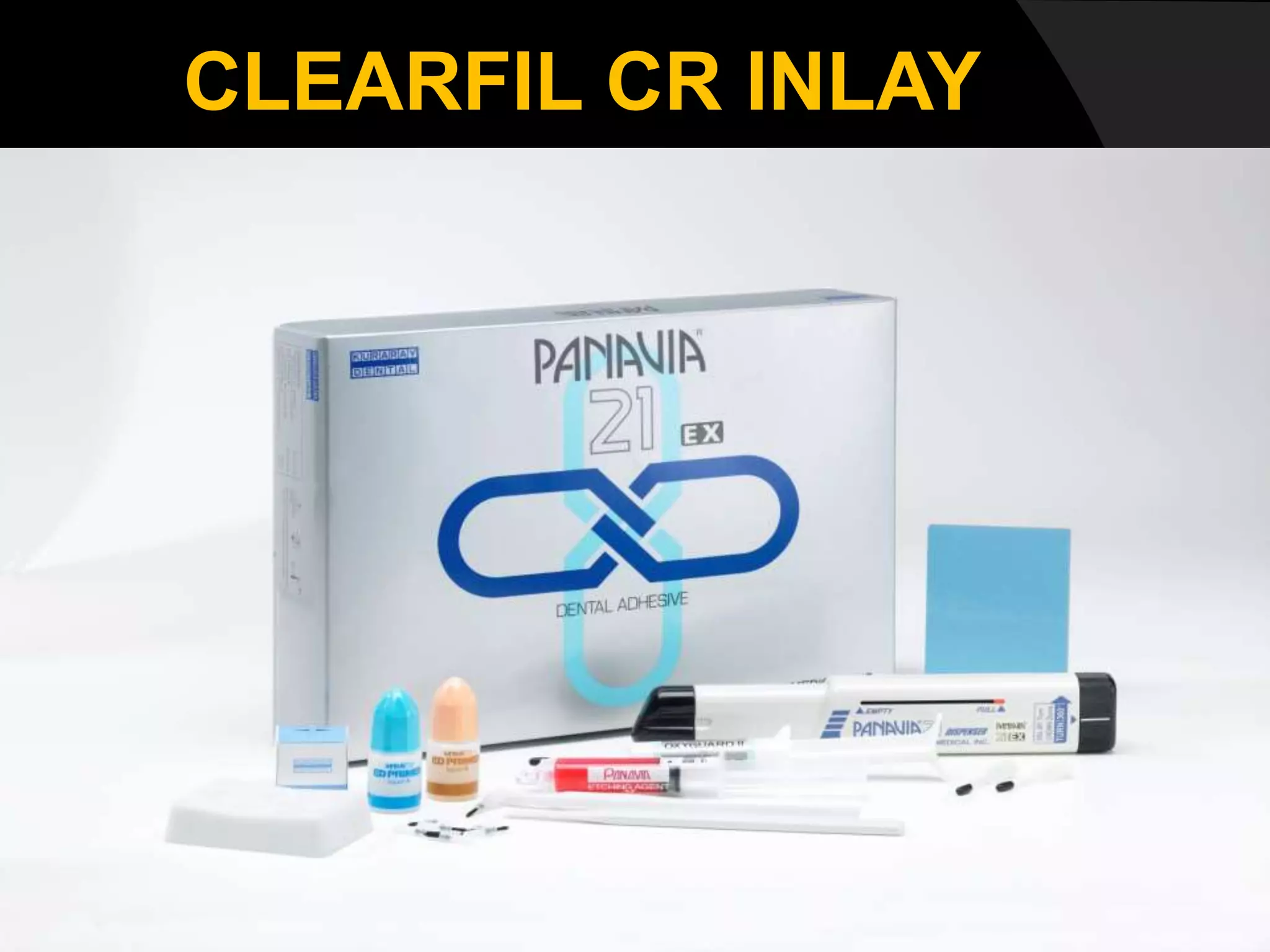
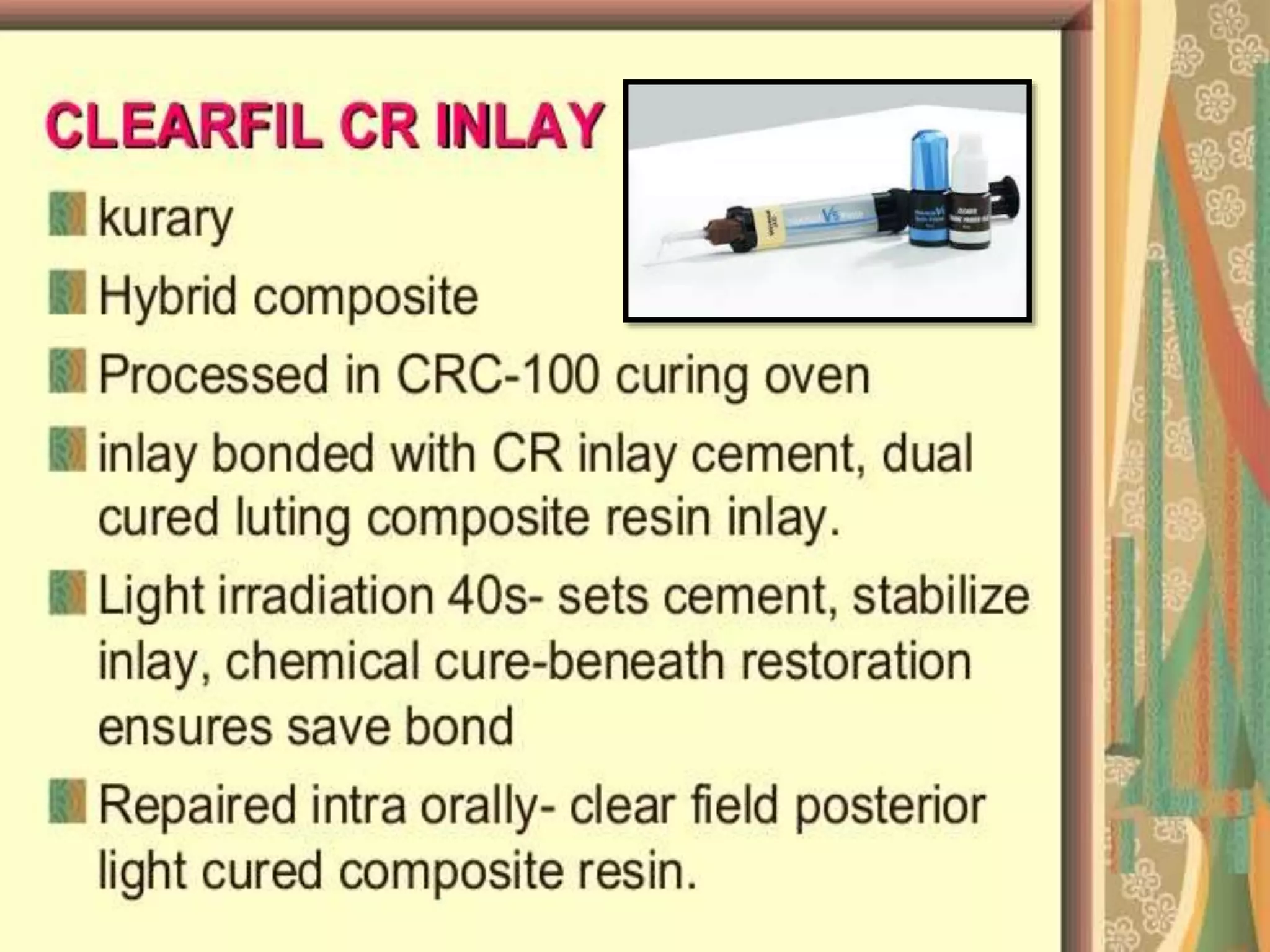
CLEARFIL CR INLAY
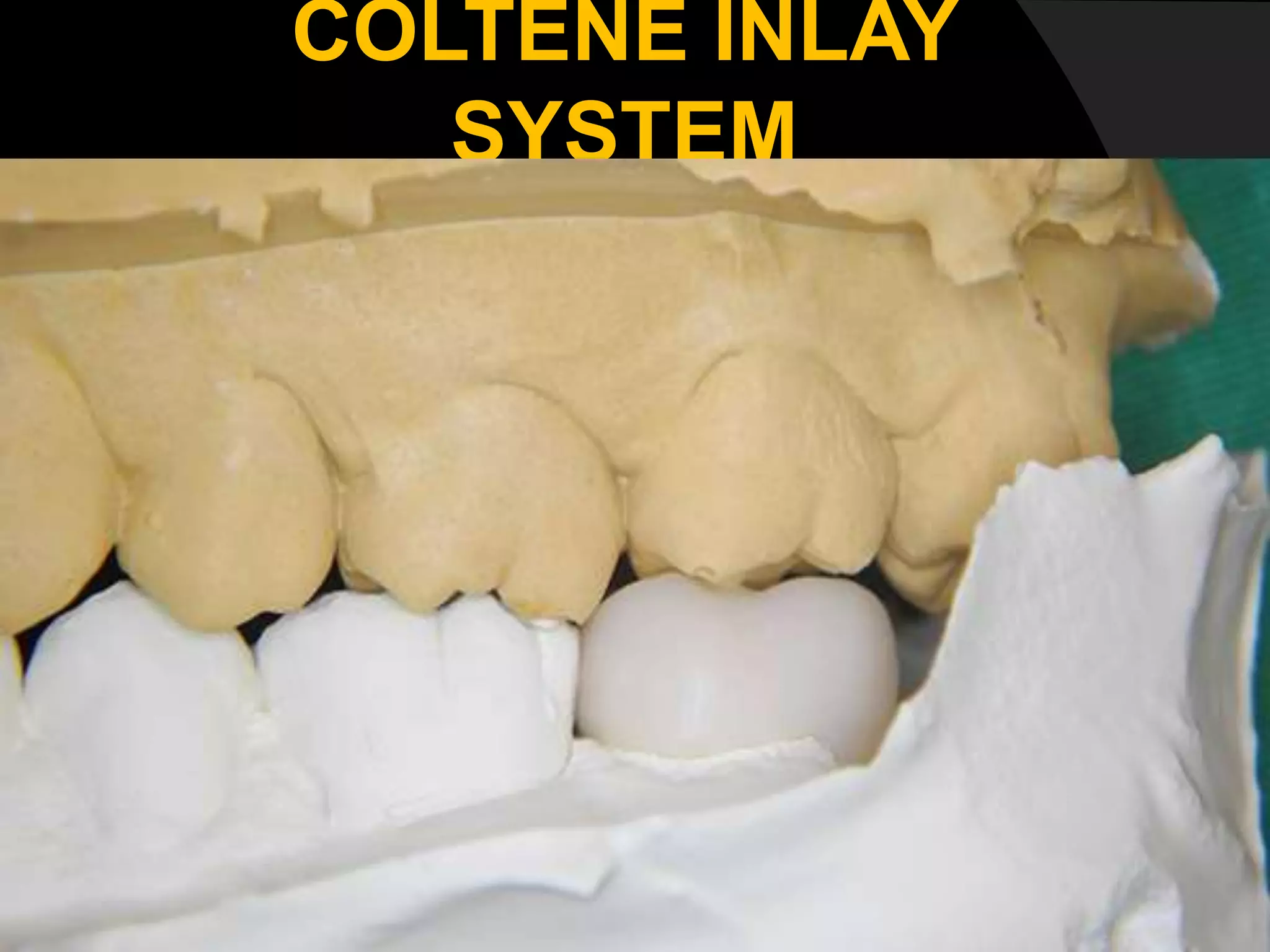
COLTENE INLAY
SYSTEM
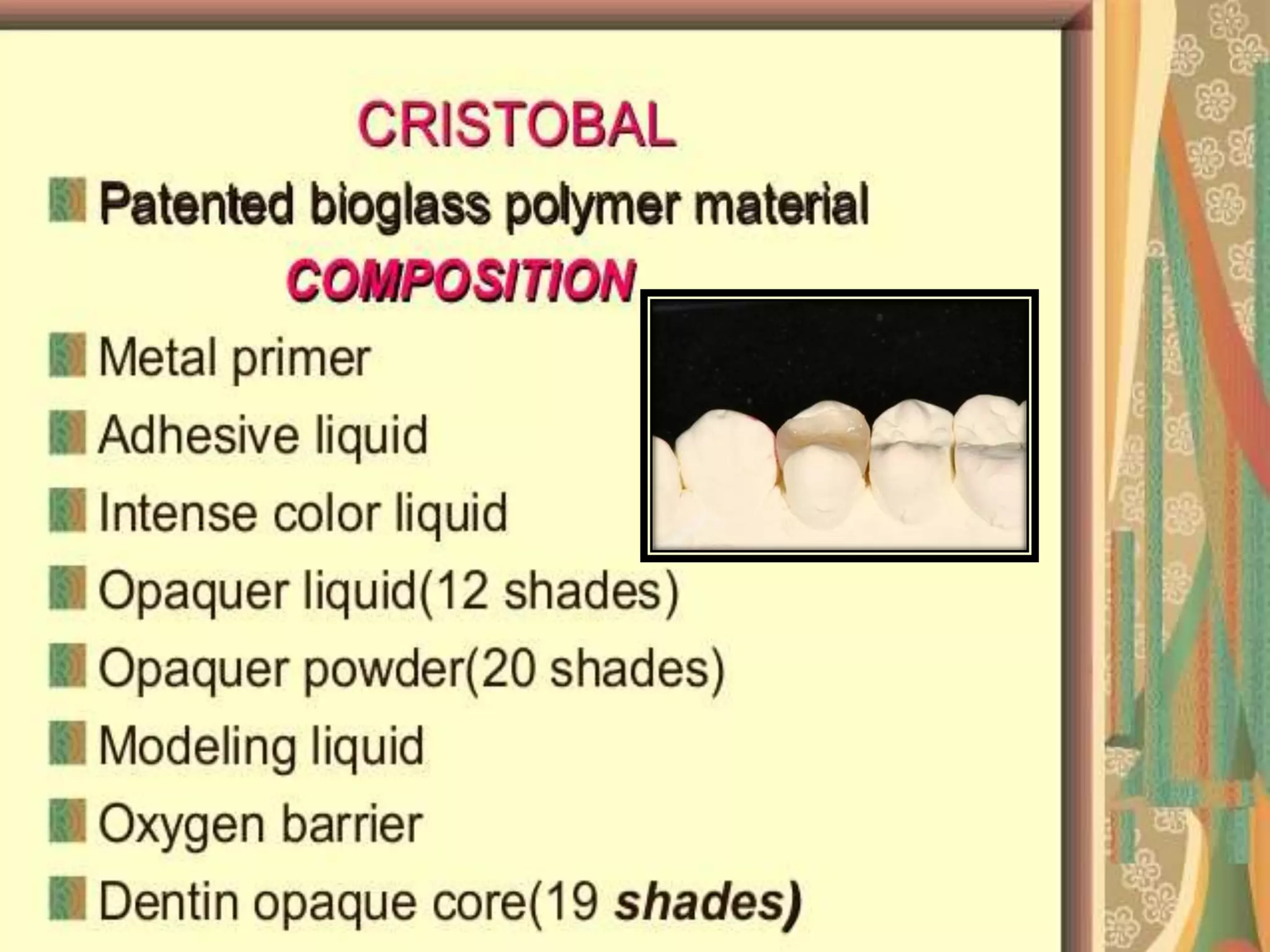
CRISTOBAL
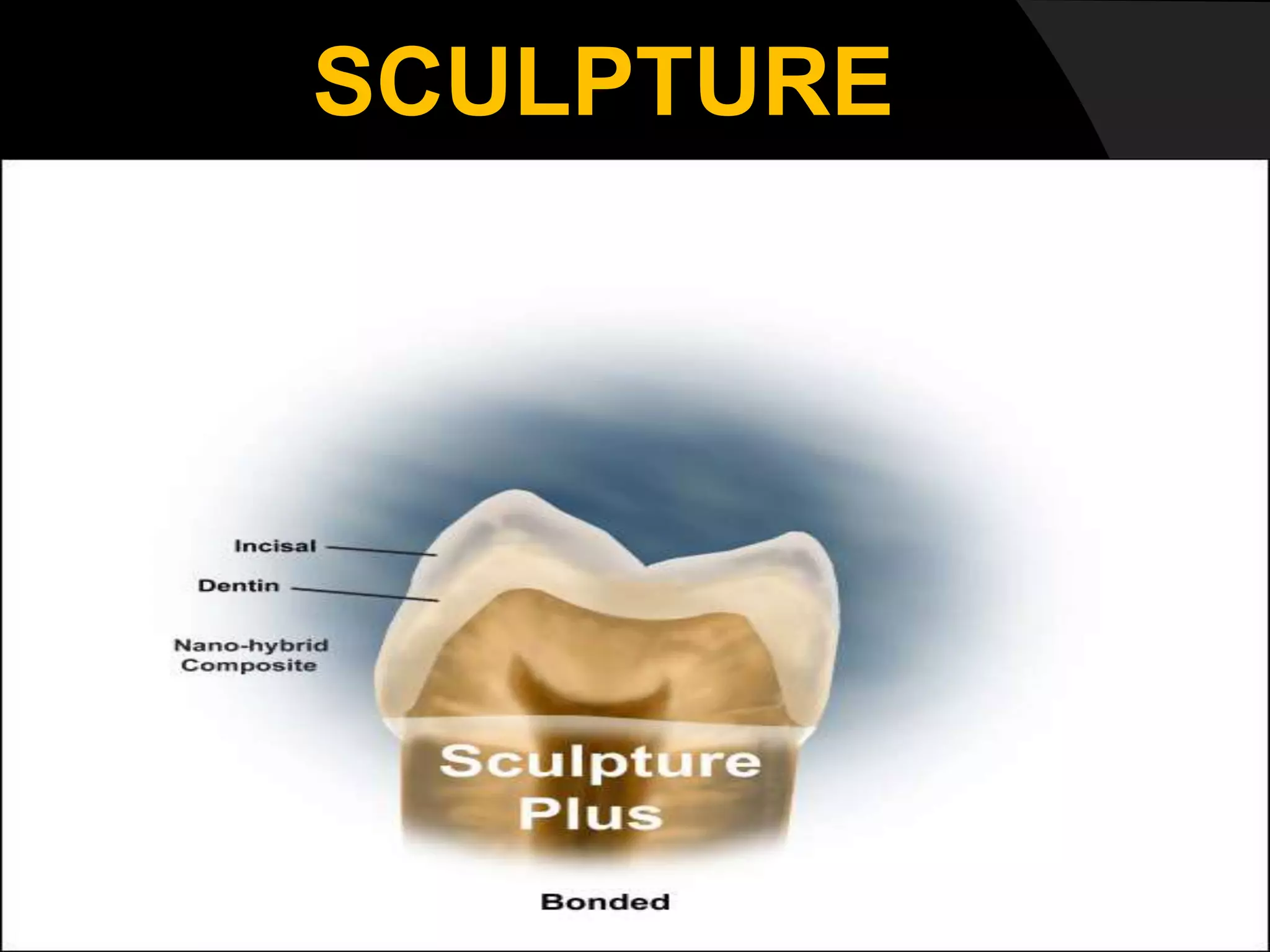
SCULPTURE
 Polycarbonate based composite resin
ADVANTAGES
Excellent polishability & esthetics
Long term luster retention
Extremely lower wear less than 1.5µm/year
SINFONY
 Introduced by 3M ESPE
MATRIX FILLER
Polyfunctional
metharylate
polymer
Pyrogenic silica
0.05µ
Visco alpha
halogen lamp source
10sec
Visco beta
Fluorecent lamp
source
15min
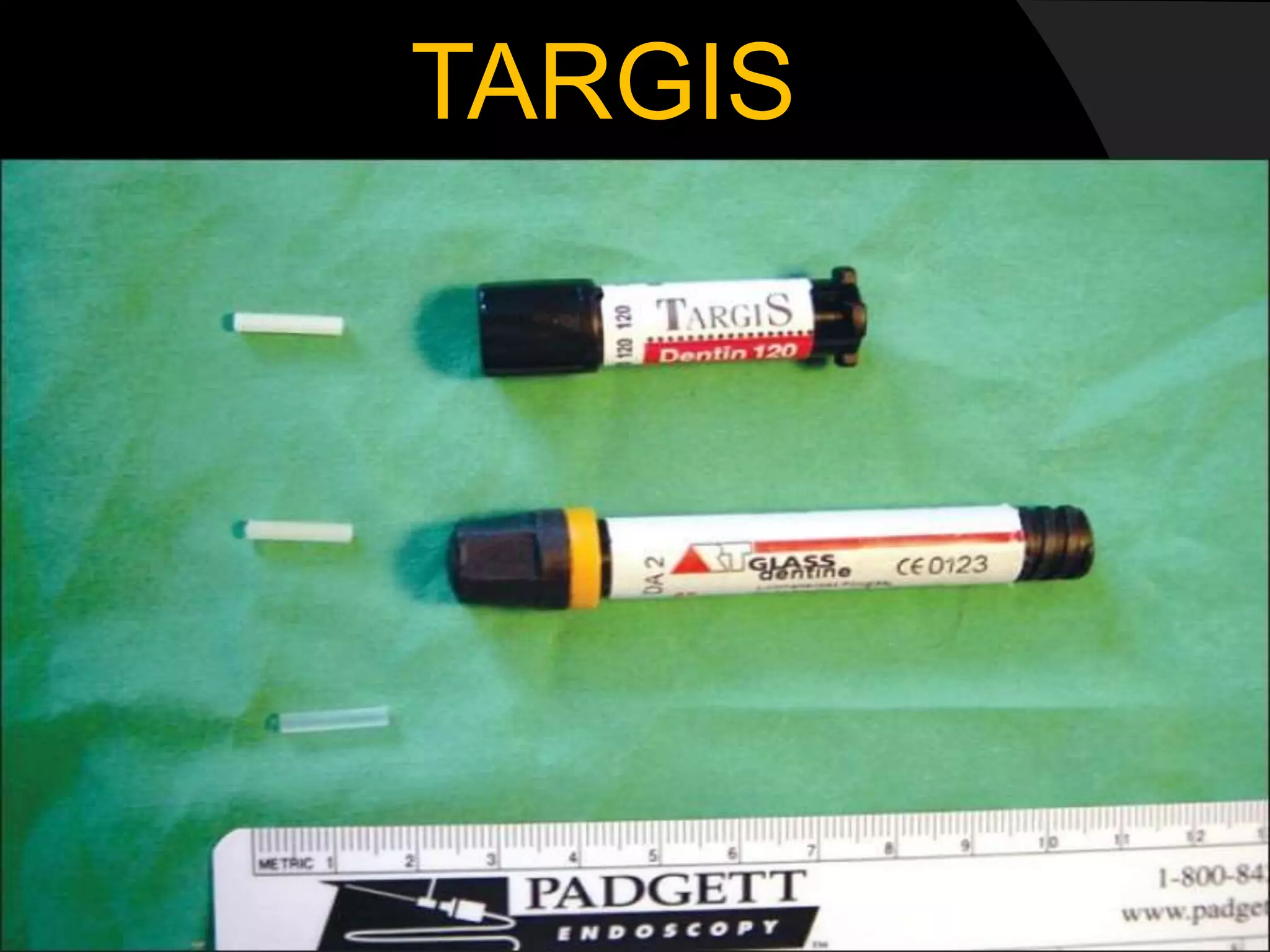
TARGIS
MATRIX FILLER
BisGMA TRIMODAL
1. Barium glass – 1µm
2. Spheroidal silica –
0.25µm
3. Colloidal silica –
0.015 to 0.050µm TARGIS gel
TARGIS power
curing unit
Light emmision 10
min+ temp. 95ºC
Cooling 5min
• Also called ceromer (ceramic optimized polymer)
• Contains approximately 77wt% of filler and 23wt% of organic resin.
TRUE VITALITY
VISIOGEM
 Initially used for anterior composite
veneers
 Light vacuum cured composite
 Initial curing – Direct – Visio alpha units
 Final cure & vaccum chamber – Visio
beta units
SINGLE
CRYSTAL
MODIFIED
COMPOSITES
 An experimental indirect composite system has
been recently developed which uses silicon
carbide single crystals as filler component.
 These are silanized and incorporated into the
resin matrix.
 Have symmetric shapes like long plates and
behave like fibers.
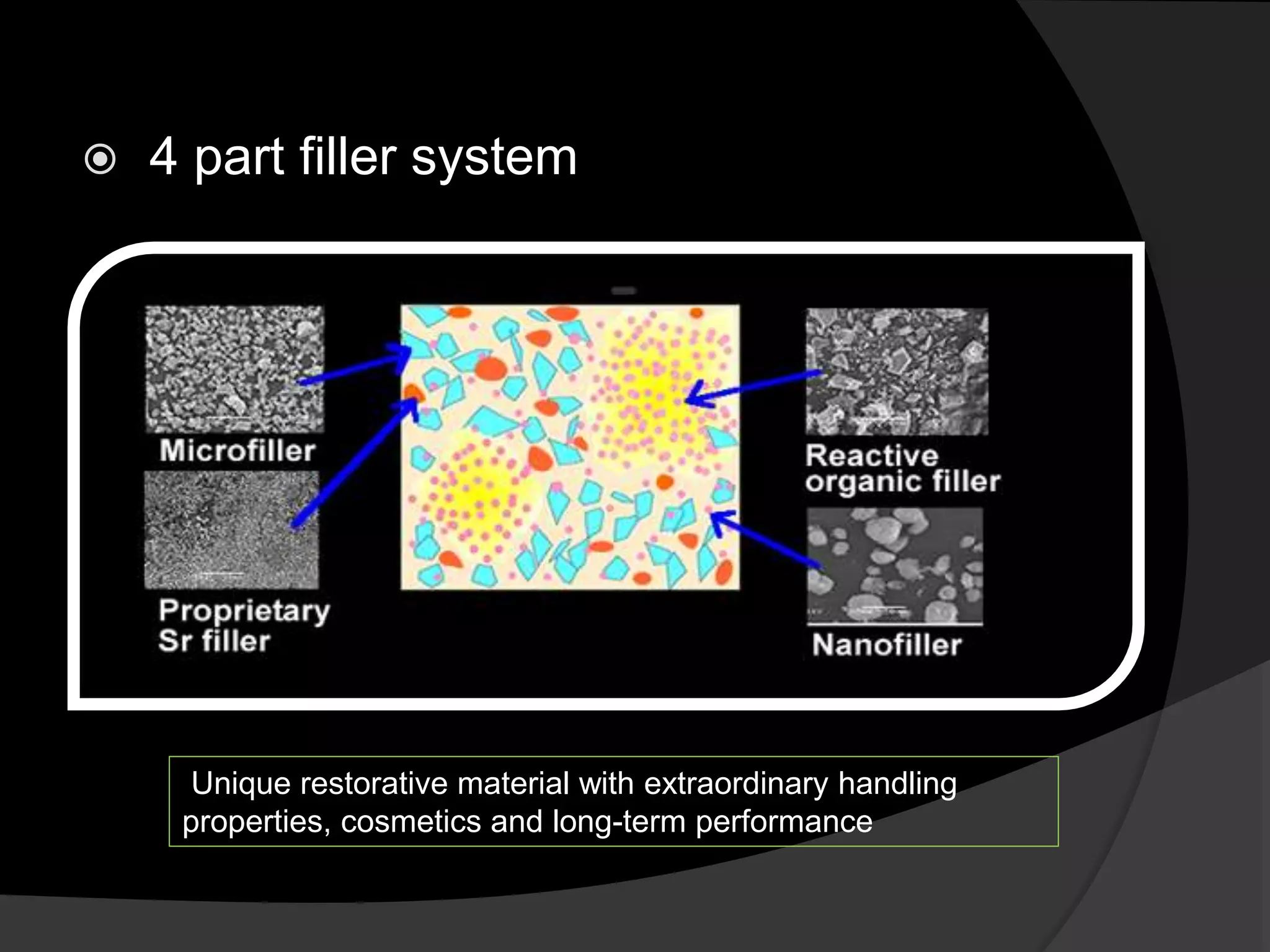
TRIMODAL TECHNOLOGY
• Novel filler technology, using 3 different fillers--prepolymerized
filler, patented Point 4 filler, and 0.02 micron filler.
• Excellent polishability, durability, and strength
FANTASISTA
 4 part filler system
Unique restorative material with extraordinary handling
properties, cosmetics and long-term performance
NANOFILLED
COMPOSITES
FUSIO
ESTELITE SIGMA
 Light-cured submicron filled resin composite
containing 82 wt% , 71 vol% of filler.
 Every inorganic filler – Spherical submicron filler
 Size range: 0.1 um-0.3um
 Outstanding mechanical strength,
Superior esthetics
Strength - Posterior restorations.
 18 different shades available.
RAP
TECHNOLOGY
Reduced curing time
Excellent stability to ambient light
Maintaining the superior esthetic and physical properties
ESTELITE® SIGMA QUICK
utilizes Tokuyama's patented innovative initiator system
STIMULI
RESPONSIVE
COMPOSITE
Purva et al., 2016
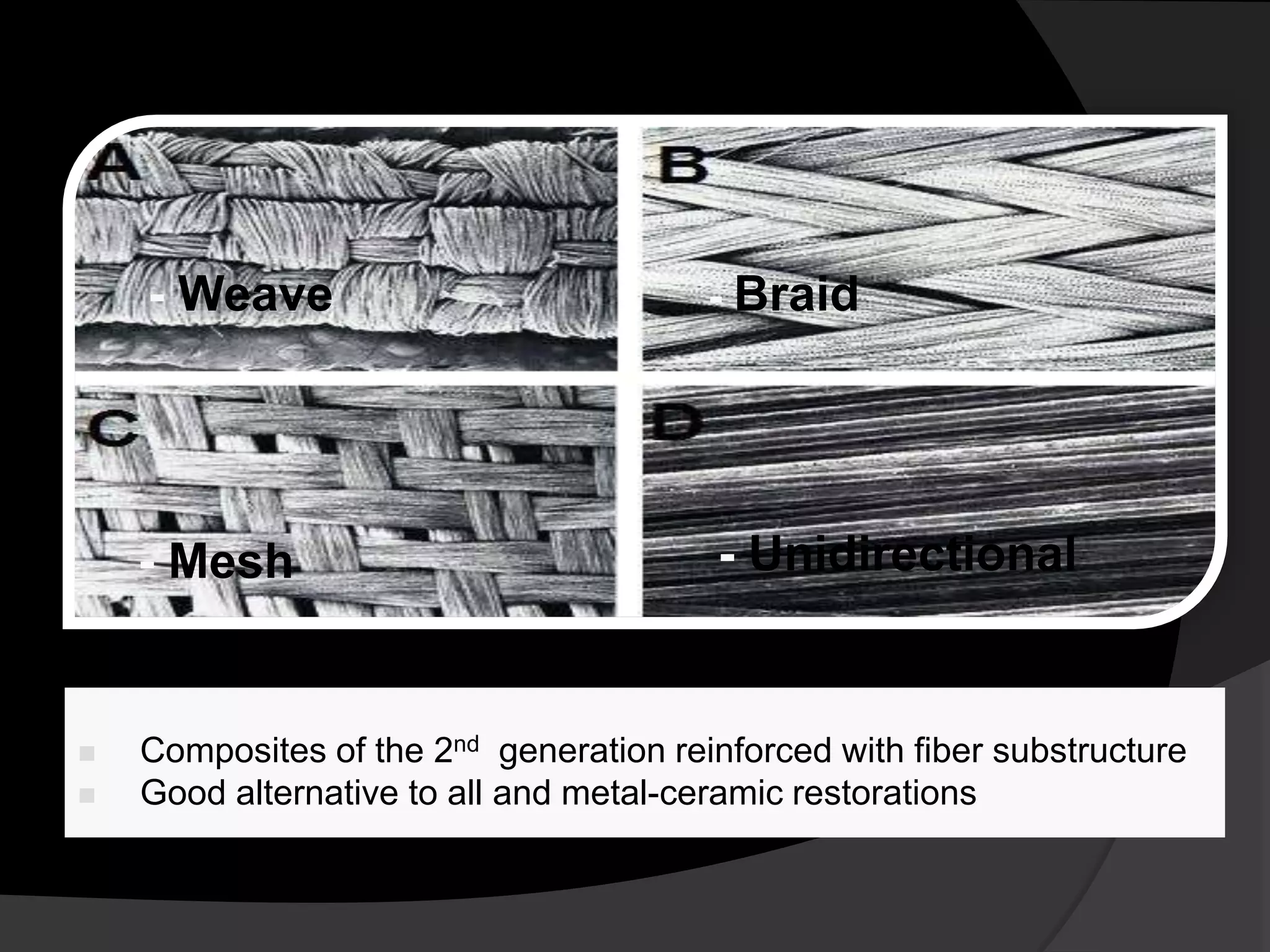
 Composites of the 2nd generation reinforced with fiber substructure
 Good alternative to all and metal-ceramic restorations
- Braid
- Unidirectional- Mesh
- Weave
• Major components: resin matrix and fibers
• Fibers- Ceramic
Glass
Carbon
Alumina
Silicon nitride
- Polymer
KEVLAR (unidirectional)
HDLPE
• Due to translucent appearance of these materials no masking
materials are needed, which allows a thin layer(0.5mm) of
composite to be placed , which is esthetic .
Triaxial Woven Spectra Fibers
Ultra-high Molecular Weight Polyethylene
(Spectra)
RIBBOND
EVER STIK
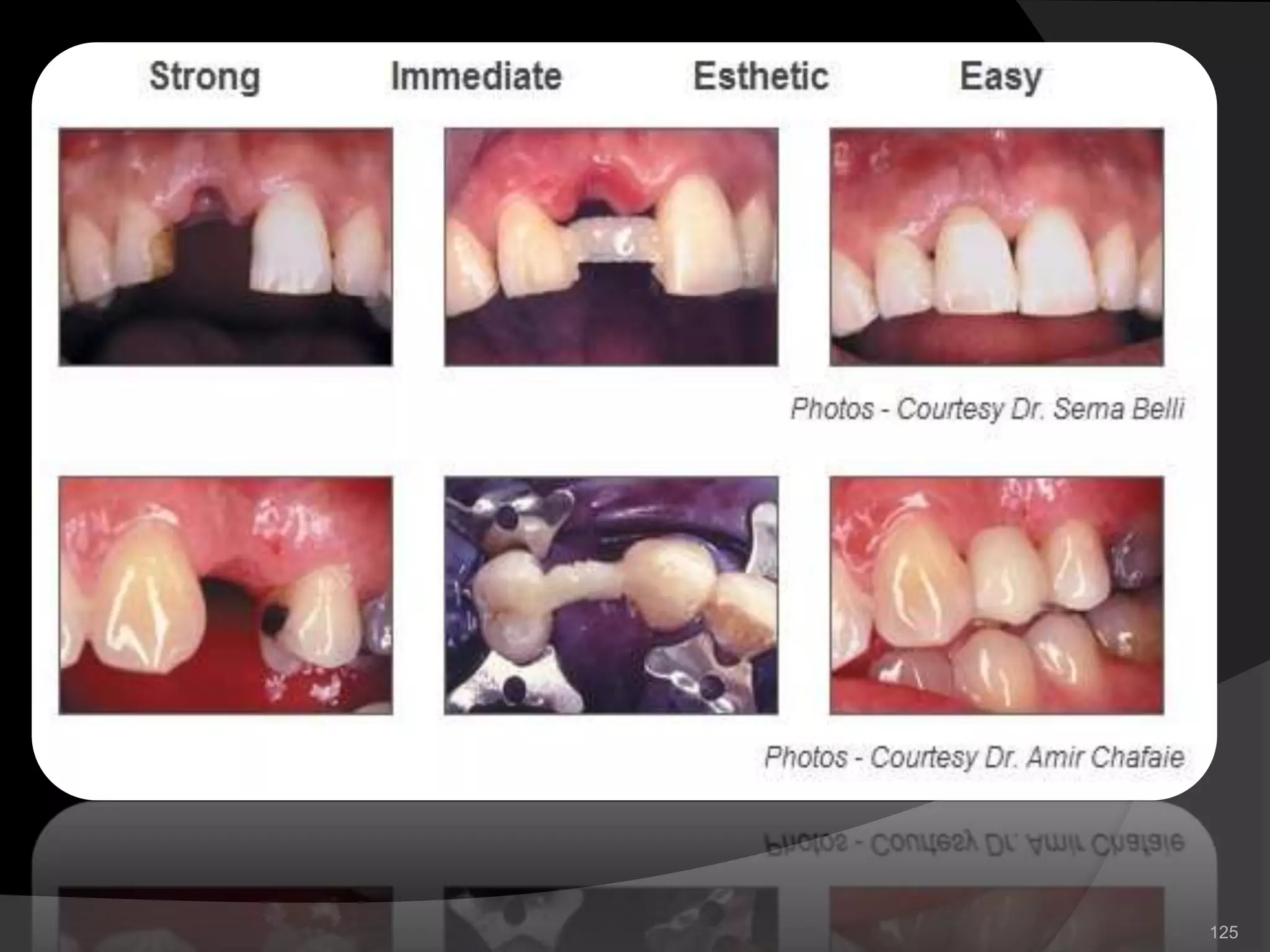
125
REVIEW OF VARIOUS
ARTICLES
Journal of Pharmaceutical Sciences & Research
Vol 8 (8), 2016, 881 - 883
International Journal of Recent Advances in Multidisciplinary Research
Vol 03, Issue 06, pp1528-1530, June 2016
NJDSR Volume 1, Number 4, 2016
International journal of Scientific Study
December 2015 Vol 3 Issue 9
CONCLUSION:
There is much room for the improvement and further development
of resin – based dental materials.
New quality of composites can be created if nanotechnology is
used & new developments in material science and biomaterials are
considered in composites in future.
Arrals & Essences of dentistry
Volume 2 Issue 3 July – Sept 2010
“The world hates change, yet it is the only thing
that has brought progress.”
-Charles Kettering
REFERENCES
 Anusavice , K J., 2004. Restorative resins: (In) Philips Science of
Dental Materials. 11thed. Restorative resins, Elsevier, India 399-
441.
 Vimal K Sikri; 2009. : (In) Text book of Operative Dentistry. 2nded.
Composites, CBS publications, India 387-426
 Gayathri R menon et al. Recent advancement in Restorative
composite materials. Int J of Recent Advances and Multidisciplinary
research 2016; 03 (06):1528-1530.
 P.Benly. Recent advances in composite-A review. J of
Pharmaceutical Sciences and research 2016;8(8); 881-883.
 Purva. S et al. Smart composite: A review article. NJDSR 2016; 1(4)
: 57-63.
 N.B. Cramer et al . Recent Advances and Developments in
composite Dental Restorative Materials. J Dent Research 2015;
90(4); 402-416
 Robert A.Lowe et al. Advances in Composite Resin Materials.
Inside Dentistry 2015; 2(12)
 Prachi Singh et al. Overwiew and recent advances in composite
resin – A review. Int J of Scientific Study 2015; 3(9); 169-172.
 Zohaib Khurshid et al. Advances in Nanotechnology for
Restorative Dentistry. Materials 2015; 8: 717-731.
 Yousef A. Aljehani et al. Current Trends in Aesthetic Dentistry.
Journal of health 2014;6: 1941-1949.
 Smart materials in dentistry. Journal of Pediatric dentistry 2014
 Robert A.Lowe. Advances in Direct Composite
Restorations.Inside Dentistry 2012; 8(9)
 Mahantesh Yeli et al. Recent advances in composite resins – A
Review. Arrals and Essences of Dentistry 2010; 2(3): 134-136.
 Yeli M et al. Recent advances in composites resins – A review. J
Oral Res Rev 2010;2: 8-14.
 Leinfelder KF. New developments in resin rstorative systems. J
Am Dent Ass0c 1997; 128: 573-581.
Recent advances in composite dentistry

Recent advances in composite dentistry

  • 2.
    Dr. A. YOGHAPADHMA 1ST YEAR POSTGRADUATE DEPT OF CONSERVATIVE DENTISTRY
  • 3.
    The aim ofthe esthetic and restorative dentistry is to replace the lost or damaged structures with artificial materials that possess biological, physical and functional properties similar to natural teeth. (Chu and Ahmed, 2003)
  • 4.
  • 6.
    Composite resins occupya paramount position because they offer excellent esthetic potential and acceptable longevity without the need for extensive sound structure preparation. (Dietschi et al., 2006)
  • 7.
  • 11.
  • 12.
  • 13.
  • 14.
  • 16.
    • Amalgam marginrepair. • Class I, II, III, IV and V • Composite repairs. • Core build up. • Crown margin repair. • Enamel defect repair. • Incisal edge repair. • Liners in class I & II • Preventive resin restorations • Pit and fissure. • Porcelain repairs. I N D I C A T I O N S
  • 17.
  • 19.
     Developed inlate 1990 – Posterior teeth  Introduced as amalgam derivatives  Stiff consistency – Packable / Condensable like amalgam
  • 20.
  • 22.
     Class Irestorations  Class II restorations INDICATIONS
  • 23.
  • 25.
     Applied inthickness upto 4mm thickness
  • 27.
  • 28.
    Filtek Bulfill Contains twonovel methacrylate monomers that in combination act to lower polymerization stress. FILTEK BULKFILL
  • 29.
  • 30.
  • 32.
    Cervical area, including composite restorationsin gingival colours V-shaped defects Exposed cervical areas Aesthetic corrections of the gingival area, Primary splinting, and the correction of red/white aesthetics Ability to mask exposed crown margins to improve aesthetics and patient satisfaction.
  • 33.
  • 34.
     Nanotechnology consistsof reducing components of a material to the nanometric scale for use in a new material to improve the final characteristics.  To establish polish of a microfill but the strength and wear resistance of hybrid composites  Particles of size  1-100 nm Swift, J Esth Rest Dent, 2005
  • 35.
  • 36.
     Was introducedto overcome the limitations and concerns of traditional and new packable restorative material  Dr. Herbert Wolters from Fraunhofer Institute for Silicate Research introduced this in 1994 Cunha et al., 2003
  • 37.
    ORGANICALLY MODIFIED CERAMICS Inorganic-organic co-polymers with inorganicsilanated fillers. Described as 3-dimensionally cross-linked copolymers with multi-polymerization with no residual unreacted monomer Manufactured by a Sol-Gel Process from Multifunctional Urethane and thioether(meth)acrylate alkoxy silanes.
  • 39.
  • 40.
    • Introduced in1994. • An acronym of the words compo site and glass ionomer.  Polyacid modified resin composite  Primarily composite resin-like materials that contain one or more basic GIC components.
  • 41.
    To have akind of modified composite having the main advantages of glass ionomer cement. Compositional modifications  Certain liquid monomer (HEMA) is modified by polyacrylic acid grafts  Filler particles similar to the powder of glass ionomer cement (calcium- fluoro-alumino-silicate- glass) Drawbacks:  Using bonding systems still mandatory  Lower wear resistant < regular composites  Insignificant release of fluoride
  • 42.
    Indications Sealing occlusal pits and fissuresRestorations of primary teeth Minimal cavity preparations Lining and Core build- up Repair of defective margins in restorations Class III, Class V, Erosion lesion - Restorations Sealing of root surface Potential root canal sealers Retrograde filing materials INDICATIONS
  • 43.
  • 44.
    To overcome somedrawbacks of compomers The filler particles are a kind of pre-polymerized glass ionomer agglomerates
  • 47.
    Restoration of ClassI. II. III. IV, & V Restoration of cervical erosion and root caries Laminate veneers and core build-up Ideal for pedodontic restorations Other dental applications  repair of fractured porcelain and composite restoration INDICATIONS
  • 48.
  • 49.
     Smart Compositesare active dental polymers that contain bioactive amorphous calcium phosphate (ACP) filler capable of responding to environmental pH changes by releasing calcium and phosphate ions and thus become adaptable to the surroundings.  These are also called as Intelligent composite 49
  • 50.
     Ivoclair introduceda material named Ariston pHC (pH control).  Releases Fluoride & Ca Hydroxide when the pH in restoration in the material is less than 5.5
  • 51.
     Ariston isan ion releasing composite material, which releases fluoride, hydroxyl and calcium ions as the pH drops in the areas immediately adjacent to the restorative material. This is said to neutralize the acid and counteract the decalcification of enamel / dentin.
  • 52.
  • 53.
    BIOACTIVE FORMULATIONS  -ACP(amorphous calcium phosphate)-2000  -ACP + BIS-GMA /TEGDMA/HEMA with Zirconyl methacrylate  Fluorinated Bis-GMA analogues  Liquid crystalline monomers
  • 55.
  • 56.
    Methacryloyl fluoride – Methylmethacrylate copolymer in pit and fissure sealant where fluoride delivery lasted for 2 years Diethylaminoethyl methacrylate into dental resin system - Fluoride is released by hydrolysis at a rate of 2- 5µg/cm2/day for 1 year.
  • 57.
  • 60.
     Class Iand II posterior restorations (stress bearing areas)  Class III and IV anterior restorations  Class V restorations cervical caries, root erosion, abfraction, wedge-shaped defects  Inlays/onlays with extraoral post-tempering INDICATIONS
  • 61.
  • 62.
     Guggenburger andWeinmann (2000)  Siloxane + oxiranes  Siloxane backbone – hydrophobic nature  Ring opening monomers, cationic cure
  • 63.
    As silorane-based composite polymerizes, “ring-opening” monomersconnect by opening, flattening and extending toward each other. As methacrylate-based composites cure, the molecules of these “linear monomers” connect by actually SHIFTING closer together in a linear response.
  • 64.
  • 66.
  • 67.
    The development ofminimal-shrink composites was based on …. 1. INCREASING THE FILLER LOAD  Using prepolymerized composite fillers  Using nano-sized fillers (Tetric Evoceram, Ivoclar-Vivadent) 2. USING ORGANIC MATRICES WITH LOWER POLYMERIZATION SHRINKAGE  Spiro-orthocarbonate, can produce composites with no setting contraction,  Oxy bis-methacrylates (bifunctional monomer) shows also a reduced rate of the polymerization contraction  Oxirane and silorane-based monomers (Feltick LS, 3M-ESPE)
  • 68.
  • 69.
     Chitosan andchitosan derivatives appear to be good candidates for the elastomeric matrix  These natural biopolymers – Biocompatible, Biodegradable and Osteoconductive.  CPC–chitosan composites - Stable in a wet environment  Have sufficient physical strength
  • 70.
  • 72.
    One material –Showed similarities to resin based dental material If a crack occurs in the epoxy resin material, some of the microcapsules are destroyed near the the crack & release the resin. The resin fills the crack & reacts with Grubbs catalyst dispersed in the epoxy composite resulting in polymerization of resin & repair of crack P. Benly et al., 2016
  • 73.
  • 75.
    Trade name :-vertise flow First compo bond introduced in 2009 by (Kerr Corp., USA) Self adhering flowable combining a resin-based composite and a SE bonding agent based on the 7th generation DBA, OptiBond®All- in-One It is a light-cured composite with similar properties to conventional flowables but with the added advantage of eliminating the bonding stage. Self-etching/self-bonding restorative composites
  • 76.
    Rationale  To getrestorations with higher mechanical properties  To reduce the subsequent effect of the polymerization shrinkage (i.e. weak bonding, microleakage, improper contact)
  • 77.
    Chair-side Start with Lightor chemical-curing inside the mouth. Then apply post-curing heat or light treatment CAD-CAM composites Laboratory Cured with heat & pressure or light & pressure on a cast Fiber-reinforced composites
  • 78.
  • 79.
    FIRST GENERATION Introduced in1980s as an attempt to decrease the rate of the polymerization shrinkage and Improve the wear resistance of the restoration. MANUFACTURERPRODUCT COMMERCIAL NAME 3M-ESPE1. Visio-gem Kulzer2. Denta Color Ivoclar-Vivadent3. Concept Ivoclar-Vivadent4. Isoset
  • 80.
    SECOND GENERATION Appeared in1990s and named ceromers, most of these materials are light-cured over a cast for 60 seconds and then followed with heat treatment. MANUFACTURERPRODUCT COMMERCIAL NAME Heraeus-Kulzer1. Artglass Kerr2. BelleGlass Ivoclar-Vivadent3. Targis 3M-ESPE4. Simphony
  • 81.
  • 82.
     Launched in1995 by Heraeus-kulzer MATRIX FILLER Organic resin matrix [BisGMA / UDMA] Barium silicate glass 0.7µ
  • 83.
    ADVANTAGES  Wear resistant Better marginal adaptation  Better esthetics  Superior proximal contact
  • 84.
  • 85.
     Introduced byBelle de St. Claire in 1996  Resin matrix – BisGMA & fillers  Belleglass Polymerized Esthetically appealing & wear resistant Pressure – 29psi Reduces the vaporization potential of monomers Temperature – 138ºC Increases the polymerization rate Nitrogen – Inert gas Increase in wear resistance
  • 86.
  • 88.
  • 90.
  • 92.
  • 93.
     Polycarbonate basedcomposite resin ADVANTAGES Excellent polishability & esthetics Long term luster retention Extremely lower wear less than 1.5µm/year
  • 94.
  • 95.
     Introduced by3M ESPE MATRIX FILLER Polyfunctional metharylate polymer Pyrogenic silica 0.05µ Visco alpha halogen lamp source 10sec Visco beta Fluorecent lamp source 15min
  • 96.
  • 97.
    MATRIX FILLER BisGMA TRIMODAL 1.Barium glass – 1µm 2. Spheroidal silica – 0.25µm 3. Colloidal silica – 0.015 to 0.050µm TARGIS gel TARGIS power curing unit Light emmision 10 min+ temp. 95ºC Cooling 5min • Also called ceromer (ceramic optimized polymer) • Contains approximately 77wt% of filler and 23wt% of organic resin.
  • 98.
  • 100.
  • 101.
     Initially usedfor anterior composite veneers  Light vacuum cured composite  Initial curing – Direct – Visio alpha units  Final cure & vaccum chamber – Visio beta units
  • 102.
  • 103.
     An experimentalindirect composite system has been recently developed which uses silicon carbide single crystals as filler component.  These are silanized and incorporated into the resin matrix.  Have symmetric shapes like long plates and behave like fibers.
  • 104.
  • 105.
    • Novel fillertechnology, using 3 different fillers--prepolymerized filler, patented Point 4 filler, and 0.02 micron filler. • Excellent polishability, durability, and strength
  • 107.
  • 108.
     4 partfiller system Unique restorative material with extraordinary handling properties, cosmetics and long-term performance
  • 110.
  • 112.
  • 114.
  • 115.
     Light-cured submicronfilled resin composite containing 82 wt% , 71 vol% of filler.  Every inorganic filler – Spherical submicron filler  Size range: 0.1 um-0.3um  Outstanding mechanical strength, Superior esthetics Strength - Posterior restorations.  18 different shades available.
  • 117.
  • 118.
    Reduced curing time Excellentstability to ambient light Maintaining the superior esthetic and physical properties ESTELITE® SIGMA QUICK utilizes Tokuyama's patented innovative initiator system
  • 119.
  • 120.
  • 122.
     Composites ofthe 2nd generation reinforced with fiber substructure  Good alternative to all and metal-ceramic restorations - Braid - Unidirectional- Mesh - Weave
  • 123.
    • Major components:resin matrix and fibers • Fibers- Ceramic Glass Carbon Alumina Silicon nitride - Polymer KEVLAR (unidirectional) HDLPE • Due to translucent appearance of these materials no masking materials are needed, which allows a thin layer(0.5mm) of composite to be placed , which is esthetic .
  • 124.
    Triaxial Woven SpectraFibers Ultra-high Molecular Weight Polyethylene (Spectra) RIBBOND EVER STIK
  • 125.
  • 126.
  • 127.
    Journal of PharmaceuticalSciences & Research Vol 8 (8), 2016, 881 - 883 International Journal of Recent Advances in Multidisciplinary Research Vol 03, Issue 06, pp1528-1530, June 2016
  • 128.
    NJDSR Volume 1,Number 4, 2016 International journal of Scientific Study December 2015 Vol 3 Issue 9
  • 129.
    CONCLUSION: There is muchroom for the improvement and further development of resin – based dental materials. New quality of composites can be created if nanotechnology is used & new developments in material science and biomaterials are considered in composites in future. Arrals & Essences of dentistry Volume 2 Issue 3 July – Sept 2010
  • 130.
    “The world hateschange, yet it is the only thing that has brought progress.” -Charles Kettering
  • 131.
  • 132.
     Anusavice ,K J., 2004. Restorative resins: (In) Philips Science of Dental Materials. 11thed. Restorative resins, Elsevier, India 399- 441.  Vimal K Sikri; 2009. : (In) Text book of Operative Dentistry. 2nded. Composites, CBS publications, India 387-426  Gayathri R menon et al. Recent advancement in Restorative composite materials. Int J of Recent Advances and Multidisciplinary research 2016; 03 (06):1528-1530.  P.Benly. Recent advances in composite-A review. J of Pharmaceutical Sciences and research 2016;8(8); 881-883.  Purva. S et al. Smart composite: A review article. NJDSR 2016; 1(4) : 57-63.  N.B. Cramer et al . Recent Advances and Developments in composite Dental Restorative Materials. J Dent Research 2015; 90(4); 402-416  Robert A.Lowe et al. Advances in Composite Resin Materials. Inside Dentistry 2015; 2(12)
  • 133.
     Prachi Singhet al. Overwiew and recent advances in composite resin – A review. Int J of Scientific Study 2015; 3(9); 169-172.  Zohaib Khurshid et al. Advances in Nanotechnology for Restorative Dentistry. Materials 2015; 8: 717-731.  Yousef A. Aljehani et al. Current Trends in Aesthetic Dentistry. Journal of health 2014;6: 1941-1949.  Smart materials in dentistry. Journal of Pediatric dentistry 2014  Robert A.Lowe. Advances in Direct Composite Restorations.Inside Dentistry 2012; 8(9)  Mahantesh Yeli et al. Recent advances in composite resins – A Review. Arrals and Essences of Dentistry 2010; 2(3): 134-136.  Yeli M et al. Recent advances in composites resins – A review. J Oral Res Rev 2010;2: 8-14.  Leinfelder KF. New developments in resin rstorative systems. J Am Dent Ass0c 1997; 128: 573-581.

Editor's Notes

  • #76 that is prerequisite before using any resin-based restorative (Kerr Corp., USA).