Types of Reactor
Ihsan Wassan
U.S –PAKISTAN CENTER FOR ADVANCED STUDIES IN WATER
MEHRAN UNIVERSITY OF ENGINEERING AND TECHNOLOGY,
JAMSHORO, SINDH
Contents
• Reactor – Introduction
• Different types of Reactors
• CSTR Modeling
• Example - sizing a CSTR
Reactor – Introduction
• Chemical kinetics is the study of chemical reaction rates and reaction
mechanisms.
• The study of chemical reaction engineering (CRE) combines the study of
chemical kinetics with the reactors in which the reactions occur.
• A reactor is the vessel, tank or cylinder in which chemical reaction takes
place.
Types of Reactors
• Batch reactors (stirred tanks)
• Continuous stirred tank reactor (CSTR)
• Plug Flow Reactor (PFR)
• Fixed Bed Reactor
• Fluidized bed Reactor (FBR)
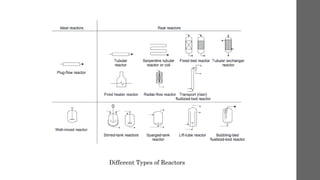
Different Types of Reactors
Batch reactors (Stirred Tanks)
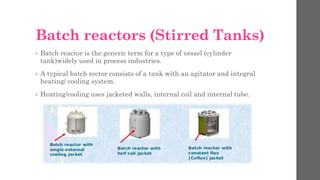
• Batch reactor is the generic term for a type of vessel (cylinder
tank)widely used in process industries.
• A typical batch rector consists of a tank with an agitator and integral
heating/ cooling system.
• Heating/cooling uses jacketed walls, internal coil and internal tube.
Batch reactors (Stirred Tanks)
Advantages:
• Batch reactors can be stopped between batches,
so the production rate is flexible.
• More flexible, one can use easily
• If process degrades the reactor in some way, a
batch reactor can be cleaned, relined etc.
• Batch reactor often achieve better quality than a
plug flow reactor and also better productivity
than CSTR.
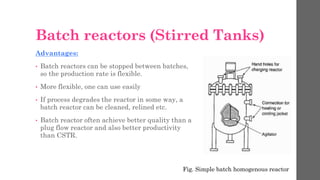
Fig. Simple batch homogenous reactor
Continuous Stirred Tank Reactor
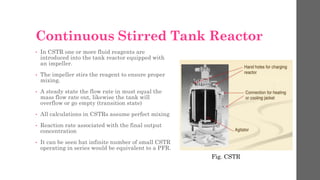
• In CSTR one or more fluid reagents are
introduced into the tank reactor equipped with
an impeller.
• The impeller stirs the reagent to ensure proper
mixing.
• A steady state the flow rate in must equal the
mass flow rate out, likewise the tank will
overflow or go empty (transition state)
• All calculations in CSTRs assume perfect mixing
• Reaction rate associated with the final output
concentration
• It can be seen hat infinite number of small CSTR
operating in series would be equivalent to a PFR.
Fig. CSTR
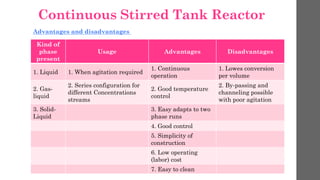
Continuous Stirred Tank Reactor
Kind of
phase
present
Usage Advantages Disadvantages
1. Liquid 1. When agitation required
1. Continuous
operation
1. Lowes conversion
per volume
2. Gas-
liquid
2. Series configuration for
different Concentrations
streams
2. Good temperature
control
2. By-passing and
channeling possible
with poor agitation
3. Solid-
Liquid
3. Easy adapts to two
phase runs
4. Good control
5. Simplicity of
construction
6. Low operating
(labor) cost
7. Easy to clean
Advantages and disadvantages
Plug Flow Reactor
• Each and every particle having same residence time, back mixing not
allowed in PFR
• PFR model is used to describe chemical reaction in continuous,
flowing systems.
• PFR sometimes called Continues tubular reactors (CTRs)
• PFR model works well for many fluids: liquids, gases and slurries.
• Fluid flow is sometimes turbulent flow or axial diffusion.
• PFR can be used to multiple reactions as well as reactions involving
changing temperatures, pressures and densities of flow.
• Used for large scale fast reactions, homogenous and heterogenous
reactions, continuous production and high temperature reactions.
Plug Flow Reactor
Advantages
• PFR have high volumetric unit conversion
• Run for long period of time without labor
• Excellent heat transfer
Disadvantages:
• Temperatures are hard to control
• Maintenance is expensive
• Shutdown and cleaning may be expensive
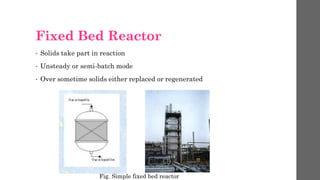
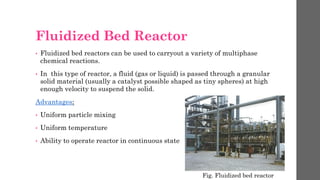
Fixed Bed Reactor
• Solids take part in reaction
• Unsteady or semi-batch mode
• Over sometime solids either replaced or regenerated
Fig. Simple fixed bed reactor
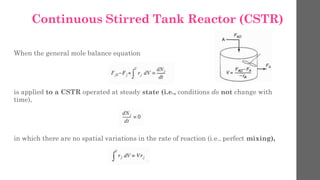
Fluidized Bed Reactor
• Fluidized bed reactors can be used to carryout a variety of multiphase
chemical reactions.
• In this type of reactor, a fluid (gas or liquid) is passed through a granular
solid material (usually a catalyst possible shaped as tiny spheres) at high
enough velocity to suspend the solid.
Advantages:
• Uniform particle mixing
• Uniform temperature
• Ability to operate reactor in continuous state
Fig. Fluidized bed reactor
Continuous Stirred Tank Reactor (CSTR)
When the general mole balance equation
is applied to a CSTR operated at steady state (i.e., conditions do not change with
time),
in which there are no spatial variations in the rate of reaction (i.e., perfect mixing),
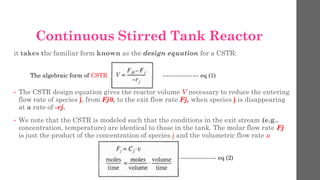
it takes the familiar form known as the design equation for a CSTR:
• The CSTR design equation gives the reactor volume V necessary to reduce the entering
flow rate of species j, from Fj0, to the exit flow rate Fj, when species j is disappearing
at a rate of -rj.
• We note that the CSTR is modeled such that the conditions in the exit stream (e.g..
concentration, temperature) are identical to those in the tank. The molar flow rate Fj
is just the product of the concentration of species j and the volumetric flow rate u
------------------ eq (1)
------------------ eq (2)
Continuous Stirred Tank Reactor
The algebraic form of CSTR
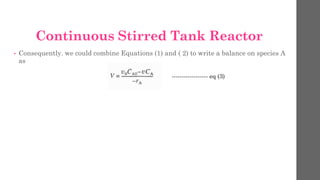
• Consequently. we could combine Equations (1) and ( 2) to write a balance on species A
as
Continuous Stirred Tank Reactor
------------------ eq (3)
CSTR Modeling
• Recall that the CSTR is modeled as being we11 mixed such that there are no
spatial variations in the reactor.
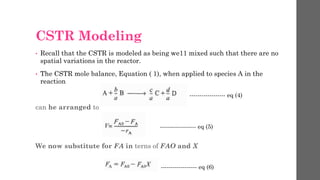
• The CSTR mole balance, Equation ( 1), when applied to species A in the
reaction
can he arranged to
We now substitute for FA in terns of FAO and X
------------------ eq (4)
------------------ eq (5)
------------------ eq (6)
CSTR Modeling (continue. )
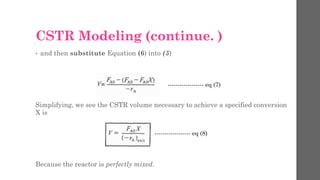
• and then substitute Equation (6) into (5)
Simplifying, we see the CSTR volume necessary to achieve a specified conversion
X is
Because the reactor is perfectly mixed.
------------------ eq (7)
------------------ eq (8)
Example - Sizing a CSTR
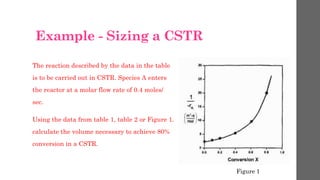
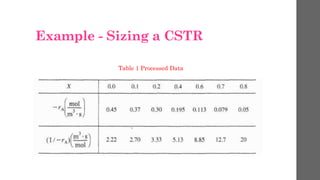
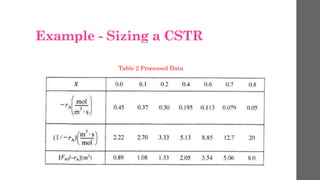
The reaction described by the data in the table
is to be carried out in CSTR. Species A enters
the reactor at a molar flow rate of 0.4 moles/
sec.
Using the data from table 1, table 2 or Figure 1.
calculate the volume necessary to achieve 80%
conversion in a CSTR.
Figure 1
Example - Sizing a CSTR
Table 1 Processed Data
Example - Sizing a CSTR
Table 2 Processed Data
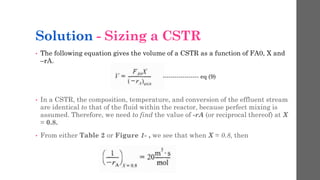
Solution - Sizing a CSTR
• The following equation gives the volume of a CSTR as a function of FA0, X and
–rA.
• In a CSTR, the composition, temperature, and conversion of the effluent stream
are identical to that of the fluid within the reactor, because perfect mixing is
assumed. Therefore, we need to find the value of -rA (or reciprocal thereof) at X
= 0.8.
• From either Table 2 or Figure 1- , we see that when X = 0.8, then
------------------ eq (9)
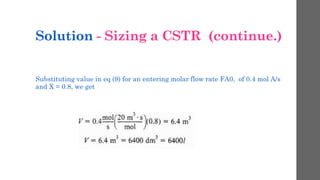
Solution - Sizing a CSTR (continue.)
Substituting value in eq (9) for an entering molar flow rate FA0, of 0.4 mol A/s
and X = 0.8, we get
Thank You !

Types of reactor

  • 1.
    Types of Reactor IhsanWassan U.S –PAKISTAN CENTER FOR ADVANCED STUDIES IN WATER MEHRAN UNIVERSITY OF ENGINEERING AND TECHNOLOGY, JAMSHORO, SINDH
  • 2.
    Contents • Reactor –Introduction • Different types of Reactors • CSTR Modeling • Example - sizing a CSTR
  • 3.
    Reactor – Introduction •Chemical kinetics is the study of chemical reaction rates and reaction mechanisms. • The study of chemical reaction engineering (CRE) combines the study of chemical kinetics with the reactors in which the reactions occur. • A reactor is the vessel, tank or cylinder in which chemical reaction takes place.
  • 4.
    Types of Reactors •Batch reactors (stirred tanks) • Continuous stirred tank reactor (CSTR) • Plug Flow Reactor (PFR) • Fixed Bed Reactor • Fluidized bed Reactor (FBR)
  • 5.
  • 6.
    Batch reactors (StirredTanks) • Batch reactor is the generic term for a type of vessel (cylinder tank)widely used in process industries. • A typical batch rector consists of a tank with an agitator and integral heating/ cooling system. • Heating/cooling uses jacketed walls, internal coil and internal tube.
  • 7.
    Batch reactors (StirredTanks) Advantages: • Batch reactors can be stopped between batches, so the production rate is flexible. • More flexible, one can use easily • If process degrades the reactor in some way, a batch reactor can be cleaned, relined etc. • Batch reactor often achieve better quality than a plug flow reactor and also better productivity than CSTR. Fig. Simple batch homogenous reactor
  • 8.
    Continuous Stirred TankReactor • In CSTR one or more fluid reagents are introduced into the tank reactor equipped with an impeller. • The impeller stirs the reagent to ensure proper mixing. • A steady state the flow rate in must equal the mass flow rate out, likewise the tank will overflow or go empty (transition state) • All calculations in CSTRs assume perfect mixing • Reaction rate associated with the final output concentration • It can be seen hat infinite number of small CSTR operating in series would be equivalent to a PFR. Fig. CSTR
  • 9.
    Continuous Stirred TankReactor Kind of phase present Usage Advantages Disadvantages 1. Liquid 1. When agitation required 1. Continuous operation 1. Lowes conversion per volume 2. Gas- liquid 2. Series configuration for different Concentrations streams 2. Good temperature control 2. By-passing and channeling possible with poor agitation 3. Solid- Liquid 3. Easy adapts to two phase runs 4. Good control 5. Simplicity of construction 6. Low operating (labor) cost 7. Easy to clean Advantages and disadvantages
  • 10.
    Plug Flow Reactor •Each and every particle having same residence time, back mixing not allowed in PFR • PFR model is used to describe chemical reaction in continuous, flowing systems. • PFR sometimes called Continues tubular reactors (CTRs) • PFR model works well for many fluids: liquids, gases and slurries. • Fluid flow is sometimes turbulent flow or axial diffusion. • PFR can be used to multiple reactions as well as reactions involving changing temperatures, pressures and densities of flow. • Used for large scale fast reactions, homogenous and heterogenous reactions, continuous production and high temperature reactions.
  • 11.
    Plug Flow Reactor Advantages •PFR have high volumetric unit conversion • Run for long period of time without labor • Excellent heat transfer Disadvantages: • Temperatures are hard to control • Maintenance is expensive • Shutdown and cleaning may be expensive
  • 12.
    Fixed Bed Reactor •Solids take part in reaction • Unsteady or semi-batch mode • Over sometime solids either replaced or regenerated Fig. Simple fixed bed reactor
  • 13.
    Fluidized Bed Reactor •Fluidized bed reactors can be used to carryout a variety of multiphase chemical reactions. • In this type of reactor, a fluid (gas or liquid) is passed through a granular solid material (usually a catalyst possible shaped as tiny spheres) at high enough velocity to suspend the solid. Advantages: • Uniform particle mixing • Uniform temperature • Ability to operate reactor in continuous state Fig. Fluidized bed reactor
  • 14.
    Continuous Stirred TankReactor (CSTR) When the general mole balance equation is applied to a CSTR operated at steady state (i.e., conditions do not change with time), in which there are no spatial variations in the rate of reaction (i.e., perfect mixing),
  • 15.
    it takes thefamiliar form known as the design equation for a CSTR: • The CSTR design equation gives the reactor volume V necessary to reduce the entering flow rate of species j, from Fj0, to the exit flow rate Fj, when species j is disappearing at a rate of -rj. • We note that the CSTR is modeled such that the conditions in the exit stream (e.g.. concentration, temperature) are identical to those in the tank. The molar flow rate Fj is just the product of the concentration of species j and the volumetric flow rate u ------------------ eq (1) ------------------ eq (2) Continuous Stirred Tank Reactor The algebraic form of CSTR
  • 16.
    • Consequently. wecould combine Equations (1) and ( 2) to write a balance on species A as Continuous Stirred Tank Reactor ------------------ eq (3)
  • 17.
    CSTR Modeling • Recallthat the CSTR is modeled as being we11 mixed such that there are no spatial variations in the reactor. • The CSTR mole balance, Equation ( 1), when applied to species A in the reaction can he arranged to We now substitute for FA in terns of FAO and X ------------------ eq (4) ------------------ eq (5) ------------------ eq (6)
  • 18.
    CSTR Modeling (continue.) • and then substitute Equation (6) into (5) Simplifying, we see the CSTR volume necessary to achieve a specified conversion X is Because the reactor is perfectly mixed. ------------------ eq (7) ------------------ eq (8)
  • 19.
    Example - Sizinga CSTR The reaction described by the data in the table is to be carried out in CSTR. Species A enters the reactor at a molar flow rate of 0.4 moles/ sec. Using the data from table 1, table 2 or Figure 1. calculate the volume necessary to achieve 80% conversion in a CSTR. Figure 1
  • 20.
    Example - Sizinga CSTR Table 1 Processed Data
  • 21.
    Example - Sizinga CSTR Table 2 Processed Data
  • 22.
    Solution - Sizinga CSTR • The following equation gives the volume of a CSTR as a function of FA0, X and –rA. • In a CSTR, the composition, temperature, and conversion of the effluent stream are identical to that of the fluid within the reactor, because perfect mixing is assumed. Therefore, we need to find the value of -rA (or reciprocal thereof) at X = 0.8. • From either Table 2 or Figure 1- , we see that when X = 0.8, then ------------------ eq (9)
  • 23.
    Solution - Sizinga CSTR (continue.) Substituting value in eq (9) for an entering molar flow rate FA0, of 0.4 mol A/s and X = 0.8, we get
  • 24.