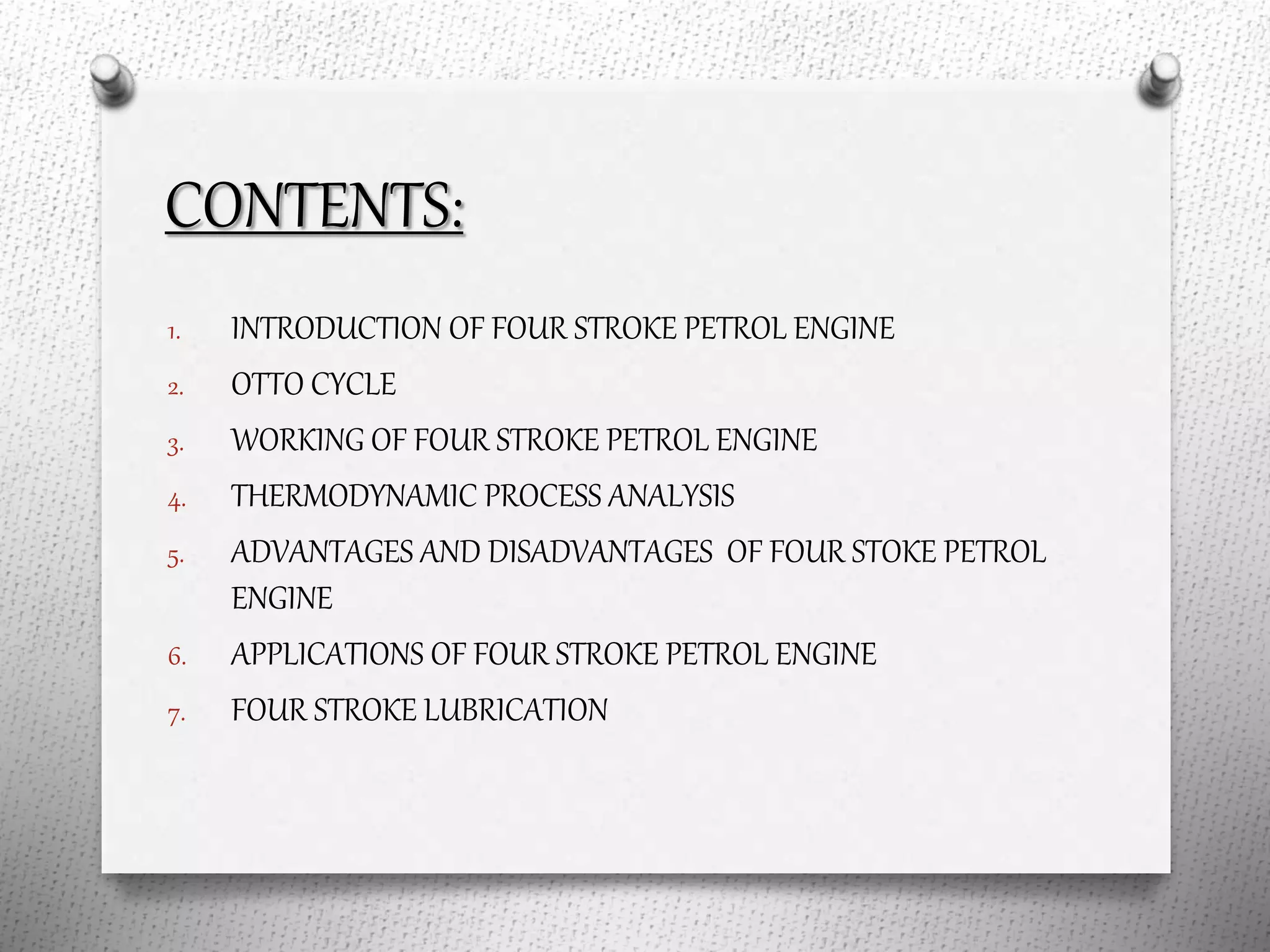
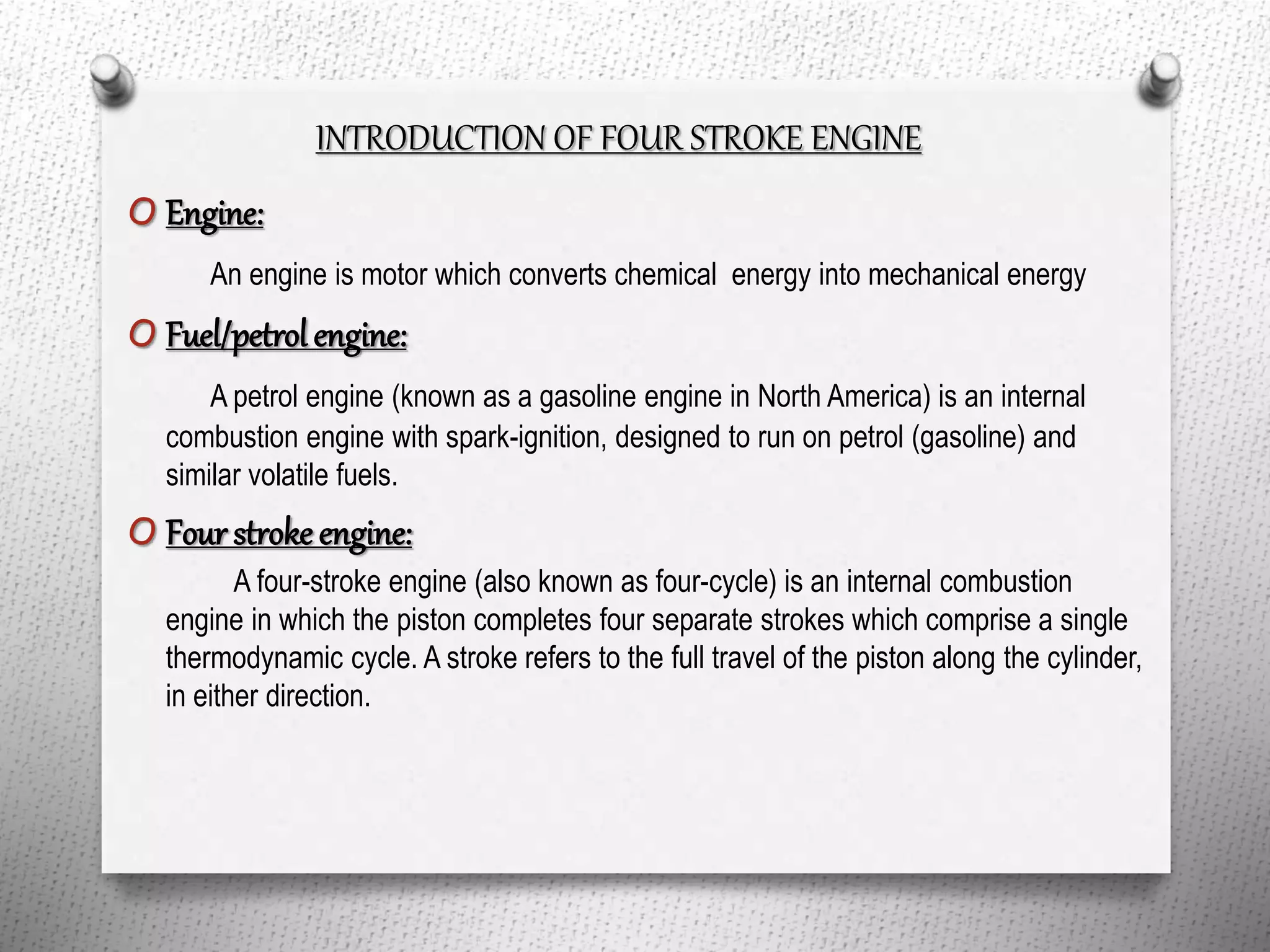
FOURSTROKEPETROLENGINE
GROUP MEMBERS
O MUHAMMAD ALI 13ME22
O MUHAMMAD AKHTAR 13ME42
O MUHAMMAD WASEEM 13ME16
O USMAN SAJID 13ME40
CONTENTS:
1. INTRODUCTION OF FOUR STROKE PETROL ENGINE
2. OTTO CYCLE
3. WORKING OF FOUR STROKE PETROL ENGINE
4. THERMODYNAMIC PROCESS ANALYSIS
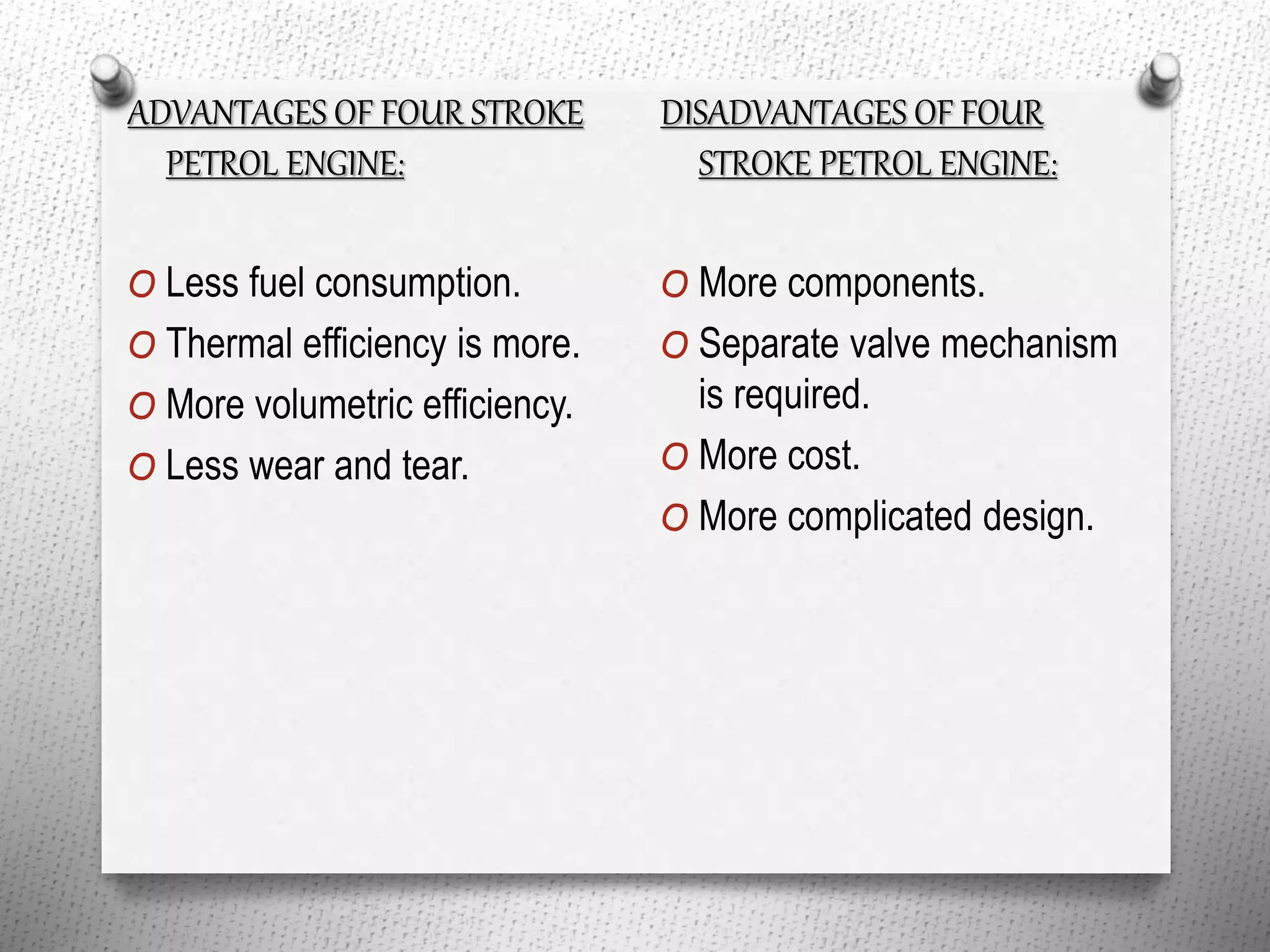
5. ADVANTAGES AND DISADVANTAGES OF FOUR STOKE PETROL
ENGINE
6. APPLICATIONS OF FOUR STROKE PETROL ENGINE
7. FOUR STROKE LUBRICATION
INTRODUCTION OF FOUR STROKE ENGINE
O Engine:
An engine is motor which converts chemical energy into mechanical energy
O Fuel/petrol engine:
A petrol engine (known as a gasoline engine in North America) is an internal
combustion engine with spark-ignition, designed to run on petrol (gasoline) and
similar volatile fuels.
O Four stroke engine:
A four-stroke engine (also known as four-cycle) is an internal combustion
engine in which the piston completes four separate strokes which comprise a single
thermodynamic cycle. A stroke refers to the full travel of the piston along the cylinder,
in either direction.
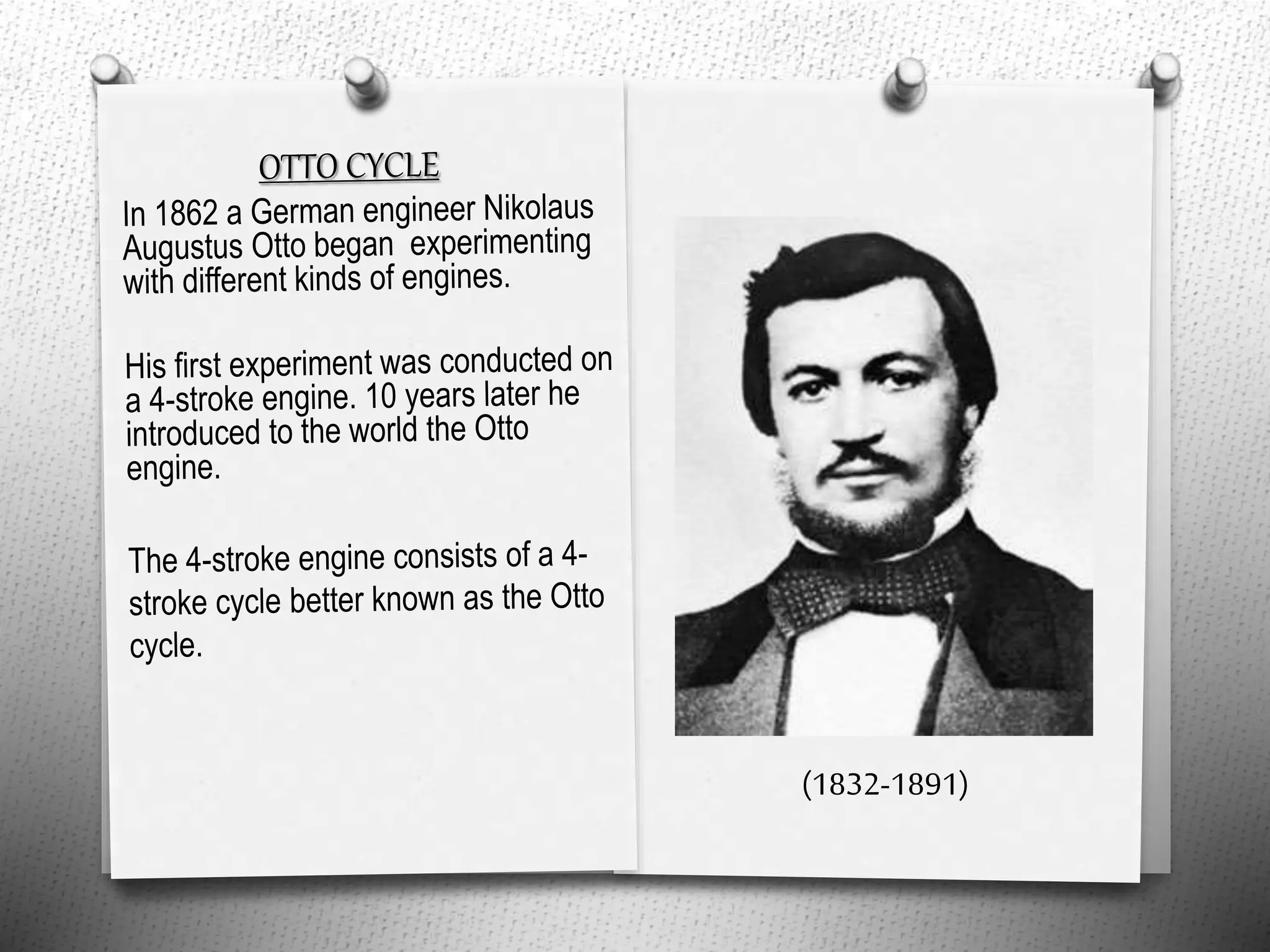
(1832-1891)
WORKING OF FOUR STROKE PETROL ENGINE
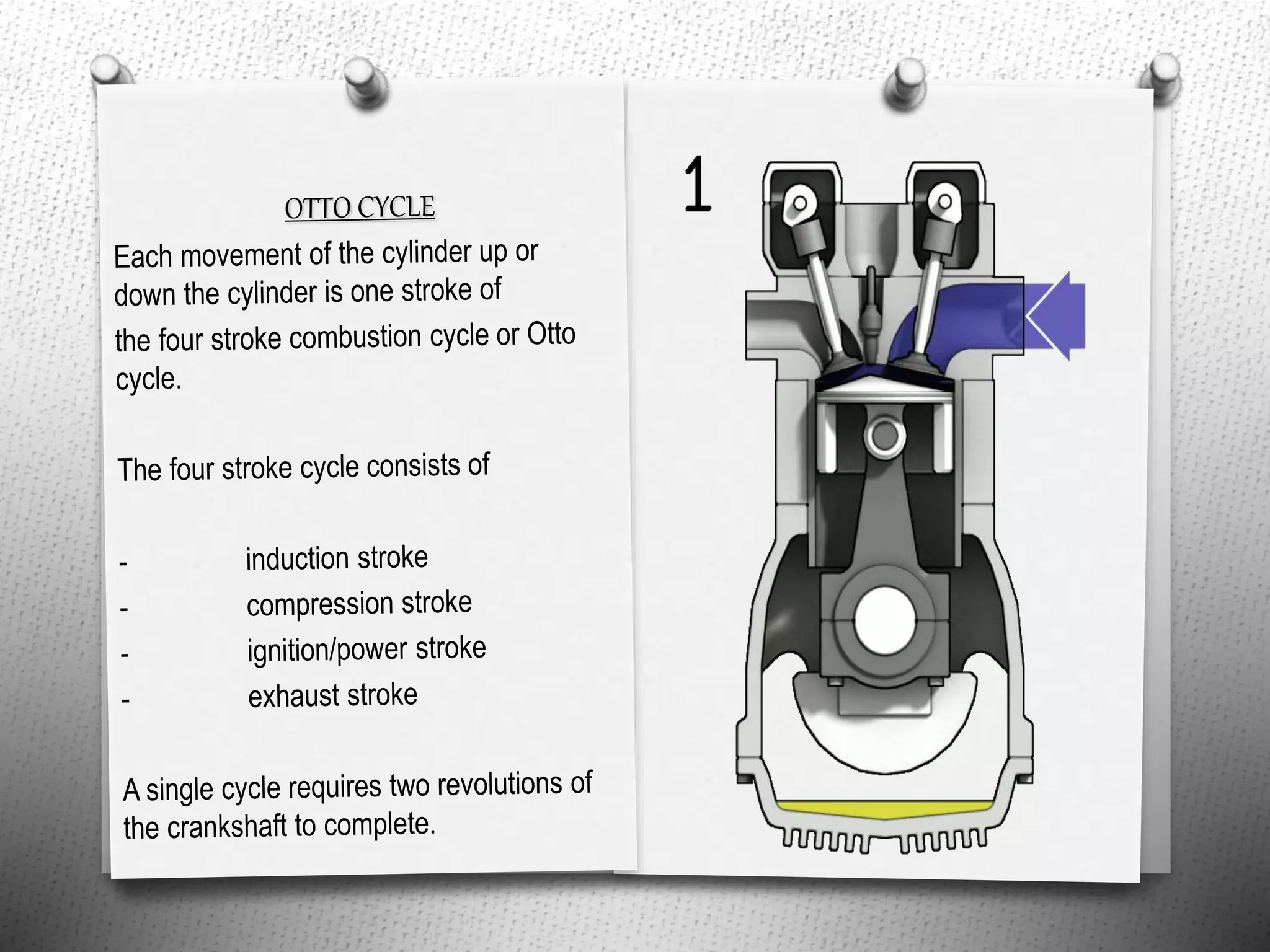
O INTAKE/SUCTION STROKE:
In suction stroke piston starts at Top Dead Center (TDC) of the cylinder and moves to the
Bottom Dead Center (BDC). Outlet valve will be closed and inlet valve will be open to
allowing the fresh charge of mixed fuel & air into the cylinder.
O COMPRESSION STROKE:
In compression stroke,Once piston reaches BDC & moves back TDC,inlet valve will be
closed,As the piston moves towards TDC,It compress air fuel mixture inside the
cylinder & compression takes place,Hence it is called compression stroke.
O EXPANSION/POWER STROKE:
In expansion stroke,Both the valves are closed,When piston reaches top of its stroke the
fuel mixture is ignited by spark plug due to spark high temperature & pressure
generated inside the cylinder & push down the piston to BDC,Hence it is known as
expansion stroke.
O EXHAUST STROKE:
In this stroke exhaust valve is opened,when piston reaches to BDC & moves to
upward.Piston pushes out the burnt gases to the atmosphere through the exhaust
valve. Hence called exhaust stroke & the engine is ready to begin the cycle again.
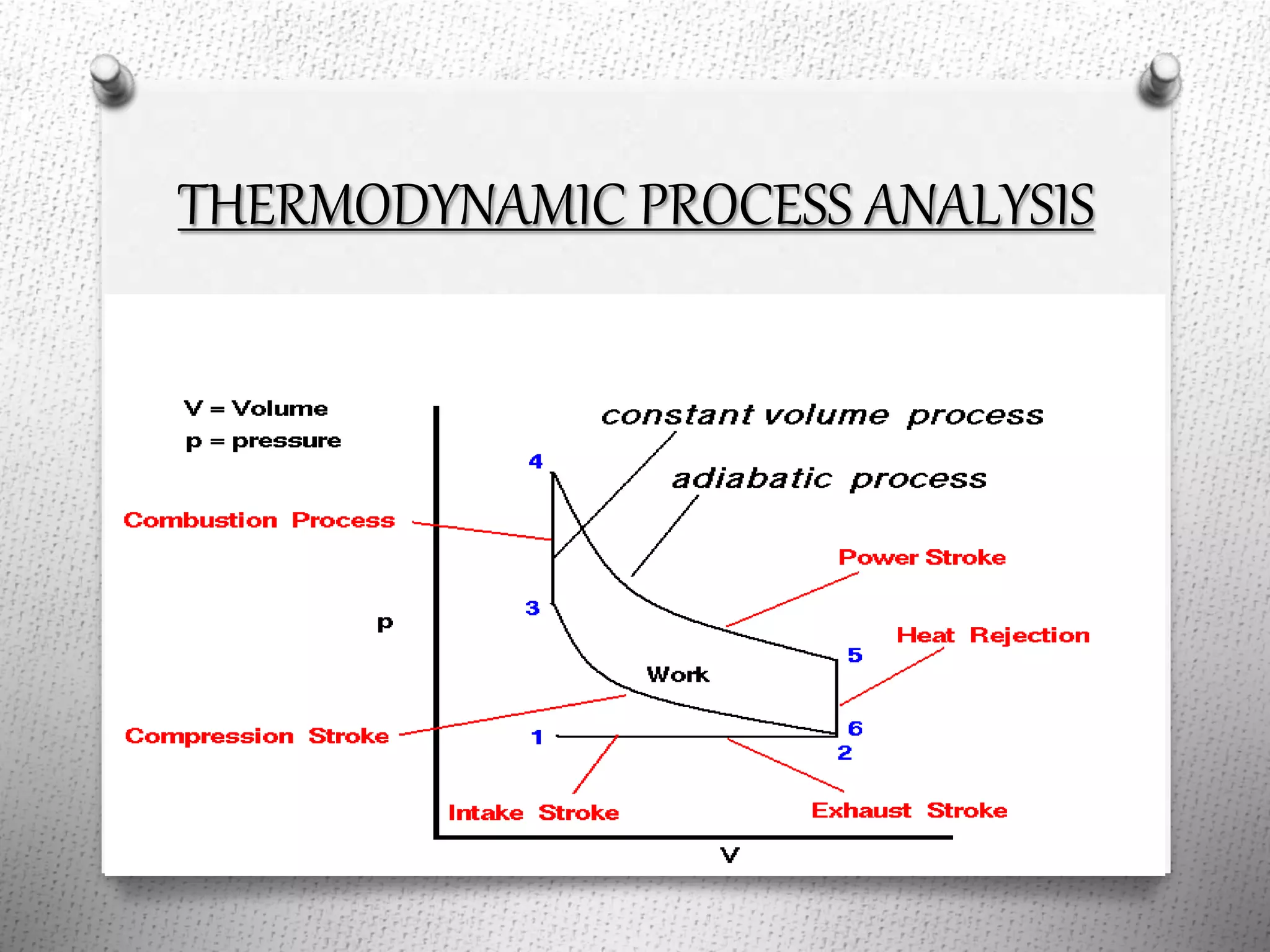
THERMODYNAMIC PROCESS ANALYSIS
ADVANTAGES OF FOUR STROKE
PETROL ENGINE:
O Less fuel consumption.
O Thermal efficiency is more.
O More volumetric efficiency.
O Less wear and tear.
DISADVANTAGES OF FOUR
STROKE PETROL ENGINE:
O More components.
O Separate valve mechanism
is required.
O More cost.
O More complicated design.
APPLICATIONS OF FOUR STROKE PETROL
ENGINE:
O The four stroke version is generally used for larger applications and is the most
common type of engine used in automobiles today.
O This type of engine is an ingenious and practical design that has powered millions of
vehicles. It produces a large amount of power in an efficient and effective manner. It
also generally produces less pollution and lasts longer than a two stroke engine. The
engine was created by Nikolas Otto in the mid 1800s, and in his honor, it's sometimes
known as the Otto Engine. The four main strokes or steps that make up the cycle are
intake, compression, combustion, and exhaust, which is sometimes called the Otto
cycle.
LUBRICATION OF FOUR STROKE PETROL ENGINE:
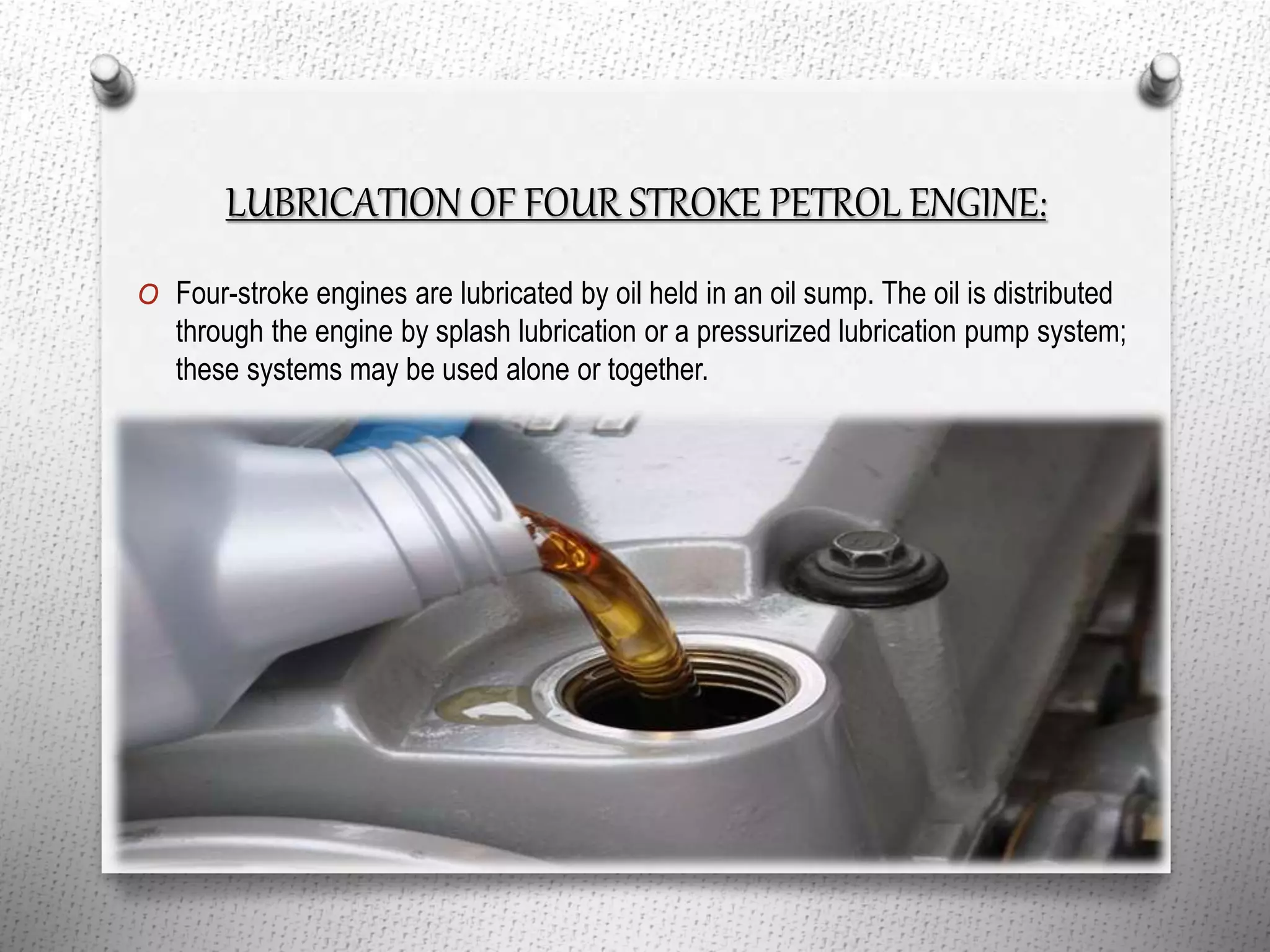
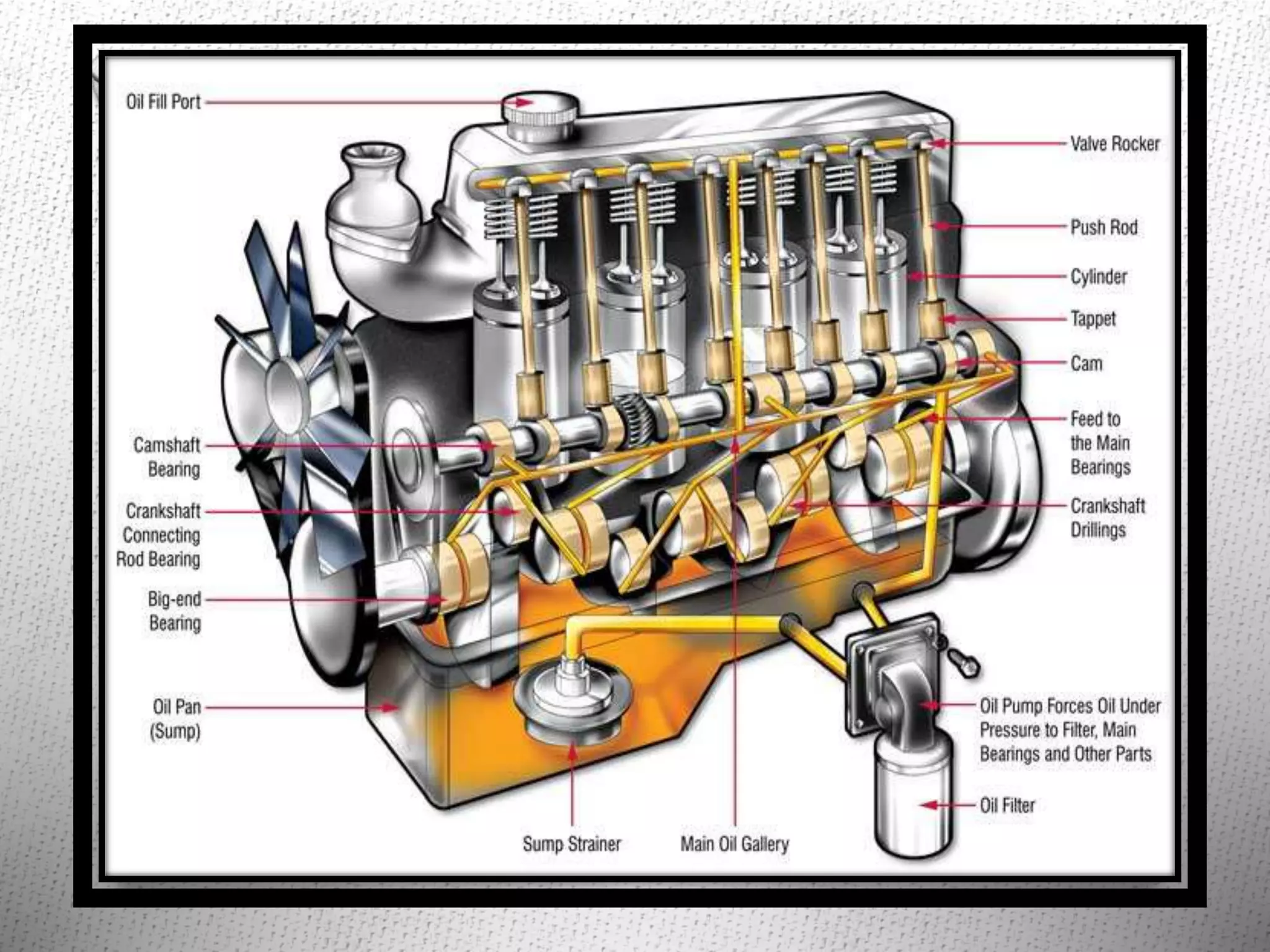
O Four-stroke engines are lubricated by oil held in an oil sump. The oil is distributed
through the engine by splash lubrication or a pressurized lubrication pump system;
these systems may be used alone or together.
Four stroke petrol engine

Four stroke petrol engine

  • 1.
  • 2.
    GROUP MEMBERS O MUHAMMADALI 13ME22 O MUHAMMAD AKHTAR 13ME42 O MUHAMMAD WASEEM 13ME16 O USMAN SAJID 13ME40
  • 3.
    CONTENTS: 1. INTRODUCTION OFFOUR STROKE PETROL ENGINE 2. OTTO CYCLE 3. WORKING OF FOUR STROKE PETROL ENGINE 4. THERMODYNAMIC PROCESS ANALYSIS 5. ADVANTAGES AND DISADVANTAGES OF FOUR STOKE PETROL ENGINE 6. APPLICATIONS OF FOUR STROKE PETROL ENGINE 7. FOUR STROKE LUBRICATION
  • 4.
    INTRODUCTION OF FOURSTROKE ENGINE O Engine: An engine is motor which converts chemical energy into mechanical energy O Fuel/petrol engine: A petrol engine (known as a gasoline engine in North America) is an internal combustion engine with spark-ignition, designed to run on petrol (gasoline) and similar volatile fuels. O Four stroke engine: A four-stroke engine (also known as four-cycle) is an internal combustion engine in which the piston completes four separate strokes which comprise a single thermodynamic cycle. A stroke refers to the full travel of the piston along the cylinder, in either direction.
  • 5.
  • 7.
    WORKING OF FOURSTROKE PETROL ENGINE O INTAKE/SUCTION STROKE: In suction stroke piston starts at Top Dead Center (TDC) of the cylinder and moves to the Bottom Dead Center (BDC). Outlet valve will be closed and inlet valve will be open to allowing the fresh charge of mixed fuel & air into the cylinder. O COMPRESSION STROKE: In compression stroke,Once piston reaches BDC & moves back TDC,inlet valve will be closed,As the piston moves towards TDC,It compress air fuel mixture inside the cylinder & compression takes place,Hence it is called compression stroke. O EXPANSION/POWER STROKE: In expansion stroke,Both the valves are closed,When piston reaches top of its stroke the fuel mixture is ignited by spark plug due to spark high temperature & pressure generated inside the cylinder & push down the piston to BDC,Hence it is known as expansion stroke. O EXHAUST STROKE: In this stroke exhaust valve is opened,when piston reaches to BDC & moves to upward.Piston pushes out the burnt gases to the atmosphere through the exhaust valve. Hence called exhaust stroke & the engine is ready to begin the cycle again.
  • 8.
  • 9.
    ADVANTAGES OF FOURSTROKE PETROL ENGINE: O Less fuel consumption. O Thermal efficiency is more. O More volumetric efficiency. O Less wear and tear. DISADVANTAGES OF FOUR STROKE PETROL ENGINE: O More components. O Separate valve mechanism is required. O More cost. O More complicated design.
  • 10.
    APPLICATIONS OF FOURSTROKE PETROL ENGINE: O The four stroke version is generally used for larger applications and is the most common type of engine used in automobiles today. O This type of engine is an ingenious and practical design that has powered millions of vehicles. It produces a large amount of power in an efficient and effective manner. It also generally produces less pollution and lasts longer than a two stroke engine. The engine was created by Nikolas Otto in the mid 1800s, and in his honor, it's sometimes known as the Otto Engine. The four main strokes or steps that make up the cycle are intake, compression, combustion, and exhaust, which is sometimes called the Otto cycle.
  • 11.
    LUBRICATION OF FOURSTROKE PETROL ENGINE: O Four-stroke engines are lubricated by oil held in an oil sump. The oil is distributed through the engine by splash lubrication or a pressurized lubrication pump system; these systems may be used alone or together.