

Completing the Square
Overview
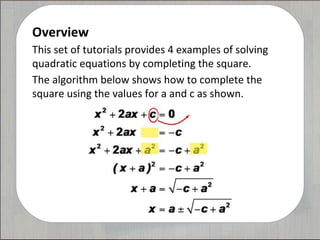
This set of tutorials provides 4 examples of solving
quadratic equations by completing the square.
The algorithm below shows how to complete the
square using the values for a and c as shown.
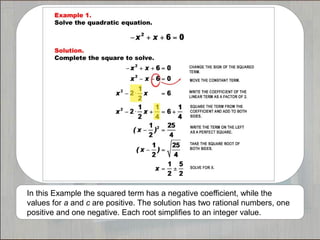
In this Example the squared term has a negative coefficient, while the
values for a and c are positive. The solution has two rational numbers, one
positive and one negative. Each root simplifies to an integer value.
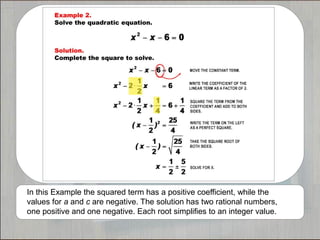
In this Example the squared term has a positive coefficient, while the
values for a and c are negative. The solution has two rational numbers,
one positive and one negative. Each root simplifies to an integer value.
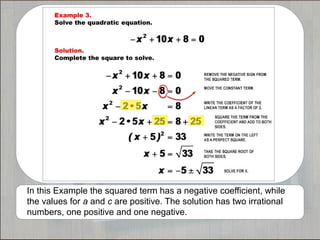
In this Example the squared term has a negative coefficient, while
the values for a and c are positive. The solution has two irrational
numbers, one positive and one negative.
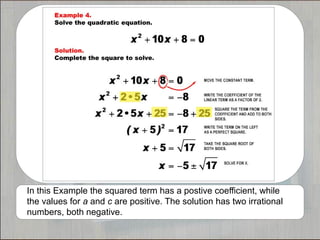
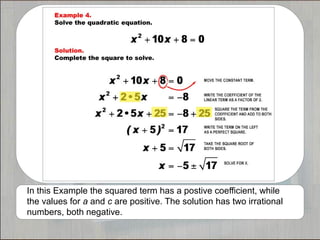
In this Example the squared term has a postive coefficient, while
the values for a and c are positive. The solution has two irrational
numbers, both negative.
In this Example the squared term has a postive coefficient, while
the values for a and c are positive. The solution has two irrational
numbers, both negative.

Tutorials--Completing the Square

  • 1.
  • 2.
    Overview This set oftutorials provides 4 examples of solving quadratic equations by completing the square. The algorithm below shows how to complete the square using the values for a and c as shown.
  • 3.
    In this Examplethe squared term has a negative coefficient, while the values for a and c are positive. The solution has two rational numbers, one positive and one negative. Each root simplifies to an integer value.
  • 4.
    In this Examplethe squared term has a positive coefficient, while the values for a and c are negative. The solution has two rational numbers, one positive and one negative. Each root simplifies to an integer value.
  • 5.
    In this Examplethe squared term has a negative coefficient, while the values for a and c are positive. The solution has two irrational numbers, one positive and one negative.
  • 6.
    In this Examplethe squared term has a postive coefficient, while the values for a and c are positive. The solution has two irrational numbers, both negative.
  • 7.
    In this Examplethe squared term has a postive coefficient, while the values for a and c are positive. The solution has two irrational numbers, both negative.