Rational Numbers
Created by
Mathukutty sunny
Definition of Rational Numbers
 The integers which are in the form of p/q where q ≠ 0 are known as Rational Numbers.
 Examples : 5/8; -3/14; 7/-15; -6/-11
Properties of Rational Numbers
1) Closure Property
2) Associative Property
3) Distributive Law
4) Additive Inverse
5) Multiplicative Inverse
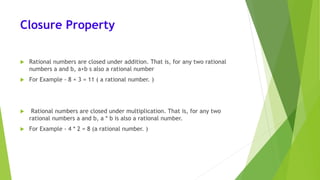
Closure Property
 Rational numbers are closed under addition. That is, for any two rational
numbers a and b, a+b s also a rational number
 For Example - 8 + 3 = 11 ( a rational number. )
 Rational numbers are closed under multiplication. That is, for any two
rational numbers a and b, a * b is also a rational number.
 For Example - 4 * 2 = 8 (a rational number. )
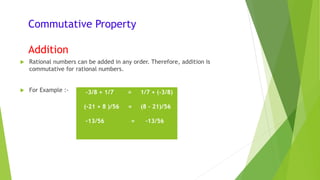
Commutative Property
Addition
 Rational numbers can be added in any order. Therefore, addition is
commutative for rational numbers.
 For Example :- -3/8 + 1/7 = 1/7 + (-3/8)
(-21 + 8 )/56 = (8 – 21)/56
-13/56 = -13/56
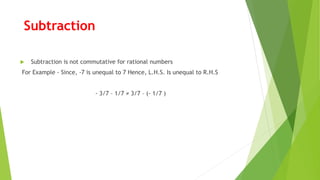
Subtraction
 Subtraction is not commutative for rational numbers
For Example - Since, -7 is unequal to 7 Hence, L.H.S. Is unequal to R.H.S
- 3/7 – 1/7 ≠ 3/7 – (- 1/7 )
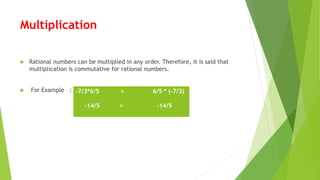
Multiplication
 Rational numbers can be multiplied in any order. Therefore, it is said that
multiplication is commutative for rational numbers.
 For Example : -7/3*6/5 = 6/5 * (-7/3)
-14/5 = -14/5
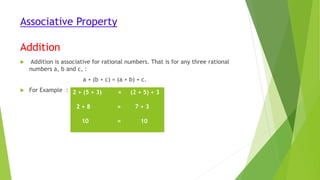
Associative Property
Addition
 Addition is associative for rational numbers. That is for any three rational
numbers a, b and c, :
a + (b + c) = (a + b) + c.
 For Example : 2 + (5 + 3) = (2 + 5) + 3
2 + 8 = 7 + 3
10 = 10
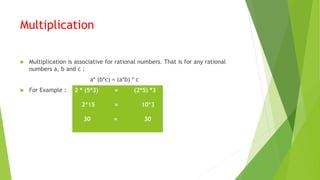
Multiplication
 Multiplication is associative for rational numbers. That is for any rational
numbers a, b and c :
a* (b*c) = (a*b) * c
 For Example : 2 * (5*3) = (2*5) *3
2*15 = 10*3
30 = 30
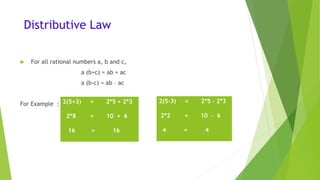
Distributive Law
 For all rational numbers a, b and c,
a (b+c) = ab + ac
a (b-c) = ab – ac
For Example : 2(5+3) = 2*5 + 2*3
2*8 = 10 + 6
16 = 16
2(5-3) = 2*5 - 2*3
2*2 = 10 - 6
4 = 4
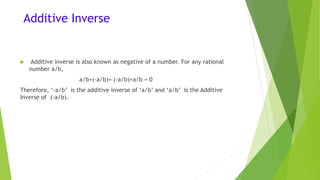
Additive Inverse
 Additive inverse is also known as negative of a number. For any rational
number a/b,
a/b+(-a/b)= (-a/b)+a/b = 0
Therefore, ‘-a/b’ is the additive inverse of ‘a/b’ and ‘a/b’ is the Additive
Inverse of (-a/b).
Multiplicative Inverse
 Multiplicative inverse is also known as reciprocal number. For any rational
number a/b,
a/b * b/a = 1
THANK YOU

Rational numbers ppt

  • 1.
  • 2.
    Definition of RationalNumbers  The integers which are in the form of p/q where q ≠ 0 are known as Rational Numbers.  Examples : 5/8; -3/14; 7/-15; -6/-11
  • 3.
    Properties of RationalNumbers 1) Closure Property 2) Associative Property 3) Distributive Law 4) Additive Inverse 5) Multiplicative Inverse
  • 4.
    Closure Property  Rationalnumbers are closed under addition. That is, for any two rational numbers a and b, a+b s also a rational number  For Example - 8 + 3 = 11 ( a rational number. )  Rational numbers are closed under multiplication. That is, for any two rational numbers a and b, a * b is also a rational number.  For Example - 4 * 2 = 8 (a rational number. )
  • 5.
    Commutative Property Addition  Rationalnumbers can be added in any order. Therefore, addition is commutative for rational numbers.  For Example :- -3/8 + 1/7 = 1/7 + (-3/8) (-21 + 8 )/56 = (8 – 21)/56 -13/56 = -13/56
  • 6.
    Subtraction  Subtraction isnot commutative for rational numbers For Example - Since, -7 is unequal to 7 Hence, L.H.S. Is unequal to R.H.S - 3/7 – 1/7 ≠ 3/7 – (- 1/7 )
  • 7.
    Multiplication  Rational numberscan be multiplied in any order. Therefore, it is said that multiplication is commutative for rational numbers.  For Example : -7/3*6/5 = 6/5 * (-7/3) -14/5 = -14/5
  • 8.
    Associative Property Addition  Additionis associative for rational numbers. That is for any three rational numbers a, b and c, : a + (b + c) = (a + b) + c.  For Example : 2 + (5 + 3) = (2 + 5) + 3 2 + 8 = 7 + 3 10 = 10
  • 9.
    Multiplication  Multiplication isassociative for rational numbers. That is for any rational numbers a, b and c : a* (b*c) = (a*b) * c  For Example : 2 * (5*3) = (2*5) *3 2*15 = 10*3 30 = 30
  • 10.
    Distributive Law  Forall rational numbers a, b and c, a (b+c) = ab + ac a (b-c) = ab – ac For Example : 2(5+3) = 2*5 + 2*3 2*8 = 10 + 6 16 = 16 2(5-3) = 2*5 - 2*3 2*2 = 10 - 6 4 = 4
  • 11.
    Additive Inverse  Additiveinverse is also known as negative of a number. For any rational number a/b, a/b+(-a/b)= (-a/b)+a/b = 0 Therefore, ‘-a/b’ is the additive inverse of ‘a/b’ and ‘a/b’ is the Additive Inverse of (-a/b).
  • 12.
    Multiplicative Inverse  Multiplicativeinverse is also known as reciprocal number. For any rational number a/b, a/b * b/a = 1
  • 13.