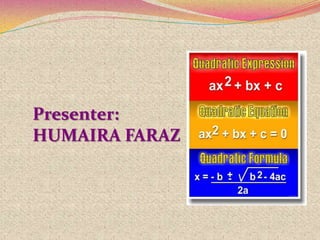
Presenter:
HUMAIRA FARAZ
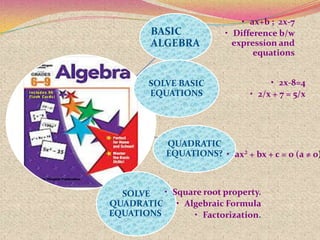
BASIC
ALGEBRA
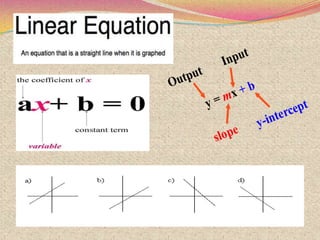
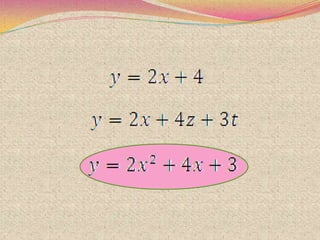
• ax+b ; 2x-7
• Difference b/w
expression and
equations
SOLVE BASIC
EQUATIONS
• 2x-8=4
• 2/x + 7 = 5/x
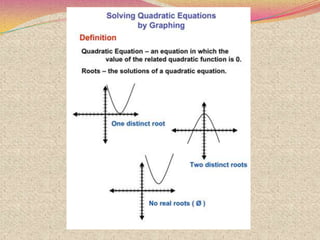
QUADRATIC
EQUATIONS? • ax² + bx + c = 0 (a ≠ 0)
SOLVE
QUADRATIC
EQUATIONS.
• Square root property.
• Algebraic Formula
• Factorization.
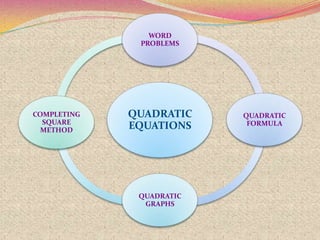
QUADRATIC
EQUATIONS
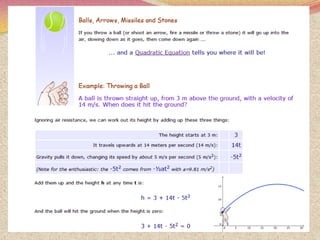
WORD
PROBLEMS
QUADRATIC
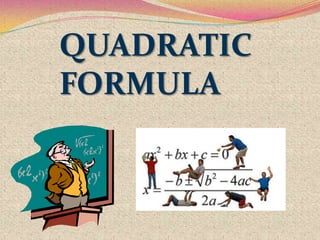
FORMULA
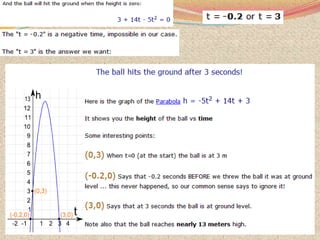
QUADRATIC
GRAPHS
COMPLETING
SQUARE
METHOD
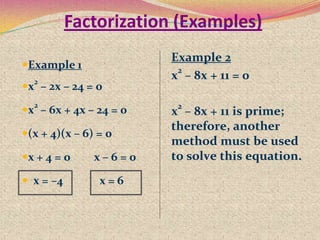
Factorization (Examples)
Example 1
x2
– 2x – 24 = 0
x2
– 6x + 4x – 24 = 0
(x + 4)(x – 6) = 0
x + 4 = 0 x – 6 = 0
 x = –4 x = 6
Example 2
x
2
– 8x + 11 = 0
x
2
– 8x + 11 is prime;
therefore, another
method must be used
to solve this equation.
COMPLETING
SQUARE
METHOD
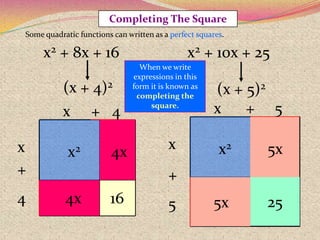
(x + 4)2
x + 4
x
+
4
x2 4x
4x 16
Completing The Square
Some quadratic functions can written as a perfect squares.
x2 + 8x + 16 x2 + 10x + 25
(x + 5)2
x + 5
x 5x
25
+
5 5x
x2
We can show this
geometrically when
the coefficient of x is
positive.
When we write
expressions in this
form it is known as
completing the
square.
Completing The Square
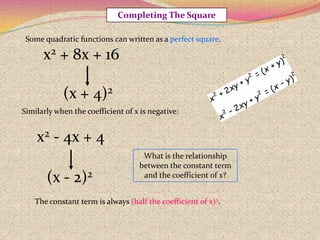
Some quadratic functions can written as a perfect square.
x2 + 8x + 16
(x + 4)2
(x - 2)2
x2 - 4x + 4
Similarly when the coefficient of x is negative:
What is the relationship
between the constant term
and the coefficient of x?
The constant term is always (half the coefficient of x)2.
Completing The Square
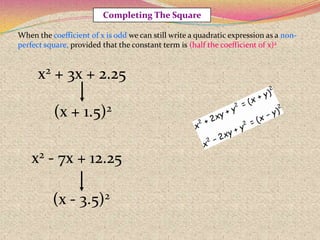
x2 + 3x + 2.25
(x + 1.5)2
(x - 3.5)2
x2 - 7x + 12.25
When the coefficient of x is odd we can still write a quadratic expression as a non-
perfect square, provided that the constant term is (half the coefficient of x)2
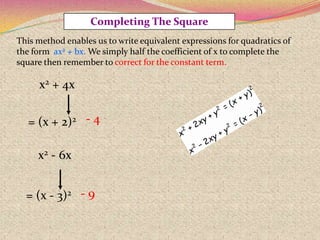
= (x + 2)2
= (x - 3)2
x2 + 4x
x2 - 6x
Completing The Square
This method enables us to write equivalent expressions for quadratics of
the form ax2 + bx. We simply half the coefficient of x to complete the
square then remember to correct for the constant term.
- 4
- 9
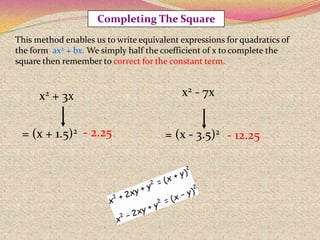
= (x + 1.5)2
= (x - 3.5)2
x2 + 3x x2 - 7x
Completing The Square
This method enables us to write equivalent expressions for quadratics of
the form ax2 + bx. We simply half the coefficient of x to complete the
square then remember to correct for the constant term.
- 2.25 - 12.25
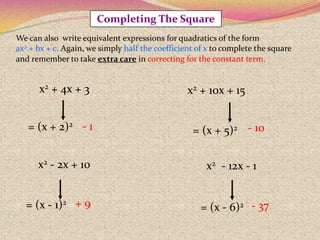
= (x + 5)2= (x + 2)2
= (x - 1)2
= (x - 6)2
x2 + 4x + 3 x2 + 10x + 15
x2 - 2x + 10 x2 - 12x - 1
Completing The Square
We can also write equivalent expressions for quadratics of the form
ax2 + bx + c. Again, we simply half the coefficient of x to complete the square
and remember to take extra care in correcting for the constant term.
- 1 - 10
+ 9 - 37
Solving Quadratic Equations
by Completing the Square
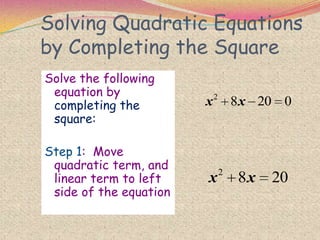
Solve the following
equation by
completing the
square:
Step 1: Move
quadratic term, and
linear term to left
side of the equation
2
8 20 0x x
2
8 20x x
Solving Quadratic Equations
by Completing the Square
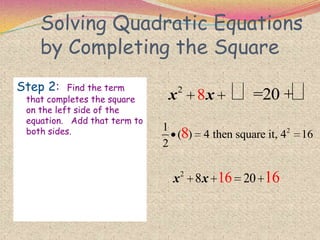
Step 2: Find the term
that completes the square
on the left side of the
equation. Add that term to
both sides.
2
8 =20 +x x  
21
( ) 4 then square it, 4 16
2
8
2
8 2016 16x x
Solving Quadratic Equations
by Completing the Square
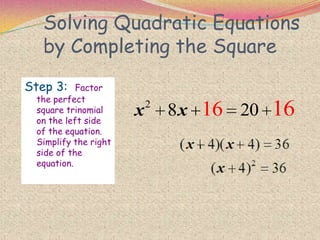
Step 3: Factor
the perfect
square trinomial
on the left side
of the equation.
Simplify the right
side of the
equation.
2
8 2016 16x x
Solving Quadratic Equations by
Completing the Square
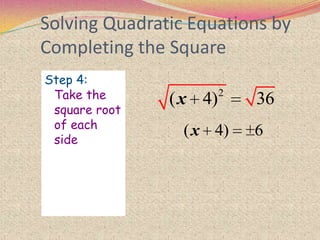
Step 4:
Take the
square root
of each
side
2
( 4) 36x
( 4) 6x
Solving Quadratic Equations by
Completing the Square
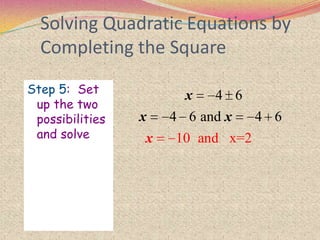
Step 5: Set
up the two
possibilities
and solve
4 6
4 6 and 4 6
10 and 2x=
x
x x
x
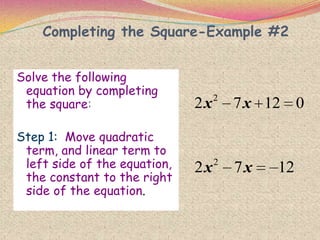
Completing the Square-Example #2
Solve the following
equation by completing
the square:
Step 1: Move quadratic
term, and linear term to
left side of the equation,
the constant to the right
side of the equation.
2
2 7 12 0x x
2
2 7 12x x
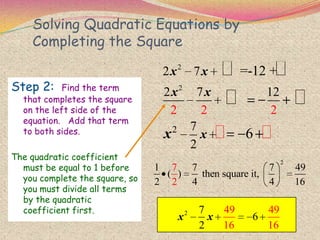
Solving Quadratic Equations by
Completing the Square
Step 2: Find the term
that completes the square
on the left side of the
equation. Add that term
to both sides.
The quadratic coefficient
must be equal to 1 before
you complete the square, so
you must divide all terms
by the quadratic
coefficient first.
2
2
2
2 7
2
2 2 2
7 12
7
2
=-12 +
6
x x
x x
xx  
 
 
2
1 7 7 49
( ) then square it,
2 62 4 4 1
7
2 49 49
16 1
7
6
2 6
x x
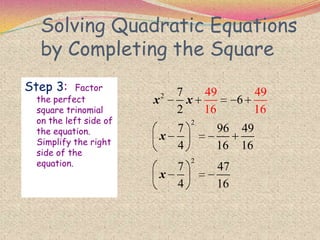
Solving Quadratic Equations
by Completing the Square
Step 3: Factor
the perfect
square trinomial
on the left side of
the equation.
Simplify the right
side of the
equation.
2
2
2
7
6
2
7 96 49
4 16 16
7 47
4
49 49
16 1
16
6
x x
x
x
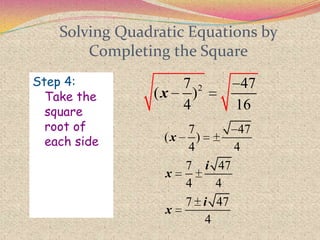
Solving Quadratic Equations by
Completing the Square
Step 4:
Take the
square
root of
each side
27 47
( )
4 16
x
7 47
( )
4 4
7 47
4 4
7 47
4
x
i
x
i
x
QUADRATIC
FORMULA
2
4
2
b b ac
x
a
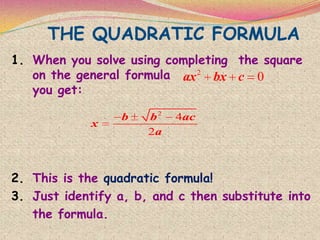
THE QUADRATIC FORMULA
1. When you solve using completing the square
on the general formula
you get:
2. This is the quadratic formula!
3. Just identify a, b, and c then substitute into
the formula.
2
0ax bx c
2
2 7 11 0x x
2
2
4
2
7 7 4(2)( 11)
2(
2, 7, 11
7 137
2 Reals - Irrational
4
2)
a b
b ac
a
c
b
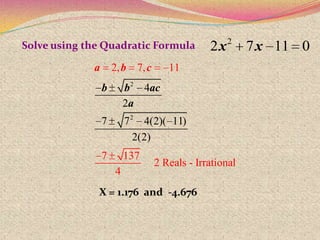
Solve using the Quadratic Formula
X = 1.176 and -4.676
SCIENTIFIC CALCULATOR
Humaira quadratic
Humaira quadratic
Humaira quadratic
Humaira quadratic

Humaira quadratic

  • 1.
  • 2.
    BASIC ALGEBRA • ax+b ;2x-7 • Difference b/w expression and equations SOLVE BASIC EQUATIONS • 2x-8=4 • 2/x + 7 = 5/x QUADRATIC EQUATIONS? • ax² + bx + c = 0 (a ≠ 0) SOLVE QUADRATIC EQUATIONS. • Square root property. • Algebraic Formula • Factorization.
  • 3.
  • 8.
    Factorization (Examples) Example 1 x2 –2x – 24 = 0 x2 – 6x + 4x – 24 = 0 (x + 4)(x – 6) = 0 x + 4 = 0 x – 6 = 0  x = –4 x = 6 Example 2 x 2 – 8x + 11 = 0 x 2 – 8x + 11 is prime; therefore, another method must be used to solve this equation.
  • 9.
  • 10.
    (x + 4)2 x+ 4 x + 4 x2 4x 4x 16 Completing The Square Some quadratic functions can written as a perfect squares. x2 + 8x + 16 x2 + 10x + 25 (x + 5)2 x + 5 x 5x 25 + 5 5x x2 We can show this geometrically when the coefficient of x is positive. When we write expressions in this form it is known as completing the square.
  • 11.
    Completing The Square Somequadratic functions can written as a perfect square. x2 + 8x + 16 (x + 4)2 (x - 2)2 x2 - 4x + 4 Similarly when the coefficient of x is negative: What is the relationship between the constant term and the coefficient of x? The constant term is always (half the coefficient of x)2.
  • 12.
    Completing The Square x2+ 3x + 2.25 (x + 1.5)2 (x - 3.5)2 x2 - 7x + 12.25 When the coefficient of x is odd we can still write a quadratic expression as a non- perfect square, provided that the constant term is (half the coefficient of x)2
  • 13.
    = (x +2)2 = (x - 3)2 x2 + 4x x2 - 6x Completing The Square This method enables us to write equivalent expressions for quadratics of the form ax2 + bx. We simply half the coefficient of x to complete the square then remember to correct for the constant term. - 4 - 9
  • 14.
    = (x +1.5)2 = (x - 3.5)2 x2 + 3x x2 - 7x Completing The Square This method enables us to write equivalent expressions for quadratics of the form ax2 + bx. We simply half the coefficient of x to complete the square then remember to correct for the constant term. - 2.25 - 12.25
  • 15.
    = (x +5)2= (x + 2)2 = (x - 1)2 = (x - 6)2 x2 + 4x + 3 x2 + 10x + 15 x2 - 2x + 10 x2 - 12x - 1 Completing The Square We can also write equivalent expressions for quadratics of the form ax2 + bx + c. Again, we simply half the coefficient of x to complete the square and remember to take extra care in correcting for the constant term. - 1 - 10 + 9 - 37
  • 16.
    Solving Quadratic Equations byCompleting the Square Solve the following equation by completing the square: Step 1: Move quadratic term, and linear term to left side of the equation 2 8 20 0x x 2 8 20x x
  • 17.
    Solving Quadratic Equations byCompleting the Square Step 2: Find the term that completes the square on the left side of the equation. Add that term to both sides. 2 8 =20 +x x   21 ( ) 4 then square it, 4 16 2 8 2 8 2016 16x x
  • 18.
    Solving Quadratic Equations byCompleting the Square Step 3: Factor the perfect square trinomial on the left side of the equation. Simplify the right side of the equation. 2 8 2016 16x x
  • 19.
    Solving Quadratic Equationsby Completing the Square Step 4: Take the square root of each side 2 ( 4) 36x ( 4) 6x
  • 20.
    Solving Quadratic Equationsby Completing the Square Step 5: Set up the two possibilities and solve 4 6 4 6 and 4 6 10 and 2x= x x x x
  • 21.
    Completing the Square-Example#2 Solve the following equation by completing the square: Step 1: Move quadratic term, and linear term to left side of the equation, the constant to the right side of the equation. 2 2 7 12 0x x 2 2 7 12x x
  • 22.
    Solving Quadratic Equationsby Completing the Square Step 2: Find the term that completes the square on the left side of the equation. Add that term to both sides. The quadratic coefficient must be equal to 1 before you complete the square, so you must divide all terms by the quadratic coefficient first. 2 2 2 2 7 2 2 2 2 7 12 7 2 =-12 + 6 x x x x xx       2 1 7 7 49 ( ) then square it, 2 62 4 4 1 7 2 49 49 16 1 7 6 2 6 x x
  • 23.
    Solving Quadratic Equations byCompleting the Square Step 3: Factor the perfect square trinomial on the left side of the equation. Simplify the right side of the equation. 2 2 2 7 6 2 7 96 49 4 16 16 7 47 4 49 49 16 1 16 6 x x x x
  • 24.
    Solving Quadratic Equationsby Completing the Square Step 4: Take the square root of each side 27 47 ( ) 4 16 x 7 47 ( ) 4 4 7 47 4 4 7 47 4 x i x i x
  • 25.
  • 26.
    2 4 2 b b ac x a THEQUADRATIC FORMULA 1. When you solve using completing the square on the general formula you get: 2. This is the quadratic formula! 3. Just identify a, b, and c then substitute into the formula. 2 0ax bx c
  • 27.
    2 2 7 110x x 2 2 4 2 7 7 4(2)( 11) 2( 2, 7, 11 7 137 2 Reals - Irrational 4 2) a b b ac a c b Solve using the Quadratic Formula X = 1.176 and -4.676
  • 30.