
CONTINUOUS MINER


         CHANDAN CHAMAN
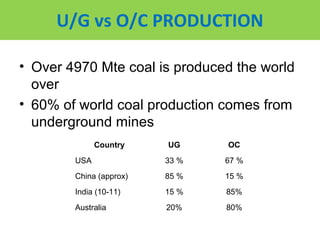
U/G vs O/C PRODUCTION

• Over 4970 Mte coal is produced the world
  over
• 60% of world coal production comes from
  underground mines
              Country    UG     OC
        USA              33 %   67 %
        China (approx)   85 %   15 %
        India (10-11)    15 %   85%
        Australia        20%    80%
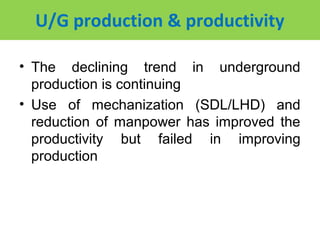
U/G production & productivity

• The declining trend in underground
  production is continuing
• Use of mechanization (SDL/LHD) and
  reduction of manpower has improved the
  productivity but failed in improving
  production
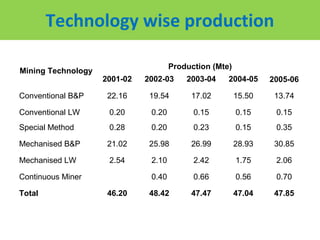
Technology wise production

                                      Production (Mte)
Mining Technology
                    2001-02   2002-03     2003-04    2004-05     2005-06

Conventional B&P     22.16     19.54       17.02         15.50    13.74

Conventional LW      0.20      0.20         0.15         0.15     0.15
Special Method       0.28      0.20         0.23         0.15     0.35

Mechanised B&P       21.02     25.98       26.99         28.93    30.85

Mechanised LW        2.54      2.10         2.42         1.75     2.06

Continuous Miner               0.40         0.66         0.56     0.70

Total                46.20     48.42       47.47         47.04    47.85
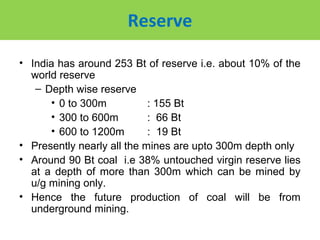
Reserve

• India has around 253 Bt of reserve i.e. about 10% of the
  world reserve
   – Depth wise reserve
      • 0 to 300m           : 155 Bt
      • 300 to 600m         : 66 Bt
      • 600 to 1200m        : 19 Bt
• Presently nearly all the mines are upto 300m depth only
• Around 90 Bt coal i.e 38% untouched virgin reserve lies
  at a depth of more than 300m which can be mined by
  u/g mining only.
• Hence the future production of coal will be from
  underground mining.
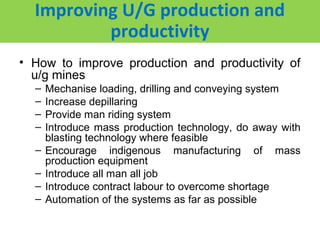
Improving U/G production and
          productivity
• How to improve production and productivity of
  u/g mines
  –   Mechanise loading, drilling and conveying system
  –   Increase depillaring
  –   Provide man riding system
  –   Introduce mass production technology, do away with
      blasting technology where feasible
  –   Encourage indigenous manufacturing of mass
      production equipment
  –   Introduce all man all job
  –   Introduce contract labour to overcome shortage
  –   Automation of the systems as far as possible
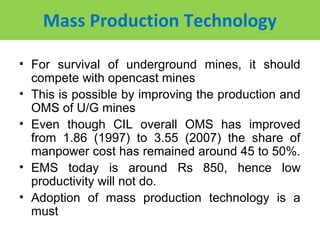
Mass Production Technology

• For survival of underground mines, it should
  compete with opencast mines
• This is possible by improving the production and
  OMS of U/G mines
• Even though CIL overall OMS has improved
  from 1.86 (1997) to 3.55 (2007) the share of
  manpower cost has remained around 45 to 50%.
• EMS today is around Rs 850, hence low
  productivity will not do.
• Adoption of mass production technology is a
  must
Continuous Miner

 Continuous miner is a mass production technology for
  underground mining that can be used in
    bord & pillar (room & pillar)
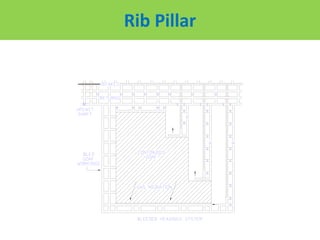
    rib pillar and
    shortwall methods.

 Continuous miner has been adopted for bord & pillar
  method in Anjan Hills/ NCPH of SECL and in Tandsi
  Mine of WCL. Adoption in Jhanjra, ECL is under
  process.
 SECL has achieved annual production of more than 0.5
  MTe with CM
 About 20 more mines have been identified for
  introduction of CM in future
Suitable conditions for CM

Though equipments are manufactured to
suit wide range of conditions, some of the
limitations of its use are as follows.
 Seam thickness: 1.8m to 5m
 Seam gradient: 1 in 8 or flatter
 Floor rock: Hard and dry floor condition
  desirable for efficient operation
 Roof condition: Bad roof condition
  adversely affects system performance.
  (RMR at NCPH Old – 55; Tandsi – 36)
Broad specifications of equipments
        being used in CIL
 Continuous        Miner       -    12CM15-10D           (Crawler-
  mounted)
  Operating height range: 2.28 – 4.6m; Cutting drum width: 3.3m;
  Total motor power: 564 kW
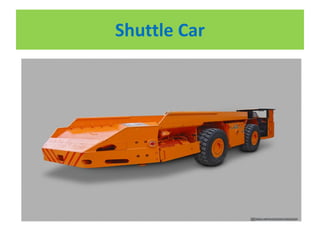
 Shuttle Cars - 10SC32B (Tyre-mounted)
  Safe carrying capacity: 13.6 t (It carries 8t of coal in NCPH); Cable
  reel capacity: 200m; Total motor power: 107 kW
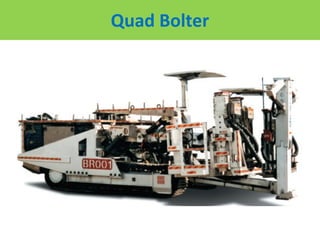
 Quad Bolter – RT117 (Crawler-mounted)
  Minimum tram height: 2.15m; Operating height range: 2.4 – 4.775m;
  No. of bolters: 4 (2 per platform); Motor power: 112 kW
 Feeder-breaker – BF-14B-3-7C (Crawler-mounted)
  Throughput: 250 & 500 tph; Breaker Motor: 112 kW
 Load-Haul-Dump (LHD) (Tyre-mounted)
 Load-centre (Trolley-mounted)
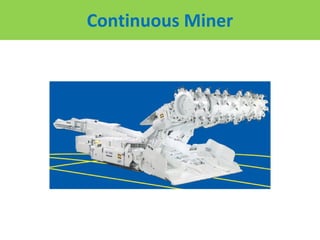
Continuous Miner
Shuttle Car
Quad Bolter
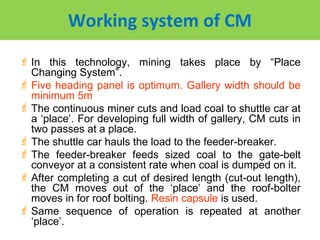
Working system of CM
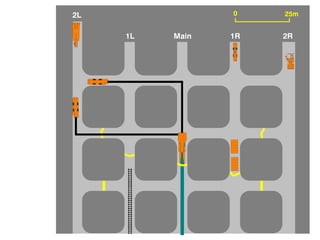
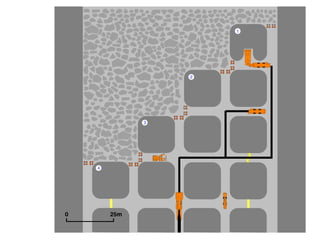
 In this technology, mining takes place by “Place
  Changing System”.
 Five heading panel is optimum. Gallery width should be
  minimum 5m
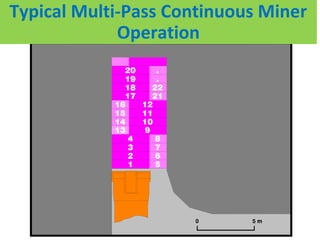
 The continuous miner cuts and load coal to shuttle car at
  a ‘place’. For developing full width of gallery, CM cuts in
  two passes at a place.
 The shuttle car hauls the load to the feeder-breaker.
 The feeder-breaker feeds sized coal to the gate-belt
  conveyor at a consistent rate when coal is dumped on it.
 After completing a cut of desired length (cut-out length),
  the CM moves out of the ‘place’ and the roof-bolter
  moves in for roof bolting. Resin capsule is used.
 Same sequence of operation is repeated at another
  ‘place’.
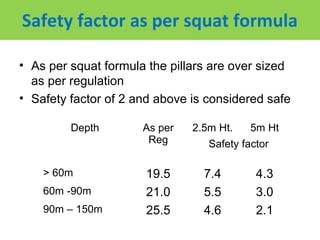
Safety factor as per squat formula

• As per squat formula the pillars are over sized
  as per regulation
• Safety factor of 2 and above is considered safe

         Depth        As per   2.5m Ht.    5m Ht
                       Reg        Safety factor

    > 60m             19.5       7.4        4.3
    60m -90m          21.0       5.5        3.0
    90m – 150m        25.5       4.6        2.1
Typical Multi-Pass Continuous Miner
             Operation
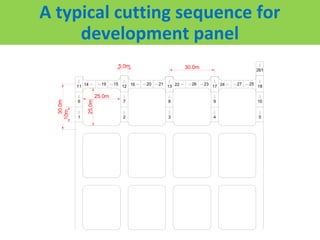
A typical cutting sequence for
     development panel
                                     5.0m                       30.0m


                          19    15            20   21             26    23           27   25
            11 14                     12 16             13 22                17 24             18

                        25.0m
            6                         7                 8                    9                 10
    30.0m


                25.0m
  10m


            1                         2                 3                    4                 5
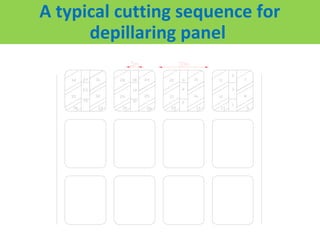
A typical cutting sequence for
      depillaring panel
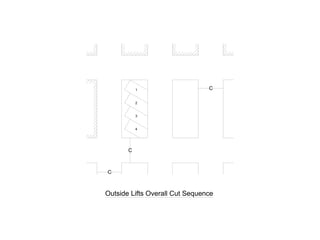
1                    C

           2


           3


           4


       C


C


Outside Lifts Overall Cut Sequence
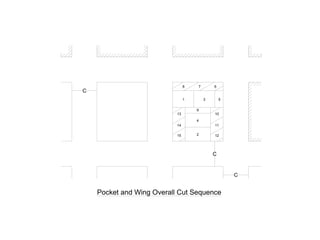
8   7       6
C
                                1       3       5


                                    9
                           13               10
                                    4
                           14               11

                           15       2       12


                                            C


                                                    C


    Pocket and Wing Overall Cut Sequence
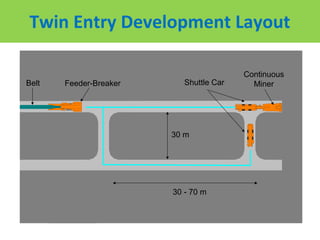
Twin Entry Development Layout

                                         Continuous
Belt   Feeder-Breaker      Shuttle Car     Miner


                        30 m


                        30 - 70 m
Rib Pillar
BLEEDER HEADINGS


                                        GAS
                                        BLEED


              LARGE STOCKS


                                          VENTILATION


                                                                   BREAKER
                                                                    PROPS
                                      NEXT FENDER

                 15                   NEXT SPLIT    16
                      CONVEYOR ROAD
RETURN ROAD


                                      WONGAWALLI BLOCK
Factors affecting production capacity
    for a given set of equipments
 Size of pillars (centre-to-centre)
 Width of galleries, splits, and slices
 Height of extraction
 Number of pillars in a row
 Maximum permissible cut-out length
 Bolting grid size/ No. of bolts per m2
 Time cycle of different equipment
 Specific gravity of coal
 Recovery percentage
 Available and utilisation hours of the system
 Sub-system capacity, spares, maintenance,
  trained manpower, etc.
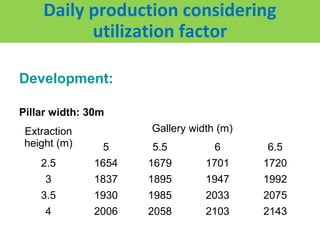
Daily production considering
          utilization factor

Development:

Pillar width: 30m
 Extraction           Gallery width (m)
 height (m)     5     5.5          6      6.5
    2.5        1654   1679       1701     1720
     3         1837   1895       1947     1992
    3.5        1930   1985       2033     2075
     4         2006   2058       2103     2143
Daily production considering
         utilisation factor

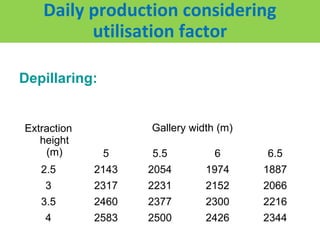
Depillaring:


Extraction          Gallery width (m)
   height
    (m)        5    5.5          6      6.5
   2.5       2143   2054       1974     1887
    3        2317   2231       2152     2066
   3.5       2460   2377       2300     2216
    4        2583   2500       2426     2344
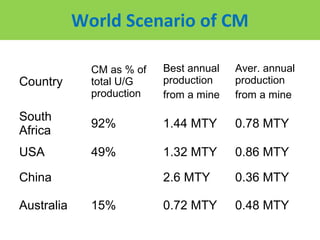
World Scenario of CM

              CM as % of   Best annual   Aver. annual
Country       total U/G    production    production
              production   from a mine   from a mine

South
              92%          1.44 MTY      0.78 MTY
Africa
USA           49%          1.32 MTY      0.86 MTY

China                      2.6 MTY       0.36 MTY

Australia     15%          0.72 MTY      0.48 MTY
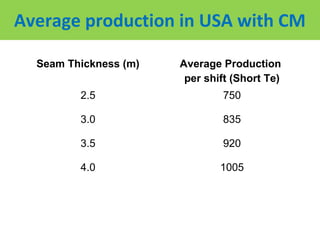
Average production in USA with CM

  Seam Thickness (m)   Average Production
                        per shift (Short Te)
         2.5                   750

         3.0                   835

         3.5                   920

         4.0                   1005
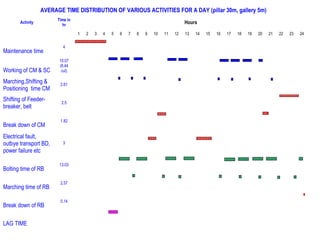
AVERAGE TIME DISTRIBUTION OF VARIOUS ACTIVITIES FOR A DAY (pillar 30m, gallery 5m)
                        Time in
       Activity
                          hr                                                                     Hours

                                     1   2   3   4   5   6   7   8   9   10      11      12      13      14      15      16      17      18      19      20      21      22      23      24
                                      
                              4
Maintenance time                                                                                                                                                                              
                            10.07 
                            (8.44                 
Working of CM & SC           cut)                                                                                                                                                         

Marching,Shifting &         2.61                  
Positioning  time CM                                                                                                                                                                      

Shifting of Feeder-          2.5                  
breaker, belt                                                                                                                                                     

                            1.82                  
Break down of CM                                                                                                                                                                          

Electrical fault, 
outbye transport BD,          3                   
power failure etc                                                                                                                                                                         

                            13.03                 
Bolting time of RB                                                                                                        

                            2.57                  
Marching time of RB                                                                                                                                               
                                                                                                                                                                                          
                            0.14                  
Break down of RB                                                                                                                                                                  

                                                  
LAG TIME                                                                                                                                                                                  
                                                                                                                                                                                          
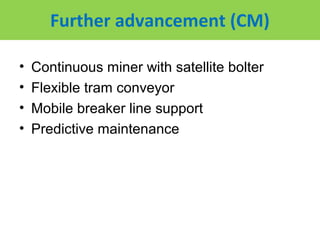
Further advancement (CM)

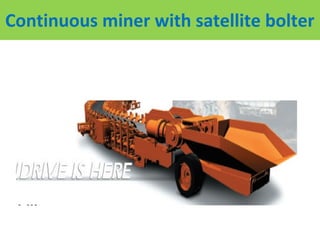
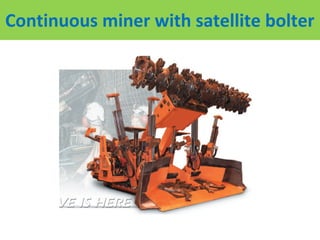
•   Continuous miner with satellite bolter
•   Flexible tram conveyor
•   Mobile breaker line support
•   Predictive maintenance
Continuous miner with satellite bolter
Man Riding

• Man-riding systems on tracks:
  – By rope haulage:
  – By locomotive (Trolley-wire/ Battery operated/
    Diesel operated)
• Trackless man-riding systems:
  – Belt conveyor
  – Chairlift:
  – Free-steered vehicle
THANKS


   chandanchaman@gmail.com

Continuous miner

  • 1.
    CONTINUOUS MINER CHANDAN CHAMAN
  • 2.
    U/G vs O/CPRODUCTION • Over 4970 Mte coal is produced the world over • 60% of world coal production comes from underground mines Country UG OC USA 33 % 67 % China (approx) 85 % 15 % India (10-11) 15 % 85% Australia 20% 80%
  • 3.
    U/G production &productivity • The declining trend in underground production is continuing • Use of mechanization (SDL/LHD) and reduction of manpower has improved the productivity but failed in improving production
  • 4.
    Technology wise production Production (Mte) Mining Technology 2001-02 2002-03 2003-04 2004-05 2005-06 Conventional B&P 22.16 19.54 17.02 15.50 13.74 Conventional LW 0.20 0.20 0.15 0.15 0.15 Special Method 0.28 0.20 0.23 0.15 0.35 Mechanised B&P 21.02 25.98 26.99 28.93 30.85 Mechanised LW 2.54 2.10 2.42 1.75 2.06 Continuous Miner 0.40 0.66 0.56 0.70 Total 46.20 48.42 47.47 47.04 47.85
  • 5.
    Reserve • India hasaround 253 Bt of reserve i.e. about 10% of the world reserve – Depth wise reserve • 0 to 300m : 155 Bt • 300 to 600m : 66 Bt • 600 to 1200m : 19 Bt • Presently nearly all the mines are upto 300m depth only • Around 90 Bt coal i.e 38% untouched virgin reserve lies at a depth of more than 300m which can be mined by u/g mining only. • Hence the future production of coal will be from underground mining.
  • 6.
    Improving U/G productionand productivity • How to improve production and productivity of u/g mines – Mechanise loading, drilling and conveying system – Increase depillaring – Provide man riding system – Introduce mass production technology, do away with blasting technology where feasible – Encourage indigenous manufacturing of mass production equipment – Introduce all man all job – Introduce contract labour to overcome shortage – Automation of the systems as far as possible
  • 7.
    Mass Production Technology •For survival of underground mines, it should compete with opencast mines • This is possible by improving the production and OMS of U/G mines • Even though CIL overall OMS has improved from 1.86 (1997) to 3.55 (2007) the share of manpower cost has remained around 45 to 50%. • EMS today is around Rs 850, hence low productivity will not do. • Adoption of mass production technology is a must
  • 8.
    Continuous Miner  Continuousminer is a mass production technology for underground mining that can be used in  bord & pillar (room & pillar)  rib pillar and  shortwall methods.  Continuous miner has been adopted for bord & pillar method in Anjan Hills/ NCPH of SECL and in Tandsi Mine of WCL. Adoption in Jhanjra, ECL is under process.  SECL has achieved annual production of more than 0.5 MTe with CM  About 20 more mines have been identified for introduction of CM in future
  • 9.
    Suitable conditions forCM Though equipments are manufactured to suit wide range of conditions, some of the limitations of its use are as follows.  Seam thickness: 1.8m to 5m  Seam gradient: 1 in 8 or flatter  Floor rock: Hard and dry floor condition desirable for efficient operation  Roof condition: Bad roof condition adversely affects system performance. (RMR at NCPH Old – 55; Tandsi – 36)
  • 10.
    Broad specifications ofequipments being used in CIL  Continuous Miner - 12CM15-10D (Crawler- mounted) Operating height range: 2.28 – 4.6m; Cutting drum width: 3.3m; Total motor power: 564 kW  Shuttle Cars - 10SC32B (Tyre-mounted) Safe carrying capacity: 13.6 t (It carries 8t of coal in NCPH); Cable reel capacity: 200m; Total motor power: 107 kW  Quad Bolter – RT117 (Crawler-mounted) Minimum tram height: 2.15m; Operating height range: 2.4 – 4.775m; No. of bolters: 4 (2 per platform); Motor power: 112 kW  Feeder-breaker – BF-14B-3-7C (Crawler-mounted) Throughput: 250 & 500 tph; Breaker Motor: 112 kW  Load-Haul-Dump (LHD) (Tyre-mounted)  Load-centre (Trolley-mounted)
  • 11.
  • 12.
  • 13.
  • 14.
    Working system ofCM  In this technology, mining takes place by “Place Changing System”.  Five heading panel is optimum. Gallery width should be minimum 5m  The continuous miner cuts and load coal to shuttle car at a ‘place’. For developing full width of gallery, CM cuts in two passes at a place.  The shuttle car hauls the load to the feeder-breaker.  The feeder-breaker feeds sized coal to the gate-belt conveyor at a consistent rate when coal is dumped on it.  After completing a cut of desired length (cut-out length), the CM moves out of the ‘place’ and the roof-bolter moves in for roof bolting. Resin capsule is used.  Same sequence of operation is repeated at another ‘place’.
  • 15.
    Safety factor asper squat formula • As per squat formula the pillars are over sized as per regulation • Safety factor of 2 and above is considered safe Depth As per 2.5m Ht. 5m Ht Reg Safety factor > 60m 19.5 7.4 4.3 60m -90m 21.0 5.5 3.0 90m – 150m 25.5 4.6 2.1
  • 17.
  • 18.
    A typical cuttingsequence for development panel 5.0m 30.0m 19 15 20 21 26 23 27 25 11 14 12 16 13 22 17 24 18 25.0m 6 7 8 9 10 30.0m 25.0m 10m 1 2 3 4 5
  • 20.
    A typical cuttingsequence for depillaring panel
  • 21.
    1 C 2 3 4 C C Outside Lifts Overall Cut Sequence
  • 22.
    8 7 6 C 1 3 5 9 13 10 4 14 11 15 2 12 C C Pocket and Wing Overall Cut Sequence
  • 23.
    Twin Entry DevelopmentLayout Continuous Belt Feeder-Breaker Shuttle Car Miner 30 m 30 - 70 m
  • 24.
  • 25.
    BLEEDER HEADINGS GAS BLEED LARGE STOCKS VENTILATION BREAKER PROPS NEXT FENDER 15 NEXT SPLIT 16 CONVEYOR ROAD RETURN ROAD WONGAWALLI BLOCK
  • 26.
    Factors affecting productioncapacity for a given set of equipments Size of pillars (centre-to-centre) Width of galleries, splits, and slices Height of extraction Number of pillars in a row Maximum permissible cut-out length Bolting grid size/ No. of bolts per m2 Time cycle of different equipment Specific gravity of coal Recovery percentage Available and utilisation hours of the system Sub-system capacity, spares, maintenance, trained manpower, etc.
  • 27.
    Daily production considering utilization factor Development: Pillar width: 30m Extraction Gallery width (m) height (m) 5 5.5 6 6.5 2.5 1654 1679 1701 1720 3 1837 1895 1947 1992 3.5 1930 1985 2033 2075 4 2006 2058 2103 2143
  • 28.
    Daily production considering utilisation factor Depillaring: Extraction Gallery width (m) height (m) 5 5.5 6 6.5 2.5 2143 2054 1974 1887 3 2317 2231 2152 2066 3.5 2460 2377 2300 2216 4 2583 2500 2426 2344
  • 29.
    World Scenario ofCM CM as % of Best annual Aver. annual Country total U/G production production production from a mine from a mine South 92% 1.44 MTY 0.78 MTY Africa USA 49% 1.32 MTY 0.86 MTY China 2.6 MTY 0.36 MTY Australia 15% 0.72 MTY 0.48 MTY
  • 30.
    Average production inUSA with CM Seam Thickness (m) Average Production per shift (Short Te) 2.5 750 3.0 835 3.5 920 4.0 1005
  • 31.
    AVERAGE TIME DISTRIBUTIONOF VARIOUS ACTIVITIES FOR A DAY (pillar 30m, gallery 5m) Time in Activity hr Hours     1 2 3 4 5 6 7 8 9 10 11 12 13 14 15 16 17 18 19 20 21 22 23 24   4 Maintenance time                                               10.07  (8.44          Working of CM & SC cut)         Marching,Shifting &  2.61         Positioning  time CM                   Shifting of Feeder- 2.5         breaker, belt                                   1.82         Break down of CM                               Electrical fault,  outbye transport BD,  3         power failure etc                               13.03         Bolting time of RB         2.57         Marching time of RB                   0.14         Break down of RB                                                 LAG TIME                                                                                        
  • 32.
    Further advancement (CM) • Continuous miner with satellite bolter • Flexible tram conveyor • Mobile breaker line support • Predictive maintenance
  • 33.
    Continuous miner withsatellite bolter
  • 34.
    Continuous miner withsatellite bolter
  • 35.
    Man Riding • Man-ridingsystems on tracks: – By rope haulage: – By locomotive (Trolley-wire/ Battery operated/ Diesel operated) • Trackless man-riding systems: – Belt conveyor – Chairlift: – Free-steered vehicle
  • 36.
    THANKS chandanchaman@gmail.com