1
2
3
4
TBM Method
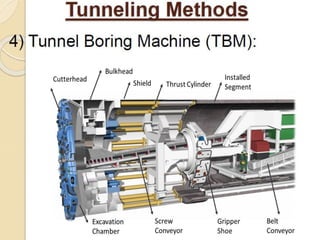
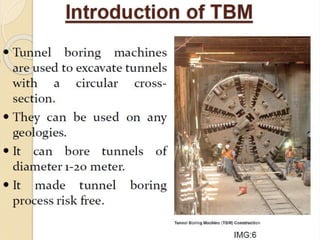
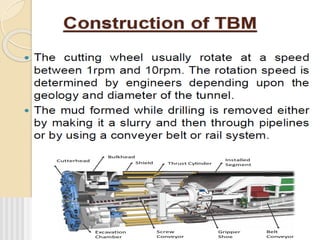
A tunnel boring machine (TBM) , is a machine used to excavate
tunnels with a circular cross section through a variety of soil
and rock strata.
Tunnel diameters can range from a metre (done with micro-TBMs)
to almost 20 metres to date.
Tunnel boring machines are used as an alternative to drilling and
blasting (D&B) methods in rock and conventional ‘hand mining’
in soil.
TBMs have the advantages of limiting the disturbance to the
surrounding ground and producing a smooth tunnel wall. This
will reduce cost of lining.
5
6
7
8
9
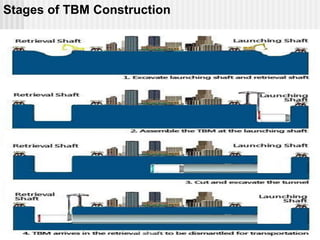
Stages of TBM Construction
10
11
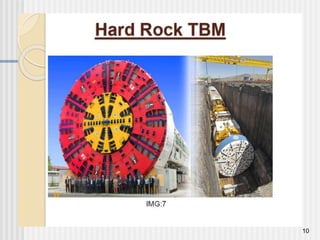
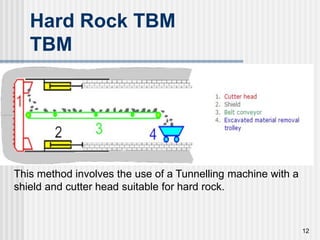
Hard Rock TBM
TBM
12
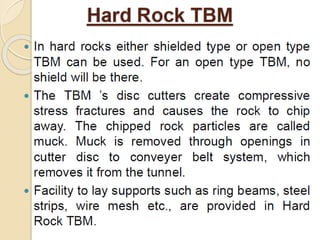
This method involves the use of a Tunnelling machine with a
shield and cutter head suitable for hard rock.
13
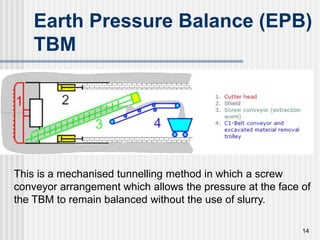
Earth Pressure Balance (EPB)
TBM
14
This is a mechanised tunnelling method in which a screw
conveyor arrangement which allows the pressure at the face of
the TBM to remain balanced without the use of slurry.
15
Slurry Pressure Balance
(SPB) TBM
16
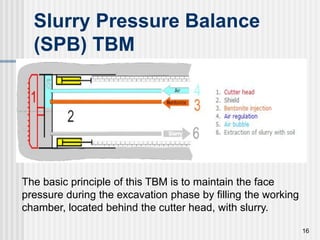
The basic principle of this TBM is to maintain the face
pressure during the excavation phase by filling the working
chamber, located behind the cutter head, with slurry.
17
18
19
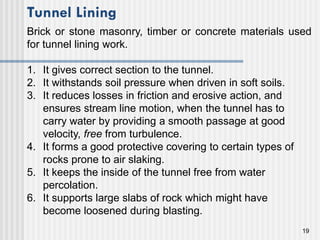
1. It gives correct section to the tunnel.
2. It withstands soil pressure when driven in soft soils.
3. It reduces losses in friction and erosive action, and
ensures stream line motion, when the tunnel has to
carry water by providing a smooth passage at good
velocity, free from turbulence.
4. It forms a good protective covering to certain types of
rocks prone to air slaking.
5. It keeps the inside of the tunnel free from water
percolation.
6. It supports large slabs of rock which might have
become loosened during blasting.
Tunnel Lining
Brick or stone masonry, timber or concrete materials used
for tunnel lining work.
20
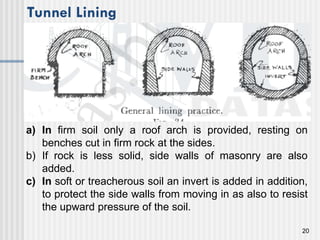
a) In firm soil only a roof arch is provided, resting on
benches cut in firm rock at the sides.
b) If rock is less solid, side walls of masonry are also
added.
c) In soft or treacherous soil an invert is added in addition,
to protect the side walls from moving in as also to resist
the upward pressure of the soil.
Tunnel Lining
Tunnel Lining
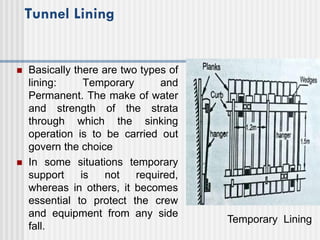
 Basically there are two types of
lining: Temporary and
Permanent. The make of water
and strength of the strata
through which the sinking
operation is to be carried out
govern the choice
 In some situations temporary
support is not required,
whereas in others, it becomes
essential to protect the crew
and equipment from any side
fall.
Temporary Lining
Tunnel Lining
Permanent Lining
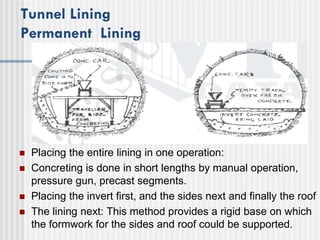
 Placing the entire lining in one operation:
 Concreting is done in short lengths by manual operation,
pressure gun, precast segments.
 Placing the invert first, and the sides next and finally the roof
 The lining next: This method provides a rigid base on which
the formwork for the sides and roof could be supported.
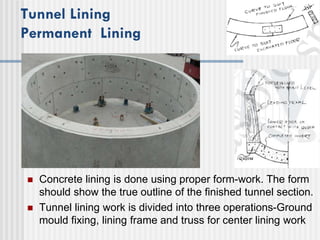
 Concrete lining is done using proper form-work. The form
should show the true outline of the finished tunnel section.
 Tunnel lining work is divided into three operations-Ground
mould fixing, lining frame and truss for center lining work
Tunnel Lining
Permanent Lining

ConstTech_Unit 4.4.pdf

  • 1.
  • 2.
  • 3.
  • 4.
  • 5.
    TBM Method A tunnelboring machine (TBM) , is a machine used to excavate tunnels with a circular cross section through a variety of soil and rock strata. Tunnel diameters can range from a metre (done with micro-TBMs) to almost 20 metres to date. Tunnel boring machines are used as an alternative to drilling and blasting (D&B) methods in rock and conventional ‘hand mining’ in soil. TBMs have the advantages of limiting the disturbance to the surrounding ground and producing a smooth tunnel wall. This will reduce cost of lining. 5
  • 6.
  • 7.
  • 8.
  • 9.
    9 Stages of TBMConstruction
  • 10.
  • 11.
  • 12.
    Hard Rock TBM TBM 12 Thismethod involves the use of a Tunnelling machine with a shield and cutter head suitable for hard rock.
  • 13.
  • 14.
    Earth Pressure Balance(EPB) TBM 14 This is a mechanised tunnelling method in which a screw conveyor arrangement which allows the pressure at the face of the TBM to remain balanced without the use of slurry.
  • 15.
  • 16.
    Slurry Pressure Balance (SPB)TBM 16 The basic principle of this TBM is to maintain the face pressure during the excavation phase by filling the working chamber, located behind the cutter head, with slurry.
  • 17.
  • 18.
  • 19.
    19 1. It givescorrect section to the tunnel. 2. It withstands soil pressure when driven in soft soils. 3. It reduces losses in friction and erosive action, and ensures stream line motion, when the tunnel has to carry water by providing a smooth passage at good velocity, free from turbulence. 4. It forms a good protective covering to certain types of rocks prone to air slaking. 5. It keeps the inside of the tunnel free from water percolation. 6. It supports large slabs of rock which might have become loosened during blasting. Tunnel Lining Brick or stone masonry, timber or concrete materials used for tunnel lining work.
  • 20.
    20 a) In firmsoil only a roof arch is provided, resting on benches cut in firm rock at the sides. b) If rock is less solid, side walls of masonry are also added. c) In soft or treacherous soil an invert is added in addition, to protect the side walls from moving in as also to resist the upward pressure of the soil. Tunnel Lining
  • 21.
    Tunnel Lining  Basicallythere are two types of lining: Temporary and Permanent. The make of water and strength of the strata through which the sinking operation is to be carried out govern the choice  In some situations temporary support is not required, whereas in others, it becomes essential to protect the crew and equipment from any side fall. Temporary Lining
  • 22.
    Tunnel Lining Permanent Lining Placing the entire lining in one operation:  Concreting is done in short lengths by manual operation, pressure gun, precast segments.  Placing the invert first, and the sides next and finally the roof  The lining next: This method provides a rigid base on which the formwork for the sides and roof could be supported.
  • 23.
     Concrete liningis done using proper form-work. The form should show the true outline of the finished tunnel section.  Tunnel lining work is divided into three operations-Ground mould fixing, lining frame and truss for center lining work Tunnel Lining Permanent Lining