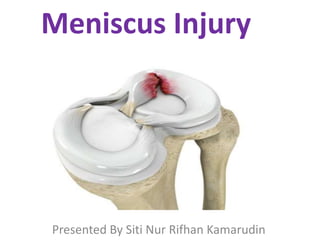
Meniscus Injury
Presented By Siti Nur Rifhan Kamarudin
ANATOMY
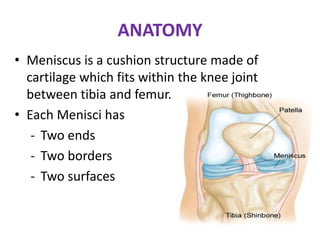
• Meniscus is a cushion structure made of
cartilage which fits within the knee joint
between tibia and femur.
• Each Menisci has
- Two ends
- Two borders
- Two surfaces
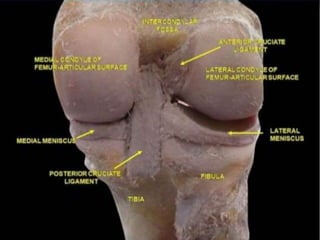
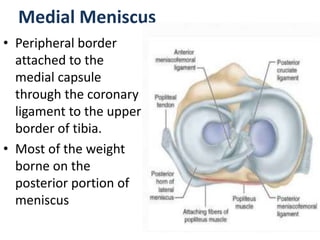
MEDIAL MENISCUS
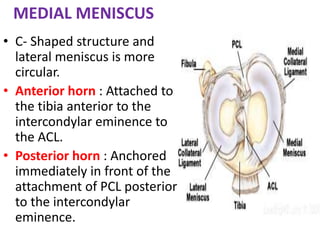
• C- Shaped structure and
lateral meniscus is more
circular.
• Anterior horn : Attached to
the tibia anterior to the
intercondylar eminence to
the ACL.
• Posterior horn : Anchored
immediately in front of the
attachment of PCL posterior
to the intercondylar
eminence.
Medial Meniscus
• Peripheral border
attached to the
medial capsule
through the coronary
ligament to the upper
border of tibia.
• Most of the weight
borne on the
posterior portion of
meniscus
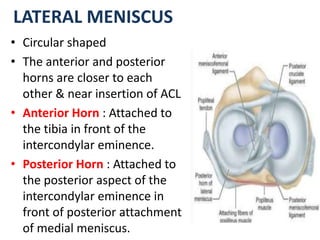
LATERAL MENISCUS
• Circular shaped
• The anterior and posterior
horns are closer to each
other & near insertion of ACL
• Anterior Horn : Attached to
the tibia in front of the
intercondylar eminence.
• Posterior Horn : Attached to
the posterior aspect of the
intercondylar eminence in
front of posterior attachment
of medial meniscus.
Lateral Meniscus
• The lateral meniscus is mobile and medical
meniscus is more fixed -> causing more tears to
occurs in medical meniscus
• Lateral meniscus is associated with discoid
meniscus and meniscal cysts
• Lateral meniscus is also assoc. with acute injury
to ACL
Medial Meniscus
• Tears of medical meniscus occurs more with
degenerative tears
• Associated with a baker’s cyst.
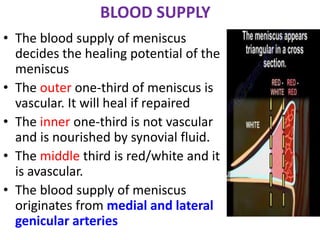
BLOOD SUPPLY
• The blood supply of meniscus
decides the healing potential of the
meniscus
• The outer one-third of meniscus is
vascular. It will heal if repaired
• The inner one-third is not vascular
and is nourished by synovial fluid.
• The middle third is red/white and it
is avascular.
• The blood supply of meniscus
originates from medial and lateral
genicular arteries
FUNCTIONS OF MENISCUS
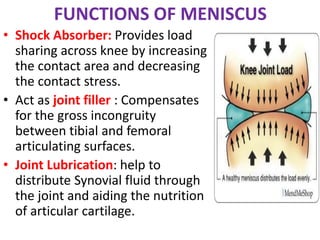
• Shock Absorber: Provides load
sharing across knee by increasing
the contact area and decreasing
the contact stress.
• Act as joint filler : Compensates
for the gross incongruity
between tibial and femoral
articulating surfaces.
• Joint Lubrication: help to
distribute Synovial fluid through
the joint and aiding the nutrition
of articular cartilage.
OVERVIEW of MENISCAL INJURY
• Epidemiology:
- Most common indication for knee surgery
• Location:
 Medial Tears
- More common
- Degenerative tears in older patients usually
occur in posterior horn of medial meniscus.
 Lateral Tears
- More common in acute ACL tears
CLINICAL FEATURES
• Pt is usually a young person who sustain
twisting injury to the knee
• Knee pain (often severe)
• Swelling of the knee within 48hours
• “Locking” : Sudden inability to extend the knee
fully – suggest a ‘bucket-handle tear’.
• Popping or clicking within the knee.
• Limited motion of knee joint.
• Tenderness when pressing on the meniscus
(Knee joint line)
CLASSIFICATION OF MENISCAL TEAR
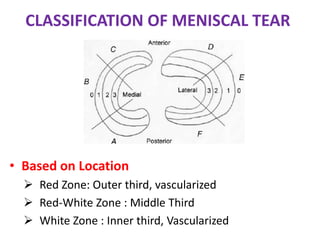
• Based on Location
 Red Zone: Outer third, vascularized
 Red-White Zone : Middle Third
 White Zone : Inner third, Vascularized
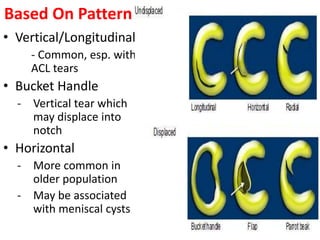
Based On Pattern
• Vertical/Longitudinal
- Common, esp. with
ACL tears
• Bucket Handle
- Vertical tear which
may displace into
notch
• Horizontal
- More common in
older population
- May be associated
with meniscal cysts
PHYSICAL EXAMINATION
• The joint may be held slightly flexed and there
is often an effusion.
• In late presentations, the quadriceps will be
wasted.
• Tenderness is localized to the joint line,
particularly the medial line.
• Flexion is usually full but extension is often
limited.
SPECIAL TESTS
1) Thessaly Test
• Standing at 20 degrees of knee flexion on
affected limb
• Patient twists with knee external and internal
rotation.
• Positive Test: Clicking, pain or discomfort on
joint line.
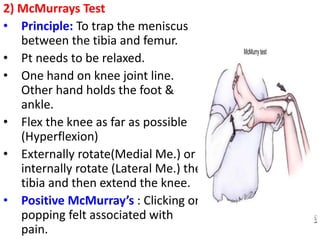
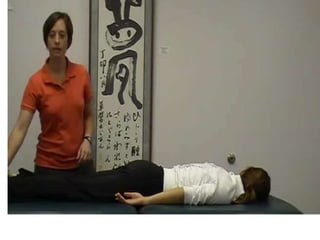
2) McMurrays Test
• Principle: To trap the meniscus
between the tibia and femur.
• Pt needs to be relaxed.
• One hand on knee joint line.
Other hand holds the foot &
ankle.
• Flex the knee as far as possible
(Hyperflexion)
• Externally rotate(Medial Me.) or
internally rotate (Lateral Me.) the
tibia and then extend the knee.
• Positive McMurray’s : Clicking or
popping felt associated with
pain.
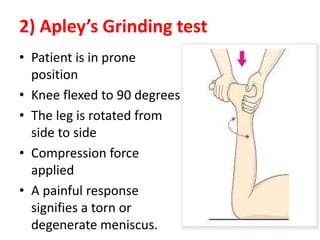
2) Apley’s Grinding test
• Patient is in prone
position
• Knee flexed to 90 degrees
• The leg is rotated from
side to side
• Compression force
applied
• A painful response
signifies a torn or
degenerate meniscus.
IMAGING
Radiographs
• Should be normal in young patient with acute
meniscal injury
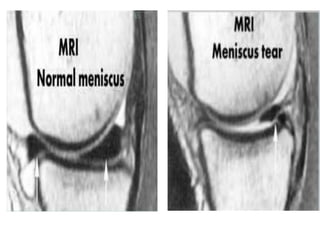
MRI
• Most sensitive diagnostic test
• Findings
- MRI Grade III signal is indicative of a tear
- Parameniscal cyst indicates presence of meniscal
tear
- May see ‘Double PCL” sign that indicates bucket-
handle meniscal tear.
MANAGEMENT
NON-OPERATIVE TREATMENT
Indication: First line of treatment for degenerative
tears
: Acute episode without locking but with
acute synovitis
• Immediate abstinence from weight bearing
• Rest
• Ice pack application
• Compression dressing
• NSAIDS
• Rehabilitation exercises
SURGICAL MANAGEMENT
1)Meniscectomy
2)Meniscal Repair
3)Meniscal Transplantation
OPERATIVE TREATMENT
1) Partial Meniscectomy
• Indication: Tears not amenable to repair (complex,
degenerative, radial tear patterns)
: Repair failure > 2 times
• Objective: Remove the torn meniscal fragment and
contour the peripheral rim, leaving a balanced, stable rim
of meniscal tissue.
• Outcomes
- >80% satisfactory function
• Partial is preferred over total meniscectomy
- Shorter operating time, Faster recovery, better
post-op function.
Anthroscopic Meniscal Repair
3 important steps:
- Appropriate patient selection : should have
documented tear that is able to heal
- Tear debridement and local synovial, meniscal
and capsular ablation to stimulate a
proliferative fibroblastic response
- Suture placement to reduce and stabilize the
meniscus
Meniscal Repair
Risks:
– Saphenous Nerve and Vein damage
– Peroneal Nerve
– Popliteal Vessels
3) Meniscal Transplantation
• Attempts at meniscal replacement with
- Allograft meniscus
- Autograft fascial material
- Synthetic meniscus
REFERENCES
• Apley and Solomon’s Concise System of
Orthopedic and Trauma, 4th Edition

Meniscus injury

  • 1.
    Meniscus Injury Presented BySiti Nur Rifhan Kamarudin
  • 2.
    ANATOMY • Meniscus isa cushion structure made of cartilage which fits within the knee joint between tibia and femur. • Each Menisci has - Two ends - Two borders - Two surfaces
  • 4.
    MEDIAL MENISCUS • C-Shaped structure and lateral meniscus is more circular. • Anterior horn : Attached to the tibia anterior to the intercondylar eminence to the ACL. • Posterior horn : Anchored immediately in front of the attachment of PCL posterior to the intercondylar eminence.
  • 5.
    Medial Meniscus • Peripheralborder attached to the medial capsule through the coronary ligament to the upper border of tibia. • Most of the weight borne on the posterior portion of meniscus
  • 6.
    LATERAL MENISCUS • Circularshaped • The anterior and posterior horns are closer to each other & near insertion of ACL • Anterior Horn : Attached to the tibia in front of the intercondylar eminence. • Posterior Horn : Attached to the posterior aspect of the intercondylar eminence in front of posterior attachment of medial meniscus.
  • 7.
    Lateral Meniscus • Thelateral meniscus is mobile and medical meniscus is more fixed -> causing more tears to occurs in medical meniscus • Lateral meniscus is associated with discoid meniscus and meniscal cysts • Lateral meniscus is also assoc. with acute injury to ACL Medial Meniscus • Tears of medical meniscus occurs more with degenerative tears • Associated with a baker’s cyst.
  • 8.
    BLOOD SUPPLY • Theblood supply of meniscus decides the healing potential of the meniscus • The outer one-third of meniscus is vascular. It will heal if repaired • The inner one-third is not vascular and is nourished by synovial fluid. • The middle third is red/white and it is avascular. • The blood supply of meniscus originates from medial and lateral genicular arteries
  • 9.
    FUNCTIONS OF MENISCUS •Shock Absorber: Provides load sharing across knee by increasing the contact area and decreasing the contact stress. • Act as joint filler : Compensates for the gross incongruity between tibial and femoral articulating surfaces. • Joint Lubrication: help to distribute Synovial fluid through the joint and aiding the nutrition of articular cartilage.
  • 10.
    OVERVIEW of MENISCALINJURY • Epidemiology: - Most common indication for knee surgery • Location:  Medial Tears - More common - Degenerative tears in older patients usually occur in posterior horn of medial meniscus.  Lateral Tears - More common in acute ACL tears
  • 11.
    CLINICAL FEATURES • Ptis usually a young person who sustain twisting injury to the knee • Knee pain (often severe) • Swelling of the knee within 48hours • “Locking” : Sudden inability to extend the knee fully – suggest a ‘bucket-handle tear’. • Popping or clicking within the knee. • Limited motion of knee joint. • Tenderness when pressing on the meniscus (Knee joint line)
  • 12.
    CLASSIFICATION OF MENISCALTEAR • Based on Location  Red Zone: Outer third, vascularized  Red-White Zone : Middle Third  White Zone : Inner third, Vascularized
  • 13.
    Based On Pattern •Vertical/Longitudinal - Common, esp. with ACL tears • Bucket Handle - Vertical tear which may displace into notch • Horizontal - More common in older population - May be associated with meniscal cysts
  • 14.
    PHYSICAL EXAMINATION • Thejoint may be held slightly flexed and there is often an effusion. • In late presentations, the quadriceps will be wasted. • Tenderness is localized to the joint line, particularly the medial line. • Flexion is usually full but extension is often limited.
  • 15.
    SPECIAL TESTS 1) ThessalyTest • Standing at 20 degrees of knee flexion on affected limb • Patient twists with knee external and internal rotation. • Positive Test: Clicking, pain or discomfort on joint line.
  • 17.
    2) McMurrays Test •Principle: To trap the meniscus between the tibia and femur. • Pt needs to be relaxed. • One hand on knee joint line. Other hand holds the foot & ankle. • Flex the knee as far as possible (Hyperflexion) • Externally rotate(Medial Me.) or internally rotate (Lateral Me.) the tibia and then extend the knee. • Positive McMurray’s : Clicking or popping felt associated with pain.
  • 19.
    2) Apley’s Grindingtest • Patient is in prone position • Knee flexed to 90 degrees • The leg is rotated from side to side • Compression force applied • A painful response signifies a torn or degenerate meniscus.
  • 21.
    IMAGING Radiographs • Should benormal in young patient with acute meniscal injury MRI • Most sensitive diagnostic test • Findings - MRI Grade III signal is indicative of a tear - Parameniscal cyst indicates presence of meniscal tear - May see ‘Double PCL” sign that indicates bucket- handle meniscal tear.
  • 23.
    MANAGEMENT NON-OPERATIVE TREATMENT Indication: Firstline of treatment for degenerative tears : Acute episode without locking but with acute synovitis • Immediate abstinence from weight bearing • Rest • Ice pack application • Compression dressing • NSAIDS • Rehabilitation exercises
  • 24.
  • 25.
    OPERATIVE TREATMENT 1) PartialMeniscectomy • Indication: Tears not amenable to repair (complex, degenerative, radial tear patterns) : Repair failure > 2 times • Objective: Remove the torn meniscal fragment and contour the peripheral rim, leaving a balanced, stable rim of meniscal tissue. • Outcomes - >80% satisfactory function • Partial is preferred over total meniscectomy - Shorter operating time, Faster recovery, better post-op function.
  • 26.
    Anthroscopic Meniscal Repair 3important steps: - Appropriate patient selection : should have documented tear that is able to heal - Tear debridement and local synovial, meniscal and capsular ablation to stimulate a proliferative fibroblastic response - Suture placement to reduce and stabilize the meniscus
  • 27.
    Meniscal Repair Risks: – SaphenousNerve and Vein damage – Peroneal Nerve – Popliteal Vessels
  • 28.
    3) Meniscal Transplantation •Attempts at meniscal replacement with - Allograft meniscus - Autograft fascial material - Synthetic meniscus
  • 29.
    REFERENCES • Apley andSolomon’s Concise System of Orthopedic and Trauma, 4th Edition

Editor's Notes

  • #10 if the meniscus is removed or injured, the pt will develop arthritis of knee joint.