RESPIRATORY TRACT
DISEASES I
DR PETER
AIMS /OBJECTIVES
At the end of this lesson student should be able to :
๏ต Define respiratory conditions/diseases
๏ต Describe various respiratory diseases
๏ต Know Signs and symptoms
๏ต Know what Causes of respiratory diseases
๏ต Diagnosis of respiratory diseases
๏ต Dental management of patient with Respiratory diseases
๏ต Treatment
Tuberculosis -overview
๏ต Symptoms
๏ต Causes
๏ต Diagnosis
๏ต Treatment
Tuberculosis
๏ต Tuberculosis (TB) is a bacterial infection spread through
inhaling tiny droplets from the coughs or sneezes of an
infected person.
๏ต It mainly affects the lungs, but it can affect any part of
the body, including the tummy (abdomen), glands, bones
and nervous system.
๏ต TB is a potentially serious condition, but it can be cured if
it's treated with the right antibiotics.
Symptoms
Typical symptoms of TB include:
๏ตA persistent cough that lasts more than 3
weeks and usually brings up phlegm,
which may be bloody
๏ตWeight loss
๏ตNight sweats
๏ตHigh temperature (fever)
๏ตTiredness and fatigue
๏ตLoss of appetite
๏ตSwellings in the neck
๏ตYou should see a GP if you have a cough
that lasts more than 3 weeks or you cough
up blood.
๏ตRead more about the symptoms of
TB and diagnosing TB.
Causes of TB
๏ต TB is a bacterial infection. TB that affects the lungs
(pulmonary TB) is the most contagious type, but it usually
only spreads after prolonged exposure to someone with
the illness.
๏ต In most healthy people, the body's natural defence against
infection and illness (the immune system) kills the
bacteria and there are no symptoms.
๏ต Sometimes the immune system cannot kill the bacteria,
but manages to prevent it spreading in the body.
๏ต You will not have any symptoms, but the bacteria will remain in your
body. This is known as latent TB.
๏ต People with latent TB are not infectious to others.
๏ต If the immune system fails to kill or contain the infection, it can
spread within the lungs or other parts of the body and symptoms will
develop within a few weeks or months.
๏ต This is known as active TB.
๏ต Latent TB could develop into an active TB disease at a later date,
particularly if your immune system becomes weakened.
Contโ€™d
๏ต Tuberculosis (TB) is caused by a type of bacterium called
Mycobacterium tuberculosis.
๏ต It's spread when a person with active TB disease in their lungs coughs
or sneezes and someone else inhales the expelled droplets, which
contain TB bacteria.
๏ต Although TB is spread in a similar way to a cold or flu, it is not as
contagious.
๏ต You would have to spend prolonged periods (several hours) in close
contact with an infected person to catch the infection yourself.
๏ต For example, TB infections usually spread between family
members who live in the same house.
๏ต It would be highly unlikely for you to become infected by
sitting next to an infected person on, for instance, a bus
or train.
๏ต Not everyone with TB is infectious.
๏ต Children with TB or people with a TB infection that occurs
outside the lungs (extrapulmonary TB) do not spread the
infection.
Latent or active TB
๏ต In most healthy people, the immune system is able to destroy the
bacteria that cause TB.
๏ต But in some cases, the bacteria infect the body but do not cause any
symptoms (latent TB), or the infection begins to cause symptoms
within weeks, months or even years (active TB).
๏ต Up to 10% of people with latent TB eventually develop active TB years
after the initial infection.
๏ต This usually happens either within the first year or two of infection, or
when the immune system is weakened โ€“ for example, if someone is
having chemotherapy treatment for cancer.
Who's most at risk?
๏ต Anyone can get TB, but those at greatest risk
include people:
๏ต Who live in, come from, or have spent time in
a country or area with high levels of TB โ€“ around 3 in
every 4 TB cases in the UK affect people born outside
the UK
๏ต In prolonged close contact with someone who's infected
๏ต Living in crowded conditions
๏ต With a condition that weakens their immune system,
such as diabetes
๏ต Having treatments that weaken the immune
system, such as chemotherapy or biological
agents
๏ต who are very young or very old โ€“ the immune
systems of people who are young or elderly
tend to be weaker than those of healthy adults
๏ต in poor health or with a poor diet because of
lifestyle and other problems, such as drug
misuse, alcohol misuse, or homelessness
DIAGNOSIS
๏ต Several tests are used to diagnose tuberculosis
(TB), depending on the type of TB suspected.
๏ต A GP may refer you to a TB specialist for testing
and treatment if they think you have TB.
Pulmonary TB
๏ต Diagnosing pulmonary TB โ€“ TB that affects the lungs โ€“ can
be difficult, and several tests are usually needed.
๏ต You may have a chest X-ray to look for changes in the
appearance of your lungs that are suggestive of TB.
๏ต Samples of phlegm will also often be taken and checked
for the presence of TB bacteria.
๏ต These tests are important in helping to decide the most
effective treatment for you.
Extrapulmonary TB
๏ต Several tests can be used to confirm suspected extrapulmonary TB, which is
TB outside the lungs.
๏ต These tests include:
๏ต A CT scan
๏ต MRI scan
๏ต Ultrasound scan of the affected part of the body
๏ต An examination of the inside of your body using a long, thin, flexible tube
with a light and camera at one end (endoscopy) โ€“ the endoscope can be
inserted through a natural opening, such as your mouth, or through a small
cut made in your skin (laparoscopy) if there's a need to check other parts of
your body
๏ต Urine and blood tests
๏ต A biopsy โ€“ a small sample of tissue or fluid is taken from
the affected area and tested for TB bacteria
๏ต You may also have a lumbar puncture, where a small
sample of cerebrospinal fluid (CSF) is taken from the base
of your spine. CSF is fluid that surrounds the brain.
๏ต The sample can be checked to see whether TB has
infected your brain and spinal cord (central nervous
system).
Testing for latent TB
๏ต In some circumstances, you may need to have a test to check for
latent TB โ€“ where you've been infected with TB bacteria, but do not
have any symptoms.
๏ต For example, you may need to have a test if you've been in close
contact with someone known to have active TB disease involving the
lungs, or if you've recently spent time in a country where TB levels are
high.
๏ต If you've just moved to the UK from a country where TB is common,
you should be given information and advice about the need for
testing.
๏ต Your GP may suggest having a test when you register as a patient.
๏ต Mantoux test
๏ต The Mantoux test is a widely used test for latent TB.
๏ต It involves injecting a small amount of a substance called PPD
tuberculin into the skin of your forearm.
๏ต It's also called the tuberculin skin test (TST).
๏ต If you have a latent TB infection, your skin will be sensitive to PPD
tuberculin and a small, hard red bump will develop at the site of
the injection, usually within 48 to 72 hours of having the test.
๏ต If you have a very strong skin reaction, you may need a chest X-ray to
confirm whether you have active TB disease.
๏ต If you do not have a latent infection, your skin will not react to the
Mantoux test.
๏ต However, as TB can take a long time to develop, you may need to be
screened again at a later stage.
๏ต If you've had the BCG vaccination, you may have a mild skin reaction
to the Mantoux test.
๏ต This does not necessarily mean you have latent TB.
๏ต Interferon gamma release assay (IGRA)
๏ต The interferon gamma release assay (IGRA) is a blood
test for TB that's becoming more widely available.
๏ต The IGRA may be used to help diagnose latent TB:
๏ต if you have a positive Mantoux test
๏ต if you previously had the BCG vaccination โ€“ the
Mantoux test may not be reliable in these cases
๏ต As part of your TB screening if you've just moved
to the UK from a country where TB is common
๏ต As part of a health check when you register with a
GP
๏ต If you're about to have treatment that will
suppress your immune system
๏ต If you're a healthcare worker
๏ต Treatment for tuberculosis (TB) usually
involves taking antibiotics for several months.
๏ตWhile TB is a serious condition that can be fatal
if left untreated, deaths are rare if treatment
is completed.
๏ตMost people do not need to be admitted
to hospital during treatment.
๏ต Pulmonary TB
๏ต You'll be prescribed at least a 6-month course of a
combination of antibiotics if you're diagnosed with
active pulmonary TB, where your lungs are affected
and you have symptoms.
๏ต The usual treatment is:
๏ต 2 antibiotics (isoniazid and rifampicin) for 6 months
๏ต 2 additional antibiotics (pyrazinamide and ethambutol) for
the first 2 months of the 6-month treatment period
๏ต It may be several weeks before you start to feel better.
๏ต The exact length of time will depend on your overall
health and the severity of your TB.
๏ต After taking antibiotics for 2 weeks, most people are no
longer infectious and feel better.
๏ต However, it's important to continue taking your medicine exactly as
prescribed and to complete the whole course of antibiotics.
๏ต Taking medication for 6 months is the best way to ensure the TB
bacteria are killed.
๏ต If you stop taking your antibiotics before you complete the course
or you skip a dose, the TB infection may become resistant to the
antibiotics.
๏ต This is potentially serious because it can be difficult to treat and will
require a longer course of treatment with different, and possibly more
toxic, therapies.
๏ต If you find it difficult to take your medicine every day, your treatment
team can work with you to find a solution.
๏ต This may include having regular contact with your treatment team at
home, at the treatment clinic, or somewhere else that's more
convenient.
๏ต If treatment is completed correctly, you should not need any further
checks by a TB specialist afterwards.
๏ต You may be given advice about spotting signs that the illness has
returned, although this is rare.
๏ต Extrapulmonary TB
๏ต Extrapulmonary TB โ€“ TB that occurs outside the lungs โ€“ can be treated
using the same combination of antibiotics as those used to treat
pulmonary TB.
๏ต If you have TB in areas like your brain or the sac surrounding your heart
(pericardium), you may initially be prescribed a corticosteroid such
as prednisolone for several weeks to take at the same time as your
antibiotics. This will help reduce any swelling in the affected areas.
๏ต As with pulmonary TB, it's important to take your medicines exactly as
prescribed and to finish the whole course.
๏ต Multidrug-resistant TB
๏ต Though uncommon in the UK there are strains of TB
that are resistant to 2 or more antibiotics.
๏ต This is known as multidrug-resistant TB.
๏ต Multidrug-resistant TB requires a much longer course of
antibiotics; between 9 to 24 months depending on the
strain.
๏ต Multidrug-resistant TB tends to have less favourable
outcomes than standard TB.
๏ต Latent TB
๏ต Latent TB is where you've been infected with the TB bacteria, but
do not have any symptoms of active infection.
๏ต If you have latent TB and are aged 65 or under, treatment is
usually recommended. However, the antibiotics used to treat TB
can cause liver damage in older adults.
๏ต If liver damage is a concern and you're aged between 35 and 65,
your TB team will discuss with you the advantages and
disadvantages of taking treatment for latent TB.
๏ต Latent TB is also not always treated if it's thought to be
drug resistant. If this is the case, you may be regularly
monitored to check the infection does not become active.
๏ต In some cases, testing and treatment for latent TB may be
recommended for people who require treatment that will
weaken their immune system, such as long-term steroid
medicines, chemotherapy or biological inhibitors like TNF
inhibitors.
๏ต This is because there's a risk of the infection
becoming active.
๏ต Treatment for latent TB generally involves:
๏ต either taking a combination of rifampicin and
isoniazid for 3 months
๏ต or isoniazid on its own for 6 months
๏ต Side effects of treatment
๏ต Isoniazid can cause nerve damage (peripheral neuropathy). You'll be given
supplements of vitamin B6 (pyridoxine) to take alongside it to reduce this
risk. Your liver function will be tested before you start treatment.
๏ต In rare cases, the antibiotics used to treat TB can cause eye damage,
which can be serious. If you're going to be treated with ethambutol, your
sight should also be tested at the beginning of the course of treatment.
๏ต Contact your TB treatment team if you develop any worrying symptoms
during treatment, such as:
๏ต being sick
๏ต Yellowing of your skin and the whites of your
eyes (jaundice)
๏ต An unexplained high temperature
๏ต Tingling or numbness in your hands or feet
๏ต A rash or itchy skin
๏ต Changes to your sight, such as blurred vision
๏ต Rifampicin can reduce the effectiveness of some types of
contraception, such as the combined contraceptive pill.
๏ต You should use an alternative method of contraception,
such as condoms, while taking rifampicin.
๏ต Rifampicin can also interact with other medication, so it's
important that your TB team know about all of the
medicine you're taking before you start treatment for TB.
๏ต Preventing the spread of infection
๏ต If you're diagnosed with pulmonary TB, you'll be contagious up to
about 2 to 3 weeks into your course of treatment.
๏ต You will not usually need to be isolated during this time, but it's
important to take some basic precautions to stop TB spreading to
your family and friends.
๏ต You should:
๏ต stay away from work, school or college until your TB treatment
team advises you it's safe to return
๏ต Always cover your mouth โ€“ preferably with a disposable
tissue โ€“ when coughing, sneezing or laughing
๏ต Carefully dispose of any used tissues in a sealed plastic
bag
๏ต Open windows when possible to ensure a good supply of
fresh air in the areas where you spend time
๏ต Do not sleep in the same room as other people โ€“ you
could cough or sneeze in your sleep without realising it
๏ต What if someone I know has TB?
๏ต When someone is diagnosed with TB, their treatment team will
assess whether other people are at risk of infection.
๏ต This may include close contacts, such as people living with the
person who has TB, as well as casual contacts, such as work
colleagues and social contacts.
๏ต Anyone who's thought to be at risk will be asked to go for testing,
and will be given advice and any necessary treatment after their
results.
PNEUMONIA
๏ต Pneumonia is an infection that inflames the
air sacs in one or both lungs.
๏ต The air sacs may fill with fluid or pus
(purulent material), causing cough with
phlegm or pus, fever, chills, and difficulty
breathing.
Causes
๏ต The most common are bacteria and viruses in the
air we breathe
๏ต A variety of organisms, including:
๏ต Bacteria
๏ต Viruses and
๏ต Fungi can cause pneumonia.
๏ต Bacteria.
๏ต The most common cause of bacterial pneumonia in the
U.S. is Streptococcus pneumoniae.
๏ต This type of pneumonia can occur on its own or after
you've had a cold or the flu.
๏ต It may affect one part (lobe) of the lung, a condition
called lobar pneumonia.
๏ต Bacteria-like organisms.
๏ตMycoplasma pneumoniae also can cause
pneumonia.
๏ตIt typically produces milder symptoms than do
other types of pneumonia.
๏ตWalking pneumonia is an informal name given
to this type of pneumonia, which typically isn't
severe enough to require bed rest.
๏ต Fungi.
๏ต This type of pneumonia is most common in people with
chronic health problems or weakened immune systems,
and in people who have inhaled large doses of the
organisms.
๏ต The fungi that cause it can be found in soil or bird
droppings and vary depending upon geographic
location.
๏ต Viruses, including COVID-19.
๏ต Some of the viruses that cause colds and the flu can cause
pneumonia.
๏ต Viruses are the most common cause of pneumonia in children
younger than 5 years.
๏ต Viral pneumonia is usually mild. But in some cases it can become
very serious.
๏ต Coronavirus 2019 (COVID-19) may cause pneumonia, which can
become severe
๏ต Pneumonia can range in seriousness from mild to life-
threatening.
๏ต It is most serious for infants and young children, people
older than age 65, and people with health problems or
weakened immune systems.
๏ต Our body usually prevents these germs from infecting your
lungs.
๏ต But sometimes these germs can overpower your immune
system, even if your health is generally good.
Classification of Pneumonia
Pneumonia is classified according to the types of germs that
cause it and where you got the infection.
Community-acquired pneumonia
๏ต Community-acquired pneumonia is the most common type
of pneumonia.
๏ต It occurs outside of hospitals or other health care facilities.
๏ต It may be caused by: bacteria, viruses and fungi
๏ต Hospital-acquired pneumonia
๏ต Some people catch pneumonia during a hospital stay for another
illness.
๏ต Hospital-acquired pneumonia can be serious because the bacteria
causing it may be more resistant to antibiotics and because the
people who get it are already sick.
๏ต People who are on breathing machines (ventilators), often used in
intensive care units, are at higher risk of this type of pneumonia.
๏ต Health care-acquired pneumonia
๏ต Health care-acquired pneumonia is a bacterial
infection that occurs in people who live in long-term
care facilities or who receive care in outpatient clinics,
including kidney dialysis centers.
๏ต Like hospital-acquired pneumonia, health care-
acquired pneumonia can be caused by bacteria that are
more resistant to antibiotics.
๏ต Aspiration pneumonia
๏ตAspiration pneumonia occurs when you inhale
food, drink, vomit or saliva into your lungs.
๏ตAspiration is more likely if something disturbs
your normal gag reflex, such as a brain injury
or swallowing problem, or excessive use of
alcohol or drugs
Signs & symptoms
๏ต The signs and symptoms of pneumonia vary
from mild to severe, depending on factors
such as the type of germ causing the
infection, and your age and overall health.
๏ต Mild signs and symptoms often are similar
to those of a cold or flu, but they last
longer.
Contโ€™d
๏ต Signs and symptoms of pneumonia may
include:
๏ตChest pain when you breathe or cough
๏ตConfusion or changes in mental
awareness (in adults age 65 and older)
๏ตCough, which may produce phlegm
Contโ€™d
๏ต Fatigue
๏ต Fever, sweating and shaking chills
๏ต Lower than normal body temperature (in adults
older than age 65 and people with weak immune
systems)
๏ต Nausea, vomiting or diarrhea
Contโ€™d
๏ต Shortness of breath
๏ต Newborns and infants may not show any
sign of the infection.
๏ต Or they may vomit, have a fever and cough,
appear restless or tired and without energy,
or have difficulty breathing and eating.
When to see a doctor
๏ต When to see a doctor
๏ต See your doctor if you have difficulty breathing, chest pain,
persistent fever of 102 F (39 C) or higher, or persistent
cough, especially if you're coughing up pus.
๏ต It's especially important that people in these high-risk groups
see a doctor:
๏ต Adults older than age 65
๏ต Children younger than age 2 with signs and symptoms
๏ต People with an underlying health condition or
weakened immune system
๏ต People receiving chemotherapy or taking
medication that suppresses the immune system
๏ต For some older adults and people with heart
failure or chronic lung problems, pneumonia can
quickly become a life-threatening condition.
Risk factors
๏ต Pneumonia can affect anyone. But the two age groups at highest risk
are:
๏ต Children who are 2 years old or younger
๏ต People who are age 65 or older
๏ต Other risk factors include:
๏ต Being hospitalized.
๏ต You're at greater risk of pneumonia if you're in a hospital intensive care unit,
especially if you're on a machine that helps you breathe (a ventilator).
Contโ€™d
๏ต Chronic disease.
๏ต You're more likely to get pneumonia if you have asthma, chronic
obstructive pulmonary disease (COPD) or heart disease.
๏ต Smoking.
๏ต Smoking damages your body's natural defenses against the
bacteria and viruses that cause pneumonia.
๏ต Weakened or suppressed immune system.
๏ต People who have HIV/AIDS, who've had an organ transplant, or
who receive chemotherapy or long-term steroids are at risk.
Complications
๏ต Even with treatment, some people with pneumonia, especially those
in high-risk groups, may experience complications, including:
๏ต Bacteria in the bloodstream (bacteremia).
๏ต Bacteria that enter the bloodstream from your lungs can spread the
infection to other organs, potentially causing organ failure.
๏ต Difficulty breathing.
๏ต If your pneumonia is severe or you have chronic underlying lung
diseases, you may have trouble breathing in enough oxygen. You may
need to be hospitalized and use a breathing machine (ventilator)
while your lung heals.
๏ต Fluid accumulation around the lungs (pleural effusion).
๏ต Pneumonia may cause fluid to build up in the thin space between layers
of tissue that line the lungs and chest cavity (pleura).
๏ต If the fluid becomes infected, you may need to have it drained through a
chest tube or removed with surgery.
๏ต Lung abscess.
๏ต An abscess occurs if pus forms in a cavity in the lung. An abscess is usually
treated with antibiotics.
๏ต Sometimes, surgery or drainage with a long needle or tube placed into the
abscess is needed to remove the pus.
Prevention
๏ต To help prevent pneumonia:
๏ต Get vaccinated.
๏ต Vaccines are available to prevent some types of
pneumonia and the flu. Talk with your doctor about
getting these shots.
๏ต The vaccination guidelines have changed over time so
make sure to review your vaccination status with your
doctor even if you recall previously receiving a
pneumonia vaccine.
๏ต Make sure children get vaccinated.
๏ต Doctors recommend a different pneumonia vaccine for children younger
than age 2 and for children ages 2 to 5 years who are at particular risk of
pneumococcal disease.
๏ต Children who attend a group child care center should also get the
vaccine. Doctors also recommend flu shots for children older than 6
months.
๏ต Practice good hygiene.
๏ต To protect yourself against respiratory infections that sometimes lead to
pneumonia, wash your hands regularly or use an alcohol-based hand
sanitizer.
๏ต Don't smoke.
๏ตSmoking damages your lungs' natural defenses
against respiratory infections.
๏ต Keep your immune system strong.
๏ตGet enough sleep, exercise regularly and eat a
healthy diet.
DIAGNOSIS
๏ต Your doctor will start by asking about your medical history
and doing a physical exam, including listening to your
lungs with a stethoscope to check for abnormal bubbling
or crackling sounds that suggest pneumonia.
๏ต If pneumonia is suspected, your doctor may recommend
the following tests
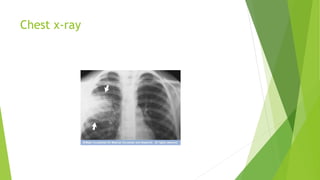
Chest x-ray
โ€ขBlood tests.
โ€ขBlood tests are used to confirm an infection and to try to identify the
type of organism causing the infection.
โ€ขHowever, precise identification isn't always possible.
โ€ขChest X-ray.
โ€ขThis helps your doctor diagnose pneumonia and determine the extent
and location of the infection.
โ€ขHowever, it can't tell your doctor what kind of germ is causing the
pneumonia.
โ€ขPulse oximetry.
โ€ขThis measures the oxygen level in your blood. Pneumonia can prevent
your lungs from moving enough oxygen into your bloodstream
โ€ขSputum test.
โ€ขA sample of fluid from your lungs (sputum) is taken after a deep cough and
analyzed to help pinpoint the cause of the infection.
โ€ขYour doctor might order additional tests if you're older than age 65, are in the
hospital, or have serious symptoms or health conditions. These may include:
โ€ขCT scan.
โ€ขIf your pneumonia isn't clearing as quickly as expected, your doctor may
recommend a chest CT scan to obtain a more detailed image of your lungs.
โ€ขPleural fluid culture.
โ€ขA fluid sample is taken by putting a needle between your ribs from the pleural
area and analyzed to help determine the type of infection.
TREATMENT
๏ต Treatment for pneumonia involves curing the infection and preventing
complications.
๏ต People who have community-acquired pneumonia usually can be
treated at home with medication.
๏ต Although most symptoms ease in a few days or weeks, the feeling of
tiredness can persist for a month or more.
๏ต Specific treatments depend on the type and severity of your
pneumonia, your age and your overall health.
๏ต The options include:
๏ต Antibiotics.
๏ต These medicines are used to treat bacterial
pneumonia. It may take time to identify the type of
bacteria causing your pneumonia and to choose the
best antibiotic to treat it.
๏ต If your symptoms don't improve, your doctor may
recommend a different antibiotic.
๏ต Cough medicine.
๏ต This medicine may be used to calm your cough so that you can
rest. Because coughing helps loosen and move fluid from your
lungs, it's a good idea not to eliminate your cough completely.
๏ต In addition, you should know that very few studies have looked at
whether over-the-counter cough medicines lessen coughing caused
by pneumonia.
๏ต If you want to try a cough suppressant, use the lowest dose that
helps you rest.
๏ต Fever reducers/pain relievers.
๏ตYou may take these as needed for fever and
discomfort.
๏ตThese include drugs such as aspirin, ibuprofen
(Advil, Motrin IB, others) and acetaminophen
(Tylenol, others).
Hospitalization
๏ต Hospitalization
๏ต You may need to be hospitalized if:
๏ต You are older than age 65
๏ต You are confused about time, people or places
๏ต Your kidney function has declined
๏ต Your systolic blood pressure is below 90 millimeters of mercury (mm Hg) or
your diastolic blood pressure is 60 mm Hg or below
๏ต Your breathing is rapid (30 breaths or more a minute)
๏ต You need breathing assistance
๏ต Your temperature is below normal
๏ต Your heart rate is below 50 or above 100
๏ต You may be admitted to the intensive care unit if you need to be placed on a
breathing machine (ventilator) or if your symptoms are severe.
๏ต Children may be hospitalized if:
๏ต They are younger than age 2 months
๏ต They are lethargic or excessively sleepy
๏ต They have trouble breathing
๏ต They have low blood oxygen levels
๏ต They appear dehydrated
Clinical trials
๏ต Lifestyle and home remedies
๏ต These tips can help you recover more quickly and decrease your
risk of complications:
๏ต Get plenty of rest.
๏ต Don't go back to school or work until after your temperature
returns to normal and you stop coughing up mucus.
๏ต Even when you start to feel better, be careful not to overdo it.
Because pneumonia can recur, it's better not to jump back into
your routine until you are fully recovered. Ask your doctor if you're
not sure.
๏ต Stay hydrated.
๏ต Drink plenty of fluids, especially water, to help loosen mucus in
your lungs.
๏ต Take your medicine as prescribed.
๏ต Take the entire course of any medications your doctor prescribed
for you.
๏ต If you stop taking medication too soon, your lungs may continue to
harbor bacteria that can multiply and cause your pneumonia to
recur.
Clinical trials
๏ต Lifestyle and home remedies
๏ต These tips can help you recover more quickly and decrease your risk of
complications:
๏ต Get plenty of rest.
๏ต Don't go back to school or work until after your temperature returns to normal and
you stop coughing up mucus.
๏ต Even when you start to feel better, be careful not to overdo it.
๏ต Because pneumonia can recur, it's better not to jump back into your routine until
you are fully recovered.
๏ต Ask your doctor if you're not sure.
๏ต Stay hydrated.
๏ต Drink plenty of fluids, especially water, to help loosen
mucus in your lungs.
๏ต Take your medicine as prescribed.
๏ต Take the entire course of any medications your doctor
prescribed for you.
๏ต If you stop taking medication too soon, your lungs may
continue to harbor bacteria that can multiply and
cause your pneumonia to recur.
๏ต Preparing for your appointment
๏ต You may start by seeing a primary care doctor or
an emergency care doctor, or you may be referred
to a doctor who specializes in infectious diseases
or in lung disease (pulmonologist).
๏ต Here's some information to help you get ready for
your appointment and know what to expect.
๏ต What you can do
๏ต Keep a record of any symptoms, including your
temperature.
๏ต Write down key medical information, including recent
hospitalizations and any medical conditions you have.
๏ต Write down key personal information, including
exposure to any chemicals or toxins, or any recent
travel.
๏ตMake a list of all medications, vitamins and
supplements that you're taking, especially an
antibiotic left over from a previous infection,
as this can lead to a drug-resistant pneumonia.
๏ตBring a family member or friend along, if
possible, to help you remember questions to
ask and what your doctor said.
๏ตWrite down questions to ask the doctor.
ASTHMA
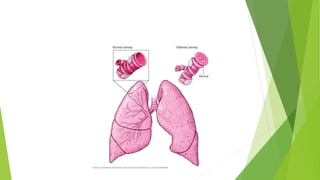
๏ต Asthma is a condition in which your airways narrow and
swell and may produce extra mucus.
๏ต This can make breathing difficult and trigger coughing, a
whistling sound (wheezing) when you breathe out and
shortness of breath.
๏ต For some people, asthma is a minor nuisance.
๏ต For others, it can be a major problem that interferes with
daily activities and may lead to a life-threatening asthma
attack.
๏ต Asthma can't be cured, but its symptoms can be
controlled.
๏ต Because asthma often changes over time, it's important
that you work with your doctor to track your signs and
symptoms and adjust your treatment as needed.
Symptoms
๏ต Asthma symptoms vary from person to person. You may have
infrequent asthma attacks, have symptoms only at certain times โ€”
such as when exercising โ€” or have symptoms all the time.
๏ต Asthma signs and symptoms include:
๏ต Shortness of breath
๏ต Chest tightness or pain
๏ต Wheezing when exhaling, which is a common sign of asthma in
children
๏ต Trouble sleeping caused by shortness of breath, coughing or wheezing
๏ต Coughing or wheezing attacks that are worsened by a
respiratory virus, such as a cold or the flu
๏ต Signs that your asthma is probably worsening include:
๏ต Asthma signs and symptoms that are more frequent and
bothersome
๏ต Increasing difficulty breathing, as measured with a device
used to check how well your lungs are working (peak flow
meter)
๏ต The need to use a quick-relief inhaler more often
๏ต For some people, asthma signs and symptoms flare up in certain
situations:
๏ต Exercise-induced asthma
๏ต Which may be worse when the air is cold and dry
๏ต Occupational asthma
๏ต Triggered by workplace irritants such as chemical fumes, gases or dust
๏ต Allergy-induced asthma
๏ต Triggered by airborne substances, such as pollen, mold spores, cockroach
waste, or particles of skin and dried saliva shed by pets (pet dander)
Causes
๏ต It isn't clear why some people get asthma and others don't, but it's probably
due to a combination of environmental and inherited (genetic) factors.
๏ต Asthma triggers
๏ต Exposure to various irritants and substances that trigger allergies (allergens) can
trigger signs and symptoms of asthma.
๏ต Asthma triggers are different from person to person and can include:
๏ต Airborne allergens, such as pollen, dust mites, mold spores, pet dander or particles
of cockroach waste
๏ต Respiratory infections, such as the common cold
๏ต Physical activity
๏ต Cold air
๏ต Air pollutants and irritants, such as smoke
๏ต Certain medications, including beta blockers, aspirin, and
nonsteroidal anti-inflammatory drugs, such as ibuprofen (Advil,
Motrin IB, others) and naproxen sodium (Aleve)
๏ต Strong emotions and stress
๏ต Sulfites and preservatives added to some types of foods and
beverages, including shrimp, dried fruit, processed potatoes, beer
and wine
๏ต Gastroesophageal reflux disease (GERD), a condition in which
stomach acids back up into your throat
Risk factors
๏ต Risk factors
๏ต A number of factors are thought to increase your chances
of developing asthma. They include:
๏ต Having a blood relative with asthma, such as a parent or
sibling
๏ต Having another allergic condition, such as atopic
dermatitis โ€” which causes red, itchy skin โ€” or hay fever โ€”
which causes a runny nose, congestion and itchy eyes
๏ต Being overweight
๏ต Being a smoker
๏ต Exposure to secondhand smoke
๏ต Exposure to exhaust fumes or other types of
pollution
๏ต Exposure to occupational triggers, such as
chemicals used in farming, hairdressing and
manufacturing
Complications
๏ต Complications
๏ต Asthma complications include:
๏ต Signs and symptoms that interfere with sleep, work and
other activities
๏ต Sick days from work or school during asthma flare-ups
๏ต A permanent narrowing of the tubes that carry air to and
from your lungs (bronchial tubes), which affects how well
you can breathe
๏ต Emergency room visits and hospitalizations for severe
asthma attacks
๏ต Side effects from long-term use of some medications used
to stabilize severe asthma
๏ต Proper treatment makes a big difference in preventing
both short-term and long-term complications caused by
asthma
Prevention
๏ต Prevention
๏ต While there's no way to prevent asthma, you and your doctor can design a
step-by-step plan for living with your condition and preventing asthma
attacks.
๏ต Follow your asthma action plan.
๏ต With your doctor and health care team, write a detailed plan for taking
medications and managing an asthma attack. Then be sure to follow your plan.
๏ต Asthma is an ongoing condition that needs regular monitoring and treatment.
Taking control of your treatment can make you feel more in control of your life.
๏ต Get vaccinated for influenza and pneumonia.
๏ต Staying current with vaccinations can prevent flu and pneumonia from triggering
asthma flare-ups.
๏ต Identify and avoid asthma triggers.
๏ต A number of outdoor allergens and irritants โ€” ranging from pollen and mold to cold
air and air pollution โ€” can trigger asthma attacks. Find out what causes or worsens
your asthma, and take steps to avoid those triggers.
๏ต Monitor your breathing.
๏ต You may learn to recognize warning signs of an impending attack, such as slight
coughing, wheezing or shortness of breath.
๏ต But because your lung function may decrease before you
notice any signs or symptoms, regularly measure and
record your peak airflow with a home peak flow meter.
๏ต A peak flow meter measures how hard you can breathe
out.
๏ต Your doctor can show you how to monitor your peak flow
at home.
๏ต Identify and treat attacks early.
๏ต If you act quickly, you're less likely to have a severe attack. You
also won't need as much medication to control your symptoms.
๏ต When your peak flow measurements decrease and alert you to an
oncoming attack, take your medication as instructed.
๏ต Also, immediately stop any activity that may have triggered the
attack. If your symptoms don't improve, get medical help as
directed in your action plan.
๏ต Take your medication as prescribed.
๏ต Don't change your medications without first talking to
your doctor, even if your asthma seems to be
improving.
๏ต It's a good idea to bring your medications with you to
each doctor visit. Your doctor can make sure you're
using your medications correctly and taking the right
dose.
๏ต Pay attention to increasing quick-relief
inhaler use.
๏ตIf you find yourself relying on your quick-
relief inhaler, such as albuterol, your
asthma isn't under control. See your
doctor about adjusting your treatment.
Diagnosis
๏ต Physical exam
๏ต Your doctor will perform a physical exam to rule out other possible
conditions, such as a respiratory infection or chronic obstructive
pulmonary disease (COPD). Your doctor will also ask you questions
about your signs and symptoms and about any other health
problems.
๏ต Tests to measure lung function
๏ต You may be given lung function tests to determine how much air
moves in and out as you breathe.
๏ต These tests may include:
๏ต Spirometry.
๏ตThis test estimates the narrowing of your
bronchial tubes by checking how much air you
can exhale after a deep breath and how fast
you can breathe out.
๏ต Peak flow.
๏ต A peak flow meter is a simple device that measures
how hard you can breathe out. Lower than usual peak
flow readings are a sign that your lungs may not be
working as well and that your asthma may be getting
worse.
๏ต Your doctor will give you instructions on how to track
and deal with low peak flow readings.
๏ต Lung function tests Often are done before and
after taking a medication to open your airways
called a bronchodilator (brong-koh-DIE-lay-tur),
such as albuterol.
๏ต If your lung function improves with use of a
bronchodilator, it's likely you have asthma.
๏ต Additional tests
๏ต Other tests to diagnose asthma include:
๏ต Methacholine challenge.
๏ต Methacholine is a known asthma trigger. When inhaled, it will cause your
airways to narrow slightly. If you react to the methacholine, you likely
have asthma. This test may be used even if your initial lung function test
is normal.
๏ต Imaging tests.
๏ต A chest X-ray can help identify any structural abnormalities or diseases
(such as infection) that can cause or aggravate breathing problems.
๏ต Allergy testing.
๏ต Allergy tests can be performed by a skin test or blood test. They tell you if
you're allergic to pets, dust, mold or pollen. If allergy triggers are identified,
your doctor may recommend allergy shots.
๏ต Nitric oxide test.
๏ต This test measures the amount of the gas nitric oxide in your breath. When
your airways are inflamed โ€” a sign of asthma โ€” you may have higher than
normal nitric oxide levels. This test isn't widely available.
๏ต Sputum eosinophils.
๏ต This test looks for certain white blood cells (eosinophils) in the
mixture of saliva and mucus (sputum) you discharge during
coughing. Eosinophils are present when symptoms develop and
become visible when stained with a rose-colored dye.
๏ต Provocative testing for exercise and cold-induced asthma.
๏ต In these tests, your doctor measures your airway obstruction
before and after you perform vigorous physical activity or take
several breaths of cold air
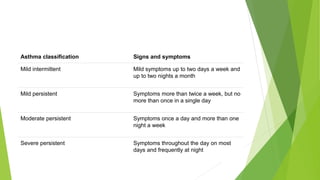
๏ต How asthma is classified
๏ต To classify your asthma severity, your doctor will consider how
often you have signs and symptoms and how severe they are.
๏ต Your doctor will also consider the results of your physical exam
and diagnostic tests.
๏ต Determining your asthma severity helps your doctor choose the
best treatment.
๏ต Asthma severity often changes over time, requiring treatment
adjustments.
๏ต Asthma is classified into four general categories:
Asthma classification Signs and symptoms
Mild intermittent Mild symptoms up to two days a week and
up to two nights a month
Mild persistent Symptoms more than twice a week, but no
more than once in a single day
Moderate persistent Symptoms once a day and more than one
night a week
Severe persistent Symptoms throughout the day on most
days and frequently at night
Treatment
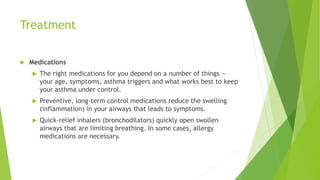
๏ต Medications
๏ต The right medications for you depend on a number of things โ€”
your age, symptoms, asthma triggers and what works best to keep
your asthma under control.
๏ต Preventive, long-term control medications reduce the swelling
(inflammation) in your airways that leads to symptoms.
๏ต Quick-relief inhalers (bronchodilators) quickly open swollen
airways that are limiting breathing. In some cases, allergy
medications are necessary.
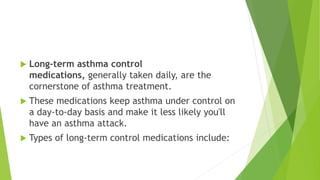
๏ต Long-term asthma control
medications, generally taken daily, are the
cornerstone of asthma treatment.
๏ต These medications keep asthma under control on
a day-to-day basis and make it less likely you'll
have an asthma attack.
๏ต Types of long-term control medications include:
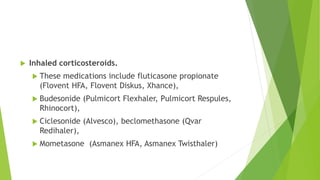
๏ต Inhaled corticosteroids.
๏ต These medications include fluticasone propionate
(Flovent HFA, Flovent Diskus, Xhance),
๏ต Budesonide (Pulmicort Flexhaler, Pulmicort Respules,
Rhinocort),
๏ต Ciclesonide (Alvesco), beclomethasone (Qvar
Redihaler),
๏ต Mometasone (Asmanex HFA, Asmanex Twisthaler)
Dental management of patient with
Asthma
๏ต Before attending to the patient thorough medical
history has to be taken
๏ต Ask the patient when was their last attack
๏ต What usually triggers their asthmatic attack
๏ต Did they bring their medication(spray, tablets etc)
๏ต If they didnโ€™t bring the medication, defer
(postpone) the treatment or refer the patient to
medical doctor to get a go ahead (clearance).
SHOULD THE BE AN ATTACK DURING TREATMENT:
1. Management of the patient
๏ต Stop the treatment
๏ต Let the patient sit or lie in comfortable position
๏ต Use inhaler or nebulizer
๏ต Minister Oxygen
2. Precautions taken if treating a known Asthmatic patient
๏ต Ally any anxiety or fear-sometime need for anti-anxiety medication (e.g
Diazepam) to be taken before or 1 hour before treatment
๏ต Book patient for early morning appointments
๏ต Treatment should be short
๏ต Avoid Non Steroidal Anti-inflammatory Drugs (NSAIDโ€™s) and Aspirin

TUBERCUL-PNEUMONIA & ASTHMA (1).pptx

  • 1.
  • 2.
    AIMS /OBJECTIVES At theend of this lesson student should be able to : ๏ต Define respiratory conditions/diseases ๏ต Describe various respiratory diseases ๏ต Know Signs and symptoms ๏ต Know what Causes of respiratory diseases ๏ต Diagnosis of respiratory diseases ๏ต Dental management of patient with Respiratory diseases ๏ต Treatment
  • 3.
    Tuberculosis -overview ๏ต Symptoms ๏ตCauses ๏ต Diagnosis ๏ต Treatment
  • 4.
    Tuberculosis ๏ต Tuberculosis (TB)is a bacterial infection spread through inhaling tiny droplets from the coughs or sneezes of an infected person. ๏ต It mainly affects the lungs, but it can affect any part of the body, including the tummy (abdomen), glands, bones and nervous system. ๏ต TB is a potentially serious condition, but it can be cured if it's treated with the right antibiotics.
  • 5.
    Symptoms Typical symptoms ofTB include: ๏ตA persistent cough that lasts more than 3 weeks and usually brings up phlegm, which may be bloody ๏ตWeight loss ๏ตNight sweats ๏ตHigh temperature (fever)
  • 6.
    ๏ตTiredness and fatigue ๏ตLossof appetite ๏ตSwellings in the neck ๏ตYou should see a GP if you have a cough that lasts more than 3 weeks or you cough up blood. ๏ตRead more about the symptoms of TB and diagnosing TB.
  • 7.
    Causes of TB ๏ตTB is a bacterial infection. TB that affects the lungs (pulmonary TB) is the most contagious type, but it usually only spreads after prolonged exposure to someone with the illness. ๏ต In most healthy people, the body's natural defence against infection and illness (the immune system) kills the bacteria and there are no symptoms. ๏ต Sometimes the immune system cannot kill the bacteria, but manages to prevent it spreading in the body.
  • 8.
    ๏ต You willnot have any symptoms, but the bacteria will remain in your body. This is known as latent TB. ๏ต People with latent TB are not infectious to others. ๏ต If the immune system fails to kill or contain the infection, it can spread within the lungs or other parts of the body and symptoms will develop within a few weeks or months. ๏ต This is known as active TB. ๏ต Latent TB could develop into an active TB disease at a later date, particularly if your immune system becomes weakened.
  • 9.
    Contโ€™d ๏ต Tuberculosis (TB)is caused by a type of bacterium called Mycobacterium tuberculosis. ๏ต It's spread when a person with active TB disease in their lungs coughs or sneezes and someone else inhales the expelled droplets, which contain TB bacteria. ๏ต Although TB is spread in a similar way to a cold or flu, it is not as contagious. ๏ต You would have to spend prolonged periods (several hours) in close contact with an infected person to catch the infection yourself.
  • 10.
    ๏ต For example,TB infections usually spread between family members who live in the same house. ๏ต It would be highly unlikely for you to become infected by sitting next to an infected person on, for instance, a bus or train. ๏ต Not everyone with TB is infectious. ๏ต Children with TB or people with a TB infection that occurs outside the lungs (extrapulmonary TB) do not spread the infection.
  • 11.
    Latent or activeTB ๏ต In most healthy people, the immune system is able to destroy the bacteria that cause TB. ๏ต But in some cases, the bacteria infect the body but do not cause any symptoms (latent TB), or the infection begins to cause symptoms within weeks, months or even years (active TB). ๏ต Up to 10% of people with latent TB eventually develop active TB years after the initial infection. ๏ต This usually happens either within the first year or two of infection, or when the immune system is weakened โ€“ for example, if someone is having chemotherapy treatment for cancer.
  • 12.
    Who's most atrisk? ๏ต Anyone can get TB, but those at greatest risk include people: ๏ต Who live in, come from, or have spent time in a country or area with high levels of TB โ€“ around 3 in every 4 TB cases in the UK affect people born outside the UK ๏ต In prolonged close contact with someone who's infected ๏ต Living in crowded conditions ๏ต With a condition that weakens their immune system, such as diabetes
  • 13.
    ๏ต Having treatmentsthat weaken the immune system, such as chemotherapy or biological agents ๏ต who are very young or very old โ€“ the immune systems of people who are young or elderly tend to be weaker than those of healthy adults ๏ต in poor health or with a poor diet because of lifestyle and other problems, such as drug misuse, alcohol misuse, or homelessness
  • 14.
    DIAGNOSIS ๏ต Several testsare used to diagnose tuberculosis (TB), depending on the type of TB suspected. ๏ต A GP may refer you to a TB specialist for testing and treatment if they think you have TB.
  • 15.
    Pulmonary TB ๏ต Diagnosingpulmonary TB โ€“ TB that affects the lungs โ€“ can be difficult, and several tests are usually needed. ๏ต You may have a chest X-ray to look for changes in the appearance of your lungs that are suggestive of TB. ๏ต Samples of phlegm will also often be taken and checked for the presence of TB bacteria. ๏ต These tests are important in helping to decide the most effective treatment for you.
  • 16.
    Extrapulmonary TB ๏ต Severaltests can be used to confirm suspected extrapulmonary TB, which is TB outside the lungs. ๏ต These tests include: ๏ต A CT scan ๏ต MRI scan ๏ต Ultrasound scan of the affected part of the body ๏ต An examination of the inside of your body using a long, thin, flexible tube with a light and camera at one end (endoscopy) โ€“ the endoscope can be inserted through a natural opening, such as your mouth, or through a small cut made in your skin (laparoscopy) if there's a need to check other parts of your body
  • 17.
    ๏ต Urine andblood tests ๏ต A biopsy โ€“ a small sample of tissue or fluid is taken from the affected area and tested for TB bacteria ๏ต You may also have a lumbar puncture, where a small sample of cerebrospinal fluid (CSF) is taken from the base of your spine. CSF is fluid that surrounds the brain. ๏ต The sample can be checked to see whether TB has infected your brain and spinal cord (central nervous system).
  • 18.
    Testing for latentTB ๏ต In some circumstances, you may need to have a test to check for latent TB โ€“ where you've been infected with TB bacteria, but do not have any symptoms. ๏ต For example, you may need to have a test if you've been in close contact with someone known to have active TB disease involving the lungs, or if you've recently spent time in a country where TB levels are high. ๏ต If you've just moved to the UK from a country where TB is common, you should be given information and advice about the need for testing. ๏ต Your GP may suggest having a test when you register as a patient.
  • 19.
    ๏ต Mantoux test ๏ตThe Mantoux test is a widely used test for latent TB. ๏ต It involves injecting a small amount of a substance called PPD tuberculin into the skin of your forearm. ๏ต It's also called the tuberculin skin test (TST). ๏ต If you have a latent TB infection, your skin will be sensitive to PPD tuberculin and a small, hard red bump will develop at the site of the injection, usually within 48 to 72 hours of having the test.
  • 20.
    ๏ต If youhave a very strong skin reaction, you may need a chest X-ray to confirm whether you have active TB disease. ๏ต If you do not have a latent infection, your skin will not react to the Mantoux test. ๏ต However, as TB can take a long time to develop, you may need to be screened again at a later stage. ๏ต If you've had the BCG vaccination, you may have a mild skin reaction to the Mantoux test. ๏ต This does not necessarily mean you have latent TB.
  • 21.
    ๏ต Interferon gammarelease assay (IGRA) ๏ต The interferon gamma release assay (IGRA) is a blood test for TB that's becoming more widely available. ๏ต The IGRA may be used to help diagnose latent TB: ๏ต if you have a positive Mantoux test ๏ต if you previously had the BCG vaccination โ€“ the Mantoux test may not be reliable in these cases
  • 22.
    ๏ต As partof your TB screening if you've just moved to the UK from a country where TB is common ๏ต As part of a health check when you register with a GP ๏ต If you're about to have treatment that will suppress your immune system ๏ต If you're a healthcare worker
  • 23.
    ๏ต Treatment fortuberculosis (TB) usually involves taking antibiotics for several months. ๏ตWhile TB is a serious condition that can be fatal if left untreated, deaths are rare if treatment is completed. ๏ตMost people do not need to be admitted to hospital during treatment.
  • 24.
    ๏ต Pulmonary TB ๏ตYou'll be prescribed at least a 6-month course of a combination of antibiotics if you're diagnosed with active pulmonary TB, where your lungs are affected and you have symptoms. ๏ต The usual treatment is: ๏ต 2 antibiotics (isoniazid and rifampicin) for 6 months
  • 25.
    ๏ต 2 additionalantibiotics (pyrazinamide and ethambutol) for the first 2 months of the 6-month treatment period ๏ต It may be several weeks before you start to feel better. ๏ต The exact length of time will depend on your overall health and the severity of your TB. ๏ต After taking antibiotics for 2 weeks, most people are no longer infectious and feel better.
  • 26.
    ๏ต However, it'simportant to continue taking your medicine exactly as prescribed and to complete the whole course of antibiotics. ๏ต Taking medication for 6 months is the best way to ensure the TB bacteria are killed. ๏ต If you stop taking your antibiotics before you complete the course or you skip a dose, the TB infection may become resistant to the antibiotics. ๏ต This is potentially serious because it can be difficult to treat and will require a longer course of treatment with different, and possibly more toxic, therapies.
  • 27.
    ๏ต If youfind it difficult to take your medicine every day, your treatment team can work with you to find a solution. ๏ต This may include having regular contact with your treatment team at home, at the treatment clinic, or somewhere else that's more convenient. ๏ต If treatment is completed correctly, you should not need any further checks by a TB specialist afterwards. ๏ต You may be given advice about spotting signs that the illness has returned, although this is rare.
  • 28.
    ๏ต Extrapulmonary TB ๏ตExtrapulmonary TB โ€“ TB that occurs outside the lungs โ€“ can be treated using the same combination of antibiotics as those used to treat pulmonary TB. ๏ต If you have TB in areas like your brain or the sac surrounding your heart (pericardium), you may initially be prescribed a corticosteroid such as prednisolone for several weeks to take at the same time as your antibiotics. This will help reduce any swelling in the affected areas. ๏ต As with pulmonary TB, it's important to take your medicines exactly as prescribed and to finish the whole course.
  • 29.
    ๏ต Multidrug-resistant TB ๏ตThough uncommon in the UK there are strains of TB that are resistant to 2 or more antibiotics. ๏ต This is known as multidrug-resistant TB. ๏ต Multidrug-resistant TB requires a much longer course of antibiotics; between 9 to 24 months depending on the strain. ๏ต Multidrug-resistant TB tends to have less favourable outcomes than standard TB.
  • 30.
    ๏ต Latent TB ๏ตLatent TB is where you've been infected with the TB bacteria, but do not have any symptoms of active infection. ๏ต If you have latent TB and are aged 65 or under, treatment is usually recommended. However, the antibiotics used to treat TB can cause liver damage in older adults. ๏ต If liver damage is a concern and you're aged between 35 and 65, your TB team will discuss with you the advantages and disadvantages of taking treatment for latent TB.
  • 31.
    ๏ต Latent TBis also not always treated if it's thought to be drug resistant. If this is the case, you may be regularly monitored to check the infection does not become active. ๏ต In some cases, testing and treatment for latent TB may be recommended for people who require treatment that will weaken their immune system, such as long-term steroid medicines, chemotherapy or biological inhibitors like TNF inhibitors.
  • 32.
    ๏ต This isbecause there's a risk of the infection becoming active. ๏ต Treatment for latent TB generally involves: ๏ต either taking a combination of rifampicin and isoniazid for 3 months ๏ต or isoniazid on its own for 6 months
  • 33.
    ๏ต Side effectsof treatment ๏ต Isoniazid can cause nerve damage (peripheral neuropathy). You'll be given supplements of vitamin B6 (pyridoxine) to take alongside it to reduce this risk. Your liver function will be tested before you start treatment. ๏ต In rare cases, the antibiotics used to treat TB can cause eye damage, which can be serious. If you're going to be treated with ethambutol, your sight should also be tested at the beginning of the course of treatment. ๏ต Contact your TB treatment team if you develop any worrying symptoms during treatment, such as: ๏ต being sick
  • 34.
    ๏ต Yellowing ofyour skin and the whites of your eyes (jaundice) ๏ต An unexplained high temperature ๏ต Tingling or numbness in your hands or feet ๏ต A rash or itchy skin ๏ต Changes to your sight, such as blurred vision
  • 35.
    ๏ต Rifampicin canreduce the effectiveness of some types of contraception, such as the combined contraceptive pill. ๏ต You should use an alternative method of contraception, such as condoms, while taking rifampicin. ๏ต Rifampicin can also interact with other medication, so it's important that your TB team know about all of the medicine you're taking before you start treatment for TB.
  • 36.
    ๏ต Preventing thespread of infection ๏ต If you're diagnosed with pulmonary TB, you'll be contagious up to about 2 to 3 weeks into your course of treatment. ๏ต You will not usually need to be isolated during this time, but it's important to take some basic precautions to stop TB spreading to your family and friends. ๏ต You should: ๏ต stay away from work, school or college until your TB treatment team advises you it's safe to return
  • 37.
    ๏ต Always coveryour mouth โ€“ preferably with a disposable tissue โ€“ when coughing, sneezing or laughing ๏ต Carefully dispose of any used tissues in a sealed plastic bag ๏ต Open windows when possible to ensure a good supply of fresh air in the areas where you spend time ๏ต Do not sleep in the same room as other people โ€“ you could cough or sneeze in your sleep without realising it
  • 38.
    ๏ต What ifsomeone I know has TB? ๏ต When someone is diagnosed with TB, their treatment team will assess whether other people are at risk of infection. ๏ต This may include close contacts, such as people living with the person who has TB, as well as casual contacts, such as work colleagues and social contacts. ๏ต Anyone who's thought to be at risk will be asked to go for testing, and will be given advice and any necessary treatment after their results.
  • 39.
    PNEUMONIA ๏ต Pneumonia isan infection that inflames the air sacs in one or both lungs. ๏ต The air sacs may fill with fluid or pus (purulent material), causing cough with phlegm or pus, fever, chills, and difficulty breathing.
  • 40.
    Causes ๏ต The mostcommon are bacteria and viruses in the air we breathe ๏ต A variety of organisms, including: ๏ต Bacteria ๏ต Viruses and ๏ต Fungi can cause pneumonia.
  • 41.
    ๏ต Bacteria. ๏ต Themost common cause of bacterial pneumonia in the U.S. is Streptococcus pneumoniae. ๏ต This type of pneumonia can occur on its own or after you've had a cold or the flu. ๏ต It may affect one part (lobe) of the lung, a condition called lobar pneumonia.
  • 42.
    ๏ต Bacteria-like organisms. ๏ตMycoplasmapneumoniae also can cause pneumonia. ๏ตIt typically produces milder symptoms than do other types of pneumonia. ๏ตWalking pneumonia is an informal name given to this type of pneumonia, which typically isn't severe enough to require bed rest.
  • 43.
    ๏ต Fungi. ๏ต Thistype of pneumonia is most common in people with chronic health problems or weakened immune systems, and in people who have inhaled large doses of the organisms. ๏ต The fungi that cause it can be found in soil or bird droppings and vary depending upon geographic location.
  • 44.
    ๏ต Viruses, includingCOVID-19. ๏ต Some of the viruses that cause colds and the flu can cause pneumonia. ๏ต Viruses are the most common cause of pneumonia in children younger than 5 years. ๏ต Viral pneumonia is usually mild. But in some cases it can become very serious. ๏ต Coronavirus 2019 (COVID-19) may cause pneumonia, which can become severe
  • 45.
    ๏ต Pneumonia canrange in seriousness from mild to life- threatening. ๏ต It is most serious for infants and young children, people older than age 65, and people with health problems or weakened immune systems. ๏ต Our body usually prevents these germs from infecting your lungs. ๏ต But sometimes these germs can overpower your immune system, even if your health is generally good.
  • 46.
    Classification of Pneumonia Pneumoniais classified according to the types of germs that cause it and where you got the infection. Community-acquired pneumonia ๏ต Community-acquired pneumonia is the most common type of pneumonia. ๏ต It occurs outside of hospitals or other health care facilities. ๏ต It may be caused by: bacteria, viruses and fungi
  • 47.
    ๏ต Hospital-acquired pneumonia ๏ตSome people catch pneumonia during a hospital stay for another illness. ๏ต Hospital-acquired pneumonia can be serious because the bacteria causing it may be more resistant to antibiotics and because the people who get it are already sick. ๏ต People who are on breathing machines (ventilators), often used in intensive care units, are at higher risk of this type of pneumonia.
  • 48.
    ๏ต Health care-acquiredpneumonia ๏ต Health care-acquired pneumonia is a bacterial infection that occurs in people who live in long-term care facilities or who receive care in outpatient clinics, including kidney dialysis centers. ๏ต Like hospital-acquired pneumonia, health care- acquired pneumonia can be caused by bacteria that are more resistant to antibiotics.
  • 49.
    ๏ต Aspiration pneumonia ๏ตAspirationpneumonia occurs when you inhale food, drink, vomit or saliva into your lungs. ๏ตAspiration is more likely if something disturbs your normal gag reflex, such as a brain injury or swallowing problem, or excessive use of alcohol or drugs
  • 50.
    Signs & symptoms ๏ตThe signs and symptoms of pneumonia vary from mild to severe, depending on factors such as the type of germ causing the infection, and your age and overall health. ๏ต Mild signs and symptoms often are similar to those of a cold or flu, but they last longer.
  • 51.
    Contโ€™d ๏ต Signs andsymptoms of pneumonia may include: ๏ตChest pain when you breathe or cough ๏ตConfusion or changes in mental awareness (in adults age 65 and older) ๏ตCough, which may produce phlegm
  • 52.
    Contโ€™d ๏ต Fatigue ๏ต Fever,sweating and shaking chills ๏ต Lower than normal body temperature (in adults older than age 65 and people with weak immune systems) ๏ต Nausea, vomiting or diarrhea
  • 53.
    Contโ€™d ๏ต Shortness ofbreath ๏ต Newborns and infants may not show any sign of the infection. ๏ต Or they may vomit, have a fever and cough, appear restless or tired and without energy, or have difficulty breathing and eating.
  • 54.
    When to seea doctor ๏ต When to see a doctor ๏ต See your doctor if you have difficulty breathing, chest pain, persistent fever of 102 F (39 C) or higher, or persistent cough, especially if you're coughing up pus. ๏ต It's especially important that people in these high-risk groups see a doctor: ๏ต Adults older than age 65 ๏ต Children younger than age 2 with signs and symptoms
  • 55.
    ๏ต People withan underlying health condition or weakened immune system ๏ต People receiving chemotherapy or taking medication that suppresses the immune system ๏ต For some older adults and people with heart failure or chronic lung problems, pneumonia can quickly become a life-threatening condition.
  • 56.
    Risk factors ๏ต Pneumoniacan affect anyone. But the two age groups at highest risk are: ๏ต Children who are 2 years old or younger ๏ต People who are age 65 or older ๏ต Other risk factors include: ๏ต Being hospitalized. ๏ต You're at greater risk of pneumonia if you're in a hospital intensive care unit, especially if you're on a machine that helps you breathe (a ventilator).
  • 57.
    Contโ€™d ๏ต Chronic disease. ๏ตYou're more likely to get pneumonia if you have asthma, chronic obstructive pulmonary disease (COPD) or heart disease. ๏ต Smoking. ๏ต Smoking damages your body's natural defenses against the bacteria and viruses that cause pneumonia. ๏ต Weakened or suppressed immune system. ๏ต People who have HIV/AIDS, who've had an organ transplant, or who receive chemotherapy or long-term steroids are at risk.
  • 58.
    Complications ๏ต Even withtreatment, some people with pneumonia, especially those in high-risk groups, may experience complications, including: ๏ต Bacteria in the bloodstream (bacteremia). ๏ต Bacteria that enter the bloodstream from your lungs can spread the infection to other organs, potentially causing organ failure. ๏ต Difficulty breathing. ๏ต If your pneumonia is severe or you have chronic underlying lung diseases, you may have trouble breathing in enough oxygen. You may need to be hospitalized and use a breathing machine (ventilator) while your lung heals.
  • 59.
    ๏ต Fluid accumulationaround the lungs (pleural effusion). ๏ต Pneumonia may cause fluid to build up in the thin space between layers of tissue that line the lungs and chest cavity (pleura). ๏ต If the fluid becomes infected, you may need to have it drained through a chest tube or removed with surgery. ๏ต Lung abscess. ๏ต An abscess occurs if pus forms in a cavity in the lung. An abscess is usually treated with antibiotics. ๏ต Sometimes, surgery or drainage with a long needle or tube placed into the abscess is needed to remove the pus.
  • 60.
    Prevention ๏ต To helpprevent pneumonia: ๏ต Get vaccinated. ๏ต Vaccines are available to prevent some types of pneumonia and the flu. Talk with your doctor about getting these shots. ๏ต The vaccination guidelines have changed over time so make sure to review your vaccination status with your doctor even if you recall previously receiving a pneumonia vaccine.
  • 61.
    ๏ต Make surechildren get vaccinated. ๏ต Doctors recommend a different pneumonia vaccine for children younger than age 2 and for children ages 2 to 5 years who are at particular risk of pneumococcal disease. ๏ต Children who attend a group child care center should also get the vaccine. Doctors also recommend flu shots for children older than 6 months. ๏ต Practice good hygiene. ๏ต To protect yourself against respiratory infections that sometimes lead to pneumonia, wash your hands regularly or use an alcohol-based hand sanitizer.
  • 62.
    ๏ต Don't smoke. ๏ตSmokingdamages your lungs' natural defenses against respiratory infections. ๏ต Keep your immune system strong. ๏ตGet enough sleep, exercise regularly and eat a healthy diet.
  • 63.
    DIAGNOSIS ๏ต Your doctorwill start by asking about your medical history and doing a physical exam, including listening to your lungs with a stethoscope to check for abnormal bubbling or crackling sounds that suggest pneumonia. ๏ต If pneumonia is suspected, your doctor may recommend the following tests
  • 64.
  • 65.
    โ€ขBlood tests. โ€ขBlood testsare used to confirm an infection and to try to identify the type of organism causing the infection. โ€ขHowever, precise identification isn't always possible. โ€ขChest X-ray. โ€ขThis helps your doctor diagnose pneumonia and determine the extent and location of the infection. โ€ขHowever, it can't tell your doctor what kind of germ is causing the pneumonia. โ€ขPulse oximetry. โ€ขThis measures the oxygen level in your blood. Pneumonia can prevent your lungs from moving enough oxygen into your bloodstream
  • 66.
    โ€ขSputum test. โ€ขA sampleof fluid from your lungs (sputum) is taken after a deep cough and analyzed to help pinpoint the cause of the infection. โ€ขYour doctor might order additional tests if you're older than age 65, are in the hospital, or have serious symptoms or health conditions. These may include: โ€ขCT scan. โ€ขIf your pneumonia isn't clearing as quickly as expected, your doctor may recommend a chest CT scan to obtain a more detailed image of your lungs. โ€ขPleural fluid culture. โ€ขA fluid sample is taken by putting a needle between your ribs from the pleural area and analyzed to help determine the type of infection.
  • 67.
    TREATMENT ๏ต Treatment forpneumonia involves curing the infection and preventing complications. ๏ต People who have community-acquired pneumonia usually can be treated at home with medication. ๏ต Although most symptoms ease in a few days or weeks, the feeling of tiredness can persist for a month or more. ๏ต Specific treatments depend on the type and severity of your pneumonia, your age and your overall health. ๏ต The options include:
  • 68.
    ๏ต Antibiotics. ๏ต Thesemedicines are used to treat bacterial pneumonia. It may take time to identify the type of bacteria causing your pneumonia and to choose the best antibiotic to treat it. ๏ต If your symptoms don't improve, your doctor may recommend a different antibiotic.
  • 69.
    ๏ต Cough medicine. ๏ตThis medicine may be used to calm your cough so that you can rest. Because coughing helps loosen and move fluid from your lungs, it's a good idea not to eliminate your cough completely. ๏ต In addition, you should know that very few studies have looked at whether over-the-counter cough medicines lessen coughing caused by pneumonia. ๏ต If you want to try a cough suppressant, use the lowest dose that helps you rest.
  • 70.
    ๏ต Fever reducers/painrelievers. ๏ตYou may take these as needed for fever and discomfort. ๏ตThese include drugs such as aspirin, ibuprofen (Advil, Motrin IB, others) and acetaminophen (Tylenol, others).
  • 71.
    Hospitalization ๏ต Hospitalization ๏ต Youmay need to be hospitalized if: ๏ต You are older than age 65 ๏ต You are confused about time, people or places ๏ต Your kidney function has declined ๏ต Your systolic blood pressure is below 90 millimeters of mercury (mm Hg) or your diastolic blood pressure is 60 mm Hg or below
  • 72.
    ๏ต Your breathingis rapid (30 breaths or more a minute) ๏ต You need breathing assistance ๏ต Your temperature is below normal ๏ต Your heart rate is below 50 or above 100 ๏ต You may be admitted to the intensive care unit if you need to be placed on a breathing machine (ventilator) or if your symptoms are severe.
  • 73.
    ๏ต Children maybe hospitalized if: ๏ต They are younger than age 2 months ๏ต They are lethargic or excessively sleepy ๏ต They have trouble breathing ๏ต They have low blood oxygen levels ๏ต They appear dehydrated
  • 74.
    Clinical trials ๏ต Lifestyleand home remedies ๏ต These tips can help you recover more quickly and decrease your risk of complications: ๏ต Get plenty of rest. ๏ต Don't go back to school or work until after your temperature returns to normal and you stop coughing up mucus. ๏ต Even when you start to feel better, be careful not to overdo it. Because pneumonia can recur, it's better not to jump back into your routine until you are fully recovered. Ask your doctor if you're not sure.
  • 75.
    ๏ต Stay hydrated. ๏ตDrink plenty of fluids, especially water, to help loosen mucus in your lungs. ๏ต Take your medicine as prescribed. ๏ต Take the entire course of any medications your doctor prescribed for you. ๏ต If you stop taking medication too soon, your lungs may continue to harbor bacteria that can multiply and cause your pneumonia to recur.
  • 76.
    Clinical trials ๏ต Lifestyleand home remedies ๏ต These tips can help you recover more quickly and decrease your risk of complications: ๏ต Get plenty of rest. ๏ต Don't go back to school or work until after your temperature returns to normal and you stop coughing up mucus. ๏ต Even when you start to feel better, be careful not to overdo it. ๏ต Because pneumonia can recur, it's better not to jump back into your routine until you are fully recovered. ๏ต Ask your doctor if you're not sure.
  • 77.
    ๏ต Stay hydrated. ๏ตDrink plenty of fluids, especially water, to help loosen mucus in your lungs. ๏ต Take your medicine as prescribed. ๏ต Take the entire course of any medications your doctor prescribed for you. ๏ต If you stop taking medication too soon, your lungs may continue to harbor bacteria that can multiply and cause your pneumonia to recur.
  • 78.
    ๏ต Preparing foryour appointment ๏ต You may start by seeing a primary care doctor or an emergency care doctor, or you may be referred to a doctor who specializes in infectious diseases or in lung disease (pulmonologist). ๏ต Here's some information to help you get ready for your appointment and know what to expect.
  • 79.
    ๏ต What youcan do ๏ต Keep a record of any symptoms, including your temperature. ๏ต Write down key medical information, including recent hospitalizations and any medical conditions you have. ๏ต Write down key personal information, including exposure to any chemicals or toxins, or any recent travel.
  • 80.
    ๏ตMake a listof all medications, vitamins and supplements that you're taking, especially an antibiotic left over from a previous infection, as this can lead to a drug-resistant pneumonia. ๏ตBring a family member or friend along, if possible, to help you remember questions to ask and what your doctor said. ๏ตWrite down questions to ask the doctor.
  • 81.
    ASTHMA ๏ต Asthma isa condition in which your airways narrow and swell and may produce extra mucus. ๏ต This can make breathing difficult and trigger coughing, a whistling sound (wheezing) when you breathe out and shortness of breath. ๏ต For some people, asthma is a minor nuisance.
  • 82.
    ๏ต For others,it can be a major problem that interferes with daily activities and may lead to a life-threatening asthma attack. ๏ต Asthma can't be cured, but its symptoms can be controlled. ๏ต Because asthma often changes over time, it's important that you work with your doctor to track your signs and symptoms and adjust your treatment as needed.
  • 84.
    Symptoms ๏ต Asthma symptomsvary from person to person. You may have infrequent asthma attacks, have symptoms only at certain times โ€” such as when exercising โ€” or have symptoms all the time. ๏ต Asthma signs and symptoms include: ๏ต Shortness of breath ๏ต Chest tightness or pain ๏ต Wheezing when exhaling, which is a common sign of asthma in children ๏ต Trouble sleeping caused by shortness of breath, coughing or wheezing
  • 85.
    ๏ต Coughing orwheezing attacks that are worsened by a respiratory virus, such as a cold or the flu ๏ต Signs that your asthma is probably worsening include: ๏ต Asthma signs and symptoms that are more frequent and bothersome ๏ต Increasing difficulty breathing, as measured with a device used to check how well your lungs are working (peak flow meter)
  • 86.
    ๏ต The needto use a quick-relief inhaler more often ๏ต For some people, asthma signs and symptoms flare up in certain situations: ๏ต Exercise-induced asthma ๏ต Which may be worse when the air is cold and dry ๏ต Occupational asthma ๏ต Triggered by workplace irritants such as chemical fumes, gases or dust ๏ต Allergy-induced asthma ๏ต Triggered by airborne substances, such as pollen, mold spores, cockroach waste, or particles of skin and dried saliva shed by pets (pet dander)
  • 87.
    Causes ๏ต It isn'tclear why some people get asthma and others don't, but it's probably due to a combination of environmental and inherited (genetic) factors. ๏ต Asthma triggers ๏ต Exposure to various irritants and substances that trigger allergies (allergens) can trigger signs and symptoms of asthma. ๏ต Asthma triggers are different from person to person and can include: ๏ต Airborne allergens, such as pollen, dust mites, mold spores, pet dander or particles of cockroach waste ๏ต Respiratory infections, such as the common cold ๏ต Physical activity ๏ต Cold air
  • 88.
    ๏ต Air pollutantsand irritants, such as smoke ๏ต Certain medications, including beta blockers, aspirin, and nonsteroidal anti-inflammatory drugs, such as ibuprofen (Advil, Motrin IB, others) and naproxen sodium (Aleve) ๏ต Strong emotions and stress ๏ต Sulfites and preservatives added to some types of foods and beverages, including shrimp, dried fruit, processed potatoes, beer and wine ๏ต Gastroesophageal reflux disease (GERD), a condition in which stomach acids back up into your throat
  • 89.
    Risk factors ๏ต Riskfactors ๏ต A number of factors are thought to increase your chances of developing asthma. They include: ๏ต Having a blood relative with asthma, such as a parent or sibling ๏ต Having another allergic condition, such as atopic dermatitis โ€” which causes red, itchy skin โ€” or hay fever โ€” which causes a runny nose, congestion and itchy eyes ๏ต Being overweight
  • 90.
    ๏ต Being asmoker ๏ต Exposure to secondhand smoke ๏ต Exposure to exhaust fumes or other types of pollution ๏ต Exposure to occupational triggers, such as chemicals used in farming, hairdressing and manufacturing
  • 91.
    Complications ๏ต Complications ๏ต Asthmacomplications include: ๏ต Signs and symptoms that interfere with sleep, work and other activities ๏ต Sick days from work or school during asthma flare-ups ๏ต A permanent narrowing of the tubes that carry air to and from your lungs (bronchial tubes), which affects how well you can breathe
  • 92.
    ๏ต Emergency roomvisits and hospitalizations for severe asthma attacks ๏ต Side effects from long-term use of some medications used to stabilize severe asthma ๏ต Proper treatment makes a big difference in preventing both short-term and long-term complications caused by asthma
  • 93.
    Prevention ๏ต Prevention ๏ต Whilethere's no way to prevent asthma, you and your doctor can design a step-by-step plan for living with your condition and preventing asthma attacks. ๏ต Follow your asthma action plan. ๏ต With your doctor and health care team, write a detailed plan for taking medications and managing an asthma attack. Then be sure to follow your plan. ๏ต Asthma is an ongoing condition that needs regular monitoring and treatment. Taking control of your treatment can make you feel more in control of your life.
  • 94.
    ๏ต Get vaccinatedfor influenza and pneumonia. ๏ต Staying current with vaccinations can prevent flu and pneumonia from triggering asthma flare-ups. ๏ต Identify and avoid asthma triggers. ๏ต A number of outdoor allergens and irritants โ€” ranging from pollen and mold to cold air and air pollution โ€” can trigger asthma attacks. Find out what causes or worsens your asthma, and take steps to avoid those triggers. ๏ต Monitor your breathing. ๏ต You may learn to recognize warning signs of an impending attack, such as slight coughing, wheezing or shortness of breath.
  • 95.
    ๏ต But becauseyour lung function may decrease before you notice any signs or symptoms, regularly measure and record your peak airflow with a home peak flow meter. ๏ต A peak flow meter measures how hard you can breathe out. ๏ต Your doctor can show you how to monitor your peak flow at home.
  • 96.
    ๏ต Identify andtreat attacks early. ๏ต If you act quickly, you're less likely to have a severe attack. You also won't need as much medication to control your symptoms. ๏ต When your peak flow measurements decrease and alert you to an oncoming attack, take your medication as instructed. ๏ต Also, immediately stop any activity that may have triggered the attack. If your symptoms don't improve, get medical help as directed in your action plan.
  • 97.
    ๏ต Take yourmedication as prescribed. ๏ต Don't change your medications without first talking to your doctor, even if your asthma seems to be improving. ๏ต It's a good idea to bring your medications with you to each doctor visit. Your doctor can make sure you're using your medications correctly and taking the right dose.
  • 98.
    ๏ต Pay attentionto increasing quick-relief inhaler use. ๏ตIf you find yourself relying on your quick- relief inhaler, such as albuterol, your asthma isn't under control. See your doctor about adjusting your treatment.
  • 99.
    Diagnosis ๏ต Physical exam ๏ตYour doctor will perform a physical exam to rule out other possible conditions, such as a respiratory infection or chronic obstructive pulmonary disease (COPD). Your doctor will also ask you questions about your signs and symptoms and about any other health problems. ๏ต Tests to measure lung function ๏ต You may be given lung function tests to determine how much air moves in and out as you breathe.
  • 100.
    ๏ต These testsmay include: ๏ต Spirometry. ๏ตThis test estimates the narrowing of your bronchial tubes by checking how much air you can exhale after a deep breath and how fast you can breathe out.
  • 101.
    ๏ต Peak flow. ๏ตA peak flow meter is a simple device that measures how hard you can breathe out. Lower than usual peak flow readings are a sign that your lungs may not be working as well and that your asthma may be getting worse. ๏ต Your doctor will give you instructions on how to track and deal with low peak flow readings.
  • 102.
    ๏ต Lung functiontests Often are done before and after taking a medication to open your airways called a bronchodilator (brong-koh-DIE-lay-tur), such as albuterol. ๏ต If your lung function improves with use of a bronchodilator, it's likely you have asthma.
  • 103.
    ๏ต Additional tests ๏ตOther tests to diagnose asthma include: ๏ต Methacholine challenge. ๏ต Methacholine is a known asthma trigger. When inhaled, it will cause your airways to narrow slightly. If you react to the methacholine, you likely have asthma. This test may be used even if your initial lung function test is normal. ๏ต Imaging tests. ๏ต A chest X-ray can help identify any structural abnormalities or diseases (such as infection) that can cause or aggravate breathing problems.
  • 104.
    ๏ต Allergy testing. ๏ตAllergy tests can be performed by a skin test or blood test. They tell you if you're allergic to pets, dust, mold or pollen. If allergy triggers are identified, your doctor may recommend allergy shots. ๏ต Nitric oxide test. ๏ต This test measures the amount of the gas nitric oxide in your breath. When your airways are inflamed โ€” a sign of asthma โ€” you may have higher than normal nitric oxide levels. This test isn't widely available.
  • 105.
    ๏ต Sputum eosinophils. ๏ตThis test looks for certain white blood cells (eosinophils) in the mixture of saliva and mucus (sputum) you discharge during coughing. Eosinophils are present when symptoms develop and become visible when stained with a rose-colored dye. ๏ต Provocative testing for exercise and cold-induced asthma. ๏ต In these tests, your doctor measures your airway obstruction before and after you perform vigorous physical activity or take several breaths of cold air
  • 106.
    ๏ต How asthmais classified ๏ต To classify your asthma severity, your doctor will consider how often you have signs and symptoms and how severe they are. ๏ต Your doctor will also consider the results of your physical exam and diagnostic tests. ๏ต Determining your asthma severity helps your doctor choose the best treatment. ๏ต Asthma severity often changes over time, requiring treatment adjustments. ๏ต Asthma is classified into four general categories:
  • 107.
    Asthma classification Signsand symptoms Mild intermittent Mild symptoms up to two days a week and up to two nights a month Mild persistent Symptoms more than twice a week, but no more than once in a single day Moderate persistent Symptoms once a day and more than one night a week Severe persistent Symptoms throughout the day on most days and frequently at night
  • 108.
    Treatment ๏ต Medications ๏ต Theright medications for you depend on a number of things โ€” your age, symptoms, asthma triggers and what works best to keep your asthma under control. ๏ต Preventive, long-term control medications reduce the swelling (inflammation) in your airways that leads to symptoms. ๏ต Quick-relief inhalers (bronchodilators) quickly open swollen airways that are limiting breathing. In some cases, allergy medications are necessary.
  • 109.
    ๏ต Long-term asthmacontrol medications, generally taken daily, are the cornerstone of asthma treatment. ๏ต These medications keep asthma under control on a day-to-day basis and make it less likely you'll have an asthma attack. ๏ต Types of long-term control medications include:
  • 110.
    ๏ต Inhaled corticosteroids. ๏ตThese medications include fluticasone propionate (Flovent HFA, Flovent Diskus, Xhance), ๏ต Budesonide (Pulmicort Flexhaler, Pulmicort Respules, Rhinocort), ๏ต Ciclesonide (Alvesco), beclomethasone (Qvar Redihaler), ๏ต Mometasone (Asmanex HFA, Asmanex Twisthaler)
  • 111.
    Dental management ofpatient with Asthma ๏ต Before attending to the patient thorough medical history has to be taken ๏ต Ask the patient when was their last attack ๏ต What usually triggers their asthmatic attack ๏ต Did they bring their medication(spray, tablets etc) ๏ต If they didnโ€™t bring the medication, defer (postpone) the treatment or refer the patient to medical doctor to get a go ahead (clearance).
  • 112.
    SHOULD THE BEAN ATTACK DURING TREATMENT: 1. Management of the patient ๏ต Stop the treatment ๏ต Let the patient sit or lie in comfortable position ๏ต Use inhaler or nebulizer ๏ต Minister Oxygen 2. Precautions taken if treating a known Asthmatic patient ๏ต Ally any anxiety or fear-sometime need for anti-anxiety medication (e.g Diazepam) to be taken before or 1 hour before treatment ๏ต Book patient for early morning appointments ๏ต Treatment should be short ๏ต Avoid Non Steroidal Anti-inflammatory Drugs (NSAIDโ€™s) and Aspirin