Tuberculosis
&
It’s therapy
Presented by
Pharmacism
What is tuberculosis?
• TB is a disease caused by infection with a
bacteria called Mycobacterium tuberculosis.
• It can also be a crippling and deadly disease,
and is on the rise in both developed and
developing worlds.
• Currently it kills “three million people” a year.
How can you catch TB?
 TB droplets are more easily
spread in areas with poor air
circulation.
 TB is not visible, and can only be
seen under a microscope.
How can you catch TB?
 TB is spread through tiny drops sprayed into the air
when an infected person coughs, sneezes, or
speaks, or another person breathes the air into their
lungs containing the TB bacteria.
 By sharing utensils or food
 By sharing cigarettes.
 By exchanging body fluids.
 By shaking hands.
 Using public telephones.
TB Infection and Disease
 The lungs are the most common place for
TB. This is known as pulmonary TB.
 TB of the voice box is the second most
common and is usually called laryngeal TB.
 TB can infect the brain, kidneys, bones, and
other areas.
 TB can also spread through the blood to
other organs; this is called miliary TB.
TB Infection and Disease
 TB infection of the lungs can fall into 2
categories of disease: Latent TB or Active
TB.
 Latent TB means a person is infected by TB
bacteria and the body’s immune system has
contained the infection but cannot infect
others, and is not coughing or appearing
sick.
TB Infection and Disease
 Active pulmonary and laryngeal TB means a
person infected with the TB bacteria is sick and
can infect others unless they are taking medicine
prescribed by their physician to treat TB.
 TB disease varies with age and the ability of your
body to fight off bacteria.
 HIV is the strongest risk factor for the progression
of Latent TB to Active TB infection
Sign and symptom
• The primary stage of the disease may be symptom-free,
or the individual may experience a flu-like illness. This
is called the “inactive stage.”
• Within the active stage of the disease, there might be-
A slight fever
Night sweats
Weight loss
Fatigue
Chest pain
Cough (2-3 weeks or more)
Coughing up blood
Feeling weak and tired
Decreased or no appetite
Diagnosis
• Tools for Diagnosing TB Infection
– Mantoux skin test (PPD)
– Chest x-ray
– Sputum cultures
Prevention
Treatment
Treatment of Latent TB
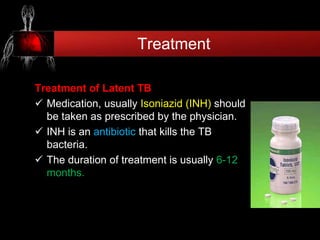
 Medication, usually Isoniazid (INH) should
be taken as prescribed by the physician.
 INH is an antibiotic that kills the TB
bacteria.
 The duration of treatment is usually 6-12
months.
Treatment
Treatment of Active TB
 When a person with active TB is
diagnosed, they should be isolated from
other people until the medication begins.
 Usually 2 weeks, but sometimes longer.
Treatment
 First Line: Most effective and have lowest toxicity.
o Isoniazid, Rifampin, Ethambutol, Streptomycin,
and Pyrazinamide.
 Second Line: Less effective and more toxic.
o p-amino salicylic acid, Streptomycin, Ethambutol
 Third Line: Least effective and most toxic.
o Amikacin, Kanamycin, Capreomycin, Viomycin.
Treatment
Multidrug-resistant TB is on the rise.
• MDR TB means that some TB bacteria have developed
resistance, so that traditional antibiotics no longer kill the
bacteria.
• Due to people not taking their medication properly
Tuberculosis and it's therapy

Tuberculosis and it's therapy

  • 1.
  • 2.
    What is tuberculosis? •TB is a disease caused by infection with a bacteria called Mycobacterium tuberculosis. • It can also be a crippling and deadly disease, and is on the rise in both developed and developing worlds. • Currently it kills “three million people” a year.
  • 3.
    How can youcatch TB?  TB droplets are more easily spread in areas with poor air circulation.  TB is not visible, and can only be seen under a microscope.
  • 4.
    How can youcatch TB?  TB is spread through tiny drops sprayed into the air when an infected person coughs, sneezes, or speaks, or another person breathes the air into their lungs containing the TB bacteria.  By sharing utensils or food  By sharing cigarettes.  By exchanging body fluids.  By shaking hands.  Using public telephones.
  • 5.
    TB Infection andDisease  The lungs are the most common place for TB. This is known as pulmonary TB.  TB of the voice box is the second most common and is usually called laryngeal TB.  TB can infect the brain, kidneys, bones, and other areas.  TB can also spread through the blood to other organs; this is called miliary TB.
  • 7.
    TB Infection andDisease  TB infection of the lungs can fall into 2 categories of disease: Latent TB or Active TB.  Latent TB means a person is infected by TB bacteria and the body’s immune system has contained the infection but cannot infect others, and is not coughing or appearing sick.
  • 8.
    TB Infection andDisease  Active pulmonary and laryngeal TB means a person infected with the TB bacteria is sick and can infect others unless they are taking medicine prescribed by their physician to treat TB.  TB disease varies with age and the ability of your body to fight off bacteria.  HIV is the strongest risk factor for the progression of Latent TB to Active TB infection
  • 9.
    Sign and symptom •The primary stage of the disease may be symptom-free, or the individual may experience a flu-like illness. This is called the “inactive stage.” • Within the active stage of the disease, there might be- A slight fever Night sweats Weight loss Fatigue Chest pain Cough (2-3 weeks or more) Coughing up blood Feeling weak and tired Decreased or no appetite
  • 11.
    Diagnosis • Tools forDiagnosing TB Infection – Mantoux skin test (PPD) – Chest x-ray – Sputum cultures
  • 12.
  • 13.
    Treatment Treatment of LatentTB  Medication, usually Isoniazid (INH) should be taken as prescribed by the physician.  INH is an antibiotic that kills the TB bacteria.  The duration of treatment is usually 6-12 months.
  • 14.
    Treatment Treatment of ActiveTB  When a person with active TB is diagnosed, they should be isolated from other people until the medication begins.  Usually 2 weeks, but sometimes longer.
  • 15.
    Treatment  First Line:Most effective and have lowest toxicity. o Isoniazid, Rifampin, Ethambutol, Streptomycin, and Pyrazinamide.  Second Line: Less effective and more toxic. o p-amino salicylic acid, Streptomycin, Ethambutol  Third Line: Least effective and most toxic. o Amikacin, Kanamycin, Capreomycin, Viomycin.
  • 16.
    Treatment Multidrug-resistant TB ison the rise. • MDR TB means that some TB bacteria have developed resistance, so that traditional antibiotics no longer kill the bacteria. • Due to people not taking their medication properly