Introduction to
Tuberculosis
(TB)
December 2023
This Slide Deck Covers the
Following Topics about
Tuberculosis (TB):
1. What is Tuberculosis (TB)?
2. How TB spreads
3. Inactive TB Infection and TB Disease
4. Risk Factors
5. TB Testing
6. Treatment
7. TB Elimination
2
What is Tuberculosis
(TB)?
Tuberculosis (TB)
• TB is spread from person to person through the air
• TB is a disease caused by bacteria called Mycobacterium
tuberculosis. The bacteria, or TB germs, usually attack the
lungs. However, TB germs can attack any part of the body such
as the kidney, spine, or brain
• Pulmonary TB is TB in the lungs
• Extrapulmonary TB is TB in places other than the lungs, such as the
kidney, spine, or brain
• Not everyone infected with TB germs becomes sick
4
TB is the one of the World’s Top Causes of Death due
to Infectious Disease
• TB is not a disease of the past
• Too many people in the United States still suffer from TB
• Approximately 10.6 million cases were reported worldwide in 2022
• In 2022, there were 8,331 cases of TB disease in the United States
• After decreasing considerably in 2020, TB cases increased in 2021 and
2022, but remain lower than in 2019
• TB is a serious disease that can cause a person to become very sick if
not treated with medicine
• Treatments are available to prevent and cure TB
5
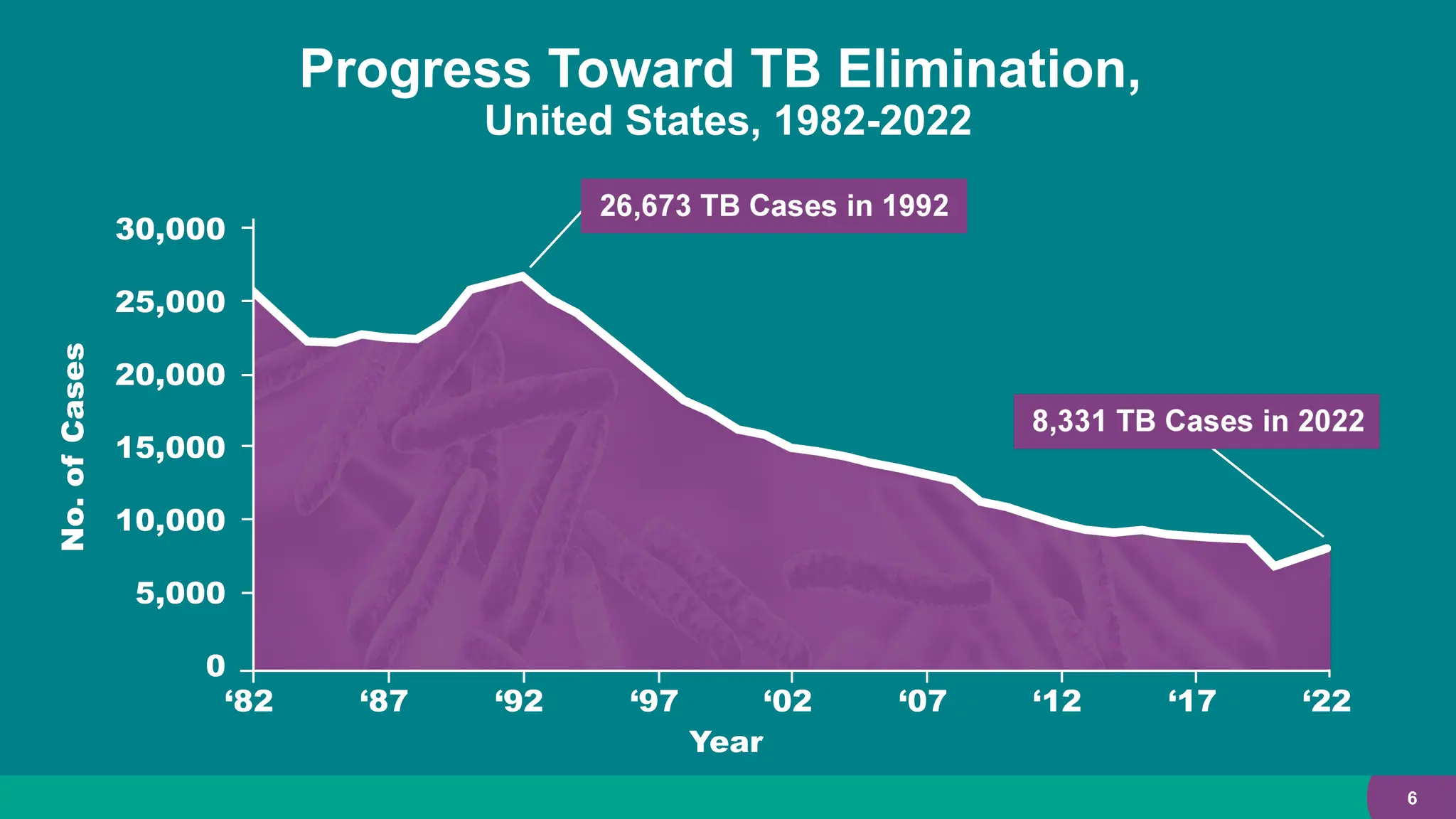
Progress Toward TB Elimination,
United States, 1982-2022
6
TB Impacts People from
All Over the United States
https://www.cdc.gov/tb/topic/basics/personalstories.htm
7
Anyone Can Get TB
8
How TB Spreads
TB Spreads
Through the Air
TB spreads from person
to person when someone
with active TB disease
coughs, speaks, or sings
10
TB Is NOT Spread by
Sharing
toothbrushes
Saliva from
kissing
Shaking
someone’s hand
Touching bed
linens or toilets
Sharing food,
drink, or utensils
11
Inactive TB
and TB Disease
Two TB-Related Conditions
Inactive TB
• People with latent TB infection or inactive TB
• Do not feel sick, do not have symptoms, and cannot spread
TB germs to others
• Can have inactive TB for years
• Have a small amount of TB germs in their bodies that are
alive but inactive
• Inactive TB can develop into TB disease
TB Disease
• If TB germs become active and multiply, inactive TB can turn
into TB disease
13
Not Everyone Who Is Infected with TB Becomes Sick
Person with
Inactive TB
Person with
TB Disease
Has a small amount of TB germs in their
body that are alive but inactive
Has a large amount of active TB
germs in their body
Cannot spread TB germs to others May spread TB germs to others
Has no symptoms and does not feel sick,
but may become sick if the germs become
active in their body
Feels sick and has symptoms such as a
cough, fever, and/or weight loss
Usually has a positive TB skin test or TB
blood test result indicating TB infection
Usually has a positive TB skin test or TB
blood test result indicating TB infection
Has a normal chest x-ray and a negative
sputum smear
May have an abnormal chest x-ray, or
positive sputum smear or culture
Needs treatment for inactive TB infection to
prevent TB disease
Needs treatment for active TB disease
14
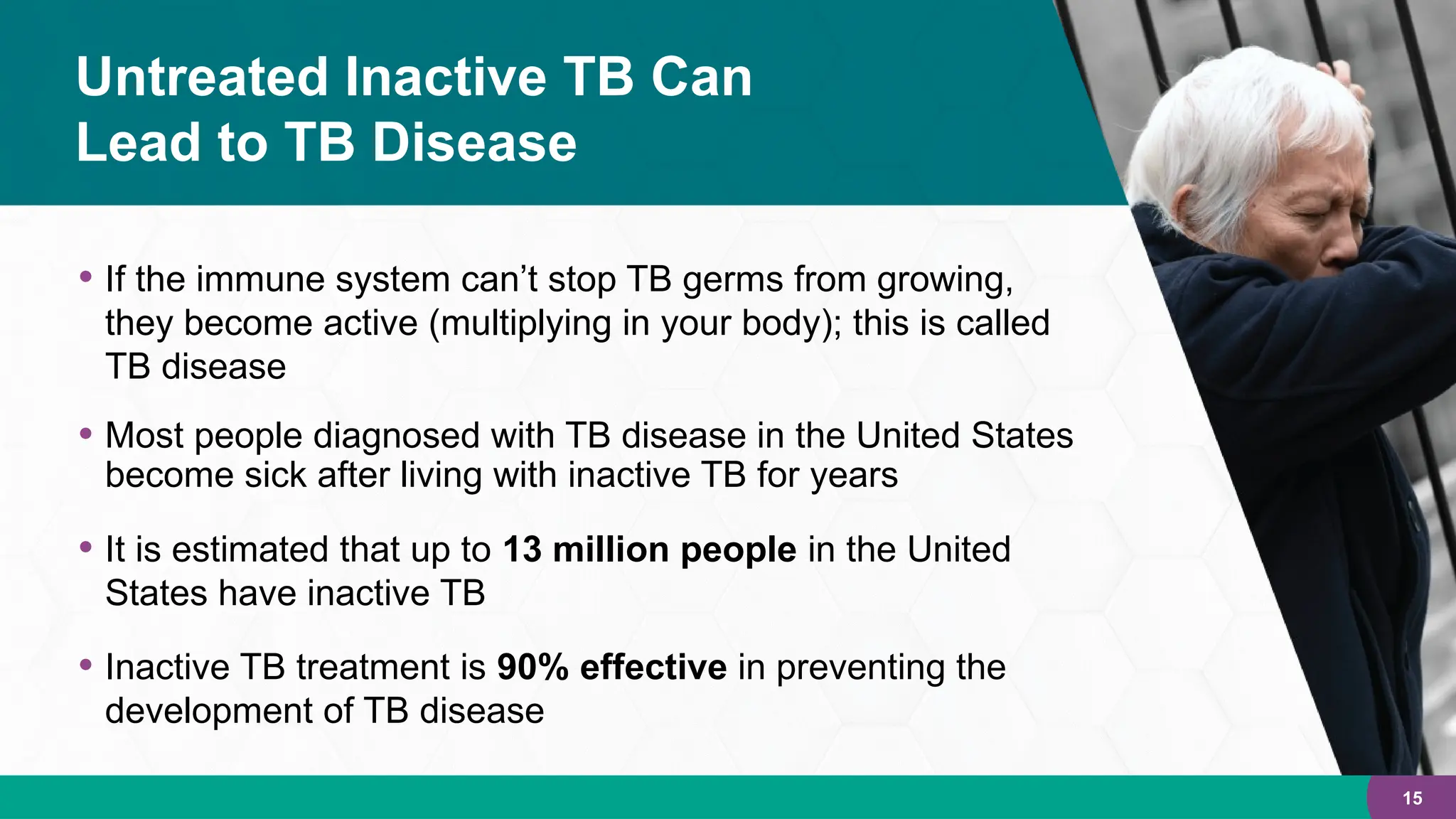
Untreated Inactive TB Can
Lead to TB Disease
• If the immune system can’t stop TB germs from growing,
they become active (multiplying in your body); this is called
TB disease
• Most people diagnosed with TB disease in the United States
become sick after living with inactive TB for years
• It is estimated that up to 13 million people in the United
States have inactive TB
• Inactive TB treatment is 90% effective in preventing the
development of TB disease
15
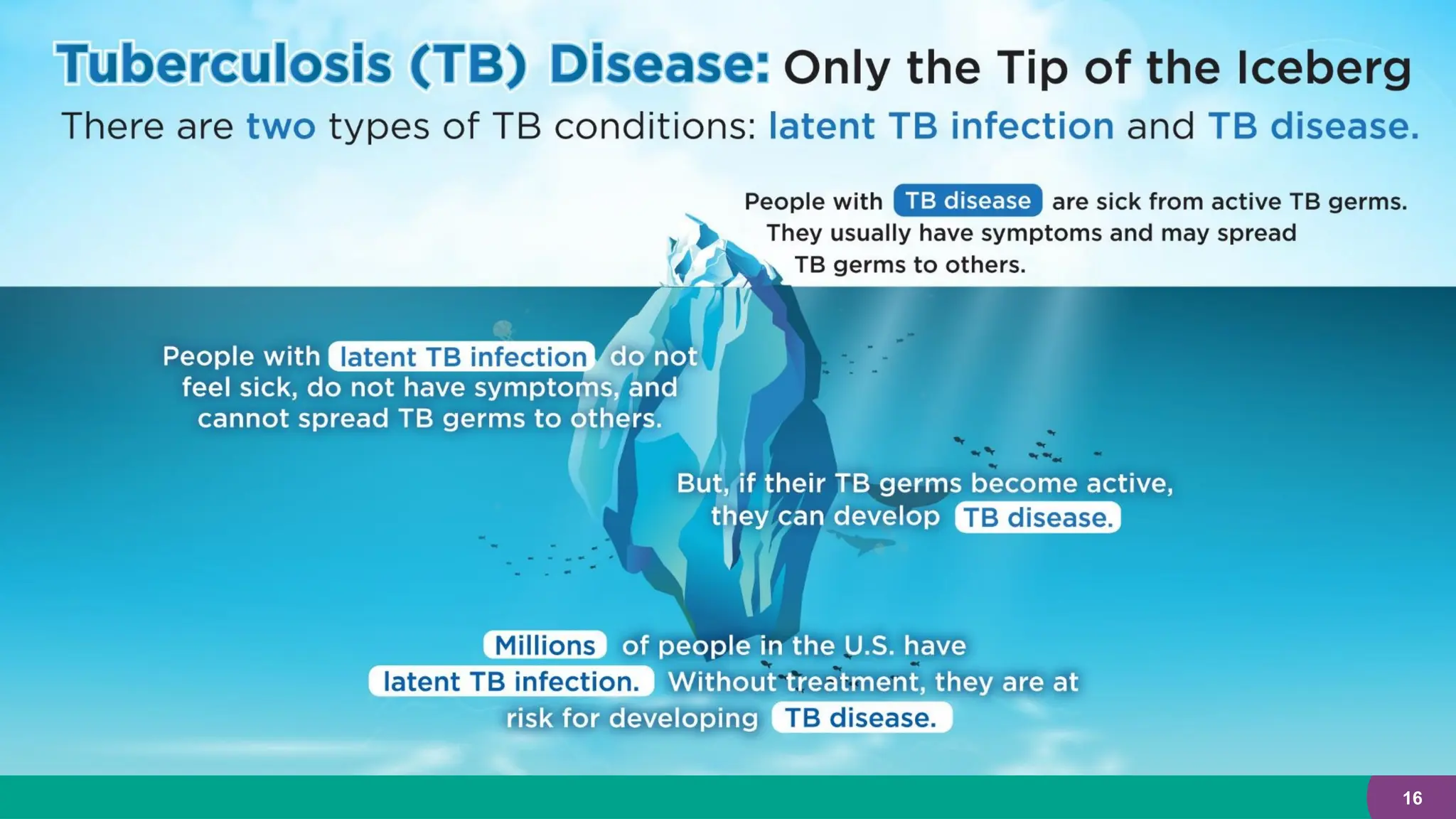
Tuberculosis (TB) Disease: Only the Tip
of the Iceburg
There are two types of TB conditions: latent TB infection and TB disease.
People with TB disease are sick from active TB germs. They usually have
symptoms and may spread TB germs to others.
People with latent TB infection do not feel sick, do not have symptoms, and cannot
spread TB germs to others.
But, if their TB germs become active, they can develop TB disease.
Millions of people in the U.S. have latent TB infection Without treatment, they are
at risk for developing TB disease.
16
Possible TB Disease Symptoms
Night Sweats Fever Chills
Weakness
or fatigue
Weight loss No appetite
Cough lasting
longer than
3 weeks
Pain in
the chest
Coughing up
blood or sputum
(phlegm from inside
the lungs)
17
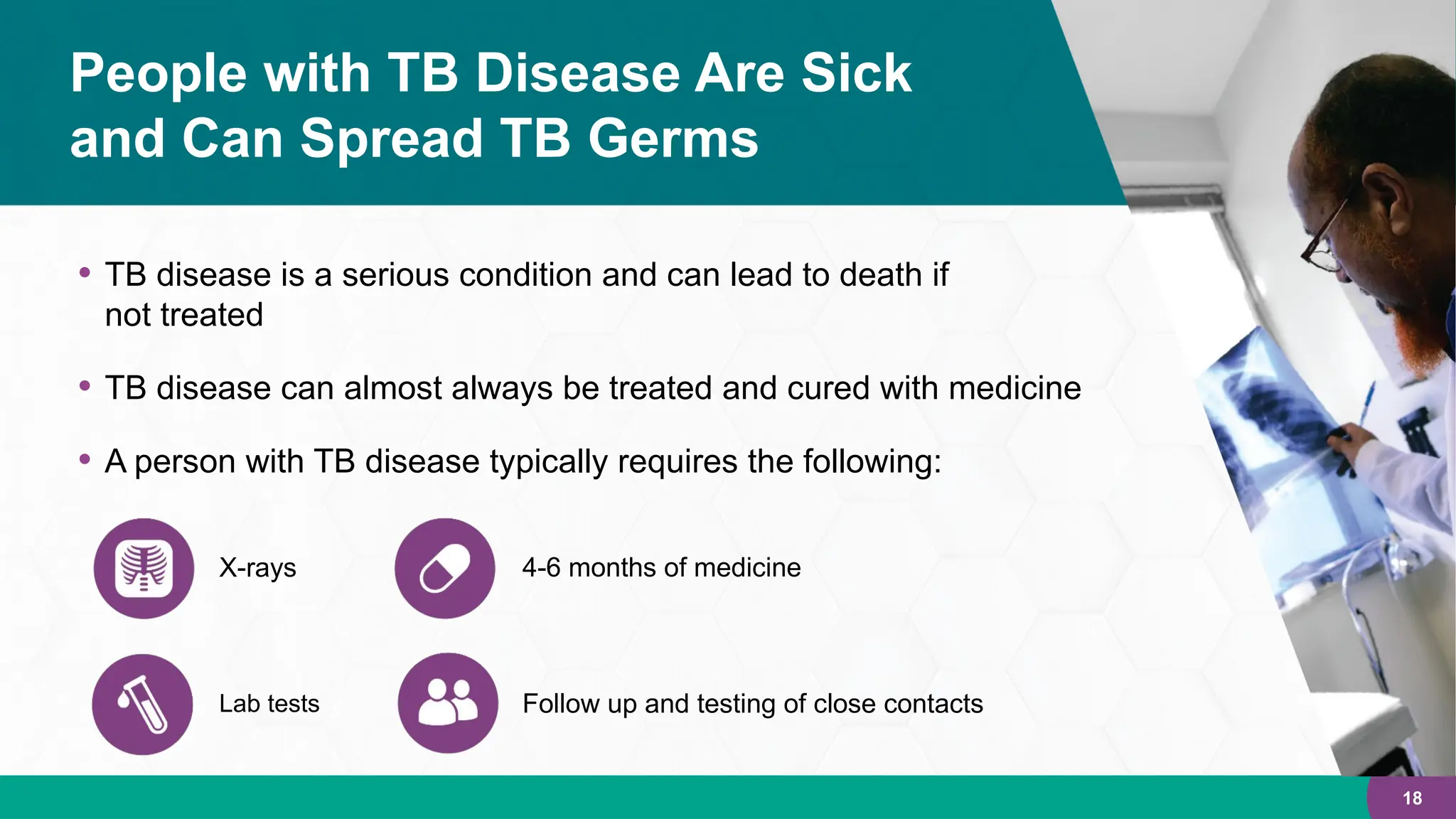
People with TB Disease Are Sick
and Can Spread TB Germs
• TB disease is a serious condition and can lead to death if
not treated
• TB disease can almost always be treated and cured with medicine
• A person with TB disease typically requires the following:
X-rays 4-6 months of medicine
Lab tests Follow up and testing of close contacts
18
Public Health Workers Are Responsible
for Finding People Exposed to TB
• A person who was exposed to someone with contagious TB
disease is considered a TB contact
• Persons exposed to someone with TB can include family
members, roommates or housemates, close friends, coworkers,
classmates, and others
• People with TB disease can spread TB germs to those around
them
• The local health department will conduct a contact investigation
by following up and testing those who have been close to
someone with TB
19
Risk Factors
Who Is at Higher Risk for Becoming
Infected with TB Germs?
Anyone can get TB
Some people have a higher risk of getting infected
with TB:
• People who have contact with someone who has infectious TB disease
• People who were born in or who frequently travel to countries where TB
disease is common, including Mexico, the Philippines, Vietnam, India,
China, Haiti, Guatemala, and other countries with high rates of TB
• Health care workers and others who work or live in places at high risk for
TB transmission, such as homeless shelters, jails, and nursing homes
21
Since 2010, the Majority of U.S. TB Cases Occur
in Persons Born Outside of the United States*
*Percentages are rounded; data from 2022 22
Countries of Birth Among Non-U.S.-born
Persons with TB, United States 2022*
*Percentages are rounded 23
Reported TB Cases by Race/Ethnicity,*
United States, 2022 (N=8,331)†
* All races are non-Hispanic; multiple race indicates two or more races reported for a person but does not include persons of Hispanic/Latino origin.
†
Excludes unknown/missing values 24
Who Is at Risk for Developing TB Disease?
People at high risk for developing TB disease generally fall into two categories:
• Those who have been recently infected with TB germs
• Those with medical conditions that weaken the immune system, such as:
HIV infection
Substance abuse
Specialized treatment for rheumatoid
arthritis or Crohn’s disease
Organ transplants Severe kidney
disease
Head or neck cancer
Diabetes
Medical treatments such
as corticosteroids
Silicosis Low body weight
25
TB Testing
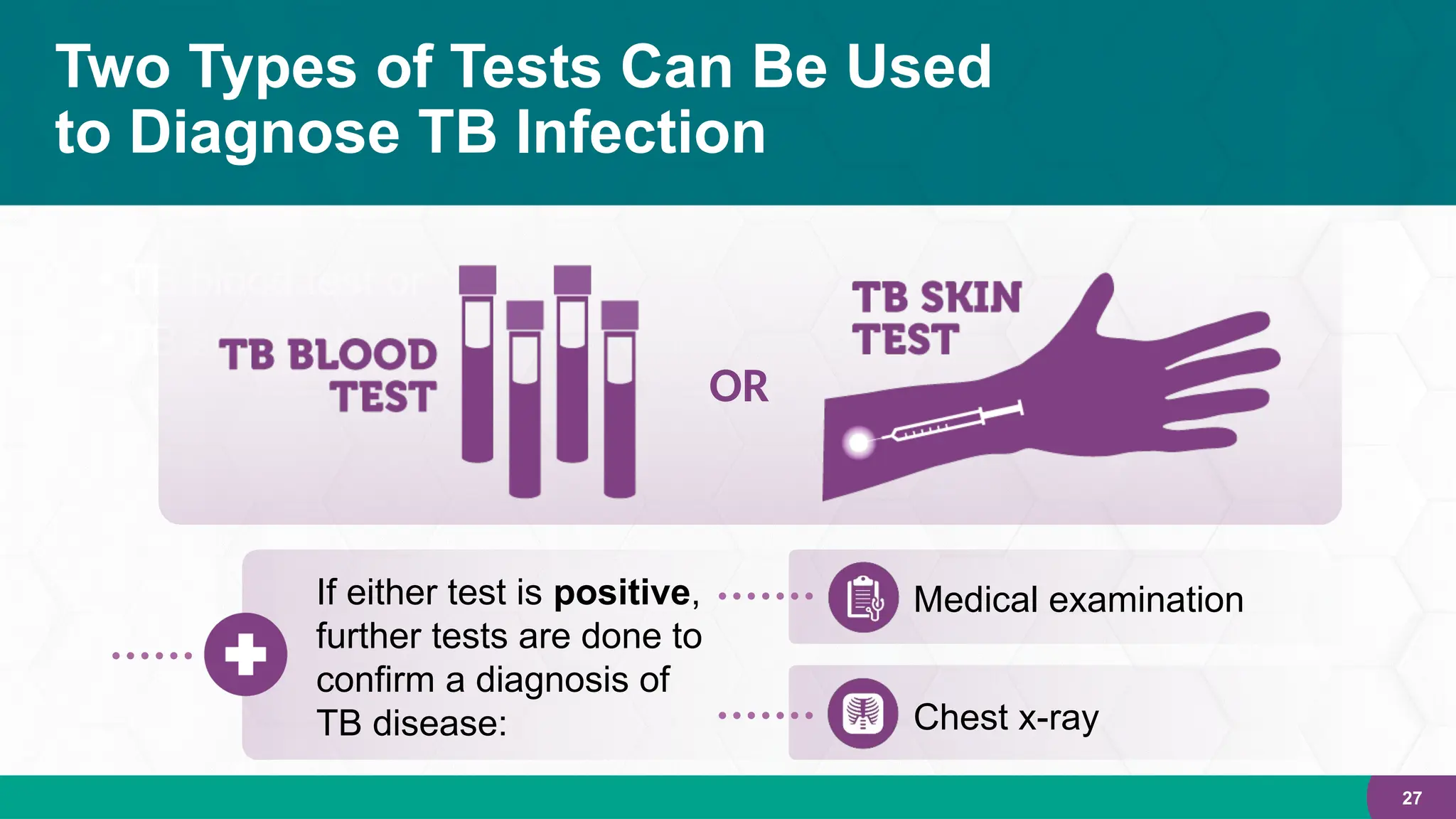
Two Types of Tests Can Be Used
to Diagnose TB Infection
• TB blood test or
• TB skin test
OR
If either test is positive,
further tests are done to
confirm a diagnosis of
TB disease:
• Medical examination
• Chest x-ray
27
TB Blood Test
Blood is drawn and sent to a lab for analysis.
•
Positive blood test: A person likely has been infected with
TB germs. Additional tests are needed to determine if the
person has inactive TB or TB disease.
•
Negative blood test: A person’s blood did not react to the
test and inactive TB, or TB disease is not likely.
The TB blood test is also known as an Interferon-Gamma Release
Assay (IGRA).
28
TB Skin Test
The TB skin test, also called the Mantoux tuberculin skin test
(TST), requires two visits with a health care provider
On the first visit, a test is placed On the second visit, the test is read
29
People Vaccinated with BCG
Can Still Get TB Disease
Bacille Calmette-Guérin (BCG)
• Is a vaccine for TB disease
• The TB vaccine is not widely used in the United States
• Is often given to infants and small children in countries
where TB is more common
• Protects against severe forms of active TB in children
• Protection from TB goes away as people get older
30
TB Blood Tests Are Preferred for People
Who Have Received the TB Vaccine (BCG)
• The TB vaccine (BCG) may cause a positive TB skin test
• The TB vaccine does not affect TB blood tests results
• TB blood tests give more accurate results in people who
have received the TB vaccine
• Anyone who has received the TB vaccine should receive
a TB blood test instead of a TB skin test
31
Treatment
Treatment for Inactive TB Can Prevent the
Development of TB Disease
• People with inactive TB will not feel sick
• As long as TB germs remain in the body, they can become active,
multiply, and make someone sick with TB disease
• People with inactive TB
• Should take medicine to prevent the development of TB disease,
even though they don’t feel sick
33
Treatment for Inactive TB
Compared to treatment for TB disease, inactive TB treatment
Is shorter
Is less costly
Has fewer side effects
34
Treating TB Disease Protects Your Health and
the Health of Others
• People with TB disease can pass TB germs to their family,
friends, and others around them if they don’t take TB
medicine the right way
• People with TB disease need to take several medicines when
they start treatment
• After taking TB medicine for several weeks, a doctor will be
able to tell TB patients when they are no longer able to spread
TB germs to others
• Most people take TB medicine for at least 4 months to
be cured
35
Directly Observed
Therapy (DOT)
• Is the most effective strategy for ensuring
that patients stay on track with their treatment
• A health care worker will meet with the
patient to watch them swallow each dose of
the prescribed drugs
• During DOT visits, the health care worker will
check in with the patient to:
• answer questions
• make sure the treatment is working
• watch for side effects
36
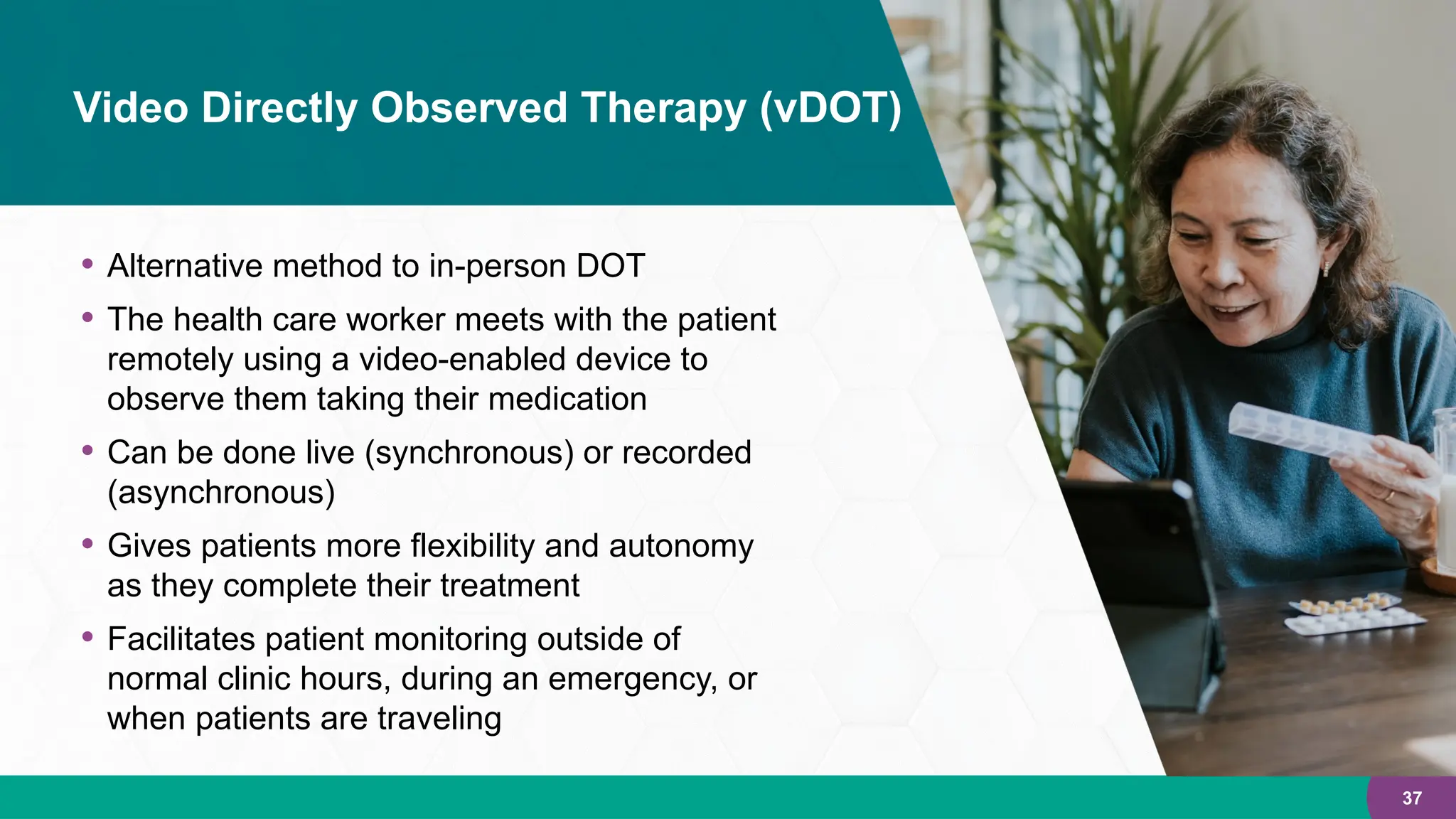
Video Directly Observed Therapy (vDOT)
• Alternative method to in-person DOT
• The health care worker meets with the patient
remotely using a video-enabled device to
observe them taking their medication
• Can be done live (synchronous) or recorded
(asynchronous)
• Gives patients more flexibility and autonomy
as they complete their treatment
• Facilitates patient monitoring outside of
normal clinic hours, during an emergency, or
when patients are traveling
37
TB Elimination
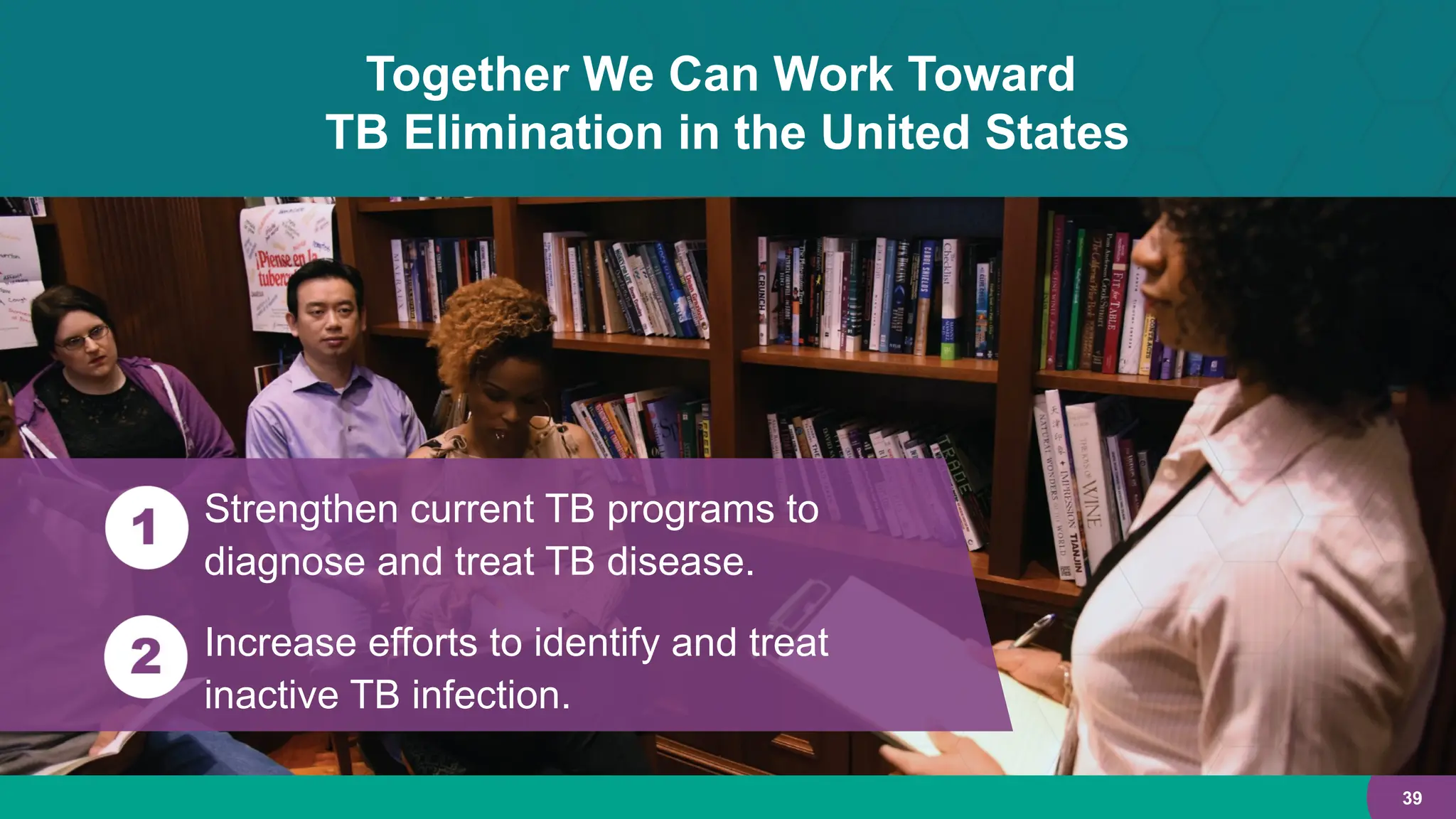
Together We Can Work Toward
TB Elimination in the United States
1. Strengthen current TB programs to
diagnose and treat TB disease.
2. Increase efforts to identify and treat
inactive TB infection.
39
Health Care Providers and Communities Need
to “Think TB!”
Protect the health and well-being of community members
at higher risk for TB:
• Know who is most at risk for TB
• Recognize the signs and symptoms of TB
• Test and treat patients who are at high risk for TB
• Be aware of latest TB research and shortest treatment
options
• Encourage conversations about TB and how it affects the
community to reduce stigma
40
Key Partners
in TB Elimination
• Health care workers in doctors’
offices and hospitals, community
health centers, and academic
institutions
• State and local health
departments
• Community organizations
• Communities at higher risk for TB
• TB survivors
41
Think. Test.
Treat TB
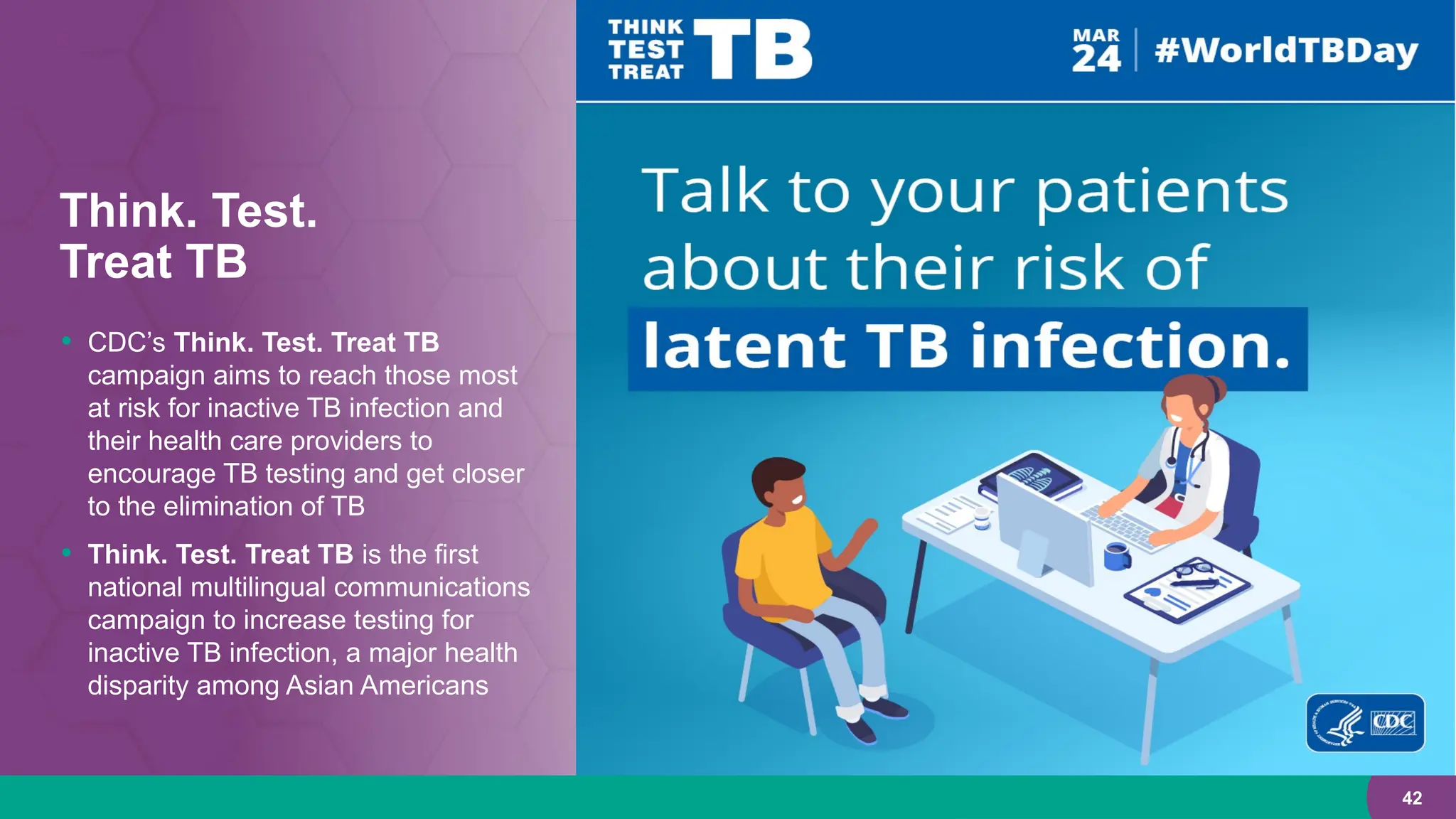
• CDC’s Think. Test. Treat TB
campaign aims to reach those most
at risk for inactive TB infection and
their health care providers to
encourage TB testing and get closer
to the elimination of TB
• Think. Test. Treat TB is the first
national multilingual communications
campaign to increase testing for
inactive TB infection, a major health
disparity among Asian Americans
42
Resources
CDC TB website:
www.cdc.gov/tb/
State & Local TB Control Offices:
www.cdc.gov/tb/links/tboffices.htm
Find TB Resources:
https://findtbresources.cdc.gov
TB Centers of Excellence:
https://www.cdc.gov/tb/education/tb_coe/default.htm
Facebook:
www.facebook.com/CDCTB/
Twitter:
www.twitter.com/cdc_tb
The findings and conclusions in this report are those of the authors and do not necessarily represent the official position of the Centers for Disease Control and Prevention. 43

TUBERCULOSIS AND ITS TYPES AND MANAGEMENT

  • 1.
  • 2.
    This Slide DeckCovers the Following Topics about Tuberculosis (TB): 1. What is Tuberculosis (TB)? 2. How TB spreads 3. Inactive TB Infection and TB Disease 4. Risk Factors 5. TB Testing 6. Treatment 7. TB Elimination 2
  • 3.
  • 4.
    Tuberculosis (TB) • TBis spread from person to person through the air • TB is a disease caused by bacteria called Mycobacterium tuberculosis. The bacteria, or TB germs, usually attack the lungs. However, TB germs can attack any part of the body such as the kidney, spine, or brain • Pulmonary TB is TB in the lungs • Extrapulmonary TB is TB in places other than the lungs, such as the kidney, spine, or brain • Not everyone infected with TB germs becomes sick 4
  • 5.
    TB is theone of the World’s Top Causes of Death due to Infectious Disease • TB is not a disease of the past • Too many people in the United States still suffer from TB • Approximately 10.6 million cases were reported worldwide in 2022 • In 2022, there were 8,331 cases of TB disease in the United States • After decreasing considerably in 2020, TB cases increased in 2021 and 2022, but remain lower than in 2019 • TB is a serious disease that can cause a person to become very sick if not treated with medicine • Treatments are available to prevent and cure TB 5
  • 6.
    Progress Toward TBElimination, United States, 1982-2022 6
  • 7.
    TB Impacts Peoplefrom All Over the United States https://www.cdc.gov/tb/topic/basics/personalstories.htm 7
  • 8.
  • 9.
  • 10.
    TB Spreads Through theAir TB spreads from person to person when someone with active TB disease coughs, speaks, or sings 10
  • 11.
    TB Is NOTSpread by Sharing toothbrushes Saliva from kissing Shaking someone’s hand Touching bed linens or toilets Sharing food, drink, or utensils 11
  • 12.
  • 13.
    Two TB-Related Conditions InactiveTB • People with latent TB infection or inactive TB • Do not feel sick, do not have symptoms, and cannot spread TB germs to others • Can have inactive TB for years • Have a small amount of TB germs in their bodies that are alive but inactive • Inactive TB can develop into TB disease TB Disease • If TB germs become active and multiply, inactive TB can turn into TB disease 13
  • 14.
    Not Everyone WhoIs Infected with TB Becomes Sick Person with Inactive TB Person with TB Disease Has a small amount of TB germs in their body that are alive but inactive Has a large amount of active TB germs in their body Cannot spread TB germs to others May spread TB germs to others Has no symptoms and does not feel sick, but may become sick if the germs become active in their body Feels sick and has symptoms such as a cough, fever, and/or weight loss Usually has a positive TB skin test or TB blood test result indicating TB infection Usually has a positive TB skin test or TB blood test result indicating TB infection Has a normal chest x-ray and a negative sputum smear May have an abnormal chest x-ray, or positive sputum smear or culture Needs treatment for inactive TB infection to prevent TB disease Needs treatment for active TB disease 14
  • 15.
    Untreated Inactive TBCan Lead to TB Disease • If the immune system can’t stop TB germs from growing, they become active (multiplying in your body); this is called TB disease • Most people diagnosed with TB disease in the United States become sick after living with inactive TB for years • It is estimated that up to 13 million people in the United States have inactive TB • Inactive TB treatment is 90% effective in preventing the development of TB disease 15
  • 16.
    Tuberculosis (TB) Disease:Only the Tip of the Iceburg There are two types of TB conditions: latent TB infection and TB disease. People with TB disease are sick from active TB germs. They usually have symptoms and may spread TB germs to others. People with latent TB infection do not feel sick, do not have symptoms, and cannot spread TB germs to others. But, if their TB germs become active, they can develop TB disease. Millions of people in the U.S. have latent TB infection Without treatment, they are at risk for developing TB disease. 16
  • 17.
    Possible TB DiseaseSymptoms Night Sweats Fever Chills Weakness or fatigue Weight loss No appetite Cough lasting longer than 3 weeks Pain in the chest Coughing up blood or sputum (phlegm from inside the lungs) 17
  • 18.
    People with TBDisease Are Sick and Can Spread TB Germs • TB disease is a serious condition and can lead to death if not treated • TB disease can almost always be treated and cured with medicine • A person with TB disease typically requires the following: X-rays 4-6 months of medicine Lab tests Follow up and testing of close contacts 18
  • 19.
    Public Health WorkersAre Responsible for Finding People Exposed to TB • A person who was exposed to someone with contagious TB disease is considered a TB contact • Persons exposed to someone with TB can include family members, roommates or housemates, close friends, coworkers, classmates, and others • People with TB disease can spread TB germs to those around them • The local health department will conduct a contact investigation by following up and testing those who have been close to someone with TB 19
  • 20.
  • 21.
    Who Is atHigher Risk for Becoming Infected with TB Germs? Anyone can get TB Some people have a higher risk of getting infected with TB: • People who have contact with someone who has infectious TB disease • People who were born in or who frequently travel to countries where TB disease is common, including Mexico, the Philippines, Vietnam, India, China, Haiti, Guatemala, and other countries with high rates of TB • Health care workers and others who work or live in places at high risk for TB transmission, such as homeless shelters, jails, and nursing homes 21
  • 22.
    Since 2010, theMajority of U.S. TB Cases Occur in Persons Born Outside of the United States* *Percentages are rounded; data from 2022 22
  • 23.
    Countries of BirthAmong Non-U.S.-born Persons with TB, United States 2022* *Percentages are rounded 23
  • 24.
    Reported TB Casesby Race/Ethnicity,* United States, 2022 (N=8,331)† * All races are non-Hispanic; multiple race indicates two or more races reported for a person but does not include persons of Hispanic/Latino origin. † Excludes unknown/missing values 24
  • 25.
    Who Is atRisk for Developing TB Disease? People at high risk for developing TB disease generally fall into two categories: • Those who have been recently infected with TB germs • Those with medical conditions that weaken the immune system, such as: HIV infection Substance abuse Specialized treatment for rheumatoid arthritis or Crohn’s disease Organ transplants Severe kidney disease Head or neck cancer Diabetes Medical treatments such as corticosteroids Silicosis Low body weight 25
  • 26.
  • 27.
    Two Types ofTests Can Be Used to Diagnose TB Infection • TB blood test or • TB skin test OR If either test is positive, further tests are done to confirm a diagnosis of TB disease: • Medical examination • Chest x-ray 27
  • 28.
    TB Blood Test Bloodis drawn and sent to a lab for analysis. • Positive blood test: A person likely has been infected with TB germs. Additional tests are needed to determine if the person has inactive TB or TB disease. • Negative blood test: A person’s blood did not react to the test and inactive TB, or TB disease is not likely. The TB blood test is also known as an Interferon-Gamma Release Assay (IGRA). 28
  • 29.
    TB Skin Test TheTB skin test, also called the Mantoux tuberculin skin test (TST), requires two visits with a health care provider On the first visit, a test is placed On the second visit, the test is read 29
  • 30.
    People Vaccinated withBCG Can Still Get TB Disease Bacille Calmette-Guérin (BCG) • Is a vaccine for TB disease • The TB vaccine is not widely used in the United States • Is often given to infants and small children in countries where TB is more common • Protects against severe forms of active TB in children • Protection from TB goes away as people get older 30
  • 31.
    TB Blood TestsAre Preferred for People Who Have Received the TB Vaccine (BCG) • The TB vaccine (BCG) may cause a positive TB skin test • The TB vaccine does not affect TB blood tests results • TB blood tests give more accurate results in people who have received the TB vaccine • Anyone who has received the TB vaccine should receive a TB blood test instead of a TB skin test 31
  • 32.
  • 33.
    Treatment for InactiveTB Can Prevent the Development of TB Disease • People with inactive TB will not feel sick • As long as TB germs remain in the body, they can become active, multiply, and make someone sick with TB disease • People with inactive TB • Should take medicine to prevent the development of TB disease, even though they don’t feel sick 33
  • 34.
    Treatment for InactiveTB Compared to treatment for TB disease, inactive TB treatment Is shorter Is less costly Has fewer side effects 34
  • 35.
    Treating TB DiseaseProtects Your Health and the Health of Others • People with TB disease can pass TB germs to their family, friends, and others around them if they don’t take TB medicine the right way • People with TB disease need to take several medicines when they start treatment • After taking TB medicine for several weeks, a doctor will be able to tell TB patients when they are no longer able to spread TB germs to others • Most people take TB medicine for at least 4 months to be cured 35
  • 36.
    Directly Observed Therapy (DOT) •Is the most effective strategy for ensuring that patients stay on track with their treatment • A health care worker will meet with the patient to watch them swallow each dose of the prescribed drugs • During DOT visits, the health care worker will check in with the patient to: • answer questions • make sure the treatment is working • watch for side effects 36
  • 37.
    Video Directly ObservedTherapy (vDOT) • Alternative method to in-person DOT • The health care worker meets with the patient remotely using a video-enabled device to observe them taking their medication • Can be done live (synchronous) or recorded (asynchronous) • Gives patients more flexibility and autonomy as they complete their treatment • Facilitates patient monitoring outside of normal clinic hours, during an emergency, or when patients are traveling 37
  • 38.
  • 39.
    Together We CanWork Toward TB Elimination in the United States 1. Strengthen current TB programs to diagnose and treat TB disease. 2. Increase efforts to identify and treat inactive TB infection. 39
  • 40.
    Health Care Providersand Communities Need to “Think TB!” Protect the health and well-being of community members at higher risk for TB: • Know who is most at risk for TB • Recognize the signs and symptoms of TB • Test and treat patients who are at high risk for TB • Be aware of latest TB research and shortest treatment options • Encourage conversations about TB and how it affects the community to reduce stigma 40
  • 41.
    Key Partners in TBElimination • Health care workers in doctors’ offices and hospitals, community health centers, and academic institutions • State and local health departments • Community organizations • Communities at higher risk for TB • TB survivors 41
  • 42.
    Think. Test. Treat TB •CDC’s Think. Test. Treat TB campaign aims to reach those most at risk for inactive TB infection and their health care providers to encourage TB testing and get closer to the elimination of TB • Think. Test. Treat TB is the first national multilingual communications campaign to increase testing for inactive TB infection, a major health disparity among Asian Americans 42
  • 43.
    Resources CDC TB website: www.cdc.gov/tb/ State& Local TB Control Offices: www.cdc.gov/tb/links/tboffices.htm Find TB Resources: https://findtbresources.cdc.gov TB Centers of Excellence: https://www.cdc.gov/tb/education/tb_coe/default.htm Facebook: www.facebook.com/CDCTB/ Twitter: www.twitter.com/cdc_tb The findings and conclusions in this report are those of the authors and do not necessarily represent the official position of the Centers for Disease Control and Prevention. 43

Editor's Notes

  • #1 This slide set is an introduction on the basics of tuberculosis, often referred to as TB.
  • #4 TB is an airborne disease that spreads from person to person through the air. When a person breathes in TB germs, the germs can settle in the lungs and begin to grow. From there, the germs can move through the blood to other parts of the body, like the kidney, spine, or brain. Pulmonary TB is TB in the lungs. Extrapulmonary TB is TB disease that occurs in places other than the lungs. For more information: https://www.cdc.gov/tb/topic/basics/default.htm
  • #5 Tuberculosis is preventable and treatable but remains the world’s deadliest infectious-disease killer. After decreasing considerably in 2020, TB cases increased in 2021 and 2022, but remain lower than in 2019 For more information: https://www.cdc.gov/tb/statistics/default.htm
  • #6 This graph shows the number of TB cases for each year from 1982 to 2022 (the most recent year for which TB data are available). In 1992, the U.S. had the highest number of reported TB cases during this period. 2022 saw some of the lowest number of U.S. TB cases and lowest incidence rate on record, continuing a trend of declining cases and incidence since 1992. Reaching the goal of TB elimination in the United States requires maintaining and strengthening current TB control priorities, while increasing efforts to identify and treat inactive TB infection (LTBI) among high-risk populations. The TB elimination threshold is <1 case per 1,000,000 population, which is approximately 330 cases per year for the current U.S. population.  For more information: https://www.cdc.gov/tb/statistics/default.htm
  • #7 TB is still a life-threatening problem in this country, and it impacts people across the United States. TB knows no borders, and people in the United States are suffering from TB. Anyone can get TB. CDC has worked with the We Are TB Survivors Network and the National TB Controllers Association to highlight the personal experiences of people who have been diagnosed with and treated for TB disease, as well as the work of TB control professionals. These stories provide insight into some of the challenges TB survivors have had to overcome regarding their diagnosis and treatment of TB. For more information: https://www.cdc.gov/tb/topic/basics/personalstories.htm
  • #8 This video shares a personal story of a TB survivor in the United States. Tenzin’s treatment for multidrug-resistant TB lasted for over 2 years. With the help of his local and state TB programs, Tenzin began the long and challenging treatment process. For more information: https://www.cdc.gov/tb/topic/basics/personalstories.htm
  • #10 This image shows how TB germs spread through the air. The TB germs are put into the air when a person with TB disease (on the left) of the lungs or throat coughs, speaks, or sings. People nearby may breathe in these germs (illustrated by the person on the right) and become infected. The person on the left has TB disease and is putting TB germs into the air. The person on the right is breathing in the TB germs into their lungs. The best way to stop TB spread is to Identify people who have TB. Isolate those who are contagious. Provide treatment as soon as possible to anyone who is contagious. People with TB disease are most likely to spread it to people they spend time with every day, including family members, friends, coworkers, or schoolmates.  For more information: https://www.cdc.gov/tb/topic/basics/howtbspreads.htm
  • #11 For more information: https://www.cdc.gov/tb/topic/basics/exposed.htm
  • #13 Not everyone infected with TB germs becomes sick. As a result, two TB-related conditions exist: inactive TB (sometimes called latent TB, or LTBI) and TB disease.  TB germs can live in the body without making you sick. This is called inactive TB. People with inactive TB have TB germs in their bodies, but do not have TB disease and cannot spread the infection to other people.  TB germs become active if the immune system can’t stop them from growing. When TB germs are active (multiplying in your body), this is called TB disease.  On this slide, the lung with inactive TB (top) has a small amount of TB due to the immune system controlling the germs. The lung with TB disease (bottom) is full of TB because the immune system cannot stop the TB germs from growing and multiplying.   For more information: https://www.cdc.gov/tb/topic/basics/tbinfectiondisease.htm
  • #14 This table compares inactive TB and TB disease. Both inactive TB and TB disease usually result in a positive TB skin test or TB blood test. For more information: https://www.cdc.gov/tb/topic/basics/tbinfectiondisease.htm
  • #15 Progression from untreated inactive TB to TB disease accounts for approximately 80% of U.S. TB cases. People can have inactive TB for years and not know it.   Many people who have inactive TB never develop TB disease. Some people develop TB disease soon after becoming infected (within weeks), before their immune system can fight the TB germs. Other people may get sick years later when their immune system becomes weak for another reason.  While not everyone with inactive TB will develop TB disease, about 5–10% will develop TB disease over their lifetimes if not treated.  The progression from inactive TB to TB disease may occur at any time, but it is most common within the first two years of infection.   For more information: https://www.cdc.gov/tb/topic/basics/tbinfectiondisease.htm
  • #16 This graphic helps summarize TB disease and inactive TB (also called latent TB infection, or LTBI) in the United States. TB disease is just the tip of the iceberg that is visible above the water. TB disease can be seen because of the active germs in a person’s body and the symptoms they experience. People with TB disease can spread TB to others. However, the larger part of the iceberg that is hidden underwater represents inactive TB. Like the iceberg, inactive TB can be easily hidden because TB germs are inactive and people with inactive TB germs do not feel sick. Many people with inactive TB do not know they are infected with TB. There are up to 13 million people in the U.S. with inactive TB. Without treatment for inactive TB, they could develop TB disease.
  • #17 Pulmonary TB disease develops in the lungs while extrapulmonary TB disease can develop in other parts of the body. Symptoms can vary depending on the type of TB Disease. For more information: https://www.cdc.gov/tb/topic/basics/signsandsymptoms.htm
  • #18 People with TB disease feel sick and can spread TB germs, especially to people they spend time with every day.  A person with TB disease typically requires 180 days of medication plus X-rays, lab tests, and follow-up and testing of contacts. TB disease is a serious condition and can lead to death if not treated. TB disease can almost always be treated and cured with medicine. TB germs become active if the immune system can’t stop them from growing. When TB germs are active (multiplying in your body), this is called TB disease. For more information: https://www.cdc.gov/tb/publications/factsheets/general/ltbiandactivetb.htm
  • #19 Conducting contact investigations is a priority for tuberculosis (TB) programs in the United States. The goals of a contact investigation are to successfully stop the spread of TB and prevent future cases and outbreaks of TB disease. For more information: https://www.cdc.gov/tb/education/ssmodules/pdfs/Module8.pdf
  • #21 Others at higher risk include Employees of high-risk congregate settings Health care workers who serve patients with TB disease Populations defined locally as having an increased incidence of inactive TB infection or TB disease, including medically underserved populations, low-income populations, or people who abuse drugs or alcohol Infants, children, and adolescents exposed to adults who are at increased risk for inactive TB infection or TB disease For more information: https://www.cdc.gov/tb/topic/basics/risk.htm
  • #22 TB disease in the United States is most common among people who were born in countries with high rates of TB.    Demographic characteristics of TB patients have remained fairly consistent over the last several years. For example, since 2010, the majority of reported TB disease cases in the U.S. occur among non-U.S.-born persons. The data on this slide is from 2022.   For more information: https://www.cdc.gov/tb/statistics/reports/2022/default.htm
  • #23 As seen on the previous slide, TB disease in the United States is most common among people who were born in countries outside the U.S., usually countries with high rates of TB. This pie chart shows the most common countries of birth among non-U.S.-born persons with TB disease reported in the U.S.  The most common countries of birth among non-U.S.-born TB patients remained fairly consistent over the last several years. This slide shows data from 2022 with Mexico (19%) the most frequently reported country of birth, followed by the Philippines (11%), India (9%), Vietnam (8%), China (6%), Guatemala (5%), and Honduras (3%). There are countries other than those you see here (grouped as Other Countries for this chart) with much higher rates of TB (i.e., cases per 100,000 people) for people who now live in the U.S., but a smaller number of people born in those countries now live in the U.S. For more information: https://www.cdc.gov/tb/statistics/reports/2022/table9.htm
  • #24 In 2022, non-Hispanic Asian persons (34%) and Hispanic persons (34%) represented the largest proportion of TB patients, followed by non-Hispanic Black persons (16%), non-Hispanic White persons (10%), Native Hawaiian/Other Pacific Islander persons (2%), American Indian/Alaska Native persons (1%), and persons of multiple races (1%). For more information: https://www.cdc.gov/tb/statistics/reports/2022/table2.htm
  • #25 While not everyone with inactive TB will develop TB disease, about 5–10% will develop TB disease over their lifetimes if not treated. Progression from untreated inactive TB to TB disease is estimated to account for approximately 80% of U.S. TB cases. Babies and young children are also at higher risk because they often have weak immune systems. For more information: https://www.cdc.gov/tb/topic/basics/risk
  • #27 Health care providers are encouraged to use newer TB blood tests to screen for TB infection. A positive TB skin test or TB blood test only tells that a person has been infected with TB germs. It does not tell whether the person has inactive TB or has progressed to TB disease. Other tests, such as a chest x-ray and a sample of sputum, are needed to see whether the person has TB disease.  Generally, it is not recommended to test a person with both a TB skin test and a TB blood test. For more information: https://www.cdc.gov/tb/topic/testing/tbtesttypes.htm
  • #28 Blood tests measure a person’s immune reactivity to TB germs. White blood cells from most people that have been infected with TB germs will release interferon-gamma (IFN-g) when mixed with antigens (substances that can produce an immune response) derived from TB germs. Results for blood tests can be read as positive or negative. If the result is not a clear positive or negative, the test can be repeated. Positive: Inactive TB likely Negative: Inactive TB unlikely, but cannot be excluded, especially if Patient has signs and symptoms consistent with TB disease Patient has a high risk for developing TB disease once infected with TB germs Blood tests are the preferred test for people who have received the bacille Calmette-Guerin (BCG) vaccine. See slides 30 and 31 for more info on BCG. For more information: https://www.cdc.gov/tb/publications/factsheets/testing/igra.htm
  • #29 The image on the left shows a TB skin test being administered into a patient’s arm. The image on the right shows the test being read by measuring the reaction at the test injection site. A skin test is NOT a vaccine for TB disease. A TB skin test requires two visits with a health care provider. On the first visit, the skin test is placed by injecting a small amount of fluid (called tuberculin) into the skin on the lower part of the arm. The skin will react if there are TB germs in the body. A person given the tuberculin skin test must return within 48–72 hours to have a trained health care worker look for a reaction on the arm. The result depends on the size of the raised, hard area where the skin reacted. The result depends on the size of the raised, hard area or swelling. Positive skin test: This means the person’s body is infected with TB germs. Additional tests are needed to determine if the person has inactive TB (LTBI) or TB disease. Negative skin test: This means the person’s body did not react to the test, and that inactive TB or TB disease is not likely. For more information: https://www.cdc.gov/tb/publications/factsheets/testing/skintesting.htm
  • #30 BCG is a vaccine for preventing TB disease. It is a weak form of bacteria that is closely related to the germs that cause TB. This vaccine is not widely used in the United States, but it is often given to infants and small children in other countries where TB is common. BCG vaccine does not always protect people from getting TB and protection goes away as people get older. For more information: https://www.cdc.gov/tb/topic/basics/vaccines.htm
  • #31 Many people born outside of the United States have received the TB vaccine. The TB vaccine may cause a false-positive reaction to the TB skin test, which can complicate decisions about treatment. The presence or size of a TB skin test reaction in those who have been vaccinated with BCG does not predict whether the vaccine will provide protection against TB disease. TB blood tests, unlike the TB skin test, are not affected by prior TB vaccination and are easier to interpret in people who have received the TB vaccine.  For more information: https://www.cdc.gov/tb/publications/factsheets/prevention/BCG.pdf
  • #33 People with inactive TB do not have symptoms, and they cannot spread TB germs to others. However, if inactive TB germs become active in the body and multiply, the person will go from having inactive TB to being sick with TB disease. For this reason, people with inactive TB should be treated to prevent them from developing TB disease. Treatment of inactive TB is essential to controlling TB in the United States because it substantially reduces the risk that inactive TB will progress to TB disease. For more information: https://www.cdc.gov/tb/topic/treatment/decideltbi.htm
  • #34 Treating inactive TB is effective in preventing TB disease. There are several options for the treatment of inactive TB. There have been advances in shortening the length of inactive TB infection treatment from 6–9 months to 3–4 months. Short-course inactive TB treatments are effective, safe, and have higher completion rates than longer treatments. Shorter regimens help patients finish treatment. For more information: https://www.cdc.gov/tb/publications/ltbi/pdf/CDC-USPSTF-LTBI-Testing-Treatment-Recommendations-508.pdf
  • #35 It is very important that people who have TB disease are treated, take the medicine exactly as prescribed, and finish all the medicine. If they stop taking the medicine too soon, they can become sick again; if they do not take the medicine correctly, the TB germs that are still alive may become resistant to those drugs. Resistance means that the drug can no longer kill the TB germs. Drug-resistant TB can occur when the drugs used to treat TB are misused or mismanaged. Examples of misuse or mismanagement include when People do not complete a full course of TB treatment. Health care providers prescribe the wrong treatment (the wrong dose or length of time). Drugs for proper treatment are not available. For more information: https://www.cdc.gov/tb/topic/treatment/tbdisease.htm https://www.cdc.gov/tb/topic/drtb/default.htm
  • #36 Directly observed therapy (DOT) for tuberculosis treatment involves observing a patient ingest medication, monitoring the patient for side effects, and providing support. DOT has typically been conducted in person; however, scheduling in-person DOT can present logistical challenges. DOT can reduce the development of drug resistance, treatment failure, or relapse after the end of treatment. DOT can be given anywhere the patient and health care worker agree upon, provided the time and location are convenient and safe. It is important that the location is convenient for the patient. For more information: https://www.cdc.gov/mmwr/volumes/72/wr/mm7212a4.htm
  • #37 vDOT can assist TB programs meet the U.S. standard of care for patients undergoing tuberculosis treatment, while using resources efficiently. It Facilitates patient monitoring outside of normal clinic hours, during an emergency, or when patients are traveling. vDOT allows persons undergoing TB treatment the opportunity to use video-enabled phones, tablets, or computers to remotely interact with health care workers in real time (synchronous) or through recorded videos (asynchronous). For more information: https://www.cdc.gov/mmwr/volumes/72/wr/mm7212a4.htm
  • #39 Current TB control measures, including early identification of TB disease, prompt and appropriate treatment for persons with TB disease, and ensuring that TB patients complete treatment, continue to be critical. Identifying and treating persons with inactive TB infection is also paramount to TB elimination. Eliminating TB in the U.S. will require this dual approach which includes strengthening existing systems to track and stop transmission of infectious TB disease and expanding efforts to address inactive TB infection. It’s Time to End TB, meaning It’s time to test for and treat inactive TB infection. It’s time to strengthen TB education and awareness among health care providers. It’s time to find, cure, and prevent all forms of TB in the United States and around the world. It’s time to end stigma. It’s time to speak up.
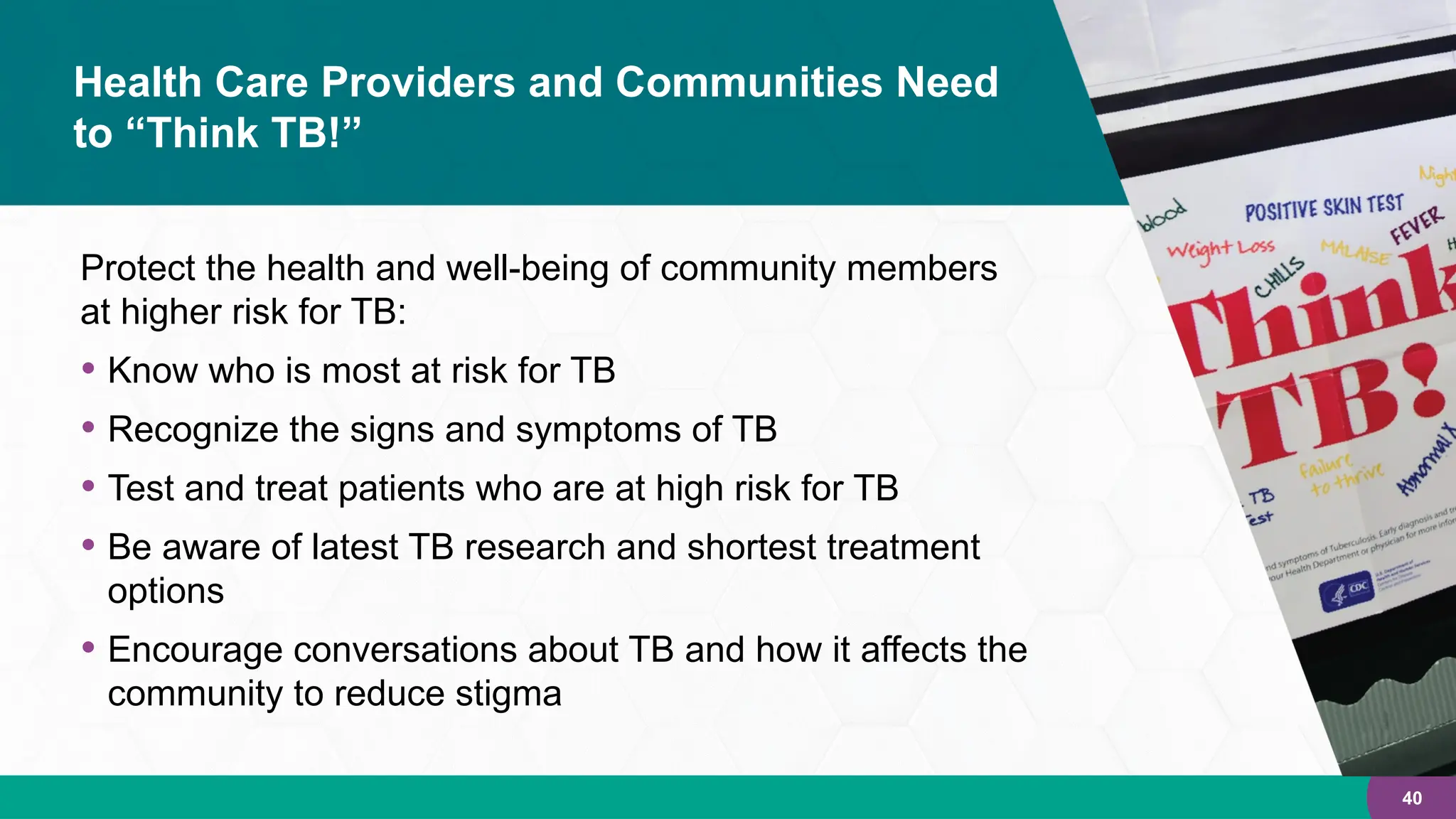
  • #40 The key to diagnosing TB is for clinicians to “think TB” when they see a patient with signs and symptoms of TB disease. Because TB is not as common as it was years ago in the United States, many clinicians do not consider the possibility of TB when evaluating patients who have symptoms of TB. When this happens, the diagnosis of TB may be delayed or even overlooked, and the patient will remain ill and possibly infectious. For more information: https://www.cdc.gov/tb/publications/posters/thinktb.htm
  • #41 TB control and prevention is a complex undertaking that requires the collaborative efforts of a broad range of individuals, organizations, and institutions in both the public and private health sectors. State and local health departments have the primary responsibility for preventing and controlling TB. This includes the essential role of planning, coordinating, and evaluating program activities. Health care workers in doctors’ offices and hospitals, community health centers, and academic institutions implement TB control efforts such as testing, treating, and reporting to health departments.
  • #42 CDC’s Think. Test. Treat TB campaign aims to reach those most at risk for latent TB infection and their health care providers to encourage TB testing and get closer to the elimination of TB. Think. Test. Treat TB is the first national multilingual communications campaign to increase testing for inactive TB, a major health disparity among Asian Americans. More information: https://www.cdc.gov/thinktesttreattb/