TUBERCULOSIS
Dr Nadia Shams Associate Professor RIHS
Mycobacterium tuberculosis
Dr Nadia Shams Associate Professor RIHS
World Incidence 2006
World map showing reported cases of tuberculosis per 100,000 citizens. Red = >300,
orange = 200-300; yellow = 100-200; green 50-100; blue = <50 and grey = n/a.
Dr Nadia Shams Associate Professor RIHS
 #1 on the list of lethal infectious diseases
 2 million deaths worldwide annually
 Every year 8 million cases reported
 Death rate after contracting the disease, if untreated,
is the same as flipping a coin
Statistics
Dr Nadia Shams Associate Professor RIHS
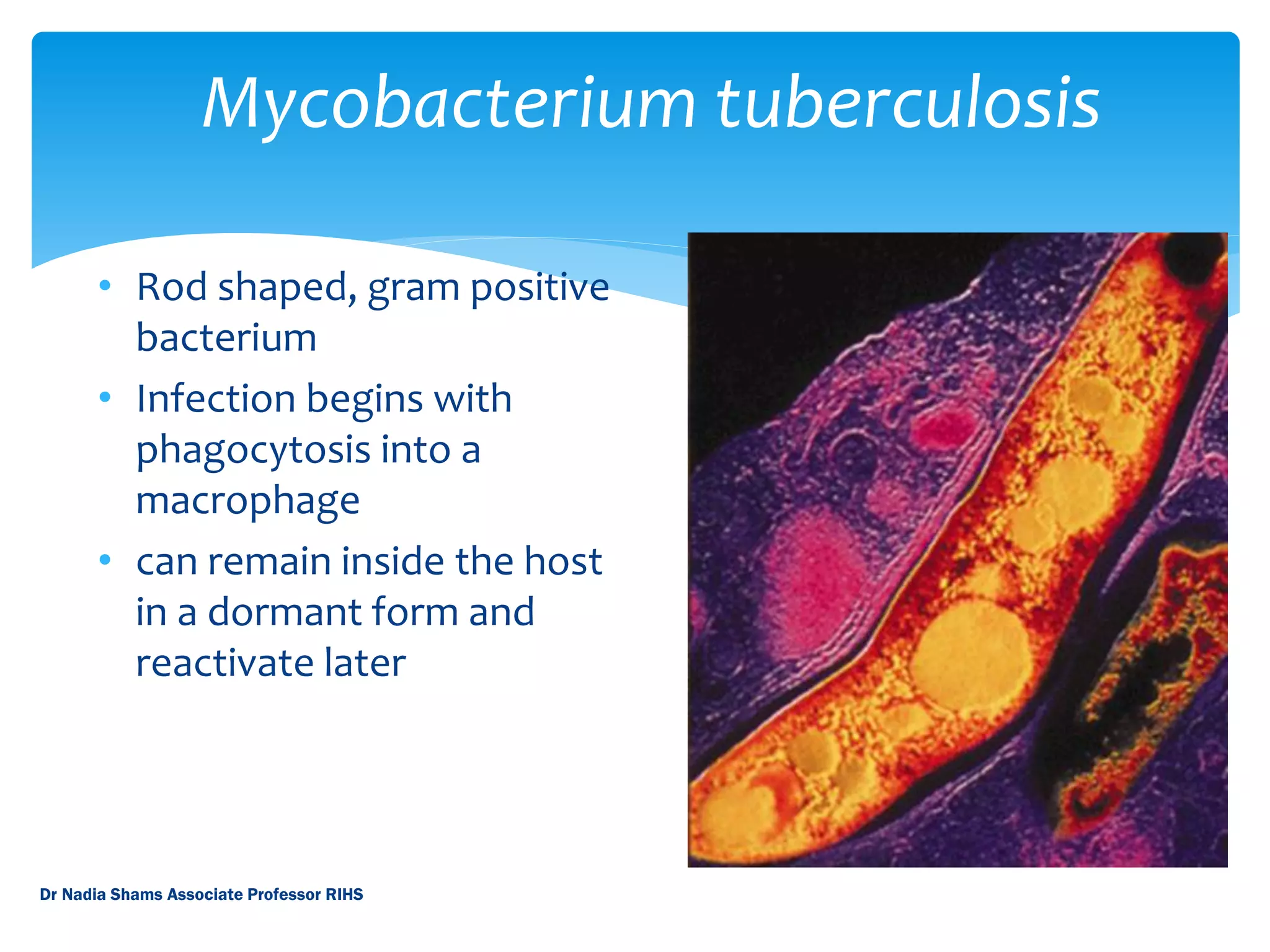
Mycobacterium tuberculosis
• Rod shaped, gram positive
bacterium
• Infection begins with
phagocytosis into a
macrophage
• can remain inside the host
in a dormant form and
reactivate later
Dr Nadia Shams Associate Professor RIHS
History
 TB has been known as
Pthisis, King’s Evil, Pott’s
disease, consumption, and
the White Plague.
 Egyptian mummies from
3500 BCE have the
presence of
Mycobacterium
tuberculosis
Dr Nadia Shams Associate Professor RIHS
The New World
 Infected the New World
before the Europeans
 10% deaths in the 19th
century were due to TB
 Isolated the infected in
sanitariums, which served
as waiting rooms for death
Dr Nadia Shams Associate Professor RIHS
Factors increasing the risk of
Tuberculosis
 Children > young < elderly
 Immigrants from high prevalence areas
 Close contacts of patients who are smear positive
 Overcrowding
 Immunosuppression
 Type 1 Diabetics
 CRF
 Malnourishment
Dr Nadia Shams Associate Professor RIHS
Time table of Tuberculosis
Time from infection manifestations
3-8 weeks Primary complex, +ve tuberculin skin test
3-6 months Meningeal milliary and pleural disease
Upto 3 yrs GIT, bone, joint, lymph node disease
Around 8 yrs Renal tract disease
From 3 yrs onwards Post primary disease due to reactivation/ reinfection
Dr Nadia Shams Associate Professor RIHS
Disease progression- Stage 1
 Stage 1
 Droplet nuclei are inhaled, and are
generated by talking, coughing and
sneezing.
 bacteria are taken up by alveolar
macrophages.
 The large droplet nuclei reaches
upper respiratory tract, and the small
droplet nuclei reaches air sacs of the
lung (alveoli) where the infection
begins.
 Disease onset - when droplet nuclei
reach the alveoli.
Dr Nadia Shams Associate Professor RIHS
 Begins after 7-21 days after initial infection.
 TB multiplies within the inactivated macrophages
until the macrophages burst.
 Other macrophages diffuse from peripheral blood,
phagocytose and are inactivated, rendering them
unable to destroy TB.
Disease Progression- Stage 2
Dr Nadia Shams Associate Professor RIHS
 Lymphocytes/T-cells recognize TB antigen. This results in T-cell
activation and the release of Cytokines, including interferon
(IFN).
 The release of IFN causes activation of macrophages, which can
release lytic enzymes and reactive intermediates that facilitates
immune pathology.
 Tubercle forms, which contains a semi-solid or “cheesy”
consistency. TB cannot multiply within tubercles due to low PH
and anoxic environment, but TB can persist within these
tubercles for extended periods.
Disease Progression- Stage 3
Dr Nadia Shams Associate Professor RIHS
 TB uses these macrophages to replicate causing the tubercle to grow.
 The growing tubercle may invade a bronchus, causing an infection which
may spread to other parts of the lungs. Tubercle may also invade artery or
other blood supply.
 MILIARY TB: Spreading of TB may cause milliary tuberculosis, which can
cause secondary lesions.
 SYSTEMIC INVOLVEMENT: Secondary lesions occur in bones, joints, lymph
nodes, genitourinary system and peritoneum.
Disease Progression- Stage 4
Dr Nadia Shams Associate Professor RIHS
 The caseous centers of the tubercles liquefy.
 This liquid is very crucial for the growth of TB, and therefore it
multiplies rapidly (extracellularly).
 This later becomes a large antigen load, causing the walls of
nearby bronchi to become necrotic and rupture.
 This results in “cavity formation” and allows TB to spread rapidly
into other airways and to other parts of the lung.
Stage 5
Dr Nadia Shams Associate Professor RIHS
Pulmonary Versus Extrapulmonary TB
PULMONARY TB
 Primary pulmonary TB
 Miliary TB
 Post Primary Pulmonary
TB
EXTRAPULMONARY TB
 Lymphadenitis
 GI Tuberculosis
 Pericardial Disease
 CNS disease
 Bone & joint disease
 Genitourinary Disease
Dr Nadia Shams Associate Professor RIHS
Symptoms of Pulmonary disease
◼ Productive cough
◼ chest pain
◼ night sweats, fatigue, fever
◼ Primary TB: Self limiting febrile illness
◼ Miliary TB: Above symptoms , heptomegaly, Headache, choroid
Tubercles, Millet seed appearance on CXR, anaemia, leukopaenia.
◼ Post Primary TB: Progressive pulmonary Symptoms,
complications, consolidation, collapse, cavitation.
Dr Nadia Shams Associate Professor RIHS
 Lyphadenitis: Cervical, mediastinal, axillary, Inginal,
supraclavicular. Collar stud abcess and fistula
formation.
 GI Tuberculosis: Ileaocaecal disease, Right iliac fossa
mass, tuberculous peritonitis, hepatic dysfunction.
 Pericardial disease: Pericardial effusion, constrictive
pericarditis.
Symptoms of Extra Pulmonary
Disease
Dr Nadia Shams Associate Professor RIHS
 CNS Disease: Tuberculous meningitis/ SOL
Tuberculomas.
 Bone and joint disease: Potts disease, Psoas Abscess.
 Genitourinary Disease: Sterile Pyuria, Infertility,
endometritis
Symptoms of Extra Pulmonary
Disease
Dr Nadia Shams Associate Professor RIHS
TB Tests
 ZN (Ziehl Neelsen) staining
 Sputum
 Gastric Washings
 BAL
 Transbronchial biopsy
 Fluid Examination (CSF, Ascitic, pleural, pericardial, Joint)
 Tuberculin Skin Test
Injection of fluid into the skin of the lower arm
48-72 hours later – checked for a reaction
Diagnosis is based on area of the raised skin
Dr Nadia Shams Associate Professor RIHS
A= Non Acid fast
B=Acid fast
Dr Nadia Shams Associate Professor RIHS
 Hb : anaemia
 CRP and ESR: Raised
 Nuclaic Acid amplification
 AFB culture (LJ, Bactec medium)
 Response to Empirical ATT
 Others: CXR, CT chest, CT/ MRI brain.
TB Tests
Dr Nadia Shams Associate Professor RIHS
 Drug resistant strains of Mycobacterium tuberculosis have
developed
 Underdeveloped countries are the most commonly affected by
TB
 95% of reported cases come from underdeveloped countries
 High HIV rates contribute to the contraction of TB
Reasons for Fear
Dr Nadia Shams Associate Professor RIHS

Tuberculosis

  • 1.
    TUBERCULOSIS Dr Nadia ShamsAssociate Professor RIHS
  • 2.
    Mycobacterium tuberculosis Dr NadiaShams Associate Professor RIHS
  • 3.
    World Incidence 2006 Worldmap showing reported cases of tuberculosis per 100,000 citizens. Red = >300, orange = 200-300; yellow = 100-200; green 50-100; blue = <50 and grey = n/a. Dr Nadia Shams Associate Professor RIHS
  • 4.
     #1 onthe list of lethal infectious diseases  2 million deaths worldwide annually  Every year 8 million cases reported  Death rate after contracting the disease, if untreated, is the same as flipping a coin Statistics Dr Nadia Shams Associate Professor RIHS
  • 5.
    Mycobacterium tuberculosis • Rodshaped, gram positive bacterium • Infection begins with phagocytosis into a macrophage • can remain inside the host in a dormant form and reactivate later Dr Nadia Shams Associate Professor RIHS
  • 6.
    History  TB hasbeen known as Pthisis, King’s Evil, Pott’s disease, consumption, and the White Plague.  Egyptian mummies from 3500 BCE have the presence of Mycobacterium tuberculosis Dr Nadia Shams Associate Professor RIHS
  • 7.
    The New World Infected the New World before the Europeans  10% deaths in the 19th century were due to TB  Isolated the infected in sanitariums, which served as waiting rooms for death Dr Nadia Shams Associate Professor RIHS
  • 8.
    Factors increasing therisk of Tuberculosis  Children > young < elderly  Immigrants from high prevalence areas  Close contacts of patients who are smear positive  Overcrowding  Immunosuppression  Type 1 Diabetics  CRF  Malnourishment Dr Nadia Shams Associate Professor RIHS
  • 9.
    Time table ofTuberculosis Time from infection manifestations 3-8 weeks Primary complex, +ve tuberculin skin test 3-6 months Meningeal milliary and pleural disease Upto 3 yrs GIT, bone, joint, lymph node disease Around 8 yrs Renal tract disease From 3 yrs onwards Post primary disease due to reactivation/ reinfection Dr Nadia Shams Associate Professor RIHS
  • 10.
    Disease progression- Stage1  Stage 1  Droplet nuclei are inhaled, and are generated by talking, coughing and sneezing.  bacteria are taken up by alveolar macrophages.  The large droplet nuclei reaches upper respiratory tract, and the small droplet nuclei reaches air sacs of the lung (alveoli) where the infection begins.  Disease onset - when droplet nuclei reach the alveoli. Dr Nadia Shams Associate Professor RIHS
  • 11.
     Begins after7-21 days after initial infection.  TB multiplies within the inactivated macrophages until the macrophages burst.  Other macrophages diffuse from peripheral blood, phagocytose and are inactivated, rendering them unable to destroy TB. Disease Progression- Stage 2 Dr Nadia Shams Associate Professor RIHS
  • 12.
     Lymphocytes/T-cells recognizeTB antigen. This results in T-cell activation and the release of Cytokines, including interferon (IFN).  The release of IFN causes activation of macrophages, which can release lytic enzymes and reactive intermediates that facilitates immune pathology.  Tubercle forms, which contains a semi-solid or “cheesy” consistency. TB cannot multiply within tubercles due to low PH and anoxic environment, but TB can persist within these tubercles for extended periods. Disease Progression- Stage 3 Dr Nadia Shams Associate Professor RIHS
  • 13.
     TB usesthese macrophages to replicate causing the tubercle to grow.  The growing tubercle may invade a bronchus, causing an infection which may spread to other parts of the lungs. Tubercle may also invade artery or other blood supply.  MILIARY TB: Spreading of TB may cause milliary tuberculosis, which can cause secondary lesions.  SYSTEMIC INVOLVEMENT: Secondary lesions occur in bones, joints, lymph nodes, genitourinary system and peritoneum. Disease Progression- Stage 4 Dr Nadia Shams Associate Professor RIHS
  • 14.
     The caseouscenters of the tubercles liquefy.  This liquid is very crucial for the growth of TB, and therefore it multiplies rapidly (extracellularly).  This later becomes a large antigen load, causing the walls of nearby bronchi to become necrotic and rupture.  This results in “cavity formation” and allows TB to spread rapidly into other airways and to other parts of the lung. Stage 5 Dr Nadia Shams Associate Professor RIHS
  • 15.
    Pulmonary Versus ExtrapulmonaryTB PULMONARY TB  Primary pulmonary TB  Miliary TB  Post Primary Pulmonary TB EXTRAPULMONARY TB  Lymphadenitis  GI Tuberculosis  Pericardial Disease  CNS disease  Bone & joint disease  Genitourinary Disease Dr Nadia Shams Associate Professor RIHS
  • 16.
    Symptoms of Pulmonarydisease ◼ Productive cough ◼ chest pain ◼ night sweats, fatigue, fever ◼ Primary TB: Self limiting febrile illness ◼ Miliary TB: Above symptoms , heptomegaly, Headache, choroid Tubercles, Millet seed appearance on CXR, anaemia, leukopaenia. ◼ Post Primary TB: Progressive pulmonary Symptoms, complications, consolidation, collapse, cavitation. Dr Nadia Shams Associate Professor RIHS
  • 17.
     Lyphadenitis: Cervical,mediastinal, axillary, Inginal, supraclavicular. Collar stud abcess and fistula formation.  GI Tuberculosis: Ileaocaecal disease, Right iliac fossa mass, tuberculous peritonitis, hepatic dysfunction.  Pericardial disease: Pericardial effusion, constrictive pericarditis. Symptoms of Extra Pulmonary Disease Dr Nadia Shams Associate Professor RIHS
  • 18.
     CNS Disease:Tuberculous meningitis/ SOL Tuberculomas.  Bone and joint disease: Potts disease, Psoas Abscess.  Genitourinary Disease: Sterile Pyuria, Infertility, endometritis Symptoms of Extra Pulmonary Disease Dr Nadia Shams Associate Professor RIHS
  • 19.
    Dr Nadia ShamsAssociate Professor RIHS
  • 20.
    TB Tests  ZN(Ziehl Neelsen) staining  Sputum  Gastric Washings  BAL  Transbronchial biopsy  Fluid Examination (CSF, Ascitic, pleural, pericardial, Joint)  Tuberculin Skin Test Injection of fluid into the skin of the lower arm 48-72 hours later – checked for a reaction Diagnosis is based on area of the raised skin Dr Nadia Shams Associate Professor RIHS
  • 21.
    A= Non Acidfast B=Acid fast Dr Nadia Shams Associate Professor RIHS
  • 22.
    Dr Nadia ShamsAssociate Professor RIHS
  • 23.
     Hb :anaemia  CRP and ESR: Raised  Nuclaic Acid amplification  AFB culture (LJ, Bactec medium)  Response to Empirical ATT  Others: CXR, CT chest, CT/ MRI brain. TB Tests Dr Nadia Shams Associate Professor RIHS
  • 24.
    Dr Nadia ShamsAssociate Professor RIHS
  • 25.
    Dr Nadia ShamsAssociate Professor RIHS
  • 26.
    Dr Nadia ShamsAssociate Professor RIHS
  • 27.
    Dr Nadia ShamsAssociate Professor RIHS
  • 28.
     Drug resistantstrains of Mycobacterium tuberculosis have developed  Underdeveloped countries are the most commonly affected by TB  95% of reported cases come from underdeveloped countries  High HIV rates contribute to the contraction of TB Reasons for Fear Dr Nadia Shams Associate Professor RIHS