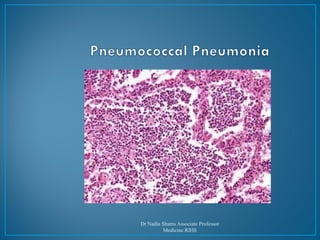
Dr Nadia Shams Associate Professor Medicine RIHS
COMMON UPPER RESPIRATORY TRACT INFECTIONS
Acute coryza ( common cold)
Acute pharyngitis
Sinusitis
Tracheo-bronchitis
Epiglottitis
Acute bronchitis
Influenza
Dr Nadia Shams Associate Professor Medicine RIHS
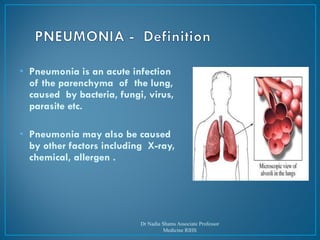
• Pneumonia is an acute infection
of the parenchyma of the lung,
caused by bacteria, fungi, virus,
parasite etc.
• Pneumonia may also be caused
by other factors including X-ray,
chemical, allergen .
Dr Nadia Shams Associate Professor
Medicine RIHS
• The morbidity and mortality of pneumonia are high especially
in children and old people.
Dr Nadia Shams Associate Professor Medicine RIHS
There are two factors involved in the formation of
pneumonia , including pathogens and host defenses.Dr Nadia Shams Associate Professor Medicine RIHS
Dr Nadia Shams Associate Professor
Medicine RIHS
• Congestion
• Red hepatization
• Grey hepatization
• Resolution
Dr Nadia Shams Associate Professor
Medicine RIHS
• By anatomy.
• Lobar Pneumonia
• Bronchopneumonia
• By pathogen
• Bacterial
• Viral
• Fungal
• Atypical
• By acquired environmental factors.
Dr Nadia Shams Associate Professor Medicine RIHS
 Aerobic Gram +ve
(strept. pneumoniae, staph. aureus, Group A hemolytic strept.)
 Aerobic Gram-ve
(Klebsiella pneumoniae, H influenzae, E coli)
 Anaerobic bacteria.
Dr Nadia Shams Associate Professor Medicine RIHS
• Adenoviruses
• Respiratory syncytial virus
• Influenza
• Cytomegalovirus
• Herpes simplex.
Dr Nadia Shams Associate Professor Medicine RIHS
• Candida
• Aspergilosis
• Pneumocystis jiroveci (PCP)
Dr Nadia Shams Associate Professor Medicine RIHS
• Legionella pneumonia
• Mycoplasmal pneumonia
• Chlamydia pneumonia.
Dr Nadia Shams Associate Professor Medicine RIHS
 Rickettsias
 Parasites
 Protozoa
Dr Nadia Shams Associate Professor Medicine RIHS
• Lobar:
Homogenous consolidation of an entire lobe
• Bronchopneumonia:
Patchy alveolar consolidation
Dr Nadia Shams Associate Professor Medicine RIHS
◆Community acquired pneumonia-------------CAP
◆Hospital acquired pneumonia----------------HAP
◆Nursing home acquired pneumonia----------NHAP
◆Immunocompromised host pneumonia--------ICAP
◆Ventilator acquired Pneumonia--------------VAP
Dr Nadia Shams Associate Professor Medicine RIHS
 “CAP refers to pneumonia acquired outside of
hospitals or extended-care facilities” .
 Most commonly identified pathogen- Strept. pneumoniae
 Other pathogens include Haemophilus influenzae,
mycoplasma pneumoniae, Chlamydophilia pneumoniae,
Moraxella catarrhalis and ects.
 Drug resistance streptococcus pneumoniae(DRSP)
Dr Nadia Shams Associate Professor Medicine RIHS
 “HAP refers to pneumonia acquired in the hospital setting”.
1. Enteric Gram-negative organisms
2. S. aureus
3. Pseudomonas aeruginosa.
➢(Gram-ve bacteria account for 55%-85% of HAP infections & gram +ve
cocci account for 20% to 30% and some other pathogens)
Dr Nadia Shams Associate Professor Medicine RIHS
 General risk factors for developing HAP:
1. age more than 70 years,
2. serious comorbidities,
3. malnutrition,
4. impaired consciousness,
5. prolonged hospitalization,
6. COPD.
Dr Nadia Shams Associate Professor Medicine RIHS
• Aspiration :
Microaspiration of contaminated oropharyngeal secretions seems to
be the most important of these factors, as it is the most common
cause of HAP.
• Inhalation
• Contamination
Dr Nadia Shams Associate Professor Medicine RIHS
• “Pneumonia in an immunocompromised host describes a lung
infection that occurs in a person whose ability to fight infection
is greatly impaired”.
Dr Nadia Shams Associate Professor Medicine RIHS
Clinical Features
Dr Nadia Shams Associate Professor Medicine RIHS
• Acute febrile illness with rigors, anorexia and
headache.
• Cough: dry / productive / rusty sputum / hemoptysis.
• Pleuritic chest pain
• Shortness of breath
• Non specific symptoms may be seen in
immunocomromised and elderly
Dr Nadia Shams Associate Professor Medicine RIHS
1. Confusion
2. Pa02 <60mmHg.
3. Respiratory rate >30/min
4. Blood pressure <90/60mmHg
5. Chest X-ray shows bilateral
infiltration, multilobar
infiltration and the
infiltrations enlarge
>50 % within 48h.
6. Renal function: U>20ml/h
Dr Nadia Shams Associate Professor Medicine RIHS
• Pulmonary tuberculosis
• Pulmonary odema
• Lung cancer
• Acute lung abcess
• Pulmonary embolism
• Noninfectious pulmonary infiltration
Dr Nadia Shams Associate Professor Medicine RIHS
INVESTIGATIONS
Dr Nadia Shams Associate Professor Medicine RIHS
Blood complete picture
Serum electrolytes, renal function tests, arterial blood gases
Pathogen identification
• Sputum
• Nasotracheal suctioning
• BAL
• Blood culture or pleural effusion culture
• Serologic testing (immunological testing)
• Molecular Techniques
Dr Nadia Shams Associate Professor Medicine RIHS
• CXR
Infiltrates appear within 12-18 hours
Effusion, abcess, empyema
• CT scan chest
Dr Nadia Shams Associate Professor Medicine RIHS
Decide about Admission ???
Dr Nadia Shams Associate Professor Medicine RIHS
CURB-65
Confusion
Urea >7 mmol/l
RR 30/min
BP< 90/60
Age>65
0-1
Home treatment
2
Consider admission
3 or more (admit)
ICU Admission if 4-5 score
Dr Nadia Shams Associate Professor Medicine RIHS
Empirical Treatment
Dr Nadia Shams Associate Professor Medicine RIHS
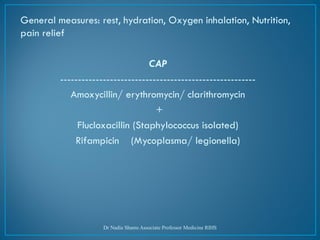
General measures: rest, hydration, Oxygen inhalation, Nutrition,
pain relief
CAP
-------------------------------------------------------
Amoxycillin/ erythromycin/ clarithromycin
+
Flucloxacillin (Staphylococcus isolated)
Rifampicin (Mycoplasma/ legionella)
Dr Nadia Shams Associate Professor Medicine RIHS
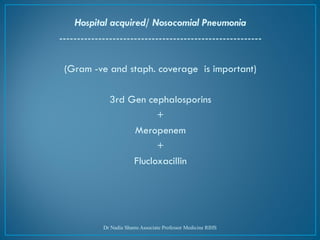
Hospital acquired/ Nosocomial Pneumonia
---------------------------------------------------------
(Gram -ve and staph. coverage is important)
3rd Gen cephalosporins
+
Meropenem
+
Flucloxacillin
Dr Nadia Shams Associate Professor Medicine RIHS
Aspiration Pneumonia
-------------------------------------------------------------
Co-Amoxicalv
+
Metronidazole
Dr Nadia Shams Associate Professor Medicine RIHS
ICAP (in immunocompromised patients)
---------------------------------------------------------
3rd gen cephalosporin/ quinolone
+
Antipseudomonal pencillin
+
Aminoglycoside
Dr Nadia Shams Associate Professor Medicine RIHS
1. Sepsis
2. lung abscess/empyema
3. pleural effusion
4. ARDS
5. ARF
6. pneumothorax
7. Extra-pulmonary infections
Dr Nadia Shams Associate Professor Medicine RIHS
Dr Nadia Shams Associate Professor
Medicine RIHS
Dr Nadia Shams Associate Professor
Medicine RIHS
Legionellae are small,
gram-negative, obligately
aerobic baclli.
.
Dr Nadia Shams Associate Professor
Medicine RIHS
• 2002- china
• Corona Virus
• Fever-muscle pains-dry cough-SOB-Rapidly worsening
CXR findings
• Supportive treatment and ventilation.
Dr Nadia Shams Associate Professor Medicine RIHS
Polyvalent pneumococcal
vaccine
1. COPD
2. CLD
3. Splenectomy
4. Diabetes mellitus
5. Elderly patients
Dr Nadia Shams Associate Professor
Medicine RIHS

Pneumonia

  • 1.
    Dr Nadia ShamsAssociate Professor Medicine RIHS
  • 2.
    COMMON UPPER RESPIRATORYTRACT INFECTIONS Acute coryza ( common cold) Acute pharyngitis Sinusitis Tracheo-bronchitis Epiglottitis Acute bronchitis Influenza Dr Nadia Shams Associate Professor Medicine RIHS
  • 3.
    • Pneumonia isan acute infection of the parenchyma of the lung, caused by bacteria, fungi, virus, parasite etc. • Pneumonia may also be caused by other factors including X-ray, chemical, allergen . Dr Nadia Shams Associate Professor Medicine RIHS
  • 4.
    • The morbidityand mortality of pneumonia are high especially in children and old people. Dr Nadia Shams Associate Professor Medicine RIHS
  • 5.
    There are twofactors involved in the formation of pneumonia , including pathogens and host defenses.Dr Nadia Shams Associate Professor Medicine RIHS
  • 6.
    Dr Nadia ShamsAssociate Professor Medicine RIHS
  • 7.
    • Congestion • Redhepatization • Grey hepatization • Resolution Dr Nadia Shams Associate Professor Medicine RIHS
  • 8.
    • By anatomy. •Lobar Pneumonia • Bronchopneumonia • By pathogen • Bacterial • Viral • Fungal • Atypical • By acquired environmental factors. Dr Nadia Shams Associate Professor Medicine RIHS
  • 9.
     Aerobic Gram+ve (strept. pneumoniae, staph. aureus, Group A hemolytic strept.)  Aerobic Gram-ve (Klebsiella pneumoniae, H influenzae, E coli)  Anaerobic bacteria. Dr Nadia Shams Associate Professor Medicine RIHS
  • 10.
    • Adenoviruses • Respiratorysyncytial virus • Influenza • Cytomegalovirus • Herpes simplex. Dr Nadia Shams Associate Professor Medicine RIHS
  • 11.
    • Candida • Aspergilosis •Pneumocystis jiroveci (PCP) Dr Nadia Shams Associate Professor Medicine RIHS
  • 12.
    • Legionella pneumonia •Mycoplasmal pneumonia • Chlamydia pneumonia. Dr Nadia Shams Associate Professor Medicine RIHS
  • 13.
     Rickettsias  Parasites Protozoa Dr Nadia Shams Associate Professor Medicine RIHS
  • 14.
    • Lobar: Homogenous consolidationof an entire lobe • Bronchopneumonia: Patchy alveolar consolidation Dr Nadia Shams Associate Professor Medicine RIHS
  • 15.
    Dr Nadia ShamsAssociate Professor Medicine RIHS
  • 16.
    Dr Nadia ShamsAssociate Professor Medicine RIHS
  • 17.
    ◆Community acquired pneumonia-------------CAP ◆Hospitalacquired pneumonia----------------HAP ◆Nursing home acquired pneumonia----------NHAP ◆Immunocompromised host pneumonia--------ICAP ◆Ventilator acquired Pneumonia--------------VAP Dr Nadia Shams Associate Professor Medicine RIHS
  • 18.
     “CAP refersto pneumonia acquired outside of hospitals or extended-care facilities” .  Most commonly identified pathogen- Strept. pneumoniae  Other pathogens include Haemophilus influenzae, mycoplasma pneumoniae, Chlamydophilia pneumoniae, Moraxella catarrhalis and ects.  Drug resistance streptococcus pneumoniae(DRSP) Dr Nadia Shams Associate Professor Medicine RIHS
  • 19.
     “HAP refersto pneumonia acquired in the hospital setting”. 1. Enteric Gram-negative organisms 2. S. aureus 3. Pseudomonas aeruginosa. ➢(Gram-ve bacteria account for 55%-85% of HAP infections & gram +ve cocci account for 20% to 30% and some other pathogens) Dr Nadia Shams Associate Professor Medicine RIHS
  • 20.
     General riskfactors for developing HAP: 1. age more than 70 years, 2. serious comorbidities, 3. malnutrition, 4. impaired consciousness, 5. prolonged hospitalization, 6. COPD. Dr Nadia Shams Associate Professor Medicine RIHS
  • 21.
    • Aspiration : Microaspirationof contaminated oropharyngeal secretions seems to be the most important of these factors, as it is the most common cause of HAP. • Inhalation • Contamination Dr Nadia Shams Associate Professor Medicine RIHS
  • 22.
    • “Pneumonia inan immunocompromised host describes a lung infection that occurs in a person whose ability to fight infection is greatly impaired”. Dr Nadia Shams Associate Professor Medicine RIHS
  • 23.
    Clinical Features Dr NadiaShams Associate Professor Medicine RIHS
  • 24.
    • Acute febrileillness with rigors, anorexia and headache. • Cough: dry / productive / rusty sputum / hemoptysis. • Pleuritic chest pain • Shortness of breath • Non specific symptoms may be seen in immunocomromised and elderly Dr Nadia Shams Associate Professor Medicine RIHS
  • 25.
    1. Confusion 2. Pa02<60mmHg. 3. Respiratory rate >30/min 4. Blood pressure <90/60mmHg 5. Chest X-ray shows bilateral infiltration, multilobar infiltration and the infiltrations enlarge >50 % within 48h. 6. Renal function: U>20ml/h Dr Nadia Shams Associate Professor Medicine RIHS
  • 26.
    • Pulmonary tuberculosis •Pulmonary odema • Lung cancer • Acute lung abcess • Pulmonary embolism • Noninfectious pulmonary infiltration Dr Nadia Shams Associate Professor Medicine RIHS
  • 27.
    INVESTIGATIONS Dr Nadia ShamsAssociate Professor Medicine RIHS
  • 28.
    Blood complete picture Serumelectrolytes, renal function tests, arterial blood gases Pathogen identification • Sputum • Nasotracheal suctioning • BAL • Blood culture or pleural effusion culture • Serologic testing (immunological testing) • Molecular Techniques Dr Nadia Shams Associate Professor Medicine RIHS
  • 29.
    • CXR Infiltrates appearwithin 12-18 hours Effusion, abcess, empyema • CT scan chest Dr Nadia Shams Associate Professor Medicine RIHS
  • 30.
    Dr Nadia ShamsAssociate Professor Medicine RIHS
  • 31.
    Decide about Admission??? Dr Nadia Shams Associate Professor Medicine RIHS
  • 32.
    CURB-65 Confusion Urea >7 mmol/l RR30/min BP< 90/60 Age>65 0-1 Home treatment 2 Consider admission 3 or more (admit) ICU Admission if 4-5 score Dr Nadia Shams Associate Professor Medicine RIHS
  • 33.
    Empirical Treatment Dr NadiaShams Associate Professor Medicine RIHS
  • 34.
    General measures: rest,hydration, Oxygen inhalation, Nutrition, pain relief CAP ------------------------------------------------------- Amoxycillin/ erythromycin/ clarithromycin + Flucloxacillin (Staphylococcus isolated) Rifampicin (Mycoplasma/ legionella) Dr Nadia Shams Associate Professor Medicine RIHS
  • 35.
    Hospital acquired/ NosocomialPneumonia --------------------------------------------------------- (Gram -ve and staph. coverage is important) 3rd Gen cephalosporins + Meropenem + Flucloxacillin Dr Nadia Shams Associate Professor Medicine RIHS
  • 36.
  • 37.
    ICAP (in immunocompromisedpatients) --------------------------------------------------------- 3rd gen cephalosporin/ quinolone + Antipseudomonal pencillin + Aminoglycoside Dr Nadia Shams Associate Professor Medicine RIHS
  • 38.
    1. Sepsis 2. lungabscess/empyema 3. pleural effusion 4. ARDS 5. ARF 6. pneumothorax 7. Extra-pulmonary infections Dr Nadia Shams Associate Professor Medicine RIHS
  • 39.
    Dr Nadia ShamsAssociate Professor Medicine RIHS
  • 40.
    Dr Nadia ShamsAssociate Professor Medicine RIHS
  • 41.
    Legionellae are small, gram-negative,obligately aerobic baclli. . Dr Nadia Shams Associate Professor Medicine RIHS
  • 42.
    • 2002- china •Corona Virus • Fever-muscle pains-dry cough-SOB-Rapidly worsening CXR findings • Supportive treatment and ventilation. Dr Nadia Shams Associate Professor Medicine RIHS
  • 43.
    Polyvalent pneumococcal vaccine 1. COPD 2.CLD 3. Splenectomy 4. Diabetes mellitus 5. Elderly patients Dr Nadia Shams Associate Professor Medicine RIHS