Dr Nadia Shams
Assistant Prof. Medicine
RIHS- Islamabad
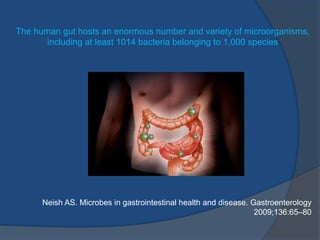
The human gut hosts an enormous number and variety of microorganisms,
including at least 1014 bacteria belonging to 1,000 species
Neish AS. Microbes in gastrointestinal health and disease. Gastroenterology
2009;136:65–80
Gut flora and Diabetes
 Recent studies show that intestinal micro-flora has
bigger influence over development of diabetes type II.
 The factors of environment, that increase energy
production, regulate more over the peripheral
metabolism and body-mass increase, as a result of
that.
 Variations in intestinal micro-flora could have their
positive, so and negative side in development and
progression of diabetes type II.
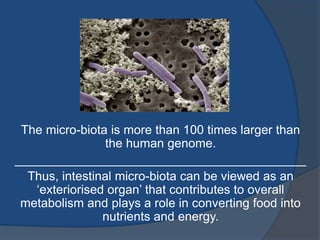
The micro-biota is more than 100 times larger than
the human genome.
__________________________________________
Thus, intestinal micro-biota can be viewed as an
‘exteriorised organ’ that contributes to overall
metabolism and plays a role in converting food into
nutrients and energy.
Most common bacteria that fulfill
the Micro-biota
Includes three bacterial divisions dominate the
adult human gut micro-biota
_____________________________________
1. Firmicutes
2. Bacteroidetes(gram –ve)
3. Actinobacteria(gram +ve)
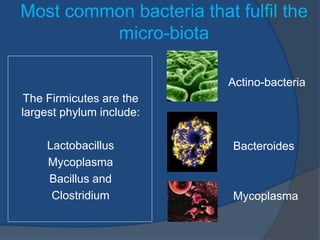
Most common bacteria that fulfil the
micro-biota
The Firmicutes are the
largest phylum include:
Lactobacillus
Mycoplasma
Bacillus and
Clostridium
Actino-bacteria
Bacteroides
Mycoplasma
The micro-biota of monozygotic twins living
separately is notably more similar than the micro-
biota of unrelated individuals.
The environment seems to be less important
__________________________________________
 Fetuses are sterile in uteri
 In the first year of life the infant intestinal tract
progresses from sterility to extremely dense
colonisation with a mixture of microbes broadly
similar to that found in the adult intestine.
 At the age of 4 years, the gut micro-
biota in host individuals has fully
matured.
 gut micro-biota of an adult could be
constant until 7th decade, fluctuates
because of use of antibiotics
Evidence for the role of gut microbiota in the regulation of
energy homeostasis and fat storage & Insulin resistance
Germ-free mice (i.e., raised in the absence of microorganisms)
had 40% less total body fat than conventionally raised mice,
even if their caloric intake was 29% higher than that of
conventionally raised animals.
In 2 weeks, conventionalization (i.e., colonization of their gut
with a cecum-derived, distal microbial community) of germ-free
mice produced a 57% increase in total body fat, a 2.3-fold
increase in hepatic triglycerides, and a dramatic increase in IR
without affecting chow consumption or energy expenditure
Backhed F, Ding H, Wang T, Hooper LV,Koh GY, Nagy A, Semenkovich CF, Gordon JI. The gut
micro-biota as an environmental factor that regulates fat storage. Proc Natl Acad Sci U S A
2004;101:15718–15723
Evidence for the role of gut microbiota in
the regulation of energy homeostasis
and fat storage & Insulin resistance
 Studies have revealed that micro-biota direct the host to increase
hepatic triacylglycerol and glucose production.
 microbial colonisation of the gut might suppress expression of the
fasting-induced-adipose-factor(FIAF),leading to decrease activity
of lipoprotein lipase(LPL) inhibitor and hence to increased activity
of LPL.
 Increased LPL activity promotes increased uptake of fatty acids
and triacylglycerol accumulation in adipocytes.
Backhed F, Ding H, Wang T, Hooper LV,Koh GY, Nagy A, Semenkovich CF, Gordon JI. The gut
micro-biota as an environmental factor that regulates fat storage. Proc Natl Acad Sci U S A
2004;101:15718–15723
Regulation of fat storage
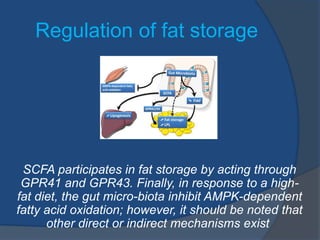
SCFA participates in fat storage by acting through
GPR41 and GPR43. Finally, in response to a high-
fat diet, the gut micro-biota inhibit AMPK-dependent
fatty acid oxidation; however, it should be noted that
other direct or indirect mechanisms exist
Inflammatory origin of diabetes
and obesity
 Obesity and diabetes are both characterised by low-grade
inflammation of unclear origin.
 Lipopolysaccaride (LPS) is a gut microbiota-related factor
that triggers secretion of proinflammatory cytokines.
 LPS is continuously produced in the gut through lysis of
gram-negative bacteria. Continuous subcutaneous low-rate
infusion of LPS led to excessive weight gain and insulin
resistance in mice
Evidence for the role of gut micro-biota in
the regulation of energy homeostasis
and fat storage & Insulin resistance
 Moreover, LPS receptor in CD-14-knockout mice tend
to be resistant to this chronic inflammatory state.
 It has been showed that high-fat diet decreases the
number of bifido-bacteria and increases plasma LPS.
 Also it has been demonstrated that modulation of gut
micro-biota, e.g. by antibiotic treatment or dietary
intervention with oligo-fructoses, reduced glucose
intolerance, decreased body weight gain and inhibited
inflammation in mice.
Mechanisms linking gut micro-biota
to Obesity, IR, and type 2 diabetes
 chronic low grade endo-toxinemia
 regulation of biologically active fatty acid
composition
 modulation of gut-derived peptide secretion.
Chronic inflammation induced by
low grade endo-toxinemia
 Metabolic pathways are functionally integrated with immune
responses
 Recent work has shown that gut bacteria can initiate the
inflammatory state of obesity and IR through the activity of
lipopolysaccharide (LPS), a component of the gram-negative
bacterial cell walls, which can trigger the inflammatory
process by binding to the CD14 toll-like receptor-4 (TLR-4)
complex at the surfaceof innate immune cells.
Shi H, Kokoeva MV, Inouye K, Tzameli I, Yin H, Flier JS. TLR4 links innate
immunity and fatty acid–induced insulin resistance. J Clin Invest 2006;116:3015–
3025
Chronic inflammation induced
by low grade endo-toxinemia
 The relevance of the TLR-4 pathways for
metabolic disease was confirmed by the
finding that the deletion of TLR-4 prevented
the high-fat diet–induced insulin resistance
Shi H, Kokoeva MV, Inouye K, Tzameli I, Yin H, Flier JS. TLR4
links innate immunity and fatty acid–induced insulin resistance.
J Clin Invest 2006;116:3015–3025
Different nutrients have different
pro-endotoxinemic potentials
 High-fat feeding reduced the expression of
epithelial tight junction proteins occludin and
ZO-1, leading to increased intestinal
permeability and LPS levels
 Intestinal fat absorption and secretion may
have a predominant role in LPS entry into the
portal blood
Cani PD, et al. Changes in gut microbiota control inflammation in obese mice
through a mechanism involving GLP-2-driven improvement of gut permeability. Gut
2009;58:1091–1103
Different nutrients have
different pro-endotoxinemic
potentials
 Data suggest different nutrients have different
abilities to induce an endo-toxinemic and
inflammatory response with fat and possibly
fructose having the greatest potential
 Plasma endotoxin increase may derive from
enhanced LPS production by micro-biota or
from increased intestinal LPS absorption.
Different nutrients have
different pro-endotoxinemic
potentials
 inhibition of chilomicron secretion may
effectively reduce metabolic endo-toxinemia
 Ultimately benefits obesity associated
metabolic disorders, even in the absence of
overt hyperlipidemia.
Other modulators of gut micro-biota composition
 Factors other than dietary habits can modulate gut
micro-flora
 1st years of life have a crucial impact on the
individual’s gut micro-biota composition.
 In a prospective study children becoming overweight
by 7 years of age had lower levels of Bifido-bacteria
and higher levels of Staphylococcus aureus during
the 1st year of life
Kallioma¨ki M, et al. Early differences in fecal microbiota composition in
children may predict overweight. Am J Clin Nutr 2008; 87:534–538
 The fetus is sterile in uterus and is colonized by
microbes during its passage through the birth canal
 Immediately after birth, the baby is exposed to several
environmental sources of bacteria (e.g., skin, mouth,
mother’s milk)
 Gut micro-biota has fully matured by the first 1–2 years
of life, coinciding with the weaning from the high-fat
milk diet to the solid high-carbohydrate diet
 thereafter remains substantially constant throughout
the individual’s life and fluctuates around a core of
stable colonizers.
 During a natural birth, infants are rapidly colonized
by microbes from the mother’s birth canal and feces,
while babies delivered by cesarean section are
colonized by environmental
 microbes from their mother, the air, and transferred
by the nursing staff
 infants delivered by cesarean section have fewer
intestinal Bifidobacteria and Bacteroides spp. (two
species shown to be protective against obesity) and
are more often colonized by C. difficile in
comparison with vaginally delivered infants.
 Formula-fed infants are more often colonized with
Enterobacteriaceae spp., C. difficile, Bacteroides
spp., and treptococcus spp.
 compared with breast-fed infants who are
predominantly colonized by Staphylococcus spp.,
Streptococcus spp.,Lacobacilllus spp., and
Bifidobacterium spp.
 findings highlight the importance of nondietary factors
in determining the composition of gut microflora.
Regulation of adipose tissue and liver fatty acid
composition by gut microbes
 Gut microbiota can also affect host metabolism and
inflammatory state by modulating the tissue fatty acid
composition
 Mammalian intestinal Lactobacilli and Bifidobacteria
can synthesize from free linoleic acid bioactive
isomers of conjugated linoleic acid
 which have antidiabetic, anti-atherosclerotic,
immunomodulatory and anti-obesity properties
Terpstra AH. Effect of conjugated linoleic acid on body composition and plasma
lipids in humans: an overview of the literature.Am J Clin Nutr 2004;79:352–361
Gut micro-biota modulates gut-derived
peptide secretion PYY.
 GLP-1 secretion. Gut microbiota fermentation of
prebiotics promoted L-cell differentiation in the
proximal colon of rats and increased glucagon-like
peptide (GLP)-1 response to a meal in healthy
humans
 GLP-2 secretion. Recent experimental data
suggest gut microbiota may modulate gut barrier
integrity and endotoxinemia through GLP-2
Gut micro-biota manipulation:
human trials
 The effects of manipulating enteric flora by
probiotics
 (live bacteria given in oral quantities that allow for
colonization of the colon)
 or prebiotics
 (nondigestible oligosaccharides like insulin and
oligofructose that are fermented by colonic microbiota and
enhance the growth of beneficial commensal organisms like
Bifidobacterium and Lactobacillus spp.)
 Two RCTs assessed the effect of maternal probiotic-
supplemented dietary counseling on pregnancy
outcome, glucose regulation, and perinatal growth
 probiotic supplementation was safe with blood
glucose concentrations and homeostasis model
assessment index during pregnancy and over the 12-
month postpartum period
Laitinen K, et al. Nutrition, Allergy, Mucosal Immunology and Intestinal Microbiota Group. Probiotics and dietary
counselling contribute to glucose regulation during and after pregnancy: a randomised controlled trial. Br J Nutr
2009;101:1679–1687
Luoto R, et al. E. Impact of maternal probiotic-supplementeddietary counselling on pregnancy outcome and
prenatal and postnatal growth: a double-blind, placebo-controlled study. Br J Nutr 2010;103:1792–1799
 In the probiotics group, there was a reduced
incidence of gestational diabetes mellitus.
 No significant differences in prenatal or
postnatal growth rates among the study groups
were detected, but dietary intervention
diminished the risk of larger birth size in
affected cases.
Laitinen K, et al. Nutrition, Allergy, Mucosal Immunology and Intestinal Microbiota Group. Probiotics and
dietary counselling contribute to glucose regulation during and after pregnancy: a randomised controlled
trial. Br J Nutr 2009;101:1679–1687
Luoto R, et al. E. Impact of maternal probiotic-supplementeddietary counselling on pregnancy outcome
and prenatal and postnatal growth: a double-blind, placebo-controlled study. Br J Nutr 2010;103:1792–
1799
Thank You

Gut flora in diabetes

  • 1.
    Dr Nadia Shams AssistantProf. Medicine RIHS- Islamabad
  • 2.
    The human guthosts an enormous number and variety of microorganisms, including at least 1014 bacteria belonging to 1,000 species Neish AS. Microbes in gastrointestinal health and disease. Gastroenterology 2009;136:65–80
  • 3.
    Gut flora andDiabetes  Recent studies show that intestinal micro-flora has bigger influence over development of diabetes type II.  The factors of environment, that increase energy production, regulate more over the peripheral metabolism and body-mass increase, as a result of that.  Variations in intestinal micro-flora could have their positive, so and negative side in development and progression of diabetes type II.
  • 4.
    The micro-biota ismore than 100 times larger than the human genome. __________________________________________ Thus, intestinal micro-biota can be viewed as an ‘exteriorised organ’ that contributes to overall metabolism and plays a role in converting food into nutrients and energy.
  • 5.
    Most common bacteriathat fulfill the Micro-biota Includes three bacterial divisions dominate the adult human gut micro-biota _____________________________________ 1. Firmicutes 2. Bacteroidetes(gram –ve) 3. Actinobacteria(gram +ve)
  • 6.
    Most common bacteriathat fulfil the micro-biota The Firmicutes are the largest phylum include: Lactobacillus Mycoplasma Bacillus and Clostridium Actino-bacteria Bacteroides Mycoplasma
  • 7.
    The micro-biota ofmonozygotic twins living separately is notably more similar than the micro- biota of unrelated individuals. The environment seems to be less important __________________________________________  Fetuses are sterile in uteri  In the first year of life the infant intestinal tract progresses from sterility to extremely dense colonisation with a mixture of microbes broadly similar to that found in the adult intestine.
  • 8.
     At theage of 4 years, the gut micro- biota in host individuals has fully matured.  gut micro-biota of an adult could be constant until 7th decade, fluctuates because of use of antibiotics
  • 9.
    Evidence for therole of gut microbiota in the regulation of energy homeostasis and fat storage & Insulin resistance Germ-free mice (i.e., raised in the absence of microorganisms) had 40% less total body fat than conventionally raised mice, even if their caloric intake was 29% higher than that of conventionally raised animals. In 2 weeks, conventionalization (i.e., colonization of their gut with a cecum-derived, distal microbial community) of germ-free mice produced a 57% increase in total body fat, a 2.3-fold increase in hepatic triglycerides, and a dramatic increase in IR without affecting chow consumption or energy expenditure Backhed F, Ding H, Wang T, Hooper LV,Koh GY, Nagy A, Semenkovich CF, Gordon JI. The gut micro-biota as an environmental factor that regulates fat storage. Proc Natl Acad Sci U S A 2004;101:15718–15723
  • 10.
    Evidence for therole of gut microbiota in the regulation of energy homeostasis and fat storage & Insulin resistance  Studies have revealed that micro-biota direct the host to increase hepatic triacylglycerol and glucose production.  microbial colonisation of the gut might suppress expression of the fasting-induced-adipose-factor(FIAF),leading to decrease activity of lipoprotein lipase(LPL) inhibitor and hence to increased activity of LPL.  Increased LPL activity promotes increased uptake of fatty acids and triacylglycerol accumulation in adipocytes. Backhed F, Ding H, Wang T, Hooper LV,Koh GY, Nagy A, Semenkovich CF, Gordon JI. The gut micro-biota as an environmental factor that regulates fat storage. Proc Natl Acad Sci U S A 2004;101:15718–15723
  • 11.
    Regulation of fatstorage SCFA participates in fat storage by acting through GPR41 and GPR43. Finally, in response to a high- fat diet, the gut micro-biota inhibit AMPK-dependent fatty acid oxidation; however, it should be noted that other direct or indirect mechanisms exist
  • 12.
    Inflammatory origin ofdiabetes and obesity  Obesity and diabetes are both characterised by low-grade inflammation of unclear origin.  Lipopolysaccaride (LPS) is a gut microbiota-related factor that triggers secretion of proinflammatory cytokines.  LPS is continuously produced in the gut through lysis of gram-negative bacteria. Continuous subcutaneous low-rate infusion of LPS led to excessive weight gain and insulin resistance in mice
  • 13.
    Evidence for therole of gut micro-biota in the regulation of energy homeostasis and fat storage & Insulin resistance  Moreover, LPS receptor in CD-14-knockout mice tend to be resistant to this chronic inflammatory state.  It has been showed that high-fat diet decreases the number of bifido-bacteria and increases plasma LPS.  Also it has been demonstrated that modulation of gut micro-biota, e.g. by antibiotic treatment or dietary intervention with oligo-fructoses, reduced glucose intolerance, decreased body weight gain and inhibited inflammation in mice.
  • 14.
    Mechanisms linking gutmicro-biota to Obesity, IR, and type 2 diabetes  chronic low grade endo-toxinemia  regulation of biologically active fatty acid composition  modulation of gut-derived peptide secretion.
  • 15.
    Chronic inflammation inducedby low grade endo-toxinemia  Metabolic pathways are functionally integrated with immune responses  Recent work has shown that gut bacteria can initiate the inflammatory state of obesity and IR through the activity of lipopolysaccharide (LPS), a component of the gram-negative bacterial cell walls, which can trigger the inflammatory process by binding to the CD14 toll-like receptor-4 (TLR-4) complex at the surfaceof innate immune cells. Shi H, Kokoeva MV, Inouye K, Tzameli I, Yin H, Flier JS. TLR4 links innate immunity and fatty acid–induced insulin resistance. J Clin Invest 2006;116:3015– 3025
  • 16.
    Chronic inflammation induced bylow grade endo-toxinemia  The relevance of the TLR-4 pathways for metabolic disease was confirmed by the finding that the deletion of TLR-4 prevented the high-fat diet–induced insulin resistance Shi H, Kokoeva MV, Inouye K, Tzameli I, Yin H, Flier JS. TLR4 links innate immunity and fatty acid–induced insulin resistance. J Clin Invest 2006;116:3015–3025
  • 17.
    Different nutrients havedifferent pro-endotoxinemic potentials  High-fat feeding reduced the expression of epithelial tight junction proteins occludin and ZO-1, leading to increased intestinal permeability and LPS levels  Intestinal fat absorption and secretion may have a predominant role in LPS entry into the portal blood Cani PD, et al. Changes in gut microbiota control inflammation in obese mice through a mechanism involving GLP-2-driven improvement of gut permeability. Gut 2009;58:1091–1103
  • 18.
    Different nutrients have differentpro-endotoxinemic potentials  Data suggest different nutrients have different abilities to induce an endo-toxinemic and inflammatory response with fat and possibly fructose having the greatest potential  Plasma endotoxin increase may derive from enhanced LPS production by micro-biota or from increased intestinal LPS absorption.
  • 19.
    Different nutrients have differentpro-endotoxinemic potentials  inhibition of chilomicron secretion may effectively reduce metabolic endo-toxinemia  Ultimately benefits obesity associated metabolic disorders, even in the absence of overt hyperlipidemia.
  • 20.
    Other modulators ofgut micro-biota composition  Factors other than dietary habits can modulate gut micro-flora  1st years of life have a crucial impact on the individual’s gut micro-biota composition.  In a prospective study children becoming overweight by 7 years of age had lower levels of Bifido-bacteria and higher levels of Staphylococcus aureus during the 1st year of life Kallioma¨ki M, et al. Early differences in fecal microbiota composition in children may predict overweight. Am J Clin Nutr 2008; 87:534–538
  • 21.
     The fetusis sterile in uterus and is colonized by microbes during its passage through the birth canal  Immediately after birth, the baby is exposed to several environmental sources of bacteria (e.g., skin, mouth, mother’s milk)  Gut micro-biota has fully matured by the first 1–2 years of life, coinciding with the weaning from the high-fat milk diet to the solid high-carbohydrate diet  thereafter remains substantially constant throughout the individual’s life and fluctuates around a core of stable colonizers.
  • 22.
     During anatural birth, infants are rapidly colonized by microbes from the mother’s birth canal and feces, while babies delivered by cesarean section are colonized by environmental  microbes from their mother, the air, and transferred by the nursing staff  infants delivered by cesarean section have fewer intestinal Bifidobacteria and Bacteroides spp. (two species shown to be protective against obesity) and are more often colonized by C. difficile in comparison with vaginally delivered infants.
  • 23.
     Formula-fed infantsare more often colonized with Enterobacteriaceae spp., C. difficile, Bacteroides spp., and treptococcus spp.  compared with breast-fed infants who are predominantly colonized by Staphylococcus spp., Streptococcus spp.,Lacobacilllus spp., and Bifidobacterium spp.  findings highlight the importance of nondietary factors in determining the composition of gut microflora.
  • 24.
    Regulation of adiposetissue and liver fatty acid composition by gut microbes  Gut microbiota can also affect host metabolism and inflammatory state by modulating the tissue fatty acid composition  Mammalian intestinal Lactobacilli and Bifidobacteria can synthesize from free linoleic acid bioactive isomers of conjugated linoleic acid  which have antidiabetic, anti-atherosclerotic, immunomodulatory and anti-obesity properties Terpstra AH. Effect of conjugated linoleic acid on body composition and plasma lipids in humans: an overview of the literature.Am J Clin Nutr 2004;79:352–361
  • 25.
    Gut micro-biota modulatesgut-derived peptide secretion PYY.  GLP-1 secretion. Gut microbiota fermentation of prebiotics promoted L-cell differentiation in the proximal colon of rats and increased glucagon-like peptide (GLP)-1 response to a meal in healthy humans  GLP-2 secretion. Recent experimental data suggest gut microbiota may modulate gut barrier integrity and endotoxinemia through GLP-2
  • 26.
    Gut micro-biota manipulation: humantrials  The effects of manipulating enteric flora by probiotics  (live bacteria given in oral quantities that allow for colonization of the colon)  or prebiotics  (nondigestible oligosaccharides like insulin and oligofructose that are fermented by colonic microbiota and enhance the growth of beneficial commensal organisms like Bifidobacterium and Lactobacillus spp.)
  • 27.
     Two RCTsassessed the effect of maternal probiotic- supplemented dietary counseling on pregnancy outcome, glucose regulation, and perinatal growth  probiotic supplementation was safe with blood glucose concentrations and homeostasis model assessment index during pregnancy and over the 12- month postpartum period Laitinen K, et al. Nutrition, Allergy, Mucosal Immunology and Intestinal Microbiota Group. Probiotics and dietary counselling contribute to glucose regulation during and after pregnancy: a randomised controlled trial. Br J Nutr 2009;101:1679–1687 Luoto R, et al. E. Impact of maternal probiotic-supplementeddietary counselling on pregnancy outcome and prenatal and postnatal growth: a double-blind, placebo-controlled study. Br J Nutr 2010;103:1792–1799
  • 28.
     In theprobiotics group, there was a reduced incidence of gestational diabetes mellitus.  No significant differences in prenatal or postnatal growth rates among the study groups were detected, but dietary intervention diminished the risk of larger birth size in affected cases. Laitinen K, et al. Nutrition, Allergy, Mucosal Immunology and Intestinal Microbiota Group. Probiotics and dietary counselling contribute to glucose regulation during and after pregnancy: a randomised controlled trial. Br J Nutr 2009;101:1679–1687 Luoto R, et al. E. Impact of maternal probiotic-supplementeddietary counselling on pregnancy outcome and prenatal and postnatal growth: a double-blind, placebo-controlled study. Br J Nutr 2010;103:1792– 1799
  • 29.