1
Trust
Trust = to be assured
= to be assured of the existence of Natural Acceptance in every
human being
Which means:
=to have the clarity that the other does not want to harm me
=to have the clarity that the other wants to make me
happy
Feelings in relationship:
1- Trust FOUNDATION VALUE
2- Respect
3- Affection
4- Care
5- Guidance
6- Reverence
7- Glory/Honour
8- Gratitude
9- Love COMPLETE VALUE
2
Problems in relationship
Doubt on intention is a major reason for problems in relationships
3
The other broke the glass
He is always late
If the other makes a mistake even
once…
– I doubt his intention, I don’t ask
“why”, “how”… I jump to the
conclusion “he makes mistakes
intentionally”
– I condemn the other, reinforce
“The other is bad”
– I get irritated, angry… have a
feeling of opposition…
The glass broke by accident
I am late
Even if I make the same mistake
100 times…
– I never doubt my intention
– I reinforce “I am good”
– I make mistakes by accident and
not intentionally
About the Other About Myself
Doubt on intention is a major reason for problems in relationships
4
The glass was broken by accident
He is late
Even if the other makes the same
mistake 100 times…
– The other is like me, I am clear
about his intention
– I know the mistake is due to lack
of competence, not lack of
intention
The glass was broken by accident
I am late
When I make a mistake even
once…
– I am clear about my intention
– I know the mistake is due to lack
of competence, not lack of
intention
About the Other About Myself
Trust on intention is the starting point for mutual development
5
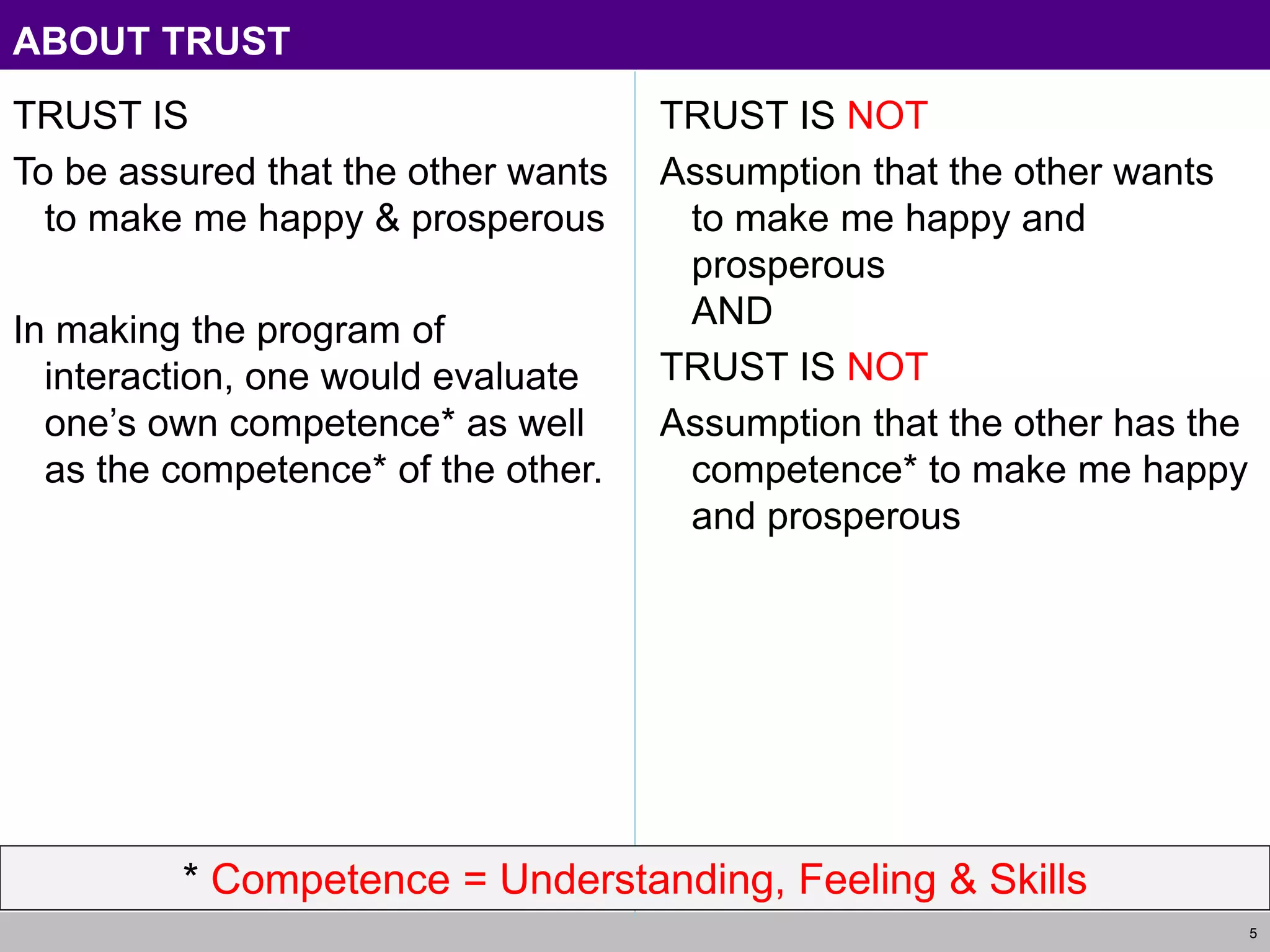
TRUST IS
To be assured that the other wants
to make me happy & prosperous
In making the program of
interaction, one would evaluate
one’s own competence* as well
as the competence* of the other.
TRUST IS NOT
Assumption that the other wants
to make me happy and
prosperous
AND
TRUST IS NOT
Assumption that the other has the
competence* to make me happy
and prosperous
ABOUT TRUST
* Competence = Understanding, Feeling & Skills
6
The Importance of Trust
• Anticipating the emotional effects that decisions
and actions might have on others
• Responding tactfully and respectfully in emotional
situations
• Eliciting the perceptions, feelings, and concerns of
others
• Recognizing that conflict is inevitable and using it
to strengthen relationships
7
Covey’s 13 behaviors
8
Behavior 1: Talk Straight
• Be honest.
• Tell the truth.
• Let people know where you stand.
• Use simple language.
• Call things what they are.
• Demonstrate integrity.
• Don’t manipulate people or distort facts.
• Don’t spin the truth.
• Don’t leave false impressions.
9
Behavior 2: Demonstrate Respect
• Genuinely care for others.
• Show you care.
• Respect the dignity of every person and every role.
• Treat everyone with respect, especially those who can’t
do anything for you.
• Show kindness in the little things.
• Don’t fake caring.
• Don’t attempt to be “efficient” with people.
10
Behavior 3: Create Transparency
• Tell the truth in a way people can verify.
• Get real and genuine.
• Be open and authentic.
• Err on the side of disclosure.
• Operate on the premise of “What you see is what you
get.”
• Don’t have hidden agendas.
• Don’t hide information.
11
Behavior 4: Right Wrongs
• Make things right when you are wrong.
• Apologize quickly.
• Make restitution where possible.
• Practice “service recoveries.”
• Demonstrate personal humility.
• Don’t cover things up.
• Don’t let pride get in the way of doing things
right.
12
Behavior 5: Show Loyalty
• Give credit freely.
• Acknowledge the contributions of others.
• Speak about people as if they were present.
• Represent others who aren’t there to speak for
themselves.
• Don’t bad mouth others behind their backs.
• Don’t disclose others’ private information.
13
Behavior 6: Deliver Results
• Establish a track record of results.
• Get the right things done.
• Make things happen.
• Accomplish what you’re hired to do.
• Be on time and within budget.
• Don’t overpromise and under deliver.
• Don’t make excuses for not delivering.
14
Behavior 7: Get Better
• Continuously improve.
• Increase your capabilities.
• Be a constant learner.
• Develop feedback systems—both formal and
informal.
• Act on the feedback you receive.
• Thank people for feedback.
• Don’t consider yourself above feedback.
• Don’t assume today’s knowledge and skills will be
sufficient for tomorrow’s challenges.
15
Behavior 8: Confront Reality
• Address the tough stuff directly.
• Acknowledge the unsaid.
• Lead out courageously in conversation.
• Remove the “sword from their hands.”
• Don’t skirt the real issues.
• Don’t bury your head in the sand.
16
Behavior 9: Clarify Expectations
• Disclose and reveal expectations.
• Discuss them.
• Validate them.
• Renegotiate them if needed and possible.
• Don’t violate expectations.
• Don’t assume that expectations are clear or shared.
17
Behavior 10: Practice Accountability
• Hold yourself accountable.
• Hold others accountable.
• Take responsibility for results.
• Be clear on how you’ll communicate how you are
doing—and how others are doing.
• Don’t avoid or shirk responsibility.
• Don’t blame others or point fingers when things go
wrong.
18
Behavior 11: Listen First
• Listen before you speak.
• Understand.
• Diagnose.
• Listen with your ears—and your eyes and heart.
• Find out what the most important behaviors are to
the people with whom you’re working.
• Don’t assume you know what matters most to others.
• Don’t presume you have all the answers—or all the
questions.
19
Behavior 12: Keep Commitments
• Say what you’re going to do, then do what you say
you’re going to do.
• Make commitments carefully and keep them.
• Make keeping commitments the symbol of your
honor.
• Don’t break confidences.
20
Behavior 13: Extend Trust
• Demonstrate a propensity to trust.
• Extend trust abundantly to those who have earned your
trust.
• Extend conditionally to those who are earning your
trust.
• Learn how to extend trust appropriately to others, based
in the situation, risk, and credibility (character and
competence) of the people involved. But have a
propensity to trust.
• Don’t withhold trust because there is risk involved.
21
ACTIVITY

Trust

  • 1.
    1 Trust Trust = tobe assured = to be assured of the existence of Natural Acceptance in every human being Which means: =to have the clarity that the other does not want to harm me =to have the clarity that the other wants to make me happy Feelings in relationship: 1- Trust FOUNDATION VALUE 2- Respect 3- Affection 4- Care 5- Guidance 6- Reverence 7- Glory/Honour 8- Gratitude 9- Love COMPLETE VALUE
  • 2.
    2 Problems in relationship Doubton intention is a major reason for problems in relationships
  • 3.
    3 The other brokethe glass He is always late If the other makes a mistake even once… – I doubt his intention, I don’t ask “why”, “how”… I jump to the conclusion “he makes mistakes intentionally” – I condemn the other, reinforce “The other is bad” – I get irritated, angry… have a feeling of opposition… The glass broke by accident I am late Even if I make the same mistake 100 times… – I never doubt my intention – I reinforce “I am good” – I make mistakes by accident and not intentionally About the Other About Myself Doubt on intention is a major reason for problems in relationships
  • 4.
    4 The glass wasbroken by accident He is late Even if the other makes the same mistake 100 times… – The other is like me, I am clear about his intention – I know the mistake is due to lack of competence, not lack of intention The glass was broken by accident I am late When I make a mistake even once… – I am clear about my intention – I know the mistake is due to lack of competence, not lack of intention About the Other About Myself Trust on intention is the starting point for mutual development
  • 5.
    5 TRUST IS To beassured that the other wants to make me happy & prosperous In making the program of interaction, one would evaluate one’s own competence* as well as the competence* of the other. TRUST IS NOT Assumption that the other wants to make me happy and prosperous AND TRUST IS NOT Assumption that the other has the competence* to make me happy and prosperous ABOUT TRUST * Competence = Understanding, Feeling & Skills
  • 6.
    6 The Importance ofTrust • Anticipating the emotional effects that decisions and actions might have on others • Responding tactfully and respectfully in emotional situations • Eliciting the perceptions, feelings, and concerns of others • Recognizing that conflict is inevitable and using it to strengthen relationships
  • 7.
  • 8.
    8 Behavior 1: TalkStraight • Be honest. • Tell the truth. • Let people know where you stand. • Use simple language. • Call things what they are. • Demonstrate integrity. • Don’t manipulate people or distort facts. • Don’t spin the truth. • Don’t leave false impressions.
  • 9.
    9 Behavior 2: DemonstrateRespect • Genuinely care for others. • Show you care. • Respect the dignity of every person and every role. • Treat everyone with respect, especially those who can’t do anything for you. • Show kindness in the little things. • Don’t fake caring. • Don’t attempt to be “efficient” with people.
  • 10.
    10 Behavior 3: CreateTransparency • Tell the truth in a way people can verify. • Get real and genuine. • Be open and authentic. • Err on the side of disclosure. • Operate on the premise of “What you see is what you get.” • Don’t have hidden agendas. • Don’t hide information.
  • 11.
    11 Behavior 4: RightWrongs • Make things right when you are wrong. • Apologize quickly. • Make restitution where possible. • Practice “service recoveries.” • Demonstrate personal humility. • Don’t cover things up. • Don’t let pride get in the way of doing things right.
  • 12.
    12 Behavior 5: ShowLoyalty • Give credit freely. • Acknowledge the contributions of others. • Speak about people as if they were present. • Represent others who aren’t there to speak for themselves. • Don’t bad mouth others behind their backs. • Don’t disclose others’ private information.
  • 13.
    13 Behavior 6: DeliverResults • Establish a track record of results. • Get the right things done. • Make things happen. • Accomplish what you’re hired to do. • Be on time and within budget. • Don’t overpromise and under deliver. • Don’t make excuses for not delivering.
  • 14.
    14 Behavior 7: GetBetter • Continuously improve. • Increase your capabilities. • Be a constant learner. • Develop feedback systems—both formal and informal. • Act on the feedback you receive. • Thank people for feedback. • Don’t consider yourself above feedback. • Don’t assume today’s knowledge and skills will be sufficient for tomorrow’s challenges.
  • 15.
    15 Behavior 8: ConfrontReality • Address the tough stuff directly. • Acknowledge the unsaid. • Lead out courageously in conversation. • Remove the “sword from their hands.” • Don’t skirt the real issues. • Don’t bury your head in the sand.
  • 16.
    16 Behavior 9: ClarifyExpectations • Disclose and reveal expectations. • Discuss them. • Validate them. • Renegotiate them if needed and possible. • Don’t violate expectations. • Don’t assume that expectations are clear or shared.
  • 17.
    17 Behavior 10: PracticeAccountability • Hold yourself accountable. • Hold others accountable. • Take responsibility for results. • Be clear on how you’ll communicate how you are doing—and how others are doing. • Don’t avoid or shirk responsibility. • Don’t blame others or point fingers when things go wrong.
  • 18.
    18 Behavior 11: ListenFirst • Listen before you speak. • Understand. • Diagnose. • Listen with your ears—and your eyes and heart. • Find out what the most important behaviors are to the people with whom you’re working. • Don’t assume you know what matters most to others. • Don’t presume you have all the answers—or all the questions.
  • 19.
    19 Behavior 12: KeepCommitments • Say what you’re going to do, then do what you say you’re going to do. • Make commitments carefully and keep them. • Make keeping commitments the symbol of your honor. • Don’t break confidences.
  • 20.
    20 Behavior 13: ExtendTrust • Demonstrate a propensity to trust. • Extend trust abundantly to those who have earned your trust. • Extend conditionally to those who are earning your trust. • Learn how to extend trust appropriately to others, based in the situation, risk, and credibility (character and competence) of the people involved. But have a propensity to trust. • Don’t withhold trust because there is risk involved.
  • 21.