







Seminar
on
Shear Walls
Presented by :-
Indrajit patra
Reg No. 1201110048
Civil Engg, 8th Sem.
Government college of engineering , kalahandi
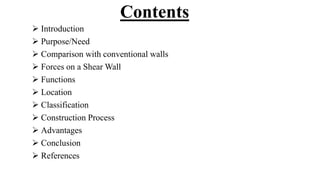
Contents
 Introduction
 Purpose/Need
 Comparison with conventional walls
 Forces on a Shear Wall
 Functions
 Location
 Classification
 Construction Process
 Advantages
 Conclusion
 References
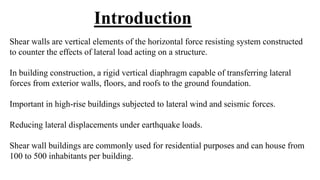
Introduction
Shear walls are vertical elements of the horizontal force resisting system constructed
to counter the effects of lateral load acting on a structure.
In building construction, a rigid vertical diaphragm capable of transferring lateral
forces from exterior walls, floors, and roofs to the ground foundation.
Important in high-rise buildings subjected to lateral wind and seismic forces.
Reducing lateral displacements under earthquake loads.
Shear wall buildings are commonly used for residential purposes and can house from
100 to 500 inhabitants per building.
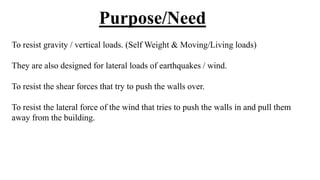
Purpose/Need
To resist gravity / vertical loads. (Self Weight & Moving/Living loads)
They are also designed for lateral loads of earthquakes / wind.
To resist the shear forces that try to push the walls over.
To resist the lateral force of the wind that tries to push the walls in and pull them
away from the building.
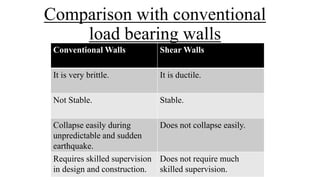
Comparison with conventional
load bearing walls
Conventional Walls Shear Walls
It is very brittle. It is ductile.
Not Stable. Stable.
Collapse easily during
unpredictable and sudden
earthquake.
Does not collapse easily.
Requires skilled supervision
in design and construction.
Does not require much
skilled supervision.
Forces On Shear Walls
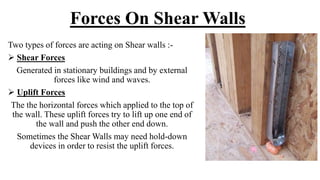
Two types of forces are acting on Shear walls :-
 Shear Forces
Generated in stationary buildings and by external
forces like wind and waves.
 Uplift Forces
The the horizontal forces which applied to the top of
the wall. These uplift forces try to lift up one end of
the wall and push the other end down.
Sometimes the Shear Walls may need hold-down
devices in order to resist the uplift forces.
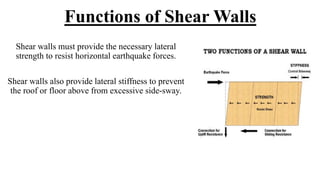
Functions of Shear Walls
Shear walls must provide the necessary lateral
strength to resist horizontal earthquake forces.
Shear walls also provide lateral stiffness to prevent
the roof or floor above from excessive side-sway.
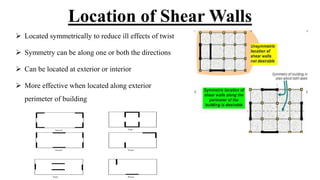
Location of Shear Walls
 Located symmetrically to reduce ill effects of twist
 Symmetry can be along one or both the directions
 Can be located at exterior or interior
 More effective when located along exterior
perimeter of building
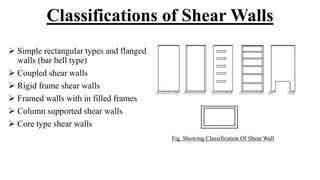
Classifications of Shear Walls
 Simple rectangular types and flanged
walls (bar bell type)
 Coupled shear walls
 Rigid frame shear walls
 Framed walls with in filled frames
 Column supported shear walls
 Core type shear walls
Fig. Showing Classification Of Shear Wall
 Excavation
 Foundation and Footings
 Bottom three floors and waffle slab
 Shear wall construction
Construction Process
Excavation
After the initial surveying and soil test, excavation of land is carried out.
Done by cranes and diggers.
If the land is very hard then blasting may be done during early mornings.
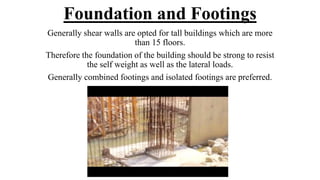
Foundation and Footings
Generally shear walls are opted for tall buildings which are more
than 15 floors.
Therefore the foundation of the building should be strong to resist
the self weight as well as the lateral loads.
Generally combined footings and isolated footings are preferred.
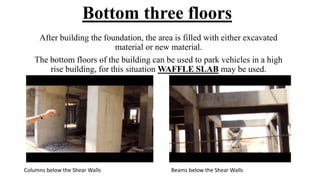
Bottom three floors
After building the foundation, the area is filled with either excavated
material or new material.
The bottom floors of the building can be used to park vehicles in a high
rise building, for this situation WAFFLE SLAB may be used.
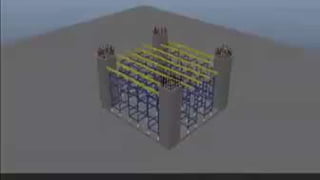
Columns below the Shear Walls Beams below the Shear Walls
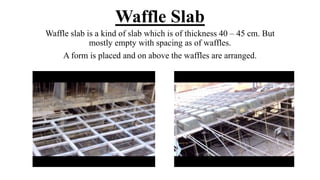
Waffle Slab
Waffle slab is a kind of slab which is of thickness 40 – 45 cm. But
mostly empty with spacing as of waffles.
A form is placed and on above the waffles are arranged.
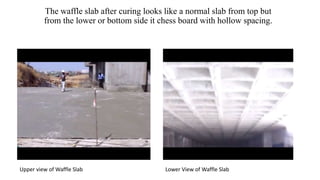
The waffle slab after curing looks like a normal slab from top but
from the lower or bottom side it chess board with hollow spacing.
Upper view of Waffle Slab Lower View of Waffle Slab
Construction of Shear Walls
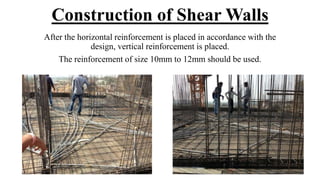
After the horizontal reinforcement is placed in accordance with the
design, vertical reinforcement is placed.
The reinforcement of size 10mm to 12mm should be used.
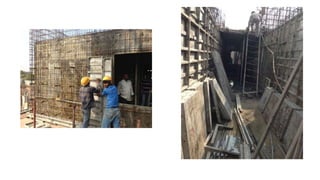
Mivan Form Work
Mivan is an aluminium formwork system developed by a European
construction company. Manufactured by Mivan Company Ltd.
From Malaysia.
MIVAN technology is suitable for constructing large number of
houses in a short span of time using room size forms to construct
walls and slabs in one continuous pour on concrete.
To facilitate fast construction, early removal of forms can be
achieved by hot air curing.
On the removal of the formwork mould a high quality concrete
finish is produced.
The finishing is really smooth and no further plastering is required.
Advantages & Disadvantages
Advantages Disadvantages
1. Fast completion of floors
2. Uniformity in structural
components.
3. Good finishing can be seen.
4. No need of plastering.
1. Expensive, used for typical
floors only.
2. Initial setup takes time.
3. Construction joints should
be executed properly.
4. Alignment maintainance
needs skilled laborers.
Concreting
 Once the complete arrangement of the form work i.e., wall ties,
pins and wedges, precision is done so that no concrete will leak
out of the form work.
 The grade of cement used in this type of construction is M30
and steel used is Fe415.
 The size of aggregate should be 10mm or 12mm. So that it
moves easily inside the wall.
 Sand here used may be either robust sand or sea sand.
 The concrete used in this type is of self compacting nature,
there is no need for additional compaction.
 After the wall form is completely filled, it is left for one
complete day to set in its position.
Curing
After one day of curing of the wall, removal of form is done.
Removal of form is done very carefully so as to not damage the
form work.
Advantages
 Easy to construct.
 Good performance.
 Earthquake resistant.
 Efficient interms of cost and construction.
 Minimal Damage.
 Provide large strength and stiffness in the direction of orientation
CONCLUSION
 Shear walls are efficient in resisting earthquakes
 The damages due to effect of lateral forces due to earthquake
and high winds can be minimized. It provides larger stiffness to
the buildings there by reducing the damage to structure and its
contents.
References
 Anna Birely and Dawn Lehman (2008). “Investigation of the seismic
behavior and analysis of reinforced concrete structural walls”. The 14th
World Conference on Earthquake Engineering, Beijing, China.
 Lepage, A (1994). “Seismic Drift Estimates for RC Structures”. Eleventh
World Conference on Earthquake Engineering, Acapulco, Mexico.
 Murty, C.V.R.(2005). “Earthquake Tips. Learning Earthquake design and
Construction”. IIT Kanpur
 Mosoarca Marius (2013). “Seismic behavior of reinforced concrete shear
walls with regular and staggered openings after the strong earthquakes
between 2009 and 2011”. Journal of Engineering Failure Analysis.
THANK YOU

Shear walls

  • 1.
    Seminar on Shear Walls Presented by:- Indrajit patra Reg No. 1201110048 Civil Engg, 8th Sem. Government college of engineering , kalahandi
  • 2.
    Contents  Introduction  Purpose/Need Comparison with conventional walls  Forces on a Shear Wall  Functions  Location  Classification  Construction Process  Advantages  Conclusion  References
  • 3.
    Introduction Shear walls arevertical elements of the horizontal force resisting system constructed to counter the effects of lateral load acting on a structure. In building construction, a rigid vertical diaphragm capable of transferring lateral forces from exterior walls, floors, and roofs to the ground foundation. Important in high-rise buildings subjected to lateral wind and seismic forces. Reducing lateral displacements under earthquake loads. Shear wall buildings are commonly used for residential purposes and can house from 100 to 500 inhabitants per building.
  • 4.
    Purpose/Need To resist gravity/ vertical loads. (Self Weight & Moving/Living loads) They are also designed for lateral loads of earthquakes / wind. To resist the shear forces that try to push the walls over. To resist the lateral force of the wind that tries to push the walls in and pull them away from the building.
  • 5.
    Comparison with conventional loadbearing walls Conventional Walls Shear Walls It is very brittle. It is ductile. Not Stable. Stable. Collapse easily during unpredictable and sudden earthquake. Does not collapse easily. Requires skilled supervision in design and construction. Does not require much skilled supervision.
  • 6.
    Forces On ShearWalls Two types of forces are acting on Shear walls :-  Shear Forces Generated in stationary buildings and by external forces like wind and waves.  Uplift Forces The the horizontal forces which applied to the top of the wall. These uplift forces try to lift up one end of the wall and push the other end down. Sometimes the Shear Walls may need hold-down devices in order to resist the uplift forces.
  • 7.
    Functions of ShearWalls Shear walls must provide the necessary lateral strength to resist horizontal earthquake forces. Shear walls also provide lateral stiffness to prevent the roof or floor above from excessive side-sway.
  • 8.
    Location of ShearWalls  Located symmetrically to reduce ill effects of twist  Symmetry can be along one or both the directions  Can be located at exterior or interior  More effective when located along exterior perimeter of building
  • 9.
    Classifications of ShearWalls  Simple rectangular types and flanged walls (bar bell type)  Coupled shear walls  Rigid frame shear walls  Framed walls with in filled frames  Column supported shear walls  Core type shear walls Fig. Showing Classification Of Shear Wall
  • 10.
     Excavation  Foundationand Footings  Bottom three floors and waffle slab  Shear wall construction Construction Process
  • 11.
    Excavation After the initialsurveying and soil test, excavation of land is carried out. Done by cranes and diggers. If the land is very hard then blasting may be done during early mornings.
  • 12.
    Foundation and Footings Generallyshear walls are opted for tall buildings which are more than 15 floors. Therefore the foundation of the building should be strong to resist the self weight as well as the lateral loads. Generally combined footings and isolated footings are preferred.
  • 13.
    Bottom three floors Afterbuilding the foundation, the area is filled with either excavated material or new material. The bottom floors of the building can be used to park vehicles in a high rise building, for this situation WAFFLE SLAB may be used. Columns below the Shear Walls Beams below the Shear Walls
  • 14.
    Waffle Slab Waffle slabis a kind of slab which is of thickness 40 – 45 cm. But mostly empty with spacing as of waffles. A form is placed and on above the waffles are arranged.
  • 15.
    The waffle slabafter curing looks like a normal slab from top but from the lower or bottom side it chess board with hollow spacing. Upper view of Waffle Slab Lower View of Waffle Slab
  • 17.
    Construction of ShearWalls After the horizontal reinforcement is placed in accordance with the design, vertical reinforcement is placed. The reinforcement of size 10mm to 12mm should be used.
  • 18.
    Mivan Form Work Mivanis an aluminium formwork system developed by a European construction company. Manufactured by Mivan Company Ltd. From Malaysia. MIVAN technology is suitable for constructing large number of houses in a short span of time using room size forms to construct walls and slabs in one continuous pour on concrete. To facilitate fast construction, early removal of forms can be achieved by hot air curing. On the removal of the formwork mould a high quality concrete finish is produced. The finishing is really smooth and no further plastering is required.
  • 21.
    Advantages & Disadvantages AdvantagesDisadvantages 1. Fast completion of floors 2. Uniformity in structural components. 3. Good finishing can be seen. 4. No need of plastering. 1. Expensive, used for typical floors only. 2. Initial setup takes time. 3. Construction joints should be executed properly. 4. Alignment maintainance needs skilled laborers.
  • 22.
    Concreting  Once thecomplete arrangement of the form work i.e., wall ties, pins and wedges, precision is done so that no concrete will leak out of the form work.  The grade of cement used in this type of construction is M30 and steel used is Fe415.  The size of aggregate should be 10mm or 12mm. So that it moves easily inside the wall.  Sand here used may be either robust sand or sea sand.  The concrete used in this type is of self compacting nature, there is no need for additional compaction.  After the wall form is completely filled, it is left for one complete day to set in its position.
  • 23.
    Curing After one dayof curing of the wall, removal of form is done. Removal of form is done very carefully so as to not damage the form work.
  • 25.
    Advantages  Easy toconstruct.  Good performance.  Earthquake resistant.  Efficient interms of cost and construction.  Minimal Damage.  Provide large strength and stiffness in the direction of orientation
  • 26.
    CONCLUSION  Shear wallsare efficient in resisting earthquakes  The damages due to effect of lateral forces due to earthquake and high winds can be minimized. It provides larger stiffness to the buildings there by reducing the damage to structure and its contents.
  • 28.
    References  Anna Birelyand Dawn Lehman (2008). “Investigation of the seismic behavior and analysis of reinforced concrete structural walls”. The 14th World Conference on Earthquake Engineering, Beijing, China.  Lepage, A (1994). “Seismic Drift Estimates for RC Structures”. Eleventh World Conference on Earthquake Engineering, Acapulco, Mexico.  Murty, C.V.R.(2005). “Earthquake Tips. Learning Earthquake design and Construction”. IIT Kanpur  Mosoarca Marius (2013). “Seismic behavior of reinforced concrete shear walls with regular and staggered openings after the strong earthquakes between 2009 and 2011”. Journal of Engineering Failure Analysis.
  • 29.