Truss Bridges

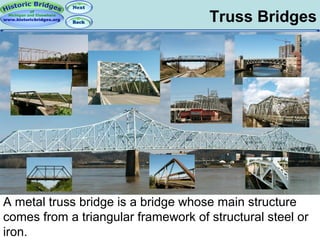
A metal truss bridge is a bridge whose main structure
comes from a triangular framework of structural steel or
iron.
Iron and Steel

Due to their variety of designs, there is a system that is
used to classify metal truss bridges by design.
Truss Basics
If the trusses run beside the deck, with no cross bracing
above the deck, it is called a pony truss bridge.

Pony Truss

Through Truss
If cross-bracing is present above the deck of the bridge,
then the bridge is referred to as a “through truss.”
Truss Basics

Deck Truss

Trusses may run under the deck: these are called simply
Deck truss bridges.
Truss Bridge Parts
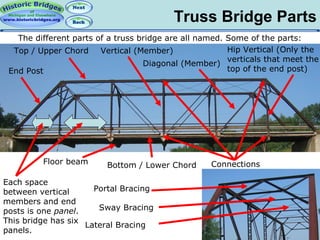
The different parts of a truss bridge are all named. Some of the parts:
Hip Vertical (Only the
Top / Upper Chord
Vertical (Member)
verticals that meet the
Diagonal (Member)
top of the end post)
End Post

Floor beam

Bottom / Lower Chord

Each space
Portal Bracing
between vertical
members and end
Sway Bracing
posts is one panel.
This bridge has six
Lateral Bracing
panels.

Connections
Truss Bridge Forces
Compression
Tension

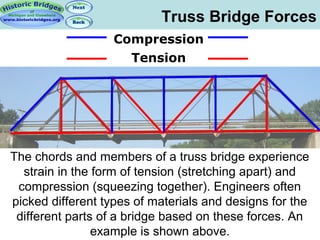
The chords and members of a truss bridge experience
strain in the form of tension (stretching apart) and
compression (squeezing together). Engineers often
picked different types of materials and designs for the
different parts of a bridge based on these forces. An
example is shown above.
Truss Bridge Connections
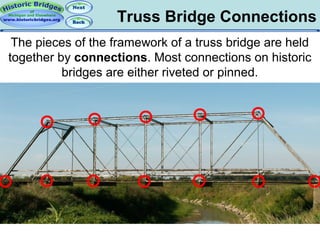
The pieces of the framework of a truss bridge are held
together by connections. Most connections on historic
bridges are either riveted or pinned.
Pinned Connections

Pin
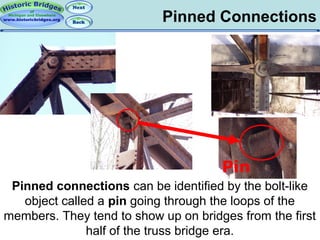
Pinned connections can be identified by the bolt-like
object called a pin going through the loops of the
members. They tend to show up on bridges from the first
half of the truss bridge era.
Riveted Connections

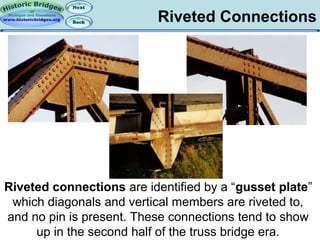
Riveted connections are identified by a “gusset plate”
which diagonals and vertical members are riveted to,
and no pin is present. These connections tend to show
up in the second half of the truss bridge era.
Truss Configurations

Pratt

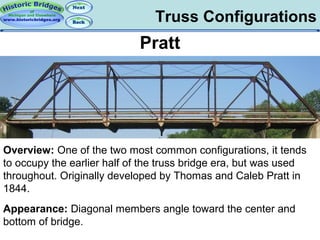
Overview: One of the two most common configurations, it tends
to occupy the earlier half of the truss bridge era, but was used
throughout. Originally developed by Thomas and Caleb Pratt in
1844.
Appearance: Diagonal members angle toward the center and
bottom of bridge.
Truss Configurations

Pratt – Additional Notes

The Pratt may have additional diagonal members,
sometimes of a smaller size, that do not follow the
standard pattern to form an “X” shape on panels toward
the center.
Truss Configurations

Whipple

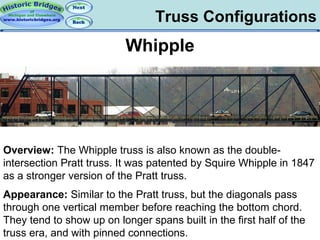
Overview: The Whipple truss is also known as the doubleintersection Pratt truss. It was patented by Squire Whipple in 1847
as a stronger version of the Pratt truss.
Appearance: Similar to the Pratt truss, but the diagonals pass
through one vertical member before reaching the bottom chord.
They tend to show up on longer spans built in the first half of the
truss era, and with pinned connections.
Truss Configurations

Baltimore

Overview: The Baltimore railroad designed a truss configuration
that eventually found use on both railroads and highways. It is a
Pratt truss with additional members added for additional strength.
Appearance: Characterized by a Pratt configuration with extra
smaller members branching off of the diagonals.
Truss Configurations

Parker

Overview: Charles
H. Parker modified
the Pratt design to
create what became
known as the Parker
truss configuration.
This design allowed
one to use less
materials to get the
a similar load
capacity. The
downside was the
more complex
design.
Appearance: Characterized by an arch-shaped (polygonal) top
chord, with diagonals that follow the Pratt configuration.
Truss Configurations

Pennsylvania

Overview: Sometimes called the Petit truss. Designed by the
Pennsylvania railroad, this configuration combines the engineering
ideas behind the Baltimore with those of the Parker or Camelback.
Appearance: Features an arch-shaped (polygonal) top chord with
a diagonal arrangement like the Baltimore.
Truss Configurations

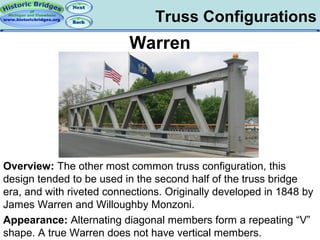
Warren

Overview: The other most common truss configuration, this
design tended to be used in the second half of the truss bridge
era, and with riveted connections. Originally developed in 1848 by
James Warren and Willoughby Monzoni.
Appearance: Alternating diagonal members form a repeating “V”
shape. A true Warren does not have vertical members.
Truss Configurations

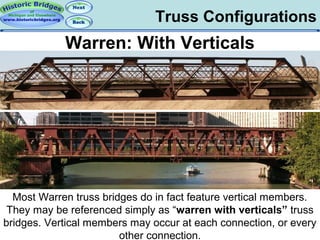
Warren: With Verticals

Most Warren truss bridges do in fact feature vertical members.
They may be referenced simply as “warren with verticals” truss
bridges. Vertical members may occur at each connection, or every
other connection.
Truss Configurations

Double-Intersection Warren

Overview: Often called simply the Double Warren, this is an
uncommon truss configuration. Bridges with this configuration
often have riveted connections.
Appearance: Looks like two Warren trusses offset and
superimposed on each other, forming a repeating “X” shape.
Truss Configurations

Lenticular

Overview: One of the rarest bridge designs in the country.
Patented by the Berlin Iron Bridge Company of East Berlin, CT
Appearance: Both the top chord and bottom chord have an
arched appearance, forming a distinctive oval or eye-like shape.
Your Turn!

Identify Truss Bridge Types
In your groups, identify the 12 bridges. For each bridge, an
overview and a connection for the bridge is shown. On a
sheet of paper, record the bridge number you are looking at
and list the following:
Truss Configuration. Do this for all photos first.
After you complete that, see if you can add the following
information for each bridge.
Connection Type (Pinned or Riveted)
Truss Arrangement (Through, Pony, Deck)
Example:
1. Pratt, Pinned, Through
Teach Historic Bridges!

Many people are not even aware that bridges aside
from covered bridges are even historic. The result
is that other types of beautiful historic bridges are
being demolished. Historic bridges can be worked
into nearly every school subject. Please bring the
beautiful world of historic bridges to your students!

Trusses

  • 1.
    Truss Bridges A metaltruss bridge is a bridge whose main structure comes from a triangular framework of structural steel or iron.
  • 2.
    Iron and Steel Dueto their variety of designs, there is a system that is used to classify metal truss bridges by design.
  • 3.
    Truss Basics If thetrusses run beside the deck, with no cross bracing above the deck, it is called a pony truss bridge. Pony Truss Through Truss If cross-bracing is present above the deck of the bridge, then the bridge is referred to as a “through truss.”
  • 4.
    Truss Basics Deck Truss Trussesmay run under the deck: these are called simply Deck truss bridges.
  • 5.
    Truss Bridge Parts Thedifferent parts of a truss bridge are all named. Some of the parts: Hip Vertical (Only the Top / Upper Chord Vertical (Member) verticals that meet the Diagonal (Member) top of the end post) End Post Floor beam Bottom / Lower Chord Each space Portal Bracing between vertical members and end Sway Bracing posts is one panel. This bridge has six Lateral Bracing panels. Connections
  • 6.
    Truss Bridge Forces Compression Tension Thechords and members of a truss bridge experience strain in the form of tension (stretching apart) and compression (squeezing together). Engineers often picked different types of materials and designs for the different parts of a bridge based on these forces. An example is shown above.
  • 7.
    Truss Bridge Connections Thepieces of the framework of a truss bridge are held together by connections. Most connections on historic bridges are either riveted or pinned.
  • 8.
    Pinned Connections Pin Pinned connectionscan be identified by the bolt-like object called a pin going through the loops of the members. They tend to show up on bridges from the first half of the truss bridge era.
  • 9.
    Riveted Connections Riveted connectionsare identified by a “gusset plate” which diagonals and vertical members are riveted to, and no pin is present. These connections tend to show up in the second half of the truss bridge era.
  • 10.
    Truss Configurations Pratt Overview: Oneof the two most common configurations, it tends to occupy the earlier half of the truss bridge era, but was used throughout. Originally developed by Thomas and Caleb Pratt in 1844. Appearance: Diagonal members angle toward the center and bottom of bridge.
  • 11.
    Truss Configurations Pratt –Additional Notes The Pratt may have additional diagonal members, sometimes of a smaller size, that do not follow the standard pattern to form an “X” shape on panels toward the center.
  • 12.
    Truss Configurations Whipple Overview: TheWhipple truss is also known as the doubleintersection Pratt truss. It was patented by Squire Whipple in 1847 as a stronger version of the Pratt truss. Appearance: Similar to the Pratt truss, but the diagonals pass through one vertical member before reaching the bottom chord. They tend to show up on longer spans built in the first half of the truss era, and with pinned connections.
  • 13.
    Truss Configurations Baltimore Overview: TheBaltimore railroad designed a truss configuration that eventually found use on both railroads and highways. It is a Pratt truss with additional members added for additional strength. Appearance: Characterized by a Pratt configuration with extra smaller members branching off of the diagonals.
  • 14.
    Truss Configurations Parker Overview: Charles H.Parker modified the Pratt design to create what became known as the Parker truss configuration. This design allowed one to use less materials to get the a similar load capacity. The downside was the more complex design. Appearance: Characterized by an arch-shaped (polygonal) top chord, with diagonals that follow the Pratt configuration.
  • 15.
    Truss Configurations Pennsylvania Overview: Sometimescalled the Petit truss. Designed by the Pennsylvania railroad, this configuration combines the engineering ideas behind the Baltimore with those of the Parker or Camelback. Appearance: Features an arch-shaped (polygonal) top chord with a diagonal arrangement like the Baltimore.
  • 16.
    Truss Configurations Warren Overview: Theother most common truss configuration, this design tended to be used in the second half of the truss bridge era, and with riveted connections. Originally developed in 1848 by James Warren and Willoughby Monzoni. Appearance: Alternating diagonal members form a repeating “V” shape. A true Warren does not have vertical members.
  • 17.
    Truss Configurations Warren: WithVerticals Most Warren truss bridges do in fact feature vertical members. They may be referenced simply as “warren with verticals” truss bridges. Vertical members may occur at each connection, or every other connection.
  • 18.
    Truss Configurations Double-Intersection Warren Overview:Often called simply the Double Warren, this is an uncommon truss configuration. Bridges with this configuration often have riveted connections. Appearance: Looks like two Warren trusses offset and superimposed on each other, forming a repeating “X” shape.
  • 19.
    Truss Configurations Lenticular Overview: Oneof the rarest bridge designs in the country. Patented by the Berlin Iron Bridge Company of East Berlin, CT Appearance: Both the top chord and bottom chord have an arched appearance, forming a distinctive oval or eye-like shape.
  • 20.
    Your Turn! Identify TrussBridge Types In your groups, identify the 12 bridges. For each bridge, an overview and a connection for the bridge is shown. On a sheet of paper, record the bridge number you are looking at and list the following: Truss Configuration. Do this for all photos first. After you complete that, see if you can add the following information for each bridge. Connection Type (Pinned or Riveted) Truss Arrangement (Through, Pony, Deck) Example: 1. Pratt, Pinned, Through
  • 21.
    Teach Historic Bridges! Manypeople are not even aware that bridges aside from covered bridges are even historic. The result is that other types of beautiful historic bridges are being demolished. Historic bridges can be worked into nearly every school subject. Please bring the beautiful world of historic bridges to your students!