ROOF TRUSSES
FINK TRUSS - W-TYPE

DRAWN BY
MICHAEL NAUTH
The roof triangle usually is isosceles (equal sides) and it extends from
wall to wall at its base. The two sides meet in the centre at the peak.
The slope or angle of the roof is stated as a unit rise (in ins.) over the
unit run (12”), in this case 7/12. The Span of the building is 6’, the total
Run is ½ of the Span or 3’ (36”), and the Rise is 7” x 3 or 21”.
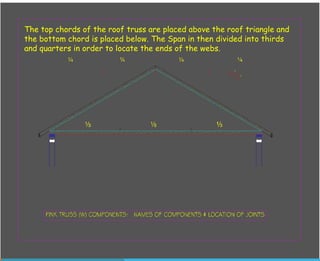
The top chords of the roof truss are placed above the roof triangle and
the bottom chord is placed below. The Span in then divided into thirds
and quarters in order to locate the ends of the webs.
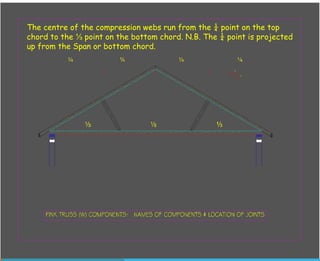
The centre of the compression webs run from the ¼ point on the top
chord to the ⅓ point on the bottom chord. N.B. The ¼ point is projected
up from the Span or bottom chord.
The tension webs run from the peak to meet the compression web at the
bottom chord.
Triangular bearing blocks are placed between the top and bottom chords to
transfer roof load to the bottom chord and then to the walls. Compression
webs longer than 6’ (1.8m) must be laterally braced.
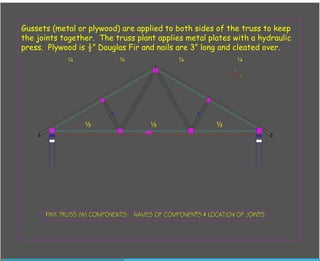
Gussets (metal or plywood) are applied to both sides of the truss to keep
the joints together. The truss plant applies metal plates with a hydraulic
press. Plywood is ½” Douglas Fir and nails are 3” long and cleated over.
The components of the truss are labelled. The base of the truss triangle
is the sum of the Total Run and the Projection. The hypotenuse of the
unit triangle (unit length) and is calculated using Pythagoras’s theorem.
Using Similar Triangles, the length (X) of the Top Chord is determined.
X/42 = 13.89/12
X = (42 x 13.89)
12 = 48.615” or 4’ ⅝”.
Trusses are built on a flat surface and the pieces are cut to suit the
layout marks.

Fink truss (w type)

  • 1.
    ROOF TRUSSES FINK TRUSS- W-TYPE DRAWN BY MICHAEL NAUTH
  • 2.
    The roof triangleusually is isosceles (equal sides) and it extends from wall to wall at its base. The two sides meet in the centre at the peak.
  • 3.
    The slope orangle of the roof is stated as a unit rise (in ins.) over the unit run (12”), in this case 7/12. The Span of the building is 6’, the total Run is ½ of the Span or 3’ (36”), and the Rise is 7” x 3 or 21”.
  • 4.
    The top chordsof the roof truss are placed above the roof triangle and the bottom chord is placed below. The Span in then divided into thirds and quarters in order to locate the ends of the webs.
  • 5.
    The centre ofthe compression webs run from the ¼ point on the top chord to the ⅓ point on the bottom chord. N.B. The ¼ point is projected up from the Span or bottom chord.
  • 6.
    The tension websrun from the peak to meet the compression web at the bottom chord.
  • 7.
    Triangular bearing blocksare placed between the top and bottom chords to transfer roof load to the bottom chord and then to the walls. Compression webs longer than 6’ (1.8m) must be laterally braced.
  • 8.
    Gussets (metal orplywood) are applied to both sides of the truss to keep the joints together. The truss plant applies metal plates with a hydraulic press. Plywood is ½” Douglas Fir and nails are 3” long and cleated over.
  • 9.
    The components ofthe truss are labelled. The base of the truss triangle is the sum of the Total Run and the Projection. The hypotenuse of the unit triangle (unit length) and is calculated using Pythagoras’s theorem.
  • 10.
    Using Similar Triangles,the length (X) of the Top Chord is determined. X/42 = 13.89/12 X = (42 x 13.89) 12 = 48.615” or 4’ ⅝”. Trusses are built on a flat surface and the pieces are cut to suit the layout marks.