
THROPHIC RELATIONSHIPS
IN WETLAND ECOSYSTEM
jitenderanduat@gmail.com

Presentation by
Livi Wilson and Jitendra Kumar
College of Fisheries, KVAFSU, Mangalore, Karnataka
jitenderanduat@gmail.com
TROPHIC RELATIONSHIPS
The study of the structure of feeding relationships
among organisms in an ecosystem



Feeding or trophic relationships can be represented
as a




food web
food chain.

jitenderanduat@gmail.com




jitenderanduat@gmail.com

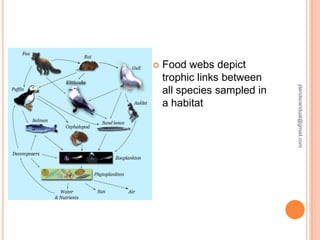
Food webs depict
trophic links between
all species sampled in
a habitat


jitenderanduat@gmail.com

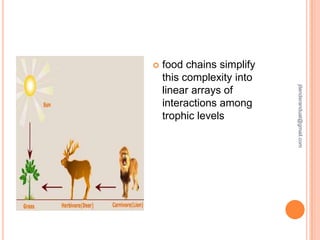
food chains simplify
this complexity into
linear arrays of
interactions among
trophic levels
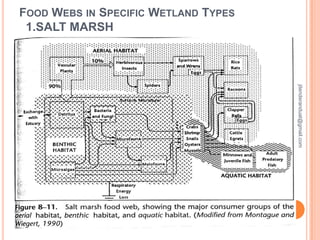
FOOD WEBS IN SPECIFIC WETLAND TYPES
1.SALT MARSH

jitenderanduat@gmail.com


.

jitenderanduat@gmail.com

Producers in a salt marsh include
marsh grasses,
Spartina
Juncus
Algae
various other salt tolerant plants
THE CONSUMERS COME IN SEVERAL CATEGORIES
ACCORDING TO THEIR PREFERRED HABITAT.



periwinkle snails that travel up and down plants,

o

marsh crabs.

jitenderanduat@gmail.com

a. Aerial Habitat--- above the substrate, not that in
the air necessarily
.
Consumers -- spiders and insects that live on plant leaves,
B.

BENTHIC HABITAT

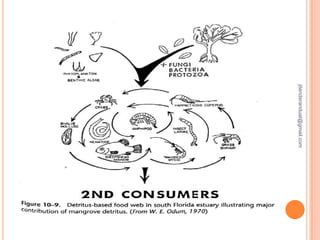
Detrital food web
 < 10% of the above ground primary productivity in a
saltmarsh actually gets grazed,. Most plant biomass
dies and decays and is passed through the detrital
food web
 consumers --- bacteria and fungi.
 These are then consumed by the smallest
animals—worms, copepods, rotifers, larval stages
of benthic invertebrates, in other words, plankton.
 The bigger benthic invertebrates are either
scavengers (crabs, snails) or filterers (oysters,
mussels


jitenderanduat@gmail.com
C. AQUATIC

HABITAT

overlaps with the benthic habitat,
 Consumers --- vertebrates.


There are several species of resident fish such as
silversides, killifish, and mummichogs



In fact about 90% of the commercially important
fish and shellfish in the southeast Atlantic and Gulf
coasts depend on marshes.

jitenderanduat@gmail.com


D. AVIAN

CONSUMERS

includes many ducks and wading birds.
 Like the fish, many of these depend on marshes
along their migration routes and are not year round
residents


E.MAMMALS



Raccoons and muskrats use salt marshes
extensively as a food source

jitenderanduat@gmail.com


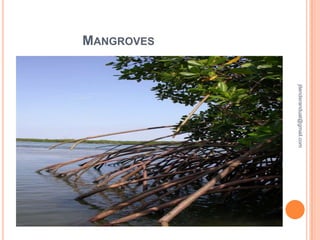
MANGROVES

jitenderanduat@gmail.com
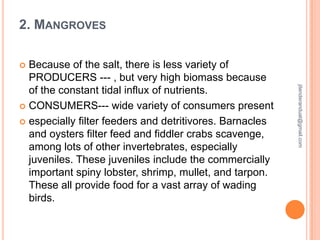
2. MANGROVES
Because of the salt, there is less variety of
PRODUCERS --- , but very high biomass because
of the constant tidal influx of nutrients.
 CONSUMERS--- wide variety of consumers present
 especially filter feeders and detritivores. Barnacles
and oysters filter feed and fiddler crabs scavenge,
among lots of other invertebrates, especially
juveniles. These juveniles include the commercially
important spiny lobster, shrimp, mullet, and tarpon.
These all provide food for a vast array of wading
birds.


jitenderanduat@gmail.com
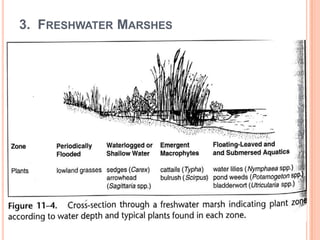
3. FRESHWATER MARSHES


jitenderanduat@gmail.com

Reed grasses, cattails, rice, sedges, and ragweed
are common to most temperate freshwater
marshes, although distribution varies with latitude.
wetlands that are the most affected by "alien
species,"
 Eg:The water hyacinth,
 is a trouble maker,
 it is very good at water filtering and then holding
onto the excess nutrients or chemicals. Thus it's
often suggested as a valuable addition to natural
wastewater treatment programs
 CONSUMERS---The most abundant invertebrates
are true flies, including mosquitoes.
 With a high diversity of invertebrates there is a high
diversity of birds


jitenderanduat@gmail.com
PEATLANDS

jitenderanduat@gmail.com
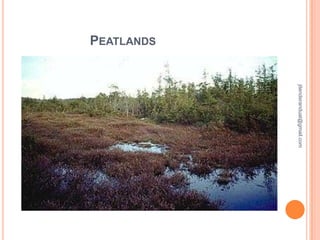
PEATLANDS
The dominant plant ---Sphagnum moss. It grows in
cushionlike spongy mats with very high water
content.
 Sphagnum moss can hold 15-23 times its dry
weight in water. The moss only grows actively at
the surface, and the lower layers die off and
decompose into peat
 . Other plants may include heathers, cranberry,
blueberry, some pines, spruce, and tamarack trees


jitenderanduat@gmail.com
Peatlands ---wetlands having the lowest
productivity
 lowest nutrient levels .




These include




pitcher plants,
sundews, and
venus flytraps.

jitenderanduat@gmail.com

hence several carnivorous plants are found here.
They get their extra nutrients from insects.
CONSUMERS
 Animal density is fairly low


because they are acidic and not much eats moss.
They do serve as trails and shelters for large
mammals.



Lots of birds pass through these areas on their
migration routes



: sandhill cranes, short-eared and great gray owls,
sharp-tailed sparrow.

jitenderanduat@gmail.com


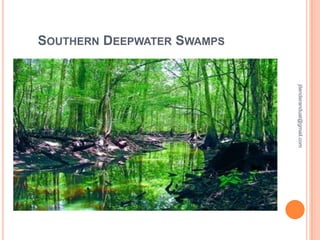
SOUTHERN DEEPWATER SWAMPS

jitenderanduat@gmail.com
. SOUTHERN DEEPWATER SWAMPS
Cypress and tupelo trees dominate these
ecosystems



There is a high diversity and high biomass
oƒ invertebrates which depend on the abundant
detritus available. Once again, this is the major
source of nutrients for the food web

Reptiles and amphibians are quite diverse because
they can adapt to changing flood levels
 Alligators are common


jitenderanduat@gmail.com


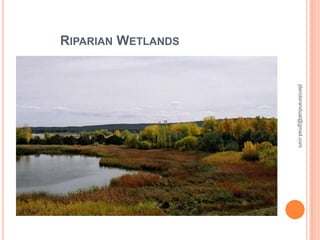
RIPARIAN WETLANDS

jitenderanduat@gmail.com
. RIPARIAN WETLANDS


. predominance of woody plants
jitenderanduat@gmail.com

shade the water, stabilize the bank, and produce
leaf litter
 this directly supports aquatic species plus those
that live on them
 . corridors for dispersal and migration

REFERENCES
Ecology and Food Webs in Wetlands
 (The introductory material on general ecology and
food webs is mostly from:
 Caduto, M.J. 1985. Pond and Brook. Hanover,
N.H.: University Press of New England. 276p.)


http://www.answers.com/topic/trophicecology#ixzz1cZ

jitenderanduat@gmail.com


jitenderanduat@gmail.com

THANK YOU


Trophic relationships in wetland ecosystem

  • 1.
    THROPHIC RELATIONSHIPS IN WETLANDECOSYSTEM jitenderanduat@gmail.com Presentation by Livi Wilson and Jitendra Kumar College of Fisheries, KVAFSU, Mangalore, Karnataka jitenderanduat@gmail.com
  • 2.
    TROPHIC RELATIONSHIPS The studyof the structure of feeding relationships among organisms in an ecosystem  Feeding or trophic relationships can be represented as a   food web food chain. jitenderanduat@gmail.com 
  • 3.
     jitenderanduat@gmail.com Food webs depict trophiclinks between all species sampled in a habitat
  • 4.
     jitenderanduat@gmail.com food chains simplify thiscomplexity into linear arrays of interactions among trophic levels
  • 5.
    FOOD WEBS INSPECIFIC WETLAND TYPES 1.SALT MARSH jitenderanduat@gmail.com
  • 6.
     . jitenderanduat@gmail.com Producers in asalt marsh include marsh grasses, Spartina Juncus Algae various other salt tolerant plants
  • 7.
    THE CONSUMERS COMEIN SEVERAL CATEGORIES ACCORDING TO THEIR PREFERRED HABITAT.  periwinkle snails that travel up and down plants, o marsh crabs. jitenderanduat@gmail.com a. Aerial Habitat--- above the substrate, not that in the air necessarily . Consumers -- spiders and insects that live on plant leaves,
  • 8.
    B. BENTHIC HABITAT Detrital foodweb  < 10% of the above ground primary productivity in a saltmarsh actually gets grazed,. Most plant biomass dies and decays and is passed through the detrital food web  consumers --- bacteria and fungi.  These are then consumed by the smallest animals—worms, copepods, rotifers, larval stages of benthic invertebrates, in other words, plankton.  The bigger benthic invertebrates are either scavengers (crabs, snails) or filterers (oysters, mussels  jitenderanduat@gmail.com
  • 9.
    C. AQUATIC HABITAT overlaps withthe benthic habitat,  Consumers --- vertebrates.  There are several species of resident fish such as silversides, killifish, and mummichogs  In fact about 90% of the commercially important fish and shellfish in the southeast Atlantic and Gulf coasts depend on marshes. jitenderanduat@gmail.com 
  • 10.
    D. AVIAN CONSUMERS includes manyducks and wading birds.  Like the fish, many of these depend on marshes along their migration routes and are not year round residents  E.MAMMALS  Raccoons and muskrats use salt marshes extensively as a food source jitenderanduat@gmail.com 
  • 11.
  • 12.
    2. MANGROVES Because ofthe salt, there is less variety of PRODUCERS --- , but very high biomass because of the constant tidal influx of nutrients.  CONSUMERS--- wide variety of consumers present  especially filter feeders and detritivores. Barnacles and oysters filter feed and fiddler crabs scavenge, among lots of other invertebrates, especially juveniles. These juveniles include the commercially important spiny lobster, shrimp, mullet, and tarpon. These all provide food for a vast array of wading birds.  jitenderanduat@gmail.com
  • 13.
  • 14.
    3. FRESHWATER MARSHES  jitenderanduat@gmail.com Reedgrasses, cattails, rice, sedges, and ragweed are common to most temperate freshwater marshes, although distribution varies with latitude.
  • 15.
    wetlands that arethe most affected by "alien species,"  Eg:The water hyacinth,  is a trouble maker,  it is very good at water filtering and then holding onto the excess nutrients or chemicals. Thus it's often suggested as a valuable addition to natural wastewater treatment programs  CONSUMERS---The most abundant invertebrates are true flies, including mosquitoes.  With a high diversity of invertebrates there is a high diversity of birds  jitenderanduat@gmail.com
  • 16.
  • 17.
    PEATLANDS The dominant plant---Sphagnum moss. It grows in cushionlike spongy mats with very high water content.  Sphagnum moss can hold 15-23 times its dry weight in water. The moss only grows actively at the surface, and the lower layers die off and decompose into peat  . Other plants may include heathers, cranberry, blueberry, some pines, spruce, and tamarack trees  jitenderanduat@gmail.com
  • 18.
    Peatlands ---wetlands havingthe lowest productivity  lowest nutrient levels .   These include    pitcher plants, sundews, and venus flytraps. jitenderanduat@gmail.com hence several carnivorous plants are found here. They get their extra nutrients from insects.
  • 19.
    CONSUMERS  Animal densityis fairly low  because they are acidic and not much eats moss. They do serve as trails and shelters for large mammals.  Lots of birds pass through these areas on their migration routes  : sandhill cranes, short-eared and great gray owls, sharp-tailed sparrow. jitenderanduat@gmail.com 
  • 20.
  • 21.
    . SOUTHERN DEEPWATERSWAMPS Cypress and tupelo trees dominate these ecosystems  There is a high diversity and high biomass oƒ invertebrates which depend on the abundant detritus available. Once again, this is the major source of nutrients for the food web Reptiles and amphibians are quite diverse because they can adapt to changing flood levels  Alligators are common  jitenderanduat@gmail.com 
  • 22.
  • 23.
    . RIPARIAN WETLANDS  .predominance of woody plants jitenderanduat@gmail.com shade the water, stabilize the bank, and produce leaf litter  this directly supports aquatic species plus those that live on them  . corridors for dispersal and migration 
  • 24.
    REFERENCES Ecology and FoodWebs in Wetlands  (The introductory material on general ecology and food webs is mostly from:  Caduto, M.J. 1985. Pond and Brook. Hanover, N.H.: University Press of New England. 276p.)  http://www.answers.com/topic/trophicecology#ixzz1cZ jitenderanduat@gmail.com 
  • 25.