Freshwater Ecosystems
(lakes, ponds, rivers, and streams)
Plants
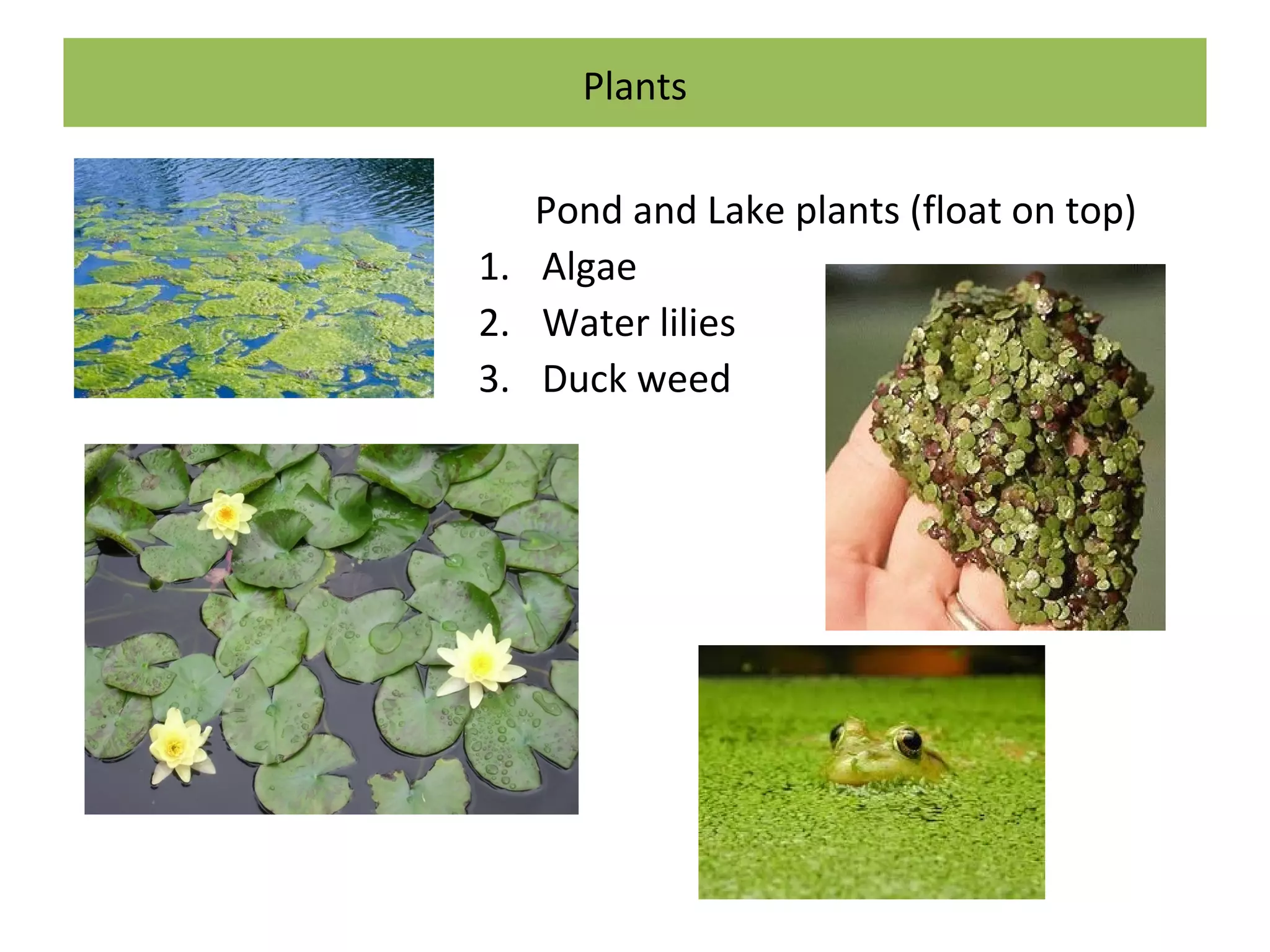
Pond and Lake plants (float on top)
1. Algae
2. Water lilies
3. Duck weed
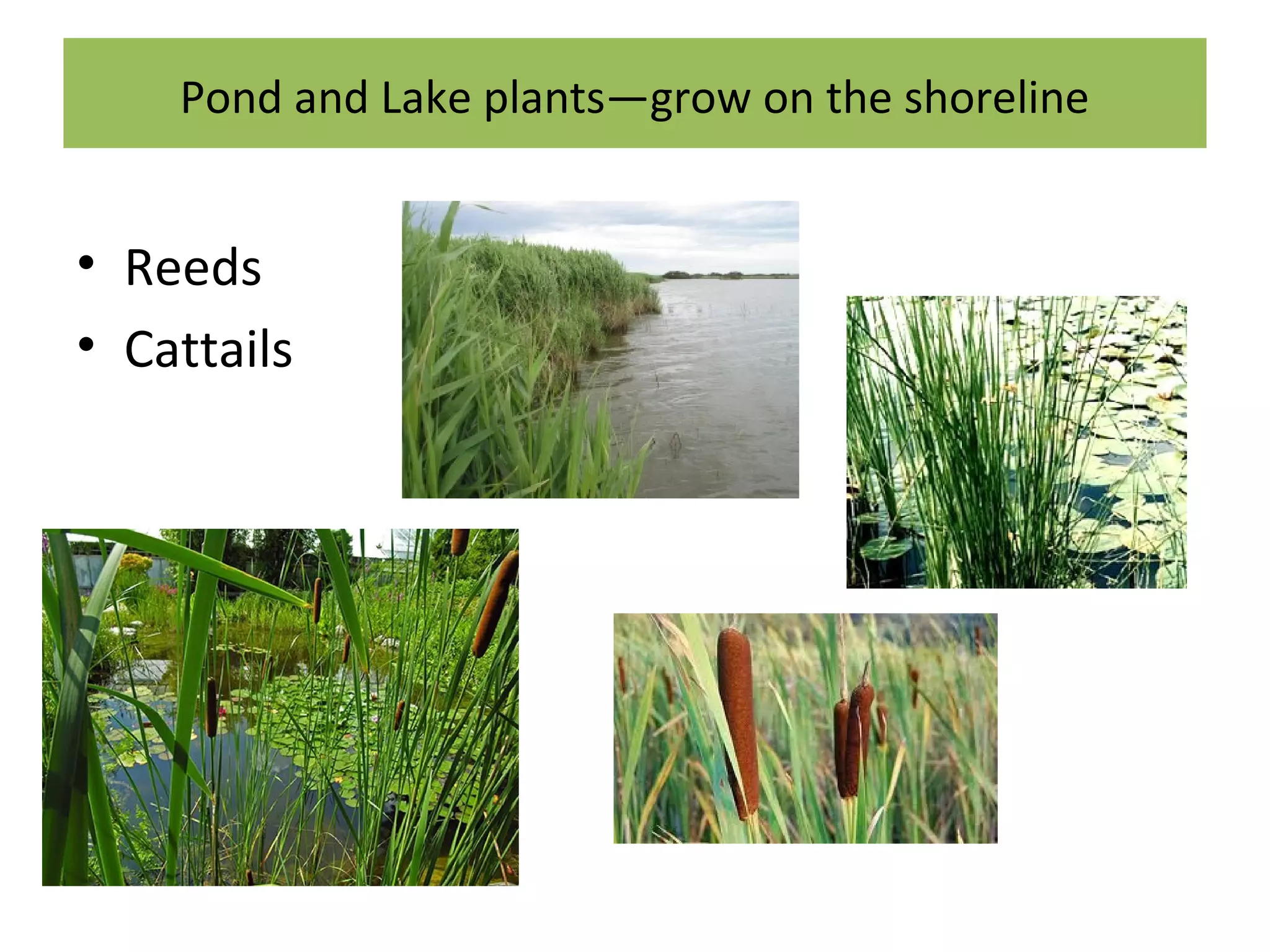
Pond and Lake plants—grow on the shoreline
• Reeds
• Cattails
Functions of Freshwater Plants
• provide oxygen through photosynthesis and food for
animals in this ecosystem
• their leaves also capture small bits of organic matter
which are dragged by the water current
• help filter the water regulating some harmful
chemicals
• provide shelter to smaller fish
• used as substrate to place eggs of an organism
Producers, consumers, or decomposers?
Freshwater Animals—Producers, consumers, or decomposers?
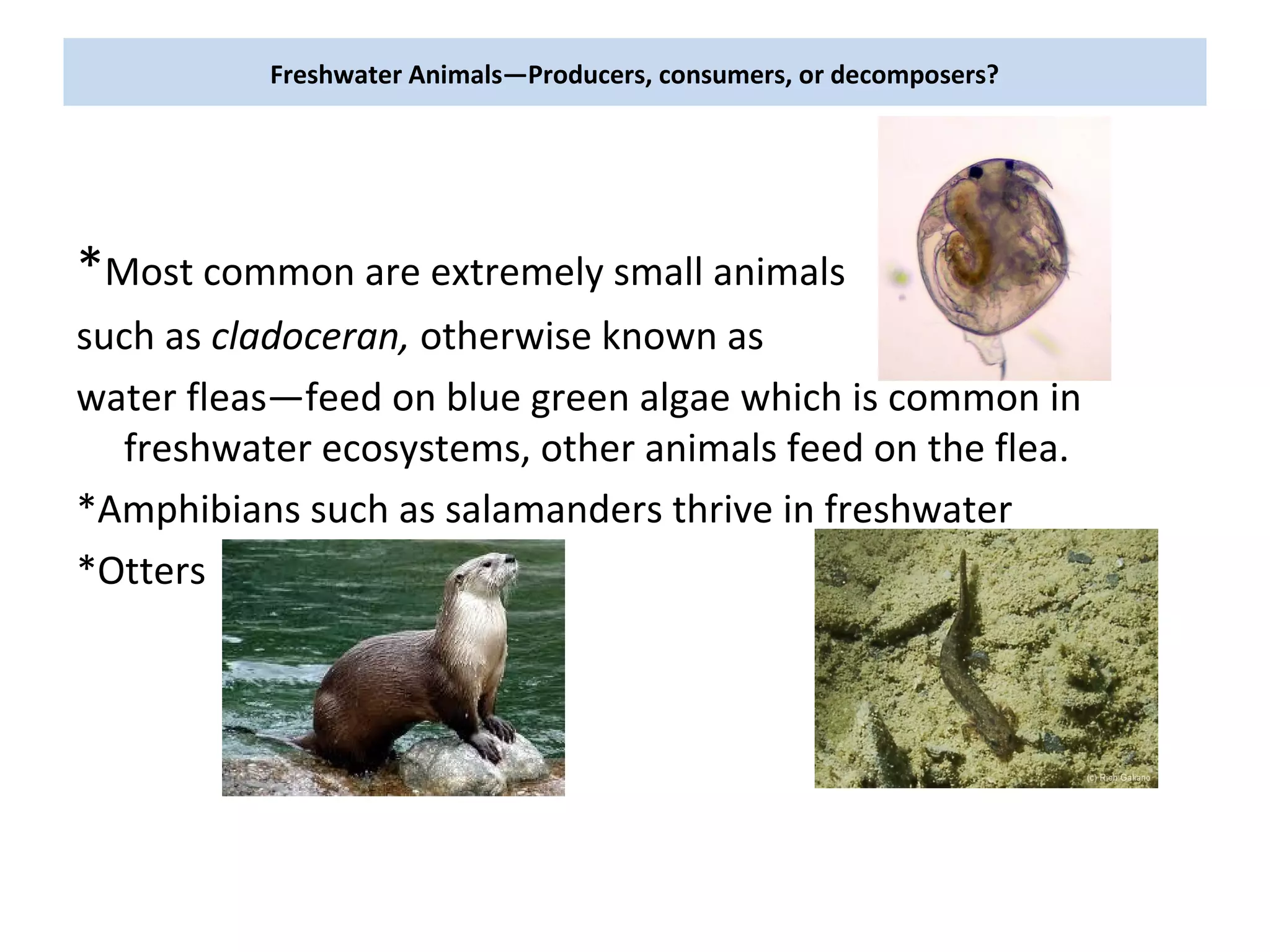
*Most common are extremely small animals
such as cladoceran, otherwise known as
water fleas—feed on blue green algae which is common in
freshwater ecosystems, other animals feed on the flea.
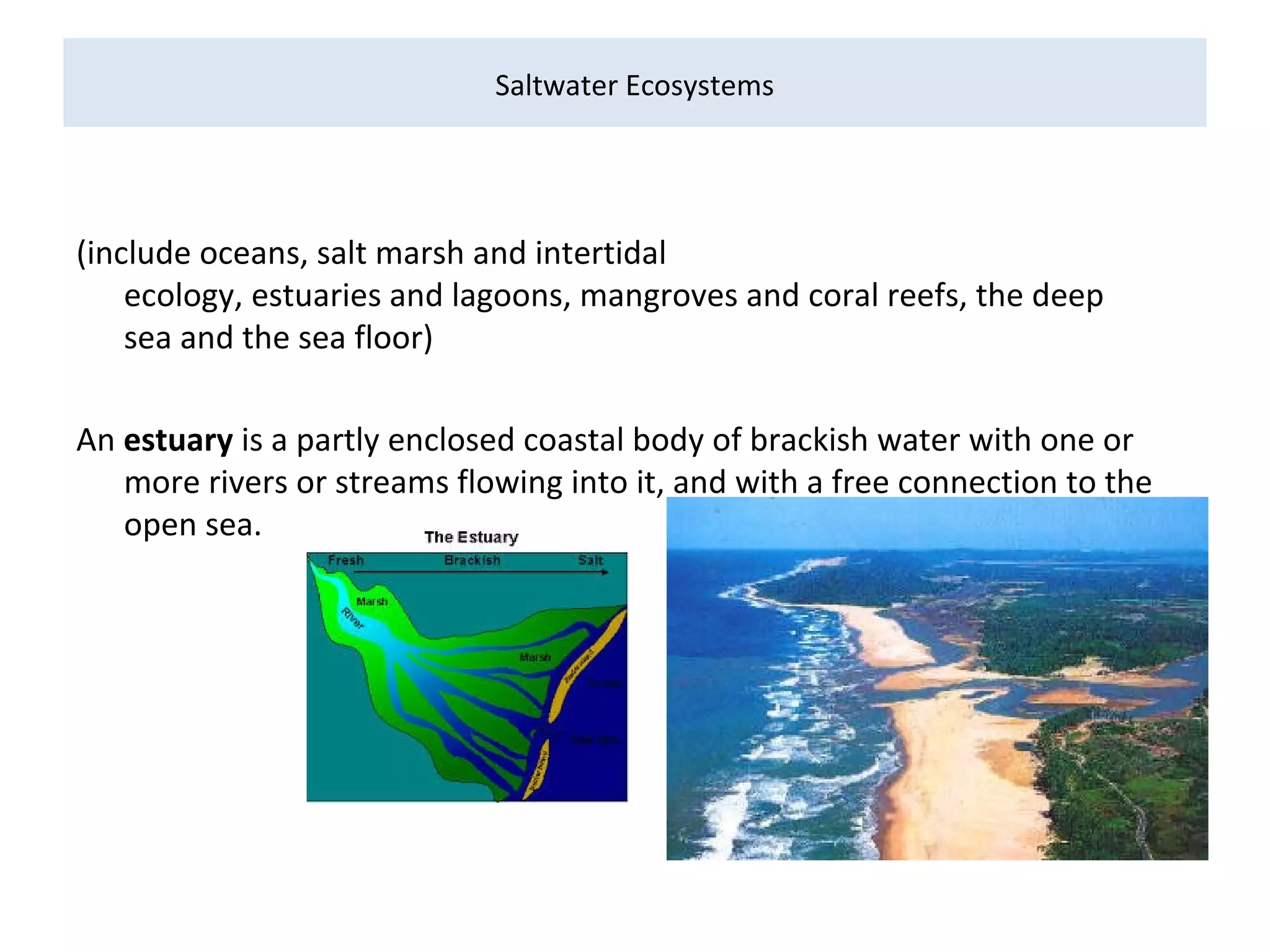
*Amphibians such as salamanders thrive in freshwater
*Otters
Saltwater Ecosystems
(include oceans, salt marsh and intertidal
ecology, estuaries and lagoons, mangroves and coral reefs, the deep
sea and the sea floor)
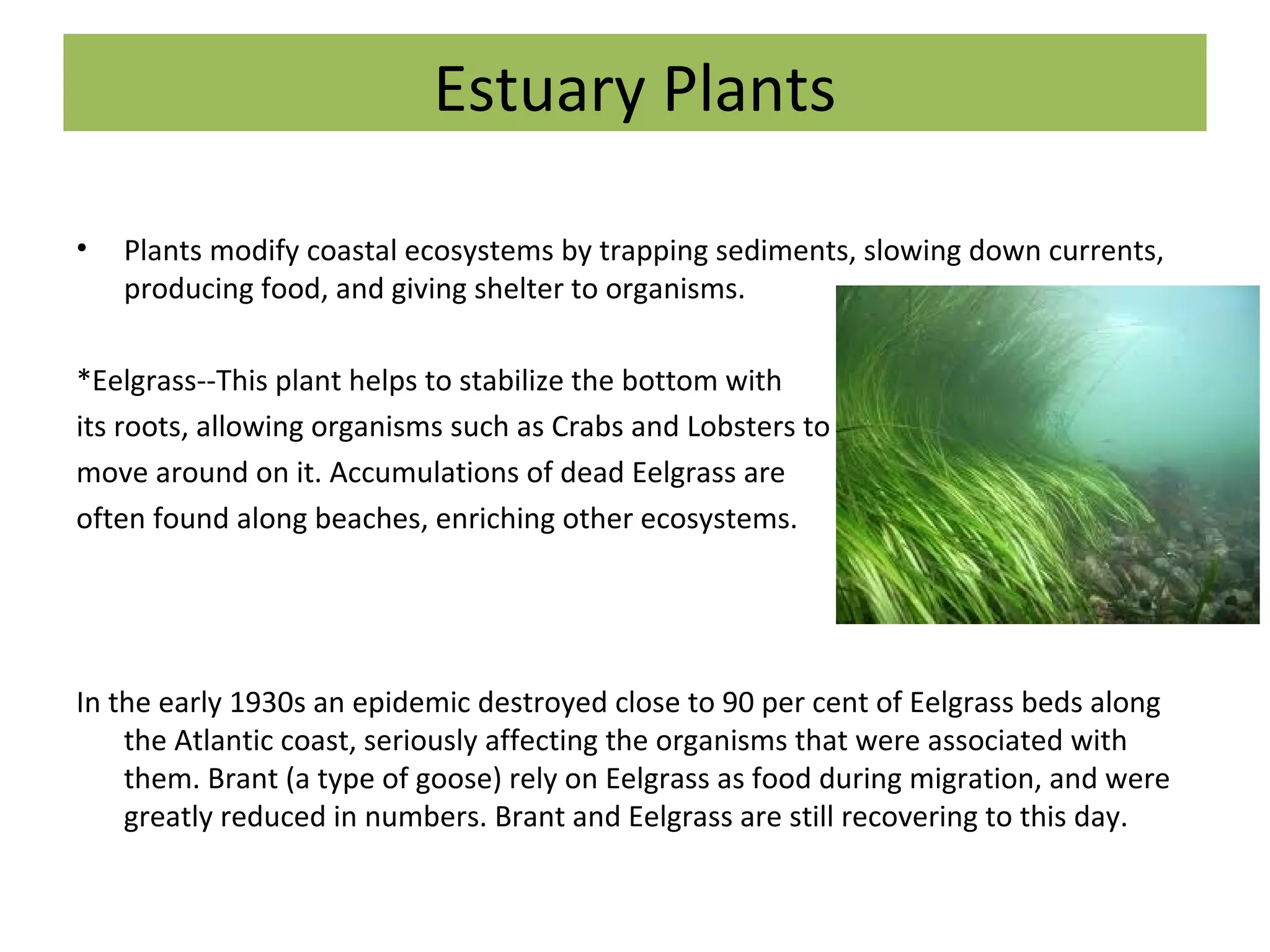
An estuary is a partly enclosed coastal body of brackish water with one or
more rivers or streams flowing into it, and with a free connection to the
open sea.
• Plants modify coastal ecosystems by trapping sediments, slowing down currents,
producing food, and giving shelter to organisms.
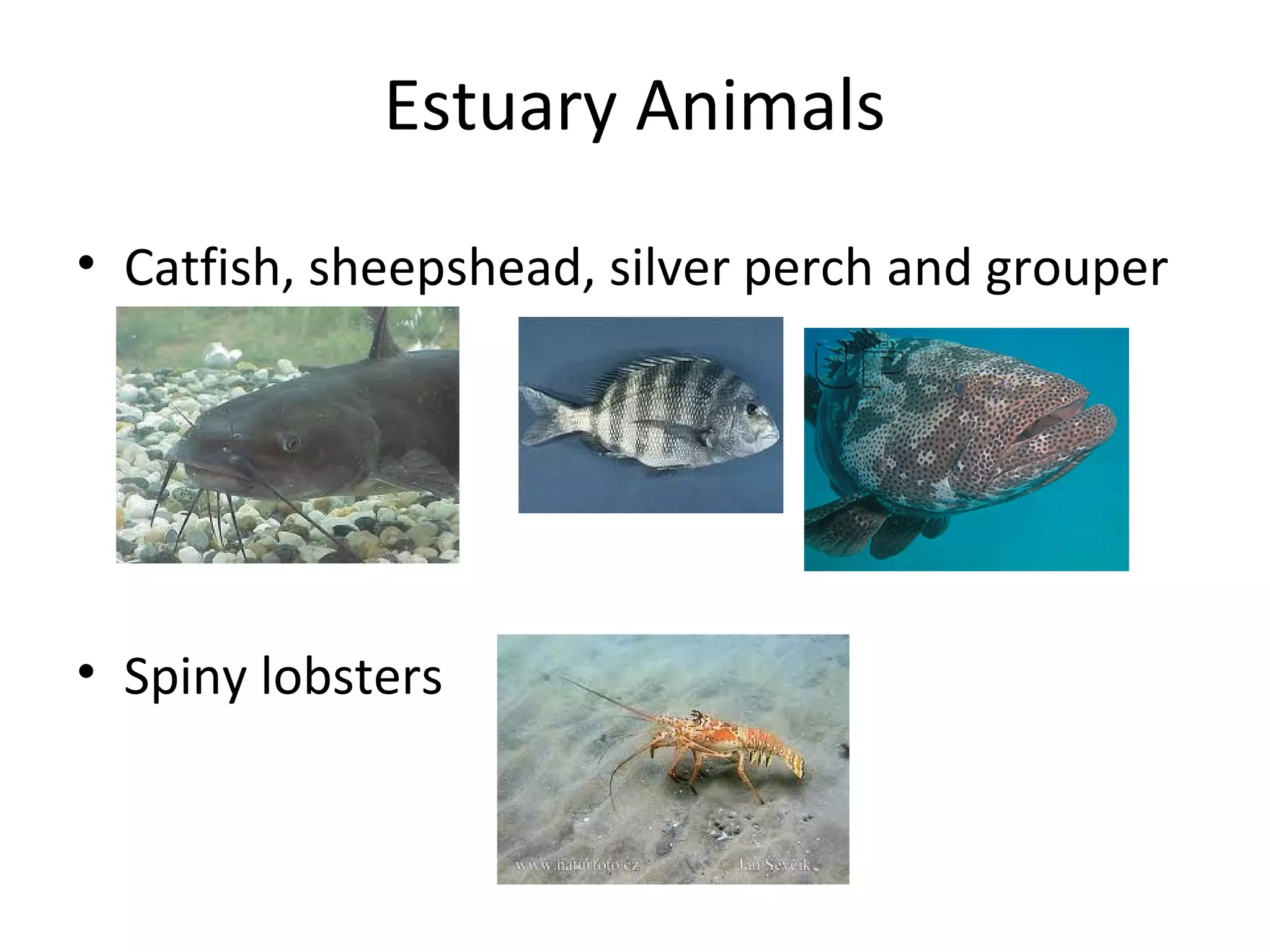
*Eelgrass--This plant helps to stabilize the bottom with
its roots, allowing organisms such as Crabs and Lobsters to
move around on it. Accumulations of dead Eelgrass are
often found along beaches, enriching other ecosystems.
In the early 1930s an epidemic destroyed close to 90 per cent of Eelgrass beds along
the Atlantic coast, seriously affecting the organisms that were associated with
them. Brant (a type of goose) rely on Eelgrass as food during migration, and were
greatly reduced in numbers. Brant and Eelgrass are still recovering to this day.
Estuary Plants
Estuary Animals
• Catfish, sheepshead, silver perch and grouper
• Spiny lobsters
Ocean Plants--FYI
• Coral is NOT a plant.
• Two types: rooted and drifting
• Rooted plants only in shallow water
• Most of the ocean is not capable of
supporting rooted plants (lack of sun)
Ocean Plants
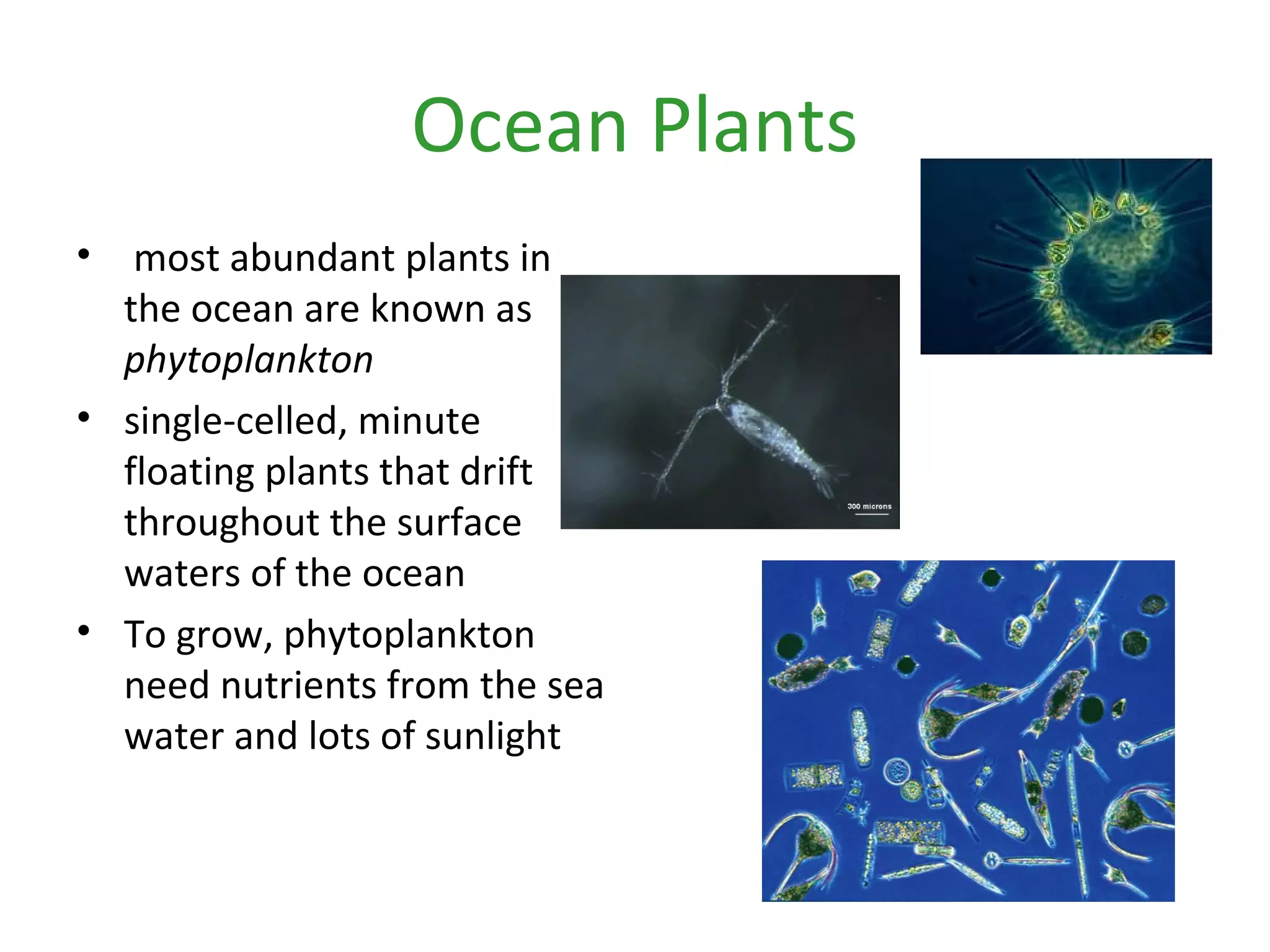
• most abundant plants in
the ocean are known as
phytoplankton
• single-celled, minute
floating plants that drift
throughout the surface
waters of the ocean
• To grow, phytoplankton
need nutrients from the sea
water and lots of sunlight
Ocean Animals—A Breakdown
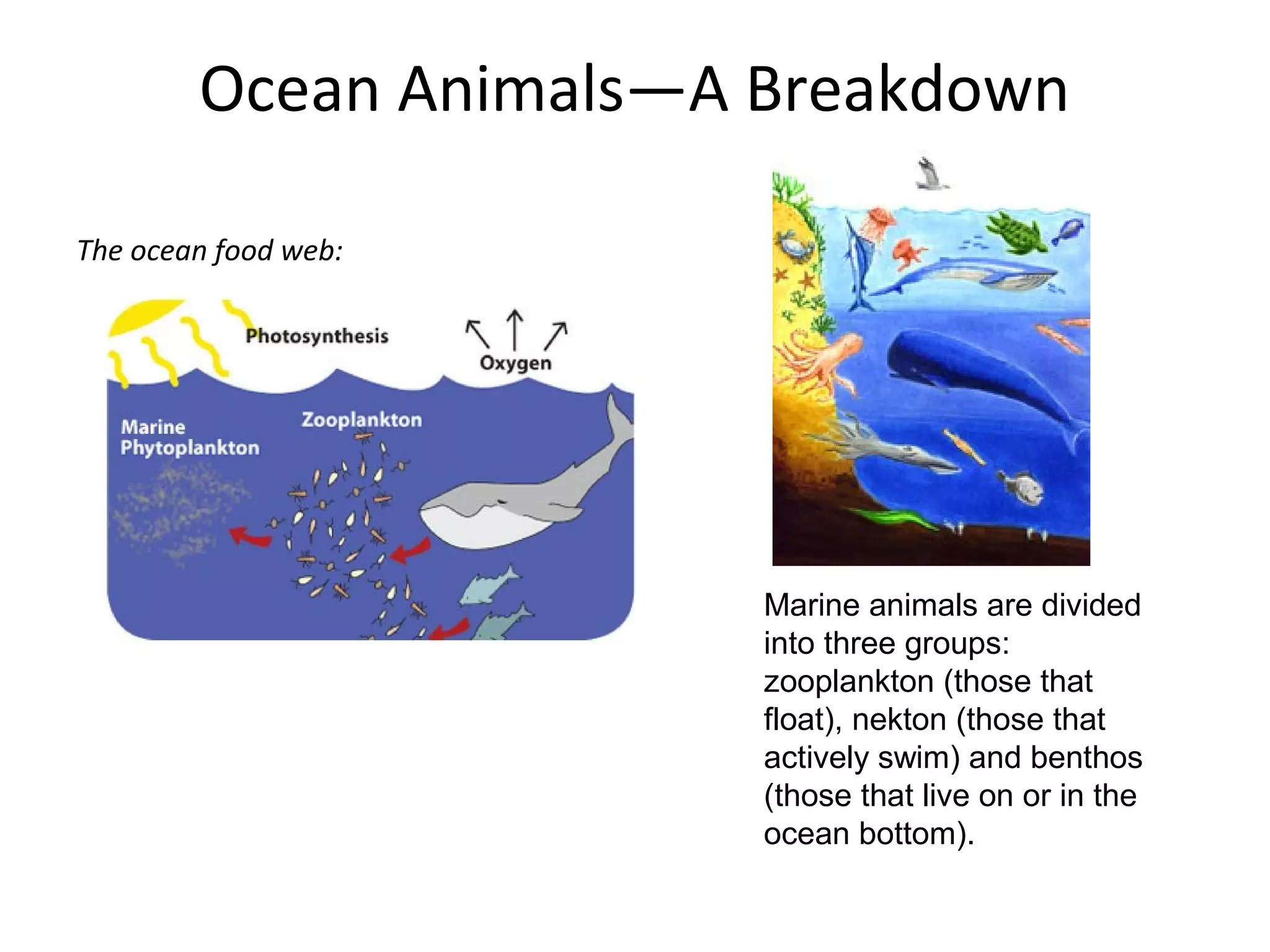
The ocean food web:
Marine animals are divided
into three groups:
zooplankton (those that
float), nekton (those that
actively swim) and benthos
(those that live on or in the
ocean bottom).
Ocean Animals
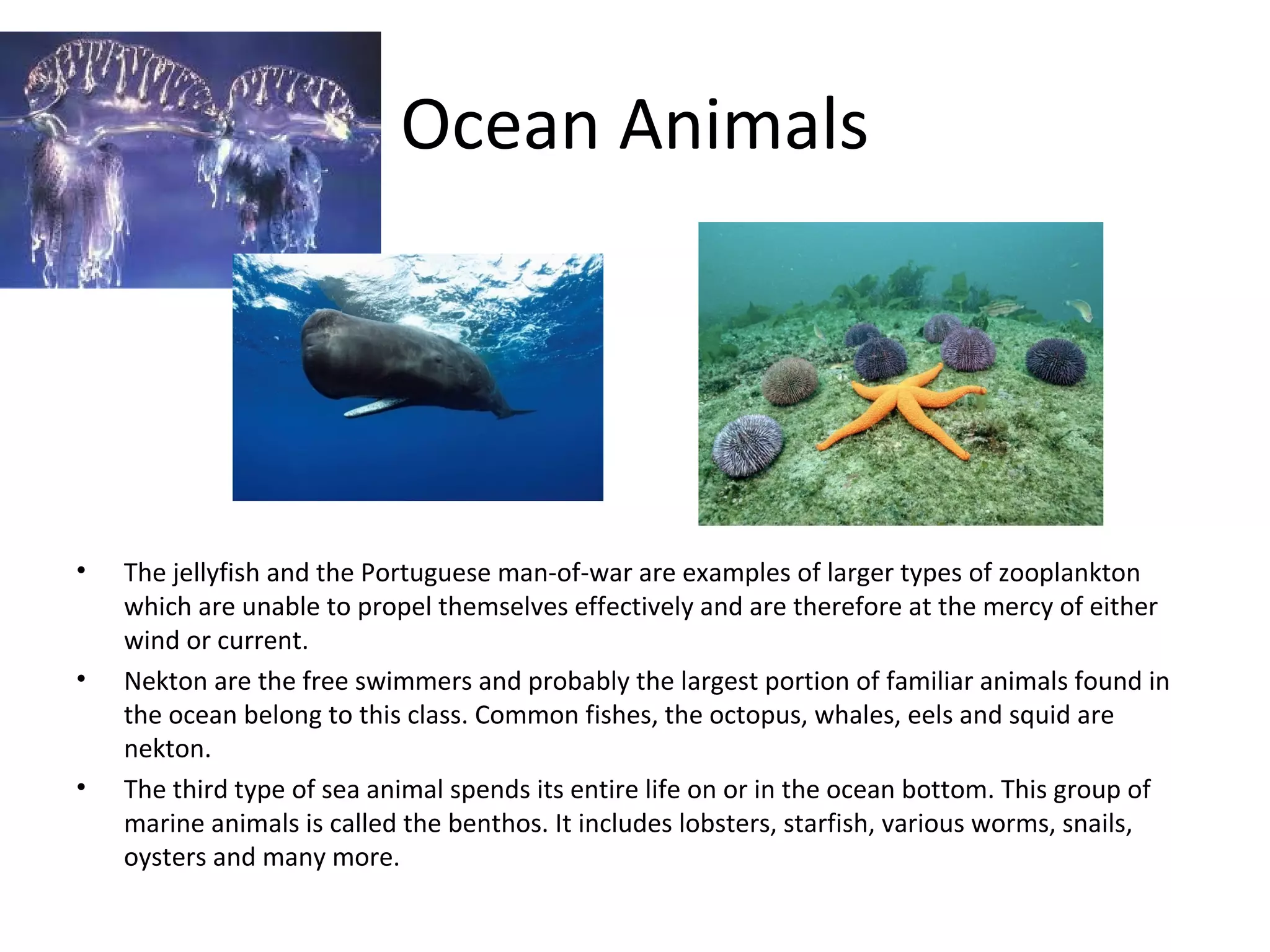
• The jellyfish and the Portuguese man-of-war are examples of larger types of zooplankton
which are unable to propel themselves effectively and are therefore at the mercy of either
wind or current.
• Nekton are the free swimmers and probably the largest portion of familiar animals found in
the ocean belong to this class. Common fishes, the octopus, whales, eels and squid are
nekton.
• The third type of sea animal spends its entire life on or in the ocean bottom. This group of
marine animals is called the benthos. It includes lobsters, starfish, various worms, snails,
oysters and many more.
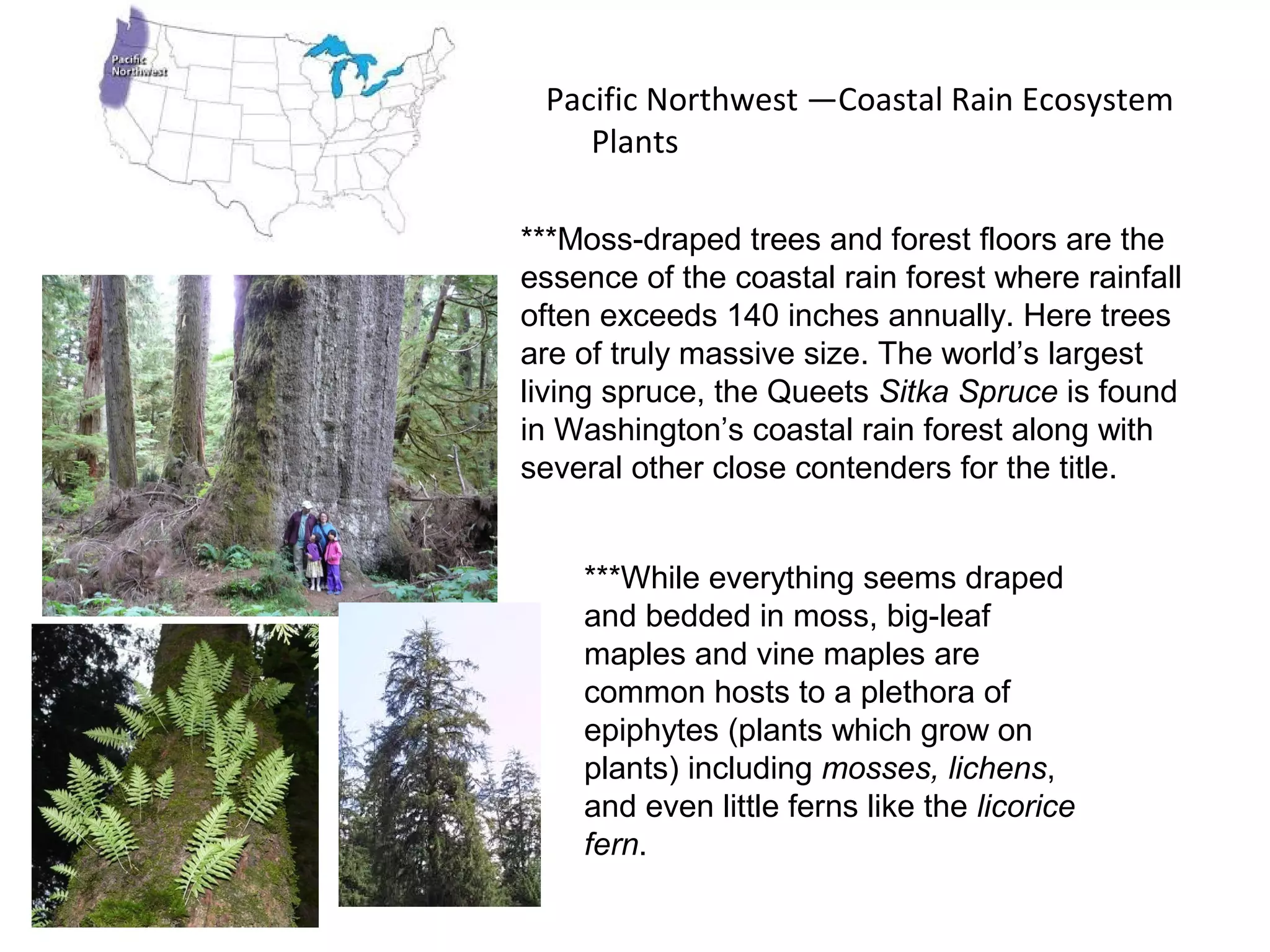
Pacific Northwest —Coastal Rain Ecosystem
Plants
***Moss-draped trees and forest floors are the
essence of the coastal rain forest where rainfall
often exceeds 140 inches annually. Here trees
are of truly massive size. The world’s largest
living spruce, the Queets Sitka Spruce is found
in Washington’s coastal rain forest along with
several other close contenders for the title.
***While everything seems draped
and bedded in moss, big-leaf
maples and vine maples are
common hosts to a plethora of
epiphytes (plants which grow on
plants) including mosses, lichens,
and even little ferns like the licorice
fern.
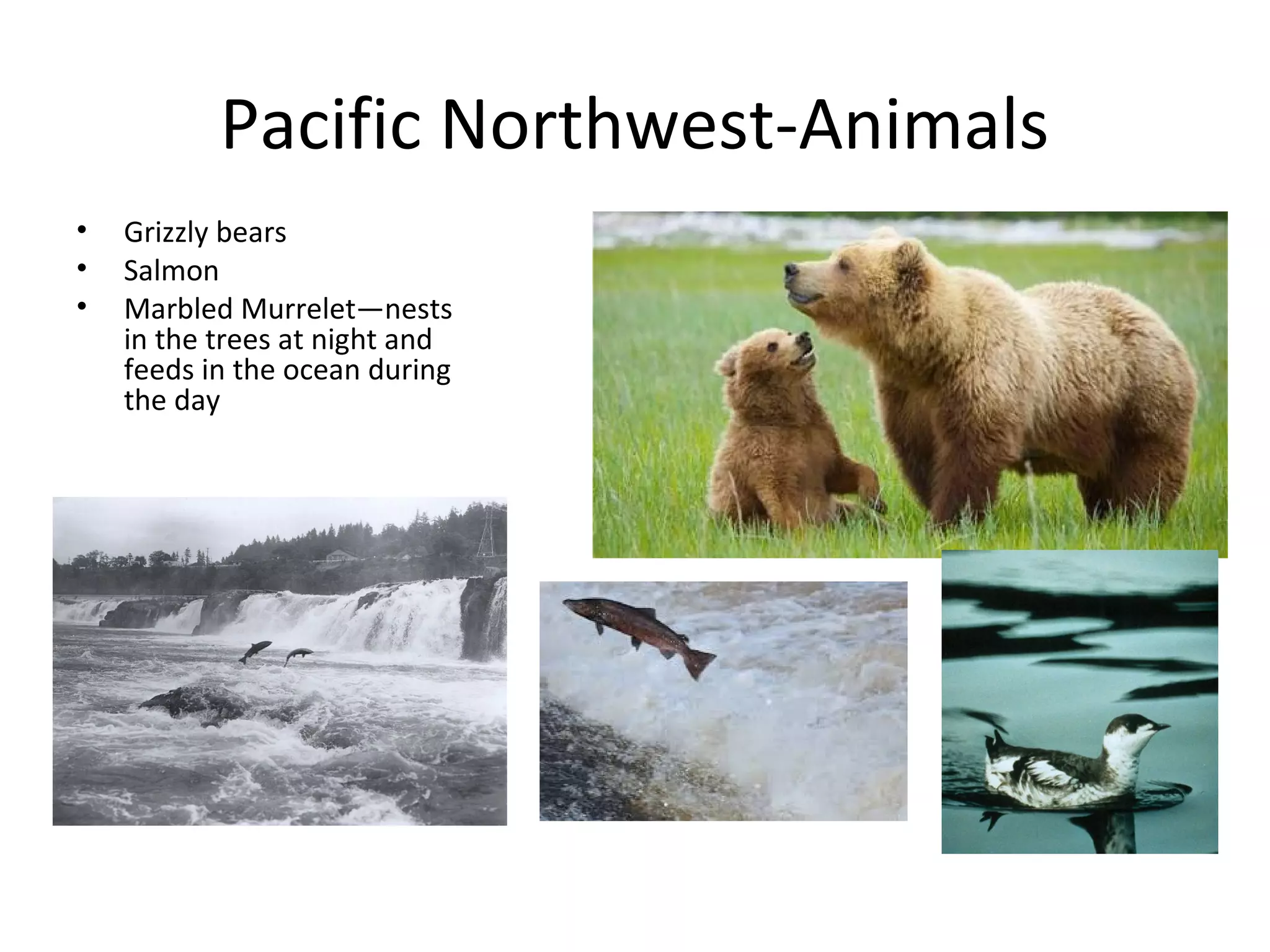
Pacific Northwest-Animals
• Grizzly bears
• Salmon
• Marbled Murrelet—nests
in the trees at night and
feeds in the ocean during
the day
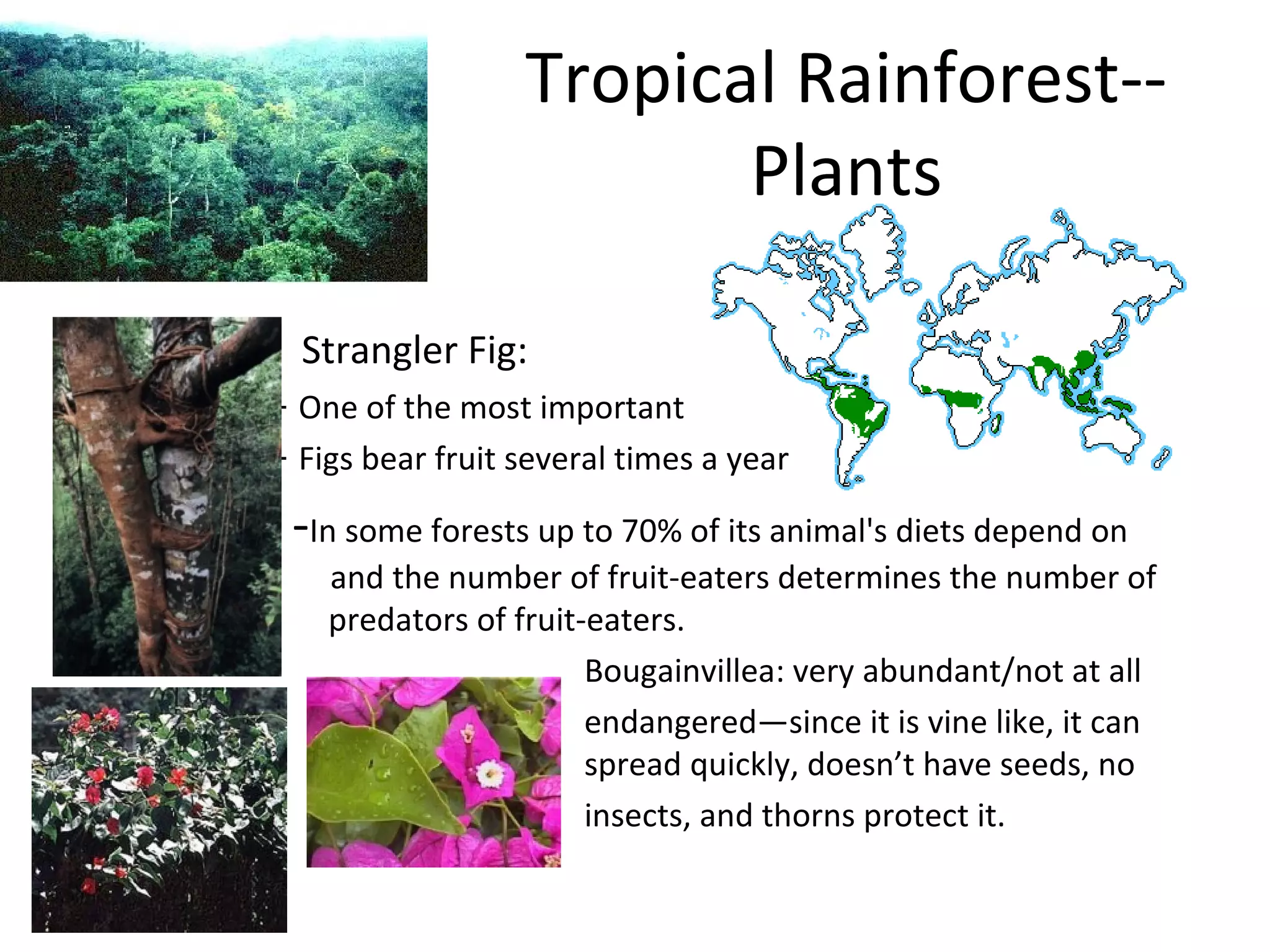
Tropical Rainforest--
Plants
• Strangler Fig:
– One of the most important
– Figs bear fruit several times a year
• S -In some forests up to 70% of its animal's diets depend on
figs, and the number of fruit-eaters determines the number of
predators predators of fruit-eaters.
Bougainvillea: very abundant/not at all
endangered—since it is vine like, it can
spread quickly, doesn’t have seeds, no
insects, and thorns protect it.
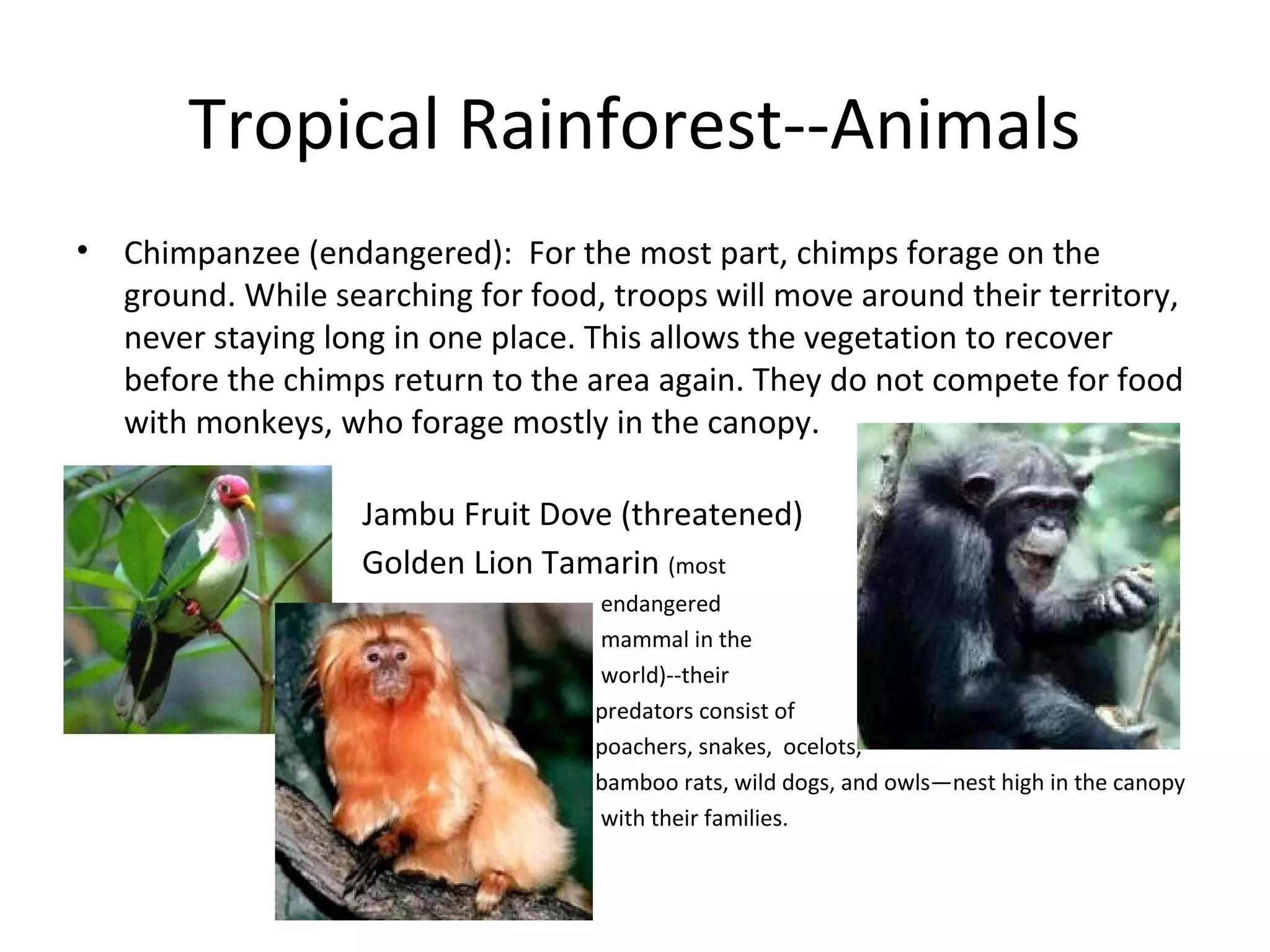
Tropical Rainforest--Animals
• Chimpanzee (endangered): For the most part, chimps forage on the
ground. While searching for food, troops will move around their territory,
never staying long in one place. This allows the vegetation to recover
before the chimps return to the area again. They do not compete for food
with monkeys, who forage mostly in the canopy.
Jambu Fruit Dove (threatened)
Golden Lion Tamarin (most
endangered
mammal in the
world)--their
predators consist of
poachers, snakes, ocelots,
bamboo rats, wild dogs, and owls—nest high in the canopy
with their families.
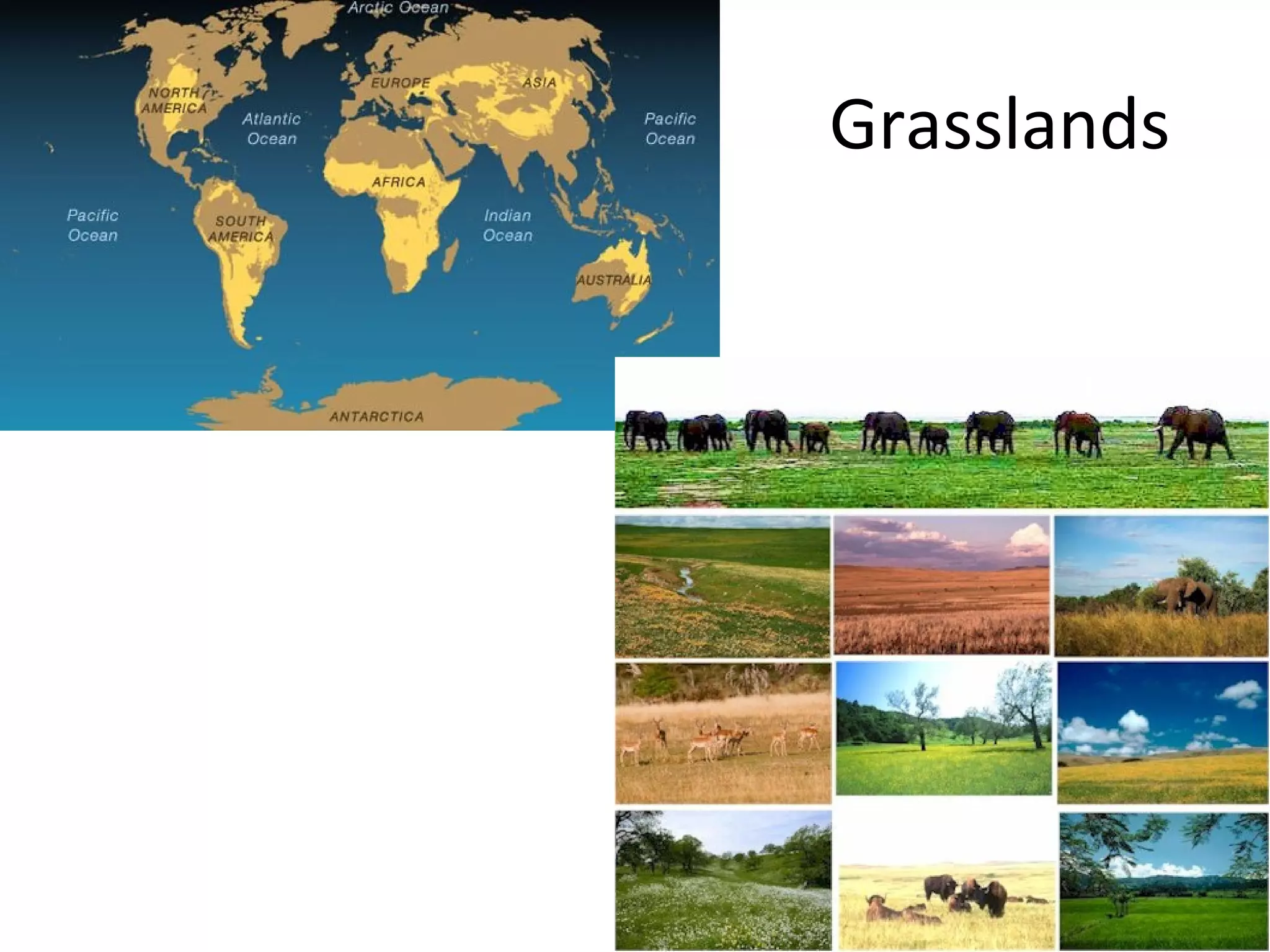
Grasslands
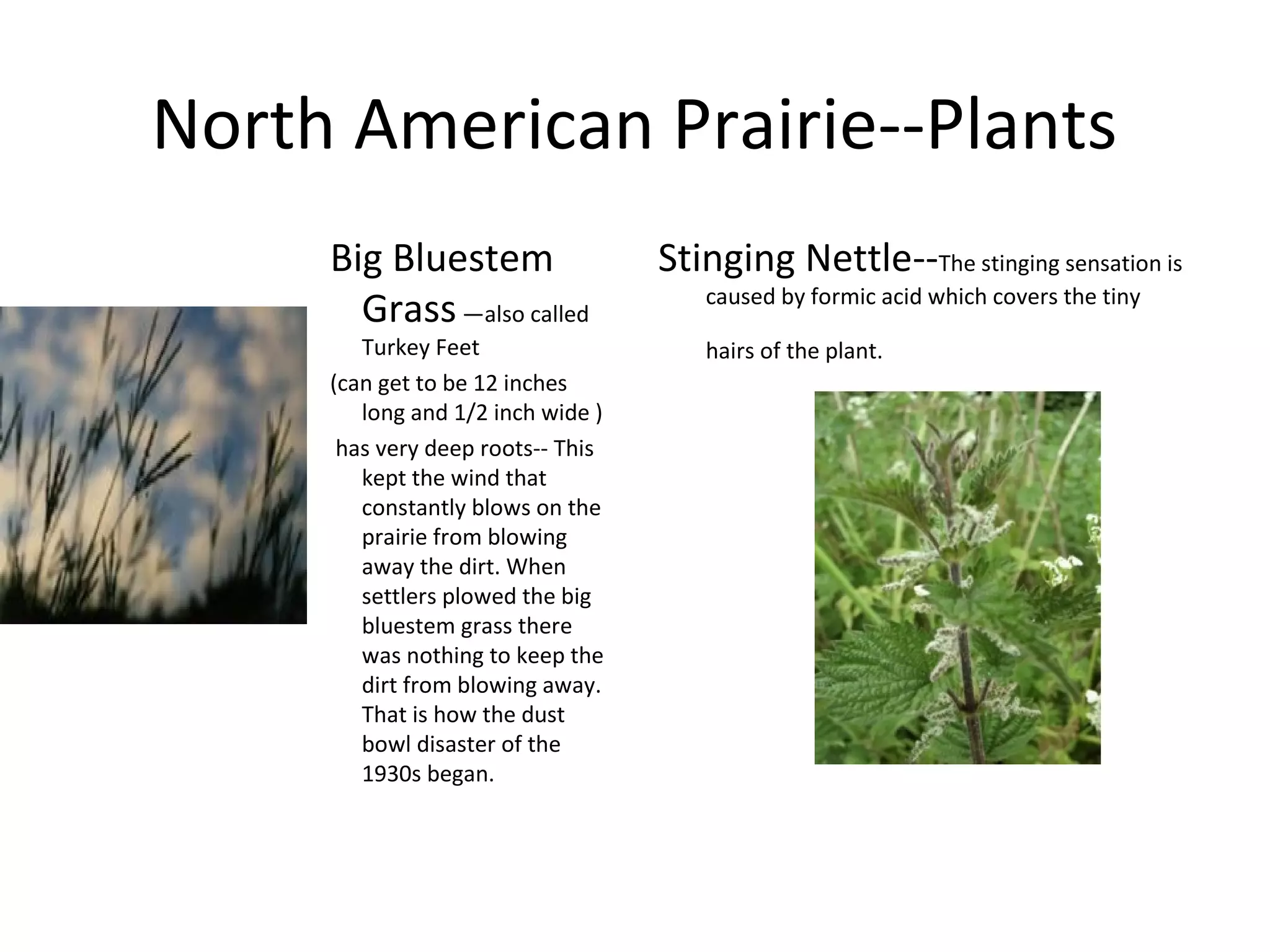
North American Prairie--Plants
Big Bluestem
Grass—also called
Turkey Feet
(can get to be 12 inches
long and 1/2 inch wide )
has very deep roots-- This
kept the wind that
constantly blows on the
prairie from blowing
away the dirt. When
settlers plowed the big
bluestem grass there
was nothing to keep the
dirt from blowing away.
That is how the dust
bowl disaster of the
1930s began.
Stinging Nettle--The stinging sensation is
caused by formic acid which covers the tiny
hairs of the plant.
North American Prairie--Animals
•
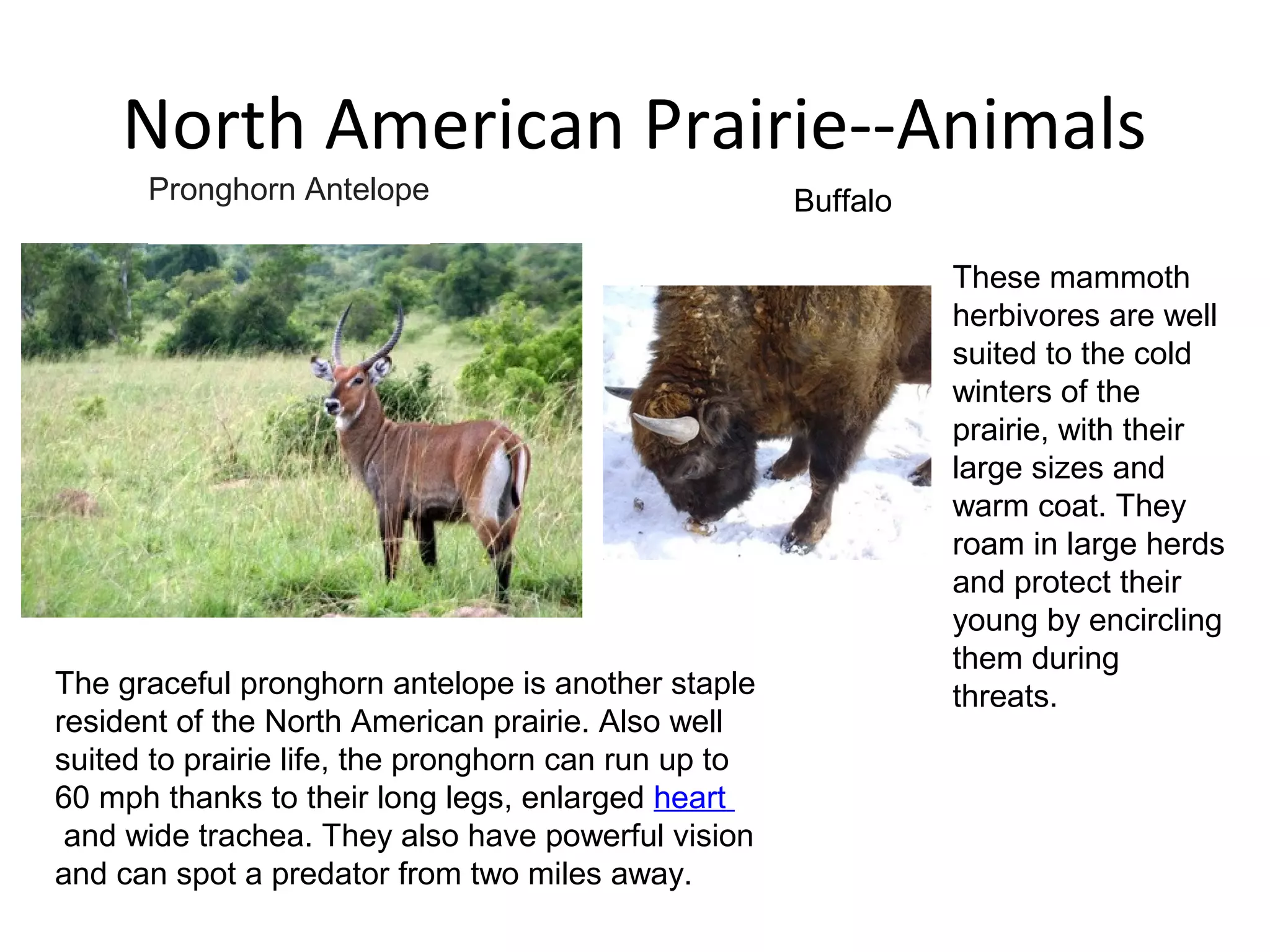
The graceful pronghorn antelope is another staple
resident of the North American prairie. Also well
suited to prairie life, the pronghorn can run up to
60 mph thanks to their long legs, enlarged heart
and wide trachea. They also have powerful vision
and can spot a predator from two miles away.
These mammoth
herbivores are well
suited to the cold
winters of the
prairie, with their
large sizes and
warm coat. They
roam in large herds
and protect their
young by encircling
them during
threats.
Pronghorn Antelope Buffalo
Desert
• http://www.neok12.com/Deserts.htm
• http://www.blueplanetbiomes.org/desert.htm
http://www.neok12.com/php/watch.php?v=zX0571505e0e7b725a057602&t=Deserts
Tundra/Arctic
• http://www.blueplanetbiomes.org/tundra.htm

Ecosystems

  • 1.
  • 2.
    Plants Pond and Lakeplants (float on top) 1. Algae 2. Water lilies 3. Duck weed
  • 3.
    Pond and Lakeplants—grow on the shoreline • Reeds • Cattails
  • 4.
    Functions of FreshwaterPlants • provide oxygen through photosynthesis and food for animals in this ecosystem • their leaves also capture small bits of organic matter which are dragged by the water current • help filter the water regulating some harmful chemicals • provide shelter to smaller fish • used as substrate to place eggs of an organism Producers, consumers, or decomposers?
  • 5.
    Freshwater Animals—Producers, consumers,or decomposers? *Most common are extremely small animals such as cladoceran, otherwise known as water fleas—feed on blue green algae which is common in freshwater ecosystems, other animals feed on the flea. *Amphibians such as salamanders thrive in freshwater *Otters
  • 6.
    Saltwater Ecosystems (include oceans,salt marsh and intertidal ecology, estuaries and lagoons, mangroves and coral reefs, the deep sea and the sea floor) An estuary is a partly enclosed coastal body of brackish water with one or more rivers or streams flowing into it, and with a free connection to the open sea.
  • 7.
    • Plants modifycoastal ecosystems by trapping sediments, slowing down currents, producing food, and giving shelter to organisms. *Eelgrass--This plant helps to stabilize the bottom with its roots, allowing organisms such as Crabs and Lobsters to move around on it. Accumulations of dead Eelgrass are often found along beaches, enriching other ecosystems. In the early 1930s an epidemic destroyed close to 90 per cent of Eelgrass beds along the Atlantic coast, seriously affecting the organisms that were associated with them. Brant (a type of goose) rely on Eelgrass as food during migration, and were greatly reduced in numbers. Brant and Eelgrass are still recovering to this day. Estuary Plants
  • 8.
    Estuary Animals • Catfish,sheepshead, silver perch and grouper • Spiny lobsters
  • 9.
    Ocean Plants--FYI • Coralis NOT a plant. • Two types: rooted and drifting • Rooted plants only in shallow water • Most of the ocean is not capable of supporting rooted plants (lack of sun)
  • 10.
    Ocean Plants • mostabundant plants in the ocean are known as phytoplankton • single-celled, minute floating plants that drift throughout the surface waters of the ocean • To grow, phytoplankton need nutrients from the sea water and lots of sunlight
  • 11.
    Ocean Animals—A Breakdown Theocean food web: Marine animals are divided into three groups: zooplankton (those that float), nekton (those that actively swim) and benthos (those that live on or in the ocean bottom).
  • 12.
    Ocean Animals • Thejellyfish and the Portuguese man-of-war are examples of larger types of zooplankton which are unable to propel themselves effectively and are therefore at the mercy of either wind or current. • Nekton are the free swimmers and probably the largest portion of familiar animals found in the ocean belong to this class. Common fishes, the octopus, whales, eels and squid are nekton. • The third type of sea animal spends its entire life on or in the ocean bottom. This group of marine animals is called the benthos. It includes lobsters, starfish, various worms, snails, oysters and many more.
  • 13.
    Pacific Northwest —CoastalRain Ecosystem Plants ***Moss-draped trees and forest floors are the essence of the coastal rain forest where rainfall often exceeds 140 inches annually. Here trees are of truly massive size. The world’s largest living spruce, the Queets Sitka Spruce is found in Washington’s coastal rain forest along with several other close contenders for the title. ***While everything seems draped and bedded in moss, big-leaf maples and vine maples are common hosts to a plethora of epiphytes (plants which grow on plants) including mosses, lichens, and even little ferns like the licorice fern.
  • 14.
    Pacific Northwest-Animals • Grizzlybears • Salmon • Marbled Murrelet—nests in the trees at night and feeds in the ocean during the day
  • 15.
    Tropical Rainforest-- Plants • StranglerFig: – One of the most important – Figs bear fruit several times a year • S -In some forests up to 70% of its animal's diets depend on figs, and the number of fruit-eaters determines the number of predators predators of fruit-eaters. Bougainvillea: very abundant/not at all endangered—since it is vine like, it can spread quickly, doesn’t have seeds, no insects, and thorns protect it.
  • 16.
    Tropical Rainforest--Animals • Chimpanzee(endangered): For the most part, chimps forage on the ground. While searching for food, troops will move around their territory, never staying long in one place. This allows the vegetation to recover before the chimps return to the area again. They do not compete for food with monkeys, who forage mostly in the canopy. Jambu Fruit Dove (threatened) Golden Lion Tamarin (most endangered mammal in the world)--their predators consist of poachers, snakes, ocelots, bamboo rats, wild dogs, and owls—nest high in the canopy with their families.
  • 17.
  • 18.
    North American Prairie--Plants BigBluestem Grass—also called Turkey Feet (can get to be 12 inches long and 1/2 inch wide ) has very deep roots-- This kept the wind that constantly blows on the prairie from blowing away the dirt. When settlers plowed the big bluestem grass there was nothing to keep the dirt from blowing away. That is how the dust bowl disaster of the 1930s began. Stinging Nettle--The stinging sensation is caused by formic acid which covers the tiny hairs of the plant.
  • 19.
    North American Prairie--Animals • Thegraceful pronghorn antelope is another staple resident of the North American prairie. Also well suited to prairie life, the pronghorn can run up to 60 mph thanks to their long legs, enlarged heart and wide trachea. They also have powerful vision and can spot a predator from two miles away. These mammoth herbivores are well suited to the cold winters of the prairie, with their large sizes and warm coat. They roam in large herds and protect their young by encircling them during threats. Pronghorn Antelope Buffalo
  • 20.
  • 21.