FOOD WEBSMALL POND
What is the Food Web for a Pond?A food web shows how many animals  and plants are connected in many ways to find or produce their food.
For example, Plants become food for plant-eating (herbivorous) animals, such as small crustaceans. They are preyed upon by small flesh-eating (carnivorous) animals including fishes, dragonfly, birds and other animals. Larger fishes eat the smaller fishes, crustaceans, and insects. If not eaten, plants and animal eventually dies and decomposes. Its protoplasm is reduced to basic materials that green plants need for growth. Organisms found in PondsThe organisms inhabiting a pong ecosystem include algae, fungi, microorganisms, plants and fishes. Organisms can be classified as producers, consumers and decomposers based on feeding habit.
ProducersProducers in a pond food web are organisms that through photosynthesis, manufacture their own food from sunlight. Examples range from microscopic phytoplankton to large plants like cattails.
Primary ConsumersPrimary consumers, essentially herbivores, are organisms that feed directly upon the producers, examples are tadpoles and crustaceans.
Secondary ConsumersThe secondary consumers in a pond, such as a small fish for example, are organisms that feed upon or consume, the primary consumers.
Top ConsumersEcologists often refer to the top consumer group as the apex predators and examples would include the osprey and humans.
DecomposersThe decomposers, like bacteria and fungi, break down the dead and decaying bodies of any of the other organisms in the pond and recycle their nutrients.
Habitats in a pond ecosystemThere are mainly four habitats in a pond ecosystem:Shore habitatsSurface film habitatsOpen water habitatsBottom water habitats
Shore HabitatsOrganisms in this habitat vary depending upon whether the shore is rocky, sandy or muddy. In case of rocky shores, plants might not be able to growWhereas in muddy of sandy shores or mixed type, plants like grasses, algae and rushes can be present along with organisms such as earthworms, protozoa, snails, insects, small fishes and microorganisms
Surface film habitatsIn general, insects like water striders and marsh traders, organisms that are free-floating and those that can walk on the surface of the water inhabit the surface of the pond. They nourish on the floating plants, dead insects, and sometimes, feed upon each other.
Open water habitatsInhabited by fishes and the plankton (tiny organisms).  Fishes feed on plankton.
Bottom water habitatsDepending upon whether the pond is shallow or deep, the habitat varies. If a pond is shallow and has sandy bottom, organism like earthworms, snails and insects inhabit the bottomWhereas if the pond is deep and has a muddy bottom, microorganisms, flatworm, rat-tailed maggot mostly inhabit the bottom.
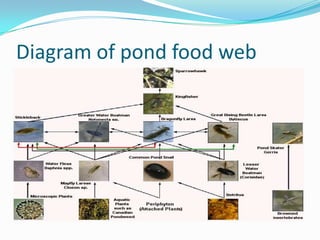
Diagram of pond food web

Pond food web

  • 1.
  • 2.
    What is theFood Web for a Pond?A food web shows how many animals and plants are connected in many ways to find or produce their food.
  • 3.
    For example, Plantsbecome food for plant-eating (herbivorous) animals, such as small crustaceans. They are preyed upon by small flesh-eating (carnivorous) animals including fishes, dragonfly, birds and other animals. Larger fishes eat the smaller fishes, crustaceans, and insects. If not eaten, plants and animal eventually dies and decomposes. Its protoplasm is reduced to basic materials that green plants need for growth. Organisms found in PondsThe organisms inhabiting a pong ecosystem include algae, fungi, microorganisms, plants and fishes. Organisms can be classified as producers, consumers and decomposers based on feeding habit.
  • 4.
    ProducersProducers in apond food web are organisms that through photosynthesis, manufacture their own food from sunlight. Examples range from microscopic phytoplankton to large plants like cattails.
  • 5.
    Primary ConsumersPrimary consumers,essentially herbivores, are organisms that feed directly upon the producers, examples are tadpoles and crustaceans.
  • 6.
    Secondary ConsumersThe secondaryconsumers in a pond, such as a small fish for example, are organisms that feed upon or consume, the primary consumers.
  • 7.
    Top ConsumersEcologists oftenrefer to the top consumer group as the apex predators and examples would include the osprey and humans.
  • 8.
    DecomposersThe decomposers, likebacteria and fungi, break down the dead and decaying bodies of any of the other organisms in the pond and recycle their nutrients.
  • 9.
    Habitats in apond ecosystemThere are mainly four habitats in a pond ecosystem:Shore habitatsSurface film habitatsOpen water habitatsBottom water habitats
  • 10.
    Shore HabitatsOrganisms inthis habitat vary depending upon whether the shore is rocky, sandy or muddy. In case of rocky shores, plants might not be able to growWhereas in muddy of sandy shores or mixed type, plants like grasses, algae and rushes can be present along with organisms such as earthworms, protozoa, snails, insects, small fishes and microorganisms
  • 11.
    Surface film habitatsIngeneral, insects like water striders and marsh traders, organisms that are free-floating and those that can walk on the surface of the water inhabit the surface of the pond. They nourish on the floating plants, dead insects, and sometimes, feed upon each other.
  • 12.
    Open water habitatsInhabitedby fishes and the plankton (tiny organisms). Fishes feed on plankton.
  • 13.
    Bottom water habitatsDependingupon whether the pond is shallow or deep, the habitat varies. If a pond is shallow and has sandy bottom, organism like earthworms, snails and insects inhabit the bottomWhereas if the pond is deep and has a muddy bottom, microorganisms, flatworm, rat-tailed maggot mostly inhabit the bottom.
  • 14.

Editor's Notes

  • #9 References Elements of Ecology and Field Biology; Robert Leo Smith; 1977